Business and Professional Verbs for Workplace English

 Learn what makes a verb sound professional, then pick up common workplace verbs for daily tasks, meetings, planning and decisions, and reporting results. It also covers polite verb choices for emails, common business verb mistakes, and homework practice tasks.
- What makes a verb sound professional
- Common workplace verbs for daily tasks
- Verbs for meetings and discussions
- Verbs for planning and decision-making
- Verbs for reporting progress and results
- Polite verb choices for emails and requests
- Common mistakes in business verb usage
- Homework: workplace verb practice tasks
Sounding confident at work takes more than correct grammar; it depends on choosing the right action verbs for real business situations. Here we the verbs people use in meetings, emails, and status updates to report progress, make requests, address problems, and confirm next steps. You will see what each verb means in context, how it affects tone, and when it may sound too strong or too soft.
What makes a verb sound professional
In workplace English, verbs tend to sound more businesslike when they are precise, neutral in tone, and aligned with common professional patterns (reporting progress, making decisions, assigning work, and documenting outcomes). The goal is to describe actions clearly without sounding casual, emotional, or vague.
Key usage patterns that create a professional tone
- Choose specific actions over general ones: Use verbs that name the work (e.g., “analyze,” “compile,” “validate”) instead of broad verbs like “do,” “get,” or “fix.”
- Prefer neutral, factual wording: “Recommend” and “note” usually sound calmer than “insist” or “complain,” which can add unnecessary emotion.
- Use outcome-focused verbs: Professional writing often highlights results: “deliver,” “complete,” “resolve,” “finalize,” “implement.”
- Match the verb to the stage of work: Early stage (“outline,” “propose”), mid-stage (“coordinate,” “track”), late stage (“approve,” “sign off,” “roll out”).
- Use common business collocations: Many verbs sound natural in professional contexts because they pair with typical nouns (e.g., “raise a concern,” “meet a deadline,” “allocate resources”).
- Prefer structured reporting verbs: “Confirm,” “clarify,” “summarize,” and “update” help readers understand status and next steps quickly.
- Use diplomatic verbs for disagreement: “Flag,” “question,” “challenge,” “suggest,” and “propose” can express a different view without sounding confrontational.
- Use responsibility verbs to show ownership: “Lead,” “own,” “oversee,” “coordinate,” and “support” clearly indicate roles.
- Choose verbs that fit formal channels: Email and reports often use “request,” “advise,” “inform,” “notify,” and “escalate” rather than “tell,” “ask,” or “push.”
- Control strength with modals and hedging: “Recommend” + “should/could” is often more appropriate than absolute commands, depending on hierarchy and context.
Common upgrades: casual verbs → workplace verbs
- ❌ “get back to you” → ✅ “follow up” / “respond”
- ❌ “talk about” → ✅ “discuss” / “review”
- ❌ “find out” → ✅ “determine” / “confirm”
- ❌ “deal with” → ✅ “address” / “handle” / “resolve”
- ❌ “look at” → ✅ “examine” / “assess” / “evaluate”
- ❌ “set up” → ✅ “arrange” / “schedule” / “configure”
- ❌ “check” → ✅ “verify” / “validate” / “confirm”
- ❌ “help” → ✅ “support” / “assist” / “enable”
- ❌ “use” → ✅ “apply” / “leverage” (use “leverage” only when it truly means “use strategically”)
- ❌ “make sure” → ✅ “ensure”
- ❌ “put off” → ✅ “postpone” / “defer”
- ❌ “give” (a report) → ✅ “deliver” / “present” / “submit”
- ❌ “tell” (stakeholders) → ✅ “inform” / “notify” / “brief”
- ❌ “pick” (a vendor) → ✅ “select”
- ❌ “think about” → ✅ “consider” / “evaluate”
- ❌ “write down” → ✅ “document” / “record”
Verb + noun combinations that sound natural at work
- “address” an issue / a risk / a gap
- “allocate” time / budget / resources
- “align” priorities / expectations / timelines
- “approve” a request / a budget / a proposal
- “clarify” requirements / ownership / next steps
- “compile” data / feedback / a list of action items
- “coordinate” schedules / stakeholders / deliverables
- “define” scope / success criteria / responsibilities
- “deliver” results / a presentation / an update
- “escalate” a concern / a blocker / an incident
- “evaluate” options / performance / impact
- “finalize” the plan / the wording / the timeline
- “implement” a change / a process / a solution
- “monitor” progress / metrics / compliance
- “prioritize” tasks / requests / issues
- “resolve” a problem / a ticket / a discrepancy
- “summarize” findings / decisions / key points
- “validate” assumptions / results / inputs
In practice, a professional verb choice is less about sounding “formal” and more about being accurate and predictable for the reader. When the verb clearly signals intent (requesting, confirming, approving, resolving), the message becomes easier to act on and less likely to be misunderstood.
Common workplace verbs for daily tasks
Daily work conversations rely on a small set of high-frequency verbs that combine with predictable nouns, prepositions, and time phrases. Learning these verb patterns helps you speak and write clearly in emails, meetings, and quick updates.
Core verbs and the patterns they follow
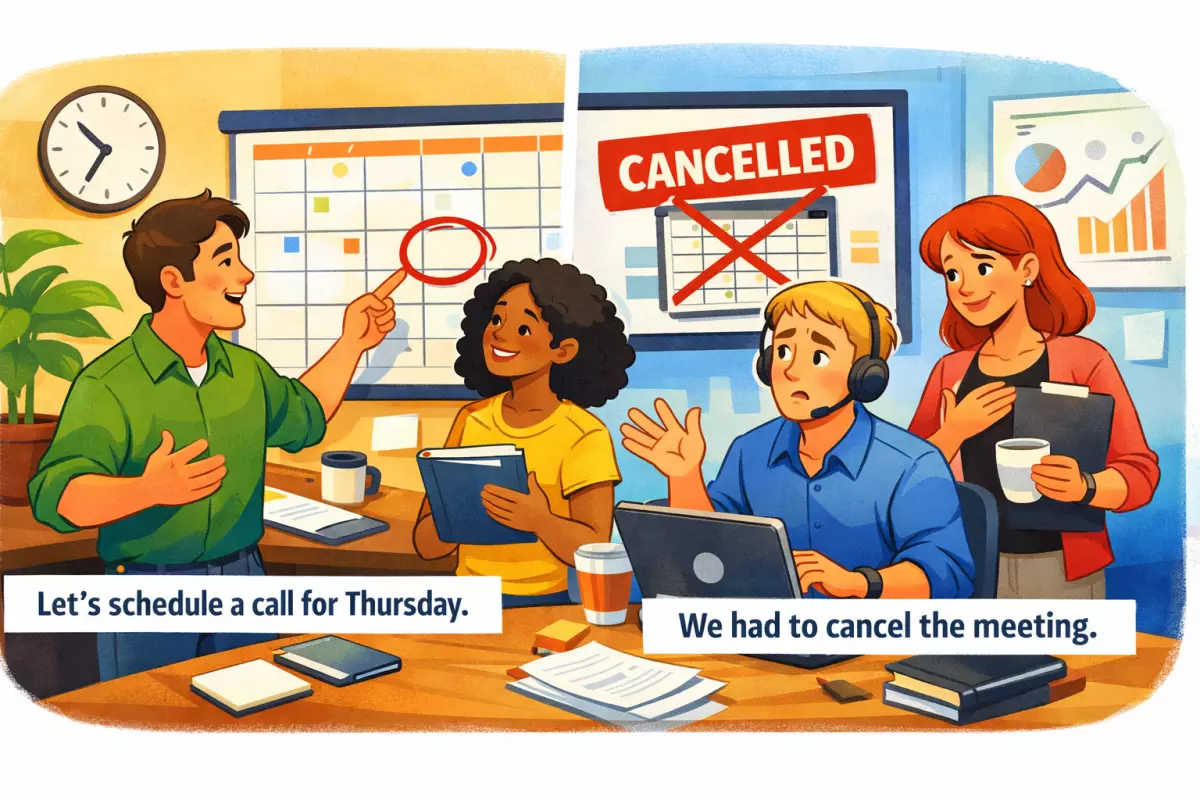
- schedule + a meeting/call/demo + for (time/date): “Let’s schedule a call for Thursday.”
- reschedule + a meeting + to (new time): “Can we reschedule to 3:00?”
- cancel + a meeting/order: “We had to cancel the meeting.”
- confirm + details/time/attendance: “Please confirm the time.”
- attend + a meeting/training: “I’ll attend the client meeting.” (No preposition: not “attend to the meeting.”)
- join + a meeting/call: “Join the call at 10.” / join + a team: “She joined the marketing team.”
- discuss + a topic/issue: “We need to discuss the timeline.” (No “discuss about.”)
- review + a document/proposal/report: “Can you review the draft?”
- edit + a file/slide deck: “I’ll edit the slides today.”
- approve + a request/budget + for (purpose, optional): “Finance approved the budget for Q2.”
- sign + a contract/form: “Please sign the agreement.” / sign off on + a decision/final version: “The director signed off on the final copy.”
- send + an email/file + to (person): “Send the invoice to Accounts Payable.”
- forward + an email + to (person): “I’ll forward this to Legal.”
- reply + to + an email/message: “Please reply to my email by EOD.”
- follow up + with (person) / on (topic): “I’ll follow up with Sam on the shipment.”
- share + a link/update + with (team): “Share the notes with everyone.”
- update + a spreadsheet/system + on (topic, optional): “Update the tracker on progress.”
- track + progress/metrics/issues: “We track defects weekly.”
- report + results/issues + to (manager/client): “Report the numbers to your manager.”
- escalate + an issue + to (higher level): “Escalate the ticket to IT.”
Useful time and priority add-ons
- by + deadline: “Send it by 5 pm.”
- before + event/time: “Review this before the meeting.”
- after + event: “Let’s debrief after the call.”
- today/this week/this afternoon: “I’ll update the file this afternoon.”
- asap (informal) vs. as soon as possible (more neutral): “Please reply as soon as possible.”
- right away (urgent) vs. when you can (less urgent): “Fix it right away” / “Fix it when you can.”
- top priority / high priority / low priority: “This is high priority for the client.”
Common accuracy fixes (prepositions and verb choice)
- ✅ “discuss the plan” → ❌ “discuss about the plan”
- ✅ “attend the meeting” → ❌ “attend to the meeting” (Use “attend to” for tasks: “attend to a customer request.”)
- ✅ “reply to your email” → ❌ “reply your email”
- ✅ “follow up with Alex” / “follow up on the issue” → ❌ “follow up Alex”
- ✅ “sign the contract” / “sign off on the final version” → ❌ “sign on the contract”
- ✅ “explain the problem to me” → ❌ “explain me the problem”
Quick practice: choose the best verb or preposition
- Please ______ the meeting to next Monday.
- I’ll follow up ______ Maria ______ the delivery date.
- Can you reply ______ my message by noon?
- We need to discuss ______ budget changes.
- The manager signed off ______ the final proposal.
- Please forward this email ______ the HR team.
Show answers
- reschedule
- with; on
- to
- the
- on
- to
Verbs for meetings and discussions
In workplace conversations, the verb you choose often signals your role: organizing the session, introducing a topic, managing turn-taking, or moving the group toward a decision. Many of these verbs follow predictable patterns (verb + noun, verb + that-clause, verb + to-infinitive), so learning the structure helps you speak accurately and naturally.
Core verbs and the patterns they use
- schedule + a meeting/call/demo: “Let’s schedule a follow-up for Thursday.”
- arrange + a meeting/intro: “I’ll arrange a meeting with Finance.”
- set up + a meeting/call: “Can you set up a quick check-in?”
- invite + someone + to + a meeting: “We invited the vendor to the review.”
- chair + a meeting: “She will chair today’s session.”
- open / kick off + a meeting: “I’ll open with a short update.”
- outline + the agenda/plan: “I’ll outline the agenda and timings.”
- introduce + a topic/speaker: “Let me introduce the next item.”
- raise + an issue/concern/question: “I’d like to raise a concern about scope.”
- bring up + a point: “Can I bring up one more point?”
- clarify + a point/requirement: “Could you clarify the approval process?”
- explain + the reason/background: “He explained the rationale for the change.”
- summarize + the discussion: “I’ll summarize what we’ve agreed so far.”
- recap + key points: “Let’s recap the action items.”
- agree / disagree + with + someone: “I agree with Priya on timing.”
- propose + a solution/approach: “I propose a two-phase rollout.”
- suggest + a change/idea: “She suggested a simpler workflow.”
- recommend + a course of action: “We recommend delaying the launch.”
- decide + to + verb / decide + on + noun: “We decided to pause” / “We decided on option B.”
Useful clause patterns for professional discussion
- Verb + that-clause (common for reporting): “We agreed that the deadline is realistic.” / “She confirmed that the budget is approved.”
- Verb + to-infinitive (common for decisions and next steps): “We need to revisit the estimate.” / “They offered to share a draft.”
- Verb + someone + to-infinitive (common for requests): “I’d like to ask you to walk us through the numbers.”
- Verb + -ing (common for suggesting/avoiding): “I suggest starting with risks.” / “Let’s avoid repeating earlier points.”
Managing the flow: turn-taking and control verbs
- hand over + to + someone: “I’ll hand over to Alex for the technical update.”
- invite + input/questions: “I’d like to invite questions before we move on.”
- interrupt (carefully) + to + clarify: “Sorry to interrupt, but can I clarify one detail?”
- pause + for + questions: “Let’s pause for questions.”
- park + a topic/question: “Let’s park that and return to it at the end.”
- defer + a decision/topic: “We’ll defer the decision until we have the data.”
- move on + to + the next item: “Let’s move on to the timeline.”
- wrap up / close + the meeting: “We’ll wrap up with next steps.”
Accuracy notes: common mistakes to avoid
- ✅ “We discussed the proposal.” ❌ “We discussed about the proposal.” (No “about” after discuss.)
- ✅ “Let’s agree on a plan.” ❌ “Let’s agree a plan.” (Use “agree on” for a noun.)
- ✅ “We decided to postpone.” / “We decided on option B.” (Choose the pattern based on verb vs. noun.)
- ✅ “Could you explain the issue?” ❌ “Could you explain me the issue?” (Use “explain + noun” or “explain + noun + to + person.”)
Verbs for planning and decision-making
In workplace English, planning and choice often show up in predictable verb patterns: verb + noun (plan a launch), verb + to-infinitive (decide to postpone), and verb + that-clause (agree that the timeline is tight). Using the right pattern helps your message sound clear and professional, especially in meetings and email updates.
Core verbs and the patterns they use
- plan + noun / to-infinitive: plan the rollout; plan to hire two analysts.
- schedule + noun: schedule a review; schedule the demo for Friday.
- prioritize + noun: prioritize customer issues; prioritize the top three tasks.
- forecast + noun: forecast demand; forecast Q3 revenue.
- estimate + noun / wh-clause: estimate the cost; estimate how long it will take.
- budget + noun / for + noun: budget $20k; budget for travel.
- allocate + noun + to + noun: allocate resources to the project; allocate time to testing.
- set + noun: set goals; set a deadline; set expectations.
- define + noun: define the scope; define success criteria.
- outline + noun: outline the approach; outline next steps.
- propose + noun / that-clause: propose a timeline; propose that we start with a pilot.
- recommend + noun / -ing / that-clause: recommend option B; recommend delaying the release; recommend that we revisit pricing.
- consider + noun / -ing / wh-clause: consider alternatives; consider extending the trial; consider whether we need legal review.
- evaluate + noun: evaluate the risks; evaluate vendor performance.
- assess + noun: assess impact; assess feasibility.
- weigh + noun / up + noun: weigh the pros and cons; weigh up the trade-offs.
- decide + to-infinitive / on + noun / wh-clause: decide to proceed; decide on a supplier; decide whether to escalate.
- choose + noun / to-infinitive: choose a solution; choose to wait.
- approve + noun: approve the budget; approve the final version.
Common structures that sound natural in meetings
- Verb + to + verb (commitment or action): decide to pause; plan to expand; agree to revise.
- Verb + -ing (activity as an object): consider moving the deadline; recommend adding a checkpoint.
- Verb + that-clause (formal reasoning): propose that we run a pilot; agree that we need more data.
- Verb + wh-clause (uncertainty or criteria): decide whether to outsource; estimate how much time we need.
- Verb + noun + to + noun (allocation/assignment): allocate funds to marketing; assign tasks to the team.
Useful contrasts: similar verbs, different focus
| Verb | Best used for | Typical pattern | Example |
|---|---|---|---|
| estimate | Approximate numbers or time | estimate + noun / wh-clause | We estimate the work will take two weeks. |
| forecast | Future performance based on data | forecast + noun | They forecast higher demand in Q4. |
| assess | Judge risk/impact/condition | assess + noun | Let’s assess the impact on support. |
| evaluate | Compare options against criteria | evaluate + noun | We evaluated three vendors. |
| prioritize | Order tasks by importance | prioritize + noun | Please prioritize the urgent tickets. |
| allocate | Distribute limited resources | allocate + noun + to + noun | We allocated two engineers to the fix. |
Accuracy notes (common errors to avoid)
- ✅ decide to proceed → ❌ decide proceed
- ✅ decide on a vendor → ❌ decide a vendor
- ✅ recommend that we postpone / recommend postponing → ❌ recommend to postpone (often incorrect in formal usage)
- ✅ approve the budget / approve the plan → ❌ approve to the plan
- ✅ schedule a meeting for Tuesday → ❌ schedule Tuesday (unclear without an object)
When you need to sound decisive, pair these verbs with a clear object and a time reference: “We’ve approved the budget and scheduled the review for Thursday.” When you need to sound careful, use evaluation verbs plus criteria: “We’ll assess the risk and decide whether to proceed after the security review.”
Verbs for reporting progress and results
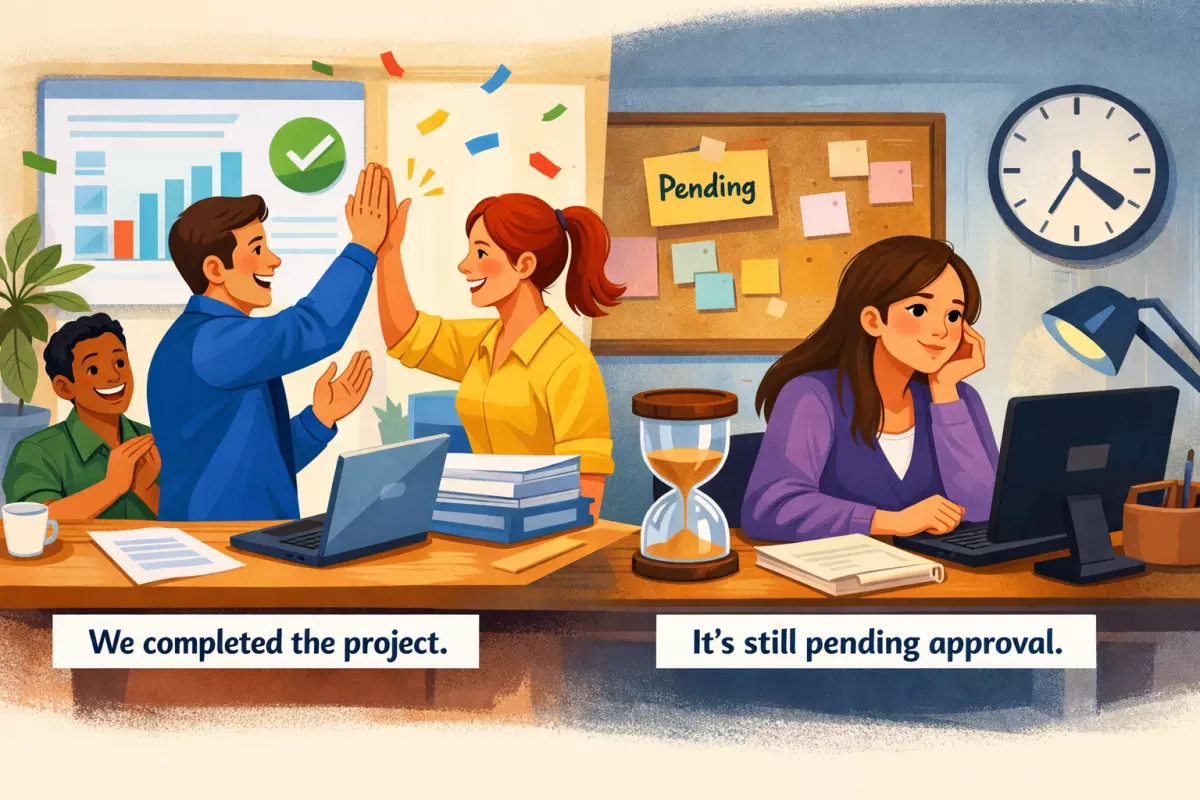
In workplace updates, the most useful verbs help you describe what has changed, what you have delivered, what is still pending, and what the outcome was. The patterns below show common ways to sound clear and appropriately formal in emails, meetings, and status reports.
Common verbs and the patterns they follow
- complete + noun: “We completed the draft proposal.” / “The team completed testing.”
- finish + noun / finish + -ing: “I finished the report.” / “We finished reviewing the contract.”
- finalize + noun: “We finalized the budget figures.”
- deliver + noun + (to + person/team): “We delivered the slides to the client.”
- submit + noun + (to + person/system): “I submitted the request in the portal.”
- send + noun + (to + person): “I sent the revised timeline to Finance.”
- share + noun + (with + person/group): “We shared the latest metrics with the stakeholders.”
- provide + noun: “They provided additional documentation.”
- confirm + noun / confirm + (that + clause): “Please confirm the meeting time.” / “They confirmed that the issue is resolved.”
- verify + noun: “We verified the numbers against last month’s report.”
- resolve + noun: “We resolved the login issue.”
- address + noun: “We addressed the main risks in the plan.”
- identify + noun: “We identified the root cause.”
- analyze + noun: “I analyzed the customer feedback.”
- evaluate + noun: “We evaluated three vendors.”
- improve + noun: “The changes improved response time.”
- reduce + noun: “We reduced processing time by 15%.”
- increase + noun: “The campaign increased sign-ups.”
Useful status-update structures
- What was done + by when: “We completed the first round of testing by Friday.”
- What is in progress + current stage: “We are reviewing the supplier quotes and will shortlist two options.”
- What is blocked + reason: “We are waiting for Legal approval, so the release is on hold.”
- What changed + impact: “We updated the scope, which adds two days to the timeline.”
- Result + evidence: “The fix reduced error rates, as shown in this week’s logs.”
- Next step + owner: “Next, I will schedule the handover with Support.”
Accuracy tips: tense, voice, and prepositions
- Use present perfect for recent progress with current relevance: “We have completed the analysis and are ready to present.”
- Use past simple for finished work at a specific time: “We completed the analysis on Tuesday.”
- Use passive voice when the doer is not important: “The report was submitted yesterday.”
- Common prepositions:
- submit to: “submitted the form to HR”
- share with: “shared the update with the team”
- deliver to: “delivered the files to the client”
- report on: “report on progress”
- result in: “resulted in fewer delays”
Common corrections
- ✅ “We completed the task.” ❌ “We completed on the task.” (No preposition needed.)
- ✅ “I submitted the file to the system.” ❌ “I submitted the file in the system.” (Use to for the action of submitting.)
- ✅ “We are reviewing the proposal.” ❌ “We are review the proposal.” (Use -ing after “are”.)
- ✅ “The change resulted in lower costs.” ❌ “The change resulted to lower costs.” (Use “result in”.)
Polite verb choices for emails and requests
Professional messages often sound more respectful when you choose verbs that soften the request, show awareness of the reader’s time, and clarify what action is needed. The most common pattern is to combine a modal verb (would/could) with a considerate main verb (ask, request, appreciate, confirm) and a clear object (the file, your feedback, a time).
Core patterns that make requests sound courteous
- Would you + verb: “Would you send the updated deck by 3 p.m.?”
- Could you + verb: “Could you confirm the attendee list?”
- I’d like to + verb: “I’d like to request access to the shared folder.”
- I’m writing to + verb: “I’m writing to ask for your approval.”
- Would it be possible to + verb: “Would it be possible to move the meeting to Thursday?”
- Do you mind + -ing: “Do you mind sharing the final numbers?”
- When you have a moment, + verb: “When you have a moment, please review the draft.”
- Please + verb (best for straightforward tasks): “Please upload the invoice to the portal.”
Verb choices that reduce pressure
- ask (neutral, common): “I’m reaching out to ask for your input on the timeline.”
- request (more formal): “We would like to request an extension until Friday.”
- appreciate (signals gratitude): “I’d appreciate it if you could share your availability.”
- wonder (very soft): “I was wondering if you could clarify the scope.”
- hope (careful: can sound vague): “I hope you can send the signed copy today.”
- advise (asks for guidance): “Could you advise on the next steps?”
- suggest (invites options): “Could you suggest a time that works for you?”
- recommend (asks for judgment): “Would you recommend proceeding with option B?”
- confirm (clear action): “Please confirm receipt of the shipment.”
- verify (accuracy-focused): “Could you verify the account details?”
- clarify (removes ambiguity): “Would you clarify which version we should use?”
- update (progress check): “Could you update me on the status of the ticket?”
- review (feedback request): “Would you review the proposal and share comments?”
- approve (decision request): “Could you approve the purchase order today?”
- forward (routing info): “Please forward this to the relevant team.”
- schedule (coordination): “Could you schedule a 15-minute call?”
Side-by-side examples: direct vs. more diplomatic
| More direct | More polite and professional |
|---|---|
| Send me the report today. | Could you send the report today, please? |
| I need this now. | Would it be possible to get this by end of day? |
| Explain this. | Could you clarify this point for me? |
| Fix the issue. | Could you look into the issue and let me know what you find? |
| Answer my questions. | I’d appreciate it if you could address the questions below. |
Useful add-ons that work well with polite verbs
- Time frame: “Could you confirm by Wednesday?” / “When convenient, could you review this?”
- Reason (brief): “To finalize the budget, could you verify the totals?”
- Choice: “Could you send the file today or tomorrow morning?”
- Offer of help: “If helpful, I can share a template—would you like me to send it?”
- Soft closing: “Thanks in advance for your help.” / “Thank you for taking a look.”
Common usage pitfalls to avoid
- ❌ “Kindly do the needful.” → ✅ “Could you please take care of this today?”
- ❌ “I demand an update.” → ✅ “Could you update me on the status?”
- ❌ “Reply ASAP.” → ✅ “Could you reply by 2 p.m. if possible?”
- ❌ “I want you to…” → ✅ “Could you…” / “Would you be able to…”
Common mistakes in business verb usage
Many workplace communication issues come from small verb choices: the wrong preposition, an unnatural collocation, or a tense that doesn’t match the timeline. The patterns below focus on frequent errors in emails, meetings, reports, and project updates, with clear corrections you can reuse.
1) Wrong prepositions with common business verbs
- ❌ discuss about the budget → ✅ discuss the budget
- ❌ explain me the process → ✅ explain the process to me
- ❌ reply me → ✅ reply to me
- ❌ respond me → ✅ respond to me
- ❌ depend of the supplier → ✅ depend on the supplier
- ❌ focus in cost reduction → ✅ focus on cost reduction
- ❌ invest on new software → ✅ invest in new software
- ❌ provide us the update → ✅ provide us with the update / provide the update
- ❌ participate on the meeting → ✅ participate in the meeting
- ❌ agree about the terms → ✅ agree on the terms / agree with the proposal
- ❌ approve for the request → ✅ approve the request
- ❌ ask to him for help → ✅ ask him for help
2) Collocations that sound “translated”
- ❌ make a meeting → ✅ hold a meeting / schedule a meeting
- ❌ do a decision → ✅ make a decision
- ❌ take an agreement → ✅ reach an agreement
- ❌ put attention on the details → ✅ pay attention to the details
- ❌ make a complaint → ✅ file a complaint / raise a concern
- ❌ open the computer → ✅ turn on the computer / open the file
- ❌ close the lights → ✅ turn off the lights
- ❌ control the project (meaning “manage”) → ✅ manage the project
- ❌ actualize the document → ✅ update the document
- ❌ assist to the training → ✅ attend the training
- ❌ compromise with the deadline → ✅ commit to the deadline
- ❌ realize a report → ✅ produce a report / prepare a report
3) Tense and time mismatches in updates
- Use present perfect for progress with a current result: ✅ We have completed the first phase (it matters now).
- Use past simple for finished actions at a finished time: ✅ We completed the first phase last week.
- Avoid mixing time markers: ❌ We have sent it yesterday → ✅ We sent it yesterday.
- Use will for decisions made now; use going to for plans already decided: ✅ I’ll call them now vs. ✅ We’re going to roll this out next quarter.
- Use by + time for deadlines: ✅ We’ll finish by Friday (deadline), not ❌ until Friday (which suggests continuing up to Friday).
4) Confusing similar verbs (meaning and register)
- ❌ We demand you to send the invoice → ✅ We request that you send the invoice / Please send the invoice (tone control matters in business writing).
- ❌ We suggest you to review it → ✅ We suggest reviewing it / We suggest that you review it
- ❌ We recommend you to contact IT → ✅ We recommend contacting IT / We recommend that you contact IT
- ❌ We will assist you to install it → ✅ We will help you install it / We will assist with the installation
- ❌ We will inform you when we will receive it → ✅ We will inform you when we receive it (future in time clauses is usually simple present).
5) Verb patterns after common workplace verbs
- Let / make / help: ✅ let me know, make it happen, help us resolve this (no “to” in these patterns).
- Agree: ✅ agree to the terms (accept), agree on a plan (choose together), agree with a person (share an opinion).
- Raise vs. rise: ✅ raise prices (someone increases something) vs. ✅ prices rise (increase by themselves).
- Say vs. tell: ✅ say something to someone vs. ✅ tell someone something.
- Advise: ✅ advise someone to do something / advise doing something (not ❌ advise to do).
6) Overusing vague verbs that hide responsibility
- Replace “do” with a specific action verb: ✅ review, approve, finalize, escalate, reconcile, draft, implement.
- Replace “make” when a stronger verb exists: ✅ create a dashboard, issue a refund, submit a request, deliver a presentation.
- Replace “handle” when you need clarity: ✅ investigate the issue, coordinate with Finance, resolve the ticket, negotiate terms.
When you correct these patterns, your messages become easier to follow: the action is clear, the timeline is accurate, and the tone fits professional contexts. A quick self-check is to scan for prepositions (to/on/in/with), then confirm the verb pattern (verb + object, verb + to-infinitive, or verb + -ing) before sending.
Homework: workplace verb practice tasks
Use these assignments to build accuracy with common office verbs, especially collocations (verb + noun), verb patterns (verb + to-infinitive / verb + -ing), and polite request forms. Aim for clear, natural workplace English rather than literal word-for-word translation.
1) Collocation building (verb + noun)
Complete each sentence with one verb that best fits the noun phrase. Use each verb once.
- We need to ________ a decision by Friday to keep the project on schedule.
- Please ________ the agenda to everyone before the meeting.
- Can you ________ the updated contract and send it back today?
- Let’s ________ a quick call to clarify the requirements.
- They ________ a complaint about the delivery time.
- I’ll ________ the budget numbers and confirm the totals.
- We should ________ progress at the end of the week.
- Could you ________ an extension on the deadline?
- HR will ________ a training session for new hires.
- We need to ________ a solution that works for both teams.
- Please ________ your availability for next Tuesday.
- They ________ a discount because of the delay.
Show answers
- make
- circulate
- sign
- schedule
- filed
- review
- track
- request
- run
- propose
- confirm
- requested
2) Verb pattern practice (to-infinitive vs. -ing)
Choose the correct form. Focus on the pattern, not just the meaning.
- We agreed (to move / moving) the deadline to next week.
- She suggested (to update / updating) the slide deck before the client call.
- They decided (to outsource / outsourcing) part of the work.
- I offered (to help / helping) with the report if you share the data.
- He avoided (to mention / mentioning) the pricing issue in the meeting.
- We need (to confirm / confirming) the figures before we present them.
- Do you mind (to resend / resending) the attachment?
- The team plans (to roll out / rolling out) the update on Monday.
- She recommended (to speak / speaking) with Legal first.
- We can’t afford (to miss / missing) the deadline again.
Show answers
- to move
- updating
- to outsource
- to help
- mentioning
- to confirm
- resending
- to roll out
- speaking
- to miss
3) Fix the workplace English (common verb errors)
Rewrite each sentence so it sounds natural and professional. Keep the meaning.
- ❌ I will discuss about the issue with my manager.
- ❌ Please explain me the process.
- ❌ We will contact to you tomorrow with an update.
- ❌ She told me to assist on the project.
- ❌ They emphasized on the need for better documentation.
- ❌ Can you suggest me a good time for the meeting?
- ❌ We will provide you the details later.
- ❌ He requested to me to send the invoice again.
Show answers
- ✅ I will discuss the issue with my manager.
- ✅ Please explain the process to me. / Please explain the process.
- ✅ We will contact you tomorrow with an update.
- ✅ She told me to assist with the project.
- ✅ They emphasized the need for better documentation.
- ✅ Can you suggest a good time for the meeting? / Can you suggest a good time to meet?
- ✅ We will provide the details later. / We will provide you with the details later.
- ✅ He asked me to send the invoice again. / He requested that I send the invoice again.
4) Email micro-writing (polite, action-focused verbs)
Write short email lines that use clear action verbs and a professional tone. Follow the instruction for each item.
- Ask a colleague to review a draft by end of day. Use: review.
- Request missing information from a client. Use: provide.
- Confirm a meeting time and include the next step. Use: confirm, schedule.
- Apologize for a delay and give a new timeline. Use: apologize, deliver.
- Escalate an issue to a manager with a brief reason. Use: escalate.
- Follow up on an unanswered message after two days. Use: follow up.
Show answers
- Could you review the draft and share any comments by end of day?
- Could you please provide the missing details so we can proceed?
- Thanks—can we confirm the meeting for 10:00 a.m.? I’ll schedule the call and send the invite.
- I apologize for the delay. We will deliver the updated file by Wednesday.
- I’m escalating this issue to my manager because it affects the delivery date.
- I’m following up on my message from Monday—could you confirm whether you had a chance to review it?
5) Speaking drill (one verb, three useful frames)
Choose 8–10 verbs from the article and practice each in three frames. Keep the same verb and change the context. This builds automatic, correct usage.
- Frame A (plan): “We plan to ________ + noun phrase by (time).”
- Frame B (request): “Could you ________ + noun phrase (today/this week)?”
- Frame C (update): “Just to update you, we’ve ________ + past participle + noun phrase.”
- Example verbs to cycle through: approve, finalize, review, submit, coordinate, resolve, prioritize, implement, allocate, escalate, confirm, deliver, negotiate, streamline, delegate, onboard.