Multi-Word Verbs: Phrasal, Prepositional, and Mixed Types

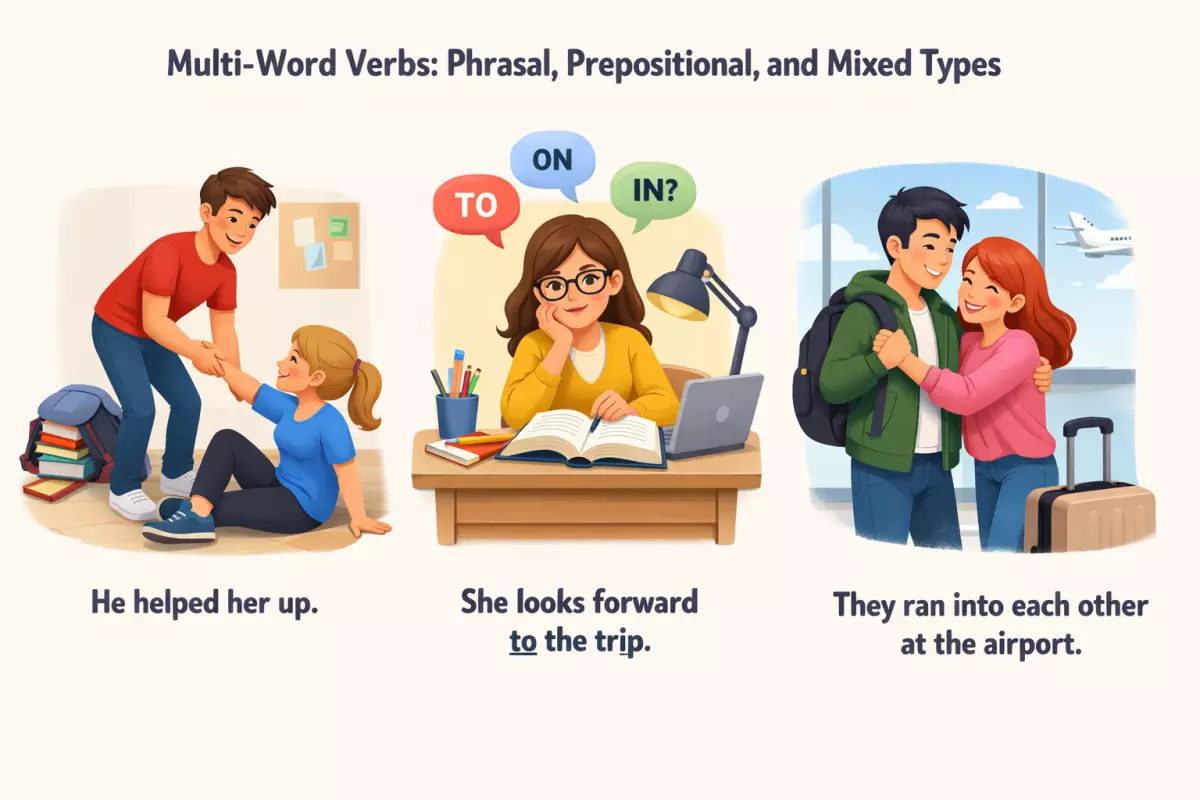 Covers what multi-word verbs are, then compares phrasal vs prepositional verbs and explains phrasal-prepositional verbs. It lays out word order and object placement, separable vs inseparable rules, meaning shifts, common mistakes with fixes, and homework practice tasks.
In everyday English, meaning often comes from verbs paired with short words, forming expressions like turn off or look after that cannot be translated word by word. These combinations fall into three types: phrasal, prepositional, and mixed, and each works a bit differently in sentences. When you notice how the small word shifts meaning and grammar, you will follow conversations faster and speak more naturally.
What multi-word verbs are
These are verb combinations made of a main verb plus one or two short words (particles) such as up, out, in, for, or with. Together, the parts act as a single unit of meaning and grammar, so the overall sense is often different from the base verb alone.
In use, they behave like ordinary verbs: they take tense, can be negative, and can form questions. The particle usually stays the same while the main verb changes form.
- They inflect like normal verbs: call off → called off → calling off
- They work with auxiliaries: will/can/should + put off, might run into
- Negation goes on the auxiliary (or do-support): did not carry on, cannot log in
- Questions follow normal word order: Did you turn in the form?
- Meaning can be literal or idiomatic: sit down (literal) vs. give up (idiomatic “quit”)
Core building blocks
The extra word after the verb is typically either a particle (adverb-like) or a preposition. This matters because it affects where objects can go and what kind of complement follows.
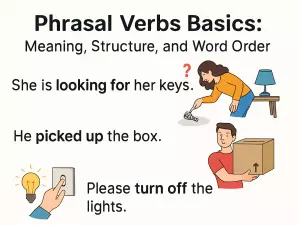
- Verb + particle: often allows object movement (e.g., turn off the light / turn the light off).
- Verb + preposition: the preposition must be followed by its object (e.g., look after + noun/pronoun: look after the kids).
- Verb + particle + preposition: forms a longer unit (e.g., put up with + noun/pronoun: put up with the noise).
Common patterns you can recognize quickly
Many combinations follow recurring meaning “families.” Learning these patterns helps you guess meaning and use them more naturally.
- Up often signals completion or increase: finish up, heat up, speed up, set up
- Out often suggests distribution, discovery, or disappearance: hand out, find out, run out, phase out
- Off often suggests separation, cancellation, or stopping: break off, call off, cut off, take off
- On often suggests continuation or wearing/attachment: carry on, keep on, put on, hold on
- In/Into often signals entry or involvement: check in, log in, look into, run into
- Over often suggests repetition or review: do over, go over, talk over
Examples as complete verb units
Each item below functions as one verb choice in a sentence, even though it has multiple words.
- bring up (mention): She brought up a concern.
- carry on (continue): They carried on working.
- check in (register/arrive): We checked in at noon.
- figure out (understand/solve): He figured out the answer.
- find out (discover): I found out later.
- give up (quit): Don’t give up.
- hold on (wait): Hold on a moment.
- look after (take care of): She looks after her sister.
- look into (investigate): We’ll look into the issue.
- pick up (collect/learn): Can you pick up the package?
- put off (delay): They put off the meeting.
- run into (meet by chance): I ran into an old friend.
- set up (arrange/create): They set up an account.
- take over (assume control): She took over the project.
- turn down (reject/lower): He turned down the offer.
- work out (resolve/exercise): It worked out in the end.
Phrasal verbs vs prepositional verbs
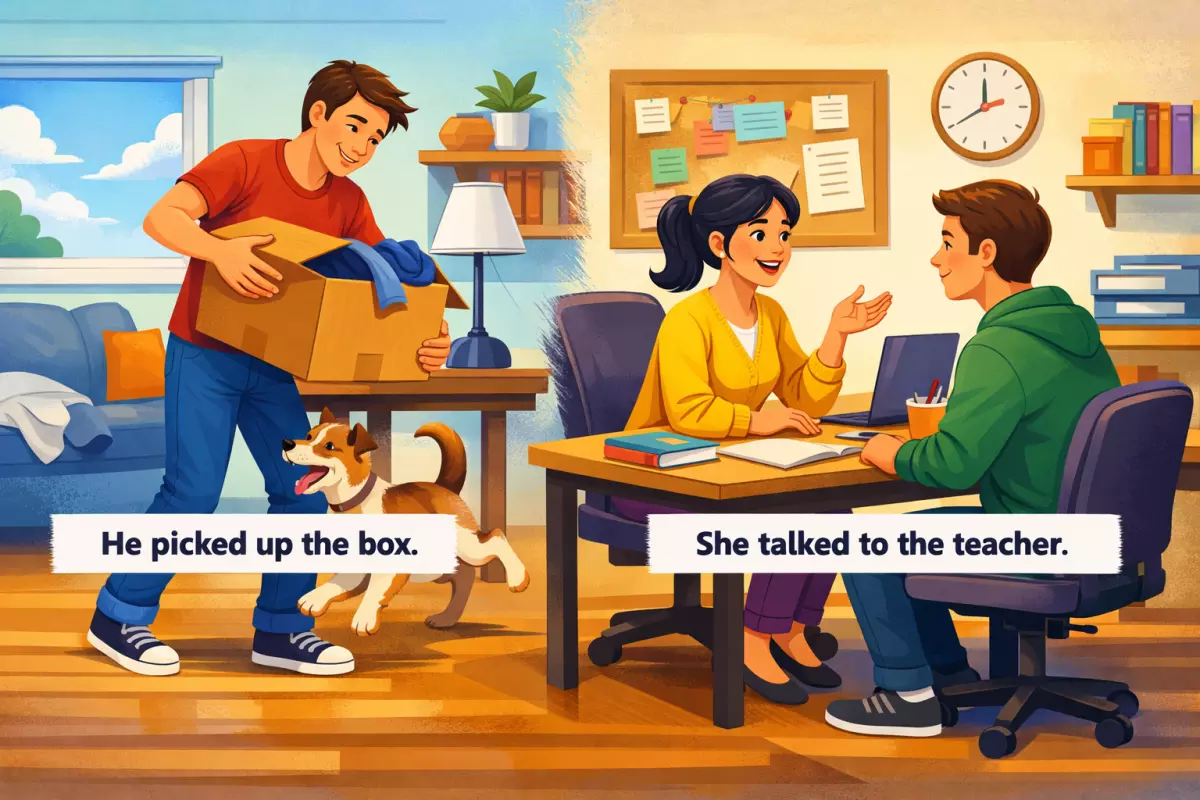
The most reliable way to tell these two multi-word patterns apart is to look at what comes after the particle. One type uses an adverb-like particle (up, out, off, on) and may allow the object to move; the other uses a true preposition (to, for, with, at) that must be followed by its object. This difference affects word order, pronoun placement, and what you can do in questions and passives.
| Feature | Phrasal verb (verb + particle) | Prepositional verb (verb + preposition) |
|---|---|---|
| Core structure | Verb + particle (often adverbial): turn off, pick up | Verb + preposition + object: listen to, depend on |
| Object placement with a noun | Often flexible: turn off the light / turn the light off | Fixed: listen to the podcast (❌ listen the podcast to) |
| Object placement with a pronoun | Pronoun goes in the middle: turn it off (❌ turn off it) | Pronoun stays after the preposition: listen to it |
| What the second word “needs” | Particle does not require an object by itself; the verb may be transitive or intransitive: wake up / wake someone up | Preposition must take an object (even if implied in context): rely on someone |
| Question formation | Object questions often target the noun phrase: What did you pick up? | Preposition is typically stranded: Who are you talking to? |
| Passives (when there is an object) | Common: The light was turned off. | Possible: She was talked to. (formal writing may prefer “spoken to”) |
Usage patterns that help you choose the right word order
- Pronoun test (quick check): if a pronoun can go between the verb and the particle, you are likely dealing with a particle verb. ✅ “put it off” vs ❌ “put off it”.
- Preposition + object is non-negotiable: the preposition introduces its object as a unit. ✅ “look after the kids” (❌ “look the kids after”).
- Noun objects may move with particle verbs: both orders can be correct, but one may sound more natural depending on length and emphasis. “turn off the lights” is often preferred to “turn the lights off” in neutral style, while “turn them off” is required with a pronoun.
- Keep long objects at the end: even when movement is possible, long noun phrases usually stay after the particle for readability. “pick up the package you ordered last week” is smoother than “pick the package you ordered last week up”.
- Meaning can change with particle placement in rare cases: most of the time it does not, but fixed expressions may strongly prefer one order, especially in informal speech.
Common examples (grouped by type)
- Typical phrasal verbs (often separable): turn off, turn on, pick up, put down, take off (remove), put on (wear), fill out, hand in, set up, look up (search), bring back, call off, carry out, figure out, throw away.
- Typical prepositional verbs (not separable): listen to, depend on, belong to, apply for, look at, deal with, approve of, complain about, insist on, apologize for, search for, pay for, wait for, agree with, care about.
- Watch for “look” and “get”: the same base verb can form both patterns with different meanings. “look up” (search) behaves like a particle verb, while “look after” (take care of) behaves like a prepositional verb.
When you are unsure, check what happens with a pronoun object. If “it/them” must sit after the second word (listen to it, rely on them), the second word is functioning as a preposition. If the pronoun must move into the middle (turn it off, pick them up), you are dealing with a particle verb and its characteristic word-order rule.
Phrasal-prepositional verbs explained
These are three-part verb phrases that combine a main verb + an adverb particle + a preposition (for example, put up with). They behave as one unit in meaning and are common in everyday English, especially in speaking and informal writing.
Core pattern and what it means for usage
The typical structure is:
- Verb + particle + preposition + object
The object is required because the final word is a preposition, and prepositions need an object. That’s why you can say “put up with the noise” but not just “put up with” (unless the object is understood from context and omitted in very informal speech).
Word order: where the object goes
With this mixed structure, the object normally comes after the preposition. Unlike many two-part phrasal verbs, you usually cannot move the object to the middle.
- ✅ I can’t put up with this noise.
- ❌ I can’t put this noise up with.
- ✅ She looked forward to the weekend.
- ❌ She looked the weekend forward to.
Pronouns: keep them after the preposition
When the object is a pronoun (him, it, them), it still stays after the preposition.
- ✅ We can do away with it.
- ❌ We can do it away with.
- ✅ I won’t put up with them.
Common examples (meaning + a model sentence)
- put up with (tolerate): I won’t put up with rude comments.
- look forward to (anticipate): They’re looking forward to the holidays.
- get away with (avoid punishment): He got away with cheating once.
- come up with (invent/think of): Can you come up with a better plan?
- run out of (use all of something): We’ve run out of milk.
- catch up with (reach the same level; meet to talk): I need to catch up with her later.
- keep up with (stay at the same pace/level): It’s hard to keep up with the reading.
- get on with (continue; have a good relationship): Let’s get on with the meeting.
- get rid of (discard/remove): Please get rid of these old boxes.
- do away with (abolish/remove): They did away with the outdated rule.
- look down on (think less of): Don’t look down on beginners.
- look up to (admire/respect): She looks up to her coach.
- check up on (monitor/verify): I’ll check up on the kids.
- go back on (break a promise/commitment): He went back on his word.
- get through to (reach/contact; make understand): I couldn’t get through to him.
- walk out on (abandon): He walked out on the project.
Grammar notes that help you choose the right form
- Passive voice is limited: many of these sound awkward in the passive because the “verb + particle + preposition” works best as an active unit. “The noise was put up with” is possible but uncommon; “They tolerated the noise” is more natural.
- Questions keep the unit together: What can’t you put up with? Who did you catch up with?
- Gerunds after the preposition are common: “look forward to meeting you,” “get away with lying,” because the preposition is followed by a noun phrase (and a gerund phrase acts like a noun).
- Meaning can be non-literal: “run out of” rarely means physically running; it usually means “have none left,” so treat it as a fixed expression.
Word order and object placement rules
Multi-word verbs follow a few predictable placement patterns. The key is to identify (1) whether the verb takes a direct object, and (2) whether the second word is a particle (adverb) or a preposition. That choice determines where nouns and pronouns can go.
Phrasal verbs (verb + particle): object can often move
- With a noun object, two positions may be possible: after the particle or between the verb and particle.
- ✅ She turned off the light. / She turned the light off.
- ✅ They picked up the package. / They picked the package up.
- With a pronoun object, placement is usually fixed: pronouns go between the verb and particle.
- ✅ She turned it off. ❌ She turned off it.
- ✅ I picked them up. ❌ I picked up them.
- Long noun phrases often sound clearer after the particle: this avoids splitting the verb and particle with a heavy object.
- ✅ He put off the meeting with the regional managers.
- Less natural: He put the meeting with the regional managers off.
- Meaning can affect placement preference: some combinations are technically separable but strongly prefer one order in everyday use.
- ✅ We set up a meeting. (common) / We set a meeting up. (possible, less common)
- Intransitive phrasal verbs have no object to place: the particle stays with the verb.
- ✅ The car broke down.
- ✅ She showed up late.
Prepositional verbs (verb + preposition): object cannot move
- The object must follow the preposition: you cannot insert it between the verb and preposition.
- ✅ She looked at the painting. ❌ She looked the painting at.
- ✅ We ran into an old friend. ❌ We ran an old friend into.
- Pronouns follow the preposition too:
- ✅ I’m waiting for him. ❌ I’m waiting him for.
- ✅ They replied to us. ❌ They replied us to.
- Questions often move the preposition to the end in informal style: this is common in speech and general writing.
- ✅ What are you talking about?
- ✅ Who are you listening to?
- More formal style can keep the preposition before the question word:
- ✅ About what are you talking? (formal, less common)
- ✅ To whom did you speak? (formal)
Mixed (phrasal-prepositional) verbs: particle stays close; object follows the preposition
- Pattern: verb + particle + preposition + object. The object normally comes after the preposition, not earlier.
- ✅ She put up with the noise. ❌ She put the noise up with.
- ✅ He looked forward to the trip. ❌ He looked the trip forward to.
- ✅ They ran out of milk. ❌ They ran milk out of.
- Pronouns follow the preposition as well:
- ✅ She put up with it. ❌ She put it up with.
- ✅ We ran out of them. ❌ We ran them out of.
Quick placement checklist (with examples)
- If the second word is a particle and there is a direct object, test separability:
- ✅ turn off the light / turn the light off
- ✅ turn it off (pronoun in the middle)
- If the second word is a preposition, keep the object after it:
- ✅ depend on your team (not: depend your team on)
- ✅ listen to her (not: listen her to)
- If there are two following words (particle + preposition), place the object after the preposition:
- ✅ get on with the work
- ✅ catch up with them
- Prefer the “unsplit” option when the object is long or complex:
- ✅ They carried out the plan for expanding the service across three regions.
- In passive voice, the object becomes the subject, and the particle/preposition stays with the verb phrase:
- ✅ The light was turned off.
- ✅ The painting was looked at closely.
- ✅ The noise was put up with for hours.
Separable vs inseparable overview
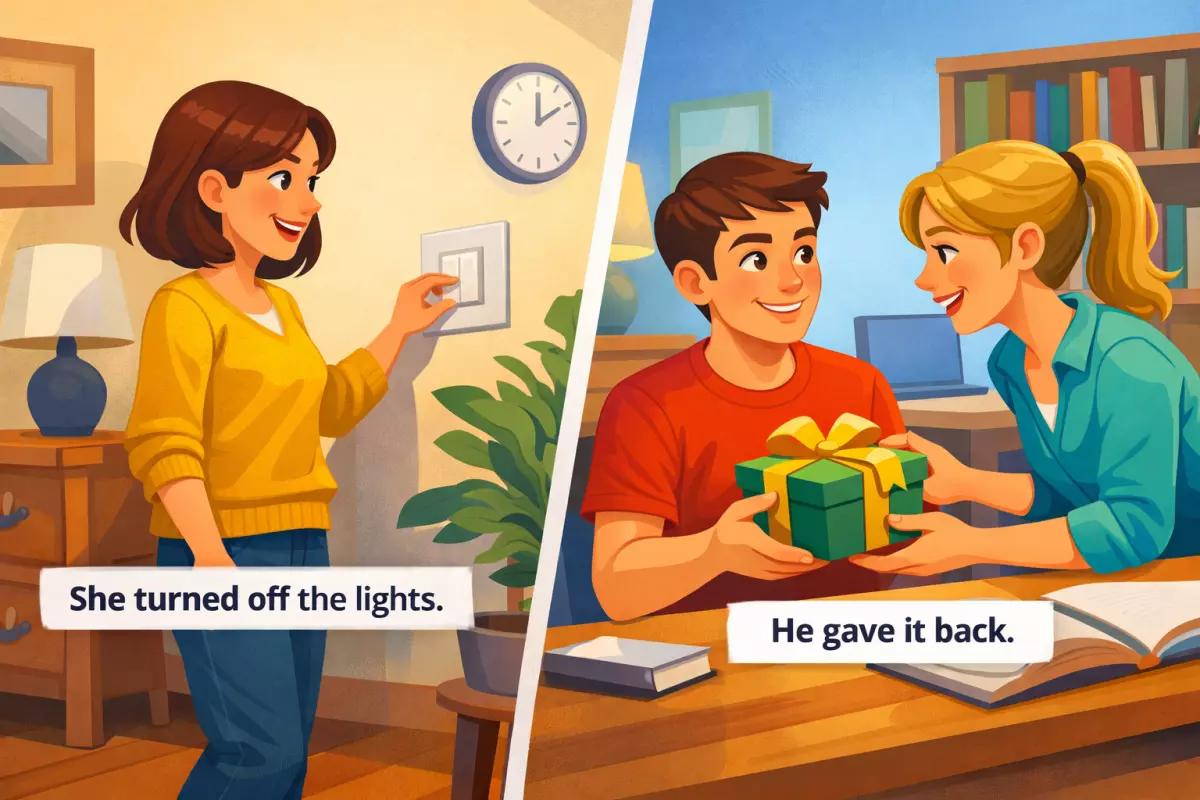
Many multi-word verbs differ in whether the object can go between the verb and the particle. This affects word order with nouns vs. pronouns, and it’s one of the fastest ways to choose the correct structure in real sentences.
Core patterns to know
- Separable phrasal verbs: the object can appear after the particle or between the verb and particle.
- Pattern A: verb + particle + object (common with longer noun phrases) → “She turned off the lights.”
- Pattern B: verb + object + particle (very common with short noun phrases) → “She turned the lights off.”
- Pronoun rule: pronouns usually go in the middle ✅ “She turned it off.” ❌ “She turned off it.”
- Inseparable multi-word verbs: the object cannot split the verb and the second word.
- Pattern: verb + particle/preposition + object → “We ran into an old friend.”
- Pronouns stay after the second word ✅ “We ran into him.” ❌ “We ran him into.”
- Mixed (three-part) verbs: often behave as inseparable units because two particles/prepositions follow the verb.
- Pattern: verb + particle + preposition + object → “She put up with the noise.”
- Pronouns follow the full unit ✅ “She put up with it.” ❌ “She put it up with.”
Quick decision checklist (usage-focused)
- If the second word behaves like a preposition (followed by an object that completes the meaning), the verb is usually not split: “look after the kids,” “depend on results,” “listen to me.”
- If the second word behaves like an adverb particle (often changing direction, completion, or intensity), splitting may be possible: “pick up,” “turn down,” “carry on.”
- If the object is a pronoun (it, them, him), place it between verb and particle only when the verb is separable: “pick it up,” “hand them in.”
- If the object is a long noun phrase, many speakers prefer the “together” option for separable verbs: “She turned off the lights in the hallway near the stairs.”
- If the verb has two words after it (three-part structure), treat it as fixed and keep the object at the end: “get away with a mistake,” “look forward to the trip.”
- When meaning changes, separability can change too; treat each meaning as its own entry (some verbs have both separable and inseparable uses depending on definition).
Common examples by behavior (for pattern recognition)
- Separable (object can split): “turn off,” “turn on,” “pick up,” “put down,” “bring back,” “hand in,” “fill out,” “set up,” “take apart,” “throw away.”
- Inseparable (do not split): “run into,” “look after,” “get over,” “deal with,” “belong to,” “listen to,” “wait for,” “apply for,” “agree with,” “consist of.”
- Three-part (usually fixed): “put up with,” “get on with,” “look forward to,” “catch up with,” “come up with,” “get away with.”
When you’re unsure, test a pronoun object. If “verb + pronoun + particle” sounds natural, it’s likely separable; if it sounds wrong, keep the object after the particle/preposition. This quick check helps you avoid the most common word-order errors with multi-word verbs.
Meaning shifts in multi-word verbs
Multi-word verb combinations often change the base verb’s sense in predictable ways. Sometimes the particle (adverb) or preposition adds a literal direction, but very often it creates an idiomatic meaning that you cannot reliably guess from the individual words. Learning the common “shift patterns” helps you interpret new items and choose natural alternatives in speaking and writing.
Common patterns that change the base meaning
- Completion / finishing: particles like up and off frequently add a “to the end” sense. Examples: use up (consume completely), eat up (finish eating), pay off (finish paying a debt), finish off (complete the last part).
- Increase / intensify: up can also mean “more” or “stronger.” Examples: speed up (go faster), heat up (make hotter), tighten up (make stricter/less loose), step up (increase effort or level).
- Decrease / reduce: down often signals reduction. Examples: calm down (become less upset), cut down (reduce consumption/size), slow down (move less fast), turn down (lower volume/heat; also “reject”).
- Start / begin: some particles mark the beginning of an activity. Examples: start up (begin operating), take up (begin a hobby), set about (begin doing something in a deliberate way).
- Stop / end / cancel: particles can signal interruption or cancellation. Examples: call off (cancel), break off (end suddenly), shut down (stop operating), wrap up (bring to a close).
- Continuation / persistence: on and away often suggest continuing. Examples: carry on (continue), keep on (continue repeatedly), work away (keep working steadily), chat away (talk continuously).
- Return / reversal: back commonly adds “return” or “respond.” Examples: go back (return), pay back (repay), call back (return a phone call), fight back (resist/retaliate).
- Separation / removal: particles like off, out, and away can mark taking something away. Examples: take off (remove clothing; also “leave the ground”), cut off (disconnect; stop supply), throw out (discard), clear out (empty a space).
- Discovery / emergence: out often signals that something becomes known or visible. Examples: find out (discover), work out (solve/understand; also “exercise”), come out (be published/appear; also “become known”).
- Distribution / division: some combinations express spreading or sharing. Examples: hand out (distribute), share out (divide among people), split up (divide; also “end a relationship”).
- Social interaction and communication: particles can shift meaning toward contact, avoidance, or discussion. Examples: get along (have a good relationship), fall out (argue and stop being friendly), talk over (discuss), bring up (mention a topic).
- Evaluation / decision: some forms signal judgment or choice. Examples: pick out (select), rule out (exclude as impossible), go over (review), settle on (choose after considering).
Usage notes: when meaning becomes less predictable
- One particle, multiple senses: take off can mean “remove” (take off your jacket) or “leave the ground” (the plane took off). Context decides the meaning, not the grammar.
- Same verb, different particles, different outcomes: pick up (collect/learn), pick out (choose), pick on (bully/criticize). Treat each as a separate vocabulary item.
- Literal vs. idiomatic readings: look up can be literal (look up at the ceiling) or idiomatic (look up a word). The object often signals which one is intended.
- Prepositional verbs keep a clear object link: in rely on, deal with, apologize for, the preposition points to what follows, and the meaning shift is usually more stable than with many phrasal verbs.
- Mixed types can feel especially idiomatic: combinations like put up with (tolerate) or look forward to (anticipate) are hard to guess; learn them as fixed units, including the required preposition.
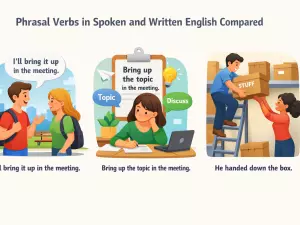
- Register differences: multi-word verb choices can sound more informal than single-word alternatives (e.g., put off vs. postpone). Pick based on audience and tone.
Common learner mistakes and fixes
Errors with multi-word verbs usually come from three areas: choosing the wrong particle (adverb vs. preposition), putting the object in the wrong place, or using the wrong pattern after the verb (noun, pronoun, -ing form, or infinitive). Use the checks below to spot the pattern and correct it quickly.
1) Mixing up phrasal vs. prepositional patterns
- ❌ discuss about the plan → ✅ discuss the plan (no particle needed)
- ❌ explain me the rule → ✅ explain the rule to me
- ❌ listen music → ✅ listen to music (preposition required)
- ❌ enter to the room → ✅ enter the room (no preposition)
- ❌ marry with someone → ✅ marry someone (no preposition)
- ❌ arrive to the station → ✅ arrive at the station / arrive in the city (choose the correct preposition)
2) Putting pronouns in the wrong position (a very common rule)
- With separable phrasal verbs, pronouns usually go in the middle: ❌ turn off it → ✅ turn it off
- ❌ pick up them → ✅ pick them up
- ❌ put on it → ✅ put it on
- With prepositional verbs, the object cannot go between verb and preposition: ❌ look the word up (meaning “search in a dictionary” is phrasal, not prepositional) → ✅ look the word up / look up the word
- With true prepositional verbs, keep the preposition next to its object: ❌ look your sister after → ✅ look after your sister
3) Using the wrong object placement with separable vs. inseparable verbs
- Some verb + particle combinations are inseparable: ❌ get the flu over → ✅ get over the flu
- ❌ run the boss into (meaning “meet unexpectedly”) → ✅ run into the boss
- When the object is long, placing it at the end often sounds more natural: ✅ put off the meeting we scheduled for next Friday (often better than splitting it)
- If the object is a pronoun, splitting is usually required for separable phrasal verbs: ✅ put it off
4) Confusing similar particles (up / out / off / on)
- up often suggests completion or increase: finish up, speed up, set up. Learners sometimes use out instead: ❌ set out a company (wrong meaning) → ✅ set up a company
- out often suggests “become visible/available” or “remove”: find out, figure out, take out. ❌ figure up the answer → ✅ figure out the answer
- off often suggests separation or stopping: take off, cut off, turn off. ❌ turn down the light (meaning “switch off”) → ✅ turn off the light (turn down = reduce)
- on often suggests continuation or connection: carry on, put on, log on. ❌ carry out (meaning “continue”) → ✅ carry on
5) Treating “to” as part of an infinitive when it is a preposition
- After a preposition, use a noun or -ing form (not a bare verb):
- ❌ look forward to see you → ✅ look forward to seeing you
- ❌ be used to work late → ✅ be used to working late
- ❌ object to pay extra → ✅ object to paying extra
- ❌ get around to do it → ✅ get around to doing it
6) Forgetting required prepositions after certain verbs
- ❌ depend you → ✅ depend on you
- ❌ apologize him → ✅ apologize to him / apologize for the mistake
- ❌ belong me → ✅ belong to me
- ❌ succeed on life → ✅ succeed in life
- ❌ complain the noise → ✅ complain about the noise
7) Overgeneralizing “verb + up” and “verb + out” meanings
- Many combinations are idiomatic and must be learned as a unit: ❌ make up homework (meaning “do”) → ✅ do homework (make up = invent/repair a relationship)
- ❌ take out a decision (meaning “decide”) → ✅ make a decision
- ❌ bring up with an idea (wrong structure) → ✅ come up with an idea / bring up an idea (different patterns, different meanings)
8) Errors with mixed (three-part) verbs
- Three-part verbs are typically inseparable; keep the parts together: ❌ put the noise up with → ✅ put up with the noise
- ❌ look the kids forward to (wrong order) → ✅ look forward to the kids coming
- ❌ get the problem away with → ✅ get away with the problem (meaning “avoid punishment”)
- Watch the object type after the final preposition: ✅ look forward to meeting them (not “to meet”)
9) Passive voice mistakes with multi-word verbs
- Keep the particle/preposition with the verb in passive forms: ❌ The issue was looked → ✅ The issue was looked into.
- ❌ The lights were turned → ✅ The lights were turned off.
- ❌ He was taken care → ✅ He was taken care of.
10) Quick self-checks that prevent most errors
- If the “particle” has an object (to/for/with/about/of), treat it as a preposition and keep it with its object: look after the baby, rely on her.
- If you can move the object before/after the particle, it’s likely a separable phrasal verb: turn the TV off / turn off the TV; but turn it off (not “turn off it”).
- If it has three parts (verb + particle + preposition), don’t split it: put up with it, get on with her, look forward to it.
- When “to” follows a verb phrase, check whether it is a preposition; if yes, use -ing: look forward to + -ing, be used to + -ing.
Homework: multi-word verb practice tasks
Use these tasks to build accuracy with multi-word verb patterns: particle placement, object type (noun vs. pronoun), and the difference between phrasal, prepositional, and mixed structures. Work through them in order; later tasks recycle earlier verbs so you practice form and meaning together.
Task 1: Identify the type (phrasal / prepositional / mixed)
Label each item as phrasal (verb + particle), prepositional (verb + preposition + object), or mixed (verb + particle + preposition + object).
- look after the kids
- turn off the lights
- put up with the noise
- run into an old friend
- get over a cold
- look forward to the weekend
- carry out the plan
- check in at the hotel
- come up with a solution
- take care of the paperwork
- break down in the middle of the road
- set up a meeting
Show answers
- prepositional
- phrasal
- mixed
- prepositional
- prepositional
- prepositional
- phrasal
- prepositional
- mixed
- prepositional
- prepositional
- phrasal
Task 2: Choose the correct word order (noun object vs. pronoun object)
For each sentence, choose the correct option (A or B). Focus on where the particle can go, and what changes when the object is a pronoun.
- Please turn off the TV. (A) turn off it (B) turn it off
- They carried out the experiment. (A) carried the experiment out (B) carried out the experiment
- I’ll pick up my sister. (A) pick up her (B) pick her up
- We set up a new account. (A) set a new account up (B) set up a new account
- He threw away the receipt. (A) threw it away (B) threw away it
- Can you write down the address? (A) write it down (B) write down it
- She looked up the word. (A) looked the word up (B) looked up the word
- We’re putting off the meeting. (A) putting it off (B) putting off it
- He handed in his application. (A) handed it in (B) handed in it
- They called off the match. (A) called the match off (B) called off the match
Show answers
- B
- A and B (both correct)
- B
- A and B (both correct)
- A
- A
- A and B (both correct)
- A
- A
- A and B (both correct)
Task 3: Add the missing particle or preposition
Complete each sentence with one word. Choose from: up, out, off, after, into, over, with, for, to, of. Use each word once.
- Could you look _____ my cat while I’m away?
- We ran _____ a problem during testing.
- She finally got _____ the flu.
- They came _____ with a better idea.
- He’s looking forward _____ meeting the team.
- Please fill _____ this form and sign at the bottom.
- The manager called _____ the meeting because of the storm.
- I can’t put _____ with that constant noise.
- Let’s figure _____ what went wrong.
- Who’s in charge _____ the keys?
Show answers
- after
- into
- over
- up
- to
- out
- off
- with
- out
- of
Task 4: Rewrite without changing the meaning
Rewrite each sentence using the multi-word verb in brackets. Keep the tense and meaning. Use 4–12 words for each rewrite.
- They cancelled the flight because of fog. (call off)
- She tolerated his rude comments for months. (put up with)
- I met my teacher by chance at the station. (run into)
- Can you take care of the children tonight? (look after)
- We postponed the launch until next week. (put off)
- He invented an excuse in two minutes. (make up)
- Let’s investigate the cause of the error. (look into)
- They completed the survey in one day. (carry out)
Show answers
- They called off the flight because of fog.
- She put up with his rude comments for months.
- I ran into my teacher at the station.
- Can you look after the children tonight?
- We put off the launch until next week.
- He made up an excuse in two minutes.
- Let’s look into the cause of the error.
- They carried out the survey in one day.
Task 5: Error correction (fix the pattern)
Each sentence has one mistake with a particle, preposition, or object placement. Rewrite each sentence correctly.
- ❌ She looked after him up when he was sick.
- ❌ I’m looking forward for the holidays.
- ❌ Please turn off it before you leave.
- ❌ We came up a plan with to save money.
- ❌ He put up the noise with during the exam.
- ❌ They carried out it successfully.
- ❌ Who’s taking care the guests of?
- ❌ I ran into to my boss yesterday.
Show answers
- ✅ She looked after him when he was sick.
- ✅ I’m looking forward to the holidays.
- ✅ Please turn it off before you leave.
- ✅ We came up with a plan to save money.
- ✅ He put up with the noise during the exam.
- ✅ They carried it out successfully. (Also possible: They carried out the project successfully.)
- ✅ Who’s taking care of the guests?
- ✅ I ran into my boss yesterday.
Task 6: Production (use the pattern in your own sentences)
Write one original sentence for each prompt. Aim for natural context and correct structure. Include at least 4 different tenses across your set.
- A plan you will carry out this month.
- Something you need to look into at work or school.
- A situation you can’t put up with.
- Someone you ran into unexpectedly.
- Something you are looking forward to.
- A task you should take care of soon.
- Something you had to get over.
- An item you should throw away or give away.
- A meeting you might put off (and why).
- A device you always turn off before leaving.