Verb + Particle Meaning Shifts Explained

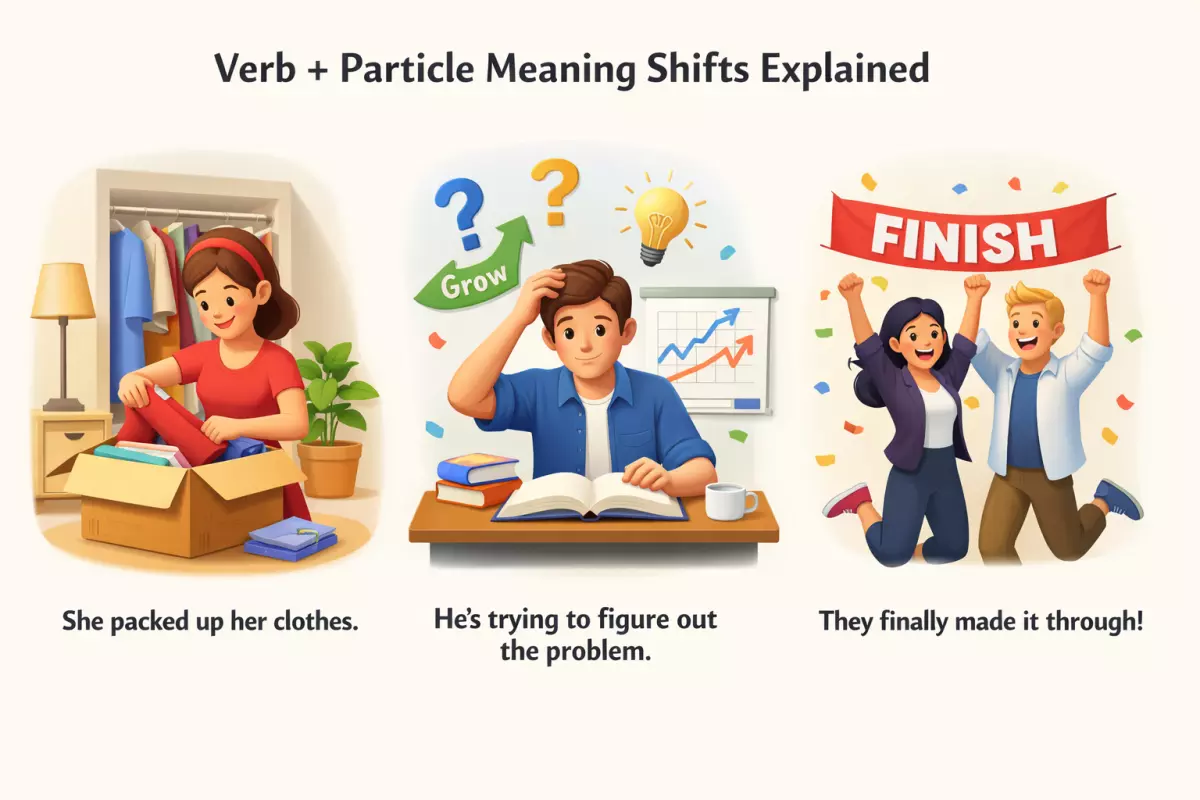 This article explains which particles appear in multi-word verbs and how they change meaning. It covers common particles, how the same verb shifts with different particles, literal vs idiomatic uses, word order and pronoun placement, common learner mistakes, and practice homework.
Have you noticed how a simple verb changes when you add a small word like up, out, or off, and the meaning suddenly feels different? In this lesson, you will explore how these verb and particle combinations shift meaning in everyday speech, helping you understand what people really mean and choose the right expression. You will learn to spot patterns from context instead of memorizing endless rules.
What particles are in multi-word verbs
In English multi-word verb constructions, the “particle” is the short word that follows the main verb and helps shape the overall meaning. It is often an adverb-like word (such as up or out) or a preposition-like word (such as on or into). The key point is that the verb and particle behave as a unit: the particle can add direction, completion, emphasis, or a more idiomatic sense that you cannot always predict from the base verb alone.
Common particle types and what they tend to signal
- Directional particles (movement or change of position): in, out, up, down, away, back, off, over.
- Completion/intensifier particles (finish, fully, to the end): up (eat up, use up), out (wear out, figure out), off (finish off).
- Continuation/maintenance particles (keep going, continue): on (carry on), along (tag along), around (hang around).
- Reversal/removal particles (separate, remove, undo): off (take off), out (cross out), down (tear down).
- Result/state-change particles (reach a new state): up (wake up), down (calm down), out (black out).
- Prepositional particles that introduce an object and form a fixed pattern: for (look for), into (run into), with (deal with), about (ask about), at (laugh at).
High-frequency particles to learn as building blocks
These small words appear again and again across different verbs. Learning their typical “flavors” makes meaning shifts easier to notice.
- up: completion or increase (set up, build up, speed up)
- out: discovery, disappearance, exhaustion (find out, fade out, burn out)
- off: separation, departure, reduction (cut off, take off, back off)
- on: continuation, attachment (go on, hold on, put on)
- in: inclusion, entry (check in, hand in, bring in)
- down: reduction, calming, recording (turn down, calm down, write down)
- away: removal, distance, persistence (throw away, run away, chip away)
- back: return, response (call back, pay back, push back)
- over: repetition, review, transfer (do over, go over, hand over)
- through: completion via process (follow through, go through)
- around: lack of direct purpose or informal movement (mess around, look around)
- by: passing, proximity, avoidance (go by, drop by, pass by)
- for: search, support, substitution (look for, stand for)
- with: handling, tolerance, accompaniment (deal with, put up with)
- into: collision or involvement (bump into, get into)
Usage patterns: particle vs. preposition behavior
- Particles (phrasal verbs) often allow object movement: ✅ “turn off the light” / “turn the light off.”
- Prepositions (prepositional verbs) keep the object after the preposition: ✅ “look after the baby.” ❌ “look the baby after.”
- Two-part combinations exist where a particle is followed by a preposition (phrasal-prepositional verbs): “put up with noise,” “look forward to summer.” In these, the object comes after the final preposition.
- Pronouns prefer the middle position with many particle verbs: ✅ “pick it up” (more natural than “pick up it”).
How particles change verb meaning

In many verb + particle combinations, the small word after the verb (up, out, off, in, on, etc.) doesn’t just add detail—it can redirect the verb toward a new idea such as completion, separation, discovery, or reduction. The result can range from a predictable extension of the base verb to a meaning you have to learn as a unit.
Common meaning shifts tied to specific particles
- up often signals completion, increase, or intensification:
→ use up (consume completely), speed up (increase speed), heat up (make hotter), set up (arrange/establish). - out frequently points to emergence, distribution, or reaching an endpoint:
→ find out (discover), hand out (distribute), run out (have none left), work out (solve or exercise). - off commonly expresses separation, removal, or deactivation:
→ take off (remove/leave the ground), cut off (disconnect), turn off (deactivate), pay off (finish paying / bring a benefit). - on often suggests continuation, attachment, or activation:
→ carry on (continue), hold on (wait), put on (wear/activate a device), move on (progress to the next thing). - in tends to imply entry, inclusion, or submission:
→ check in (register/arrive), hand in (submit), fill in (complete missing information), break in (enter by force or train something new, depending on context). - down often signals reduction, calming, or recording:
→ slow down (reduce speed), calm down (become calmer), turn down (reduce volume/refuse), write down (record in writing). - over commonly adds repetition, review, or excess:
→ go over (review), do over (repeat), take over (assume control), think over (consider carefully). - back typically marks return or reversal:
→ call back (return a call), pay back (repay), take back (retract/return), get back (return/recover). - away often conveys removal, disappearance, or continuous activity:
→ throw away (discard), fade away (disappear gradually), give away (donate/reveal), work away (work steadily for a period). - through can indicate completion from start to finish:
→ get through (finish or connect by phone), read through (read completely), pull through (recover), follow through (complete what you promised).
Patterns that explain why meanings shift
- From literal space to abstract result: a particle that once described movement often becomes a marker of outcome. For example, bring up can move from “lift upward” to “raise a topic for discussion.”
- Telic “finish” readings: particles like up, out, and through frequently add a sense of reaching an endpoint: eat up, clean out, talk through.
- Change-of-state focus: some combinations highlight a transition rather than an action: wake up (become awake), calm down (become calm), dry out (become dry).
- Idiomatic “new verb” effect: the combined meaning may not be predictable from parts, so it behaves like a separate vocabulary item: give up (quit), look after (care for), put up with (tolerate).
- Register and context steer interpretation: the same verb + particle can split into different senses depending on situation: take off (remove clothing / a plane leaves the ground / something becomes successful).
Usage tips for choosing the right meaning
- Check the object and topic: pick up + “a package” (collect), + “a language” (learn), + “a signal” (detect).
- Notice whether the action is “completed”: drink up implies finishing what’s in the glass; drink does not.
- Watch for fixed collocations: some pairings are strongly preferred in everyday English (for example, find out is far more natural than “discover out”).
- Learn high-frequency clusters: focusing on a small set of particles (up/out/off/on) gives quick coverage because they form many common combinations.
- Use correction checks for separable forms: ✅ “Turn the light off.” / “Turn it off.” ❌ “Turn off it.” (with pronoun objects, the pronoun typically goes between verb and particle in separable phrasal verbs).
Common particles and typical meanings
In verb + particle combinations, the particle often contributes a recurring “direction” or relationship (movement, completion, separation, contact, increase). These are tendencies, not fixed rules: the same particle can signal different ideas depending on the verb, context, and whether the phrase is literal or idiomatic.
Particles that often suggest movement or direction
- up: movement to a higher position; often extends to “increase” or “completion.” Examples: stand up, pick up, speed up, use up.
- down: movement to a lower position; often extends to “reduce,” “calm,” or “stop.” Examples: sit down, turn down, calm down, shut down.
- in: movement into an enclosed space; often extends to “become involved” or “arrive/enter a state.” Examples: come in, check in, hand in, join in.
- out: movement from inside to outside; often extends to “remove,” “disappear,” or “make public.” Examples: go out, take out, wear out, find out.
- away: movement from the speaker or from a place; often suggests “continuous action” or “removal.” Examples: walk away, throw away, chip away, work away.
- back: return to a previous position/state; often implies “reply” or “restore.” Examples: go back, bring back, pay back, call back.
- over: movement across/above; often extends to “review” or “do again.” Examples: go over, look over, talk over, do over.
- through: movement from start to finish; often signals “completion despite difficulty.” Examples: go through, follow through, see through, pull through.
Particles that often suggest completion, change, or intensity
- up (completion/intensity): the action reaches an endpoint. Examples: finish up, clean up, tighten up, heat up.
- off: separation from a surface or source; often extends to “stop” or “disconnect.” Examples: take off, cut off, turn off, back off.
- on: contact/attachment; often extends to “continue” or “start operating.” Examples: put on, hold on, carry on, switch on.
- around: movement without a fixed direction; often suggests “informal activity” or “avoidance.” Examples: look around, hang around, mess around, beat around (the bush).
- along: progress/continuation; often implies “accompany” or “develop.” Examples: come along, get along, tag along, move along.
Particles that often suggest separation, distribution, or reduction
- apart: separation into pieces or distance in relationships. Examples: pull apart, break apart, drift apart.
- out (removal/exhaustion): something is taken away or runs to zero. Examples: cross out, rinse out, run out, burn out.
- down (reduction): less quantity/energy/volume. Examples: cut down, slow down, tone down, narrow down.
- up (collection/bringing together): items are gathered into one place. Examples: pick up, round up, bundle up.
Particles that often signal relationships and interaction
- with: association or agreement; sometimes “deal with.” Examples: go with, side with, meet with, stick with.
- against: opposition or resistance. Examples: push against, argue against, vote against.
- for: support, purpose, or substitution. Examples: stand for, call for, cover for.
Usage patterns to watch (where meaning shifts are common)
- Literal vs. idiomatic: take off can mean “remove” (literal) or “leave the ground / become successful” (idiomatic). Context decides.
- Completion vs. direction with up: walk up (toward/ascending) vs. eat up (finish completely).
- Out as “outside” vs. “discover” vs. “extinguish”: go out (leave home), find out (learn), put out (extinguish).
- On as “attach” vs. “continue” vs. “operate”: put on (attach/wear), carry on (continue), turn on (activate).
- Off as “separate” vs. “cancel/stop”: tear off (remove by tearing) vs. call off (cancel).
- Back as “return” vs. “respond”: go back (return) vs. text back (respond).
- Through as “from beginning to end” vs. “not deceived”: read through (finish reading) vs. see through (detect a trick).
- Particle choice changes the outcome: compare look up (search for information), look after (take care of), look into (investigate), look over (quickly review).
Same verb, different particle, new meaning
When you keep the verb but swap the particle (up, out, off, in, over, etc.), you often get a different idea rather than a small grammar tweak. The particle can signal direction, completion, separation, continuation, or a change in state. Learning the common “verb families” helps you predict meaning shifts and choose the right combination in context.
How particles tend to change the message
- Up often suggests completion, increase, or making something “ready”: finish up, speed up, set up.
- Out commonly points to removal, disappearance, or making something visible/known: clean out, fade out, find out.
- Off frequently signals separation, departure, or stopping: take off, cut off, call off.
- On often adds continuation or attachment: carry on, hold on, put on.
- In tends to mean entering, including, or submitting: check in, hand in, chip in.
- Over often implies review, repetition, or transfer: look over, do over, hand over.
- Down can suggest reduction, calming, or writing/recording: slow down, calm down, write down.
- Away often highlights removal or persistence: throw away, work away, fade away.
High-value verb families (same verb, new particle, new meaning)
| Verb family | Meaning shift by particle | Example |
|---|---|---|
| take off / take out / take over | leave the ground or depart / remove from a place / gain control | The plane took off on time. / Please take out the trash. / She took over the project. |
| turn on / turn off / turn up / turn down | activate / deactivate / increase or appear / reduce or reject | Turn on the lights. / Turn off your phone. / Turn up the volume. / He turned down the offer. |
| set up / set out / set off | arrange or establish / begin a journey or present / start a trip or trigger | They set up a meeting. / We set out early. / The alarm was set off by smoke. |
| pick up / pick out / pick on | collect or learn informally / choose / bully or target repeatedly | I’ll pick up the package. / She picked out a jacket. / Don’t pick on him. |
| look up / look for / look after | search for information / try to find / take care of | Look up the word. / I’m looking for my keys. / She looks after her niece. |
| get in / get out / get over | enter / leave / recover from (emotion, illness, difficulty) | Get in the car. / Get out of the room. / He finally got over the flu. |
| give up / give in / give out | quit / yield or surrender / distribute or stop working | She didn’t give up. / They gave in to pressure. / The printer gave out. |
| put on / put off / put out | wear or place on a surface / postpone / extinguish or publish | Put on a coat. / Let’s put off the meeting. / Firefighters put out the fire. |
| break down / break out / break up | stop functioning or analyze / start suddenly (often trouble) / end a relationship or separate | The car broke down. / A fight broke out. / They broke up last year. |
| run into / run out / run over | meet unexpectedly / have no more left / hit with a vehicle or review quickly | I ran into an old friend. / We ran out of milk. / Let’s run over the plan. |
Usage patterns to watch
- Literal vs. figurative meaning: take off can be literal (a plane departs) or figurative (a trend becomes popular). Context decides.
- Different particles can change the object relationship: look up usually takes an information target (a word, a number), while look after takes a person/thing needing care.
- Register and tone: some combinations feel more conversational (pick on, give in) while others fit formal instructions (hand in, carry out).
- Don’t assume a “direction” particle is physical: turn down can mean reduce volume, but also reject an offer.
- Check for multiple meanings: put out = extinguish, inconvenience (“Sorry to put you out”), or publish (“put out a statement”).
- Learn in clusters: studying turn on/off/up/down together makes the contrasts stick and reduces confusion.
Literal vs idiomatic meaning shifts
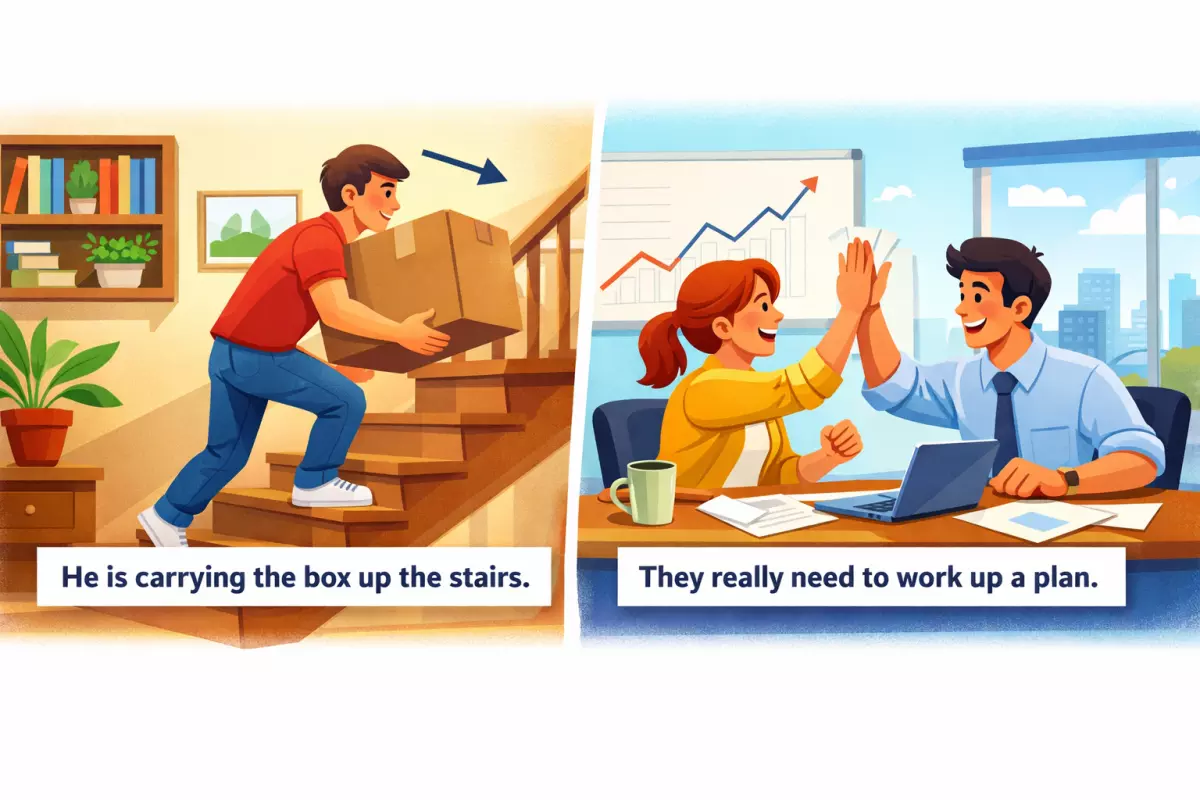
Verb + particle combinations often start with a concrete, physical sense (movement, position, direction) and then develop a figurative sense that feels less predictable. A useful habit is to ask: “Is the particle describing a real spatial action, or is it signaling a more abstract result like completion, separation, or a change of state?”
How to tell when the meaning is still concrete
In more literal uses, the particle keeps its core spatial idea. You can usually picture the action, and the object is often a physical thing that can move, open, close, or change location.
- up = toward a higher position: “pick up the box,” “climb up the stairs.”
- down = toward a lower position: “sit down,” “push down the lid.”
- in / into = entering a space: “walk in,” “put the keys in the drawer.”
- out = leaving a space: “step out,” “take the trash out.”
- on = contact/attachment: “put on a jacket,” “stick on a label.”
- off = separation/removal: “take off the cap,” “peel off the sticker.”
- over = across/covering: “jump over the puddle,” “spread a sheet over the table.”
- through = from start to end inside something: “walk through the tunnel,” “read through the report” (often borderline literal/extended).
Common pathways into figurative meanings
When the combination becomes idiomatic, the particle often stops being about physical direction and starts marking an outcome. These are recurring patterns that explain many “surprising” meanings.
- Completion / finishing (often with up, off, through)
- “use up” = consume completely (not “use upward”).
- “finish off” = complete the last part, often decisively.
- “see through” = continue until the end (“see the project through”).
- Increase / intensify (often with up)
- “speed up” = become faster.
- “heat up” = become hotter.
- “tighten up” = become stricter or more controlled.
- Decrease / reduce (often with down)
- “calm down” = become less agitated.
- “cut down” = reduce quantity.
- “slow down” = reduce speed.
- Separation / cancellation (often with off, out)
- “call off” = cancel (an event/plan).
- “write off” = decide something is a loss or not worth pursuing.
- “rule out” = eliminate a possibility.
- Discovery / appearance (often with out)
- “find out” = discover information.
- “turn out” = be discovered to be; result in (“It turned out fine”).
- “come out” = become public or visible (news, truth, a product release).
- Starting / continuing (often with on)
- “carry on” = continue.
- “move on” = proceed to the next topic/stage.
- “go on” = continue; also “happen” in some contexts (“What’s going on?”).
- Recovery / return (often with back)
- “get back” = return; also regain something (“get your money back”).
- “bounce back” = recover after difficulty.
- “pay back” = repay.
Pairs that show the shift clearly
These examples are useful because the same verb + particle can be literal in one sentence and idiomatic in another. Notice how the object type and context push the interpretation.
- take off
- Concrete: “Take off your shoes.”
- Figurative: “The business took off.” (started succeeding quickly)
- pick up
- Concrete: “Pick up the pen.”
- Figurative: “Pick up Spanish quickly.” (learn informally)
- put down
- Concrete: “Put down the glass.”
- Figurative: “Don’t put him down.” (insult/criticize)
- turn down
- Concrete: “Turn down the volume.”
- Figurative: “Turn down the offer.” (reject)
- break down
- Concrete: “Break the box down.” (take apart)
- Figurative: “The car broke down.” (stopped working)
- Figurative: “Break down the argument.” (analyze into parts)
- work out
- Concrete: “Work out at the gym.”
- Figurative: “It worked out.” (ended well)
- Figurative: “Work out the total.” (calculate/solve)
Usage clues that predict an idiomatic reading
- Abstract objects often trigger figurative meaning: “figure out a plan,” “carry out an investigation,” “set up a meeting.”
- Result-focused contexts lean idiomatic: deadlines, decisions, success/failure (“pull off a deal,” “fall through”).
- Fixed collocations behave like single vocabulary items: “run into trouble,” “look after someone,” “come across as rude.”
- Pronoun placement can signal a phrasal verb unit in separable forms: “turn it down,” “pick them up” (not “turn down it”).
- Stress and rhythm in speech often treat the combination as one chunk, especially in common idioms (helpful for listening even when the meaning is not literal).
Word order and pronoun placement overview
With verb + particle combinations (often called phrasal verbs), word order depends mainly on two things: whether the verb takes an object, and whether the particle can “move” (separable) or must stay next to the verb (inseparable). Pronouns add an extra rule: when movement is possible, pronouns usually go between the verb and the particle.
Core patterns to remember
- Intransitive (no object): verb + particle stays together because there is no object to place.
- ✅ The plane took off.
- Transitive + separable: you can place the object after the particle or between verb and particle (noun objects allow both).
- ✅ She turned off the light.
- ✅ She turned the light off.
- Transitive + inseparable: the object must come after the particle; you cannot split the verb and particle.
- ✅ We ran into an old friend.
- ❌ We ran an old friend into.
- Pronoun object with separable verbs: pronouns go in the middle (verb + pronoun + particle).
- ✅ She turned it off.
- ❌ She turned off it.
Common placement rules (with quick examples)
- If the object is a pronoun (it, them, him, her, us): place it between verb and particle when splitting is allowed.
- ✅ I picked them up.
- ❌ I picked up them.
- If the object is a short noun: both positions can work with separable pairs; choice often depends on rhythm or emphasis.
- ✅ Please put on your coat.
- ✅ Please put your coat on.
- If the object is long/heavy: speakers often prefer verb + particle + object to avoid splitting a long noun phrase.
- ✅ She put off the meeting with the regional managers until next week.
- ✅ (Less natural) She put the meeting with the regional managers off until next week.
- If the particle is followed by its own complement (common with “away,” “out,” “up” in some uses): keeping verb + particle together can sound cleaner.
- ✅ They worked out a plan for the launch.
- With inseparable combinations: pronouns do not “force” splitting; they still follow the particle.
- ✅ I looked after her.
- ❌ I looked her after.
High-utility examples (patterns you can reuse)
- Separable, noun object either position: ✅ take off your shoes / take your shoes off
- Separable, pronoun must be mid-position: ✅ take them off → ❌ take off them
- Separable, noun object either position: ✅ bring back the file / bring the file back
- Separable, pronoun must be mid-position: ✅ bring it back
- Separable, noun object either position: ✅ hand in the form / hand the form in
- Separable, pronoun must be mid-position: ✅ hand it in
- Separable, noun object either position: ✅ set up a meeting / set a meeting up
- Separable, pronoun must be mid-position: ✅ set it up
- Inseparable, object must follow particle: ✅ get over the flu (not: get the flu over)
- Inseparable, object must follow particle: ✅ run into them (not: run them into, in this meaning)
- Inseparable, object must follow particle: ✅ look into it (not: look it into)
- Inseparable, object must follow particle: ✅ come across a photo (not: come a photo across)
- Inseparable, object must follow particle: ✅ deal with it (not: deal it with)
- Intransitive, no object: ✅ show up late
- Intransitive, no object: ✅ calm down quickly
When meaning shifts, the grammar rules above usually stay the same: what changes is which verb + particle pairing you choose and whether that pairing is separable in that particular sense. If you learn each combination with its object pattern (no object, separable object, or inseparable object), pronoun placement becomes predictable.
Typical learner mistakes
Errors with verb–particle combinations usually come from treating the particle as “extra” or assuming it keeps one fixed meaning. In practice, the particle often changes the direction, completeness, intensity, or even the whole sense of the verb, so small form choices create big meaning changes.
1) Assuming the base verb meaning stays the same
Learners often translate word-for-word from the main verb and ignore the shift created by the particle. This leads to sentences that are grammatical but communicate the wrong idea.
- ❌ “I will look up the street.” (often means “search for information”) → ✅ “I will look up the word.” / “I will look along the street.”
- ❌ “She gave up the kids at school.” (means “quit/stop”) → ✅ “She dropped off the kids at school.”
- ❌ “He ran into the report.” (suggests an accidental meeting) → ✅ “He read through the report.”
- ❌ “Please take off the meeting to Monday.” → ✅ “Please move the meeting to Monday.” / “Please put off the meeting.”
2) Mixing up particles that signal different meaning patterns
Some particles commonly signal “completion” (up), “continuation” (on), “separation/removal” (off), “return/response” (back), or “descent/reduction” (down). Confusing them can flip the message.
- ❌ “Can you turn up the TV?” (means increase volume) when you want lower volume → ✅ “Can you turn down the TV?”
- ❌ “Let’s carry off.” (sounds like removing/stealing) → ✅ “Let’s carry on.”
- ❌ “I’ll write down you later.” → ✅ “I’ll write back later.”
- ❌ “Please cut up the noise.” (cut up = chop into pieces) → ✅ “Please cut down the noise.”
- ❌ “He broke up the computer.” (break up = separate into parts / end a relationship) → ✅ “He broke down the computer.” (if it stopped working) / “He took apart the computer.”
3) Getting word order wrong with separable phrasal verbs
With many transitive combinations, the object can go between verb and particle, but pronouns almost always must go in the middle. Placing the pronoun after the particle is a frequent, noticeable mistake.
- ❌ “Turn off it.” → ✅ “Turn it off.”
- ❌ “Pick up them.” → ✅ “Pick them up.”
- ❌ “Put away it.” → ✅ “Put it away.”
- ❌ “Hand in it tomorrow.” → ✅ “Hand it in tomorrow.”
- ❌ “Figure out it.” → ✅ “Figure it out.”
4) Treating inseparable combinations as separable
Some verb–particle units do not allow the object in the middle. Splitting them sounds unnatural or can become confusing.
- ❌ “She ran her old teacher into.” → ✅ “She ran into her old teacher.”
- ❌ “We looked the issue into.” → ✅ “We looked into the issue.”
- ❌ “He got the flu over quickly.” → ✅ “He got over the flu quickly.”
- ❌ “They came a solution up with.” → ✅ “They came up with a solution.”
5) Using the wrong register (too informal or too formal)
Many phrasal verbs are neutral in everyday speech, but some sound casual in formal writing. Learners sometimes use them in academic or business contexts where a single-word verb is expected, or avoid them so much that the text becomes stiff.
- Overly casual in a report: “The team messed up the schedule.” → More formal: “The team disrupted the schedule.” / “The schedule was mismanaged.”
- Overly formal in conversation: “I will investigate this.” → More natural: “I’ll look into it.”
- Job emails: “Can you sort out the invoice?” (often fine) but “Can you fix up the contract?” may sound too casual → “Can you revise the contract?”
6) Confusing literal vs. idiomatic readings
Many combinations have both a physical meaning and an idiomatic one. Context usually decides, but learners may pick the wrong interpretation and produce odd collocations.
- “Take off” = remove clothing / leave the ground / become successful; mixing these can cause ambiguity.
- “Put down” = place on a surface / insult / euthanize; using it with people can sound harsh if you mean “write.”
- “Bring up” = raise a child / mention a topic; “bring up a problem” is fine, but “bring up the stairs” is literal and needs a physical object.
- “Work out” = exercise / find a solution; “work out the answer” (solve) vs “work out at the gym” (exercise).
7) Choosing a particle that clashes with the intended aspect
Particles often encode whether an action is completed, repeated, or ongoing. A common pattern is using “on” when you mean “finish,” or “up” when you mean “continue.”
- ❌ “I’ll read on the article tonight.” (continue reading) when you mean finish → ✅ “I’ll finish the article tonight.” / “I’ll read through the article tonight.”
- ❌ “Let’s eat on the cake.” (continue) when you mean consume completely → ✅ “Let’s eat up the cake.”
- ❌ “She cleaned on the kitchen.” → ✅ “She kept cleaning.” / “She cleaned up the kitchen.”
8) Overgeneralizing one “rule” across all verbs
Even when particles have common tendencies, each combination has its own meaning and constraints. Learners sometimes apply a pattern too widely, creating forms that native speakers do not use.
- Assuming “up” always means “finish”: “sleep up,” “arrive up,” “know up” (not standard).
- Assuming “out” always means “remove”: “explain out” (not standard) instead of “explain” or “spell out” (specific meaning).
- Assuming every verb can take “back” for “return”: “return back” is often redundant; prefer “return” or “go back,” depending on structure.
Homework: verb + particle practice tasks
Focus on how the particle changes the base verb’s meaning (direction, completion, separation, continuation, or social interaction). Work through the tasks in order: start with meaning, then move to form (object position, pronouns), and finish with short production.
1) Choose the best particle
Complete each sentence with one particle: up, out, off, on, in, down, away, back. Use each particle at least once.
- I need to look ___ the train times before we leave.
- They turned ___ the offer because the pay was too low.
- Please write ___ your password somewhere safe.
- The meeting was canceled, so we called it ___.
- She carried ___ working even when the software crashed.
- Can you fill ___ this form and sign at the bottom?
- He ran ___ of coffee, so he went to the shop.
- Let’s cut ___ on sugar for a week and see how you feel.
- The plane took ___ on time despite the rain.
- I’ll drop ___ later if you’re free.
- They sorted ___ the problem by restarting the server.
- She gave ___ smoking last year.
Show answers
- up
- down
- down
- off
- on
- in
- out
- down
- off
- by
- out
- up
Note: #10 is commonly “drop by.” If you are limiting yourself to the particle list given, treat “by” as the needed particle for that item.
2) Decide: literal or meaning shift?
Label each phrasal verb use as (A) mostly literal movement/direction or (B) idiomatic/abstract meaning. Then write a short meaning paraphrase.
- She sat down near the window.
- He set up a new account for the project.
- We walked out of the building quietly.
- They worked out a solution together.
- I looked after my niece all weekend.
- The lights went out during the storm.
- She put off the appointment until Friday.
- He came back at midnight.
- Please hand in your assignment by noon.
- We ran into an old friend at the station.
Show answers
- A — moved into a sitting position
- B — created/arranged; established
- A — exited by walking
- B — found/solved (by thinking or calculating)
- B — took care of
- B — stopped working; became dark
- B — postponed
- A — returned (movement back)
- B — submitted (to an authority/system)
- B — met unexpectedly
3) Object position practice (separable vs. inseparable)
Rewrite each sentence in the second form. Pay attention to pronouns: when a separable verb takes a pronoun object, the pronoun goes between verb and particle.
- Rewrite with a pronoun: “Turn off the TV.” → “Turn ___ ___.”
- Rewrite with the object after the particle: “She looked up the word.” → “She looked ___ ___.”
- Rewrite with the object between verb and particle: “They picked up the package.” → “They picked ___ ___.”
- Rewrite with a pronoun: “Please fill in the form.” → “Please fill ___ ___.”
- Keep the object after the particle (inseparable): “We ran into our teacher.” → “We ran into ___.”
- Keep the object after the particle (inseparable): “She looked after the kids.” → “She looked after ___.”
- Rewrite with a pronoun: “I’ll put off the meeting.” → “I’ll put ___ ___.”
- Rewrite with the object after the particle: “He turned down the offer.” → “He turned ___ ___.”
Show answers
- it off
- up the word
- the package up
- it in
- our teacher / her / him (object stays after “into”)
- them (object stays after “after”)
- it off
- down the offer
4) Match the pattern to the meaning shift
For each item, choose the best meaning category: (1) completion, (2) continuation, (3) reduction, (4) separation/removal, (5) discovery/appearance, (6) rejection, (7) submission/transfer, (8) increase/improvement.
- eat up
- carry on
- cut down (on)
- take off (clothes)
- find out
- turn down
- hand in
- speed up
- use up
- keep on
- tear off
- work out (an answer)
Show answers
- 1
- 2
- 3
- 4
- 5
- 6
- 7
- 8
- 1
- 2
- 4
- 5
5) Production: short writing with constraints
Write 8–10 sentences about a normal week (work, study, home tasks). Include exactly one example of each pattern below. Keep tense consistent.
- One separable verb with a noun object placed between verb and particle (e.g., “pick the kids up”).
- One separable verb with a pronoun object (e.g., “turn it off”).
- One inseparable verb + object (e.g., “run into someone,” “look after someone”).
- One “up” verb showing completion (e.g., “use up,” “finish up”).
- One “out” verb showing discovery or resolution (e.g., “find out,” “sort out”).
- One “down” verb showing reduction or rejection (e.g., “cut down,” “turn down”).
- One “on” verb showing continuation (e.g., “carry on,” “keep on”).
- One “off” verb showing separation/ending (e.g., “take off,” “call off”).
Self-check before you submit: confirm object placement is correct, confirm the particle matches the intended meaning shift, and confirm you did not overuse one particle (especially “up”) when another particle expresses the meaning more precisely.