Fixed Verb Expressions and Common Patterns

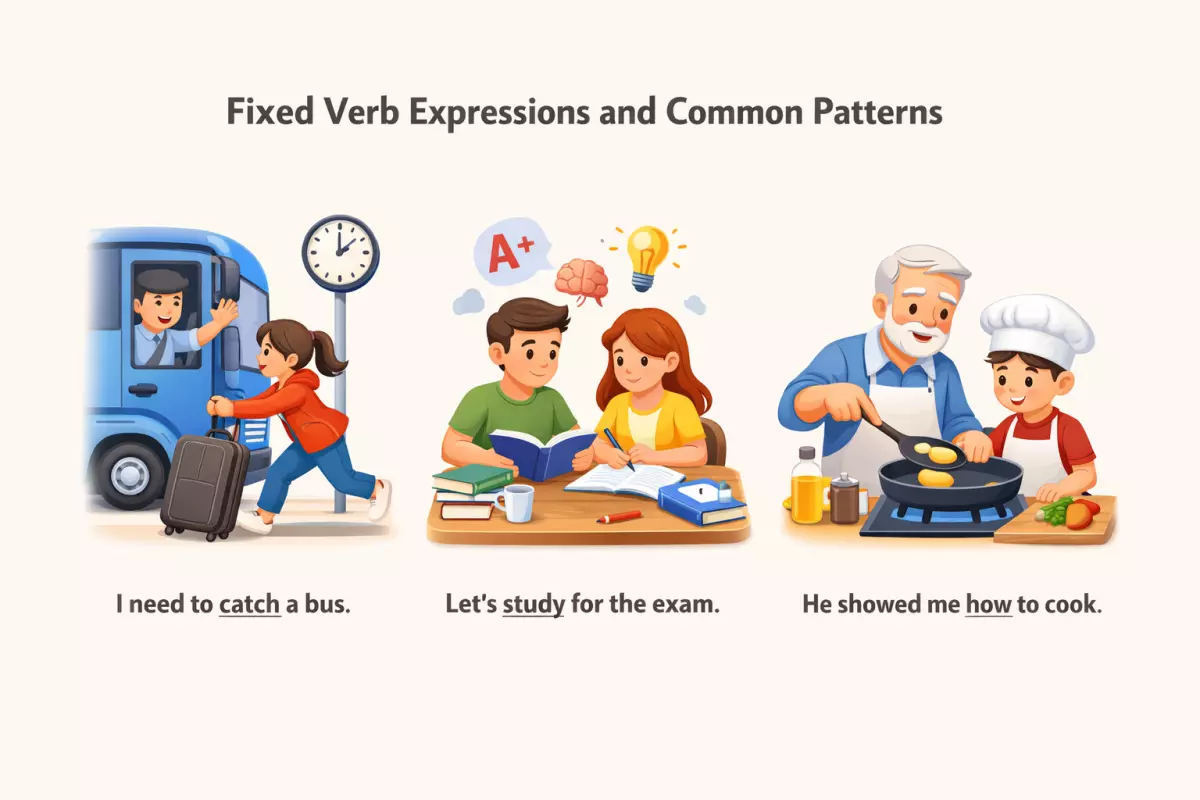 This article explains what fixed verb expressions are, shows common everyday patterns, and focuses on set phrases with do, make, have, and take. It breaks down the grammar inside them, compares informal vs formal options, flags common learner mistakes with fixes, and ends with study tips plus homework practice tasks.
- What fixed verb expressions are
- Common fixed patterns in everyday English
- Fixed expressions with do, make, have, take
- Grammar patterns inside fixed expressions
- Register: informal vs formal fixed phrases
- Common learner mistakes and corrections
- How to learn fixed expressions efficiently
- Homework: fixed expression practice tasks
Everyday English depends on common verb phrases and familiar patterns that native speakers use automatically. Learning these chunks as complete units helps you speak and write more smoothly, with fewer pauses and less awkward wording. In real conversations, people often say take a look, make a decision, or run out of time. To sound natural, notice how these combinations work in context and practice them until they feel automatic.
What fixed verb expressions are
Fixed verb expressions are multi-word verb units that speakers treat as a single, familiar chunk. They often look like ordinary verb + object or verb + preposition combinations, but the wording is partly “locked in,” and the overall meaning or grammar is not fully predictable from the individual words.
How they behave in real sentences
The key feature is stability: you can usually change tense, aspect, or subject, but you cannot freely swap the verb, preposition, or noun without sounding unnatural or changing the meaning. Many of these chunks also carry a conventional meaning (sometimes literal, sometimes idiomatic), so learners get better results by learning the whole pattern rather than translating word by word.
- They function as one unit: the phrase acts like a single verb choice in a sentence, even though it contains multiple words.
- They allow limited variation: you can often change tense/person (e.g., “take” → “took” → “has taken”), but the core wording stays the same.
- They have preferred grammar: some require a particular preposition, object type, or clause pattern, and alternatives may be incorrect or uncommon.
- They can be literal or idiomatic: some are transparent (“make a decision”), while others are meaning-based conventions (“take part” = participate).
- They are frequent in everyday English: using them improves naturalness because native speakers rely on ready-made combinations.
Common structural patterns
These expressions show up in a few repeating shapes. Recognizing the shape helps you predict what can change and what usually cannot.
- Verb + noun (light-verb patterns): a general verb carries grammar, and the noun carries the main meaning (e.g., “make” + decision).
- Verb + preposition: the preposition is part of the pattern and is typically not interchangeable (e.g., “depend on,” not “depend of”).
- Verb + noun + preposition: a fixed noun phrase plus a required preposition (e.g., “take responsibility for”).
- Verb + particle (phrasal verbs): the particle changes meaning and may affect word order (e.g., “turn down” a request).
- Verb + complement clause: certain verbs prefer a specific clause type (e.g., “decide to” + verb; “suggest” + -ing or that-clause).
Examples worth learning as whole chunks
Below are common, useful combinations. Notice that the verb can change form, but the pairing itself is the part to memorize.
- make a decision
- take a break
- have a look
- give someone a hand
- pay attention (to)
- take part (in)
- keep in mind
- set an example
- raise a question
- meet a deadline
- reach an agreement
- make an effort
- take responsibility for
- depend on
- apologize for
- complain about
- look forward to
- run out of
What to watch for when using them
- Preposition choice: learn it as part of the unit (✅ “rely on” ❌ “rely in”).
- Article and number: some prefer a/an or a plural noun (✅ “make an effort” ❌ “make effort” in most contexts).
- Verb choice is not freely replaceable: “do a decision” is not the usual pairing; “make a decision” is.
- Object placement in phrasal verbs: some allow “turn it down” vs. “turn down the offer,” while others do not.
Common fixed patterns in everyday English
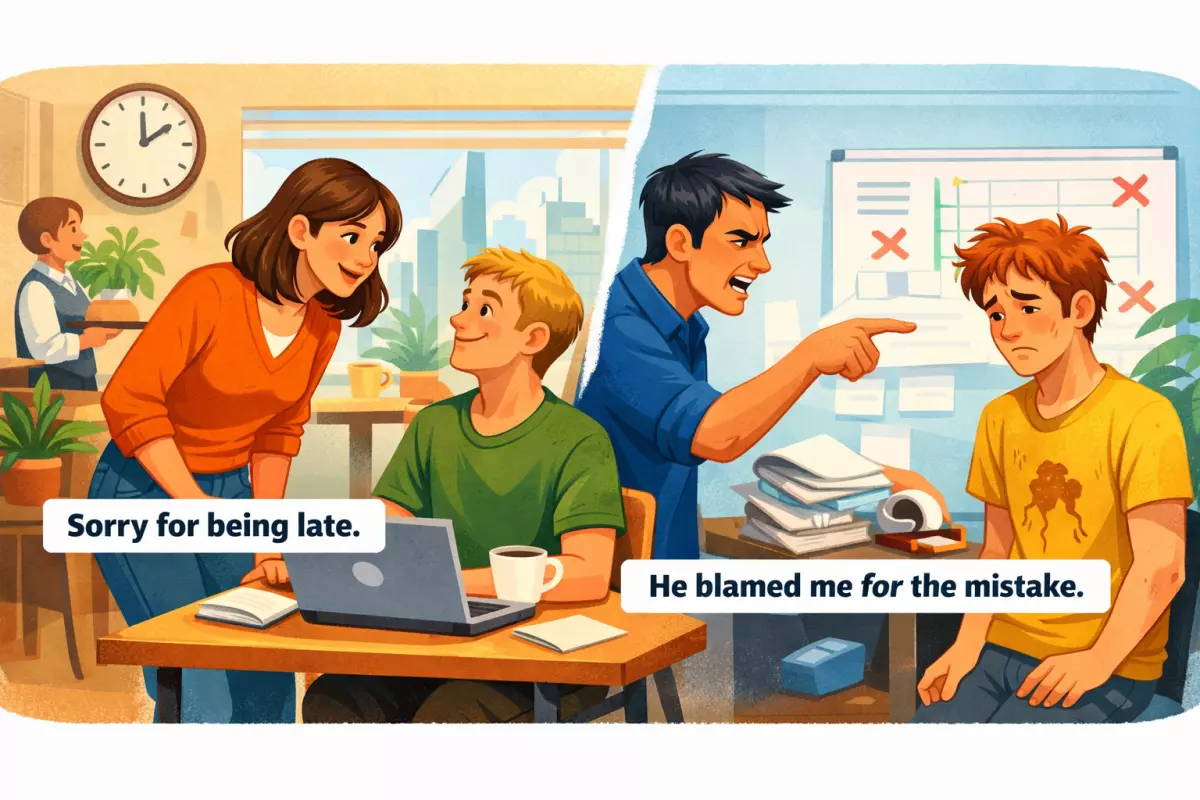
Many everyday verb phrases follow set shapes that speakers reuse with little variation. Learning the pattern (not just the individual words) helps you choose the right preposition, object type, and word order, especially in fast conversation.
High-frequency fixed patterns (with examples)
- Verb + preposition + noun/gerund:
✅ depend on something; apologize for being late; insist on paying; belong to someone - Verb + object + preposition:
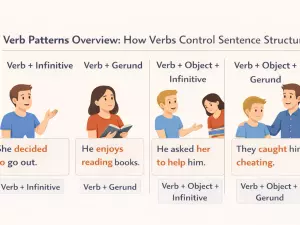
✅ remind someone of something; blame someone for something; accuse someone of something; protect someone from something - Verb + infinitive (to + base verb):
✅ decide to leave; agree to help; refuse to answer; manage to finish - Verb + gerund (-ing):
✅ avoid talking; consider moving; finish eating; keep trying - Verb + that-clause:
✅ think that it’s true; hope that you understand; suggest that we start; promise that I’ll call - Verb + wh-clause:
✅ know what to do; remember where you parked; explain how it works; wonder why she left - Verb + object + infinitive:
✅ need you to listen; want him to come; expect them to arrive; tell me to wait - Verb + object + bare infinitive (no “to”):
✅ make me wait; let her go; help him carry it (also possible: help him to carry) - Verb + object + adjective:
✅ keep it simple; make it clear; find it useful; leave the door open - Verb + object + noun (role/label):
✅ call it a mistake; name her manager; consider him a friend; elect her president - Verb + “it” (dummy object) + adjective + to-clause:
✅ find it hard to focus; make it easy to follow; think it important to respond - Verb + particle (phrasal verb) + object position changes:
✅ turn off the light / turn the light off; pick up the phone / pick the phone up
❌ turn off it → ✅ turn it off - Verb + preposition + time/place phrase:
✅ arrive at 6; arrive in London; stay at a hotel; live in a city; get to work - Verb + “from…to…” change pattern:
✅ change from A to B; switch from coffee to tea; move from sales to marketing - Verb + “as” for roles and functions:
✅ work as a teacher; serve as evidence; use it as a backup; treat it as a priority
Usage notes that prevent common errors
- Prepositions are often fixed: you usually say depend on, not depend of; apologize for, not apologize about (unless you mean the topic in a broader sense).
- Gerund vs. infinitive is pattern-based: avoid + -ing is standard, while decide + to is standard. When both are possible, meaning can change (for example, stop to do vs. stop doing).
- Pronouns affect phrasal verb word order: with many separable phrasal verbs, pronouns go in the middle (✅ pick it up), while full nouns can go either position (✅ pick up the package / pick the package up).
- “Make/let/help” take a different infinitive form: make/let + object + base verb is the usual structure; help allows both forms in modern usage.
Fixed expressions with do, make, have, take
Many everyday actions in English are expressed with a “light verb” plus a noun, rather than a single strong verb. The verb carries tense and grammar, while the noun carries most of the meaning. Learning these chunks as complete units helps you sound natural and avoid odd combinations.
Core pattern and quick usage rules
- Structure: verb + noun phrase (often with a/an/the or a possessive): make a decision, take a break, have a look, do homework.
- Collocation matters: you usually can’t swap the verbs freely. For example, ✅ make a mistake but ❌ do a mistake.
- Tense and aspect sit on the verb: made a complaint, is making progress, have taken notes.
- Articles vary by expression: ✅ do homework (no article) vs. ✅ do a job (article needed).
- Pronouns go before the noun in some patterns: take it easy, make it clear (fixed “it” constructions).
Common expressions with do
- do homework
- do housework
- do the dishes
- do the laundry
- do the shopping
- do exercise / do some exercise
- do research
- do a course
- do a test / do an exam
- do your best
- do someone a favor
- do business
Common expressions with make
- make a decision
- make a plan
- make an appointment
- make a suggestion
- make a complaint
- make a mistake
- make progress
- make an effort
- make money
- make a promise
- make a difference
- make friends
Common expressions with have
- have breakfast / have lunch / have dinner
- have a snack
- have a drink
- have a conversation
- have a meeting
- have an argument
- have a look
- have a rest
- have a shower / have a bath
- have a problem
- have an idea
- have time / have no time
Common expressions with take
- take a break
- take a seat
- take a look
- take a chance
- take notes
- take a photo
- take a trip / take a journey
- take a shower (also common in some varieties of English)
- take responsibility
- take action
- take part (in something)
- take care (of someone/something)
Choosing the right verb: meaning tendencies
- do often groups tasks, work, and routines: do paperwork, do the cleaning.
- make commonly signals creating, producing, or causing a result: make a change, make a mess.
- have frequently introduces experiences and activities (meals, talks, events): have a chat, have a good time.
- take often suggests “getting/using” time or an opportunity, or performing a short action: take a moment, take a step.
Common learner errors to avoid
- ✅ make a decision → ❌ do a decision
- ✅ do homework → ❌ make homework
- ✅ take a break → ❌ have a break (possible in some contexts, but less standard in many varieties)
- ✅ have a look → ❌ do a look
- ✅ make progress → ❌ do progress
Grammar patterns inside fixed expressions
Many fixed verb expressions follow predictable grammatical “frames,” even when the overall meaning is idiomatic. Learning the frame helps you choose the right object, preposition, and verb form, and it also makes it easier to spot what cannot be changed without sounding unnatural.
Common frames and how they behave
- Verb + noun (often with a light verb): the verb carries little meaning and the noun does the heavy lifting. Examples: make a decision, take a break, have a look, give a sigh, pay attention. These often allow tense changes (made, took, has had) but resist swapping the noun for a near-synonym (e.g., make a decision is natural; make a choice is possible but not always interchangeable in tone or context).
- Verb + object + preposition: the preposition is usually fixed. Examples: put pressure on someone, take advantage of something, keep an eye on something, hold someone responsible for something. Changing the preposition often breaks the expression (❌ take advantage from → ✅ take advantage of).
- Verb + preposition + noun (prepositional verb): the verb “selects” its preposition. Examples: rely on, deal with, run into, look after, come across. These typically do not allow the object to move in front of the preposition (❌ rely it on).
- Phrasal verb (verb + particle): the particle (up, out, off, etc.) is part of the unit. Examples: carry on, figure out, put off, set up, break down. Some are separable (put the meeting off / put off the meeting), while others are not (run into an old friend ❌ run an old friend into).
- Verb + -ing clause: the next verb is fixed as a gerund in many set combinations. Examples: can’t help doing, avoid doing, keep doing, risk doing, admit doing. Using an infinitive may sound wrong (❌ avoid to do → ✅ avoid doing).
- Verb + to-infinitive: some fixed patterns require to + verb. Examples: tend to do, manage to do, fail to do, refuse to do, be about to do. These often signal intention, success/failure, or imminence.
- Verb + object + to-infinitive: common with reporting, persuading, and enabling. Examples: tell someone to do, remind someone to do, encourage someone to do, allow someone to do, force someone to do. The object is usually required; dropping it can change meaning or make the phrase incomplete.
- Verb + object + bare infinitive: typical after certain verbs of perception and causation. Examples: make someone do, let someone do, hear someone do, see someone do. Compare: see someone do (whole action) vs. see someone doing (in progress) when the expression allows both.
- Verb + that-clause: frequent in stance and reporting formulas. Examples: make sure (that) …, insist (that) …, suggest (that) …, it turns out (that) …. In some varieties, the subjunctive appears in set contexts (insist that he be), but many speakers use a normal present form (insist that he is) depending on region and formality.
- Fixed “it” as a dummy subject: the pronoun is structural, not referential. Examples: it depends, it turns out, it makes sense, it’s worth doing. These often have limited flexibility: you can add complements, but you usually keep it in place.
- There + be + noun in set announcements: used for existence/availability in routine phrasing. Examples: there’s no point (in), there’s no way (to), there’s a chance (that). The following complement type is often fixed: no point in doing is far more natural than ❌ no point to do in most contexts.
- Comparative or paired structures: the grammar comes as a matched set. Examples: the sooner, the better; more often than not; by and large; one way or another. These are usually learned as whole chunks because word order changes quickly sound unnatural.
- Negative polarity frames: certain items strongly prefer negatives or questions. Examples: don’t have a clue, hardly lift a finger, not give a damn. Using them in a plain affirmative can sound odd or change the meaning.
- Passive-friendly vs. passive-resistant units: some combinations move smoothly into the passive, others rarely do. Examples: be taken into account, be held responsible (common passives) vs. many phrasal verbs that become clunky or ambiguous when passivized in everyday use.
What usually stays fixed (and what can change)
- Usually fixed: the preposition/particle (on in rely on), the core noun in light-verb phrases (attention in pay attention), and the complement type (doing vs. to do).
- Often changeable: tense and aspect (take / took / have taken), pronouns and determiners (keep an eye on → keep your eye on in context), and modifiers that fit the meaning (make a quick decision).
- Change with caution: pluralizing the noun (take responsibility vs. take responsibilities), swapping synonyms (make a decision vs. do a decision ❌), and moving objects in phrasal verbs (separable vs. inseparable behavior).
When you learn a fixed expression, learn it with its frame: the preposition, the typical object type, and the complement form. That frame is what keeps your usage natural even as you vary tense, subject, or details.
Register: informal vs formal fixed phrases
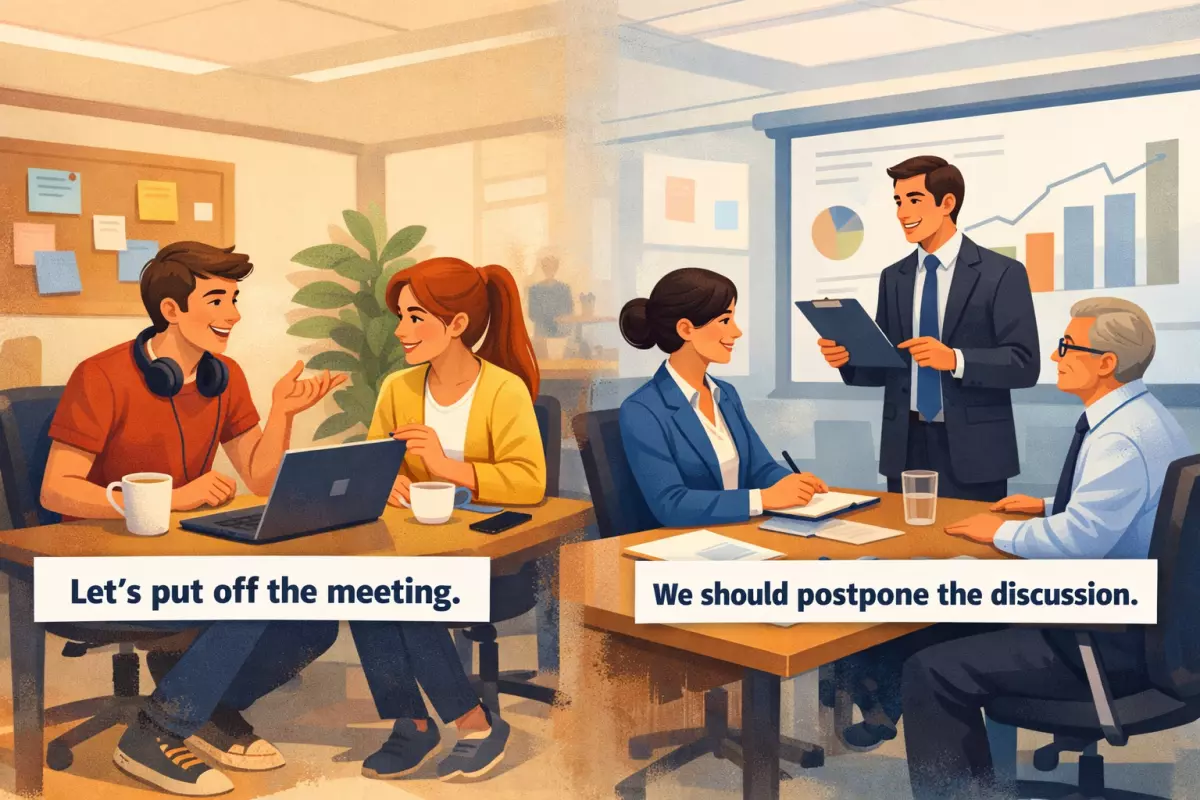
Many fixed verb expressions are tied to a level of formality. The same basic meaning can be expressed with a casual set phrase (common in speech and friendly messages) or a more formal one (common in emails, reports, and meetings). Choosing the right option helps your tone sound natural and avoids seeming too blunt, too chatty, or overly stiff.
How fixed phrases signal formality
- Verb choice: informal phrases often use short, common verbs (get, put, make), while formal ones prefer Latinate verbs (obtain, submit, arrange).
- Particles and phrasal verbs: “put off,” “bring up,” “look into” are normal in everyday English; formal alternatives often avoid particles (“postpone,” “raise,” “investigate”).
- Directness: casual fixed expressions can be more direct (“Can you send it over?”). Formal phrasing often softens requests (“Could you forward it at your earliest convenience?”).
- Set openings/closings: business writing uses conventional frames (“Please find attached…,” “I would like to…”), while conversation uses shorter patterns (“Here it is,” “Just wanted to…”).
Common informal fixed expressions (and when they fit)
- “Can you give me a hand?” (asking for help; friendly, spoken)
- “I’ll get back to you.” (promising a reply; neutral-informal)
- “Let me know.” (inviting a response; casual but widely acceptable)
- “Hang on a second.” (asking someone to wait; spoken)
- “I’m just checking in.” (following up; common in quick emails/messages)
- “Thanks for the heads-up.” (thanking for advance notice; informal)
- “That works for me.” (agreeing to a plan; conversational)
- “No worries.” (reassuring; informal, not ideal for serious situations)
- “I’ll sort it out.” (handling a problem; informal)
- “Let’s call it a day.” (ending work; spoken, team context)
- “We’re running into an issue.” (problem appears; neutral-informal)
- “Can we push it back?” (delay a meeting/deadline; casual)
Common formal fixed expressions (and when they fit)
- “I would like to request…” (formal requests; emails, letters)
- “Please be advised that…” (official notices; careful tone)
- “For your consideration…” (submitting ideas/documents)
- “I am writing to inform you…” (formal announcements)
- “Please find attached…” (sending files; standard business phrase)
- “At your earliest convenience” (polite timing; avoid if you need urgency)
- “We regret to inform you…” (bad news; formal and conventional)
- “Should you have any questions…” (formal closing; customer-facing)
- “We appreciate your cooperation.” (polite compliance request)
- “In accordance with…” (rules, policies, contracts)
- “This matter will be addressed…” (formal commitment; careful wording)
- “Further to our conversation…” (follow-up referencing prior talk)
Practical pattern swaps (keep meaning, change tone)
- ✅ “Can you send it over?” → “Could you forward it?”
- ✅ “I’ll look into it.” → “I will investigate the issue.”
- ✅ “Let’s put it off.” → “Let’s postpone it.”
- ✅ “Can you bring it up in the meeting?” → “Could you raise this in the meeting?”
- ✅ “We ran out of time.” → “We were unable to complete this within the allotted time.”
- ✅ “I’ll follow up tomorrow.” → “I will contact you again tomorrow.”
- ❌ “Please get back to me ASAP.” (can sound abrupt) → ✅ “Could you reply by [time/date]?”
When you learn fixed verb expressions, learn the typical setting with them: who says it, in what channel (speech, chat, email), and how direct it feels. A good rule is to keep informal set phrases for familiar contexts, and switch to more standard, conventional wording when the relationship is new, the topic is sensitive, or the message is part of a record.
Common learner mistakes and corrections
Fixed verb expressions often go wrong in predictable ways: learners swap a preposition, change an article, pick the wrong verb, or try to “build” the phrase logically. The key is to learn the chunk (verb + object + preposition) as a single pattern and then adjust tense, person, or time words around it.
1) Preposition swaps (the most frequent issue)
- ❌ depend of → ✅ depend on (depend on something/someone)
- ❌ married with → ✅ married to (be married to a person)
- ❌ discuss about → ✅ discuss (no preposition: discuss a topic)
- ❌ explain me → ✅ explain to me (explain something to someone)
- ❌ listen music → ✅ listen to music (listen to + noun)
- ❌ arrive to (general) → ✅ arrive at (places) / arrive in (cities/countries)
- ❌ responsible of → ✅ responsible for (responsible for a task/result)
- ❌ interested on → ✅ interested in (interested in + topic/activity)
- ❌ good in (skills) → ✅ good at (good at tennis/coding)
- ❌ apply in a job → ✅ apply for a job (apply for + position)
- ❌ ask to someone (when it means “request information”) → ✅ ask someone (ask someone a question)
- ❌ enter to the room → ✅ enter the room (enter is usually direct)
2) Using the wrong verb because the phrase “sounds logical”
- ❌ make a photo → ✅ take a photo
- ❌ do a mistake → ✅ make a mistake
- ❌ give an exam (meaning “sit the exam”) → ✅ take an exam (students take; teachers give)
- ❌ say me → ✅ tell me (tell + person + message)
- ❌ borrow me → ✅ lend me (lend to someone; borrow from someone)
- ❌ put attention → ✅ pay attention
- ❌ make sports → ✅ do sport / play a sport (play tennis; do sport in general)
- ❌ open the light → ✅ turn on the light
3) Breaking fixed patterns by changing articles or word order
- ❌ in the other hand → ✅ on the other hand
- ❌ by the way of (when you mean “incidentally”) → ✅ by the way
- ❌ at the end (meaning “finally”) → ✅ in the end (at the end = at the final part of something)
- ❌ make a party (meaning “organize”) → ✅ have a party (or throw a party for organize)
- ❌ do a decision → ✅ make a decision
- ❌ take a rest (not wrong, but less natural in many contexts) → ✅ have a rest / take a break
4) Confusing similar-looking expressions (meaning changes)
- look for = search; look at = direct your eyes; look after = take care of
- hear about = receive news; hear from = get a message/call from someone
- think about = consider; think of = produce an idea/remember (“think of a name”)
- work on = develop/improve; work for = be employed by; work as = job role
- agree with = share an opinion; agree to = accept a plan/offer
- wait for = wait until something arrives; wait to (rare) usually needs a verb (“wait to see”)
5) Grammar around the chunk: tense changes are fine; the core pattern stays
- Keep the expression intact and only change the verb form: take care of → takes care of / took care of / will take care of.
- Don’t insert extra words inside a set phrase: ❌ pay carefully attention → ✅ pay close attention or pay attention carefully.
- Watch verb + -ing patterns: ❌ avoid to do → ✅ avoid doing; ❌ suggest to go → ✅ suggest going.
- Watch verb + infinitive patterns: ❌ decide going → ✅ decide to go; ❌ promise doing → ✅ promise to do.
When you learn a new verb expression, record it with a short model sentence and the “slot” it needs (object, preposition, or -ing/to-infinitive). That makes the expression easier to reproduce accurately in new contexts.
How to learn fixed expressions efficiently
Progress with set phrases comes from noticing which words “stick together” and practicing them as single units. Instead of memorizing long definitions, focus on the typical verb + noun, verb + preposition, and verb + complement patterns, then reuse them in small, repeatable contexts.
1) Learn the chunk, not the individual word
Treat common combinations as one piece of language. This helps you avoid unnatural choices that are grammatically possible but not idiomatic.
- Prefer storing: “make a decision” (not “do a decision”).
- Store the whole frame: “take responsibility for + noun” rather than only “responsibility”.
- Include the “fixed” small words: “depend on”, “apologize for”, “belong to”.
- Learn common complements: “tend to + verb”, “manage to + verb”, “avoid + -ing”.
2) Group expressions by pattern (so practice transfers)
Organizing by structure makes review faster because one pattern can generate many correct sentences.
- Verb + noun: make progress, take notes, pay attention, raise funds, reach an agreement.
- Verb + preposition: rely on, deal with, focus on, run into, look after.
- Verb + object + preposition: provide someone with something, accuse someone of something, remind someone of something.
- Verb + to-infinitive: decide to, refuse to, afford to, fail to, promise to.
- Verb + -ing: avoid doing, consider doing, suggest doing, keep doing, risk doing.
- Verb + clause: admit (that)…, insist (that)…, recommend (that)…
3) Practice with “slots” (controlled variation)
Fixed verb expressions often have one stable core and one changeable slot. Train the slot so you can produce the phrase fluently.
- “take responsibility for X” → for the delay / for the mistake / for the outcome
- “pay attention to X” → to the details / to pronunciation / to safety
- “deal with X” → complaints / pressure / technical issues
- “provide someone with something” → provide customers with updates
- “remind someone to verb” → remind me to call / remind them to submit
4) Use contrast to prevent common errors
Many combinations are learned fastest by pairing the natural form with a typical mistake. Keep the correction short and repeat it in your own sentences.
- ✅ “make a mistake” ❌ “do a mistake”
- ✅ “do homework” ❌ “make homework”
- ✅ “depend on” ❌ “depend of”
- ✅ “interested in” ❌ “interested on”
- ✅ “responsible for” ❌ “responsible of”
- ✅ “married to” ❌ “married with”
5) Build short, repeatable speaking and writing drills
Frequent retrieval beats occasional re-reading. Keep drills brief, but require accurate wording each time.
- Three-sentence drill: write 3 sentences using the same chunk with different nouns (e.g., “reach an agreement” with price/timeline/scope).
- Question-answer drill: ask “What do you rely on?” and answer with “I rely on…” using new objects each time.
- Substitution drill: keep the verb fixed and swap only the object (“take notes” in a meeting/lecture/call).
- Mini-dialogue drill: two lines that force the expression (“We ran into a problem.” / “How did you deal with it?”).
- Editing drill: take a paragraph you wrote and replace general verbs (do/make/get) with more precise collocations where appropriate.
6) Track what’s truly fixed vs. flexible
Some phrases are rigid, while others allow variation. Knowing which part is stable prevents awkward combinations.
- Mostly fixed: “take into account”, “by accident”, “in charge of”, “on purpose”.
- Flexible noun slot: “make + noun” (make a plan/choice/effort), “raise + noun” (raise prices/concerns/awareness).
- Flexible verb choice with meaning shift: “do the dishes” vs. “wash the dishes” (similar), but “make a photo” vs. “take a photo” (not similar).
- Register-sensitive: “put off” (informal) vs. “postpone” (more formal), “find out” vs. “discover”.
7) Maintain a small, high-utility review set
A short list you can recycle weekly leads to more automatic use than a long list you rarely revisit. Prioritize expressions you need for your typical situations (work, study, travel), then expand gradually.
- Keep 15–25 core chunks active at a time; retire items only after you can use them without hesitation.
- Review by pattern (all “verb + preposition” together) to reinforce the structure.
- When you meet a new phrase, record it with one example sentence and one common partner word (e.g., “raise” + “concerns”).
Homework: fixed expression practice tasks
These activities help you notice which verbs “lock in” with particular nouns, prepositions, or structures. Focus on learning the whole chunk (not just the verb), and pay attention to what can and cannot change (article, preposition, verb form, word order).
1) Choose the correct fixed pattern
- We need to (make / do) a decision by noon.
- Can you (give / make) me a hand with these boxes?
- They (took / made) responsibility for the mistake.
- I (did / made) my best, but it wasn’t enough.
- She (paid / gave) attention to the warning signs.
- He (made / did) an effort to arrive on time.
- Let’s (take / do) a break after this section.
- We (had / took) a look at the report together.
- They (made / took) progress faster than expected.
- Please (make / do) sure the door is locked.
Show answers
- make
- give
- took
- did
- paid
- made
- take
- had
- made
- make
2) Preposition check (keep the verb + preposition together)
- I’m looking ___ my keys. (for / at)
- She apologized ___ being late. (for / to)
- We agreed ___ the plan. (on / to)
- He insisted ___ paying. (on / for)
- They complained ___ the noise. (about / for)
- Are you interested ___ joining us? (in / on)
- I’m responsible ___ the schedule. (for / of)
- She succeeded ___ solving the problem. (in / at)
- We’re waiting ___ the results. (for / on)
- He depends ___ his team. (on / of)
- They’re worried ___ the deadline. (about / of)
- Please focus ___ the main point. (on / in)
Show answers
- for
- for
- on
- on
- about
- in
- for
- in
- for
- on
- about
- on
3) Correct the sentence (one change each)
Each line contains one unnatural verb choice, missing preposition, or incorrect structure. Rewrite each sentence so it matches a common pattern.
- ❌ She did a complaint about the service.
- ❌ I suggested him to call you.
- ❌ We discussed about the budget.
- ❌ He explained me the rules.
- ❌ They made me to wait outside.
- ❌ I’m looking forward to meet you.
- ❌ She insisted to pay for dinner.
- ❌ He said me that he was busy.
- ❌ We arrived to the station early.
- ❌ She married with a doctor.
Show answers
- ✅ She made a complaint about the service.
- ✅ I suggested that he call you. / I suggested he call you.
- ✅ We discussed the budget.
- ✅ He explained the rules to me.
- ✅ They made me wait outside.
- ✅ I’m looking forward to meeting you.
- ✅ She insisted on paying for dinner.
- ✅ He told me that he was busy.
- ✅ We arrived at the station early.
- ✅ She married a doctor.
4) Build sentences from chunks (practice flexible grammar inside fixed frames)
Use each prompt to write one natural sentence. Keep the key expression intact, but change tense, subject, or time phrase as needed.
- make up your mind + by tomorrow
- take advantage of + opportunity
- pay attention to + instructions
- have trouble + -ing form
- get used to + -ing form
- be in charge of + project
- take part in + event
- keep an eye on + something
- come to an agreement + with someone
- do someone a favor + this afternoon
5) Pattern notebook (short, repeatable routine)
- Pick 10 expressions you met this week and write them as full frames: verb + object + preposition (if any). Example frame: “insist on + -ing”.
- For each frame, add two “safe” subjects (I/they) and two tenses (past/present) to see what changes without breaking the chunk.
- Underline the fixed parts (preposition, article, noun) and circle the changeable parts (subject, time phrase, adverb).
- Write one negative and one question form for three of the frames to practice word order.
- Read the sentences aloud twice; aim for smooth delivery of the whole unit rather than word-by-word translation.