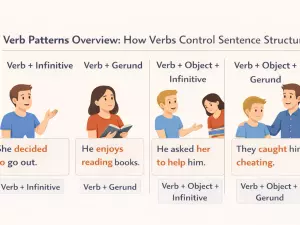
Verb Collocations by Topic and Context

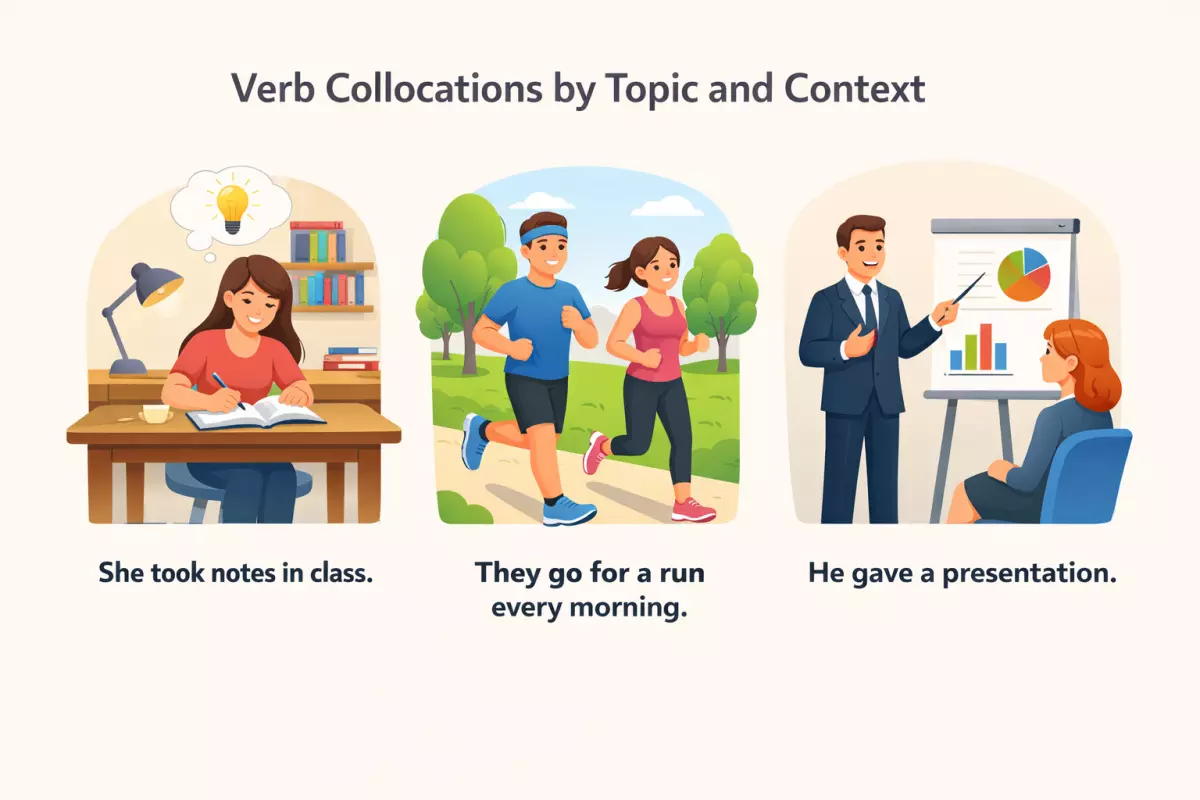 Explains what collocations are and why they matter, then lists verb collocations for everyday topics, work and business, study and research, and travel and services. Shows how to avoid unnatural combinations, fixes common learner errors, and ends with homework practice tasks.
Ever notice how some verbs naturally fit with certain words when you talk about work, travel, or relationships? This is the skill of choosing common verb and noun pairings that match the topic and situation, so your English sounds smooth rather than translated. Here you’ll learn the combinations people actually use in daily life and how to choose the best one for what you mean.
What collocations are and why they matter
Collocations are word partnerships that native speakers use repeatedly because they sound natural together. With verbs, these partnerships often show up as predictable patterns such as verb + noun (make a decision), verb + preposition (depend on), or verb + adverb (strongly recommend). Learning the pattern as a unit helps you choose verbs that fit the situation and avoid combinations that feel “translated.”
Collocations vs. “any correct verb”
Many verb choices are grammatically possible, but only some are typical. Collocations are about usage, not just correctness. A sentence can be accurate in meaning and still sound off if the verb doesn’t match the usual partner.
- ✅ make a mistake → ❌ do a mistake
- ✅ take a break → ❌ make a break (in this meaning)
- ✅ pay attention → ❌ give attention (possible, but different nuance)
- ✅ raise an issue → ❌ lift an issue
- ✅ meet a deadline → ❌ reach a deadline (common in some varieties, but less standard)
Why these patterns matter for topic and context
Verb combinations shift depending on the setting: academic writing, workplace communication, customer service, everyday conversation, or storytelling. Topic-based learning works because the same nouns and situations repeat, so the same verb pairings repeat too. When you store them together, you produce smoother sentences faster.
- Precision: the verb choice signals the exact action (file a complaint vs. make a complaint).
- Register control: some pairings sound formal (conduct research) while others are casual (do research is common in speech).
- Speed and fluency: ready-made chunks reduce hesitation (reach an agreement, draw a conclusion).
- Clarity: familiar pairings are easier for readers to process (pose a question, deliver a presentation).
- Fewer “near-miss” errors: you avoid unnatural combinations even when the grammar is fine (perform a mistake).
Common verb-collocation patterns to notice
Verb collocations aren’t random; they follow recurring structures. Paying attention to the structure helps you learn new examples quickly and reuse them across topics.
- Verb + noun (action/result): make progress, reach a verdict, draw a conclusion, raise funds
- Verb + noun (communication): give a speech, deliver a message, ask a question, lodge a complaint
- Verb + noun (work/management): set priorities, allocate resources, meet targets, run a meeting
- Verb + preposition: depend on, deal with, refer to, approve of, focus on
- Verb + adverb (strength/attitude): strongly recommend, deeply regret, fully understand, clearly state
- Verb + adjective (state/change): become aware, remain calm, grow impatient, fall ill
- Verb + to-infinitive: refuse to comment, tend to happen, fail to notice, agree to meet
- Verb + -ing: avoid making, consider changing, keep trying, risk losing
- Light verb + noun (common in English): take responsibility, have a look, give advice, make an effort
- Fixed or semi-fixed phrases: come to terms with, take into account, keep in mind, bear in mind
How to learn them effectively in a topic-based article
The most useful approach is to learn the verb with its typical partner and a short context. This mirrors how collocations appear in real communication and makes them easier to recall when you need them.
- Record the collocation as a chunk, not as separate words (e.g., “raise concerns,” not just “raise”).
- Add one realistic sentence that matches the topic (workplace, study, travel, health).
- Note the common grammar around it (raise concerns about X; comply with Y; apply for Z).
- Group items by situation (meet a deadline, miss a deadline, extend a deadline) to learn contrasts.
- Practice swapping only one element at a time (make a decision / make a choice / make an exception).
Everyday verb collocations by topic
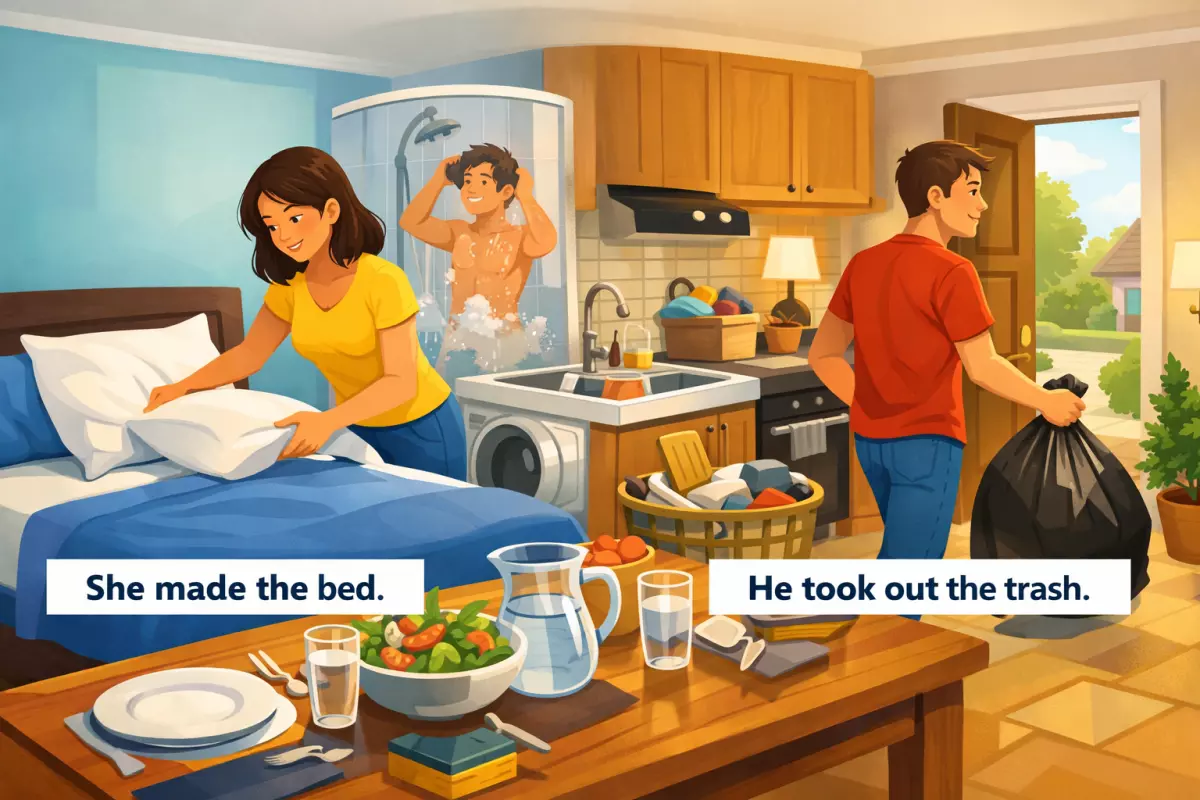
In daily English, many verbs “prefer” certain nouns, and these pairings sound natural because they follow common usage patterns. Learning them by situation helps you choose the right verb quickly and avoid literal translations that sound unusual.
Home and daily routines
- make the bed
- do the laundry
- do the dishes
- take a shower / have a shower
- get dressed
- set the table
- clear the table
- tidy up the room
- clean the kitchen
- take out the trash
- turn on the lights / turn off the lights
- lock the door
Food, cooking, and eating
- make breakfast / make dinner
- cook a meal
- prepare ingredients
- chop onions / slice bread
- boil water / boil pasta
- bake a cake
- heat up leftovers
- order takeout
- set a timer
- have a snack
- grab a coffee
- pay the bill
Work, school, and productivity
- go to work / go to school
- start a task / finish a task
- meet a deadline
- make progress
- take notes
- do research
- write a report
- give a presentation
- attend a meeting
- schedule an appointment
- send an email
- follow up on an email
- solve a problem
Communication and relationships
- have a conversation
- ask a question
- give advice
- take advice
- make a suggestion
- keep a secret
- break the news (to someone)
- make an apology → more natural than ❌ “do an apology”
- pay a compliment
- keep in touch
- lose touch
- get to know someone
Health, exercise, and wellbeing
- get some sleep
- catch a cold
- feel better / feel sick
- take medicine
- make an appointment (with a doctor)
- see a doctor
- work out (at the gym)
- go for a run / go for a walk
- do yoga
- lift weights
- stay hydrated
- manage stress
Travel, transport, and getting around
- catch a bus / catch a train
- miss a flight
- book a ticket
- make a reservation
- check in (at the airport / hotel)
- pick up a rental car
- take a taxi
- get on the bus / get off the bus
- ask for directions
- follow directions
- get stuck in traffic
- make a stop
Money, shopping, and services
- go shopping
- buy groceries
- compare prices
- place an order
- pay in cash / pay by card
- withdraw cash
- save money
- spend money
- charge a fee
- request a refund
- renew a subscription
- cancel an appointment
When you learn these pairings, focus on the verb choice rather than the individual words. For example, English typically uses do for tasks and chores (do the dishes, do research), make for creating or producing something (make progress, make a reservation), and take for receiving/using something as an action (take notes, take medicine). This pattern-based approach makes collocations easier to remember and apply in new contexts.
Work and business verb collocations
In professional settings, verb + noun pairings tend to follow predictable patterns: you make decisions, meet deadlines, run a business, and raise funds. Learning these chunks helps you sound natural in meetings, emails, reports, and interviews because the verb choice is often fixed by convention rather than logic.
Common patterns (verb + noun) used at work
- meet a deadline / miss a deadline
- set a deadline / extend a deadline
- schedule a meeting / cancel a meeting / reschedule a meeting
- chair a meeting (lead it formally)
- take minutes (write the official notes)
- make a decision / reach a decision
- give approval / grant approval / withhold approval
- raise an issue / address an issue
- solve a problem / fix a problem (more informal)
- conduct research / carry out research
- run a business / operate a business
- launch a product / roll out a feature
- develop a strategy / implement a strategy
- set goals / achieve goals
- deliver results / deliver a presentation
- submit a report / file a report (common in formal/legal contexts)
- allocate resources / reallocate resources
- manage a team / lead a team / supervise staff
- hire staff / recruit staff / onboard new hires
- negotiate a contract / sign a contract / renew a contract
Collocations for communication and reporting
- send an email / forward an email / reply to an email
- copy someone (CC them) / loop someone in (informal)
- share an update / provide an update (more formal)
- give feedback / receive feedback / act on feedback
- raise a concern / flag a risk
- clarify expectations / set expectations
- make a recommendation / offer a suggestion
- present findings / report findings
- draft a proposal / revise a proposal / finalize a proposal
- confirm details / confirm receipt
Money, sales, and performance verbs that commonly “go with” business nouns
- cut costs / reduce costs / control costs
- increase revenue / boost revenue
- generate revenue / generate leads
- raise prices / lower prices
- win a client / lose a client
- close a deal / negotiate a deal
- place an order / process an order / fulfill an order
- issue an invoice / pay an invoice
- meet targets / hit targets (more informal) / miss targets
- track performance / measure performance / improve performance
Usage notes: choosing the natural verb
- ✅ make a decision → common in everyday business English. ❌ do a decision
- ✅ meet a deadline → standard for finishing on time. ❌ finish a deadline
- ✅ take minutes → fixed phrase for recording meeting notes. ❌ write minutes (possible, but less idiomatic)
- do is used with broad tasks: do your job, do the paperwork, do an audit (also conduct an audit in more formal writing).
- carry out, conduct, and perform often signal formality: conduct interviews, carry out checks, perform an analysis.
Study and research verb collocations
Academic and research English relies on predictable verb + noun pairings. Learning these patterns helps you describe what you did (methods), what you found (results), and what you think it means (interpretation) in a natural, conventional way.
Common patterns and where they fit
- do research (general activity): “They do research on sleep patterns.”
- conduct research (formal, planned project): “The team conducted research across three sites.”
- carry out research (process-focused, often in reports): “We carried out research over six months.”
- undertake a study (formal decision to begin): “The lab undertook a study of coastal erosion.”
- design a study (planning the structure): “They designed a study with two control groups.”
- devise a method / develop a method (creating an approach): “We developed a method for rapid screening.”
- formulate a hypothesis (stating a testable idea): “The researchers formulated a hypothesis about memory load.”
- test a hypothesis (checking it with evidence): “They tested the hypothesis using survey data.”
- pose a question / address a question (framing and responding): “This section addresses the question of causality.”
- review the literature (summarising prior work): “We reviewed the literature on bilingual education.”
- cite a source (referencing): “The article cites several longitudinal studies.”
- collect data (gathering): “They collected data from 240 participants.”
- gather evidence (often broader than data): “The report gathers evidence from interviews and archives.”
- record observations (noting what is seen): “Observers recorded changes in behaviour.”
- analyse data (BrE) / analyze data (AmE): “We analysed the data using regression.”
- interpret results (explaining meaning): “It is difficult to interpret the results without baseline measures.”
- draw a conclusion (final claim): “They drew the conclusion that the effect is small.”
- present findings / report findings (communicating outcomes): “The paper reports findings from two experiments.”
- replicate a study (repeat to verify): “Independent teams replicated the study.”
Useful collocations by stage of a project
- Planning: define a scope; set an objective; establish criteria; select a sample; choose a framework.
- Method: run an experiment; administer a test; perform an analysis; apply a model; control for variables.
- Results: obtain results; observe an effect; detect a pattern; identify a trend; yield evidence.
- Discussion: support a claim; challenge an assumption; account for differences; acknowledge limitations; suggest implications.
- Next steps: propose future work; recommend further research; refine the approach; extend the study; explore alternatives.
Accuracy notes (common collocation pitfalls)
- ✅ conduct research → ❌ “make research” (use do/conduct/carry out instead).
- ✅ collect data → ❌ “compile data” when you mean gathering from participants (use compile mainly for assembling existing information).
- ✅ draw a conclusion → ❌ “take a conclusion” (the standard verb is draw or reach).
- ✅ analyse data → ❌ “study data” in method sections (use study for the overall topic; use analyse for the data work).
When choosing a collocation, match the verb to your level of formality and the stage you are describing: do is neutral, conduct and undertake are more formal, and verbs like analyse, interpret, and replicate signal specific research actions.
Travel and services collocations
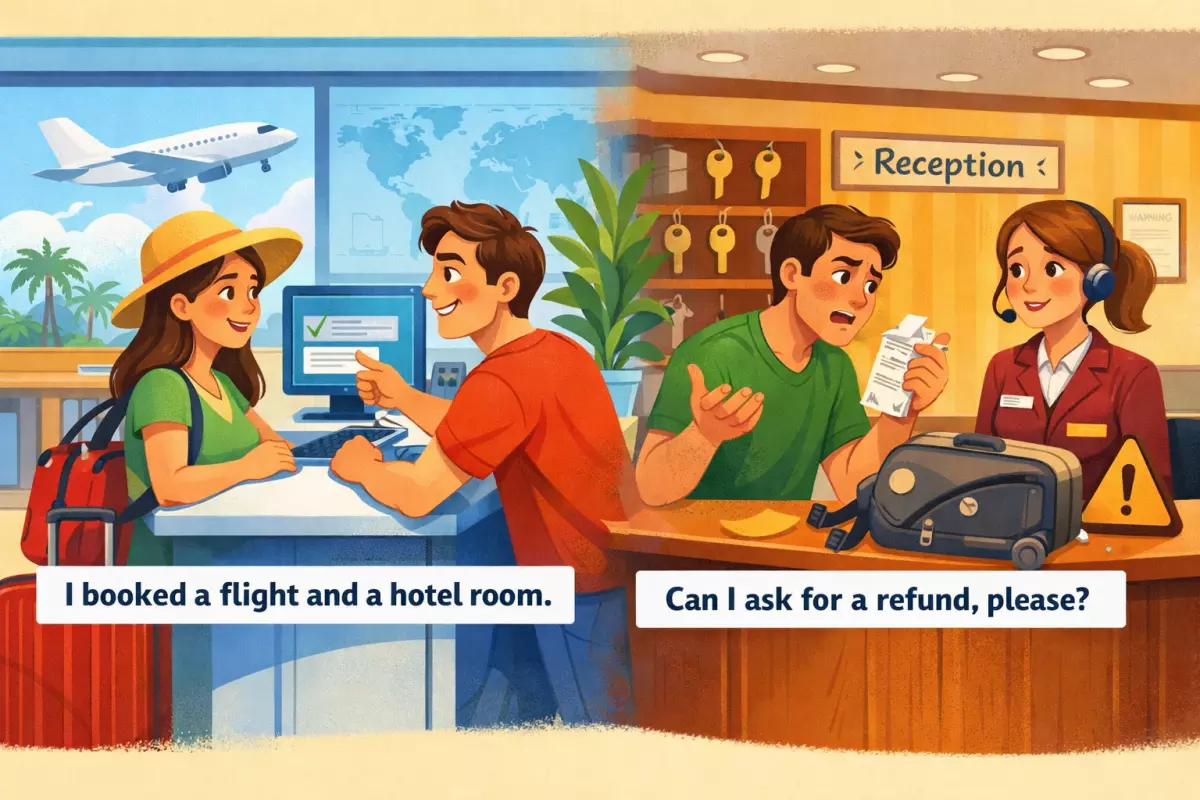
In travel situations, verbs often pair with specific nouns in predictable ways. Learning these pairings helps you sound natural when booking, checking in, asking for help, and dealing with common service problems. Pay attention to the typical verb patterns: verb + noun (book a room), verb + preposition (check in at), and verb + object + preposition (ask for a refund).
Booking, planning, and tickets
- book a flight / a room / a table (common for reservations)
- make a reservation / an appointment (more general than “book”)
- reserve a seat / a room (slightly more formal)
- buy a ticket / a pass (focus on payment and ownership)
- purchase travel insurance (formal alternative to “buy”)
- confirm a booking / a reservation (often before travel)
- cancel a booking / a ticket (end the arrangement)
- change a flight / a reservation (modify dates, times, or details)
- rebook a flight (book again, usually after a change or disruption)
- apply for a visa / a permit (fixed preposition “for”)
- renew a passport / a visa (extend validity)
- plan an itinerary / a route (organize steps and timing)
At the airport, station, or terminal
- check in online / at the counter → “check in” is usually intransitive, followed by where/how
- check in a bag (when “check” takes an object, it means hand luggage to the airline)
- drop off luggage / a bag (leave it at a desk or point)
- go through security / passport control (process you pass)
- clear security / customs (successfully complete a control)
- board a plane / a train (no preposition: not “board on”)
- miss a flight / a connection (arrive too late)
- catch a flight / a train / a bus (manage to get it on time)
- make a connection (successfully transfer to the next service)
- announce a delay / a gate change (what staff or systems do)
- delay a flight / a departure (what the airline does; also “the flight is delayed”)
- divert a flight (send it to a different airport)
Hotels and accommodation services
- check in at the hotel / check out of the hotel (fixed prepositions)
- collect the key / a key card (receive it from reception)
- upgrade a room / your booking (move to a better option)
- request a late checkout / extra towels (polite, service-focused)
- ask for a wake-up call / assistance (common spoken request)
- report a problem / a leak / a noise issue (formal and clear)
- fix the air conditioning / the lock (what staff do; guests can “ask to have it fixed”)
- clean the room / service the room (hotel housekeeping actions)
- pay a deposit / pay for breakfast (note the pattern difference)
- charge a fee / charge it to the room (hotel billing collocation)
Customer service: problems, solutions, and outcomes
- file a complaint / a claim (formal process, often written)
- make a complaint (common alternative to “file”)
- raise an issue / a concern (polite, professional tone)
- request a refund / compensation (typical service language)
- issue a refund / a replacement (what the company does)
- offer compensation / an apology (what staff do)
- resolve a problem / an issue (complete a fix)
- handle a complaint / a request (manage the situation)
- escalate a case / a complaint (move it to a higher level)
- waive a fee (remove a charge, often after a problem)
- replace an item / a product (service remedy)
- follow up on a request / a complaint (continue after first contact)
Common pattern notes (to avoid typical errors)
- ✅ check in at the desk / the hotel ❌ “check in to the desk” (use “at” for the place)
- ✅ board the train ❌ “board on the train” (no preposition with “board”)
- ✅ pay a fee / pay for a service (object vs. “for” + thing)
- ✅ ask for a refund ❌ “ask a refund” (use “for” with the noun)
- ✅ complain about the noise / complain to reception (about = topic, to = person)
- ✅ arrive at the airport / arrive in a city (at = point, in = larger place)
Avoiding unnatural word combinations
Natural-sounding verb choices often depend on fixed partnerships between verbs and nouns (or verbs and prepositions). When you pick a verb that is “logical” but not typical, the sentence can feel translated or slightly off. The goal is to notice the patterns that native speakers repeat and reuse them as chunks.
Choose the verb that matches the noun’s “usual action”
Many nouns strongly prefer one or two verbs because of convention. If you learn the noun with its common verb, you reduce awkward phrasing and write more fluently.
- ✅ make a decision → ❌ do a decision
- ✅ take a break → ❌ make a break
- ✅ have an idea → ❌ get an idea (in most contexts)
- ✅ raise a question/issue → ❌ lift a question
- ✅ pay attention → ❌ give attention (unless a specific meaning is intended)
- ✅ draw a conclusion → ❌ make a conclusion (common in some varieties, but often less natural)
- ✅ reach an agreement → ❌ arrive an agreement
- ✅ meet a requirement → ❌ match a requirement (unless comparing)
- ✅ pose a risk/threat → ❌ put a risk
- ✅ file a complaint/report → ❌ write a complaint (possible, but different focus)
- ✅ deliver a presentation/speech → ❌ say a presentation
- ✅ run an experiment → ❌ do an experiment (possible, but less precise in academic style)
- ✅ commit a crime → ❌ do a crime
- ✅ set a goal/deadline → ❌ put a goal/deadline
- ✅ launch a product/campaign → ❌ open a product/campaign
Watch for “near-synonyms” that don’t collocate the same way
Two verbs can be close in meaning but differ in what they typically take as an object. This is a common source of unnatural combinations, especially with formal vocabulary.
- do vs make: do homework/research/work; make a plan/mistake/promise.
- say vs tell: say something; tell someone something; tell the truth; say a few words.
- borrow vs lend: borrow from someone; lend to someone.
- bring vs take: bring to here/this place; take to there/another place (context decides).
- learn vs teach: learn a language; teach a class; teach someone a skill.
- solve vs resolve: solve a problem/math question; resolve a dispute/conflict (solve a dispute is possible but less typical).
- increase vs raise: increase prices/levels (neutral); raise prices/taxes (often by decision).
- provide vs offer: provide support/resources (ensure availability); offer help/discounts (voluntary proposal).
Learn verb + preposition pairings as a unit
Unnatural phrasing often comes from using the wrong preposition after a verb. Memorize the combination, not the verb alone, because the preposition is part of the pattern.
- ✅ depend on → ❌ depend of
- ✅ focus on → ❌ focus in
- ✅ succeed in (doing) → ❌ succeed on
- ✅ apply for a job → ❌ apply to a job (apply to a company is possible, but meaning shifts)
- ✅ participate in an event → ❌ participate on
- ✅ contribute to a project → ❌ contribute in a project
- ✅ belong to → ❌ belong with (different meaning)
- ✅ approve of (an idea/behavior) → ❌ approve for (approve a request is a different structure)
- ✅ complain about → ❌ complain for
- ✅ insist on (doing) → ❌ insist for
Use “safe” high-frequency collocations in formal writing
When you are unsure, choose combinations that are widely used in academic and professional contexts. They are flexible and rarely sound odd.
- carry out research / carry out an investigation
- conduct a survey / conduct an interview
- provide evidence / provide support
- raise concerns / raise awareness
- meet expectations / meet standards
- address an issue / address a concern
- achieve results / achieve an objective
- draw attention to / draw a distinction
- make an assumption / make a recommendation
- take responsibility / take action
Quick self-check before you commit to a phrasing
- Ask: “Is this the verb people usually use with this noun?” If not, switch to a more typical pairing.
- Prefer verb-noun chunks you have seen multiple times (in articles, reports, emails) over one-off inventions.
- If a noun is abstract (decision, progress, attention), it often has a conventional verb (make, achieve, pay).
- If you change the verb to a synonym, re-check the preposition and the object type (tell someone, depend on).
Common learner errors and fixes
Collocations often go wrong in predictable ways: learners translate word-for-word, choose a “near synonym” that doesn’t pair naturally, or mix patterns (verb + noun vs. verb + preposition). Use the fixes below to spot the pattern and swap in the verb that native speakers typically use in that context.
1) Overusing “do” and “make”
These two verbs are high-frequency, so they get used as default choices. The correction usually depends on whether the noun refers to an activity/process (often “do”) or a created result/decision (often “make”).
- ❌ do a decision → ✅ make a decision
- ❌ make homework → ✅ do homework
- ❌ do a mistake → ✅ make a mistake
- ❌ make an exam → ✅ take an exam (or sit an exam)
- ❌ do a photo → ✅ take a photo
- ❌ make a party → ✅ have a party (or throw a party)
- ❌ do progress → ✅ make progress
- ❌ make a break → ✅ take a break
2) Picking a synonym that doesn’t “fit” the noun
Many verbs share general meaning (get/receive/obtain; say/tell/speak), but only one is standard with a given noun. When in doubt, learn the pair as a chunk.
- ❌ get a salary → ✅ earn a salary
- ❌ win money (from your job) → ✅ earn money
- ❌ receive a cold → ✅ catch a cold
- ❌ take a gift (meaning “accept”) → ✅ accept a gift
- ❌ say someone a secret → ✅ tell someone a secret
- ❌ explain me the problem → ✅ explain the problem to me
- ❌ discuss about the plan → ✅ discuss the plan
- ❌ mention about the issue → ✅ mention the issue
3) Using the wrong verb for “work + career” contexts
Professional English relies on a small set of verbs that pair with roles, tasks, and outcomes. Errors often come from translating directly from another language.
- ❌ make a meeting → ✅ hold a meeting (or have a meeting)
- ❌ do a presentation → ✅ give a presentation
- ❌ realize a project → ✅ carry out a project (or complete a project)
- ❌ elaborate a report → ✅ write a report (or prepare a report)
- ❌ assist to a meeting → ✅ attend a meeting
- ❌ take contact with a client → ✅ contact a client (or get in touch with a client)
- ❌ put attention to detail → ✅ pay attention to detail
- ❌ do a complaint → ✅ make a complaint (or file a complaint)
4) Preposition mistakes inside common verb patterns
Some combinations are mainly “verb + preposition” patterns. Changing the preposition can sound unnatural or change meaning, so it’s worth memorizing the full frame.
- ❌ depend of → ✅ depend on
- ❌ spend time for something → ✅ spend time on something
- ❌ wait me → ✅ wait for me
- ❌ listen music → ✅ listen to music
- ❌ explain about the rules → ✅ explain the rules
- ❌ marry with someone → ✅ marry someone (or get married to someone)
- ❌ enter to the room → ✅ enter the room
- ❌ arrive to the airport → ✅ arrive at the airport (arrive in a city/country)
5) Confusing “take / get / have” in everyday routines
Daily-life phrases often use a fixed verb even when alternatives seem logical. Treat these as set expressions tied to context (transport, health, food, routines).
- ❌ drink a medicine → ✅ take medicine
- ❌ eat a breakfast → ✅ have breakfast
- ❌ make a shower → ✅ take a shower (or have a shower)
- ❌ take a bus (meaning “drive”) → ✅ take a bus (correct for using transport) / drive a bus (as a job)
- ❌ get a rest (as a planned break) → ✅ take a rest (or get some rest)
- ❌ have a walk (possible but limited) → ✅ take a walk (more standard)
6) Mixing “raise / rise” and other transitive vs. intransitive pairs
A frequent pattern error is using a verb that needs an object as if it doesn’t (or the reverse). Check whether the verb acts on something (transitive) or happens by itself (intransitive).
- ❌ prices raised → ✅ prices rose
- ❌ rise the price → ✅ raise the price
- ❌ happened an accident → ✅ an accident happened
- ❌ explain me → ✅ explain to me
7) Fixing errors systematically
- Learn the whole unit (verb + noun + preposition if needed): “pay attention to,” not just “pay.”
- Group phrases by situation: meetings (hold/attend), study (take/pass/fail), health (catch/take/recover).
- Notice “light verb” patterns: make/take/have/give often form natural chunks (make progress, take notes, have doubts, give advice).
- When a noun feels abstract (progress, advice, permission), check the typical partner verb rather than guessing.
Homework: collocation practice tasks
Focus on picking the verb that naturally “goes with” the noun in each context. Work in chunks (verb + noun) rather than translating word by word. When you check your work, notice which patterns repeat: make/do, take/have, give/provide, raise/increase, and verb + preposition combinations.
Task 1: Choose the best verb
Complete each sentence with the most natural verb collocation.
- Please ______ a decision by Friday so we can plan the next steps.
- We need to ______ research before we invest in new equipment.
- The company will ______ a complaint if the issue isn’t resolved.
- Can you ______ me a call when you arrive?
- They ______ a meeting to discuss the budget.
- I’m trying to ______ progress on my writing every day.
- The team ______ a risk assessment before launching the product.
- She ______ an apology for the misunderstanding.
- We should ______ attention to the safety instructions.
- The new policy will ______ an impact on working hours.
- He ______ responsibility for the mistake.
- They ______ a deadline because of unexpected delays.
Show answers
- make
- do
- file
- give
- held
- make
- carried out
- offered
- pay
- have
- took
- missed
Task 2: Fix the collocation (rewrite)
Each sentence contains an unnatural verb+noun pairing. Rewrite each one using a more natural combination while keeping the meaning.
- I did a decision to change jobs.
- She made her homework after dinner.
- We took a party for his promotion.
- They gave a mistake in the report.
- He did a complaint to customer service.
- The manager made a meeting at 3 p.m.
- Could you do me a favor and email the file?
- The article says the changes will do an impact.
- We made a photo of the receipt.
- He took an effort to improve his pronunciation.
Show answers
- I made a decision to change jobs.
- She did her homework after dinner.
- We had a party for his promotion.
- They made a mistake in the report.
- He made a complaint to customer service. / He filed a complaint with customer service.
- The manager held a meeting at 3 p.m.
- Could you do me a favor and email the file?
- The article says the changes will have an impact.
- We took a photo of the receipt.
- He made an effort to improve his pronunciation.
Task 3: Build collocation sets by topic
Write one original sentence for each collocation. Keep the context consistent with the topic named.
- Work/Business: meet a deadline; raise a concern; reach an agreement; launch a product; cut costs
- Study/Learning: take notes; revise for an exam; conduct an experiment; improve fluency; ask a question
- Daily life: do the laundry; make the bed; run an errand; take a break; catch a bus
- Health: get some rest; make an appointment; take medicine; relieve pain; recover from an illness
Task 4: Pattern practice (verb + preposition)
Complete the sentences with the correct preposition. Use the most common pattern for each verb.
- She apologized ______ the delay.
- We’re looking forward ______ meeting the new team.
- He insisted ______ paying for lunch.
- They succeeded ______ solving the problem.
- Please apply ______ the internship by Monday.
- I’m responsible ______ updating the schedule.
- Can you remind me ______ the meeting time?
- They complained ______ the noise.
- We agreed ______ a new price.
- He specializes ______ data analysis.
Show answers
- for
- to
- on
- in
- for
- for
- about
- about
- on
- in
Task 5: Short production (controlled writing)
Write a short paragraph (80–120 words) about one topic below. Include at least 8 natural verb+noun pairings and at least 2 verb+preposition patterns.
- A busy week at work (planning, meetings, deadlines, problems)
- Preparing for an exam (study routine, progress, stress, results)
- Organizing an event (arrangements, invitations, issues, outcomes)
Checklist before you finish:
- Use common chunks like “make a decision,” “take notes,” “hold a meeting,” “meet a deadline.”
- Avoid literal translations that create odd pairings (❌ “do a decision” → ✅ “make a decision”).
- Keep tense and form consistent (e.g., “carried out an assessment,” “has had an impact”).