Typical Verb Patterns in Conversation and Writing

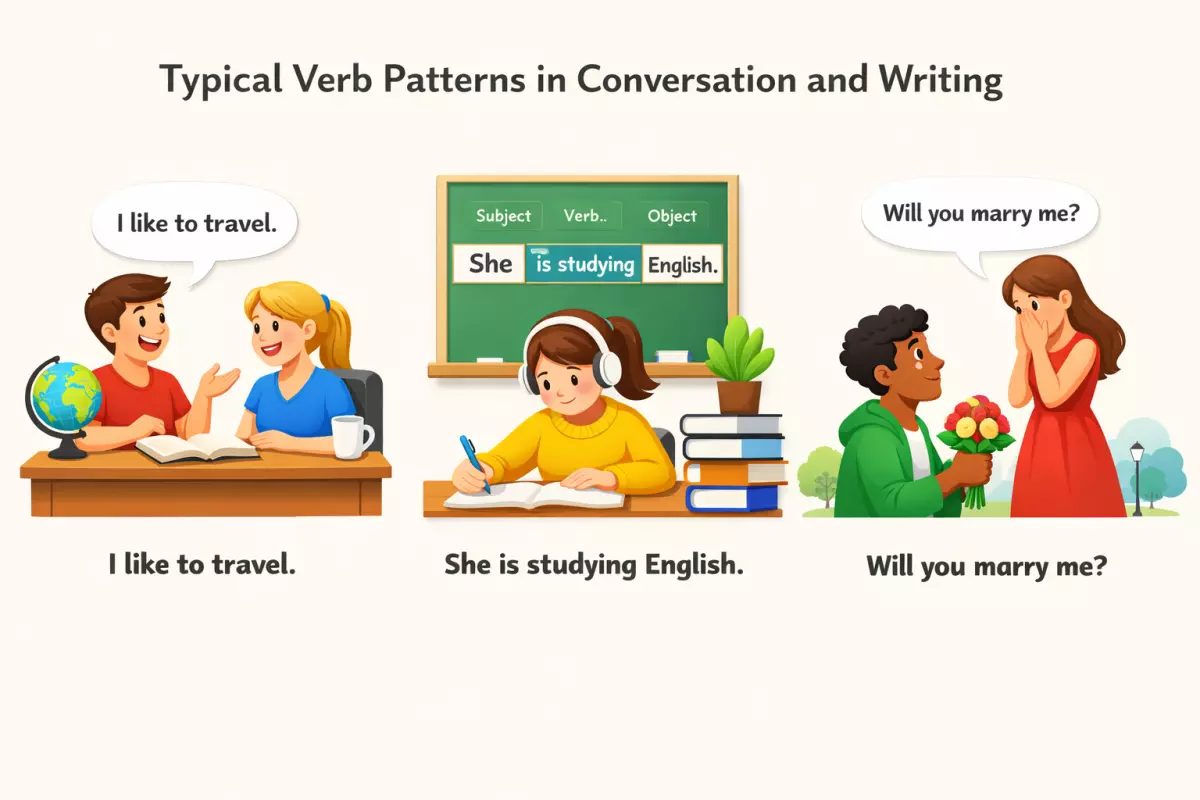 This article shows how verb choices change by register, comparing everyday conversation patterns with formal writing, including phrasal verbs vs formal alternatives and the use of ellipsis and short forms.
- How verb choices differ by register
- Common patterns in everyday conversation
- Typical patterns in formal writing
- Phrasal verbs vs formal alternatives
- Ellipsis and short forms in conversation
- Clarity and precision in writing patterns
- Common learner mistakes by register
- Homework: conversation vs writing practice tasks
Verbs in everyday speech and formal writing often follow familiar patterns that shape how messages sound and feel. By noticing common verb pairings and sentence frames, you can understand others faster and choose your own words with more confidence. This article compares how these habits change between casual conversation and polished prose, with practical examples you can reuse.
How verb choices differ by register
Verb selection shifts with context: informal talk tends to favor shorter, more flexible verb phrases that manage interaction, while formal writing often uses more specific, information-dense verbs that package ideas precisely. Noticing these patterns helps you choose verbs that fit the situation without sounding overly casual or unnecessarily stiff.
| Register tendency | Common verb patterns | Typical effect | Example |
|---|---|---|---|
| Conversation: interaction-first | Light verbs + pronouns (do, get, go, have) with vague objects | Keeps speech quick; meaning fills in from shared context | “I got a message.” / “Can you do that?” |
| Conversation: stance and hedging | Think/feel/guess + clauses; maybe/kind of; modals (might, could) | Softens claims; invites agreement | “I think it’ll rain.” / “It might work.” |
| Conversation: managing turns | Discourse verbs (mean, say, ask) and short imperatives | Signals clarification, repair, or topic shifts | “I mean, not today.” / “Say that again?” |
| Conversation: phrasal verbs | Verb + particle (pick up, put off, figure out) | Sounds natural and idiomatic; often less formal | “Let’s figure out a plan.” |
| Writing: precision and density | Single-word lexical verbs (investigate, indicate, constitute) | Condenses meaning; supports exact claims | “The data indicate a trend.” |
| Writing: nominal style | Verbs that support nouns (conduct an analysis, make a recommendation) | Creates an institutional tone; can add formality | “We conducted an analysis of…” |
| Writing: cautious claims | Reporting verbs + that-clauses (suggest, argue, demonstrate) | Attributes ideas; shows evidence level | “The results suggest that…” |
| Writing: passive and agent control | Passive voice when the actor is unknown/irrelevant | Highlights process or outcome over the doer | “The samples were stored at 4°C.” |
| Writing: explicit logical links | Cause/effect and framing verbs (lead to, result in, depend on) | Makes relationships clear and traceable | “Delays resulted in higher costs.” |
| Writing: controlled evaluation | Measured evaluative verbs (support, challenge, justify) | Assesses claims without sounding personal | “These findings support the hypothesis.” |
Practical shifts when moving from speech to formal prose
When you revise conversational phrasing into a more formal register, the goal is usually not to “sound fancy,” but to make actions and relationships explicit. The following shifts are common in editing and in academic or professional writing.
- Replace very general verbs with a more specific action when the context is not shared: “do” → “complete,” “perform,” “implement,” or “carry out.”
- Reduce heavy reliance on “get” by naming the process: “get better” → “improve”; “get worse” → “deteriorate.”
- Turn “there is/there are” openings into clearer subjects where possible: “There are three factors…” → “Three factors influence…”
- Swap casual stance markers for evidence-based framing: “I think” → “The evidence suggests” (when the claim is supported).
- Use reporting verbs to attribute views: “They say” → “The authors argue/claim/observe.”
- Choose modals carefully to match certainty: “might” for possibility, “may” for permission or formal possibility, “must” for strong necessity (avoid unintended force).
- Prefer explicit logical verbs for relationships: “makes” → “causes,” “enables,” “constrains,” “predicts,” depending on meaning.
- Limit idiomatic phrasal verbs in formal contexts when a precise alternative exists: “set up” → “establish”; “find out” → “determine.”
- Use passive voice strategically, not automatically: keep it when the method matters more than the actor; avoid it when it hides responsibility.
- Watch for verb + noun padding that adds length without meaning: “make a decision” → “decide” (unless the noun phrase is required for emphasis or structure).
- Keep conversation-style imperatives for instructions only: “Just do this” → “Follow these steps” in guidelines.
- Replace vague “stuff/things” objects with concrete nouns so the verb has a clear target: “fix things” → “resolve the scheduling conflict.”
Common verb choices that signal informality (and how to handle them)
Some verbs are not “wrong” in writing, but they often sound more casual because they depend on shared context or idiom. In formal prose, either keep them when the tone is intentionally relaxed, or revise to a verb that states the action more directly.
- “kind of/sort of + verb” → remove the hedge or replace with “partly,” “approximately,” or a quantified limit.
- “want to” in neutral explanations → “aim to,” “seek to,” or “intend to” (when describing purpose).
- “need to” in policy or requirements → “must” or “is required to” (when it is truly mandatory).
- “help” as a vague causal link → “contribute to,” “facilitate,” or “support” (choose the strength of relationship).
- “talk about” in analytical writing → “discuss,” “address,” or “examine.”
- “deal with” in formal analysis → “handle,” “manage,” “treat,” or “resolve,” depending on the task.
Common patterns in everyday conversation

Spoken English relies on a small set of verb structures that help speakers react quickly, soften statements, and manage turn-taking. These patterns show up in requests, opinions, plans, and quick follow-up questions, often with reduced forms (like contractions) and short answers.
High-frequency verb patterns you will hear and use
- Want/need + to-infinitive: “I need to leave soon.” / “Do you want to grab lunch?”
- Would like + to-infinitive (polite): “I’d like to ask a quick question.”
- Can/Could + base verb (ability, requests): “Can you help me?” / “Could you send it today?”
- Would you mind + -ing (very polite): “Would you mind opening the window?”
- Let’s + base verb (suggestions): “Let’s meet at 3.”
- Be going to + base verb (plans, near future): “I’m going to call her later.”
- Present continuous for arrangements: “I’m meeting Sam tomorrow.”
- Think/guess + (that) clause (opinions, hedging): “I think it’s fine.” / “I guess we can wait.”
- Know/remember/forget + to-infinitive (tasks): “Remember to lock the door.” / “I forgot to reply.”
- Know/remember + -ing (memories, experiences): “I remember meeting her once.”
- Stop + -ing (quit an activity): “He stopped smoking.”
- Stop + to-infinitive (pause to do something): “I stopped to get coffee.”
- Try + to-infinitive (make an effort): “I’ll try to finish today.”
- Try + -ing (experiment with a method): “Try restarting your phone.”
- Help + (to) base verb (both common): “Can you help (to) carry this?”
- Make/let + object + base verb (causatives): “They made me wait.” / “Let me check.”
- Get + object + to-infinitive (persuade): “I got him to agree.”
- Have + object + past participle (services): “I had my hair cut.” / “We’re having the car repaired.”
- Used to + base verb (past habits/states): “I used to live nearby.”
Short, interactive add-ons that shape spoken grammar
- Question tags (check/confirm): “You’re coming, aren’t you?” / “We can park here, can’t we?”
- Echo questions (clarify): “You did what?” / “He said when?”
- So/Neither + auxiliary (agreement): “So do I.” / “Neither can I.”
- Auxiliary-only replies (efficient answers): “Do you like it?” “I do.” / “Are you ready?” “I’m not.”
- Backchannel verbs (show listening): “Got it.” / “Makes sense.” / “Sounds good.”
Common trouble spots to watch for
- Verb after modals stays in base form: ✅ “She can drive.” ❌ “She can drives.”
- Mind/enjoy/finish + -ing: ✅ “Do you mind waiting?” ❌ “Do you mind to wait?”
- Suggest + -ing / suggest + (that) clause: ✅ “I suggest leaving now.” / “I suggest (that) we leave now.”
- Ask/tell + object + to-infinitive: ✅ “He told me to call.” ❌ “He told me call.”
- Say vs. tell: “say (something)” but “tell (someone) (something)”: “She said it was late.” / “She told me it was late.”
Typical patterns in formal writing
Formal writing tends to favor verb patterns that sound precise, cautious, and information-focused. Compared with everyday speech, it uses fewer contractions, fewer vague verbs (like get), and more structures that clearly signal purpose, evidence, and limits. The patterns below are common in academic, professional, and official texts.
Common verb-pattern choices and where they appear
- Reporting verbs + that-clause: argue/claim/suggest/indicate/report + that + clause
Example: The results suggest that the treatment is effective. - Reporting verbs + noun phrase: describe/outline/summarize + NP
Example: This section outlines the procedure. - Verb + to-infinitive for aims and intentions: aim/seek/intend/plan + to + verb
Example: The study aims to evaluate long-term outcomes. - Verb + to-infinitive for recommendations: recommend/advise/encourage + NP + to + verb
Example: We recommend users to update passwords. ❌ → We recommend that users update passwords. ✅ - Verb + that-clause for recommendations/requirements: recommend/require/propose + that + clause (often with a base verb)
Example: The policy requires that employees submit the form. - Verb + -ing clause for processes and methods: involve/require/entail + -ing
Example: The procedure involves collecting samples daily. - Verb + preposition + -ing: focus on / depend on / result in + -ing
Example: The analysis focuses on comparing two datasets. - Passive patterns to foreground actions and results: be + past participle
Example: Data were collected over six months. - Passive + to-infinitive for purpose or expectation: be expected/assumed/considered + to + verb
Example: The device is expected to reduce energy use. - Hedging with modal verbs: may/might/could + base verb
Example: These findings may indicate a broader trend. - Hedging with “appear/seem” structures: appear/seem + to + verb or it appears/seems that + clause
Example: It appears that demand has increased. - “There is/are” + noun + to-infinitive for formal problem framing
Example: There is a need to revise the guidelines. - Nominalization-friendly verb choices: conduct/carry out/undertake + noun
Example: The team conducted an assessment of risk factors. - Cause–effect verbs with clear objects: lead to / result in / contribute to + noun/-ing
Example: Poor ventilation contributes to higher infection rates. - Constraint and scope verbs: limit/restrict/exclude + noun
Example: The sample excludes participants under 18. - Definition and classification patterns: define/characterize/consist of + noun
Example: The index consists of three components. - Evidence framing with “show/demonstrate/confirm”: show/demonstrate + that-clause
Example: The data demonstrate that the model is stable. - Precision in obligation: must (strong) vs. should (recommended) vs. may (permitted)
Example: Applicants must provide identification; they may submit documents electronically.
Usage notes that improve register
- Prefer explicit subjects for claims: “The evidence suggests…” is clearer than “It says…” and avoids informal pronouns.
- Avoid conversational multi-purpose verbs when a specific verb fits better: use obtain, receive, increase, become, or require instead of overusing get.
- Use “that”-clauses for clarity after reporting verbs when the sentence could be misread without them.
- Keep tense consistent in method descriptions: many reports use past passive for completed procedures (“was measured”), and present tense for general truths (“results indicate”).
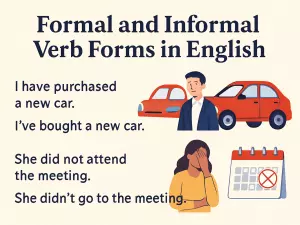
- Limit contractions (e.g., “do not” rather than “don’t”) to maintain a neutral, formal tone.
Phrasal verbs vs formal alternatives
Everyday English often prefers verb + particle combinations (for example, a verb followed by up, out, or off) because they sound natural and efficient in speech. In more formal writing, single-word or Latinate verbs are common because they feel more precise or neutral. The key is not “better vs worse,” but choosing the pattern that matches the situation and keeping the grammar consistent.
Typical usage patterns to notice
- Conversation: phrasal verbs are frequent in quick narratives and instructions: “pick up the keys,” “work out the answer,” “head off early.”
- Formal writing: alternatives often appear in reports, policies, and academic prose: “collect the keys,” “determine the answer,” “depart early.”
- Register mixing: a formal verb can sound stiff in casual speech, while a very idiomatic phrasal verb can sound too informal in a legal or technical document.
- Meaning shifts: the “formal alternative” is not always a perfect synonym; particles can add nuance (completion, direction, intensity) that a single verb may not carry.
Side-by-side examples (meaning and register)
| Common in conversation (phrasal verb) | More formal alternative | Typical use / nuance |
|---|---|---|
| find out | discover / determine | Getting information; “determine” often implies a process. |
| put off | postpone / defer | Delay; “defer” is common in official contexts. |
| set up | establish / arrange | Create or organize; “establish” suits institutions/systems. |
| carry out | conduct / perform / implement | Doing a task or plan; “implement” fits policies. |
| look into | investigate / examine | Checking details; “investigate” is more formal/official. |
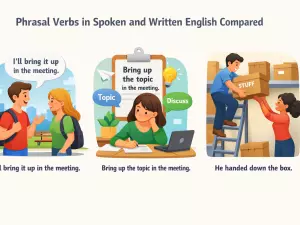
| bring up | raise / mention | Introducing a topic; “raise” is common in meetings/writing. |
| come up with | devise / develop / propose | Producing an idea; “propose” is common in recommendations. |
| go over | review | Checking information; “review” is standard in documents. |
| point out | note / indicate | Drawing attention; “indicate” sounds more detached. |
| rule out | exclude / eliminate | Removing options; “exclude” is common in criteria lists. |
| cut down on | reduce | Lowering quantity; “reduce” is concise in formal writing. |
| run into | encounter | Meeting or facing a problem; “encounter” suits reports. |
Grammar choices that affect tone and clarity
- Separable vs inseparable: some verb + particle combinations allow the object in the middle: “turn the light off / turn off the light.” With a pronoun, separation is usually required: ✅ “turn it off” ❌ “turn off it.”
- Object length: long objects often sound smoother after the particle: “set up a system for tracking customer complaints,” not “set a system for tracking customer complaints up.”
- Passive voice: formal alternatives may form cleaner passives in academic style: “The procedure was implemented” often reads more smoothly than “The procedure was carried out,” though both are possible.
- Idiomatic meaning: avoid replacing an idiom with a near-synonym if it changes meaning. “Look up” (search in a reference) is not the same as “look” or “see.”
- Consistency within a document: if a report uses “investigate,” switching repeatedly to “look into” can make the register uneven.
When editing, a practical method is to identify the verb pattern first (verb + particle, or single verb), then choose the version that matches the audience and the level of formality. Keep an eye on object placement, pronoun rules, and whether the alternative preserves the same nuance.
Ellipsis and short forms in conversation

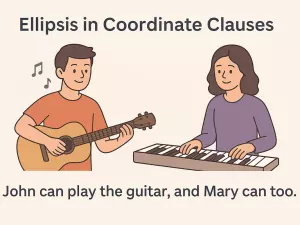
Spoken English often compresses verb phrases when the meaning is obvious from context. Speakers drop repeated words, rely on auxiliaries, and use reduced forms to keep turns quick and interactive. These shortcuts are systematic: they follow predictable verb patterns rather than being random “mistakes.”
Common places where words are left out
Omission is most common when the missing material can be recovered from the previous clause, the shared situation, or a routine exchange. The verb system helps listeners reconstruct what is not said.
- After auxiliaries: the main verb phrase is understood.
- ✅ “I haven’t finished, but she has.” → (has finished)
- ✅ “Are you coming?” “I might.” → (might come)
- After modal verbs: the lexical verb is omitted when it repeats prior information.
- ✅ “You don’t have to, but you can.” → (can do it / can come)
- ✅ “I should, really.” → (should go / should call)
- Short answers to yes/no questions: only the auxiliary (or be) is kept.
- ✅ “Did you email her?” “I did.”
- ✅ “Are they ready?” “They are.”
- ✅ “Have you eaten?” “Not yet, I haven’t.”
- Leaving out the subject in informal, fast turns (especially with verbs like got, need, think).
- ✅ “Sounds good.” → (That sounds good.)
- ✅ “Got to go.” → (I’ve got to go.)
- ✅ “Hope so.” → (I hope so.)
- Leaving out “that” after reporting verbs and adjectives.
- ✅ “I think you’re right.” → (I think that you’re right.)
- ✅ “I’m glad you called.” → (glad that you called)
- Reduced coordination: repeating verbs is avoided when two clauses share the same structure.
- ✅ “I’ll call you and let you know.” (not “I’ll call you and I’ll let you know.”)
- ✅ “She went home, had a shower, then crashed.”
Short forms that shape verb patterns
Contractions and reduced negatives are central to spoken grammar. They influence what counts as the “verb” in a clause because the auxiliary carries tense, polarity, and sometimes person.
- Auxiliary contractions (common with be, have, will):
- I’m / you’re / he’s / we’re / they’re
- I’ve / you’ve / we’ve / they’ve
- I’ll / you’ll / she’ll / we’ll / they’ll
- Negative contractions:
- don’t, doesn’t, didn’t
- can’t, won’t, shouldn’t, wouldn’t, couldn’t
- isn’t, aren’t, wasn’t, weren’t, hasn’t, haven’t, hadn’t
- Reduced “to” and “going to” in future or intention talk:
- “gonna” (informal spelling) often signals a planned action: “I’m gonna call him later.”
- “gotta” often signals obligation: “I gotta leave at six.”
- “wanna” often signals desire: “Do you wanna sit here?”
- Tag-like confirmations with auxiliaries: the auxiliary repeats the tense/polarity of the main clause.
- “You’re coming, aren’t you?”
- “He didn’t tell you, did he?”
- “We should go, shouldn’t we?”
Typical conversational patterns to notice
- Auxiliary-only replies are preferred over repeating the full verb phrase: “Yes, I do / No, I don’t / I can / I will.”
- Elliptical agreement often uses “so” and “neither/nor” with an auxiliary: “So do I.” “Neither have I.”
- Repair and restart creates fragments that still follow verb logic: “I was—well, I thought I was—ready.”
- Context-driven omission is common with routine verbs (know, think, mean, guess): “Dunno.” “Think so.” “Mean, later?”
- Clarity rule: if leaving words out could cause ambiguity, speakers usually keep the full verb phrase: “She said she’d call” (not just “She said she would,” unless the verb is obvious).
In writing, these reductions are used more cautiously because readers cannot ask for clarification. In speech, they are a normal part of turn-taking: the auxiliary carries the grammar, while the rest is supplied by shared context.
Clarity and precision in writing patterns
Formal writing usually needs verb patterns that make who did what, when, and why easy to track. Compared with conversation, written sentences often avoid vague complements and rely on stable structures such as controlled infinitives, clear reporting verbs, and consistent tense choices.
Choose patterns that state responsibility and action
When the subject and the action are explicit, readers do not have to infer meaning from context. These patterns are especially useful in academic, professional, and instructional writing.
- Prefer active patterns when the agent matters: “The team approved the proposal” instead of “The proposal was approved.”
- Use passive patterns when the process or result matters more than the agent: “The samples were stored at 4°C.”
- Use “there is/are” sparingly: replace “There are several reasons…” with “Several factors explain…”
- Use precise reporting verbs: “The study demonstrates…” vs. “The study says…”
- Control stance with verb + that-clause: “We argue that…” / “The results suggest that…”
- Use verb + noun phrase + to-infinitive for clear directives: “The policy requires employees to complete training.”
- Use verb + to-infinitive for planned actions: “The committee intends to revise the guidelines.”
- Use verb + -ing for ongoing or general activities: “The report avoids using informal language.”
Match complement type to meaning (to-infinitive vs. -ing vs. that-clause)
Many verbs allow more than one complement pattern, but the choice changes meaning or emphasis. Picking the expected complement reduces ambiguity.
- ✅ “We recommend that the device be restarted.” → formal recommendation
- ✅ “We recommend restarting the device.” → concise instruction
- ✅ “The data show that errors decreased.” → explicit claim tied to evidence
- ❌ “The data shows…” → treat “data” consistently (often plural in formal contexts)
- ✅ “The manager agreed to extend the deadline.” → agreement about an action
- ✅ “The manager agreed that the deadline was unrealistic.” → agreement about a statement
- ✅ “Remember to attach the file.” → don’t forget a future action
- ✅ “I remember attaching the file.” → memory of a past action
- ✅ “Stop to check the figures.” → pause one activity in order to check
- ✅ “Stop checking the figures.” → cease the checking activity
Use consistent tense and aspect to keep timelines clear
Writing often compresses complex timelines into a few sentences. Stable tense choices and careful aspect (simple vs. perfect vs. progressive) prevent confusion.
- Use present simple for general truths and stable descriptions: “This section explains the method.”
- Use past simple for completed procedures and results: “We collected responses from 120 participants.”
- Use present perfect to connect past work to the current discussion: “Researchers have identified three main causes.”
- Avoid unnecessary tense switching within one paragraph: keep the same time frame unless the meaning requires a shift.
- Prefer exact time markers when needed: “In 2023, the team implemented…” rather than “Recently, the team…”
Reduce ambiguity in long sentences with structured verb phrases
Long sentences are easier to follow when verbs signal structure: cause, contrast, condition, and purpose. Choose patterns that show relationships explicitly.
- Cause: “The change led to delays” / “This resulted in higher costs.”
- Purpose: “We updated the script to improve stability.”
- Condition: “If the input exceeds the limit, the system rejects the request.”
- Contrast: “Although the model fits the training data, it performs poorly on new data.”
- Clarifying reference: repeat the noun instead of relying on “this/it” when multiple options exist: “This policy…” not “This…”
- Prefer specific verbs over general ones: replace “do/make/get” with “conduct/produce/obtain” when accuracy improves.
Common learner mistakes by register
Verb patterns often shift with formality. Learners commonly mix conversational choices (short, flexible, sometimes incomplete) with written choices (more explicit, more “finished”), which can make the tone sound unnatural even when the grammar is mostly correct.
Conversation: patterns that sound too formal, too written, or too “complete”
- Overusing “whom” and other formal choices in casual speech: ❌ “Whom did you talk to?” → ✅ “Who did you talk to?”
- Avoiding end-position prepositions (common in speech): ❌ “To whom are you speaking?” → ✅ “Who are you talking to?”
- Using heavy nominalizations instead of verb-based patterns: ❌ “We conducted a discussion about…” → ✅ “We talked about…”
- Choosing “shall” for everyday offers/suggestions: ❌ “Shall we go now?” (can sound stiff in many contexts) → ✅ “Should we go now?” / “Do you want to go now?”
- Over-explicit “that”-clauses where speech prefers simpler structures: ❌ “I think that it is…” (repeated often) → ✅ “I think it’s…”
- Overusing passive voice in quick interaction: ❌ “It was decided that…” → ✅ “We decided…” / “They decided…”
- Forcing full relative clauses instead of reduced forms: ❌ “The person who is sitting there…” → ✅ “The person sitting there…”
- Using “moreover/furthermore” as spoken connectors: ❌ “Moreover, I…” → ✅ “Also,” “And,” “Plus,”
- Overusing “I would like to…” for simple wants: ❌ “I would like to get a coffee.” → ✅ “Can I get a coffee?” / “I’ll have a coffee.”
- Sounding unnatural with “do not” in relaxed talk: ❌ “I do not know.” → ✅ “I don’t know.”
Writing: patterns that sound too casual, vague, or chat-like
- Using conversation-only ellipsis in formal writing: ❌ “Seems like the results are off.” → ✅ “The results seem inconsistent.”
- Overusing “get” where writing prefers a more specific verb: ❌ “We got an increase in sales.” → ✅ “Sales increased.” / “We saw an increase in sales.”
- Using “gonna/wanna/kinda/sorta” outside informal contexts: ❌ “We’re gonna test…” → ✅ “We are going to test…” / “We will test…”
- Relying on “and” chains instead of clear clause structure: ❌ “We analyzed the data and we found errors and we fixed them…” → ✅ “We analyzed the data, identified errors, and corrected them.”
- Using “like” as a filler or approximator: ❌ “It was like 20%.” → ✅ “It was approximately 20%.”
- Using “you” to mean “people in general” in academic/professional text: ❌ “You can see that…” → ✅ “The data show that…” / “One can see that…” (depending on style)
- Overusing phrasal verbs when a single verb fits the register: ❌ “The team looked into the issue and came up with a plan.” → ✅ “The team investigated the issue and developed a plan.”
- Underusing explicit subjects in instructions or reports: ❌ “Need to update the file.” → ✅ “Update the file.” (instruction) / “The file needs to be updated.” (report)
- Mixing informal stance verbs with formal claims: ❌ “I feel the results prove…” → ✅ “The results suggest/indicate…”
- Using contractions in very formal documents where they may be discouraged: ❌ “We can’t confirm…” → ✅ “We cannot confirm…” (if the style guide requires it)
Cross-register verb-pattern mix-ups (conversation vs. writing)
- Misjudging “help (to) + verb”: both “help do” and “help to do” are possible, but consistent choices matter; writing often prefers the more explicit option in careful prose.
- Confusing “suggest” patterns: ❌ “She suggested me to apply.” → ✅ “She suggested that I apply.” / “She suggested applying.”
- Confusing “recommend” patterns: ❌ “They recommended me to take it.” → ✅ “They recommended that I take it.” / “They recommended taking it.”
- Overusing “make + object + verb” where register prefers alternatives: ❌ “This will make you to understand…” → ✅ “This will help you understand…” / “This will enable you to understand…”
- Mismatch with reporting verbs: casual speech often uses “say/tell,” while writing may need “state/argue/claim/confirm,” chosen to match certainty and evidence.
- Inconsistent tense choices in narratives: conversational “historical present” (“So he goes…”) can sound out of place in formal writing unless used deliberately.
When editing for register, focus on the verb pattern first (clause vs. -ing vs. infinitive, active vs. passive, phrasal vs. single verb). Small pattern choices usually do more for tone than swapping individual vocabulary items.
Homework: conversation vs writing practice tasks
Choose tasks that match the register you want: spoken English tends to use shorter verb phrases, more stance verbs (think, guess, mean), and more “verb + to” patterns for plans and intentions. Writing often prefers denser structures (verb + that-clause, passive reporting verbs, and more precise verb–noun collocations). The activities below train the same verb patterns in two modes so you can notice what changes and what stays stable.
Practice menu (pick 3–5 tasks per week)
- Conversation drill: stance verbs + clause — Record 60–90 seconds using at least 8 of these frames: “I think (that) …”, “I guess …”, “I feel like …”, “I mean …”, “It seems (that) …”, “I’m not sure (if/whether) …”, “I doubt (that) …”, “I bet …”. Keep clauses short and natural.
- Writing drill: reporting verbs + that-clause — Write a 120–160 word mini-summary using 8 reporting verbs: “argue that”, “suggest that”, “claim that”, “note that”, “show that”, “indicate that”, “admit that”, “deny that”. Aim for clear subjects (the author, the data, the results).
- Conversation drill: verb + object + infinitive — Use 10 prompts with “want/need/expect/ask/tell/remind/encourage” (e.g., “I asked him to…”, “They encouraged me to…”). Focus on smooth pronouns and reduced forms (“asked ’em to”).
- Writing drill: verb + object + infinitive with formal control — Rewrite the same ideas with more formal verbs: “require”, “instruct”, “permit”, “enable”, “allow”, “advise”. Keep the agent explicit when it matters (“The policy requires employees to…”).
- Conversation drill: verb + -ing for real experience — Tell a short story using “enjoy”, “keep”, “avoid”, “finish”, “consider”, “can’t stand”, “don’t mind”, “end up”. Include time markers (“then”, “after that”) to support the flow.
- Writing drill: verb + -ing as a noun phrase — Write 6–8 sentences where the -ing form functions as a topic: “Reducing costs requires…”, “Improving access involves…”, “Avoiding delays depends on…”. Check that the -ing phrase has a clear logical subject.
- Mode switch: same meaning, different pattern — Take 8 meanings and express each in two ways: (1) conversational, (2) written. Example: “I think we should leave” → “It is recommended that we leave / Leaving now is advisable.”
- Error hunt: pattern choice — Collect 10 sentences from your own messages or drafts and check whether the verb pattern fits the register. Typical fixes: “discuss about” ❌ → “discuss” ✅; “suggest to do” ❌ → “suggest doing / suggest that…” ✅.
- Collocation builder (writing-leaning) — Make a list of 12 “verb + noun” pairs common in formal prose: “conduct research”, “draw a conclusion”, “raise a concern”, “pose a risk”, “reach an agreement”, “provide evidence”, “address an issue”, “make an assumption”, “offer an explanation”, “achieve results”, “meet requirements”, “reduce uncertainty”. Use each once in a paragraph.
- Fluency builder (conversation-leaning) — Practice 12 light-verb chunks that sound natural in speech: “have a look”, “take a break”, “make a call”, “give it a try”, “take a guess”, “have a chat”, “make a plan”, “take a seat”, “give me a hand”, “have a think”, “make a choice”, “take your time”. Use them in a role-play.
- Editing focus: hedging vs certainty — Write two versions of the same 6 sentences: a careful version (may, might, appear to, tend to) and a direct version (will, clearly, show, prove). Notice how verb choice and pattern change the tone.
- Listening-to-writing transfer — Transcribe 6–10 lines of a conversation (your own or a recording), then rewrite it as a short email or report. Keep the meaning but adjust patterns (more that-clauses, fewer fragments, fewer vague verbs like “do” and “get”).
Mini assignment set (with answers)
Complete the tasks to practice typical verb patterns across registers. Keep contractions in the spoken versions and use full forms in the written versions.
- Choose the best completion (conversation): “I can’t ____ staying up that late anymore.”
- stand
- suggest
- promise
- agree
- Choose the best completion (writing): “The results ____ that the treatment is effective.”
- enjoy
- indicate
- avoid
- mind
- Rewrite for conversation (use a stance verb + clause): “It is likely that prices will rise.”
- Rewrite for writing (use a reporting verb + that-clause): “I think the sample size is too small.”
- Correct the verb pattern (writing): “The report suggests to reduce costs by 10%.”
- Correct the verb pattern (conversation): “She explained me how to do it.”
- Pick the more natural written option:
- “We talked about the findings, and they were kind of surprising.”
- “The findings were discussed and were unexpectedly strong.”
- Pick the more natural spoken option:
- “I would like to inquire whether you have received my previous correspondence.”
- “Hey, just checking if you got my last message.”
Show answers
- a
- b
- Example: “I think prices are gonna rise.” / “Looks like prices will go up.”
- Example: “The author argues that the sample size is too small.” / “The data suggest that the sample size is too small.”
- “The report suggests reducing costs by 10%.” or “The report suggests that costs should be reduced by 10%.”
- “She explained how to do it to me.” or “She explained it to me.”
- b
- b