Verbs for Beginners: What They Are and How They Work

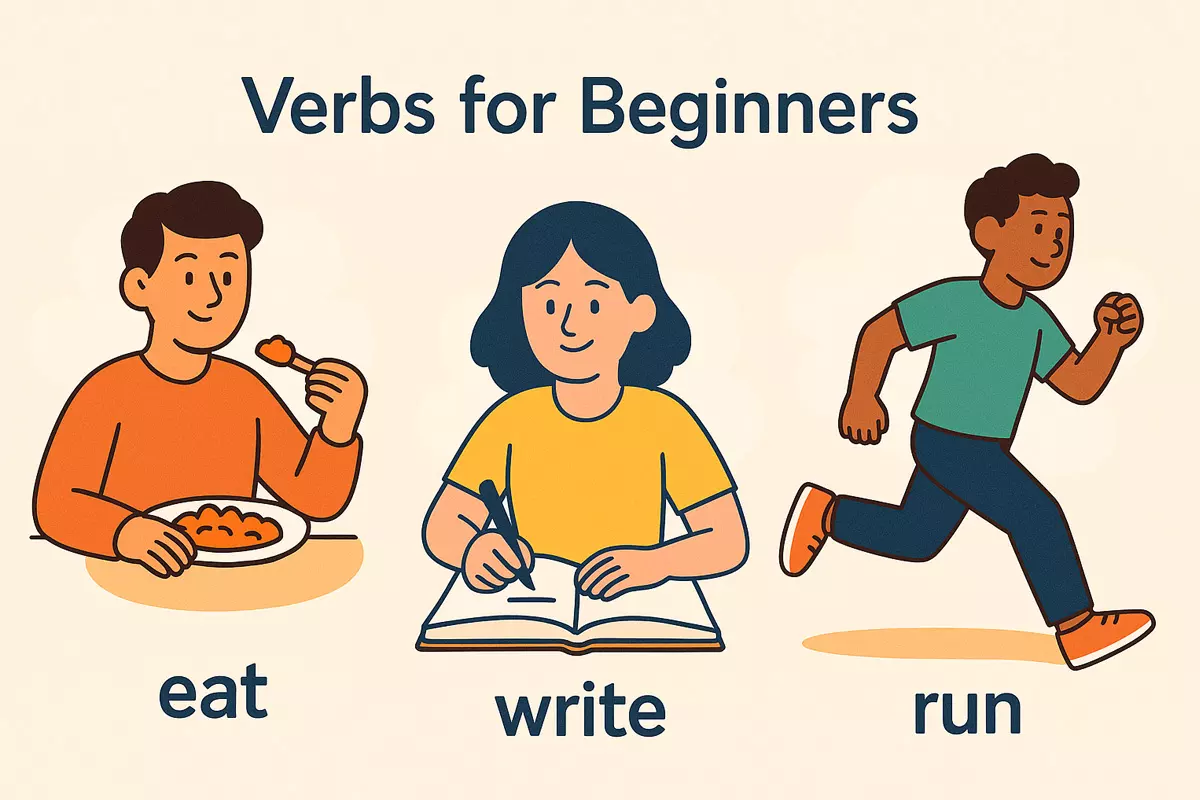 This article explains what verbs are, how to use their base and -s forms, and when to use be, have, and do as main or helper verbs. It also covers negatives, questions, simple present word order, and common mistakes.
Mastering action words, also known as verbs, is essential for beginners learning English, as they allow speakers and writers to express actions, occurrences, and states of being. By using action words effectively, learners can make their sentences more dynamic and precise, clearly conveying who is doing what. A strong grasp of these words not only helps in constructing meaningful sentences but also enhances both written and spoken communication, making it easier to share ideas and engage with others confidently.
What Is a Verb?
A verb is a word that describes an action, a state, or an occurrence. In English sentences, verbs often tell you what the subject is doing or what is happening to them. Without a verb, a sentence usually feels incomplete. For example, in the sentence "Birds sing," the word "sing" is the verb because it shows the action performed by the birds.
Types of Verbs
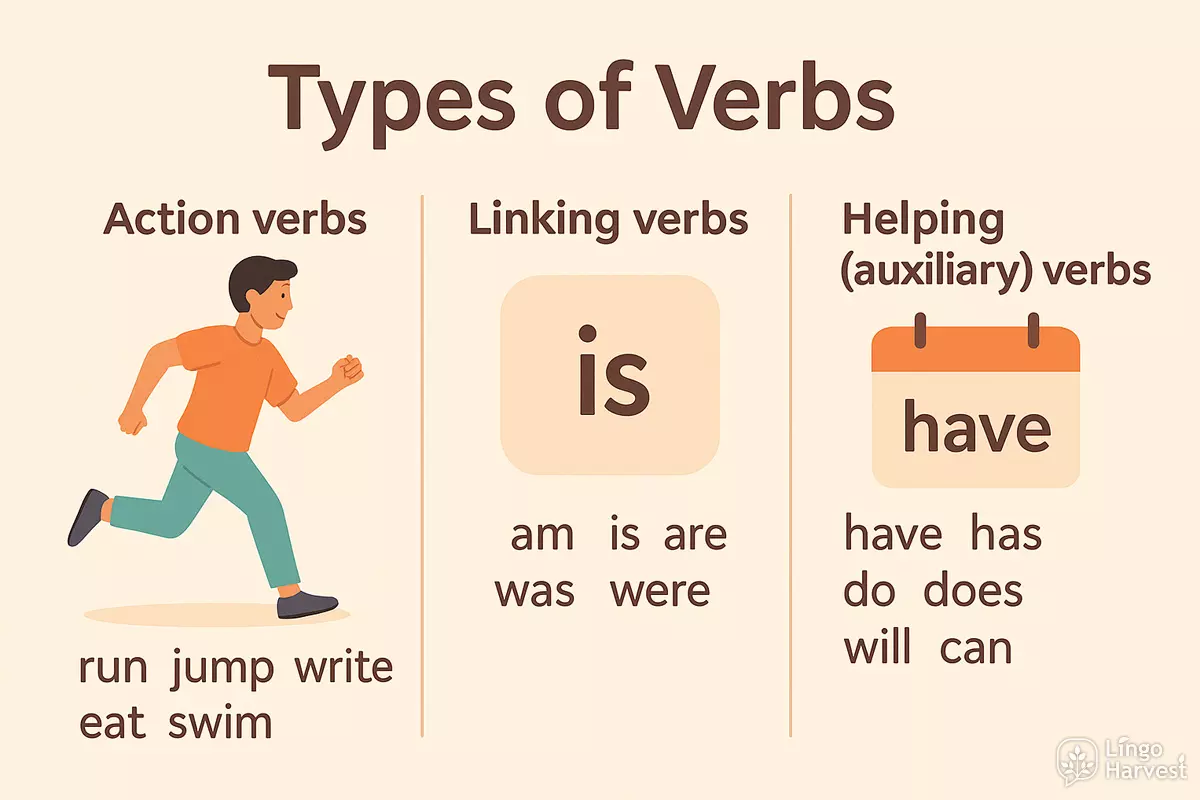
There are several kinds of verbs, each serving a different purpose in a sentence. Some verbs show action, while others express a state of being or link the subject to more information.
- Action verbs: run, jump, write, eat, swim
- Linking verbs: am, is, are, was, were, seem
- Helping (auxiliary) verbs: have, has, do, does, will, can
Verbs in Sentences
In English, verbs can change form depending on tense, subject, or intention. For instance, "play" becomes "played" in the past, and "playing" when describing a continuous action. Verbs are essential for building questions, commands, and statements.
Common Examples of Verbs
| Base form | 3rd person -s | Past | Past participle | -ing form |
|---|---|---|---|---|
| go | goes | went | gone | going |
| make | makes | made | made | making |
| talk | talks | talked | talked | talking |
| listen | listens | listened | listened | listening |
| read | reads | read | read | reading |
| sleep | sleeps | slept | slept | sleeping |
| draw | draws | drew | drawn | drawing |
| learn | learns | learned / learnt | learned / learnt | learning |
| laugh | laughs | laughed | laughed | laughing |
| cry | cries | cried | cried | crying |
| walk | walks | walked | walked | walking |
| open | opens | opened | opened | opening |
| close | closes | closed | closed | closing |
| think | thinks | thought | thought | thinking |
| bring | brings | brought | brought | bringing |
| show | shows | showed | shown (also: showed) | showing |
| teach | teaches | taught | taught | teaching |
| feel | feels | felt | felt | feeling |
| wait | waits | waited | waited | waiting |
| start | starts | started | started | starting |
How Verbs Change
Verbs often shift form to match time (tense) or number. For example, "She runs" (present), "She ran" (past), and "She will run" (future). These changes are called conjugations and help give more details about when or how something happens.
| Verb (Base Form) | Past Simple | Present Participle | Third Person Singular |
|---|---|---|---|
| walk | walked | walking | walks |
| eat | ate | eating | eats |
| study | studied | studying | studies |
| go | went | going | goes |
To sum up, verbs are vital for expressing actions, conditions, and events. Recognizing different verb forms is a key part of learning how sentences work in English.
Base Form and -s Form (3rd person)
Understanding how verbs change depending on the subject is a key step for beginners. In English, the main or "base" form of a verb is used with most subjects: I, you, we, and they. When the subject is he, she, or it (third person singular), the verb usually adds -s or -es. This small change signals who is doing the action and helps sentences sound natural.
When to Use Each Form
Use the base form for the pronouns I, you, we, and they. Add -s (or -es) for he, she, or it in the present simple tense. This rule applies to regular verbs, but there are a few spelling details to remember.
| Subject | Base Form | -s Form |
|---|---|---|
| I/you/we/they | run | ❌ |
| he/she/it | ❌ | runs |
| I/you/we/they | read | ❌ |
| he/she/it | ❌ | reads |
| I/you/we/they | study | ❌ |
| he/she/it | ❌ | studies |
| I/you/we/they | go | ❌ |
| he/she/it | ❌ | goes |
Common Spelling Patterns
- Add -es for verbs ending in -ch, -sh, -x, -ss, -o (e.g., teach → teaches, go → goes).
- For verbs ending with a consonant + y, change y to i and add -es (e.g., study → studies).
- Most other verbs simply take -s (e.g., reads, writes, plays).
More Examples
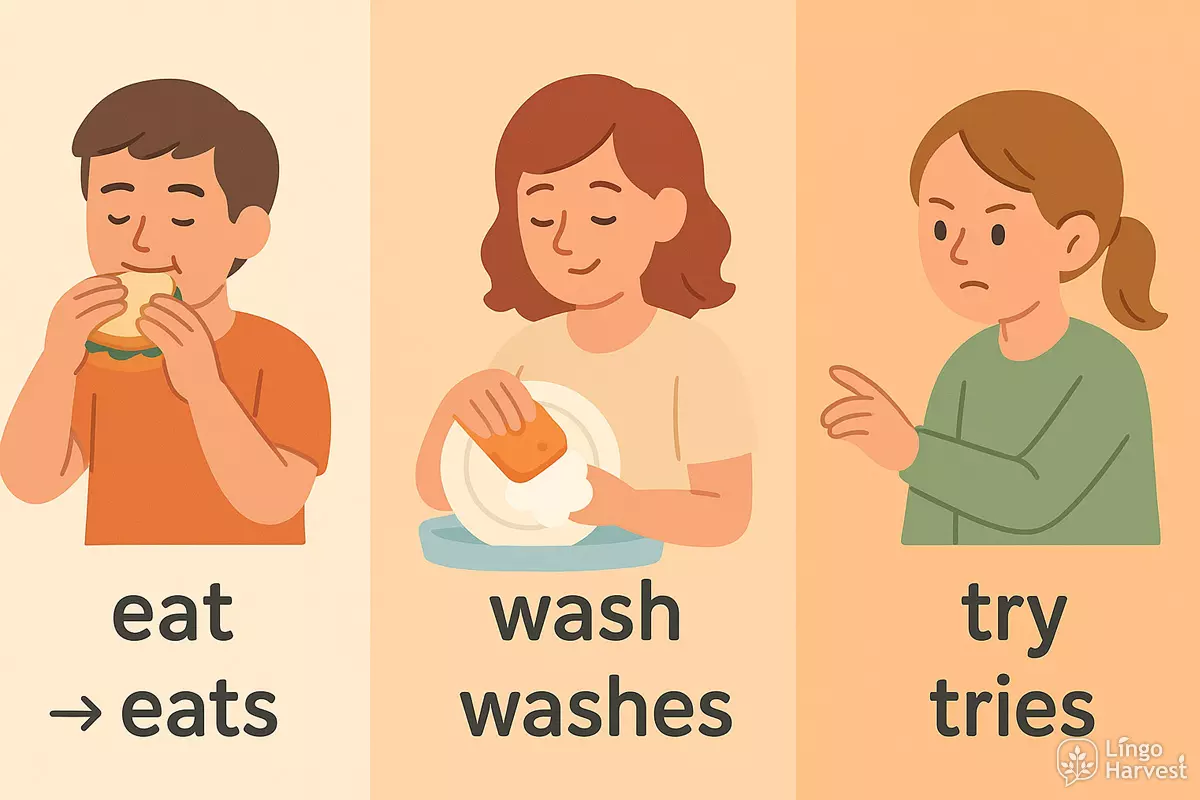
- eat → eats
- make → makes
- fix → fixes
- watch → watches
- wash → washes
- try → tries
- carry → carries
- mix → mixes
- miss → misses
- draw → draws
- jump → jumps
- sing → sings
Choosing the correct verb form is an important habit for clear English. Paying attention to the subject and remembering these patterns will help you avoid common mistakes.
Be/Have/Do as Main vs Helper Verbs
Understanding how “be,” “have,” and “do” function in sentences is key for English learners. These verbs can act as the main action or as grammatical helpers. It all depends on what you want to say and how you structure your sentence.
When They Work Alone: Main Verbs
When “be,” “have,” or “do” stand alone, they carry the main meaning in the sentence. Think of them as the star of the show, not just background support. Examples include:
- “I am a student.” (Here, “am” shows existence or identity.)
- “She has a cat.” (“Has” expresses ownership.)
- “They do their homework.” (“Do” describes the action of completing homework.)
Each of these verbs can describe states, possessions, or actions by themselves.
Helping Other Verbs: Auxiliary Use
Sometimes, these verbs work together with another verb to build different tenses, questions, or negatives. In these cases, they’re called “helper verbs” or auxiliaries.
- “He is running.” (“Is” helps form the present continuous.)
- “We have finished.” (“Have” makes the present perfect.)
- “Do you like pizza?” (“Do” turns the statement into a question.)
- “She does not agree.” (“Does” helps make the sentence negative.)
Comparing Their Roles
It’s easy to get confused, since the same word can fill both roles. The context and sentence structure tell you which job the verb is doing. The table below highlights some typical uses for each:
| Main Verb Example | Helper (Auxiliary) Example |
|---|---|
| I am tired. (state) | I am studying. (present continuous) |
| She has a bike. (possession) | She has eaten. (present perfect) |
| We do our best. (action) | Do you understand? (question) |
| He is a teacher. (identity) | He is being silly. (present continuous) |
Quick Tips to Tell the Difference
- If “be,” “have,” or “do” are the only verbs, they’re probably main verbs.
- If another verb follows (like “running” or “eaten”), they’re likely helping verbs.
- For negatives and questions in simple tenses, “do/does/did” usually act as helpers.
Recognizing when these common verbs play the lead or simply assist helps you build clear, correct sentences in English. Practice spotting their roles in everyday speech and writing for stronger language skills.
Making Negatives and Questions with Do/Does
Forming negatives and yes/no questions in the present simple tense often requires the helping verbs “do” or “does.” This is an essential step for clear, correct English, especially at the beginner level. “Do” is used with plural subjects and “I/you/we/they,” while “does” is for third person singular subjects (he, she, it).
How to Make Negative Sentences
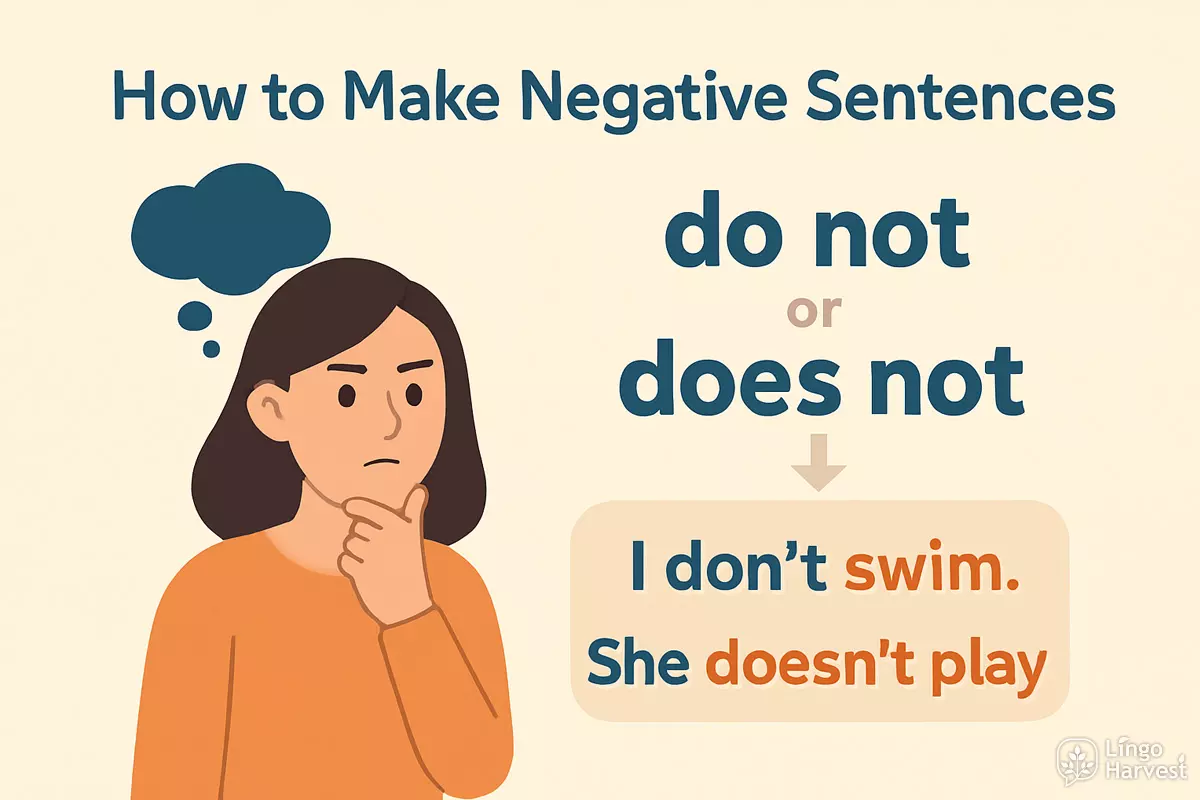
To say that something does not happen, add “do not” or “does not” before the main verb. The short forms “don’t” and “doesn’t” are also common in conversation. Notice that the verb after “do/does” stays in its base form (no “-s”).
- I do not like coffee.
- He does not play football.
- We don’t understand.
- She doesn’t work here.
- They do not agree.
- It doesn’t rain much.
- You do not need help.
- She doesn’t eat meat.
- He does not drive.
- I don’t remember.
How to Ask Yes/No Questions
To form a question, put “do” or “does” at the beginning, followed by the subject and the base verb. Don’t add “-s” to the verb, even with “does.”
- Do you like music?
- Does he speak Spanish?
- Do they live here?
- Does it work?
- Do we start now?
- Does she play tennis?
- Do I need to wait?
- Does your brother cook?
- Do the children sleep early?
- Does Anna drive to work?
Quick Reference: Present Simple with “Do/Does”
The following table summarizes the basic forms for making negatives and questions in the present simple. Notice how the verb form stays unchanged after “do/does.”
| Subject | Negative Example | Question Example |
|---|---|---|
| I/You/We/They | I do not (don’t) eat bread. | Do you eat bread? |
| He/She/It | She does not (doesn’t) eat bread. | Does he eat bread? |
| Plural Nouns | The dogs do not bark. | Do the dogs bark? |
| Singular Nouns | The cat does not sleep. | Does the cat sleep? |
Common Mistakes to Avoid
Using the wrong form is a frequent error. For example, “He don’t like pizza” is incorrect; it should be “He doesn’t like pizza.” Remember to use “does” with singular third person and keep the main verb in its base form. Understanding these patterns helps you build clear negative statements and questions in everyday English. With practice, these structures will become automatic.
Word Order in Simple Present
Understanding how to arrange words in present tense sentences is essential for building clear and correct statements in English. The structure can look a bit different depending on whether you are making a statement, asking a question, or giving a negative response.
Basic Sentence Structure
For positive statements using the simple present, English typically follows a Subject–Verb–Object pattern. This means you first say who or what the sentence is about (the subject), then what they do (the verb), and finally, what is affected by the action (the object), if there is one.
- She reads books.
- They play football.
- I eat breakfast.
- We watch movies.
- He drives a car.
- The dog barks.
- You learn English.
- It rains often.
- Anna cooks dinner.
- Birds sing songs.
Questions and Negatives
When turning a statement into a question in the simple present, English uses "do" or "does" at the start (except with the verb "to be"). For negatives, "do not" (don't) or "does not" (doesn't) comes before the main verb.
| Type | Word Order Example |
|---|---|
| Statement | Subject + Verb (+ Object) She drinks tea. |
| Negative | Subject + do/does not + Verb (+ Object) He does not work here. |
| Question | Do/Does + Subject + Verb (+ Object)? Do they play chess? |
| With "to be" | Am/Is/Are + Subject (+ Complement)? Are you ready? |
Key Points to Remember
- Use "does" for he, she, it; use "do" for I, you, we, they.
- The main verb stays in its base form in questions and negatives.
- For statements, add -s or -es to the verb for he, she, it (e.g., "She watches").
- No auxiliary is used for positive statements, except with "to be."
- Adverbs (like "always," "often," "never") usually come before the main verb: "They often visit us."
Mastering these patterns helps beginners form correct and natural sentences in daily conversation. Practice with a variety of subjects and verbs to become more comfortable with these word sequences.
Common Mistakes and Fixes
Understanding verbs can be tricky for newcomers, especially when it comes to picking the right form or remembering irregularities. Many learners fall into similar traps, but with careful attention and some practice, these issues are easy to overcome.
Mixing Up Verb Tenses
Using the wrong tense is a frequent pitfall. Beginners sometimes use the present instead of the past, or future forms when talking about current actions. This confuses listeners and can change the meaning of your sentence. Always check if your sentence refers to something happening now, in the past, or in the future.
Subject-Verb Agreement Errors
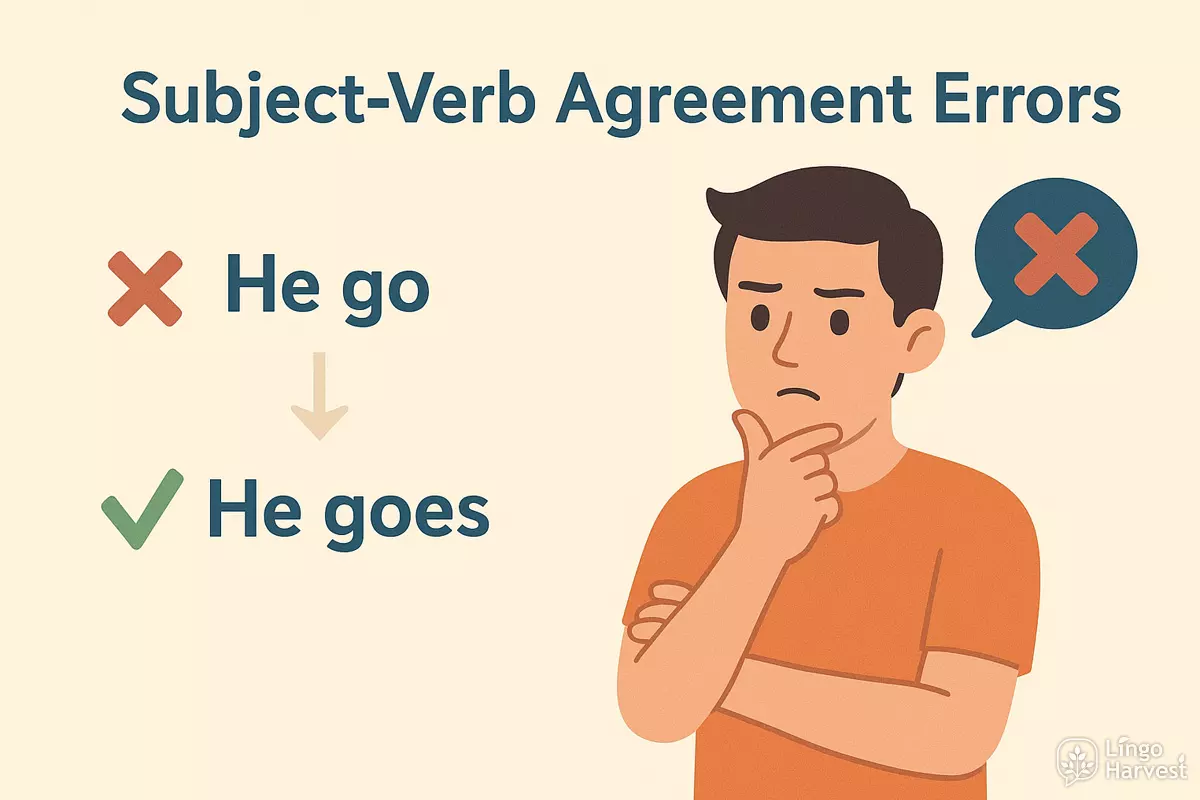
Another common challenge is matching verbs correctly with their subjects. For example, “He go” instead of “He goes.” This mistake can make speech sound unnatural and is easy to fix with practice.
- She runs every morning. ✅
- She run every morning. ❌
- They are happy. ✅
- They is happy. ❌
Confusing Regular and Irregular Forms
It’s easy to assume all verbs follow the same rules, but English has many exceptions. Regular verbs add “-ed” in the past (“walk” → “walked”), while irregular ones change in unique ways (“go” → “went”). Memorizing common irregular verbs helps avoid awkward mistakes.
| Base Form | Past Simple | Past Participle |
|---|---|---|
| go | went | gone |
| eat | ate | eaten |
| see | saw | seen |
| walk | walked | walked |
| play | played | played |
Omitting “Be” in Continuous Tenses
Leaving out the auxiliary verb “be” when using continuous forms is another frequent slip. For instance, “I going to school” should be “I am going to school.”
Tips to Avoid These Pitfalls
- Double-check your tense: Is the action happening now, before, or later?
- Say the sentence out loud; mistakes often sound wrong to your ear.
- Practice with common irregular verbs until they feel natural.
- Remember to adjust the verb for the subject: I am, you are, he/she/it is.
- Look for patterns, but watch for exceptions in English verb forms.
- Use simple sentences at first, then add complexity as you gain confidence.
Attentiveness and regular review make these issues easier to spot and fix. With time and exposure, using verbs correctly will become second nature.
Practice
Building confidence with action words starts with hands-on activities. Below are exercises and examples to help you notice, use, and understand these words in sentences. You’ll also see common patterns and forms, so you can recognize how verbs behave.
Spotting Action Words in Sentences
Read each sentence and identify the word that shows an action or state. This is a great way to train your eye for these essential parts of speech:
- She runs every morning.
- They are happy today.
- I eat breakfast at 7 a.m.
- The cat sleeps on the sofa.
- We play outside after school.
Show answers
- runs
- are
- eat
- sleeps
- play
Forms of Common Verbs
Knowing the basic forms helps you build sentences correctly. Here’s a quick overview of some frequently used verbs in different forms:
| Base Form | Past Simple | Present Participle | Third Person Singular |
|---|---|---|---|
| go | went | going | goes |
| eat | ate | eating | eats |
| make | made | making | makes |
| see | saw | seeing | sees |
| be | was/were | being | is |
| have | had | having | has |
Exercise: Complete the Sentences
Choose the correct word from the list to fill in each blank:
- He ______ (plays/play) football on Sundays.
- We ______ (is/are) ready to go.
- I ______ (see/saw) a rainbow yesterday.
- She ______ (make/makes) delicious cakes.
- They ______ (go/goes) to school together.
Show answers
- plays
- are
- saw
- makes
- go
Everyday Action Words to Learn
Here’s a handy list of useful verbs for daily conversation and writing. Try to use each in your own sentence:
- read
- write
- listen
- walk
- talk
- drink
- find
- think
- open
- close
- feel
- call
- give
- take
- help
- wait
- learn
- show
- ask
- answer
Regular practice with these activities will help you recognize and use verbs naturally, making your sentences clearer and more expressive.