Collocation Bins: do / have / make / take + noun patterns

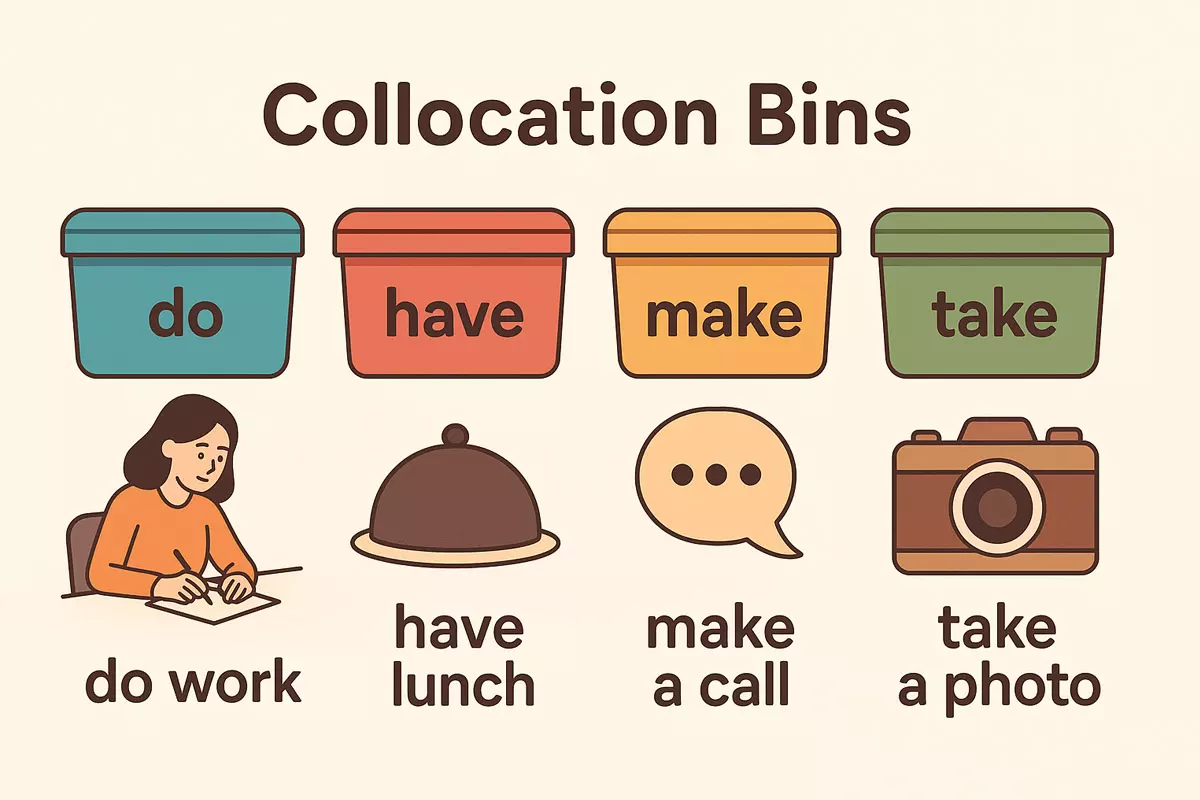 This article explains collocation bins and shows which core verbs—do, make, have, and take—commonly pair with certain nouns. It covers typical patterns, how verb choice affects meaning, and includes practice exercises.
Mastering the art of pairing common action verbs such as do, have, make, and take with the appropriate nouns is essential for sounding more natural in English. These verb-noun combinations, often called collocations, are used frequently by native speakers and help your speech and writing flow more smoothly. By learning and practicing these collocations, you can express yourself more clearly and confidently in a wide range of everyday situations, making your English communication much more effective and authentic.
What Collocation Bins Are
When learning English, it’s helpful to recognize that certain verbs frequently pair with specific nouns to form natural-sounding expressions. These common pairings are often sorted into groups known as “collocation bins.” Each bin includes combinations built around a particular verb—like do, have, make, or take—plus a range of nouns that typically follow them. By grouping these patterns, learners can more easily remember and use them correctly in conversation and writing.
Understanding the Purpose of Collocation Bins
Native speakers rarely stop to think about which verb to use with which noun—such as “make a decision” instead of “do a decision.” For language learners, however, these combinations can be confusing. Organizing expressions into bins helps clarify which noun fits with each verb, reducing guesswork and making speech sound more natural.
Benefits of Grouping Collocations
- Improves fluency by encouraging the use of authentic phrases
- Reduces mistakes from incorrect verb-noun pairings
- Makes it easier to memorize and recall common expressions
- Highlights subtle differences in meaning or usage
- Boosts confidence when speaking or writing
Examples of Collocation Bins: do / have / make / take
Below is a table with sample noun collocations for each of the four verbs. Notice how each verb “owns” certain expressions, and switching verbs often sounds unnatural or changes the meaning.
| Verb | Common Noun Collocations |
|---|---|
| do | homework, the dishes, a favor, business, exercise |
| have | a shower, a break, lunch, an idea, a chat |
| make | a decision, a mistake, a call, an effort, a plan |
| take | a photo, a seat, a risk, notes, a test |
Why This Matters
Mastering these bins helps you avoid typical errors, like saying “make homework” or “do a shower.” By sorting expressions into these groups, you’ll find it easier to build accurate and idiomatic sentences. As you expand your vocabulary, adding new nouns to each verb group becomes a natural process, strengthening your overall language skills.
Core Verbs Used in Bin Patterns
When English speakers combine certain verbs with nouns, some word pairings sound natural while others do not. These groupings, sometimes called "collocation bins," rely heavily on a handful of versatile verbs: do, have, make, and take. Each of these verbs forms set phrases with specific nouns, and choosing the right verb often depends on convention rather than logic.
Overview of the Main Verbs
- Do is commonly used with tasks, work, and non-specific activities.
- Have often appears with nouns for experiences, possessions, and states.
- Make is typically used with nouns that involve creation, production, or causing change.
- Take tends to partner with nouns for actions, opportunities, or physical processes.
Typical Noun Partners
The following examples show how these four verbs combine with common nouns. Choosing the correct verb is crucial for fluent, idiomatic English.
| Verb | Common Collocations (Noun Partners) |
|---|---|
| do | homework, the dishes, a favor, business, exercise, work, research, the laundry, a job, a test |
| have | a break, lunch, a chance, an idea, a bath, a look, fun, a dream, a rest, a meeting |
| make | a decision, a mistake, money, a call, a promise, an effort, a plan, a choice, a suggestion, a list |
| take | a photo, a shower, a risk, a seat, a walk, notes, a break, a test, responsibility, a nap |
Key Points for Usage
- Many noun + verb combinations are fixed; using the wrong verb can sound unnatural (e.g., ❌ make homework → ✅ do homework).
- Some nouns, like break or test, can combine with more than one verb, but the meaning or context will change.
- Memorizing common pairings helps learners avoid mistakes and sound more fluent.
Typical do-Collocations
When talking about actions, tasks, or general activities, English often uses "do" with certain nouns to create common expressions. These pairings are especially frequent when the activity is broad, routine, or does not produce a concrete result. Understanding which nouns naturally combine with "do" can help learners sound more natural and avoid awkward phrasing.
Common Activities and Tasks
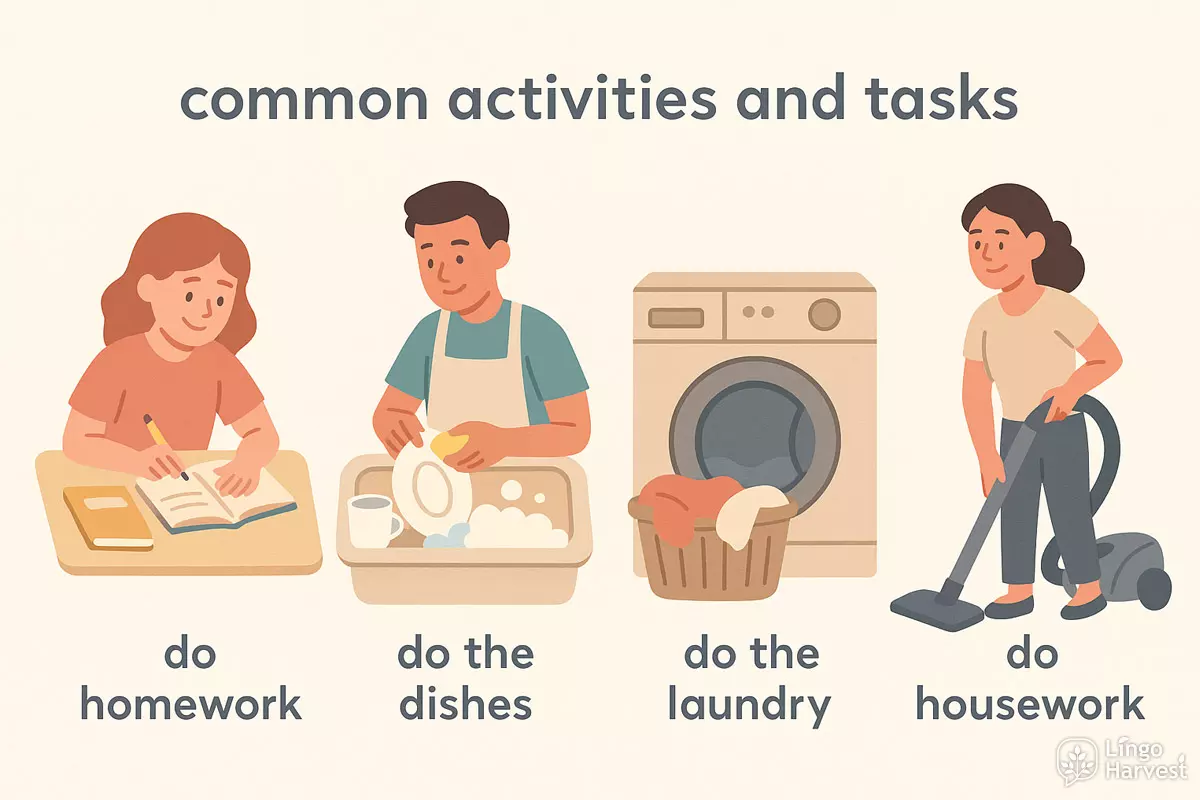
"Do" is commonly used with a range of nouns that refer to work, chores, or unspecified actions. Here are some of the most frequent combinations:
- do homework
- do the dishes
- do the laundry
- do housework
- do business
- do a favor
- do research
- do a job
- do an exercise
- do your best
- do damage
- do harm
- do a course
- do time (serve a prison sentence)
- do your hair
- do a project
- do a puzzle
- do a test
General and Non-Specific Actions
Sometimes, "do" is used when the action itself is more important than the result, or when the specific details are not given. For example:
- do something
- do nothing
- do everything
- do anything
These patterns are especially useful for speaking in general terms or when the exact activity is not the focus.
Comparison: "Do" vs. Other Verbs
Learners often confuse "do" with "make," "have," or "take." To clarify, here are some examples comparing "do" with other common collocation verbs:
| With "do" | Similar, but not with "do" |
|---|---|
| do homework | make a mistake |
| do the dishes | take a shower |
| do research | have a break |
| do a favor | make a decision |
By learning which nouns combine naturally with "do," you can avoid common errors and make your English more fluent and idiomatic. While some combinations may overlap with other verbs, the collocations listed above are widely accepted and recognized in everyday use.
Typical make-Collocations
When using "make" with nouns in English, certain word combinations are much more natural and frequent than others. These patterns often relate to producing, causing, or planning something, and are best learned as fixed expressions. Recognizing these pairings helps learners sound more fluent and reduces hesitation in conversation.
Common Expressions with "make"
You’ll find "make" used with a variety of nouns to express actions, decisions, or the creation of something. Here are some of the most widely used examples:
- make a decision
- make a mistake
- make an effort
- make a choice
- make a suggestion
- make a promise
- make a plan
- make a phone call
- make an appointment
- make progress
- make an excuse
- make a complaint
- make a deal
- make a list
- make a wish
- make a point
- make friends
- make money
- make a noise
- make a difference
Usage Patterns and Nuances
Many of these collocations are not interchangeable with "do," "have," or "take." For example, "make a mistake" is correct, but "do a mistake" is not. This is why memorizing these combinations as set phrases is helpful.
Comparison Table: "Make" vs. Other Verbs
Some nouns may seem like they could go with more than one verb, but only one is correct in standard usage. Here’s a quick comparison to clarify which verb fits with which noun:
| Noun | ✅ Correct Verb | ❌ Incorrect Verb Example |
|---|---|---|
| decision | make a decision | do a decision |
| progress | make progress | do progress |
| promise | make a promise | do a promise |
| effort | make an effort | do an effort |
| list | make a list | do a list |
Tips for Mastery
To use these expressions naturally, try to learn them in context, such as in sentences or short dialogues. Noticing them in reading or listening materials will also reinforce correct usage. In summary, combining "make" with these nouns is an essential part of everyday English, and mastering these common pairings will make your speech and writing more idiomatic.
Typical have-Collocations
In English, the verb "have" often combines with nouns to form fixed expressions. These patterns are widely used in both spoken and written language, covering everything from daily activities to more formal situations. Mastering these combinations helps learners sound natural and fluent.
Common Expressions with "Have"
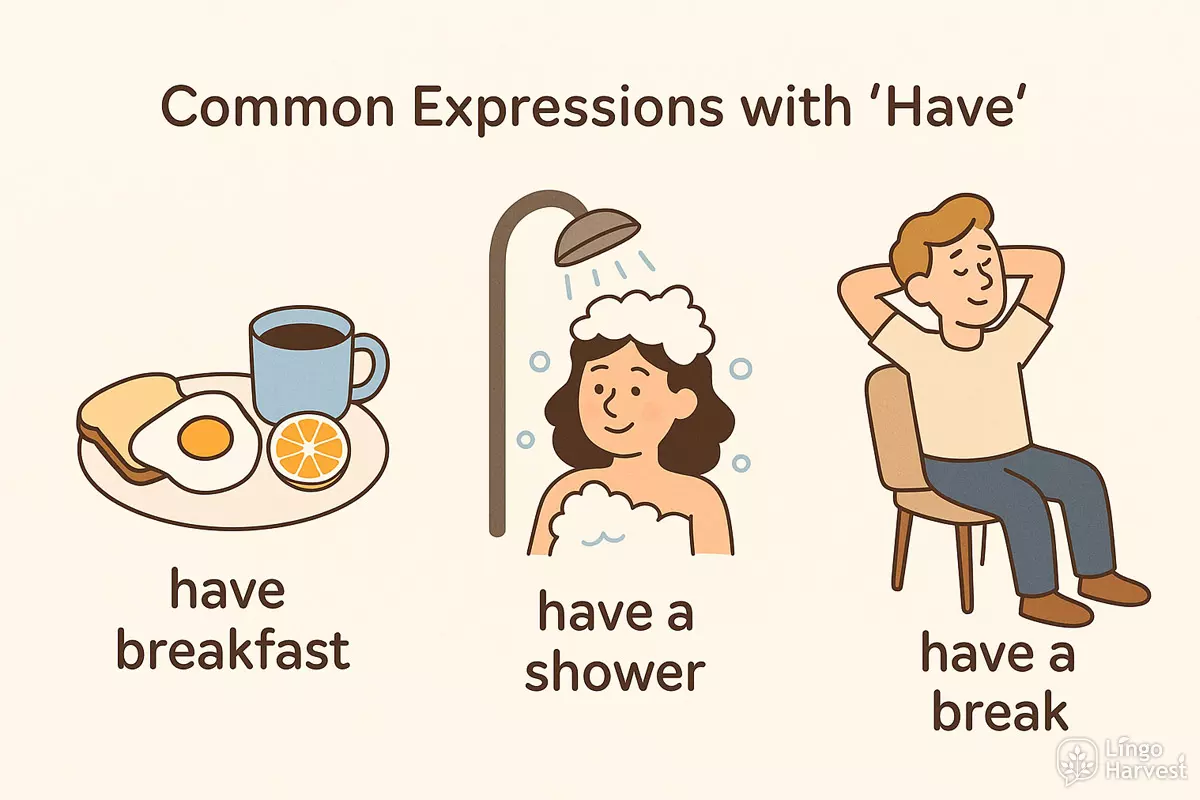
Some of the most frequent noun partners for "have" relate to basic needs, experiences, or scheduled events. Here are several everyday examples:
- have breakfast
- have a shower
- have a break
- have a meeting
- have a look
- have a rest
- have a conversation
- have lunch
- have a problem
- have an idea
- have a chance
- have a nap
- have a drink
- have fun
- have a good time
- have a baby
- have a headache
- have a party
- have a word (with someone)
- have faith
Types of "Have" Collocations
The use of "have" with nouns can be grouped into categories based on meaning. For example, some refer to actions (like "have a shower"), others to states or possessions (such as "have a problem"), and some to experiences (for example, "have fun"). Understanding these types makes it easier to select the right expression in context.
| Expression | Typical Meaning or Use |
|---|---|
| have a shower / bath | To wash oneself; a daily routine action |
| have a break | To pause from work or activity for rest |
| have an idea | To think of something new; a moment of inspiration |
| have a meeting | To participate in a planned discussion or event |
| have a headache | To experience pain in the head |
| have fun | To enjoy oneself; to be entertained |
| have a problem | To face a difficulty or challenge |
| have a baby | To give birth; to become a parent |
Usage Tips
Many of these combinations cannot be replaced by other verbs without changing the meaning or making the phrase sound unnatural. For instance, we say "have a nap" rather than "do a nap" or "make a nap." Practicing these structures in real-life contexts is the best way to remember and use them correctly.
By becoming familiar with these set phrases, you’ll find it easier to communicate smoothly and understand native speakers in everyday situations.
Typical take-Collocations
When it comes to English verb patterns, "take" appears in a range of common expressions. These combinations are often fixed, meaning you can’t easily swap in another verb without changing the meaning or making the phrase sound unnatural. Mastering these set phrases can help your English sound much more fluent and idiomatic.
Frequent noun partners for "take"
The verb "take" is widely used with nouns to form natural-sounding phrases. Here are some of the most frequent pairings:
- take a break
- take a seat
- take a chance
- take a look
- take responsibility
- take a photo / picture
- take notes
- take action
- take advice
- take part (in)
- take a risk
- take a test / exam
- take a shower / bath
- take care (of)
- take a deep breath
- take medicine
- take a decision
- take a walk
- take a stand
- take cover
How meaning changes with "take"
These noun combinations often create meanings that are not always predictable from the individual words. For instance, "take a break" means to pause your activity, while "take a stand" means to adopt a firm position on an issue. It’s important to learn these as whole units rather than translating word by word.
Comparing "take" with similar verbs
Some expressions with "take" can be confused with similar collocations using "have," "make," or "do." The table below illustrates how the choice of verb changes the meaning or acceptability of the phrase.
| Expression | Correct Verb |
|---|---|
| a shower | take / have |
| notes | take |
| an exam | take / do |
| care (of) | take |
| a decision | make / take (BrE) |
| action | take |
| a photo | take |
Usage tips
Some collocations are more common in British or American English. For example, "take a decision" is more frequent in British English, while "make a decision" is standard in American English. Pay attention to these regional differences, and try to notice how native speakers use "take" with different nouns in context. Focusing on these fixed expressions will make your spoken and written English more natural. Try to learn them as whole phrases, and practice using them in sentences to build confidence.
How Collocation Choice Changes Meaning
Choosing between verbs like do, have, make, and take with nouns isn’t just about grammar—it shapes the nuance of what you’re saying. Each verb brings its own shade of meaning, and picking the wrong one can easily lead to confusion or an unnatural-sounding sentence. For example, “make a decision” and “take a decision” might look similar, but the first is standard in American English while the second is more common in British English.
Why the Verb Matters
The verb chosen in a collocation often hints at the action, responsibility, or result involved. For instance, “do homework” focuses on completing a task, while “make progress” emphasizes the process of improvement. These subtle differences can change how your message is received.
Common Collocation Patterns and Their Effects
- Do a favor → Performing a helpful act
- Have lunch → Taking part in a meal
- Make a mistake → Causing an error
- Take a break → Pausing from activity
- Do business → Engaging in commerce
- Have an idea → Possessing a thought
- Make a plan → Creating intentions
- Take a photo → Capturing an image
- Do the dishes → Washing up
- Have a conversation → Participating in dialogue
- Make money → Earning income
- Take responsibility → Accepting duty
- Do your best → Trying hard
- Have a look → Inspecting briefly
- Make an effort → Trying
- Take notes → Writing information
- Do research → Investigating
- Have a bath → Bathing
- Make a complaint → Expressing dissatisfaction
- Take a risk → Facing danger
Comparing Collocations: How Meaning Shifts
| Verb + Noun | Meaning / Example |
|---|---|
| Do a job | Perform work or a task She did a great job on the project. |
| Make a job | Create employment or a position The company made new jobs last year. |
| Take a test | Sit for an exam He will take a test tomorrow. |
| Do a test | Complete or work through a test (sometimes used in British English) The students did a test in class. |
| Have a meeting | Participate in a meeting We have a meeting at noon. |
| Make a meeting | Organize or arrange a meeting Can you make a meeting for us? |
| Take a call | Answer a phone call She’ll take your call now. |
| Make a call | Initiate a phone call I need to make a call. |
By being attentive to which verb pairs with which noun, you can avoid awkward phrasing and communicate your intended meaning clearly. These patterns are often fixed, so learning them as chunks is more effective than trying to translate word-for-word from your native language.
Practice: Pick the Correct Verb for Each Noun
Choosing the right verb to pair with a noun is essential for natural English. Below, you'll find exercises to help you master common "do," "have," "make," and "take" collocations. Read each sentence, then select the best verb for the noun given.
Match the Verb to the Noun
For each noun below, decide which verb (do, have, make, or take) naturally fits. If you're not sure, think about how you'd hear it in everyday conversation.
- _____ a decision
- _____ a shower
- _____ an exam
- _____ a suggestion
- _____ a break
- _____ an effort
- _____ a mistake
- _____ responsibility
- _____ a look
- _____ progress
- _____ a seat
- _____ a conversation
- _____ a complaint
- _____ a promise
- _____ a risk
- _____ a party
- _____ a nap
- _____ business
- _____ a favor
- _____ a plan
Show answers
- make a decision
- take a shower
- take an exam
- make a suggestion
- take a break
- make an effort
- make a mistake
- take responsibility
- have a look
- make progress
- take a seat
- have a conversation
- make a complaint
- make a promise
- take a risk
- have a party
- take a nap
- do business
- do a favor
- make a plan
Common Collocation Patterns: Quick Reference
It's helpful to see which nouns usually go with each verb. Here's a table showing typical pairings to reinforce your understanding.
| Noun | Best Verb |
|---|---|
| coffee | have |
| homework | do |
| notes | take |
| an appointment | make |
| photos | take |
| fun | have |
| friends | make |
| money | make |
| your bed | make |
| an effort | make |
| an excuse | make |
| a mess | make |
| an appointment | make |
| an impression | make |
| your time | take |
| exercise | do |
| lunch | have |
| a decision | make |
| a call | make |
| a bath | take/have |
Mini Quiz: Complete the Sentences
- He always _____ his homework after dinner.
- We _____ a lot of fun at the party last night.
- Can you _____ a photo of us together?
- She _____ a promise to call me.
- They _____ a break after two hours of work.
Show answers
- does
- had
- take
- made
- took
Practicing with these examples will help you remember which verbs to use with common nouns, making your English more natural and fluent.