Imperatives: How to Give Simple Instructions in English

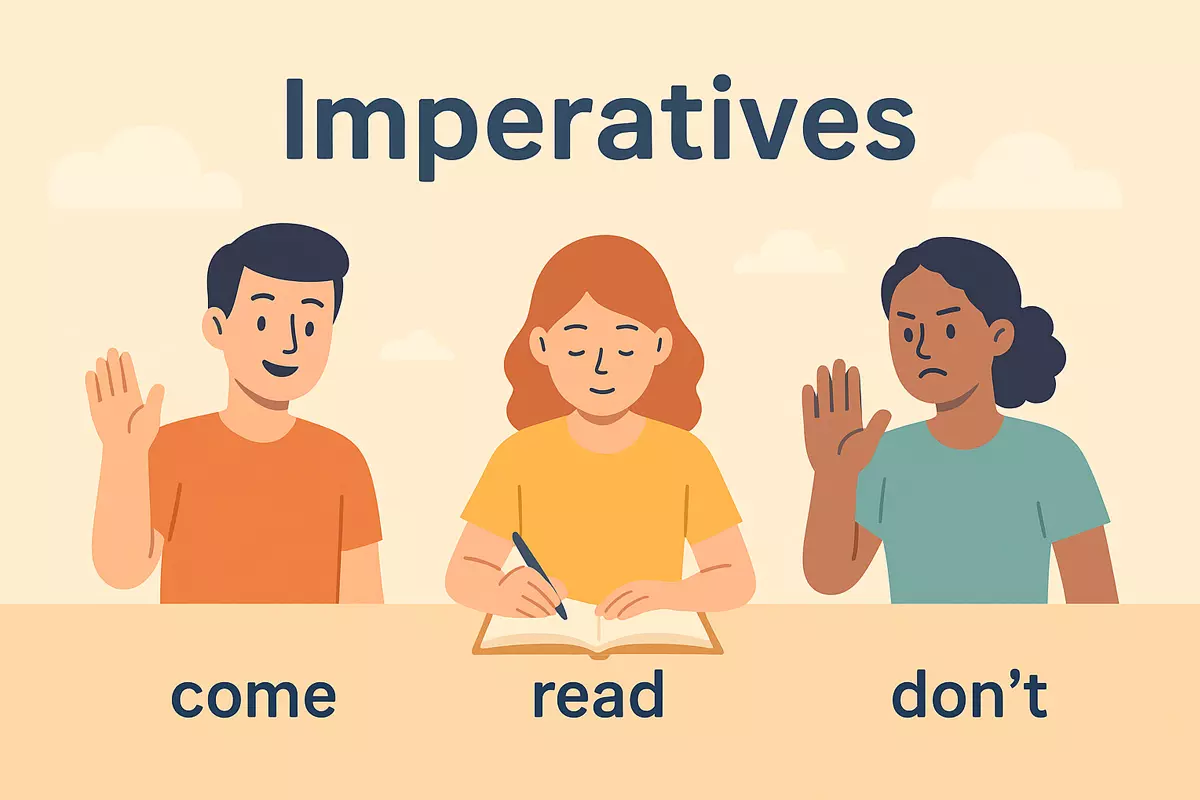 This article explains what the imperative form is, covers both positive and negative commands, and shows how to use polite language. It includes tips for sequencing instructions, examples from daily life, common mistakes, and practice exercises.
Being able to give clear and direct instructions is a crucial skill in everyday communication. This article will show you how straightforward it can be to ask for something or tell someone what to do in English, using simple and effective language. Whether you need to make a request, offer guidance, or provide step-by-step directions, learning a few basic structures can help you communicate your message confidently and avoid misunderstandings in a variety of situations.
What the Imperative Form Is
The imperative is a verb form used to give instructions, commands, requests, or advice. It is direct and clear, making it ideal for telling someone exactly what to do. In English, this form typically uses the base form of the verb without a subject. For example, instead of saying “You open the window,” you simply say, “Open the window.” The subject “you” is understood, so it’s not stated.
How Imperatives Are Formed
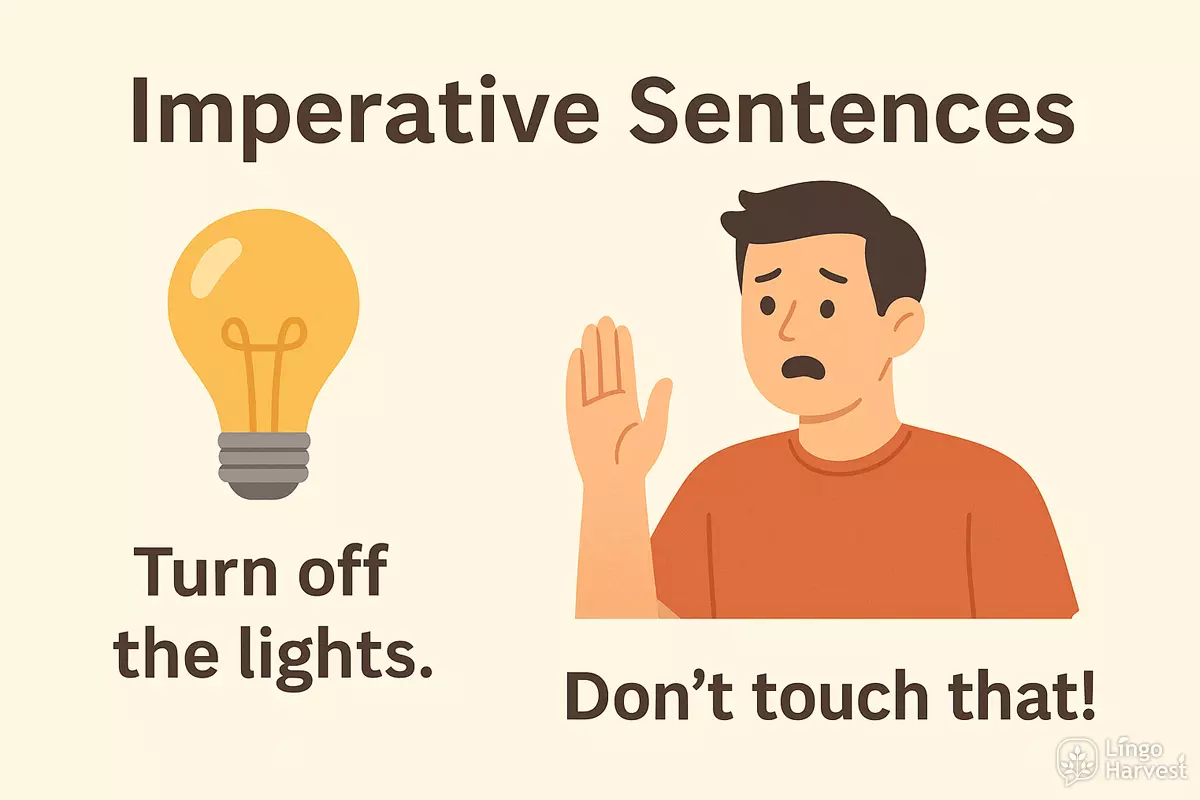
To use this structure, start with the infinitive of the verb (the base form) and drop “to.” There is no need to add “do” or any other auxiliary verb. Negative instructions are made by putting “don’t” before the verb.
- Turn off the lights.
- Don’t touch that!
- Please sit down.
- Be quiet.
- Don’t forget your keys.
- Take a deep breath.
- Keep going.
- Don’t be late.
- Listen carefully.
- Write your name here.
- Don’t worry.
- Wait for me.
When to Use Imperatives
Imperatives are most commonly found in:
- Instructions and manuals (e.g., “Insert the disk.”)
- Signs and warnings (e.g., “Keep out!”)
- Recipes and guides (e.g., “Chop the onions.”)
- Friendly advice (e.g., “Try to relax.”)
- Requests (often with “please,” e.g., “Please hand me the book.”)
Positive vs. Negative Imperatives
| Type | Example |
|---|---|
| Positive | Close the door. |
| Negative | Don’t run. |
| Positive | Take your seat. |
| Negative | Don’t forget your homework. |
In conversation, this direct style is often softened with “please” or a polite tone. For example, “Please wait here” is friendlier than “Wait here.” Imperatives can sound abrupt if not used carefully, especially in English-speaking cultures where politeness is valued. Imperative sentences are a fundamental tool for clear communication, especially when giving directions, making requests, or offering advice. Understanding how to use them will help you sound more natural and effective in everyday English.
Positive and Negative Commands
When giving instructions in English, you can tell someone what to do (affirmative) or what not to do (negative). Both forms are direct and clear, which makes them useful for everyday situations, classroom settings, recipes, directions, and more.
How to Form Affirmative Imperatives
Making a positive directive is simple: use the base form of the verb without a subject. This structure is used for requests, advice, or orders.
- Open the window.
- Take a seat.
- Please listen carefully.
- Write your name here.
- Turn left at the corner.
- Wait for your turn.
- Try again.
- Speak slowly.
- Read the instructions.
- Call me when you arrive.
Politeness can be added by using "please" at the beginning or end of the sentence.
Making Negative Imperatives
To tell someone not to do something, simply add "do not" or the contraction "don’t" before the verb. This form is used for warnings, prohibitions, or advice.
- Don’t touch that.
- Do not enter.
- Don’t forget your keys.
- Don’t be late.
- Do not disturb.
- Don’t make noise.
- Don’t run in the hallway.
- Do not feed the animals.
- Don’t use your phone here.
- Don’t worry.
Comparing Affirmative and Negative Instructions
The difference between telling someone to do something and telling them not to do it is clear in the verb form. Here is a comparison of common patterns:
| Affirmative Command | Negative Command |
|---|---|
| Sit down. | Don’t sit down. |
| Start now. | Don’t start yet. |
| Close the door. | Don’t close the door. |
| Speak up. | Don’t speak. |
| Touch the screen. | Don’t touch the screen. |
Using these forms helps you communicate instructions efficiently. Remember, tone and context matter—sometimes a polite request is better than a strict command, especially in social or formal situations.
Using Please, Let’s and Polite Tone
When giving instructions in English, how you express yourself can make a big difference. Adding words like “please” or using “let’s” helps your message sound more friendly and cooperative. This is especially important in classrooms, workplaces, or when talking to people you don’t know well.
Making Imperatives Polite
Simply telling someone what to do (“Sit.”, “Open the door.”) can sound direct. To soften the request or instruction, you can add certain words or change your tone. “Please” is the most common way to make a command more courteous. Placing “please” at the start or end of the sentence works well:
- Please close the window.
- Close the window, please.
- Could you please be quiet?
- Pass me the salt, please.
Inviting Cooperation with “Let’s”
When you want to include yourself in the action, “let’s” is useful. It’s an invitation rather than an order. This form is friendly and encourages teamwork:
- Let’s start the meeting.
- Let’s take a break.
- Let’s clean up together.
- Let’s check our work.
Comparing Direct, Polite, and Inclusive Imperatives
The table below shows how the same instruction changes tone using different forms:
| Direct | Polite | Inclusive (Let’s) |
|---|---|---|
| Turn off the lights. | Please turn off the lights. | Let’s turn off the lights. |
| Start reading. | Could you start reading, please? | Let’s start reading. |
| Be quiet. | Please be quiet. | Let’s try to be quiet. |
| Finish your homework. | Finish your homework, please. | Let’s finish our homework. |
| Listen carefully. | Please listen carefully. | Let’s listen carefully. |
Extra Ways to Soften Instructions
Besides “please” and “let’s,” there are other phrases and strategies to make commands sound less forceful:
- Would you mind closing the door?
- Could you help me with this?
- Do you think you could pass the pen?
- It would be great if you could join us.
- Why don’t we start now?
- Shall we go?
- Maybe we can try this together.
- I’d appreciate it if you could listen.
Being mindful of your tone and word choice not only shows respect but also increases the chances that your instructions will be followed. Using these techniques helps create a positive and cooperative atmosphere in any situation.
Sequencing Instructions Clearly
Guiding someone through a task is much easier when each step is presented in a logical order. In English, certain words and phrases help organize instructions so that actions are completed in the correct sequence. This not only prevents confusion, but also makes your directions much easier to follow.
Using Sequencing Words and Phrases
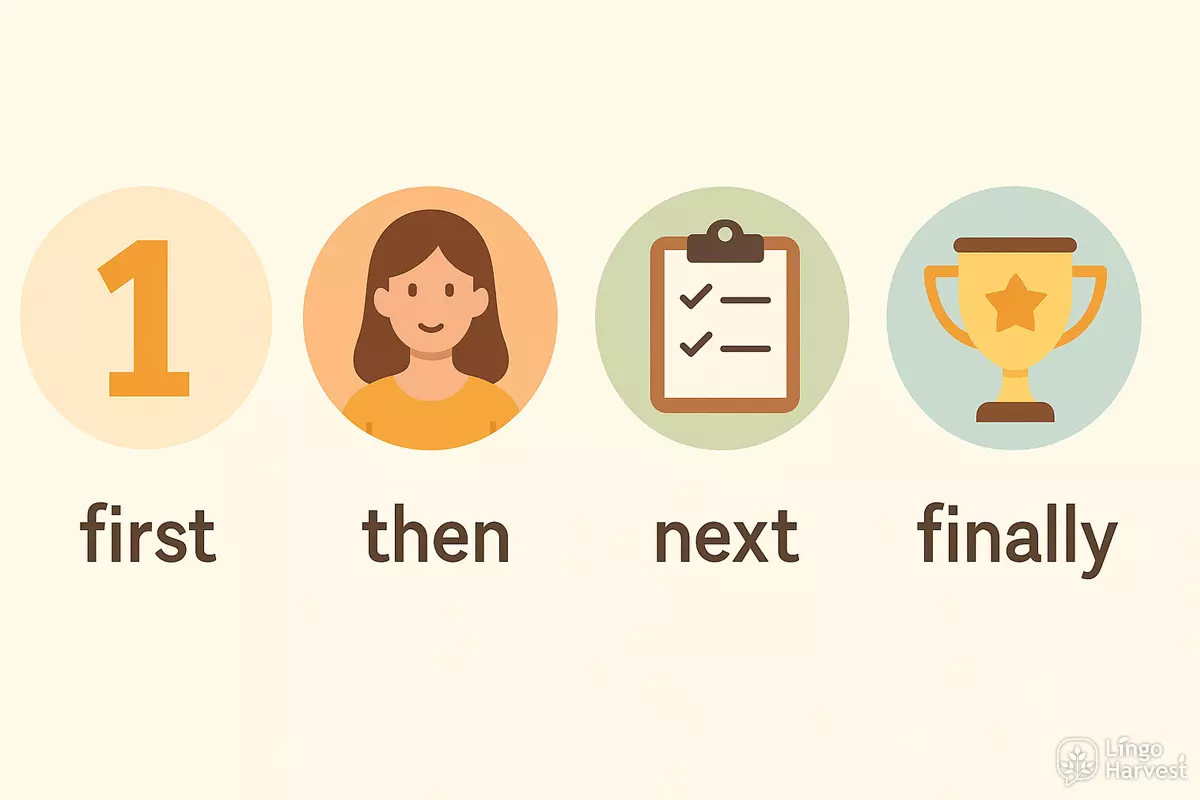
Words like "first," "then," "next," and "finally" are commonly used to indicate the order of steps. These transition words act as signposts, showing what should happen at each stage. Here are some useful sequencing expressions you can include when giving directions or describing a process:
- First
- To begin with
- Initially
- After that
- Then
- Next
- Once you have...
- When you finish...
- Before you...
- Meanwhile
- At the same time
- Afterwards
- Finally
- In the end
- Last of all
- Don’t forget to...
- Make sure to...
- Lastly
Building Clear Step-by-Step Instructions
Organizing directions with clear transitions minimizes mistakes. For example, instead of simply listing actions, connect them using sequencing language:
- First, preheat the oven to 180°C.
- Next, mix the flour and sugar.
- After that, add the eggs and stir well.
- Finally, bake for 25 minutes.
This approach helps listeners or readers understand the correct order and prevents them from skipping important steps.
Common Mistakes to Avoid
- Missing steps that are necessary for the process.
- Using vague references like “do the thing” instead of clear verbs.
- Not stating the order, leading to confusion or tasks done incorrectly.
- Repeating steps or omitting transitions.
Sequencing Words: Placement and Usage
The position of sequencing adverbs and phrases can vary. Sometimes they start a sentence, and other times they come after the subject. Compare these two patterns:
- Then, pour the mixture into the pan.
- Pour the mixture into the pan then let it cool.
Both are correct, but starting with the sequencing word often makes directions clearer, especially for beginners.
Examples for Everyday Tasks
Below is a comparison table showing how sequencing language can transform basic instructions into clear, step-by-step directions.
| Basic Instruction | With Sequencing Language |
|---|---|
| Wash the vegetables. Cut them. Cook them. | First, wash the vegetables. Next, cut them. Then, cook them. |
| Turn on the computer. Open the document. Print it. | First, turn on the computer. Then, open the document. Finally, print it. |
| Mix the ingredients. Bake the cake. Serve. | First, mix the ingredients. After that, bake the cake. Lastly, serve. |
| Find the page. Read the text. Answer the questions. | First, find the page. Next, read the text. Then, answer the questions. |
Using sequencing terms and clear action verbs will make your instructions much more effective. This approach is especially useful when teaching, writing manuals, or helping someone complete a new task.
Examples from Class, Cooking, and Travel
When you want someone to do something, using clear, direct language is essential. In English, imperatives are the go-to form for simple instructions. Whether you are teaching a lesson, preparing food, or guiding someone through an airport, the patterns are similar—short, direct sentences that start with the verb.
Classroom Instructions
In educational settings, teachers use straightforward commands to guide students. Here are some typical phrases:
- Open your books.
- Listen carefully.
- Turn to page ten.
- Write your name at the top.
- Repeat after me.
- Don’t talk.
- Raise your hand.
- Work in pairs.
- Check your answers.
- Close the door, please.
Cooking Instructions
Recipes and kitchen routines rely on simple, direct steps. These commands help keep cooking organized and safe:
- Preheat the oven to 180°C.
- Chop the onions.
- Add the salt.
- Stir well.
- Boil for ten minutes.
- Don’t burn the garlic.
- Mix all ingredients.
- Serve hot.
- Let it cool.
- Wash your hands.
Travel and Directions
When traveling or giving directions, short imperatives help people understand quickly and avoid confusion. Some common phrases include:
- Go straight.
- Turn left at the corner.
- Take the second exit.
- Show your passport.
- Wait here.
- Don’t cross the line.
- Follow the signs.
- Keep your ticket ready.
- Board the train now.
- Ask for help if needed.
Comparing Imperative Forms
Sometimes, you need to soften a command or make it more polite, especially in public or formal situations. Here’s how different forms compare:
| Direct Instruction | Polite/Indirect Alternative |
|---|---|
| Close the window. | Could you close the window, please? |
| Pass the salt. | Would you mind passing the salt? |
| Wait here. | Please wait here. |
| Don’t touch that. | It’s better not to touch that. |
| Take a seat. | Please take a seat. |
These examples show that while the basic imperative is simple and clear, adapting your tone can make your instructions more suitable for different contexts. Practice using both direct and polite forms to communicate your message effectively.
Common Mistakes to Avoid
When using imperatives to give instructions in English, learners often encounter pitfalls that can make their directions unclear or even impolite. Recognizing these frequent errors can help you communicate more effectively and politely.
Forgetting to Use the Base Form
One frequent issue is using the wrong verb form. Imperatives always require the base form of the verb, without “to” or any endings. For example, say “Open the window,” not “To open the window” or “Opens the window.”
Sounding Too Direct or Rude
Direct commands can come across as harsh in English if not softened. Adding “please” or using a polite tone can make a big difference. Compare:
- Shut the door. ❌
- Please shut the door. ✅
Misplacing Negatives
When making negative instructions, “do not” or “don’t” should come before the base verb. Avoid placing “not” after the verb or at the end of the sentence.
| Incorrect | Correct |
|---|---|
| Not touch the switch. | Don’t touch the switch. |
| Do touch not that. | Do not touch that. |
| Touch not the wire. | Don’t touch the wire. |
| Don’t to speak. | Don’t speak. |
Omitting the Subject (When Needed)
Although the subject (“you”) is usually omitted in imperatives, sometimes it’s necessary for emphasis or clarity, especially in group settings (“Everybody listen!”). Forgetting this can make the instruction vague.
Mixing Imperatives with Questions
Confusing commands and questions leads to unclear instructions. For instance, “Can you close the door?” is a polite request, not an imperative. Stick to the base verb for straightforward directions.
Overusing Imperatives
Using too many commands in succession can seem bossy. It’s helpful to mix in suggestions or requests to keep your communication friendly.
List of Typical Errors
- Adding “please” in the wrong place (“Close please the door.”)
- Using continuous or past forms (“Be closing the window.”)
- Omitting objects (“Take.” instead of “Take a seat.”)
- Translating word-for-word from your native language
- Using “let’s” for solo actions (“Let’s go to sleep.” when you mean only yourself)
- Placing adverbs incorrectly (“Quickly, come here.” should be “Come here quickly.” for clarity)
- Starting with “You” (“You clean your room.” instead of “Clean your room.”)
- Forgetting context (giving commands without explanation)
- Using double negatives (“Don’t never touch that.”)
- Being too brief and causing confusion (“Do it!” without specifying what “it” is)
By being aware of these common slip-ups, you can give clear, polite, and effective instructions in English that are easy for others to follow.
Practice: Rewrite Instructions
Sharpen your command-giving skills by transforming wordy or unclear directions into clear, concise imperatives. This activity helps you recognize and produce simple instruction forms in English, making your communication more direct and effective.
Below are several sentences written in less direct or overly polite language. Your task is to rewrite each one as a straightforward imperative. Remember, imperatives often drop the subject ("you") and start with the verb:
Task 1: Make These Instructions Direct
- Could you please turn off the lights when you leave the room?
- I would appreciate it if you could hand me that book.
- If it's not too much trouble, can you close the window?
- It would be great if you could call me back later.
- Would you mind washing your hands before dinner?
- Can you please write your name at the top of the page?
- Don't forget to lock the door before you go out.
- Please remember to feed the cat in the morning.
- Be sure to check your answers before submitting the test.
- Make sure that you arrive on time for the meeting.
Show answers
- Turn off the lights when you leave the room.
- Hand me that book.
- Close the window.
- Call me back later.
- Wash your hands before dinner.
- Write your name at the top of the page.
- Lock the door before you go out.
- Feed the cat in the morning.
- Check your answers before submitting the test.
- Arrive on time for the meeting.
Task 2: Identify the Imperative
Read the following sentences and decide which ones are written as imperatives. Mark them with ✅.
- Open your books to page 20.
- You should open your books to page 20.
- Don’t touch that button.
- Could you not touch that button?
Show answers
- ✅ Open your books to page 20.
- You should open your books to page 20.
- ✅ Don’t touch that button.
- Could you not touch that button?
Common Imperative Patterns
Here are some frequent ways to give instructions in English. Notice how each pattern is used to deliver clear, direct commands:
- Turn off the TV.
- Don’t forget your keys.
- Please sit down.
- Wait here.
- Be quiet.
- Don’t run.
- Take a seat.
- Read the instructions carefully.
- Wash your hands.
- Follow me.
- Don’t touch.
- Listen closely.
- Keep the door closed.
- Write your answer here.
- Check your work.
- Speak clearly.
- Don’t interrupt.
- Look at the board.
- Stay calm.
- Finish your homework.
By practicing these transformations and recognizing imperatives, you will become more confident in giving and understanding clear instructions in everyday English.