Encouragement and Praise: Well Done! Good Job!

 Here we when praise is most effective, practical phrases for study and work, the difference between targeted and generic praise, how to balance praise with advice, cultural notes on frequency, sample dialogues, and tips for avoiding overuse or sarcasm.
Recognizing and celebrating achievements, whether they are big or small, plays a significant role in boosting motivation and self-esteem. Providing positive feedback and authentic encouragement helps individuals feel valued and supported, which in turn nurtures their growth and strengthens their confidence. This approach benefits people of all ages, as it creates an environment where accomplishments are acknowledged and efforts are appreciated, ultimately promoting continuous personal development and a more positive outlook.
When Praise Works Best
Recognizing the right moments to offer encouragement or positive feedback can make a significant difference in how it's received. Praise tends to be most effective when it's specific, timely, and genuinely reflective of effort or progress. Instead of reserving compliments for major achievements alone, acknowledging small steps and improvements fosters motivation and a sense of accomplishment.
Effective Timing and Context
Delivering positive feedback immediately after the desired behavior reinforces the connection between action and recognition. For example, commenting on a child's perseverance right after they finish a challenging puzzle helps them associate effort with positive reinforcement. Similarly, adults or colleagues respond well when their contributions are noticed in real time, rather than delayed or generalized.

- After someone tries a new strategy, regardless of outcome
- When visible effort or persistence is shown
- Upon overcoming a previous difficulty
- When teamwork or cooperation stands out
- After creative or resourceful problem-solving
- When a positive change in attitude or approach is observed
- Upon taking initiative or showing leadership
- After demonstrating responsibility or reliability
- When someone helps others without being asked
- Upon making steady progress toward a long-term goal
- When respectful communication is used during conflict
- After following through on a commitment
- Upon admitting a mistake and taking steps to correct it
- When someone models patience or self-control
- After showing curiosity or asking thoughtful questions
Forms of Praise That Have Impact
Personalized, meaningful feedback is more motivating than generic expressions. Instead of saying "Good job!" for every situation, tailor your words to the context and the individual's unique efforts. Here are examples of how to structure praise for maximum effect:
| Generic Praise | Targeted Praise Example |
|---|---|
| Well done! | I noticed how carefully you checked your work—great attention to detail! |
| Nice work! | Your persistence on that project really paid off. |
| Good job! | You asked insightful questions during the meeting today. |
| Awesome! | It was impressive how you supported your teammate when they needed help. |
| You're smart! | Your creative solution showed real problem-solving skills. |
Common Scenarios for Encouragement
Offering positive reinforcement is especially meaningful in situations where someone:
- Is learning a new skill or task
- Needs reassurance during setbacks
- Shows initiative without prompting
- Contributes to group success
- Works independently and responsibly
Matching your praise to the situation and the individual's needs creates a supportive atmosphere that encourages growth and confidence.
Phrases for Study and Work
When navigating school or professional environments, offering the right words of encouragement can boost motivation and help build confidence. Whether acknowledging effort, progress, or achievement, choosing the appropriate expression makes your praise feel genuine and supportive.
Encouraging Words for Academic Success
Students benefit from specific, positive feedback that recognizes both effort and results. Here are some ways to express approval or motivate further learning:
- You’re making great progress!
- Keep up the consistent work!
- Your improvement is impressive.
- That was a clever solution.
- Excellent focus on this assignment.
- You handled that challenge really well.
- This shows a lot of dedication.
- Outstanding participation today!
- Your attention to detail pays off.
- That’s a creative approach.
Motivational Phrases for the Workplace
In professional settings, encouragement can foster teamwork and productivity. Recognize colleagues’ contributions or successes with these options:
- Your effort really made a difference.
- That’s a job well done!
- I appreciate your initiative.
- You went above and beyond.
- This project benefited from your expertise.
- Great collaboration—thank you!
- Your problem-solving stands out.
- Impressive results on this task.
- You consistently deliver quality work.
- Your positive attitude is contagious.
Comparing Formal and Informal Praise
Sometimes, the way you express praise depends on the situation and your relationship with the person. Here’s a comparison of common formal and informal phrases:
| Formal Expression | Informal Expression |
|---|---|
| Excellent performance on this assignment. | Nice work! |
| Your contribution is highly valued. | You nailed it! |
| I commend your dedication. | Way to go! |
| Impressive attention to detail. | Great job! |
| Your professionalism stands out. | You crushed it! |
Finding the right words, whether formal or conversational, helps reinforce positive behaviors and achievements in both study and work environments. Adapt your feedback to the context and the individual for the greatest impact.
Targeted vs Generic Praise
When offering encouragement, the way we phrase praise can greatly influence how it is received. Specific feedback highlights exactly what someone did well, making the recognition more meaningful. On the other hand, broad, all-purpose comments might feel nice in the moment but often lack lasting impact or guidance.
What Makes Praise Specific?
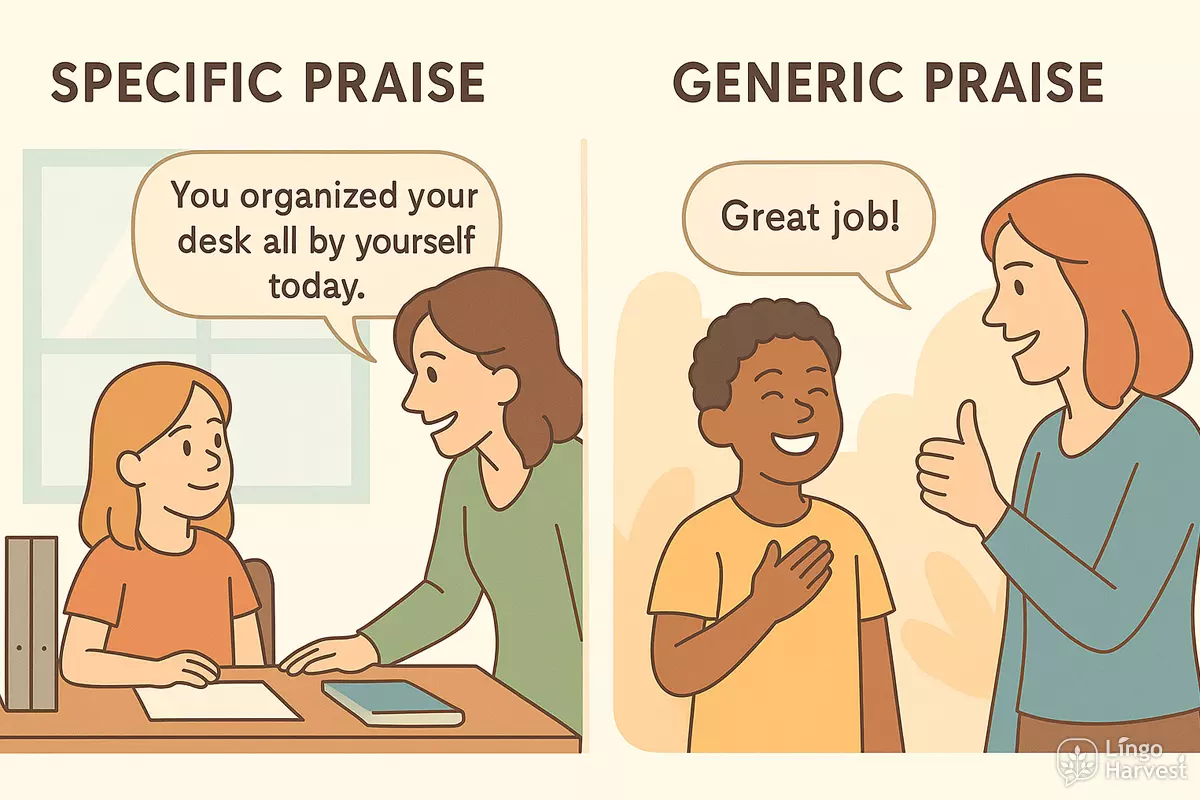
Descriptive praise focuses on actions, efforts, or improvements. It shows that you noticed the details, which helps reinforce particular behaviors and skills. In contrast, unspecific compliments use general language and can be overused, eventually losing their motivational power.
| Targeted Praise | Generic Praise |
|---|---|
| “You organized your desk all by yourself today.” | “Great job!” |
| “I noticed how patiently you helped your friend with their homework.” | “Well done!” |
| “Your use of color in this drawing is very creative.” | “Awesome!” |
| “You kept practicing even when it was hard.” | “Good job!” |
| “Thank you for listening so carefully during story time.” | “Nice work!” |
| “You remembered to put your shoes away without being asked.” | “Fantastic!” |
| “Your solution to the puzzle was really clever.” | “Super!” |
| “I appreciate how you shared your toys today.” | “Excellent!” |
| “You asked a thoughtful question during our discussion.” | “You’re amazing!” |
| “It was helpful that you cleaned up after snack time.” | “Bravo!” |
Why Focus on the Details?
Recognizing specific actions lets the person know exactly what to repeat in the future. This approach is especially effective with children, but adults benefit as well. When praise is clear and concrete, it supports growth, learning, and self-esteem more reliably than vague encouragement.
- Promotes self-awareness and reflection
- Encourages continued effort in areas that matter
- Reduces confusion about what was successful
- Strengthens motivation by highlighting progress
Next time you want to acknowledge someone’s effort, try to point out what stood out to you. Over time, this habit leads to more authentic interactions and helps build lasting confidence.
Balancing Praise and Advice
Finding the right combination of encouragement and constructive feedback can help learners grow while staying motivated. Too much praise may lead to complacency, while constant suggestions for improvement might feel discouraging. The goal is to support progress by acknowledging strengths and guiding toward the next step.
Why Both Are Important
Positive feedback boosts confidence and lets people know their efforts are valued. However, advice for improvement ensures continued development and prevents stagnation. Together, they create an environment where learners feel safe to try, make mistakes, and improve.
Practical Ways to Combine Support and Guidance
- Start with a specific compliment before offering advice.
- Use encouraging language when suggesting changes.
- Balance praise and recommendations in each interaction.
- Focus on effort and strategy, not just results.
- Encourage self-reflection: ask what went well and what could be better.
- Offer clear examples to illustrate both strengths and growth areas.
- Be genuine—avoid overpraising or sugarcoating feedback.
- Adapt your approach to individual needs and personalities.
- Highlight progress over time, not just isolated achievements.
- Give advice that is actionable and specific.
Examples: Blending Affirmation with Suggestions
- ✅ "You did a great job organizing your ideas. Next time, try to add more supporting details."
- ✅ "I can see you worked hard on this project. To make it even better, check the formatting."
- ✅ "Excellent participation today! Think about speaking a bit louder so everyone can hear."
- ✅ "Your solution is creative. As a next step, see if you can find a faster method."
- ✅ "Nice improvement on your timing. Keep practicing to reduce small errors."
- ✅ "I appreciate your teamwork. Try to involve quieter members next time."
- ✅ "Great start! Now, let’s focus on organizing your paragraphs."
- ✅ "Strong analysis. Consider adding more examples to support your points."
- ✅ "Well done on your presentation. Work on making your slides less text-heavy."
- ✅ "Your enthusiasm is clear. Remember to check your facts for accuracy."
Common Pitfalls and How to Avoid Them
- ❌ Overusing generic praise (e.g., "Good job!")—be specific instead.
- ❌ Giving feedback only when something is wrong—acknowledge what works, too.
- ❌ Mixing praise and criticism in a way that confuses the message—keep both clear and separate.
- ❌ Ignoring individual preferences for feedback—some prefer direct advice, others need more encouragement.
When encouragement is paired thoughtfully with advice, learners feel respected and inspired to take their next steps. This approach fosters resilience, self-awareness, and a lasting desire to improve.
Cultural Notes on Frequency
How often encouragement or praise is given can vary a lot depending on cultural background, social context, and even the relationship between the people involved. In some societies, frequent positive feedback is seen as supportive and motivating, while in others it may feel excessive or insincere if overused. Understanding these nuances helps avoid misunderstandings and ensures that supportive words like “Well done!” and “Good job!” have the intended effect.
Comparing Approaches Across Cultures
Some cultures, such as those in North America and Australia, tend to offer verbal encouragement regularly, especially in educational and workplace settings. This is often intended to build confidence and reinforce positive behaviors. In contrast, countries like Japan or Germany may use praise more sparingly, reserving it for truly exceptional achievements. Here, frequent use might be considered artificial or could even embarrass the recipient.
| Culture/Region | Typical Frequency of Praise |
|---|---|
| United States | High — encouragement is common in daily interactions |
| United Kingdom | Moderate — praise is used, but with more restraint |
| Japan | Low — only for notable accomplishments; modesty valued |
| Germany | Low — direct praise is rare; actions may speak louder |
| Brazil | High — expressive encouragement is culturally accepted |
| France | Moderate — praise given, but often accompanied by suggestions |
| South Korea | Low — group achievements praised over individuals |
| Russia | Moderate — encouragement is present, but not always overt |
When to Use Praise: Context Matters
- With children, frequent positive feedback can nurture self-esteem → but overuse may reduce its impact.
- In workplaces, regular but specific praise motivates teams; generic comments may seem insincere.
- Among friends, encouragement is often more informal and spontaneous.
- Academic settings may encourage a balance — too much praise can lead to complacency, too little to discouragement.
- Public versus private praise: some prefer recognition in front of others, while some cultures value private acknowledgment.
Ultimately, the best practice is to be mindful of both the recipient’s background and the social situation. Adapting the frequency and style of uplifting feedback ensures it remains meaningful and respectful across different contexts.
Mini Dialogues (teacher, friend)
Short conversational exchanges are a practical way to practice supportive language in real-life situations. Below are examples of how encouragement and praise can be naturally woven into discussions between a teacher and a student, or between friends. These sample interactions show how positive feedback motivates and builds confidence.
Classroom Scenarios: Teacher to Student
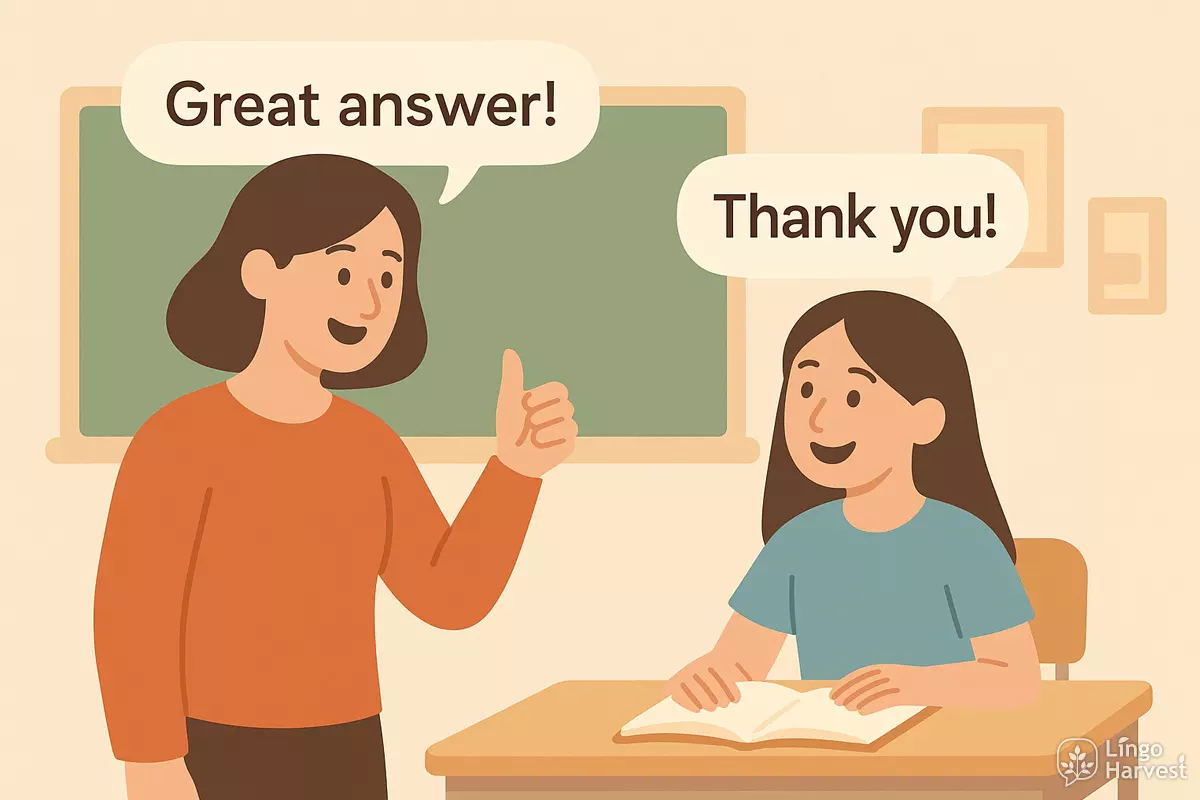
- Teacher: That was a great answer! You really understood the question.
- Student: Thank you! I studied a lot for this topic.
- Teacher: Well done on your project. You put in a lot of effort.
- Student: I’m glad you noticed. I enjoyed working on it.
- Teacher: Good job! You improved your handwriting.
- Student: I practiced every day, just like you suggested.
- Teacher: Excellent work! Keep it up!
- Student: I will! Thank you for your support.
Everyday Exchanges: Friends Supporting Each Other
- Friend 1: I finished my first 5K run today!
- Friend 2: That’s amazing! I’m really proud of you.
- Friend 1: I finally solved that tough puzzle.
- Friend 2: Good job! I knew you could do it.
- Friend 1: I managed to speak up in the meeting.
- Friend 2: Well done! That took courage.
- Friend 1: I got a compliment from my boss today.
- Friend 2: You totally deserve it. Keep going!
Useful Encouraging Phrases
- You did great!
- That’s the way!
- Keep up the good work.
- I’m impressed.
- You’re making progress.
- Bravo!
- Nice effort.
- Way to go!
- You’re on the right track.
- That’s a big improvement.
- I can see how hard you tried.
- Keep trying—you’re so close!
- That was a smart solution.
- I appreciate your determination.
- Your dedication is inspiring.
Comparing Praise Styles: Teacher vs. Friend
| Teacher’s Feedback | Friend’s Support |
|---|---|
| Excellent effort on your assignment! | You totally nailed that task! |
| I’m proud of your progress. | I knew you could do it! |
| Keep practicing, you’re improving. | Don’t give up, you’re doing great! |
| That’s a thoughtful answer. | That was really clever! |
Realistic dialogues and vocabulary like these can help you recognize and use supportive language in a variety of contexts, whether you’re learning, teaching, or simply encouraging a friend.
Avoiding Overuse and Sarcasm
While positive feedback helps build confidence, repeating the same phrases too often can make them lose their meaning. When "Well done!" or "Good job!" is used automatically, children and adults alike may begin to tune it out or even question its sincerity. Striking the right balance ensures that encouragement remains genuine and impactful.
Recognizing Signs of Overuse
- Responses become routine rather than thoughtful
- Receivers show little reaction or seem uninterested
- Praise is given for minor or expected actions, not real effort
- Feedback feels disconnected from specific achievements
Relying on the same praise for every situation can feel empty. Instead, try to notice specific actions or improvements and mention them directly. This makes your encouragement personal and meaningful.
The Risks of Sarcasm
Sarcasm, especially when disguised as praise, can be confusing or hurtful. Phrases like "Nice job… not!" or a forced "Well, that was brilliant," often leave people feeling criticized rather than supported. Young children, in particular, may not understand sarcasm and could misinterpret the intent.
Alternatives to Generic Praise
Varying your responses keeps encouragement fresh. Here are some alternative phrases and approaches that avoid both monotony and insincerity:
- I noticed you tried a new approach today.
- Your effort really paid off in this part.
- That solution was creative and effective.
- You stuck with it even when it was tough.
- This shows a lot of improvement from last time.
- I appreciate how carefully you worked.
- You asked helpful questions along the way.
- Your teamwork made a difference.
- It's clear you practiced this skill.
- The details here show great focus.
- You managed your time really well.
- Your positive attitude helped the group.
- I like how you explained your thinking.
- This is a big step forward!
- Thank you for helping others today.
- I can tell you put thought into this.
- Your patience really stood out.
- The way you solved that problem was impressive.
- Great persistence—well done!
- This reflects your hard work.
Using specific feedback makes praise more authentic and less likely to be mistaken as sarcasm or empty routine.
Quick Comparison: Sincere vs. Sarcastic Praise
| Sincere Encouragement | Sarcastic or Overused Praise |
|---|---|
| You really improved your handwriting today. ✅ | Well, that was just perfect… ❌ |
| Thanks for helping clean up after class. | Good job, as always… (eye roll) |
| I saw how you shared your materials with others. | Wow, you finally did it. About time! |
| Your project shows a lot of effort. | Great, another masterpiece… |
By choosing words thoughtfully and avoiding sarcasm, you help ensure that your praise supports growth and strengthens relationships.
Practice: Upgrade Weak Praise
Generic compliments like “Nice work!” or “Good job!” are easy to give, but they rarely help someone understand what they did well or how to repeat their success. Let’s explore how to transform vague feedback into specific, actionable encouragement that has a greater impact.
From Generic to Specific: Why It Matters
Specific praise highlights the effort, strategy, or improvement someone demonstrated, making your feedback more meaningful. Instead of a blanket “Well done,” focus on what the person did, how they did it, or what made their work stand out. This not only boosts motivation but also helps the recipient know exactly what behaviors to continue.
Common Weak Praise and How to Upgrade It
Below is a list of common, non-specific compliments, followed by stronger alternatives that provide clarity and encouragement. Use these examples as inspiration to make your feedback more effective.
- “Good job!” → “You organized your ideas clearly in your report.”
- “Nice work!” → “You showed real patience solving that tricky problem.”
- “Well done!” → “I noticed you checked your calculations twice for accuracy.”
- “Awesome!” → “Your introduction really grabbed my attention.”
- “Great effort!” → “You kept trying even when it got difficult.”
- “Wonderful!” → “Your color choices made the poster easy to read.”
- “Super!” → “You asked thoughtful questions during the discussion.”
- “Excellent!” → “You explained your answer so everyone could understand.”
- “Perfect!” → “You remembered to check for spelling errors.”
- “Fantastic!” → “You listened carefully to your teammate’s ideas.”
- “Impressive!” → “You used evidence from the text to support your answer.”
- “You’re smart!” → “You figured out a new way to solve that puzzle.”
- “You’re talented!” → “You practiced a lot and it shows in your performance.”
- “You’re so creative!” → “Your story had a surprising ending that made me think.”
- “You’re a natural!” → “You improved so much after practicing.”
- “You always get it right!” → “You worked through your mistakes and learned from them.”
- “You’re amazing!” → “You helped your classmate understand the assignment.”
Try It Yourself: Rewrite Weak Praise
Rewrite the following weak praise statements to make them more specific and helpful.
- “Great job on your test!”
- “Nice drawing!”
- “Awesome presentation!”
- “You’re so smart!”
Show answers
- “You used clear examples to support your answers on the test.”
- “Your drawing has a lot of detail and creative use of colors.”
- “You spoke clearly and kept your audience interested during your presentation.”
- “You solved the problem by trying a new approach and didn’t give up.”
Tips for Creating Stronger Praise
- Focus on effort, strategy, or improvement, not just results.
- Describe specifically what the person did well.
- Avoid empty adjectives; replace them with concrete observations.
- Encourage continued growth by highlighting learning and persistence.