Trip, Travel, or Journey? Confusing Nouns Explained Simply

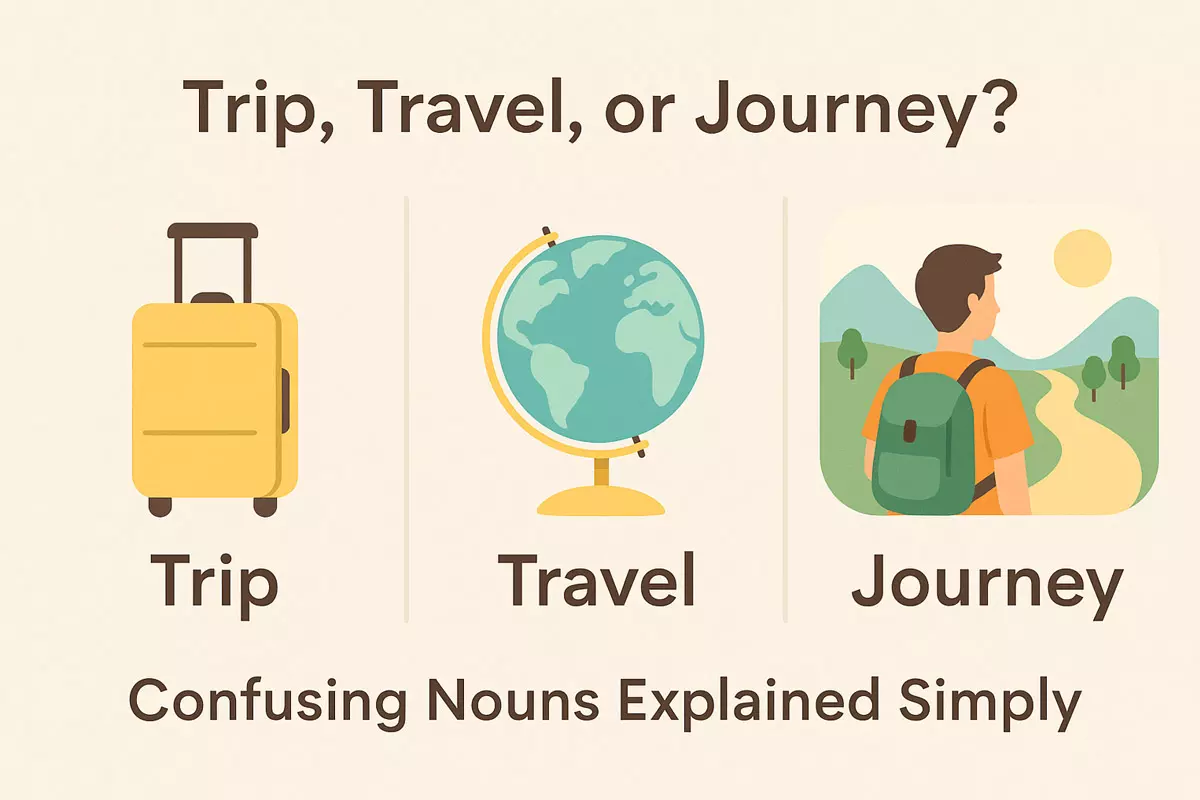 The article clarifies the key differences between trip, travel, and journey, explains when to use each, highlights common phrases and typical learner mistakes, and provides a practice exercise to help you choose the right word.
Choosing the right word to describe an adventure away from home can be tricky, as English offers several similar terms like trip, journey, voyage, and expedition. A trip usually refers to a short or routine outing, such as a weekend trip to the beach. A journey often describes the process of traveling from one place to another, sometimes over a long distance or time, like a train journey across the country. Voyage is typically used for long journeys by sea or in space, while expedition refers to a trip with a specific purpose, often involving exploration or research. Understanding these distinctions helps you select the most accurate word for your experience.
Key Meaning Differences
Understanding the distinctions between "trip," "travel," and "journey" helps you choose the right word for any situation. Each term paints a different picture of movement or experience, even though all are related to going from one place to another.
Trip: A Specific Outing or Excursion

A "trip" usually refers to a short excursion or visit, often with a clear destination and purpose. You might take a weekend trip to the mountains or a business trip to another city. It’s typically countable and implies you’ll return soon.
- She went on a school trip to the museum.
- He took a quick trip to the supermarket.
- Our family trip lasted three days.
Travel: The Broad Activity
"Travel" is a general term for the act of moving from place to place, especially over long distances. It can be used as both a noun and a verb, but it’s usually uncountable when used as a noun. It doesn’t focus on a specific journey, but rather the action itself, habits, or the experience as a whole.
- Travel broadens the mind.
- She loves to travel.
- Business travel can be exhausting.
Journey: The Process or Experience
A "journey" highlights the process of traveling, often emphasizing the experience, duration, or challenges along the way. It may describe a literal route or a metaphorical path (for example, a journey of self-discovery). Journeys are often longer and more significant than trips.
- The journey across the desert was difficult.
- He described his journey from student to doctor.
- The train journey took eight hours.
Comparing Usage at a Glance
| Word | Typical Meaning & Use | Example Sentence |
|---|---|---|
| Trip | Short visit or excursion, often with a clear purpose; countable noun | We took a trip to Paris last spring. |
| Travel | General activity of moving between places; uncountable or verb | Travel is one of her passions. |
| Journey | The process or act of traveling, often long or meaningful; countable noun | The journey was full of unexpected events. |
Quick Reference: Common Collocations
Knowing which words commonly go together helps you sound natural. Here are some typical pairings:
- Business trip
- Road trip
- Day trip
- Space travel
- Solo travel
- Group travel
- Long journey
- Return journey
- Spiritual journey
- Epic journey
Choosing between these terms depends on whether you want to highlight the destination, the experience, or the act of moving itself. With these distinctions in mind, you can communicate your adventures and plans more precisely.
When to Use Trip
The noun trip is most often chosen when you want to talk about going somewhere and then returning, usually for a short period. It typically refers to the whole process of leaving, visiting a place, and coming back. This word is common for both business and leisure purposes, and it doesn’t focus on the route or the experience along the way, but rather the event as a whole.
Typical Contexts for "Trip"
- Short visits for pleasure (e.g., a weekend trip to the coast)
- Business-related travel (e.g., a sales trip to another city)
- School or group excursions (e.g., a field trip)
- Organized tours or packages (e.g., a guided trip through Europe)
- Quick errands or necessary visits (e.g., a trip to the dentist)
- Returning to the original place after visiting another (round-trips)
- Family holidays (e.g., a family trip to Disneyland)
- Exploring nearby attractions (e.g., a day trip to a museum)
- Shopping visits (e.g., a trip to the mall)
- Commuting for a special event (e.g., a trip to see a concert)
- Short breaks for relaxation (e.g., a spa trip)
- Adventure activities (e.g., a hiking trip)
Key Features of "Trip"
A few main characteristics set this word apart from similar nouns:
- Usually short-term: Most often, it’s not a long or complex expedition.
- Focus on purpose: The reason for going is usually clear—work, fun, learning, etc.
- Round trip: Implies a return to the starting point.
- Not about the details of travel: The means of transport or the route are less important.
Common Collocations
Here are some typical ways to use "trip" in conversation and writing:
- go on a trip
- take a trip
- plan a trip
- business trip
- school trip
- day trip
- road trip
- round-trip ticket
- field trip
- make a trip
- short trip
- weekend trip
Quick Comparison: "Trip" vs. "Travel" and "Journey"
| Word | Typical Use |
|---|---|
| Trip ✅ | A specific visit or event, often short, with a clear purpose and return (e.g., a trip to Paris for a conference) |
| Travel | The general act of moving from place to place; more abstract or uncountable (e.g., "I love travel") |
| Journey | Focuses on the process or experience of getting from A to B, often long or difficult (e.g., "a journey across the desert") |
In summary, choose "trip" when you mean a defined outing with a purpose and a return, especially if it’s not too long or complex. This makes it the most natural word for most everyday excursions, both personal and professional.
When to Use Travel
The noun travel is a bit different from trip or journey. It usually refers to the general act or concept of moving from place to place, rather than a specific event or route. This word is often used in a broad or abstract sense, and is more common in formal or academic contexts. For example, you might talk about “air travel,” “business travel,” or “the benefits of travel.” You wouldn’t normally say, “I had a travel to Paris,” but rather “I love to travel” or “Travel broadens the mind.”
Situations That Call for "Travel"
- Discussing the activity or process of going from one place to another in general terms
- Referring to the industry or field (e.g., travel industry, travel agent)
- Talking about travel as an experience or concept (e.g., “Travel changes people”)
- Describing repeated or habitual movement (e.g., “His job involves a lot of travel”)
- In compound nouns or set phrases (e.g., “travel documents,” “travel insurance”)
- When speaking about travel in a collective or uncountable sense (“international travel is increasing”)
- Writing formal or academic texts about tourism or movement
- Talking about the mode of movement (“rail travel,” “space travel”)
- Describing the overall experience, not a single event (“her travels took her around the world”)
- In reports, news, or statistics about movement between places
Common Phrases with "Travel"
- travel arrangements
- travel expenses
- business travel
- travel restrictions
- travel itinerary
- travel agency
- travel companion
- travel destination
- travel guide
- travel season
- travel policy
- travel visa
- travel grant
- travel advisory
- travel blog
How "Travel" Differs from "Trip" and "Journey"
| Word | Typical Usage | Countable? | Example Sentence |
|---|---|---|---|
| Travel | General activity or concept of moving from place to place | No (usually uncountable) | Travel can teach you a lot about the world. |
| Trip | A specific visit or excursion with a clear start and end | Yes (countable) | We went on a trip to Italy last summer. |
| Journey | The process or experience of traveling, often focusing on the distance or path | Yes (countable) | The train journey across the country was unforgettable. |
When to Use Journey
The noun “journey” is typically used to describe travel from one place to another, focusing on the process or experience rather than just the act of moving. Unlike “trip,” which often refers to the whole event including activities and purpose, “journey” highlights the travel itself, especially if it is long, challenging, or transformative.
Common Contexts for “Journey”
You’ll most often encounter “journey” in contexts where the distance is significant, the travel is difficult, or the experience is meaningful. Here are some typical scenarios:
- Long-distance travel, especially overland or by sea (“the journey across the desert,” “a journey by train through Siberia”)
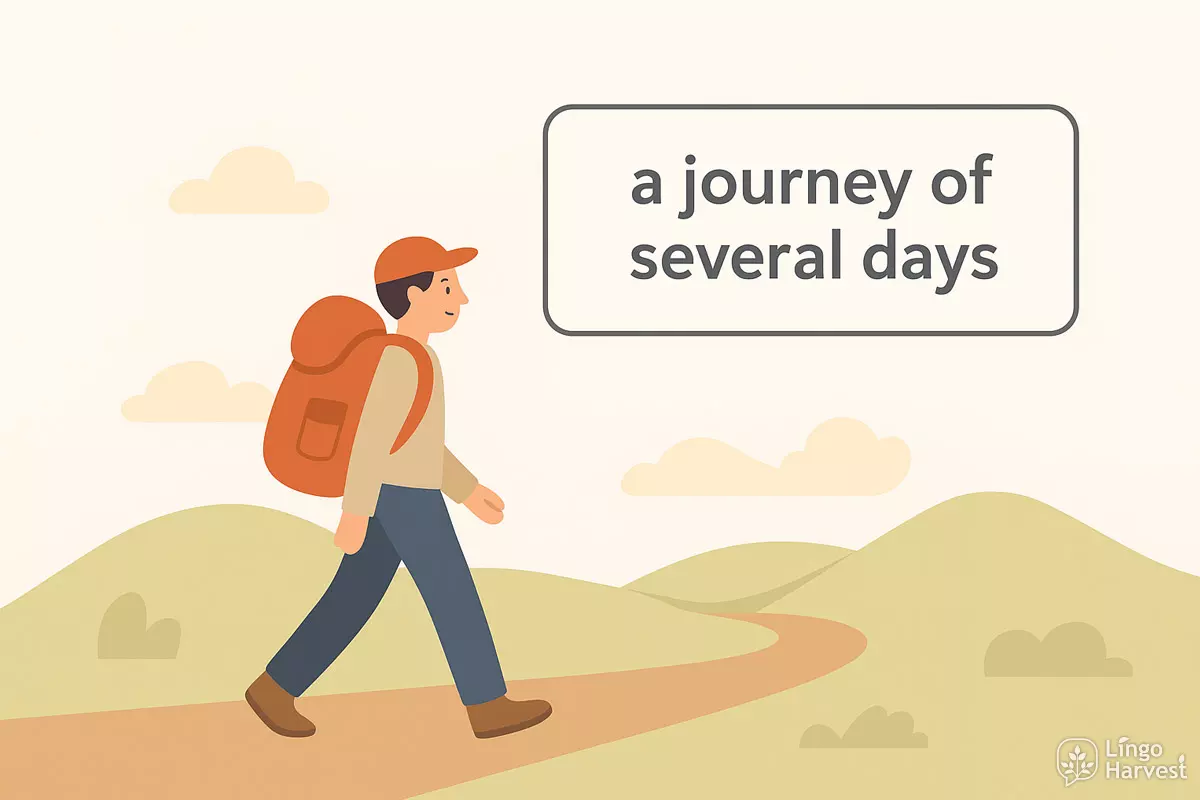
- Travel that takes a lot of time (“a journey of several days”)
- Figurative use to describe personal development or change (“her journey to becoming a doctor”)
- Stories or narratives focusing on what happens during the travel, not just the destination
- Historical or epic adventures (“the journey of the first explorers”)
- Travel where the challenges or hardships are important to the story
- Poetic or literary contexts (“life’s journey”)
- Descriptions emphasizing the route or path taken, not just the start and end points
- When you want to stress the experience, not just the practical outcome
- Metaphorical uses, such as spiritual or emotional journeys
Examples of “Journey” in Sentences
- It was a long and exhausting journey through the mountains.
- The journey from childhood to adulthood is full of surprises.
- Our journey by boat took three days.
- He wrote a book about his journey across Africa.
- Her journey to recovery inspired many people.
- The journey was more important than the destination.
- They faced many obstacles during their journey home.
- Life is a journey, not a race.
Quick Comparison: “Journey” vs. “Trip” vs. “Travel”
| Word | Typical Use | Example |
|---|---|---|
| Journey | Focus on the process or experience, often long or challenging | “The journey across the Sahara was dangerous.” |
| Trip | Event or occasion, includes activities and purpose | “We took a weekend trip to the lake.” |
| Travel | General act or concept of moving between places | “He loves to travel.” |
Summary
Use “journey” when you want to emphasize the experience, challenges, or transformative aspects of travel, whether literal or figurative. This word is less about the event and more about the story of getting from one place (or state) to another. If the focus is on the adventure itself, “journey” is usually the best choice.
Common Collocations
When learning the difference between "trip," "travel," and "journey," it helps to notice which words and expressions frequently appear with each noun. These word pairings make your English sound more natural and help you choose the right term for each situation.
Typical Expressions with "Trip"
"Trip" is often used with specific verbs and adjectives. Here are some combinations that native speakers use:
- go on a trip
- take a trip
- plan a trip
- business trip
- school trip
- day trip
- round trip
- field trip
- short trip
- weekend trip
Frequent Pairings with "Travel"
"Travel" is more general and often used as a verb, but as a noun, it usually refers to the act or experience of moving from place to place. Some common pairings include:
- international travel
- business travel
- air travel
- travel arrangements
- travel agency
- travel insurance
- travel experience
- travel plans
- travel restrictions
- travel documents
Usual Combinations with "Journey"
"Journey" emphasizes the process or distance covered, and is often used for longer or more significant trips. Here are some typical combinations:
- long journey
- safe journey
- begin a journey
- end a journey
- epic journey
- return journey
- overland journey
- spiritual journey
- memorable journey
- train journey
Quick Reference: Collocations at a Glance
Below is a table showing which phrases are most natural with each noun, helping you avoid common mistakes.
| With "Trip" | With "Travel" | With "Journey" |
|---|---|---|
| go on a trip | business travel | long journey |
| day trip | travel insurance | safe journey |
| school trip | travel documents | epic journey |
| round trip | international travel | overland journey |
| business trip | travel agency | spiritual journey |
Understanding these combinations will make your English more fluent and help you communicate your experiences clearly. When in doubt, think about which word fits naturally with the adjective or verb you want to use.
Typical Errors by Learners
Many English learners mix up "trip," "travel," and "journey" because their meanings overlap but are not interchangeable. Mistakes often happen when translating directly from other languages or when using these nouns without considering context.
Common Mix-Ups and Misuses
- Using "travel" as a countable noun (e.g., "a travel") instead of the correct uncountable usage.
- Saying "a journey to work" instead of "commute" or "trip to work" for daily routines.
- Confusing "trip" and "journey" by using them interchangeably (e.g., "It was a long trip by train" instead of "It was a long journey by train").
- Incorrectly using "trip" as a verb ("We tripped to Paris") instead of "travelled" or "went".
- Forming plurals incorrectly, such as "travels" to mean several trips (when "travels" usually refers to general experiences, not individual occasions).
- Describing time incorrectly: "My travel was two hours" instead of "My journey took two hours" or "The trip lasted two hours".
- Using "journey" for short or non-significant distances ("My journey to the shop") instead of "trip".
- Mixing up the verb and noun forms (e.g., "I journeyed a trip").
- Misplacing prepositions: "On the trip" vs. "in the journey".
- Overusing "travel" when "trip" or "journey" is more natural.
Comparison Table: Correct Usage at a Glance
| Word | Typical Meaning | Countable? | Example Sentence |
|---|---|---|---|
| Trip | An event or visit from one place to another, usually for a short time or specific purpose | ✅ Yes | I took a trip to Rome last summer. |
| Travel | The act of moving from place to place, in general (uncountable); can mean the experience of traveling | ❌ No (usually uncountable) | Travel broadens the mind. |
| Journey | The process of traveling from one place to another, often a long distance or time | ✅ Yes | The journey across the desert was exhausting. |
Tips to Avoid Confusion
- Remember: "trip" is a single event, "journey" emphasizes the process, "travel" is the general activity.
- Use "trip" for vacations, business visits, or excursions.
- Choose "journey" for long or challenging routes, not daily activities.
- Reserve "travel" for talking about the concept or experience, not individual occasions.
Being aware of these patterns can help you sound more natural and accurate in English conversations and writing.
Practice: Choose the Correct Word
Understanding when to use "trip," "travel," or "journey" can be tricky. To help clarify, try the following exercises. Read each sentence and decide which noun fits best. Pay attention to context—sometimes more than one answer might seem possible, but only one makes the sentence sound natural.
Fill in the Blank
Complete each sentence with trip, travel, or journey:
- My business _______ to London was very productive.
- He loves to _______ and discover new cultures.
- The _______ across the desert took three days.
- We are planning a weekend _______ to the mountains.
- Her _______ from beginner to fluent speaker was impressive.
- Did you enjoy your _______ to Paris?
- After months of _______, she finally returned home.
- The hero’s _______ was full of danger and excitement.
- I have to _______ for work every month.
- Our school is organizing a _______ to the science museum.
Show answers
- trip
- travel
- journey
- trip
- journey
- trip
- travel
- journey
- travel
- trip
Choose the Most Natural Option
For each pair, select the word that feels most appropriate in English. Think about whether the situation describes an individual experience, the act of moving, or the overall process.
- Our overnight — (trip / journey) was exhausting.
- He dreams of — (travel / journey) the world.
- They made a — (trip / travel) to the coast last summer.
- The — (travel / journey) from childhood to adulthood can be difficult.
Show answers
- trip
- travel
- trip
- journey
Summary Table: Typical Usage
| Word | Typical Use |
|---|---|
| trip | A short or specific visit, usually for pleasure or business (e.g., a weekend trip, a business trip). |
| travel | The general act of moving from place to place, often over a long distance or as a verb (e.g., I love to travel, travel broadens the mind). |
| journey | A long or challenging process, often with a sense of adventure or personal growth (e.g., a journey across the ocean, the journey of life). |
Quick Practice: Which Word?
Match the situations with the most suitable noun:
- Visiting a new city for a weekend — _______
- Moving between countries frequently — _______
- Describing someone’s progress in learning — _______
- Going on an organized group tour — _______
Show answers
- trip
- travel
- journey
- trip