Common False Friends at B2 (actual, eventually, sympathetic)

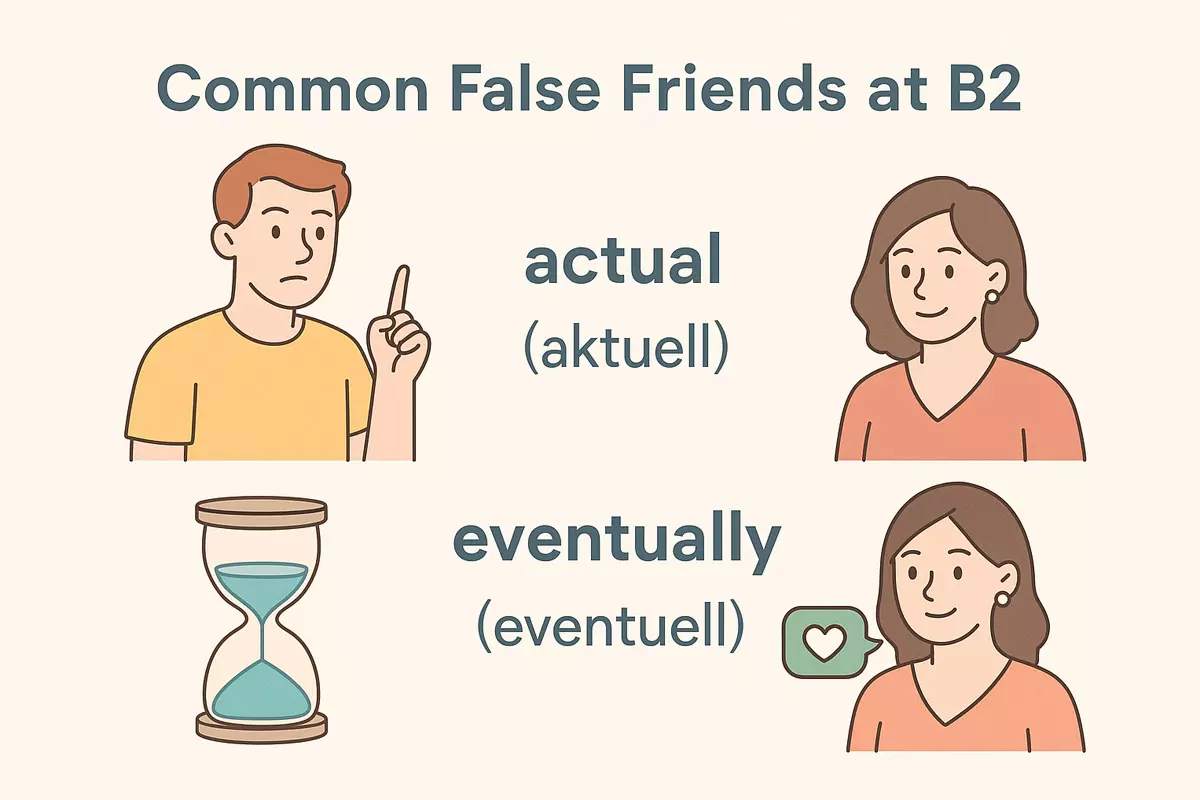 The article defines false friends and identifies high-risk word pairs at B2 level. It explains their meaning differences with examples, points out common learner errors, suggests memorization strategies, and includes practice sentences for revision.
Learning English at the upper-intermediate stage can present unexpected challenges, particularly when familiar-looking words have meanings that differ from what learners might expect. Words such as "actual," "eventually," and "sympathetic" often cause confusion because their definitions are not always straightforward, especially for those whose native languages contain similar terms with different meanings. Navigating these tricky vocabulary items requires careful attention and practice to avoid misunderstandings and to build greater confidence in using English accurately.
What False Friends Are
When learning a new language, some words look or sound very similar to words in your native tongue. This often leads to confusion, because those familiar-looking words might actually have different meanings. Linguists call these tricky pairs “false friends.” They can cause misunderstandings, especially at intermediate levels like B2, where learners start to use a wider vocabulary. False friends often appear in languages that share roots or borrowings, such as English and many European languages. For example, in English and Spanish, “actual” and “actual” look identical but don’t mean the same thing. These misleading similarities can trip up even confident speakers, making communication less clear.
How to Recognize False Friends
Pay attention to words that look almost the same as ones you know from your first language, but check their definitions before using them. Sometimes, the meanings have shifted over time, or the original sense has changed completely in one language but not the other.
- They often have similar spelling or pronunciation across languages.
- Their meanings are sometimes completely unrelated.
- They can appear in common situations, such as meetings, emotions, or daily routines.
Common Characteristics
- Borrowed from Latin, French, or another shared source.
- Different everyday usage compared to their look-alikes.
- Lead to classic learner mistakes in both writing and conversation.
Examples of Typical False Friends
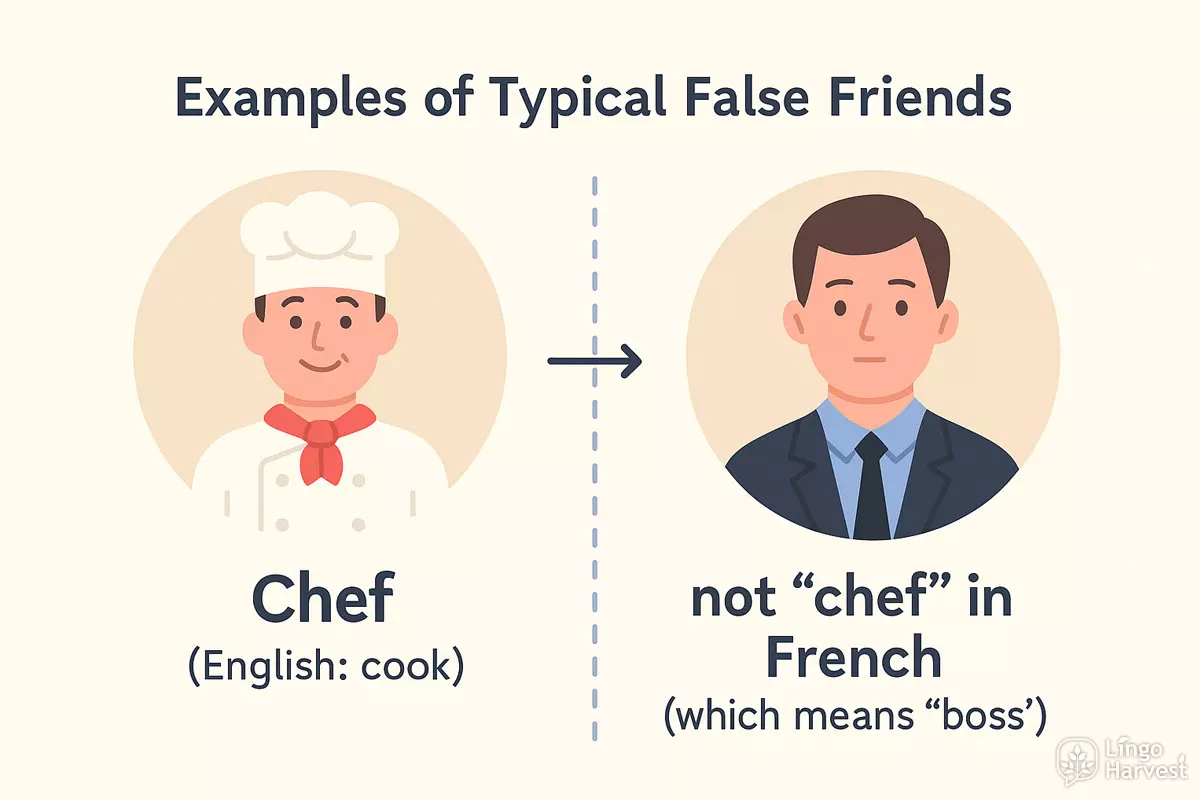
Here are some classic examples relevant to B2 learners:
- Actual (English: real, current) → not “actual” in Spanish (which means “current”, not “real”)
- Eventually (English: in the end) → not “eventualmente” in French or Spanish (which often means “possibly”)
- Sympathetic (English: showing understanding) → not “sympathique” in French (which means “nice”)
- Library (English: place to borrow books) → not “librarie” in French (which means “bookstore”)
- Assist (English: to help) → not “assister” in French (which means “to attend”)
- Chef (English: cook) → not “chef” in French (which means “boss”)
- Sensible (English: reasonable) → not “sensible” in Spanish (which means “sensitive”)
- Fabric (English: cloth) → not “fábrica” in Spanish (which means “factory”)
- Parent (English: mother or father) → not “parent” in French (which means “relative”)
- Eventually (English: finally) → not “eventuellement” in French (which means “possibly”)
- Magazine (English: a periodical) → not “magasin” in French (which means “shop”)
- Introduce (English: to present someone) → not “introducir” in Spanish (which means “to insert”)
- Preservative (English: substance to keep food fresh) → not “préservatif” in French (which means “condom”)
Why They Matter for Learners
Misusing these confusing terms can change the meaning of what you want to say, sometimes in awkward or funny ways. Being aware of these pitfalls helps you avoid mistakes and sound more natural.
Quick Comparison Table
| Word in English | False Friend Meaning | Actual English Meaning |
|---|---|---|
| Actual | Current (Spanish: actual) | Real, factual |
| Eventually | Possibly (French: éventuellement) | In the end, finally |
| Sympathetic | Nice (French: sympathique) | Understanding, compassionate |
| Assist | Attend (French: assister) | Help |
| Library | Bookstore (French: librairie) | Place to borrow books |
Remember, spotting these word traps can help you communicate more clearly and confidently as your language skills grow.
High-Risk Word Pairs at B2
Many intermediate English learners struggle with certain vocabulary pairs known as "false friends"—words that look similar in two languages but differ in meaning. At the B2 level, these confusions can lead to misunderstandings in both spoken and written communication. Recognizing and mastering these words helps avoid common pitfalls and improves overall language accuracy.
Common False Friends for B2 Learners
Below are some frequently confused pairs, especially for speakers of European languages. These words may seem familiar but carry very different meanings from their apparent counterparts.
- Actuality (English: reality) → NOT “actualité” in French (means “news”)
- Essay (English: written composition) → NOT “essai” in French (means “attempt/test”)
- Attend (English: to be present) → NOT “attender” in Spanish (means “to take care of”)
- Exit (English: way out) → NOT “éxito” in Spanish (means “success”)
- Constipated (English: blocked bowels) → NOT “constipado” in Spanish (means “having a cold”)
- Embarassed (English: ashamed) → NOT “embarazada” in Spanish (means “pregnant”)
- Notice (English: observe) → NOT “noticia” in Spanish (means “news”)
- Rope (English: thick cord) → NOT “ropa” in Spanish (means “clothes”)
- Lecture (English: academic talk) → NOT “lección” in Spanish (means “lesson”)
- College (English: university-type school) → NOT “collège” in French (means “middle school”)
- Assist (English: help) → NOT “assistir” in Portuguese (means “to watch”)
- Support (English: help, back up) → NOT “supporter” in French (means “to tolerate/endure”)
How to Recognize and Avoid Mistakes
Understanding the differences in meaning is the first step. Always check a reliable dictionary if you are unsure about a familiar-looking word. Practice using these terms in context to reinforce the correct meanings.
| English Word | False Friend Meaning | Correct English Meaning |
|---|---|---|
| Actual | Current (in Spanish/French/German) | Real, genuine |
| Eventually | Possibly (in French/Spanish) | In the end, finally |
| Sympathetic | Friendly (in French) | Compassionate, understanding |
| Library | Bookstore (in French/Spanish) | Place to borrow books |
| Assist | To attend (in French/Spanish) | To help |
| Fabric | Factory (in Spanish) | Material, cloth |
| Pretend | To claim (in French) | To act as if |
| Chef | Boss/leader (in French) | Head cook |
Focusing on these easily confused pairs can help learners build confidence and communicate more precisely, especially in academic or professional settings. Regular exposure and mindful practice are the best ways to overcome the challenges these words present.
Meaning Differences with Examples
Learners at the B2 level often stumble over “false friends”—words that look similar in English and their native language but have different meanings. Let's examine the distinctions between “actual,” “eventually,” and “sympathetic,” as these are frequently misunderstood. Each of these words can cause confusion if translated directly without considering their real usage in English. Below, you’ll find clear explanations and practical examples to help you avoid common mistakes.
Actual vs. "Актуальный"
- Actual (English): means “real” or “existing,” not “current” or “relevant.”
- Актуальный (Russian/other languages): means “current,” “relevant,” or “topical.”
Examples:
- EN: The actual cost was higher than expected. (real cost, not the estimated one)
- RU: Актуальная проблема = a pressing issue (not “actual problem” in English!)
- WRONG: This is an actual topic. ❌ (should be “This is a relevant/topical issue.”)
Eventually vs. "В результате"/"В конце концов"
- Eventually (English): means “in the end,” “after some time.”
- Eventuell (German/other languages): can mean “possibly,” “maybe.”
Examples:
- EN: She eventually finished her homework. (after a period of time)
- DE: Eventuell komme ich morgen. = I might come tomorrow.
- WRONG: Eventually, I come tomorrow. ❌ (should be “Maybe/possibly, I’ll come tomorrow.”)
Sympathetic vs. "Симпатичный"
- Sympathetic (English): means “showing understanding or compassion.”
- Симпатичный (Russian/other languages): means “attractive” or “nice-looking.”
Examples:
- EN: She was very sympathetic when I lost my job. (she showed understanding)
- RU: Он симпатичный парень. = He’s a handsome/nice guy.
- WRONG: He is a sympathetic boy. ❌ (should be “He is a nice/good-looking boy.”)
Quick Reference Table
| Word | False Friend Meaning | Correct English Usage | Example in Context |
|---|---|---|---|
| Actual | Current, relevant (not correct!) | Real, existing | The actual results surprised us. |
| Eventually | Possibly, maybe (not correct!) | In the end, after some time | She eventually agreed. |
| Sympathetic | Attractive, nice-looking (not correct!) | Showing understanding/compassion | The teacher was sympathetic. |
Typical Learner Errors
Learners at the B2 level often misinterpret "actual," "eventually," and "sympathetic" due to their resemblance to similar-looking words in other languages. These pitfalls usually stem from direct translation, leading to confusion in both speaking and writing. Understanding these differences is essential for clear communication.
Common Confusions and Mistakes
- Using "actual" to mean "current" or "real" in the sense of "present" (e.g., "the actual situation" instead of "the current situation").
- Writing "eventually" when intending "possibly" or "finally" (e.g., "I will eventually call you" to mean "I might call you").
- Describing a kind or empathetic person as "sympathetic" when "sympathetic" in English means "showing sympathy," not "friendly."
- Assuming "actual" and "actually" are interchangeable, leading to awkward phrases like "Actually, I am here" instead of "In fact, I am here."
- Mixing up "eventually" with "eventual" (adjective vs. adverb), resulting in incorrect expressions.
- Misusing "sympathetic" for "nice," "pleasant," or "likeable" based on false cognates.
Examples of Incorrect and Correct Usage
| Mistaken Sentence ❌ | Corrected English ✅ |
|---|---|
| The actual problem is very difficult now. | The current problem is very difficult now. |
| Eventually, I am tired. | Actually, I am tired. |
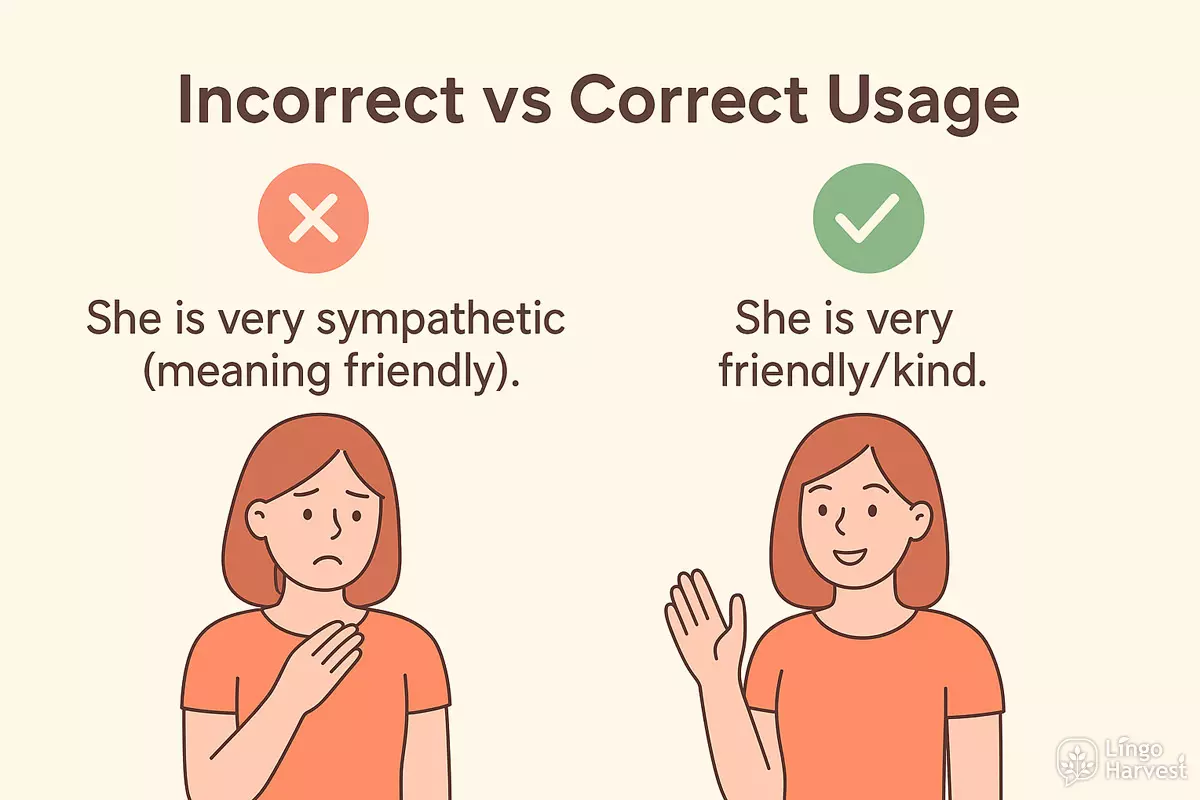
| She is very sympathetic (meaning friendly). | She is very friendly/kind. |
| He will eventually come (meaning possibly). | He might come. |
| My actual job is teacher. | My current job is teacher. |
| She gave me a sympathetic answer (meaning nice). | She gave me a friendly answer. |
Troublesome Patterns to Watch For
- Translating "aktuell" (German), "actual" (Spanish), or "aktualny" (Polish) as "actual" in English.
- Assuming "eventually" is a direct equivalent to "eventualmente" or similar words in Romance languages.
- Using "sympathetic" for "sympathique" (French) or "simpático" (Spanish/Portuguese).
- Confusing adverb and adjective forms (eventually vs. eventual).
- Overusing these words in formal writing due to perceived sophistication.
Awareness of these common slips helps learners avoid awkward misunderstandings and develop more natural English usage. Paying close attention to context and checking meaning with reliable resources also supports more accurate communication.
How to Memorize Correct Usage
Grasping the correct meanings of tricky words like "actual," "eventually," and "sympathetic" can be challenging, especially since they look similar to words in other languages but differ in meaning. Focusing on context and frequent comparison with your native language can help prevent confusion.
Compare English Meanings vs. False Friends
Seeing how these words differ from their "false friends" in other languages is useful. For example, "actual" in English means "real" or "current," not "eventual." "Eventually" refers to something happening after some time, not "possibly." "Sympathetic" is about showing understanding, not feeling sorry for someone.
| English Word | Correct English Meaning | Common False Friend Meaning |
|---|---|---|
| actual | real, current, existing | eventual, possible (not correct in English) |
| eventually | in the end, after a period of time | possibly, maybe (not correct in English) |
| sympathetic | showing understanding or compassion | feeling sorry, pity (not correct in English) |
Practice with Short Sentences
Making your own examples is one of the most effective ways to reinforce the correct usage of these words. Try to use them in short, everyday sentences. Here are some suggestions:
- The actual cost was higher than I expected. ✅
- She will eventually finish her project. ✅
- My friend was very sympathetic when I lost my job. ✅
- He gave me the actual address. ✅
- It took a while, but we eventually found the answer. ✅
- Her boss is sympathetic to her situation. ✅
- Incorrect: The actual result will happen next year. ❌ (Should use "eventual")
- Incorrect: Eventually, he comes every day. ❌ (Should use "actually")
- Incorrect: She was sympathetic about the weather. ❌ (Not used for situations, but for people)
Tips for Remembering the Differences
- Link each word to its true English meaning with a personal story or memory.
- Notice when native speakers use these words and jot down the sentence.
- Quiz yourself: cover the meanings and try to recall them from context.
- Group false friends together in your vocabulary notebook for review.
- Repeat sentences aloud to build automatic recall.
- Check for "false friend" mistakes in your writing before submitting work.
Regular exposure, active usage, and comparison with your first language are key strategies for mastering these confusing vocabulary items. The more you interact with real examples, the less likely you are to make common mistakes.
Practice Sentences for Revision
Understanding the pitfalls of false friends like "actual", "eventually", and "sympathetic" is crucial at the B2 level. Below, you’ll find targeted sentences and tasks designed to help you recognize and use these tricky words correctly. Try each set before checking your answers.
Choose the Correct Option
Select the word that fits best in each sentence:
- After many delays, we __________ finished the project last week. (actually/eventually)
- He seemed __________ when I told him about my problem. (sympathetic/actual)
- The __________ reason for his absence was illness. (actual/eventually)
- They promised to send the documents, but they __________ never did. (eventually/actually)
- My boss was not very __________ when I was late. (sympathetic/actual)
Show answers
- eventually
- sympathetic
- actual
- actually
- sympathetic
Spot the Mistake
In each sentence, decide whether the highlighted word is used correctly. If not, suggest the correct word.
- We actually meet at 7 p.m., not 6 p.m. (highlight: actually)
- She was very sympathetic to my situation. (highlight: sympathetic)
- Eventually, the book is about a young woman’s journey. (highlight: eventually)
- What is the actual price of this jacket? (highlight: actual)
- He was very actual about my mistake. (highlight: actual)
Show answers
- Correct
- Correct
- Incorrect – should be "actually"
- Correct
- Incorrect – should be "sympathetic"
Comparison Table: False Friends vs. Correct Meanings
| English Word | Common Misunderstanding & Correct Usage |
|---|---|
| actual | Often confused with "current" or "present" (e.g., "actual news" ❌). Correct meaning: real, true, or exact (e.g., "the actual reason"). |
| eventually | Mistaken for "possibly" or "maybe" (e.g., "I will eventually come" meaning "maybe" ❌). Correct meaning: in the end, after some time (e.g., "She eventually agreed"). |
| sympathetic | Confused with "nice" or "friendly" (e.g., "He is very sympathetic" meaning "friendly" ❌). Correct meaning: showing understanding or compassion (e.g., "a sympathetic listener"). |
Rewrite the Sentences
Rewrite the following sentences, correcting the misuse of the false friends:
- He is very sympathetic, so everyone likes him.
- I will eventually call you if I have time.
- The actual situation is not so bad.
- Can you give me the actual time?
- Eventually, I am tired today.
Show answers
- He is very friendly, so everyone likes him.
- I will possibly call you if I have time. (Or: I might call you...)
- Correct as is.
- Can you give me the exact time?
- Actually, I am tired today.
By practicing with these examples, learners can better spot and avoid common mistakes with these confusing words. Regular revision of such sentences will help you use "actual", "eventually", and "sympathetic" with confidence in both writing and speaking.