Nouns for Activities and Hobbies: Everyday English Examples

 Here we vocabulary for daily routines, sports, arts, leisure, and work activities. It introduces useful verb-noun pairs, shows how to talk about frequency, and includes a practice exercise for making your own schedule.
Choosing the right words to talk about your hobbies and interests can make conversations easier and more enjoyable. Here we useful vocabulary for describing your favorite activities, whether you enjoy sports, arts, reading, or spending time with friends. By learning these common terms and phrases, you will be able to share your interests more clearly and connect with others in daily English conversations. Expanding your vocabulary in this area can boost your confidence and help you participate more actively in discussions about leisure and pastimes.
Daily Activities
Everyday routines revolve around a set of common actions and habits. Learning the right nouns for these actions helps you describe your schedule, talk about routines, and understand others in daily conversations. Below, you'll find essential vocabulary and examples to make your English more precise when discussing what people do from morning to night.
Essential Nouns for Everyday Routines
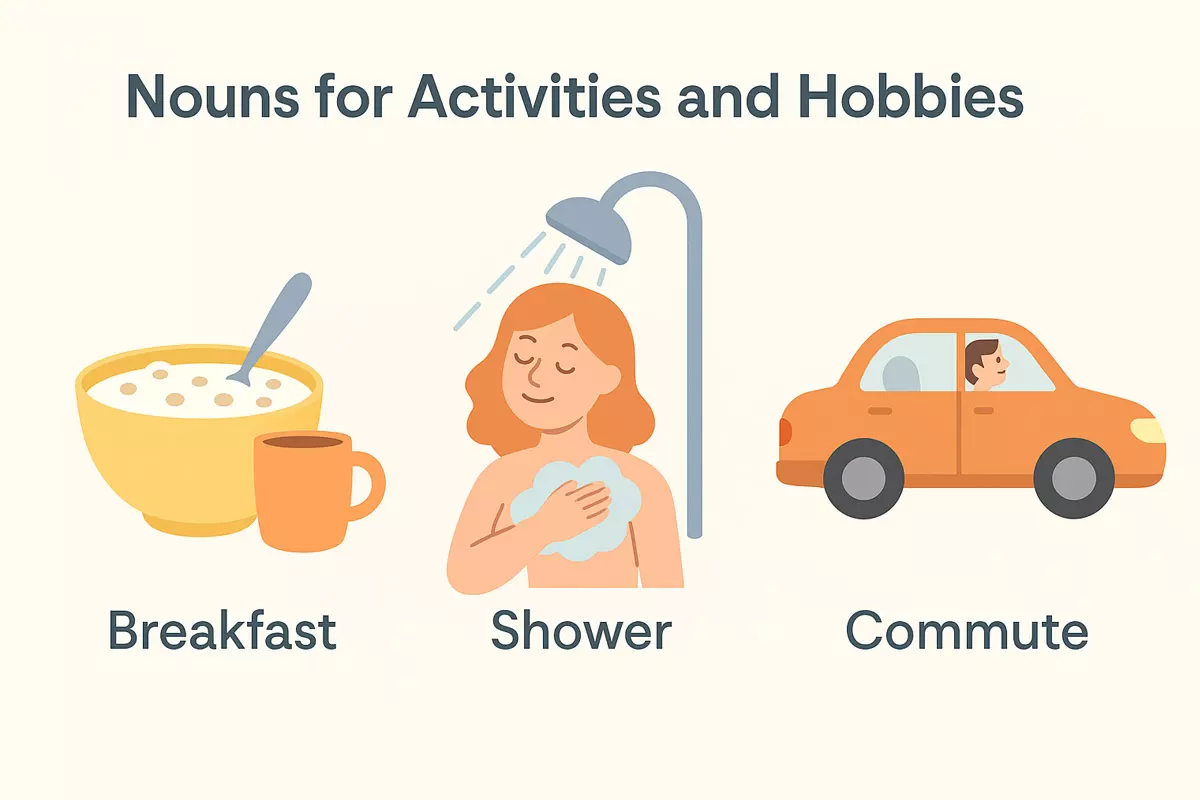
- Breakfast – the first meal of the day
- Shower – washing yourself under running water
- Commute – the journey to and from work or school
- Work – tasks performed for a job or profession
- Lunch – the midday meal
- Break – a short period of rest during work or study
- Meeting – a planned discussion with colleagues or classmates
- Chore – a routine household task (e.g., cleaning, laundry)
- Errand – a short trip to do a specific task (e.g., shopping, mailing a letter)
- Dinner – the main evening meal
- Exercise – physical activity to stay healthy
- Homework – assignments given to students for completion at home
- Call – a telephone conversation
- Appointment – a scheduled meeting (doctor, dentist, etc.)
- Nap – a short sleep during the day
- Conversation – an exchange of spoken words
- Snack – a small amount of food between meals
- Bedtime – the time when one goes to sleep
Comparing Common Household Tasks
| Household Task | Typical Noun | Description |
|---|---|---|
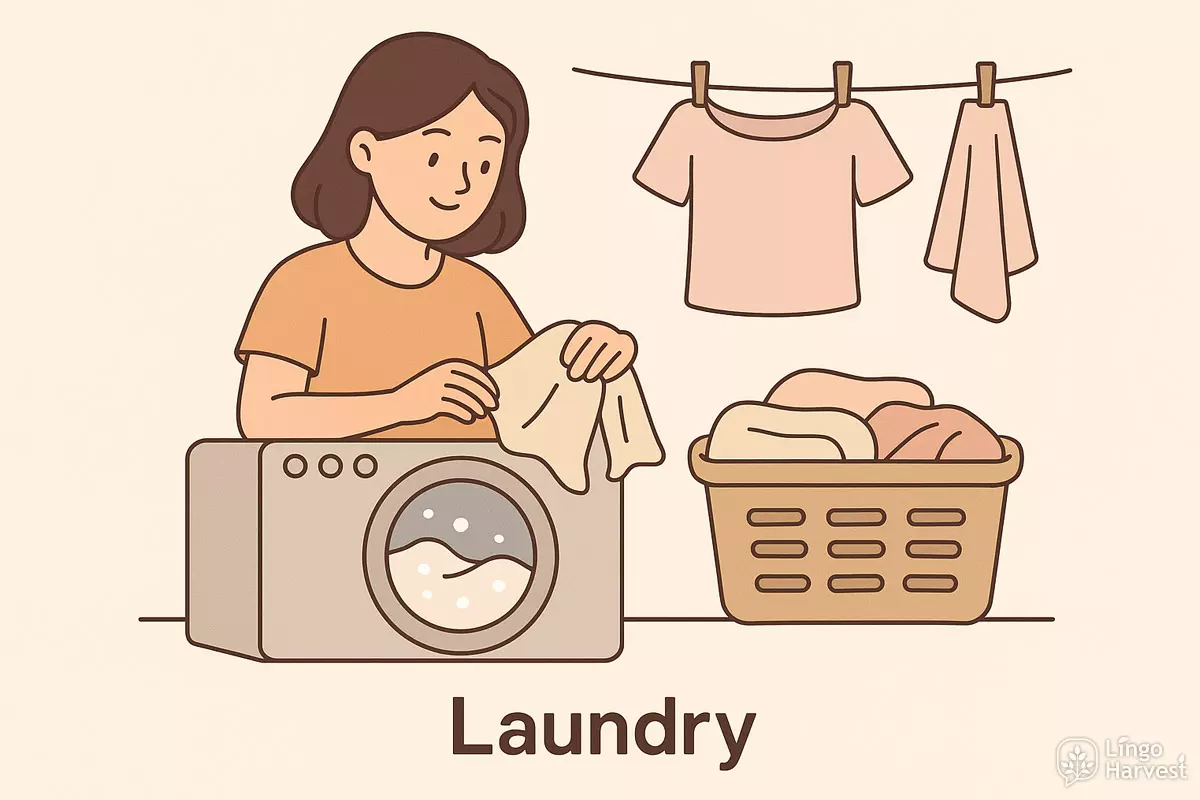
| Washing clothes | Laundry | Cleaning and drying garments and linens |
| Cleaning floors | Mopping | Using water and a mop to wash the floor |
| Taking out rubbish | Garbage | Removing household waste to bins |
| Preparing food | Cooking | Making meals in the kitchen |
Practice: Match the Activity to the Noun
Match each description to the correct noun from the list above:
- A short period of rest during the workday
- The journey you make to get to work or school
- A scheduled visit to the dentist
- The act of preparing the evening meal
Show answers
- Break
- Commute
- Appointment
- Dinner (or Cooking)
Understanding the nouns for routine actions lets you communicate your habits, schedule, and responsibilities clearly. Practice using these words in sentences to build confidence in daily conversations.
Sports and Fitness
Participating in physical activities is a common way people spend their free time, whether for health, enjoyment, or competition. In everyday English, many nouns are used to describe these pastimes, ranging from individual exercises to team games. Understanding these terms can help you talk about your hobbies, routines, and interests more clearly.
Common Nouns for Physical Activities
Here are some frequently used nouns to talk about different ways people stay active or play sports:
- Running
- Swimming
- Cycling
- Yoga
- Gymnastics
- Boxing
- Weightlifting
- Tennis
- Basketball
- Soccer
- Volleyball
- Golf
- Baseball
- Rowing
- Martial arts
- Skating
- Climbing
- Hiking
- Badminton
- Table tennis
Activity vs. Equipment Nouns
Some words describe the activity itself, while others refer to necessary gear or places. For example:
- Activity nouns: jogging, fencing, Pilates
- Equipment nouns: racket, helmet, dumbbell, mat, sneakers
- Place nouns: stadium, court, gym, pool, track
Describing Participation and Competition
You may also encounter nouns that refer to people or roles, as well as competitive events:
- Player
- Coach
- Referee
- Team
- Opponent
- Match
- Tournament
- League
- Medal
- Score
Examples of Activity and Equipment Nouns
| Activity | Common Equipment |
|---|---|
| Basketball | Ball, hoop, sneakers |
| Swimming | Goggles, swimsuit, cap |
| Cycling | Bicycle, helmet, gloves |
| Tennis | Racket, ball, net |
| Weightlifting | Barbell, weights, belt |
| Soccer | Ball, goal, cleats |
| Yoga | Mat, blocks, strap |
| Climbing | Rope, harness, shoes |
When talking about your favorite ways to stay fit or enjoy games, choosing the right nouns helps you be specific and clear. Whether you’re discussing team games, solo workouts, or the gear you use, these words are an essential part of everyday conversation about active pastimes.
Arts and Free-time Hobbies
Exploring creative pursuits and leisure interests is a great way to expand your English vocabulary. Many common nouns describe these pastimes, whether you enjoy visual arts, performing arts, or simply relaxing activities at home. Knowing the right words helps you talk about your interests and connect with others who share your passions.
Popular Nouns for Creative Activities
From painting to photography, many hobbies involve artistic expression. Here are some useful nouns you might encounter:
- drawing
- painting
- sculpture
- photography
- crafts
- knitting
- sewing
- calligraphy
- pottery
- origami
- scrapbooking
- woodworking
- jewelry-making
- printmaking
Music, Performing Arts, and More
If your interests are musical or theatrical, you’ll find a different set of nouns helpful for describing your activities:
- singing
- dancing
- acting
- drumming
- guitar
- piano
- theater
- choir
- band
- orchestra
- composing
- songwriting
Comparing Visual Arts and Performing Arts Terms
Some words are specific to certain fields. Here’s a comparison of typical nouns for visual and performing arts:
| Visual Arts | Performing Arts |
|---|---|
| painting | acting |
| drawing | singing |
| sculpture | dancing |
| photography | theater |
| crafts | music |
Leisure and Relaxation Activities
Not all pastimes are creative; some are simply for unwinding. Here are more nouns for casual hobbies:
- reading
- gardening
- puzzles
- birdwatching
- cooking
- baking
- fishing
- hiking
- camping
- journaling
- meditation
- yoga
Work and Study Activities
Daily routines often involve a mix of job-related and educational tasks. In English, there are many nouns that describe these activities, from specific duties to general responsibilities. Understanding these words can help you discuss your schedule, share your experiences, or ask about someone else’s day.
Common Nouns for Professional Tasks
- Meeting – a planned discussion with colleagues or clients
- Assignment – a piece of work given as part of your job
- Project – a large task or series of tasks with a goal
- Deadline – the latest time by which something must be completed
- Presentation – an organized talk or demonstration
- Report – a written account of something, often for work
- Interview – a formal meeting for discussion, often to get a job
- Conference – a large meeting for discussion and sharing information
- Task – a piece of work to be done
- Break – a short rest during work hours
Typical Study-Related Nouns
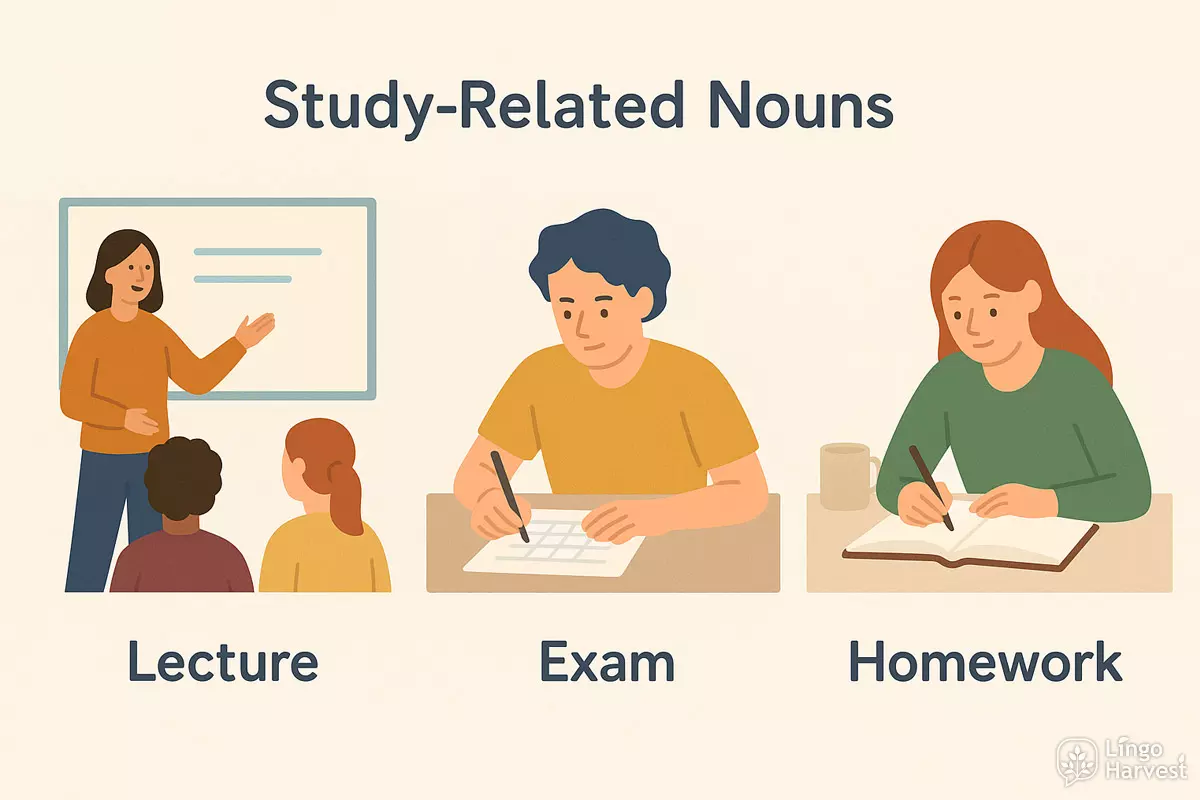
- Lecture – a formal educational talk, usually at university
- Exam – a test to measure knowledge or skills
- Homework – assignments given to students to complete outside class
- Essay – a short piece of writing on a particular subject
- Quiz – a short test
- Seminar – a class where a small group discusses a topic
- Note – a brief record of facts, topics, or ideas
- Assignment – a task or piece of work given to students
- Research – systematic investigation to discover facts
- Revision – reviewing study material to prepare for a test
Comparing Work and Study Nouns
| Professional Activity | Academic Activity |
|---|---|
| Meeting | Lecture |
| Report | Essay |
| Project | Assignment |
| Presentation | Seminar |
| Break | Revision |
Practice: Identify the Noun
Read each sentence and choose the correct noun from the lists above.
- She gave a detailed ______ about last month’s sales.
- Tomorrow, we have a math ______ at 9 am.
- After lunch, I have a science ______ with my classmates.
- Every Monday, our team has a ______ to discuss progress.
- He finished his English ______ before the deadline.
Show answers
- report
- exam
- seminar
- meeting
- assignment
Learning these nouns helps you describe your day-to-day responsibilities and educational experiences more precisely. Try using them to talk about your week or to ask others about their routines.
Useful Verb + Noun Pairs
When talking about activities and hobbies in everyday English, certain verbs naturally combine with specific nouns. These combinations help you sound more fluent and make your sentences clear and natural. For example, we "play chess" or "do yoga," but we don't usually say "make chess" or "play yoga." Knowing which action words go with which hobbies can make conversations about your interests much easier.
Common Action Words for Activities
Some verbs are especially common when describing pastimes and leisure activities. Here are a few of the most useful ones:
- Play – often used with games and sports
- Do – typically used with exercises or solo hobbies
- Go – used with activities ending in -ing
- Collect – for gathering items as a hobby
- Watch – for viewing activities
- Read – for books or magazines
- Make or Create – with crafts or hands-on hobbies
- Take – for lessons or photos
Everyday Examples
Here are some common verb and noun combinations you might hear when people talk about how they spend their free time:
- play football
- play the piano
- do yoga
- do puzzles
- go swimming
- go hiking
- collect coins
- collect stamps
- watch movies
- watch birds
- read novels
- read comics
- make jewelry
- create art
- take photos
- take dance lessons
Overview Table: Action Words with Hobbies
| Verb | Example Nouns |
|---|---|
| Play | tennis, chess, guitar, video games |
| Do | karate, gardening, crosswords, aerobics |
| Go | cycling, fishing, jogging, skating |
| Collect | postcards, action figures, shells, toys |
| Make/Create | models, pottery, crafts, scrapbooks |
| Watch | sports, documentaries, sunsets, theater |
| Read | magazines, newspapers, poetry, blogs |
By learning which verbs naturally pair with different hobbies and pastimes, you can easily describe your interests and understand others when they talk about what they enjoy doing in their spare time. These combinations are widely used in everyday English conversations.
Talking About Frequency
When describing how often you do various activities or hobbies, English speakers use specific words and phrases to express frequency. These terms help clarify routines, habits, and occasional actions, making your descriptions more precise and natural.
Common Frequency Words
People often use adverbs and expressions to indicate how regularly something happens. Here are some of the most useful options:
- always
- usually
- often
- sometimes
- occasionally
- rarely
- seldom
- hardly ever
- never
These words can be placed before the main verb (e.g., "I usually read books"), or after the verb "to be" (e.g., "She is always busy with gardening").
Phrases for Specific Time Frames
To be more exact, you can add expressions that show how many times or how regularly you do something. Here are some examples:
- every day / every weekend
- once a week
- twice a month
- three times a year
- on Mondays
- in the evenings
- from time to time
- almost never
- whenever I can
- during holidays
These phrases are often used at the beginning or end of a sentence: "I go swimming every weekend" or "During holidays, I travel."
Frequency Words in Context
To see how these words work with nouns for different hobbies or activities, compare the following examples:
| Sample Activity | How to Express Frequency |
|---|---|
| playing chess | I often play chess with friends. |
| painting | She paints once a week. |
| cycling | They usually go cycling on Sundays. |
| gardening | My grandmother is always gardening in the morning. |
| reading novels | I rarely read novels these days. |
| cooking | He sometimes tries new recipes. |
| jogging | We jog every evening. |
| knitting | She knits from time to time. |
Tips for Sounding Natural
Try to vary your vocabulary when describing how much you do something. Instead of always using "sometimes" or "often," mix in "occasionally," "hardly ever," or specific time phrases for richer expression. This will make your English sound more fluent and engaging when discussing your daily habits or favorite pastimes.
Practice: Build Your Schedule
Organizing your week is a great way to use activity and hobby nouns in real-life contexts. Below, you’ll find sample vocabulary, a planning task, and a structured table to help you visualize how these words work in a daily routine.
Step 1: Useful Nouns for Activities and Hobbies
- reading
- swimming
- gardening
- painting
- cooking
- cycling
- dancing
- fishing
- yoga
- photography
- hiking
- jogging
- knitting
- drawing
- singing
- chess
- puzzles
- baking
- writing
- camping
Step 2: Build a Weekly Plan
Use the nouns above to fill in your personal schedule for the week. Think about which activities you enjoy and when you like to do them. Here is an example format to follow:
| Day | Activity/Hobby | Example Sentence |
|---|---|---|
| Monday | yoga | I do yoga in the morning to start my week calmly. |
| Tuesday | reading | On Tuesdays, I spend an hour reading mystery novels. |
| Wednesday | cycling | I enjoy cycling in the park after lunch. |
| Thursday | cooking | Thursday evenings are for cooking new recipes. |
| Friday | painting | On Fridays, I relax by painting landscapes. |
| Saturday | hiking | I go hiking with friends on Saturday mornings. |
| Sunday | gardening | Sunday is my day for gardening and enjoying nature. |
Step 3: Try It Yourself
Now, create your own schedule. Choose at least five different hobbies or pastimes from the list and write a sentence for each, describing when you do them. For extra practice, use different time expressions (in the morning, after work, on weekends, etc.).
- Pick five nouns from the list above.
- Assign each activity to a day of the week.
- Write a full sentence for each, using correct English.
Show answers
- Monday: I go jogging in the park before breakfast.
- Tuesday: After work, I enjoy knitting while listening to music.
- Wednesday: I play chess with my neighbor in the evening.
- Saturday: Baking is my Saturday afternoon tradition.
- Sunday: I take photographs of nature every Sunday morning.
Using activity nouns in your weekly plan helps you practice vocabulary and makes your English more natural and relevant to daily life. Try changing your schedule each week to use even more words!