Describing Rooms and Homes in English

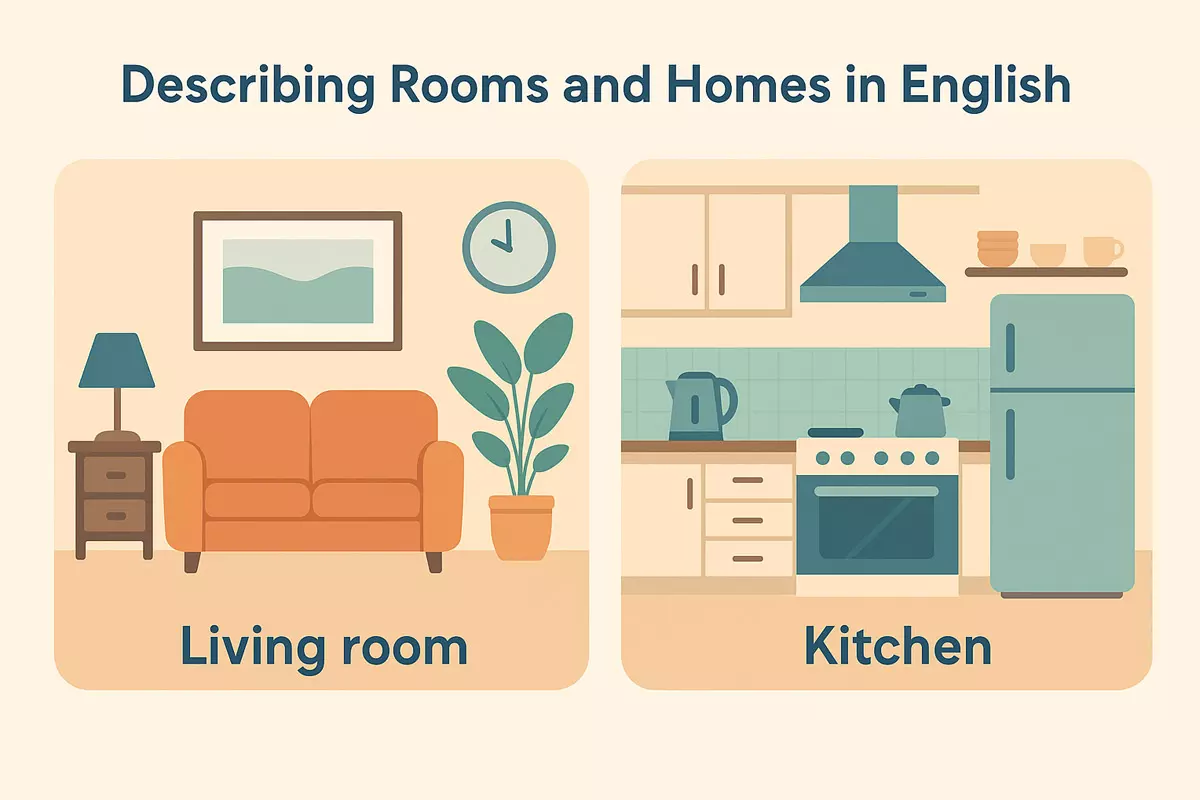 This article explains room names and types, furniture vocabulary, size and color adjectives, and prepositions of place. It also guides you in describing your home and includes practice for writing about your own room.
Learning how to talk about where we live helps us connect with others and express ourselves more clearly in English. By describing spaces like a cozy bedroom or a lively family kitchen, we can share our daily lives and personal experiences, making conversations more engaging and meaningful. Expanding your vocabulary to include words for different rooms, furniture, and household activities not only improves your language skills but also builds confidence when communicating about your home and lifestyle with others.
Room Names and Types
Understanding the different areas within a house or apartment helps you describe living spaces accurately in English. Each part of a home has a specific name and often a particular function. Whether you’re talking about your own place or describing someone else’s, knowing these terms makes conversations clearer and more detailed.
Common Rooms in a Home
Most residences contain several standard spaces. Here are some of the most frequently mentioned rooms:
- Living room – for relaxing, watching TV, or entertaining guests
- Kitchen – where you cook and sometimes eat meals
- Bedroom – a private area for sleeping
- Bathroom – includes a toilet, sink, and usually a shower or bathtub
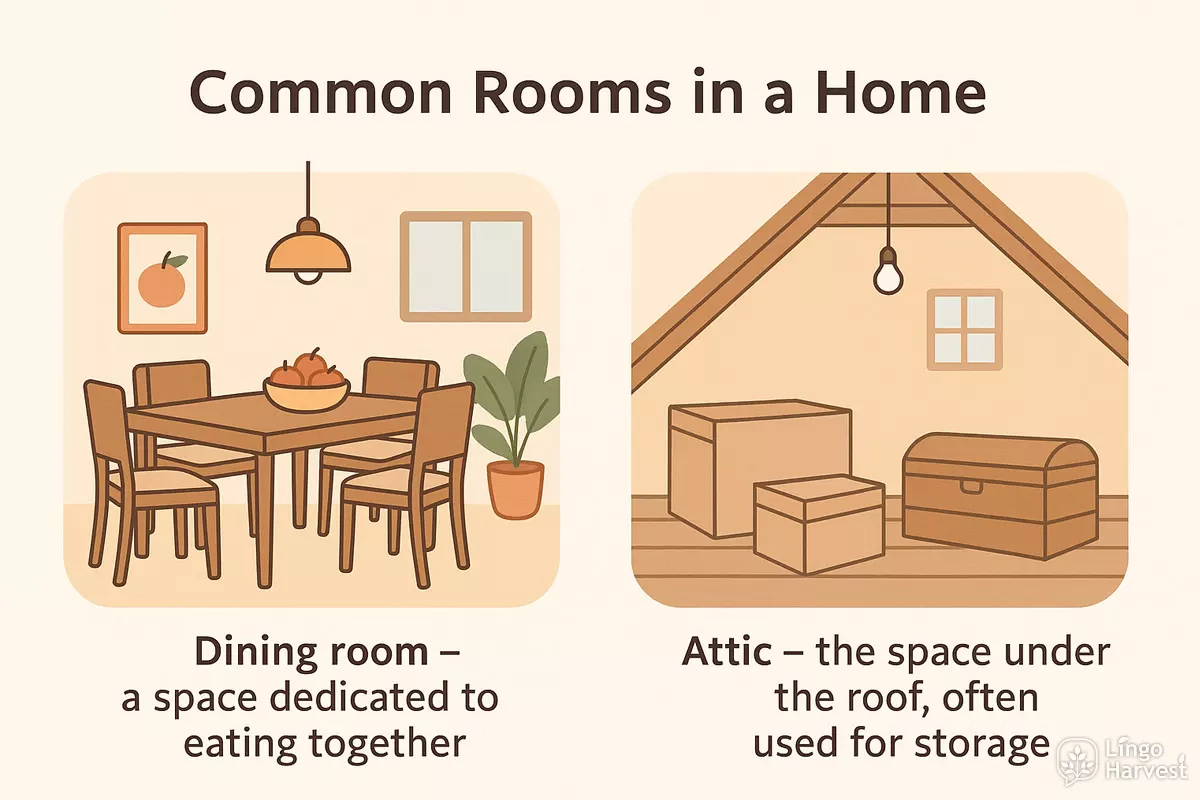
- Dining room – a space dedicated to eating together
- Hallway/corridor – connects different parts of the home
- Study or office – used for working or studying
- Garage – for storing vehicles or tools
- Utility room/laundry room – for washing clothes and storing cleaning supplies
- Attic – the space under the roof, often used for storage
- Basement – located below the ground floor, sometimes used as a living area or for storage
- Porch – a covered area at the entrance of a house
- Balcony – an outdoor platform attached to an upper floor
- Closet – a small space or cupboard for storing clothes
- Pantry – a small room or cupboard for food storage
- Guest room – a spare room for visitors
- Sunroom – a glass-enclosed sitting area with lots of sunlight
- Playroom – a space set aside for children’s activities
Types of Rooms and Their Purposes
Some homes may have unique or less common areas, depending on their size and style. For example, a library is a room with bookshelves for reading, while a mudroom is used to take off shoes and coats before entering the main part of the house.
Comparing Room Functions
Below is a comparison of several room types and their main uses:
| Room Type | Main Function |
|---|---|
| Bedroom | Sleeping, resting, personal space |
| Kitchen | Cooking, food preparation, sometimes eating |
| Living room | Socializing, relaxing, entertainment |
| Bathroom | Personal hygiene, bathing, using the toilet |
| Dining room | Eating meals together |
| Study/Office | Working, studying, using a computer |
| Garage | Parking vehicles, storage |
| Attic | Storing items, sometimes extra living space |
Knowing these terms allows you to give more precise descriptions of homes, ask questions about properties, or simply enhance your everyday vocabulary when discussing where you live.
Furniture Vocabulary
When talking about rooms and homes, it helps to know the names of common household items. This section introduces essential words for pieces you’ll find in living rooms, bedrooms, kitchens, and other spaces. Understanding these terms makes it easier to describe your home or ask about someone else’s in English.
Common Items in Different Rooms
Every room in a house has its own typical furnishings. Here are some examples you might use when describing interiors:
- Sofa – a comfortable seat for several people, often in the living room
- Armchair – a single seat with armrests
- Coffee table – a low table in front of a sofa
- Bookshelf – shelves for storing books or decorations
- Dining table – a table where meals are eaten
- Chair – a seat for one person, usually with a back
- Bed – a piece for sleeping, found in the bedroom
- Wardrobe – a tall cupboard for clothes
- Nightstand – a small table beside the bed, often for a lamp or alarm clock
- Desk – a table for working or studying
- Dresser – a low chest of drawers for clothing
- Cabinet – a storage unit, often in kitchens or bathrooms
- Couch – another word for sofa
- Recliner – a chair that tilts back for comfort
- Stool – a simple seat, often without a back or arms
- Sideboard – a long, low storage piece, often in dining rooms
- Bookshelves – plural for bookshelf, describing multiple units
- Cupboard – a storage space with doors, often in kitchens
- Shoe rack – a stand for organizing footwear
- TV stand – a piece designed to hold a television
Describing Furniture
To give more detail about home items, you can use adjectives for size, material, and color. For example: “a large wooden table,” “a soft blue sofa,” or “a tall metal bookshelf.” This helps paint a clearer picture of each room.
Furniture Types and Their Functions
Some furnishings have specific uses that set them apart. Here’s a quick overview:
| Name | Typical Use |
|---|---|
| Sofa | Seating for several people in the living room |
| Desk | Working, writing, or studying |
| Wardrobe | Storing clothes and accessories |
| Dining table | Gathering for meals |
| Bed | Sleeping and resting |
| Bookshelf | Holding books or decorative items |
| Nightstand | Keeping small items next to the bed |
| Cabinet | General storage in kitchens, bathrooms, or hallways |
Learning these words and how to use them will help you describe your home more accurately and confidently, whether you’re writing, speaking, or having a casual conversation.
Adjectives for Size and Color
When describing rooms or homes in English, being precise about dimensions and hues helps listeners or readers picture the space more clearly. Words related to how big, small, spacious, or narrow a place feels, as well as those that capture shades and tones, are essential for vivid descriptions.
Common Size Descriptors
Rooms and houses come in all shapes and sizes, so you’ll often need vocabulary that covers a range of possibilities. Here are some useful terms:
- Large
- Small
- Spacious
- Cramped
- Tiny
- Enormous
- Compact
- Wide
- Narrow
- Cozy
- Expansive
- Roomy
- Petite
- Massive
- Miniature
These words help you communicate whether a bedroom feels open and airy or if a kitchen is more intimate and close.
Popular Color Adjectives for Interiors
Color is a major part of how people experience a space. Here are common color words you might use for walls, furniture, or decor:
- White
- Beige
- Gray
- Blue
- Green
- Yellow
- Red
- Brown
- Purple
- Pink
- Black
- Ivory
- Teal
- Olive
- Turquoise
People often combine these with other words for more detail: “light blue,” “dark brown,” or “pale yellow.”
Combining Size and Color for Clearer Descriptions
Pairing these adjectives gives a more complete picture. For example, you might say, “a spacious green living room” or “a tiny white bathroom.” This makes your description both visual and specific.
| Size Word | Example Phrase |
|---|---|
| Spacious | Spacious blue kitchen |
| Cozy | Cozy beige bedroom |
| Massive | Massive white hallway |
| Compact | Compact green office |
| Bright | Bright yellow dining area |
| Petite | Petite pink nursery |
Choosing the right words to indicate both how big or small a space is and what colors define it adds clarity and personality to your English descriptions. This approach helps others imagine the exact look and feel of a room or home.
Prepositions of Place
Understanding how to talk about where things are located is essential when describing rooms, furniture, or the layout of a home. These small words help you explain the position of objects and people in relation to each other, making your descriptions clear and precise.
Common Words for Describing Location
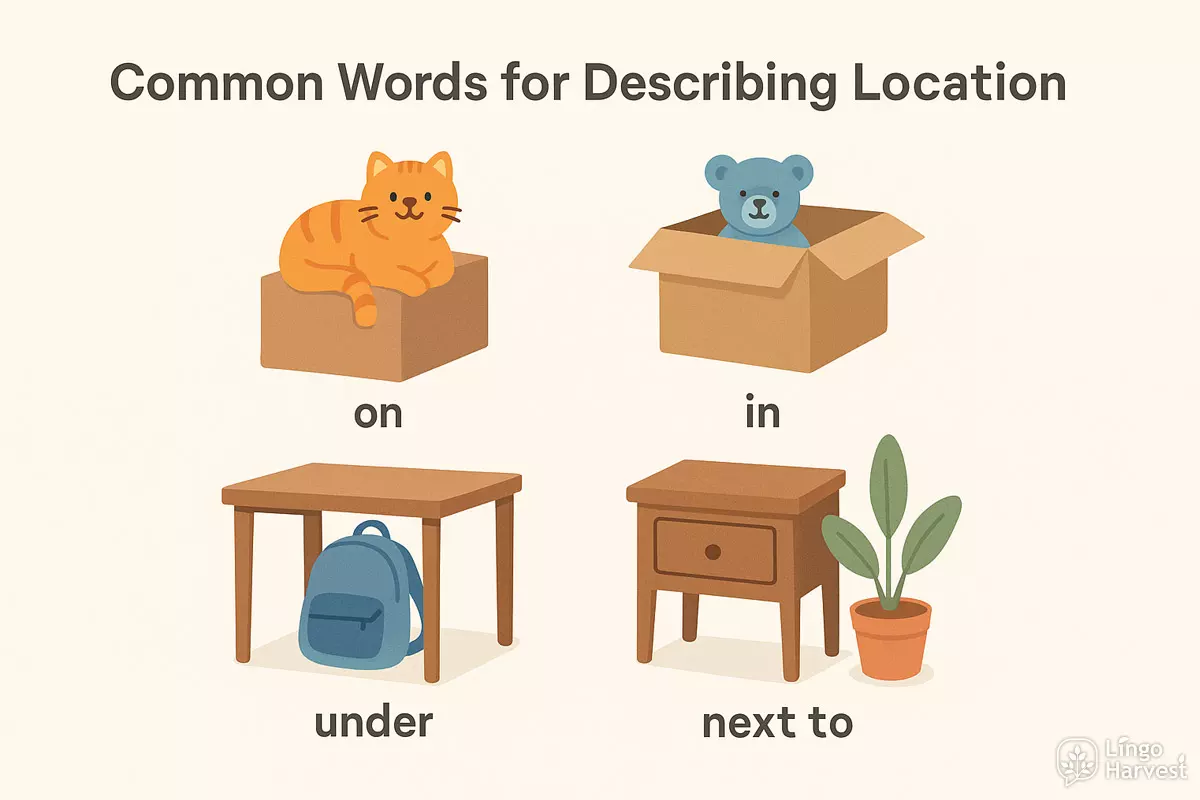
Here are some frequently used terms that tell us where something is inside a room or house:
- on – The lamp is on the table.
- in – There are books in the box.
- under – Shoes are under the bed.
- next to – The sofa is next to the window.
- between – The armchair is between the bookshelf and the door.
- behind – The desk is behind the chair.
- in front of – The rug is in front of the fireplace.
- above – A clock hangs above the TV.
- below – The cat sleeps below the table.
- opposite – The sofa is opposite the TV.
- near – There’s a lamp near the bed.
- far from – The bathroom is far from the kitchen.
- at the corner of – The plant is at the corner of the room.
- by – The keys are by the door.
- over – There’s a shelf over the desk.
- inside – The towels are inside the cabinet.
- outside – The garden is outside the living room.
- around – Pictures are around the mirror.
- along – Chairs are placed along the wall.
- through – The hallway goes through the house.
Usage Patterns in Sentences
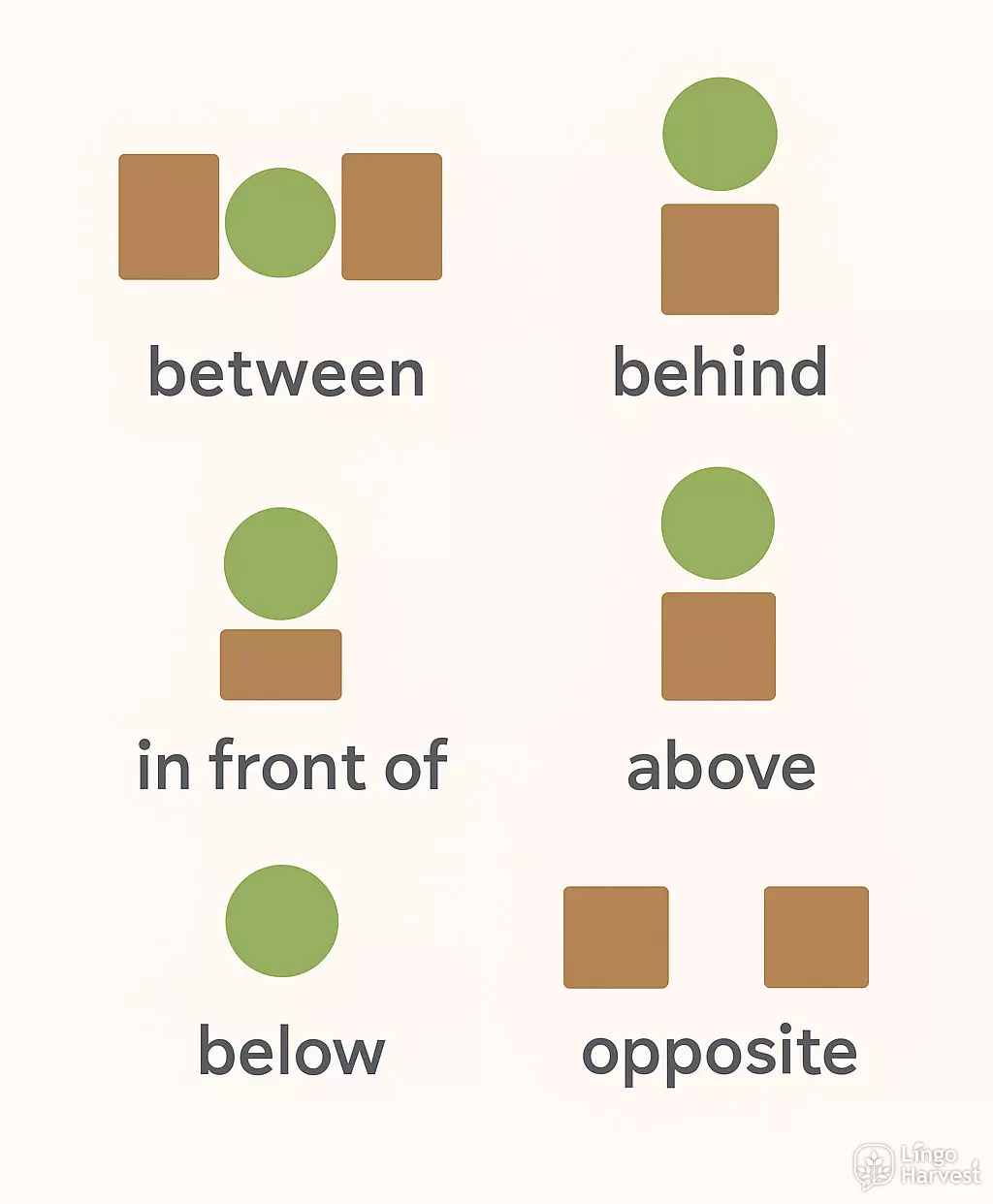
For clarity, here’s how these positional words fit into typical statements about a home:
| Preposition | Example Sentence |
|---|---|
| on | The remote is on the coffee table. |
| under | The slippers are under the bed. |
| between | The lamp stands between the sofa and the bookshelf. |
| next to | The fridge is next to the stove. |
| behind | The dog is hiding behind the curtain. |
| in front of | The TV is in front of the sofa. |
| above | The picture hangs above the fireplace. |
| near | The laundry basket is near the door. |
| by | The phone charger is by the bed. |
| inside | The cat is inside the box. |
Tips for Describing Interiors
When you want to paint a picture of a room or home, combine these words with furniture and room vocabulary. For example, say “There’s a mirror above the sink” or “The chairs are along the wall.” Notice how these small details help listeners or readers imagine the space more easily. To practice, try describing your own living space using as many different location words as you can. This will help you feel more confident when talking about homes in English.
Describing Your Home
When you talk about where you live in English, it’s useful to know how to share details about your house or apartment. Start by mentioning the type of place: is it a detached house, a flat, a cottage, or maybe a studio? You can then describe the size, the number of rooms, and any special features that make it unique.
Useful Vocabulary and Phrases
- It's a spacious apartment.
- I live in a small studio.
- My house has three bedrooms and a garden.
- There is a balcony with a nice view.
- The kitchen is modern and fully equipped.
- We have a cozy living room.
- The bathroom is quite large for an apartment.
- It's located in a quiet neighborhood.
- There is a lot of natural light.
- The walls are painted light blue.
- We have wooden floors throughout the home.
- There’s a fireplace in the living room.
- The apartment is on the fifth floor.
- We have a small balcony overlooking the park.
- It's close to public transport.
- The house is old but well-maintained.
- There’s a big window in the bedroom.
- We have a garage and a driveway.
Describing Location and Atmosphere
Your home’s location and the feeling it gives are often just as important as its size. You might want to mention if it’s in the city center, near a park, or in a quiet suburb. Use words like "peaceful," "lively," or "convenient" to convey the atmosphere.
- It's in a lively neighborhood with lots of shops.
- The area is very peaceful and green.
- We’re close to the city center.
- The surroundings are quiet and safe.
Comparing Different Types of Homes
If you need to compare two places, you can use phrases like "bigger than," "more modern," or "closer to downtown." Here is a structured way to compare different types of dwellings:
| Type of Home | Typical Features |
|---|---|
| Detached House | Private garden, several bedrooms, more privacy |
| Apartment/Flat | Shared building, may have a balcony, usually smaller than a house |
| Studio | One main room, compact, often in city centers |
| Cottage | Cozy, often in the countryside, sometimes with a fireplace |
| Terraced House | Shares walls with neighbors, typically two floors |
| Penthouse | Top floor, luxury features, large terrace or balcony |
Tips for Giving a Full Description
To give a clear picture, combine details about size, layout, and atmosphere. For example: "I live in a bright two-bedroom apartment on the third floor. It has large windows, a small balcony, and is close to the metro. The area is friendly and quiet, perfect for families." Remember, being specific helps your listener visualize your living space and understand what makes it feel like home to you.
Practice: Write About Your Room
Describing your own space in English helps you build vocabulary and express personal details clearly. Begin by observing your surroundings and noting what stands out to you. Think about the size, furniture, colors, and what makes your room unique. Use the following prompts and vocabulary to guide your description.
Useful Words and Phrases
- spacious
- cozy
- bright
- tidy
- messy
- carpeted
- wooden floor
- window
- curtains
- desk
- bookshelf
- wardrobe
- poster
- lamp
- mirror
- bedside table
- drawer
- pillow
- blanket
- chair
Sentence Starters
- My room is...
- I have a...
- The walls are painted...
- There is/are...
- On my desk, I keep...
- Next to the window, you can find...
- It feels...
- I like my room because...
Task: Describe Your Room
Write 4–6 sentences about your bedroom using the vocabulary and sentence starters above. Try to include:
- The size and atmosphere of your room
- At least three pieces of furniture or objects
- Something special or personal in your space
- How you feel about your room
Sample Descriptions
- My room is small but very cozy. There is a big window with blue curtains. I have a wooden desk and a comfortable chair where I study. On the wall, I put up a poster of my favorite band. I like my room because it is quiet and peaceful.
- The walls in my bedroom are light green. Next to my bed, I have a bedside table with a lamp and some books. My wardrobe is near the door, and I keep my clothes there. My favorite thing in my room is a soft blanket my grandmother gave me. It makes me feel at home.
Quiz: Identify the Correct Description
- Which sentence best describes a tidy room?
a) "There are clothes everywhere on the floor."
b) "Everything is in its place and the bed is made."
c) "My desk is covered with books and papers." - Which object would you NOT usually find in a bedroom?
a) Pillow
b) Oven
c) Lamp - What makes a room feel cozy?
a) Hard chairs
b) Soft lighting and warm blankets
c) Loud music
Show answers
- b) "Everything is in its place and the bed is made."
- b) Oven
- b) Soft lighting and warm blankets