School Life Nouns: Common Words Students Should Know

 This article explains common school vocabulary, including people like teachers and students, subjects, classroom objects, and places in a school. It also covers homework, rules, useful phrases, and has a school map labeling exercise.
From classrooms to playgrounds, students encounter various terms that reflect the routines and experiences of school life. Understanding these essential school-related words helps students communicate more effectively with teachers and peers, participate confidently in lessons and activities, and adapt more easily to the school environment. Building a strong vocabulary not only supports academic achievement but also fosters positive relationships and a sense of belonging within the school community.
People at School
Understanding the different roles in an educational setting helps students navigate daily life and communicate clearly. Each person you meet at a school has a specific title, and learning these terms is useful for conversations, writing assignments, and building relationships within the school community.
Main Roles and Their Descriptions
The following list covers the most common titles you’ll encounter in a school environment:
- Principal – the head administrator responsible for managing the entire school.
- Vice Principal – assists the principal and often handles discipline or special programs.
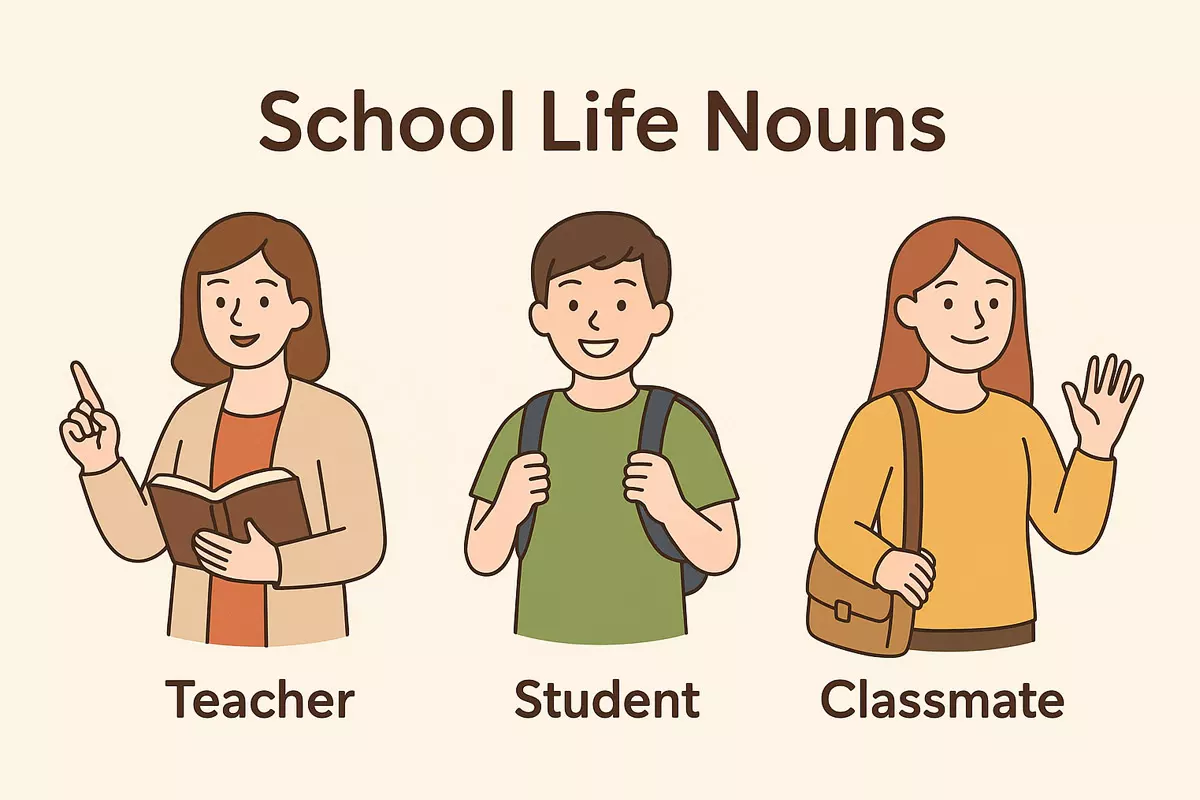
- Teacher – leads classes and helps students learn specific subjects.
- Student – anyone enrolled in classes, from young children to teens.
- Classmate – a fellow student in your class or grade.
- Homeroom Teacher – the teacher responsible for a particular group of students, especially at the start and end of the day.
- School Counselor – supports students with academic, social, or emotional issues.
- Librarian – manages the library and helps students find books or resources.
- Coach – leads sports teams and organizes athletic activities.
- Janitor – keeps the school clean and maintains the facilities.
- School Nurse – provides medical assistance and cares for sick or injured students.
- Secretary – handles administrative tasks and helps manage communication in the office.
- Lunch Lady/Server – prepares and serves meals in the cafeteria.
- Security Guard – ensures safety and order within the school grounds.
- Substitute Teacher – temporarily replaces regular educators when they are absent.
Comparing School Roles
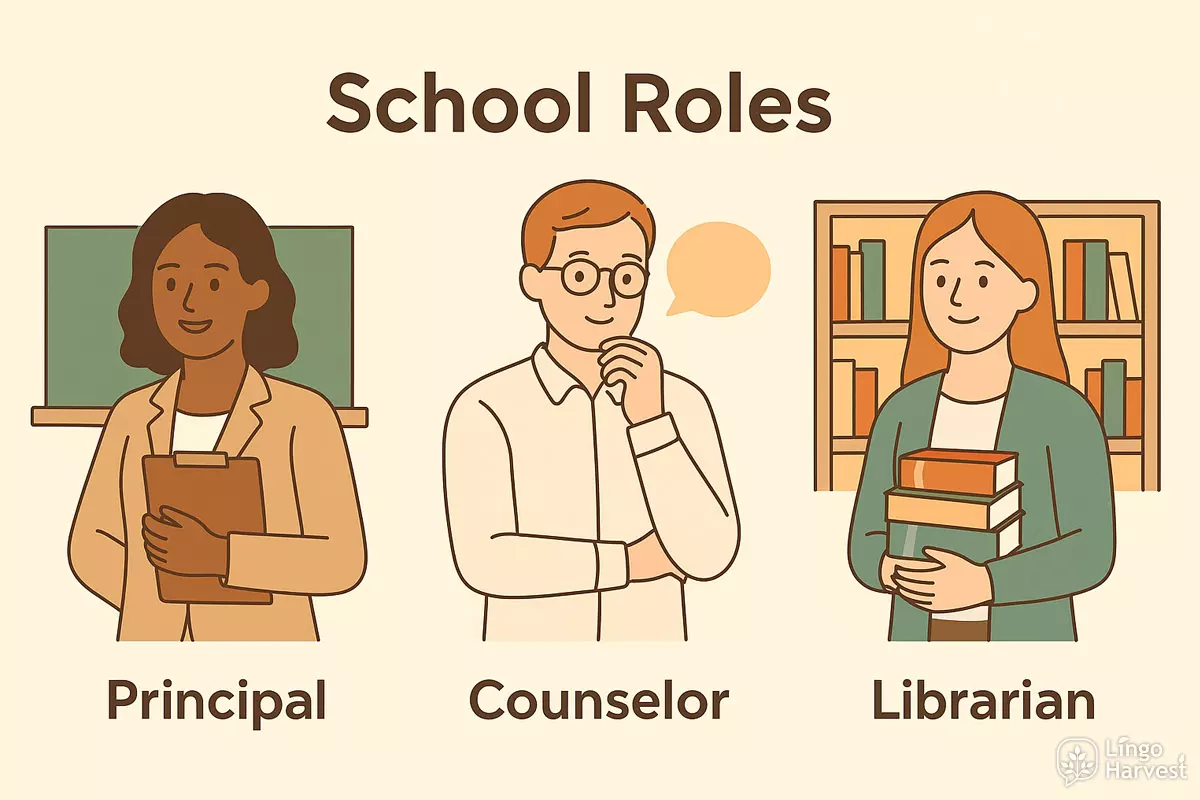
Some positions can be confusing, especially if their responsibilities overlap. The table below highlights a few key differences and similarities among selected roles.
| Role | Main Responsibility |
|---|---|
| Principal | Leads the school, makes important decisions, and oversees staff and students. |
| Teacher | Instructs students in specific subjects and supports their learning progress. |
| Counselor | Advises students on academic, personal, and social matters. |
| Janitor | Maintains cleanliness and handles minor repairs in the building. |
| Librarian | Organizes library resources and helps students find information. |
Other Useful Vocabulary
Beyond official job titles, school life includes informal terms and group names. Here are a few more words you might hear or use:
- Peer – another student at your level or age.
- Advisor – a staff member who guides students in academics or extracurricular activities.
- Prefect – a student with extra duties, often helping to enforce rules.
- Alumnus/Alumna – a former student who has graduated.
- Volunteer – someone who helps out at school without pay, sometimes parents or community members.
Knowing these terms makes it easier to describe who does what at school, ask for help, or talk about your experiences in English.
Subjects and Classes
Learning the words for different areas of study is important for every student. Knowing how to talk about what you are learning helps you understand schedules, assignments, and conversations with classmates or teachers. Let’s look at some of the most common terms used to describe what you might study at school.
Core School Subjects
Many schools have a set of main topics that all students must take. Here are some of the most common:
- Mathematics (Math): numbers, equations, geometry, algebra
- Science: biology, chemistry, physics, experiments
- History: past events, timelines, important figures
- Geography: maps, countries, physical features
- Language Arts: reading, writing, grammar, literature
- Foreign Language: Spanish, French, German, Mandarin, etc.
- Physical Education (PE): sports, exercise, health
- Art: drawing, painting, sculpture
- Music: singing, instruments, rhythm
- Computer Science: coding, typing, digital skills
Classroom Vocabulary
Talking about learning goes beyond just naming subjects. Here are some helpful words for discussing your school day:
- Lesson: a single period of instruction
- Assignment: homework or classwork you need to complete
- Test / Exam: a way to check your knowledge
- Project: a bigger task, often done in groups
- Timetable (Schedule): a plan showing when classes happen
- Classroom: the room where you learn
- Teacher: the person leading the lesson
- Classmate: another student in your group
- Homework: exercises or reading to do at home
- Grade: the score or mark for your work
Comparing Types of Classes
Some courses are required, while others can be chosen. Here is a quick comparison:
| Type of Class | Description |
|---|---|
| Compulsory | Must be taken by all students (e.g., math, native language) |
| Elective | Chosen by students based on interest (e.g., art, robotics) |
| Advanced | More challenging than standard classes; sometimes called "Honors" or "AP" |
| Remedial | Extra help for students who need to strengthen skills |
Places and Objects
When talking about everyday life at school, it’s helpful to know the names of different locations and things found on campus. These words make it easier to describe where events happen, what tools are used for learning, and how students navigate their environment. Being familiar with these terms can also help students follow directions and participate more confidently in classroom or group activities.
Common Areas in a School
Many educational institutions have similar spaces, each serving a specific purpose. Here are some names you’ll often hear:
- classroom
- library
- cafeteria
- gym (gymnasium)
- auditorium
- hallway
- playground
- principal’s office
- nurse’s office
- laboratory (lab)
- locker room
- staff room
- restroom
- parking lot
Essential School Items
Certain objects are part of daily routines, whether used for studying, organizing, or transporting materials. Here are some of the most important ones students encounter:
- desk
- chair
- blackboard (chalkboard) / whiteboard
- marker
- textbook
- notebook
- pencil case
- pen
- pencil
- eraser
- ruler
- backpack
- folder
- calculator
- computer
- projector
- globe
- map
Comparing School Locations and Objects
Some terms might seem similar but refer to different things. Here’s a table to help clarify a few commonly confused items:
| Word | What It Means |
|---|---|
| Classroom | A room where lessons are taught; students spend most of their day here. |
| Laboratory | A room equipped for science experiments and practical work. |
| Library | A place for reading and borrowing books; often quiet for studying. |
| Auditorium | A large hall used for assemblies, performances, or presentations. |
Understanding these names helps students feel more comfortable and prepared in school settings. Whether you’re finding your way to the gym, borrowing a book, or packing the right supplies, knowing this vocabulary makes daily routines smoother and more enjoyable.
Homework and Exams
Completing assignments and taking tests are central aspects of student life. Understanding the vocabulary related to these tasks helps learners follow instructions, organize their materials, and communicate with teachers and classmates more confidently. Knowing the right terms also makes it easier to discuss study routines, deadlines, and academic expectations.
Essential Vocabulary
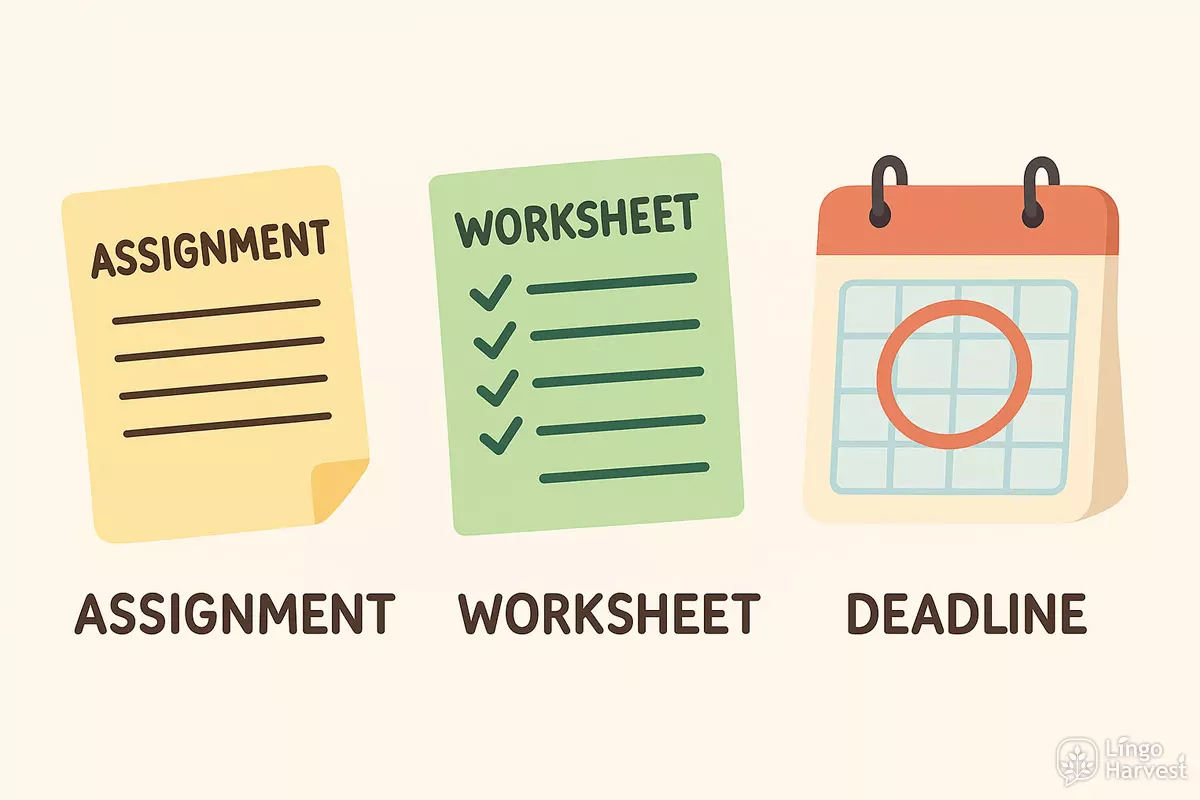
Here are some common nouns that students often encounter in connection with assignments and assessments:
- Assignment – a task or piece of work given to students
- Worksheet – a sheet with exercises or problems to solve
- Deadline – the final date or time when work must be finished
- Quiz – a short test, usually on a specific topic
- Essay – a written piece discussing a topic in detail
- Project – a larger task, often involving research or teamwork
- Grade – the mark or score given for work
- Rubric – a guide listing criteria for grading assignments
- Revision – reviewing or correcting work
- Feedback – comments or advice from teachers about your work
- Exam – a formal test covering one or more subjects
- Paper – a longer written assignment or report
- Instructions – directions on what to do for a task
- Score – the number of points earned on a test
- Retake – an opportunity to try an exam or test again
- Cheat sheet – a small summary of notes (sometimes not allowed)
- Marking scheme – the way points are distributed for answers
- Submission – turning in your completed work
- Plagiarism – copying someone else’s work without permission
- Answer sheet – the paper where students write their responses
Types of Tests and Assignments
Different words describe various forms of academic evaluation. Recognizing these helps students prepare appropriately.
- Multiple choice – questions with several possible answers
- Short answer – questions that require a brief written response
- Oral exam – a test where answers are given verbally
- Open-book test – allows use of notes or textbooks during the exam
- Timed test – must be completed within a set period
Common Instructions and Terms
Instructors often use particular words when explaining tasks or giving directions. Here are some examples students should know:
- Submit – to hand in completed work
- Resubmit – to hand in work again after making changes
- Review – to look over work or study material again
- Correct – to fix errors
- Complete – to finish all parts of an assignment
- Skip – to leave out a question or section
Sample Grading Terms
It helps to be familiar with the language of assessment. Here’s a quick comparison of common grading-related nouns:
| Term | Meaning |
|---|---|
| Grade | The letter or number showing how well you did (e.g., A, 90%) |
| Score | The total points earned on a test or assignment |
| Mark | A symbol or number showing correctness or mistakes for individual questions |
| Pass/Fail | Whether you met the minimum standard (✅ or ❌) |
By learning these words and their meanings, students can better navigate academic tasks, understand expectations, and communicate more clearly about their progress and challenges in school.
Rules and Timetable Terms
Understanding the language used to talk about school regulations and daily schedules is essential for students. These words help you follow instructions, stay organized, and communicate clearly about your day-to-day routines at school.
Essential Vocabulary for School Regulations
Many terms describe the guidelines and expectations in academic settings. Knowing these can help students navigate classroom life more smoothly. Here are some common words you might encounter:
- Rule — a guideline that must be followed
- Permission — approval to do something
- Punishment — a consequence for breaking a rule
- Detention — staying after school as a penalty
- Uniform — required clothing for students
- Attendance — being present at school
- Absence — not being at school when expected
- Late slip — a note for arriving after the start time
- Excuse note — written explanation for missing school
- Assembly — a gathering of students, often for announcements or events
- Permission slip — a form parents sign to allow participation in activities
Timetable and Schedule Terms
Talking about your daily plan at school involves specific nouns. These terms make it easier to describe when and where classes or activities happen.
- Timetable — a table showing the times of classes
- Period — a block of time for one subject
- Break — a short rest between lessons
- Lunch — the midday meal and associated break
- Bell — a signal marking the start or end of a period
- Subject — a particular course or area of study (e.g., Math, History)
- Classroom — the room where lessons take place
- Schedule — the plan for the day's or week's activities
- Homeroom — the room or period for administrative tasks at the start of the day
- Dismissal — the end of the school day when students can leave
- Rotation — changing classes or subjects according to a set pattern
Comparing Key Timetable Terms
Some words may seem similar but have distinct meanings in a school context. The table below helps clarify these differences:
| Term | Meaning |
|---|---|
| Period | A set length of time for one lesson or subject |
| Break | A short pause between classes for rest or snacks |
| Lunch | The time allocated for eating in the middle of the day |
| Homeroom | A session at the start of the school day for announcements and attendance |
| Dismissal | The official end of the school day |
Simple Classroom Phrases
Understanding everyday expressions in school settings helps students communicate confidently with teachers and classmates. These common sayings are used throughout lessons, group work, and even during breaks. Mastery of such expressions can make navigating school life much smoother, especially for those new to the classroom environment.
Useful Expressions for Students
Here are some frequently used sayings that you might hear or need to use during a typical school day:
- May I go to the bathroom?
- I don’t understand.
- Can you repeat that, please?
- What does this word mean?
- How do you spell that?
- Can I borrow a pencil?
- Could you help me, please?
- Is this homework due tomorrow?
- I finished my work.
- Do we have to write this down?
- Can I sit here?
- I forgot my notebook.
- When is the test?
- Can I work with a partner?
- Do we need our textbooks?
- Excuse me, I have a question.
- Should we use a pen or pencil?
- Is this correct?
- What page are we on?
- Can you speak more slowly?
Common Teacher Instructions
Teachers often use clear, direct commands to guide students. Knowing these instructions can help learners follow along without confusion.
- Open your books to page ten.
- Listen carefully.
- Please be quiet.
- Work in pairs.
- Hand in your assignments.
- Raise your hand.
- Take out your notebooks.
- Line up at the door.
- Read the instructions.
- Turn in your homework.
Polite Classroom Requests
Being polite is important in any learning environment. Here are some ways to ask or respond kindly:
- Could you please explain that again?
- Would you mind helping me?
- Thank you for your help.
- I appreciate your explanation.
- Sorry for being late.
- Excuse me, may I come in?
Quick Reference: Student vs. Teacher Phrases
| Student Says | Teacher Says |
|---|---|
| Can I go to the bathroom? | Raise your hand to speak. |
| I don’t understand. | Let’s review the answer together. |
| Can you help me, please? | Work with your partner. |
| What page are we on? | Open your books to page twenty. |
| Do we have homework? | Don’t forget to turn in your homework. |
Familiarity with these expressions supports smoother communication and helps everyone focus on learning. Whether you’re asking a question, following an instruction, or making a polite request, these phrases are essential for daily school life.
Practice: Label a School Map
Understanding the vocabulary used to describe different areas and rooms in a school is essential for clear communication. To help you remember these important nouns, let's try a practical activity: imagine you have a simple school map in front of you. Each area on the map needs the correct label based on its function or features.
Common School Locations to Know
Before starting, review these typical places found in most schools. Make sure you are familiar with each term and what happens there:
- Classroom – where lessons take place
- Library – for reading and borrowing books
- Cafeteria – where students eat lunch
- Gym – for sports and physical education
- Office – where the principal and school staff work
- Hallway – corridors connecting different rooms
- Locker – a small storage space for student belongings
- Restroom – for personal hygiene needs
- Playground – outdoor area for recess and games
- Auditorium – for assemblies and performances
- Science Lab – where experiments are conducted
- Music Room – for band and choir practice
- Art Room – for drawing, painting, and crafts
- Nurse’s Office – for health and first aid
- Computer Lab – where students use computers
- Storage Room – for supplies and equipment
- Staff Room – a space for teachers to take breaks
- Entrance – main door to the school
- Stairs – for moving between floors
- Parking Lot – where vehicles are parked
Activity: Match the Area to Its Description
Read the descriptions below and write the correct noun from the list above for each numbered location on your map. If you don’t have a map, just match the words to the descriptions.
- This is where students go to borrow books or study quietly.
- Meals are served and eaten here during lunchtime.
- Sports classes and games are held in this large indoor space.
- Students keep their backpacks and coats in this small, personal space.
- This room is used for science experiments and practical lessons.
- Children play outside during recess in this area.
- Students and teachers walk through here to get from one room to another.
- This is where the main administrative work of the school happens.
Show answers
- Library
- Cafeteria
- Gym
- Locker
- Science Lab
- Playground
- Hallway
- Office
Useful Nouns for School Maps: Quick Reference
Here is a summary table of some of the most frequently used school location nouns and their typical purposes:
| Place | What Happens There |
|---|---|
| Classroom | Lessons, studying, group work |
| Cafeteria | Eating meals, socializing at lunch |
| Gym | Sports, exercise, physical education |
| Library | Reading, research, borrowing books |
| Auditorium | Assemblies, performances, meetings |
| Restroom | Personal hygiene, washing hands |
| Office | Administration, principal’s work |
| Playground | Outdoor games, recess, free play |
| Locker | Storage for bags and personal items |
| Science Lab | Experiments, hands-on learning |
Challenge Yourself
Try drawing a simple map of a school and label at least ten different rooms or areas using the vocabulary above. This will help reinforce your understanding of these essential school nouns. If you’re studying with a partner, quiz each other by describing a location and asking for the correct word.
Show answers
Any combination of the nouns listed above for different rooms/areas is correct if the label matches the function. For example: Classroom, Library, Gym, Office, Cafeteria, Restroom, Playground, Music Room, Science Lab, Art Room, etc.