Learn Prepositions Visually: Picture Method for Beginners

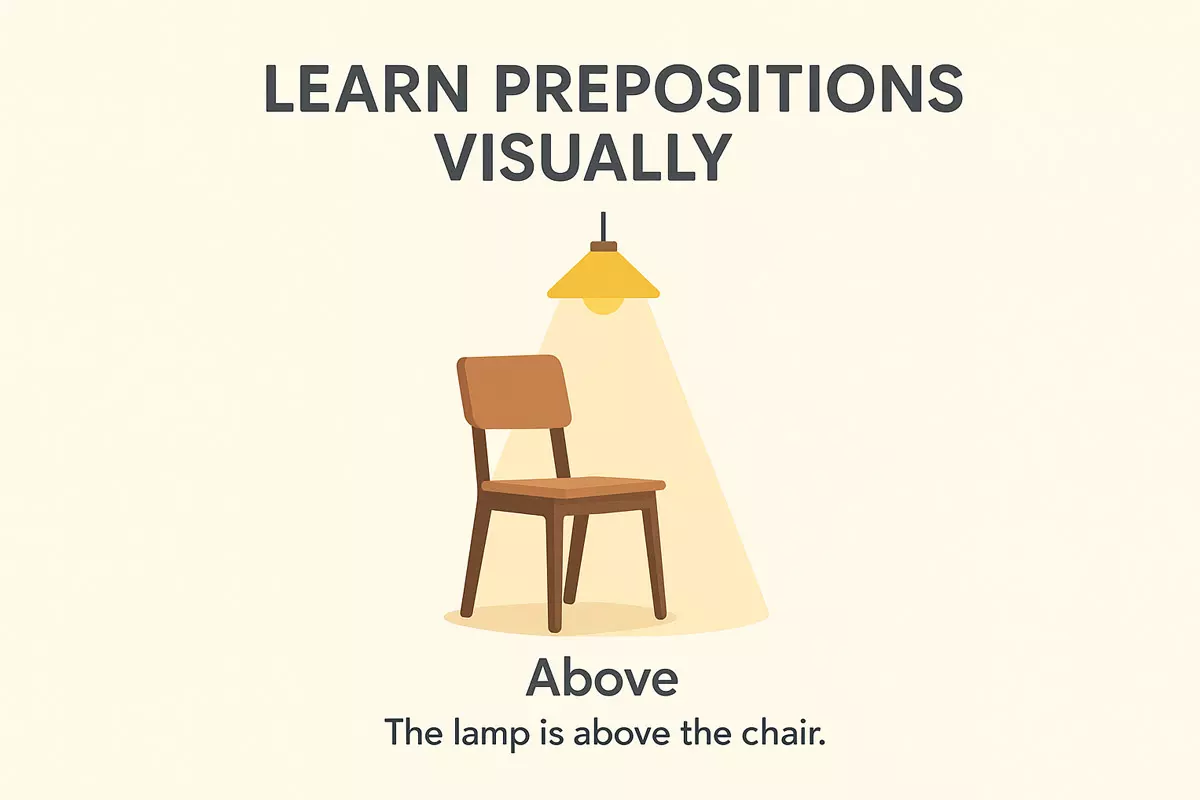 Here we how visual learning makes prepositions easier to understand by using pictures to show place, time, and direction. It also provides memory tips and practical exercises with real objects to help learners practice prepositions effectively.
Learning prepositions can be challenging for those new to English, but using images alongside language instruction makes the process easier and more enjoyable. Visual aids allow learners to associate words with real-world contexts, helping them understand how prepositions function in everyday situations. This approach transforms abstract grammar rules into concrete examples, making it simpler to remember and apply what has been learned. By connecting language with visuals, learners build stronger comprehension and confidence in using prepositions correctly.
How Visual Learning Helps
Seeing prepositions in context makes abstract language more concrete. When beginners connect words like “on,” “under,” or “between” with clear images, it’s easier to grasp how these words function in real life. Instead of memorizing translations, learners develop an intuitive sense of spatial relationships and movement.
Why Pictures Make Prepositions Clearer
Images break down complex grammar into digestible chunks. For example, a picture of a cat on a box instantly illustrates the meaning, while a cat under a table demonstrates a different relationship. This visual approach reduces confusion, especially for words that don’t translate directly between languages.
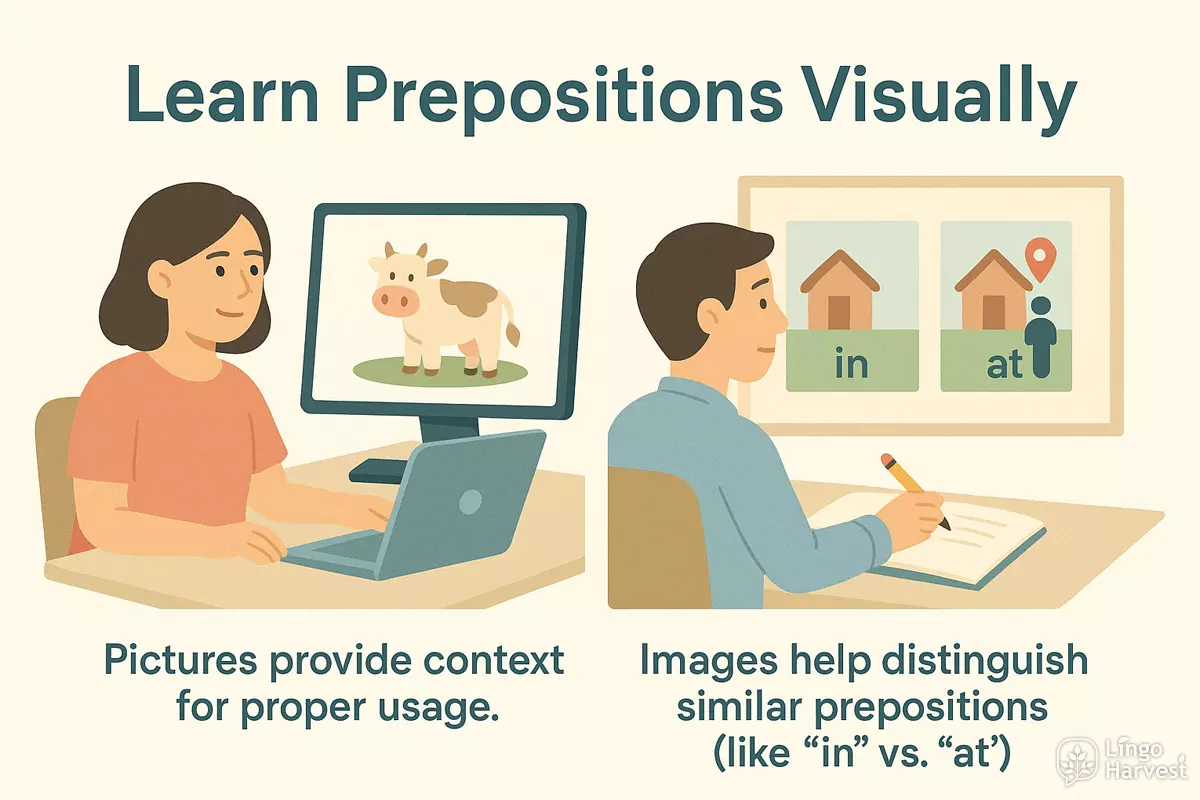
- Visuals reinforce memory through association.
- Pictures provide context for proper usage.
- Images help distinguish similar prepositions (like “in” vs. “at”).
- Seeing scenarios makes learning more engaging and less abstract.
Common Prepositions Made Visual
Here are examples of how pictures can clarify basic prepositions for beginners:
- in – The apple in the basket
- on – The book on the table
- under – The shoes under the bed
- between – The dog between two chairs
- behind – The ball behind the door
- in front of – The bike in front of the house
- next to – The lamp next to the sofa
- above – The clock above the shelf
- below – The keys below the mat
- over – The plane over the city
- across – The bridge across the river
- through – The tunnel through the hill
Benefits for Different Learning Styles
Not everyone learns the same way. Visual aids support:
- Visual learners – who recall information best through images.
- Kinesthetic learners – who benefit from acting out scenarios shown in pictures.
- Auditory learners – who can pair images with spoken examples for stronger recall.
By incorporating visual elements, mastering spatial words becomes more intuitive and less reliant on rote memorization.
Using Pictures to Show Relationships
Pictures are a powerful way to clarify how prepositions work, especially for beginners. Instead of memorizing rules, seeing images helps you instantly grasp the connection between objects and their positions. Visuals make it easy to understand what words like on, under, or between really mean in everyday situations.
How Visuals Help With Prepositions
Images illustrate spatial relationships that can be hard to describe with words alone. For example, a picture showing a cat on a table versus a cat under a table makes the difference obvious. This method is especially useful for visual learners and for those who are just starting to study English or any language with prepositions.
Common Prepositions in Pictures
- in – the ball in the box
- on – the book on the table
- under – the cat under the chair
- next to – the lamp next to the bed
- between – the apple between two oranges
- behind – the dog behind the door
- in front of – the car in front of the house
- over – the plane over the city
- above – the clock above the shelf
- below – the shoes below the bed
- near – the park near the school
- far from – the station far from the hotel
- inside – the keys inside the bag
- outside – the kids outside the house
- through – the train through the tunnel
- across – the bridge across the river
- along – the dog along the street
- around – the fence around the garden
- onto – the cat jumps onto the sofa
- off – the bird flies off the branch
Comparing Prepositions Visually
Some prepositions can be confusing when described only with words. A visual table can help compare the meaning and use of similar prepositions.
| Preposition | Picture Example (Description) |
|---|---|
| on | The cup is on the table (cup rests on top of the surface) |
| in | The apple is in the bowl (apple surrounded by the bowl) |
| under | The dog is under the chair (dog below, covered by the chair) |
| between | The ball is between two shoes (ball in the middle of two objects) |
| behind | The cat is behind the curtain (cat hidden at the back) |
| in front of | The bike is in front of the garage (bike before, facing the garage) |
| next to | The bag is next to the chair (bag beside, close to the chair) |
| above | The lamp is above the table (lamp higher, not touching the table) |
Using illustrated examples or simple sketches can make abstract preposition meanings concrete. Try drawing your own simple pictures, or look for illustrated flashcards to reinforce your understanding. Over time, connecting words with images helps you remember and use prepositions more naturally.
Prepositions of Place in Images
Visuals make it easier to understand how words like “on,” “under,” and “between” describe where things are. When learning these terms, looking at pictures can help you remember what each one means. For example, seeing a cat under a table or a ball in a box gives instant understanding of where something is located. With this approach, even beginners can quickly connect words to real-life situations.
Common Location Words Used in Pictures
- In – The toy is in the box.
- On – The book is on the table.
- Under – The shoes are under the bed.
- Behind – The dog is behind the door.
- In front of – The chair is in front of the desk.
- Next to – The lamp is next to the sofa.
- Between – The picture is between the windows.
- Above – The clock is above the blackboard.
- Below – The keys are below the shelf.
- Near – The park is near the school.
- Opposite – The bank is opposite the post office.
- Inside – The bird is inside the cage.
- Outside – The children are outside the house.
- At – Meet me at the bus stop.
- Over – The plane is over the city.
- Through – The car goes through the tunnel.
- Around – The fence goes around the garden.
- Along – Walk along the river.
- Across – The bridge is across the river.
- Past – Go past the bakery.
How Images Help with Understanding
Seeing illustrations or photos creates a direct link between the spatial word and the object’s position. For example, a diagram showing a ball next to a box versus a ball in front of a box highlights the difference in placement. This method is especially useful for those who are just starting to build their vocabulary.
| Preposition | Picture Example Description |
|---|---|
| On | The cat sits on the mat (the cat is touching the surface). |
| Under | The ball is under the chair (the ball is below, not touching). |
| Between | The apple is between two books (one on each side). |
| Behind | The dog is behind the fence (the dog is at the back). |
| In | The keys are in the bag (inside, surrounded by the bag). |
| Next to | The mug is next to the laptop (close, at the side). |
| Above | The lamp is above the table (higher than, not touching). |
| Opposite | The school is opposite the library (facing each other). |
To sum up, matching words with visuals helps make spatial relationships clear and memorable. Try to look at illustrations or draw your own to practice these expressions. Over time, you’ll be able to describe locations more confidently by recalling the images that go with each term.
Time and Direction Examples
Understanding how prepositions work with both time and movement is easier when you see them in action. Visual learners can especially benefit from matching phrases with clear mental images. Below, you’ll find common scenarios for both time and direction prepositions, with simple explanations and sample sentences.
Prepositions of Time
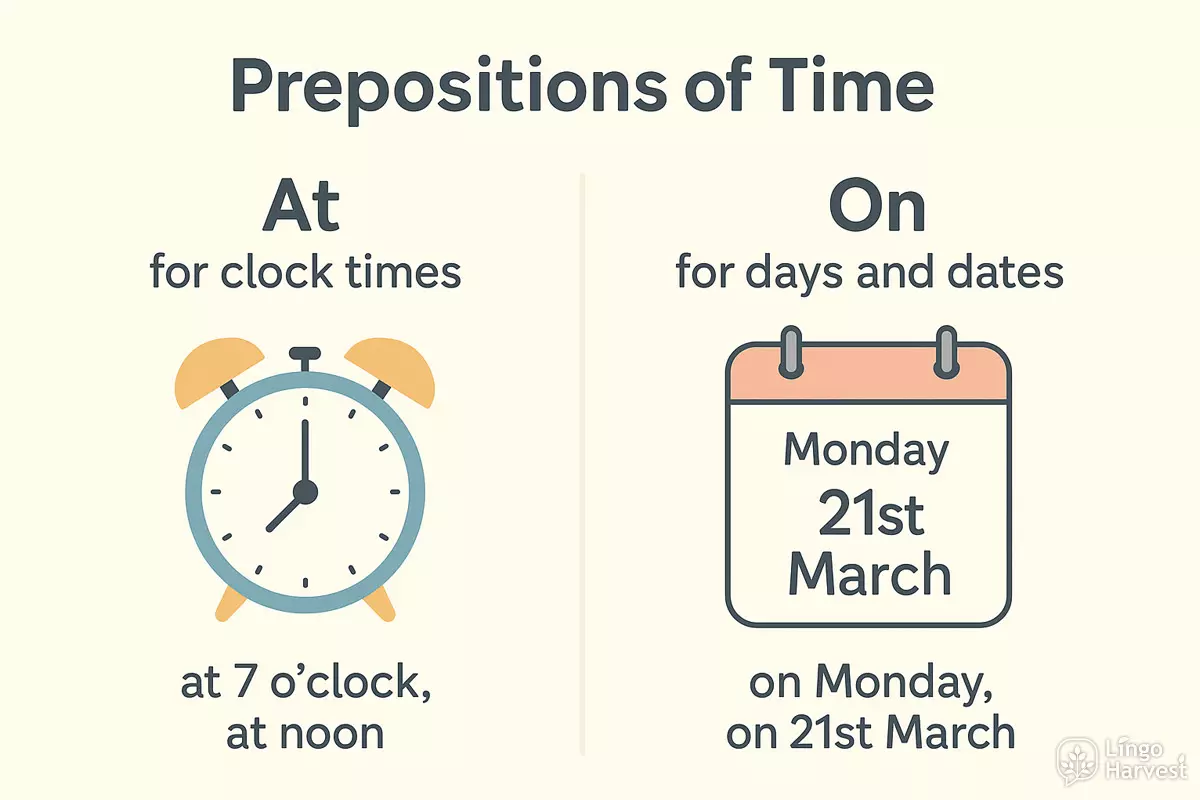
These are used to describe when something happens. Notice how each preposition relates to a specific kind of time reference:
- At – for clock times: at 7 o’clock, at noon
- On – for days and dates: on Monday, on 21st March
- In – for months, years, seasons, and long periods: in April, in 2024, in summer
- By – not later than a certain time: by 5 pm
- Before – earlier than a point in time: before lunch
- After – later than a point in time: after dinner
- During – throughout a period: during the meeting
- From…to – start and end points: from Monday to Friday
- Until – up to a point: until midnight
- Since – from a specific time in the past: since 2020
Prepositions of Direction
These help describe movement from one place to another. They are useful for giving instructions or telling stories about travel and change in position.
| Preposition | Example Sentence |
|---|---|
| To | She walked to the park. |
| Into | The cat jumped into the box. |
| Out of | He ran out of the building. |
| Across | They swam across the river. |
| Through | We drove through the tunnel. |
| Toward | The dog moved toward its owner. |
| Past | The runner went past the school. |
| Along | She walked along the beach. |
| Up | He climbed up the stairs. |
| Down | The ball rolled down the hill. |
Tips for Visualizing
Try to picture each scene as you read. Imagine the clock for “at 5 o’clock,” a calendar for “on Tuesday,” or a path for “across the street.” Creating a mental image with each phrase helps fix the meaning of each preposition in your memory. This approach is especially helpful for beginners who want to build a solid foundation for using prepositions accurately.
Practice with Real Objects
Connecting language to the physical world makes prepositions much easier to grasp, especially for beginners. Handling everyday items and physically moving them helps you visualize the meaning of each preposition. Try using simple household objects—such as a cup, a book, or a pencil—to act out different scenarios. This tactile approach reinforces abstract concepts by linking them to real experiences.
How to Set Up Your Practice
- Choose 2–3 small objects (e.g., a toy, a key, a box).
- Find a flat surface like a table to serve as your “stage.”
- Use your objects to act out different spatial relationships.
- Say the preposition aloud as you move the objects: “The key is under the box.”
- Repeat with different items and positions to reinforce each concept.
Common Prepositions to Try with Objects
- on
- under
- in
- next to
- between
- behind
- in front of
- above
- below
- near
- far from
- inside
- outside
- around
- through
- across
- against
- beside
Visual Preposition Examples
Below is a structured set of example sentences using a cup and a book. You can recreate these positions at home and say each sentence aloud while arranging the objects.
| Preposition | Example with Objects |
|---|---|
| on | The cup is on the book. |
| under | The cup is under the book. |
| between | The cup is between two books. |
| next to | The cup is next to the book. |
| in | The pencil is in the cup. |
| behind | The cup is behind the book. |
| in front of | The cup is in front of the book. |
| above | The cup is above the book (hold it in the air). |
| below | The cup is below the book (hold it under a shelf). |
| inside | The eraser is inside the cup. |
Mini-Quiz: Move and Say
- Place a pencil next to a book. Say the sentence.
- Put a toy under a box. Say the sentence.
- Move a key between two cups. Say the sentence.
- Hold a pen above a notebook. Say the sentence.
- Put an eraser in a cup. Say the sentence.
Show answers
- The pencil is next to the book.
- The toy is under the box.
- The key is between the two cups.
- The pen is above the notebook.
- The eraser is in the cup.
By physically arranging and describing objects, you connect language to real situations, making prepositions more memorable. This hands-on method is especially helpful for visual learners and those new to English grammar.
Memory Tips for Learners
For those starting out with English prepositions, using visualization makes abstract meanings clearer and much easier to remember. Connecting each preposition to a simple mental image—like “in” as an object inside a box or “on” as something resting on a surface—gives your mind a shortcut for recall. Try sketching or imagining these scenes each time you study new prepositions.
Visual Associations
Instead of memorizing word lists, picture the relationship each preposition describes. For example, “under” evokes an image of an object beneath a table. The more vivid or silly the image, the more likely you are to recall it later. Practice drawing or searching for pictures that represent these relationships.
Common Prepositions with Visual Examples
- in – apple in a bowl
- on – book on a table
- under – cat under a chair
- between – ball between shoes
- behind – dog behind a door
- in front of – shoes in front of a bench
- next to – lamp next to a sofa
- over – plane over a city
- above – lamp above a table
- below – fish below the surface
- beside – bag beside a chair
- near – park near the river
- opposite – café opposite the post office
- at – people at the bus stop
- by – house by the lake
- through – train through a tunnel
- across – bridge across the river
- around – fence around a garden
- into – child into the pool
- out of – bird out of the cage
Practice with Comparison Table
Sometimes, similar prepositions can be confusing. Comparing them visually helps clarify their differences. Here’s a table illustrating a few commonly mixed-up prepositions:
| Preposition | Visual Example / Meaning |
|---|---|
| in | Ball in the box (inside, surrounded by boundaries) |
| on | Book on the table (touching and supported by a surface) |
| at | People at the station (specific point or place) |
| under | Cat under the chair (lower than, covered by something) |
| over | Bird flying over the field (above and moving across) |
| above | Lamp above the table (higher than, not necessarily touching) |
Regular Review and Self-Testing
Frequent, short review sessions help move new prepositions from short-term to long-term memory. Quiz yourself with flashcards showing only the image, and try to recall the correct preposition. Switch it up by describing a picture and asking a friend to name the preposition, or vice versa.
Tips for Lasting Retention
- Group similar prepositions together and spot their differences visually.
- Invent simple stories where the objects move according to each preposition.
- Use prepositions in your daily surroundings—describe where things are in your room or on your desk.
- Repeat new patterns aloud to reinforce the connection between the word and the image.
- Mix drawing, speaking, and listening for multi-sensory learning.
By making prepositions concrete through images and real-life context, you’ll gradually build a solid foundation and recall them with confidence.