Comma After Introductory Words and Phrases: Easy Rules

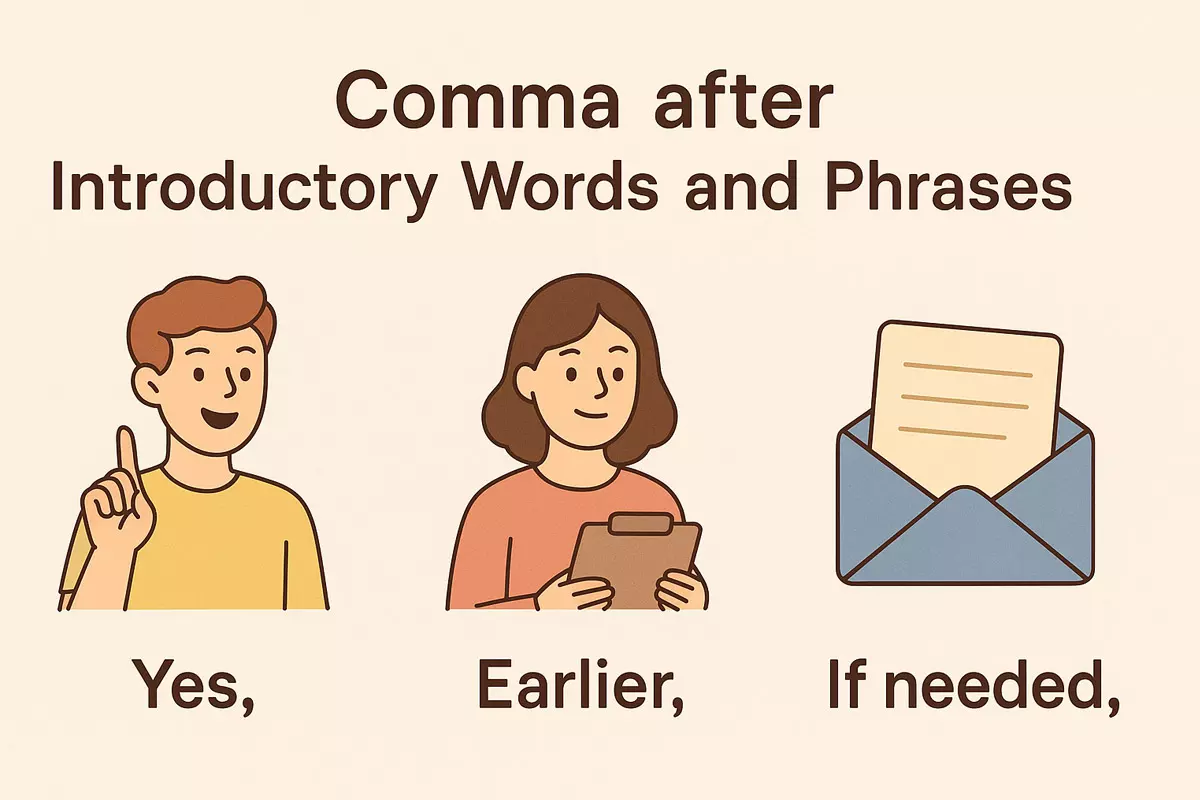 This article explains when to use commas after introductory adverbs, phrases, and dependent clauses. It covers interjections, transitions, exceptions, common mistakes, and provides practice exercises for correct punctuation.
Getting punctuation right can be tricky, especially when it comes to placing a comma after introductory expressions or phrases. Mastering this simple rule not only makes your writing clearer but also helps your sentences flow smoothly and sound more natural to readers. By consistently using a comma after opening words, phrases, or clauses, you guide your readers through your ideas and prevent confusion. With practice, applying this punctuation rule becomes second nature, improving both your writing style and your ability to communicate effectively.
Introductory Adverbs and Phrases
When a sentence begins with a word or group of words that sets the stage for the main idea, a comma usually follows this introductory element. These openers help clarify meaning and guide the reader, especially when they indicate time, place, manner, or connect ideas.
Common Types of Sentence Openers
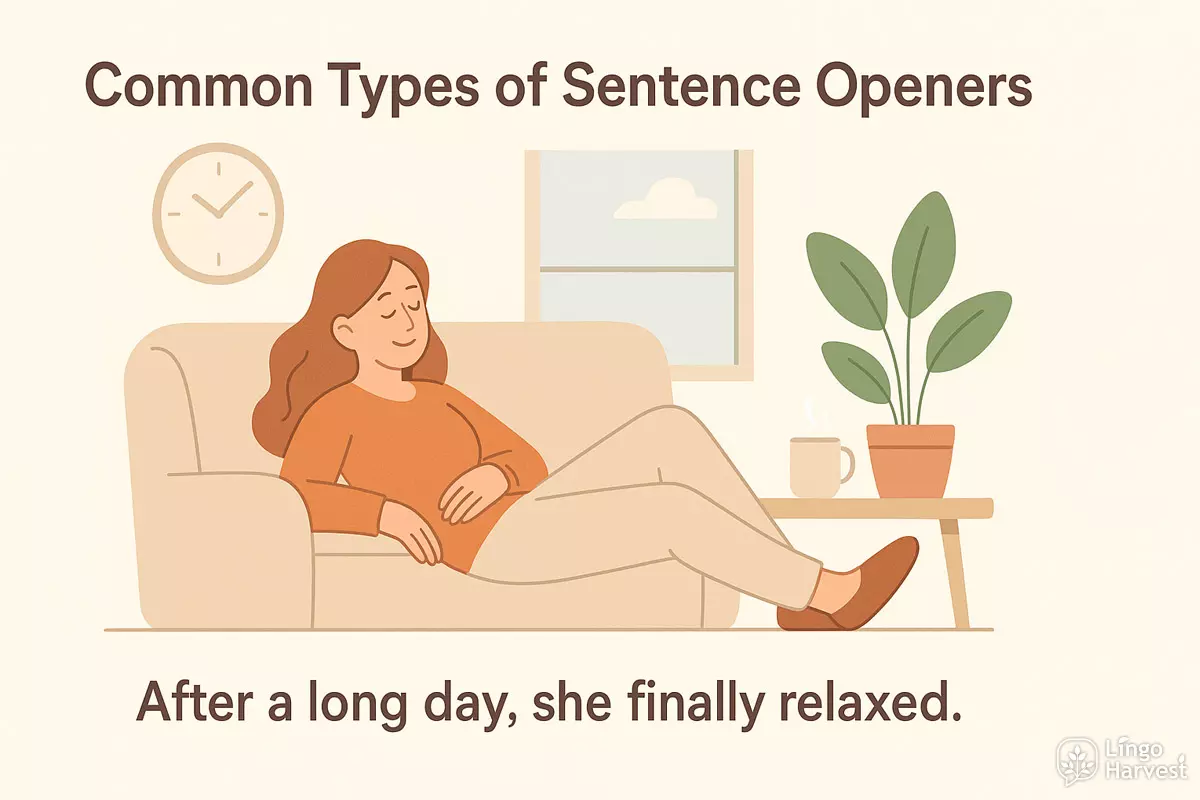
Writers often use single adverbs, short adverbial phrases, or even longer prepositional phrases to introduce a statement. The comma after these elements separates them from the core subject and verb, preventing confusion.
- Firstly, we need to review the data.
- After a long day, she finally relaxed.
- Interestingly, the results matched our expectations.
- Without warning, the storm began.
- In the morning, the streets are quiet.
- Quickly, he closed the window.
- During the meeting, several questions arose.
- Generally speaking, cats dislike water.
- To be honest, I forgot your birthday.
- On the other hand, some prefer tea over coffee.
- Suddenly, the lights went out.
- For example, many animals migrate for food.
- With a smile, she accepted the award.
- In conclusion, the experiment was a success.
- When the bell rings, please leave quietly.
- Once upon a time, there lived a wise king.
- By the way, your package arrived.
- Afterward, we went for ice cream.
- To summarize, the plan is effective.
When to Use the Comma
Place a comma after most introductory words or phrases, especially if they are longer than three or four words or could cause misreading. Short adverbs like "now" or "then" sometimes allow for omission, but including the comma is always correct and improves clarity.
Quick Reference: Introductory Elements and Comma Usage
| Introductory Element | Sentence Example |
|---|---|
| Short adverb | Fortunately, we arrived on time. |
| Prepositional phrase | In the distance, a train whistle sounded. |
| Adverbial clause | While you were out, your friend called. |
| Participial phrase | Running late, he skipped breakfast. |
| Transitional phrase | On the contrary, the evidence was clear. |
Exceptions and Special Cases
Very short adverbs such as "now," "then," or "so" sometimes appear without a comma, especially in informal writing. Still, in formal contexts, or whenever clarity is needed, it's safer to include the comma. Remember: the goal is to make your writing easy to read and understand.
Dependent Clauses at the Start
When a sentence begins with a clause that cannot stand alone, a comma is usually required before the main part of the sentence. These introductory clauses often begin with words like “because,” “if,” “when,” “although,” or “since.” The comma helps readers understand where the introductory thought ends and the main statement begins, preventing confusion or misreading.
Writers sometimes forget to add this comma, especially in short sentences, but it’s best to include it for clarity and consistency. Omitting the comma can make sentences difficult to parse, especially when the introductory part is long or complex.
Common Subordinating Words
- After
- Although
- As
- Because
- Before
- Even though
- If
- Once
- Since
- Though
- Unless
- Until
- When
- Whenever
- Where
- Wherever
- While
Examples of Correct Comma Placement
- After she finished her homework, she watched a movie.
- If you need help, just ask.
- Because it was raining, the match was postponed.
- Although he was tired, he kept working.
- When the bell rings, please line up.
- Since you’re here, let’s get started.
- Even though it’s late, I’ll answer your questions.
- Unless you hurry, you’ll miss the bus.
- Before you leave, turn off the lights.
- While I understand your point, I disagree.
Why the Comma Matters
Punctuation helps readers follow your meaning. Without the comma, readers might stumble over the sentence or misinterpret your message. For instance, compare:
- “If you eat, Grandma will be happy.” ✅
- “If you eat Grandma will be happy.” ❌
Notice how the comma signals the end of the introductory clause, making the sentence easier to read.
Exceptions and Short Clauses
Occasionally, writers omit the comma when the introductory clause is very short and the sentence is unlikely to be misunderstood. However, for formal writing or when in doubt, include the comma to ensure clarity.
Interjections and Transitions
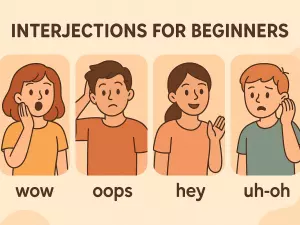
Phrases like "well," "however," or "oh" often appear at the beginning of sentences to express emotion, hesitation, or to smoothly guide the reader from one idea to another. When these words or short phrases introduce a statement, they are usually set off with a comma to clarify the sentence structure and indicate a natural pause for the reader.
Common Introductory Words That Need a Comma
- Well,
- However,
- Yes,
- No,
- Therefore,
- Indeed,
- Actually,
- Furthermore,
- Meanwhile,
- Nevertheless,
- Oh,
- First,
- Finally,
- Next,
- On the other hand,
- Moreover,
- In fact,
- Still,
- By the way,
- For example,
Using a comma after these introductory expressions helps prevent misreading. For instance, "Yes, I agree with you." is clearer than "Yes I agree with you." The comma signals a brief pause, making communication smoother.
When to Omit the Comma
If an interjection is very short and does not create confusion, some writers may skip the comma in informal writing. However, in formal or academic contexts, it’s best to include the comma for clarity. Transitions that are integral to the sentence, such as "then" or "now" when they directly modify a verb, often do not require a comma.
| Introductory Word or Phrase | Correct Usage |
|---|---|
| Well | Well, I suppose we could try another approach. |
| However | However, the results were inconclusive. |
| Oh | Oh, I didn’t realize you were waiting. |
| Meanwhile | Meanwhile, the committee reviewed the data. |
| Yes | Yes, you may leave early today. |
| No | No, that is not the correct answer. |
| First | First, let’s clarify our goals. |
| For example | For example, many birds migrate south for winter. |
To sum up, placing a comma after introductory interjections or transition phrases makes your writing easier to follow and more professional. When in doubt, add the comma for clarity—especially when writing for a broad audience or in formal settings.
When to Use a Comma
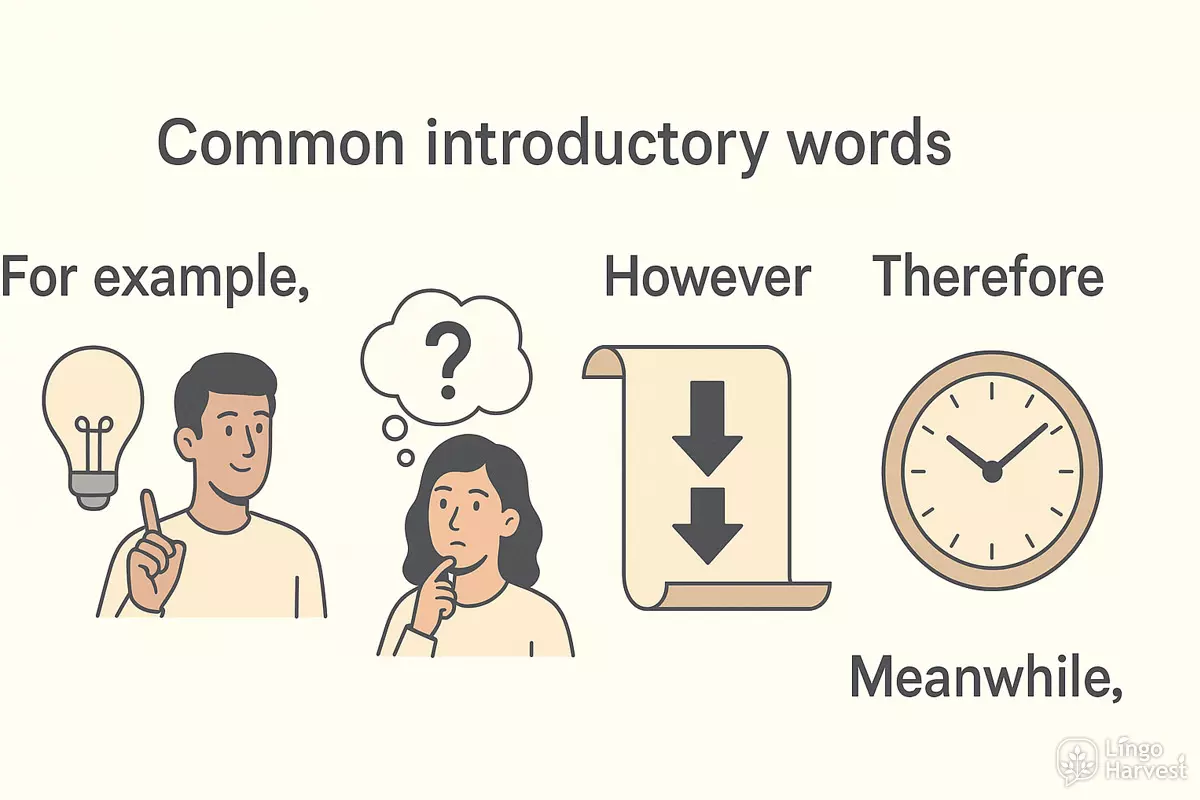
Knowing where to place a comma after introductory words and phrases helps your writing flow smoothly and prevents confusion. Typically, a brief pause is needed after certain openers, setting off the introduction from the main part of the sentence. Let’s look at the most common situations and practical guidelines to help you decide.
Common Introductory Elements Requiring a Comma
- Single transition words: For example, However, Therefore, Meanwhile.
- Introductory phrases: Such as After the meeting, In the morning, To be honest.
- Dependent clauses: For example, If you’re ready, Although it was raining, When the bell rings.
- Short prepositional phrases (usually 4+ words): For example, At the end of the day, In spite of the weather.
- Participial phrases: For example, Walking down the street, Having finished dinner.
- Introductory adverbs: Such as Quickly, Unfortunately, Surprisingly.
- Direct address: When speaking to someone directly, e.g., Lisa, my friend, everyone.
- Interjections: Words like Well, Yes, No, Oh.
- Absolute phrases: For example, Her voice trembling, The sun setting.
- Multiple introductory elements: Sometimes, more than one phrase or word appears before the subject.
Introductory Word or Phrase: Examples
Here are several sentences showing how comma placement clarifies meaning after an introductory element:
- After the storm, the streets were empty.
- Yes, I would love some coffee.
- To be honest, I forgot your birthday.
- Although it was late, we kept talking.
- Lisa, could you help me with this?
- Running quickly, he caught the bus.
- In the meantime, please wait here.
- When the lights went out, everyone was surprised.
- Of course, you can join us.
- Feeling tired, she went to bed early.
Quick Reference: Where the Comma Goes
| Introductory Element | Example Sentence |
|---|---|
| Transitional word | However, we decided to stay inside. |
| Prepositional phrase (4+ words) | At the start of the movie, the theater was full. |
| Dependent (subordinate) clause | If you look closely, you’ll see the difference. |
| Direct address | Sarah, can you pass the salt? |
| Participial phrase | Having finished the test, he left the room. |
| Interjection | Oh, I didn’t realize you were here! |
| Absolute phrase | The sun having set, the park became quiet. |
| Introductory adverb | Quietly, she closed the door. |
A comma is usually not needed after a very short introductory phrase (fewer than four words), unless omitting it would cause confusion. When in doubt, read your sentence aloud; if you naturally pause, a comma is probably appropriate.
When to Skip the Comma
Not every introductory word or phrase automatically demands a comma. In fact, there are clear situations where leaving out the punctuation makes sentences flow more naturally and avoids choppiness. Understanding these exceptions helps you write in a way that feels smooth and direct.
Short Introductory Elements
Brief openers—usually one or two words—can often go without a comma, especially if there’s no risk of misreading the sentence. This is common in casual writing or when the rhythm feels right without a pause. For example:
- Yesterday I went to the store.
- Later we’ll discuss the results.
- Perhaps you could try again.
- Today I feel better.
- Sometimes we disagree.
- Quickly he packed his bag.
- First we need to finish this.
- Finally the rain stopped.
- Next we’ll review your options.
- Maybe you’re right.
Introductory Prepositional Phrases
If a prepositional phrase at the beginning of a sentence is short—typically fewer than four words—a comma is usually not required. Longer or more complex phrases, however, often need one for clarity. Consider these examples:
- In June we start rehearsals.
- On Tuesday the meeting begins.
- At noon lunch is served.
- By nightfall everyone was gone.
When the Sentence Is Clear Without It
Sometimes, the meaning of a sentence is obvious without a separating comma. In these cases, omitting the punctuation helps keep the writing concise. For instance:
- After dinner we watched a movie.
- If possible meet me there.
- Before sunrise we left the house.
- During class phones are off.
Common Introductory Words That Rarely Need a Comma
Certain words or short phrases at the start of a sentence are usually fine without any extra punctuation, unless you want to add emphasis or slow the pace. Some examples include:
- Now let’s get started.
- Then she smiled.
- Perhaps you’re right.
- Maybe he forgot.
- Usually I take the bus.
- Often we cook together.
- Sometimes it rains.
- Finally we agreed.
- Usually he’s early.
- Still I wonder.
Summary Table: Skip or Use the Comma?
| Introductory Element | Comma Needed? |
|---|---|
| Short (1–2 words) opener (e.g., “Today I’ll begin”) |
❌ Usually not needed |
| Short prepositional phrase (e.g., “At home we relax”) |
❌ Often omitted |
| Long or complex introductory phrase (e.g., “After a long day at work, I rested”) |
✅ Use a comma |
| Intro phrase causing ambiguity (e.g., “Before eating, children must wash hands”) |
✅ Use a comma for clarity |
| Single introductory adverb (e.g., “Sometimes we argue”) |
❌ Not usually required |
In summary, trust your ear and the needs of clarity. Short, simple openers rarely require a comma, but longer or potentially confusing phrases often do. When in doubt, consider whether a pause helps the reader or simply interrupts the flow.
Common Introductory Errors
Missteps with commas after opening words or phrases are frequent in writing, especially when the rhythm or structure of a sentence is misunderstood. Learning to spot these pitfalls can improve clarity and flow.
Typical Mistakes to Watch For
Writers often skip the comma after introductory elements or, conversely, add one where it isn’t needed. Here are some scenarios where errors tend to happen:
- Omitting the comma after a brief introductory phrase:
After lunch we went back to work. (Should be: After lunch, we went back to work.) - Adding a comma after a single introductory word that doesn’t require it:
Yesterday, I finished the report. (Correct: comma needed for clarity.)
Today I will call her. (No comma needed if “Today” is short and the sentence is clear.) - Forgetting the comma after introductory clauses:
If you need help let me know. (Should be: If you need help, let me know.) - Placing a comma after a short prepositional phrase unnecessarily:
In June, we travel to Spain. (Optional for very short phrases like this, but often omitted.) - Using a comma after a conjunction at the start:
But, I disagree. (Should be: But I disagree.) - Inserting a comma after interjections that do not need one:
Well, I suppose you are right. (Correct.)
Yes, we can start now. (Correct.)
No I don’t think so. (Should be: No, I don’t think so.) - Neglecting commas in longer introductory phrases:
To be honest I didn’t expect that. (Should be: To be honest, I didn’t expect that.) - Adding a comma after a subject instead of after the introductory element:
Before the meeting, John, prepared the slides. (Should be: Before the meeting, John prepared the slides.) - Confusing introductory appositives with main sentence elements.
- Forgetting that “however,” “therefore,” and similar adverbs need a comma when they start a sentence.
Comparison of Correct and Incorrect Usage
| Incorrect Example | Corrected Version |
|---|---|
| Because it was raining we stayed inside. | Because it was raining, we stayed inside. |
| Obviously I missed your call. | Obviously, I missed your call. |
| In the morning we jog together. | In the morning, we jog together. |
| But, that isn’t the main point. | But that isn’t the main point. |
| Well I think you’re right. | Well, I think you’re right. |
| Yes we can leave now. | Yes, we can leave now. |
| After dinner we watched a movie. | After dinner, we watched a movie. |
| To sum up let’s review the results. | To sum up, let’s review the results. |
| Therefore we should reconsider. | Therefore, we should reconsider. |
| In 2020, we saw many changes. (optional comma) | In 2020 we saw many changes. (also acceptable) |
Quick Tips for Avoiding Mistakes
- Pause after the opening element; if it feels natural, a comma is likely needed.
- Longer or more complex introductory phrases almost always require a comma.
- Single words (“Today,” “Now,” “Soon”) may not always need one—use your judgment.
- Check if the sentence starts with an adverb or clause; these often need separation with a comma.
- Read your sentence aloud; awkward pauses can signal missing punctuation.
By staying mindful of these patterns, you can sidestep the most frequent missteps and keep your writing polished and easy to read.
Practice: Rewrite with Proper Punctuation
Understanding how to use commas after introductory elements is best achieved through hands-on work. Below, you’ll find sentences missing necessary punctuation after their introductory words or phrases. Your task is to rewrite each one, adding commas where appropriate. This will help reinforce the rules and build your confidence in editing your own writing.
Instructions
Read each sentence carefully. If an introductory word or phrase appears at the beginning, decide whether a comma should follow it. Rewrite the sentence, inserting the comma correctly.
- However you should always check your work for errors.
- In the morning we will review the results.
- To be honest I didn’t expect that outcome.
- After the meeting let me know your thoughts.
- Unfortunately the package arrived late.
- When you’re ready we can begin.
- As a result the project was delayed.
- By the time we arrived the event had started.
- Of course you can join us for lunch.
- Once you have finished please submit your work.
- Before leaving remember to lock the door.
- For example many writers use this technique.
- In fact he was already aware of the problem.
- During the summer break students often travel.
- To sum up we achieved all our goals.
- While waiting she read a book.
- Because of the rain the game was postponed.
- After a long day he was exhausted.
- Suddenly everyone turned to look.
- In the end we agreed on a solution.
Show answers
- However, you should always check your work for errors.
- In the morning, we will review the results.
- To be honest, I didn’t expect that outcome.
- After the meeting, let me know your thoughts.
- Unfortunately, the package arrived late.
- When you’re ready, we can begin.
- As a result, the project was delayed.
- By the time we arrived, the event had started.
- Of course, you can join us for lunch.
- Once you have finished, please submit your work.
- Before leaving, remember to lock the door.
- For example, many writers use this technique.
- In fact, he was already aware of the problem.
- During the summer break, students often travel.
- To sum up, we achieved all our goals.
- While waiting, she read a book.
- Because of the rain, the game was postponed.
- After a long day, he was exhausted.
- Suddenly, everyone turned to look.
- In the end, we agreed on a solution.
Common Introductory Words and Phrases
Here’s a list of typical introductory elements that often require a comma when starting a sentence. Familiarity with these can help you spot where punctuation is needed.
- However
- In fact
- For example
- To be honest
- After (time phrase)
- Before (time phrase)
- Because of (reason phrase)
- While (time clause)
- Once (condition)
- Unfortunately
- Of course
- Suddenly
- During (time phrase)
- As a result
- In the end
- To sum up
- By the time (clause)
- When (clause)
Practicing with real sentences and reviewing these common starters will make you more attentive to correct comma use after introductory words and phrases.