Useful Sentence Patterns Every Beginner Should Know

 Here we the most common English sentence structures and shows how to form affirmative, negative, and question patterns with everyday verbs. It also includes practice exercises for building sentences using these patterns.
Learning a new language may seem overwhelming at first, but focusing on essential sentence structures can make the process much more manageable. By mastering a few fundamental patterns, beginners are able to form a wide variety of sentences, which helps them communicate more effectively and gain confidence. This approach not only simplifies learning but also encourages regular practice, as students notice steady progress in their ability to express ideas and understand others. Ultimately, building a strong foundation in basic sentence structures sets the stage for further language development.
Most Common Sentence Structures
Understanding how sentences are put together is essential for building your language skills. At the beginner level, there are a few basic patterns that form the foundation of clear communication. Mastering these will help you create statements, ask questions, and express ideas with confidence.
Basic Patterns to Know
- Subject + Verb (SV): The simplest structure. Example: Birds sing.
- Subject + Verb + Object (SVO): Adds an object receiving the action. Example: She reads books.
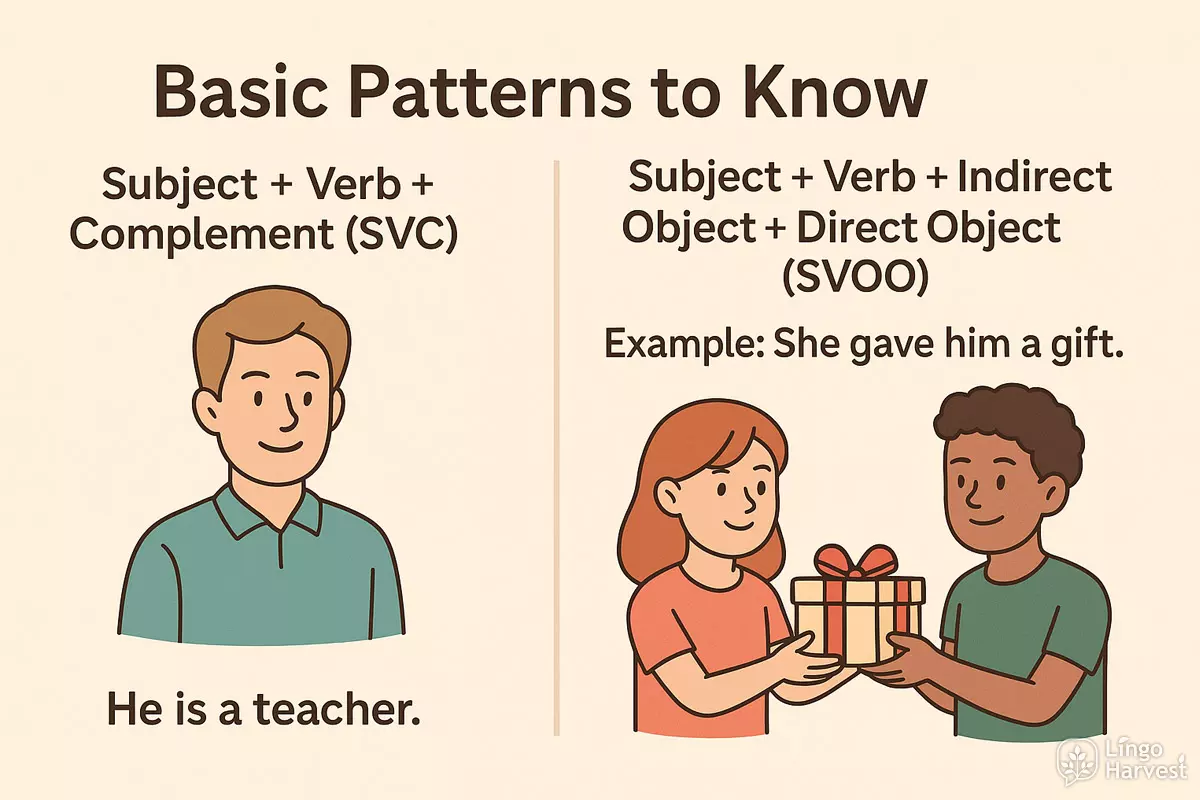
- Subject + Verb + Complement (SVC): The complement describes or renames the subject. Example: He is a teacher.
- Subject + Verb + Adverbial (SVA): Ends with a word or phrase showing time, place, or manner. Example: They work at home.
- Subject + Verb + Indirect Object + Direct Object (SVOO): Used for giving and sending. Example: She gave him a gift.
- Subject + Verb + Object + Complement (SVOC): The object is followed by a word describing it. Example: They elected him president.
- Yes/No Questions: Start with an auxiliary or modal verb. Example: Are you ready?
- Wh- Questions: Begin with who, what, where, when, why, or how. Example: Where do you live?
- Imperatives: Used for commands or instructions. Example: Close the door.
- Negatives: Add "not" after the auxiliary or use "do/does/did not." Example: I do not understand.
Quick Comparison of Core Structures
| Pattern | Example Sentence |
|---|---|
| SV | Cats sleep. |
| SVO | Anna drinks water. |
| SVC | The sky is blue. |
| SVOO | She sent me a letter. |
| SVOC | We found the room empty. |
Tips for Practice
Try creating your own sentences using these structures. Mix and match the elements to describe daily activities, ask questions, or share information. The more you use these patterns, the more natural your communication will become.
Affirmative, Negative, and Question Patterns
Understanding how to build positive, negative, and interrogative sentences is crucial for clear communication. Beginners often find it helpful to see how the same idea changes form depending on whether you want to confirm, deny, or ask about something. Each sentence type follows its own basic structure, but once you know the patterns, you can quickly adapt your meaning.
Basic Sentence Structures
Most simple sentences in English use a straightforward word order. For beginners, it helps to focus on the subject, verb, and (sometimes) object. Here are the most common structures:
- Affirmative (Positive): Subject + Verb (+ Object)
- Negative: Subject + Auxiliary + not + Verb (+ Object)
- Question: Auxiliary + Subject + Verb (+ Object)?
Common Examples
You can swap out the subject, verb, or object to express different ideas. Here are some useful examples for each pattern:
- I like apples. ✅ (affirmative)
- I do not like apples. ❌ (negative)
- Do you like apples? → (question)
- She is tired. (affirmative)
- She is not tired. (negative)
- Is she tired? (question)
- They have a car. (affirmative)
- They do not have a car. (negative)
- Do they have a car? (question)
- He can swim. (affirmative)
- He cannot swim. (negative)
- Can he swim? (question)
- We are students. (affirmative)
- We are not students. (negative)
- Are we students? (question)
Quick Reference Table
Below is a handy reference comparing how a basic statement changes when made positive, negative, or turned into a question. This will help you visualize the shift in word order and auxiliary use.
| Type | Example |
|---|---|
| Affirmative | She speaks English. |
| Negative | She does not speak English. |
| Question | Does she speak English? |
| Short Answer | Yes, she does. / No, she doesn't. |
Tips for Practice
To get comfortable with these patterns, try writing your own sentences using different verbs and subjects. Practice switching between positive, negative, and question forms. Pay attention to auxiliary verbs like do/does and is/are, as they often signal the change in pattern. With regular practice, forming clear and correct sentences will become second nature.
Examples with Everyday Verbs
Learning how to build simple and clear sentences with common action words is a practical way to start communicating confidently. In daily life, verbs like “go,” “have,” “eat,” and “make” appear constantly. By mastering a few basic sentence structures, you can quickly express your needs, ask questions, and describe routines or preferences. Below are some key patterns using typical verbs, along with sample sentences to illustrate how these forms work in real conversations.
Basic Affirmative Sentences
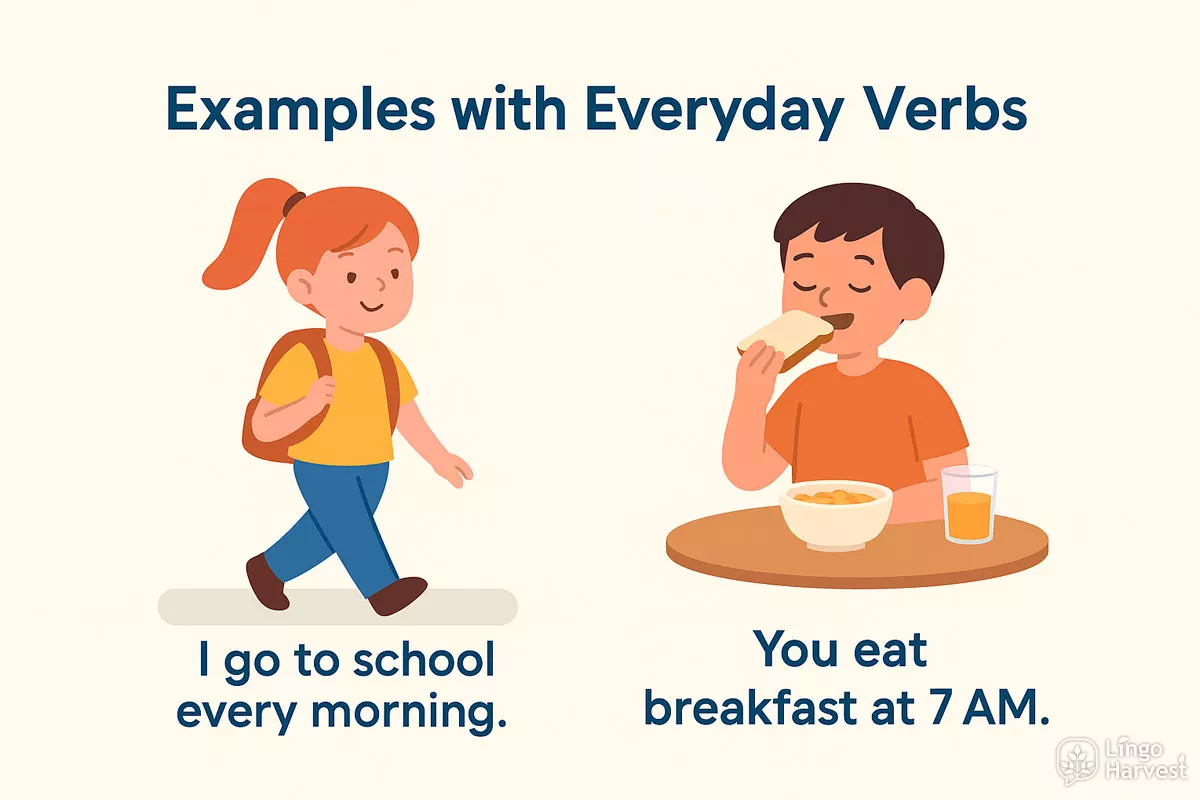
- I go to school every morning.
- You eat breakfast at 7 AM.
- She makes good coffee.
- We play soccer after class.
- They read books in the library.
Simple Questions
- Do you have a pen?
- Does he like music?
- Can we start now?
- Are they coming to the party?
- Is it raining outside?
Making Requests and Offers
- Can you help me?
- Would you like some tea?
- Please open the window.
- Let’s watch a movie.
Comparing Verb Forms
Understanding how verbs change in different situations helps you use them correctly. Here’s a comparison of present, past, and future forms for a few everyday verbs:
| Verb | Present | Past | Future |
|---|---|---|---|
| go | I go | I went | I will go |
| eat | You eat | You ate | You will eat |
| make | We make | We made | We will make |
| have | She has | She had | She will have |
| see | They see | They saw | They will see |
Combining these patterns with common verbs helps you talk about your daily schedule, ask for help, or share your experiences. Practice forming your own sentences with these verbs to build confidence and fluency.
Practice: Build Sentences with Patterns
Building confidence with sentence structures comes from hands-on use. Below, you’ll find practical exercises and example patterns designed to help you put theory into action. Try adapting the sample sentences to your own experiences or interests for deeper learning.
Common Patterns for Beginners
- Subject + Verb: She runs.
- Subject + Verb + Object: I eat apples.
- Subject + be + Adjective: The book is interesting.
- Subject + like(s) + Noun/Verb-ing: We like music. / He likes swimming.
- There is/are + Noun: There is a cat on the roof.
- Can + Verb: You can dance.
- Subject + have/has + Noun: They have a car.
- Subject + want(s) + to + Verb: I want to learn.
- Subject + need(s) + to + Verb: She needs to rest.
- Subject + Verb + Adverb: He speaks slowly.
- Let’s + Verb: Let’s go.
- How + Adjective/Adverb + be/Verb: How tall are you?
- Subject + don’t/doesn’t + Verb: We don’t know.
- Do/Does + Subject + Verb?: Do you play chess?
- Wh- Question + be/Verb: Where is my bag?
- It is + time to + Verb: It is time to eat.
Exercises: Build and Expand Your Own Sentences
- Make a sentence using: I + can + Verb
- Form a question with: Where + is/are + Noun?
- Write a negative sentence: Subject + don’t/doesn’t + Verb
- Describe something you like using: Subject + like(s) + Noun
- State ownership: Subject + have/has + Noun
Show answers
- I can swim.
- Where is my phone?
- She doesn’t eat meat.
- I like books.
- They have a dog.
Pattern Comparison Table
| Pattern | Example Sentence |
|---|---|
| Subject + Verb | Birds sing. |
| Subject + Verb + Object | Tom reads books. |
| Subject + be + Adjective | The sky is blue. |
| Subject + like(s) + Noun/Verb-ing | Anna likes dancing. |
| Wh- Question + be/Verb | What is your name? |
Try It Yourself: Quick Practice
Challenge yourself to build sentences with these prompts:
- Use "There is/are" to describe your room.
- Ask someone what time it is.
- Say what you want to do tomorrow.
- Make a negative sentence about liking food.
Show answers
- There is a desk in my room.
- What time is it?
- I want to visit the park tomorrow.
- I don’t like spicy food.
Practicing these structures regularly will help you communicate more naturally and confidently. Try creating more examples based on your daily life for even better language retention.