Articles in Simple Descriptions: My Room, My City

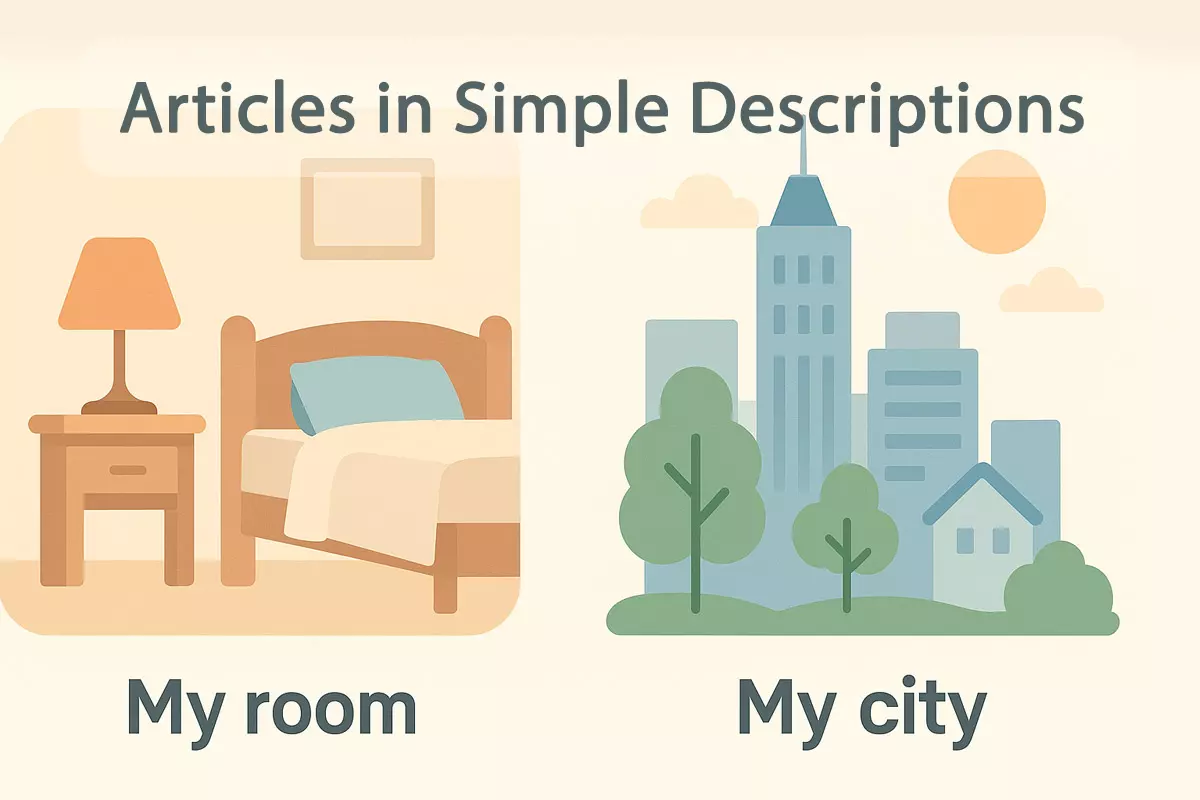 This article explains how to describe objects in a room and places in a city. It shows when to use a, an, the, or no article, and offers practice in writing short, accurate English descriptions for common situations.
Describing your bedroom or the lively streets outside your window using simple, clear language can make it easier for others to picture your world. Focusing on basic words and straightforward sentences allows you to communicate your surroundings in a way that anyone can understand, regardless of their language skills. This approach not only helps you express yourself more effectively but also encourages meaningful connections, as people from different backgrounds can relate to your experiences and imagine your environment more vividly.
Describing objects in a room
Looking around your space, you can notice many different items, each with its own features. To talk about what you see, it helps to use clear language about size, color, position, and purpose. These details make your descriptions more interesting and help others imagine the place better.
Common words to describe things in your room
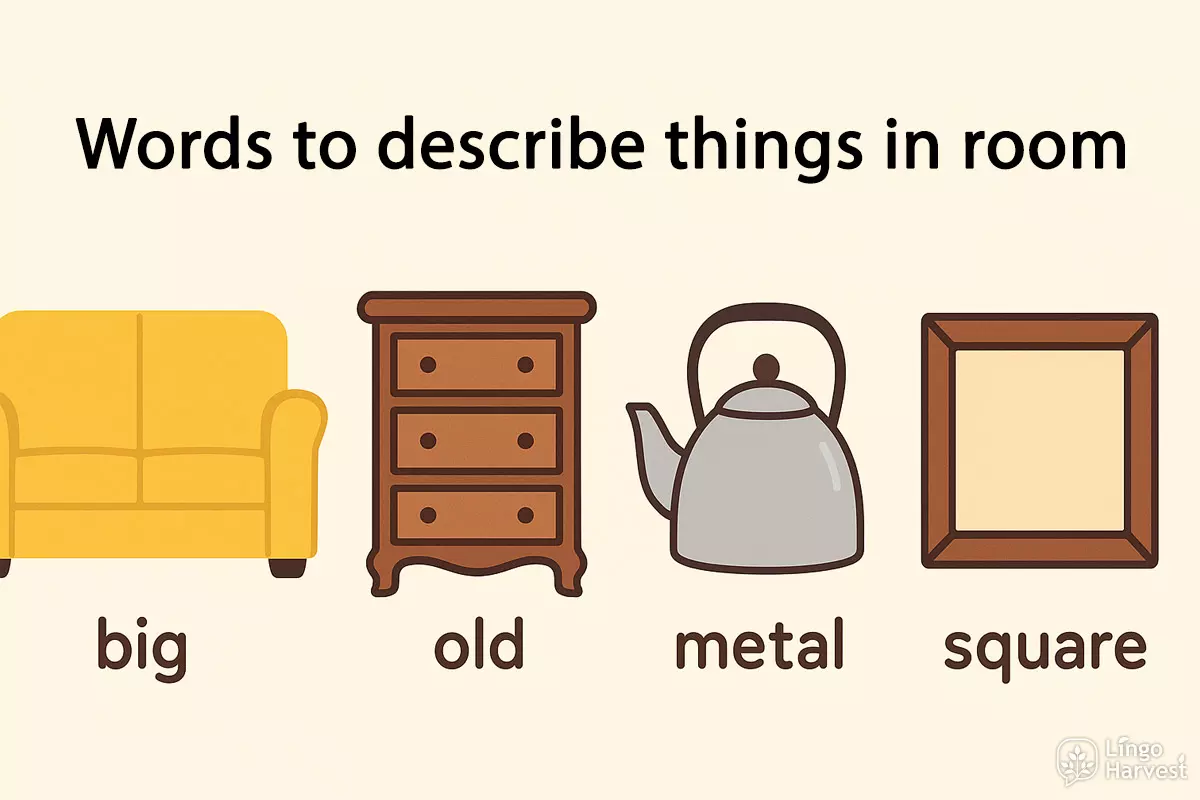
You can use a variety of adjectives and phrases to explain what’s in your personal space. Here are some useful words and expressions:
- big / small
- old / new
- comfortable
- wooden / metal / plastic
- round / square / rectangular
- soft / hard
- bright / dark
- clean / messy
- next to / in front of / behind
- on the left / on the right
- under / above / between
- favorite
- useful
- decorative
- broken / fixed
Sample sentences for describing items
Simple sentences help you talk about the furniture and things you find at home. Here are some examples:
- There is a large bed in the middle of my room.
- My desk is next to the window.
- A comfortable chair stands in the corner.
- The bookshelf is full of colorful books.
- I have a small lamp on my nightstand.
- There are two big posters on the wall.
- My closet is old but very useful.
- A soft rug covers the floor.
- The mirror hangs above the dresser.
- Plants make the room feel fresh and lively.
Comparing objects in your space
Sometimes, you want to show how one thing is different from another. Comparison words like “bigger,” “smaller,” “more comfortable,” or “darker” are useful. Here’s a simple comparison table:
| Object | Description |
|---|---|
| Bed | Bigger than the chair; soft and comfortable |
| Desk | Smaller than the bed; made of wood |
| Bookshelf | Taller than the desk; full of books |
| Rug | Softer than the floor; bright colors |
Focusing on details like color, material, and placement makes your descriptions more vivid. Practice by looking around and naming each object with a short phrase—this builds both vocabulary and confidence in describing your own environment.
Describing places in a city
When talking about urban locations, it helps to use simple words and short sentences. This makes it easier for learners to share information about their surroundings and ask for directions. You can describe different types of buildings, streets, and public spaces by mentioning their main features, what people do there, and how they look.
Useful vocabulary for talking about city locations
- park
- museum
- library
- street
- market
- bridge
- river
- church
- bus stop
- station
- square
- hospital
- hotel
- shopping mall
- school
- cinema
- café
- bank
- post office
- restaurant
Simple patterns for describing city places
- There is a big park near my house.
- The library is quiet and has many books.
- Our school is next to the hospital.
- The market is always busy in the morning.
- There are many restaurants on this street.
- My favorite place is the bridge over the river.
- The cinema is behind the shopping mall.
- You can catch a bus at the bus stop.
- The museum is old but very interesting.
- People relax in the square on weekends.
Comparing different city places
Sometimes, you need to compare locations to explain their differences or similarities. Here are some ways to do that:
| Place | Description Example |
|---|---|
| Park | It is green and quiet. People walk and play here. |
| Market | It is noisy and busy. You can buy fruit and vegetables. |
| Library | It is silent. You can read books or study here. |
| Cinema | It is dark inside. People watch movies together. |
| Square | It is open and public. Many people meet or relax here. |
Tips for describing your favorite spot
- Mention its name and location (e.g., "The café on Main Street").
- Say what you do there ("I meet my friends").
- Describe what it looks like ("It is small and cozy").
- Share why you like it ("The coffee is very good").
Using these simple words and examples, you can talk about many places in any city, making your descriptions clear and easy to understand.
A/an for new information
When describing your room or city, you often mention objects or places for the first time. In English, we use a or an to introduce something new to the listener or reader. This signals that the information is fresh and not previously discussed. For example, if you say, "There is a bed in my room," it’s likely the first time you’re mentioning the bed.
How it works in simple descriptions
Imagine you are telling a friend about your room. If you mention something for the first time, use a or an before the noun. Once your friend knows what you are talking about, you can use the to refer to it again. This helps your listener understand what is new and what is already known.
- There is a window near my desk.
- I have a lamp on the table.
- My city has a big park.
- There is an old building in the center.
- I see a cat on the street.
- There is a chair next to the bed.
- My room has a carpet.
- There is an interesting museum here.
- I bought a poster yesterday.
- My city has a river.
- I live near a market.
- There is a mirror on the wall.
- We have a library close to my house.
- There is an airport outside the city.
- My room has a balcony.
When to use "a" or "an"
The choice between a and an depends on the sound at the beginning of the next word. Use a before words that start with a consonant sound, and an before words that start with a vowel sound. Here’s a quick reference:
| Use a before | Use an before |
|---|---|
| bed | armchair |
| lamp | umbrella |
| carpet | old house |
| city | interesting place |
| desk | airport |
The for known items
In English, we use "the" when we talk about something both the speaker and listener already know. This can be because the item was mentioned before, or it's clear from the situation. For example, if you say, "There is a bed in my room. The bed is next to the window," the second sentence uses "the" because now everyone knows which bed is meant.
When to use "the" in simple descriptions
- Talking about something already mentioned: "I have a desk. The desk is brown."
- Referring to unique objects in a context: "The door of my room is white."
- Describing parts of a place: "The street by my house is quiet."
- Speaking about things everyone in the conversation knows: "The school is near my home."
Examples from "My Room" and "My City"
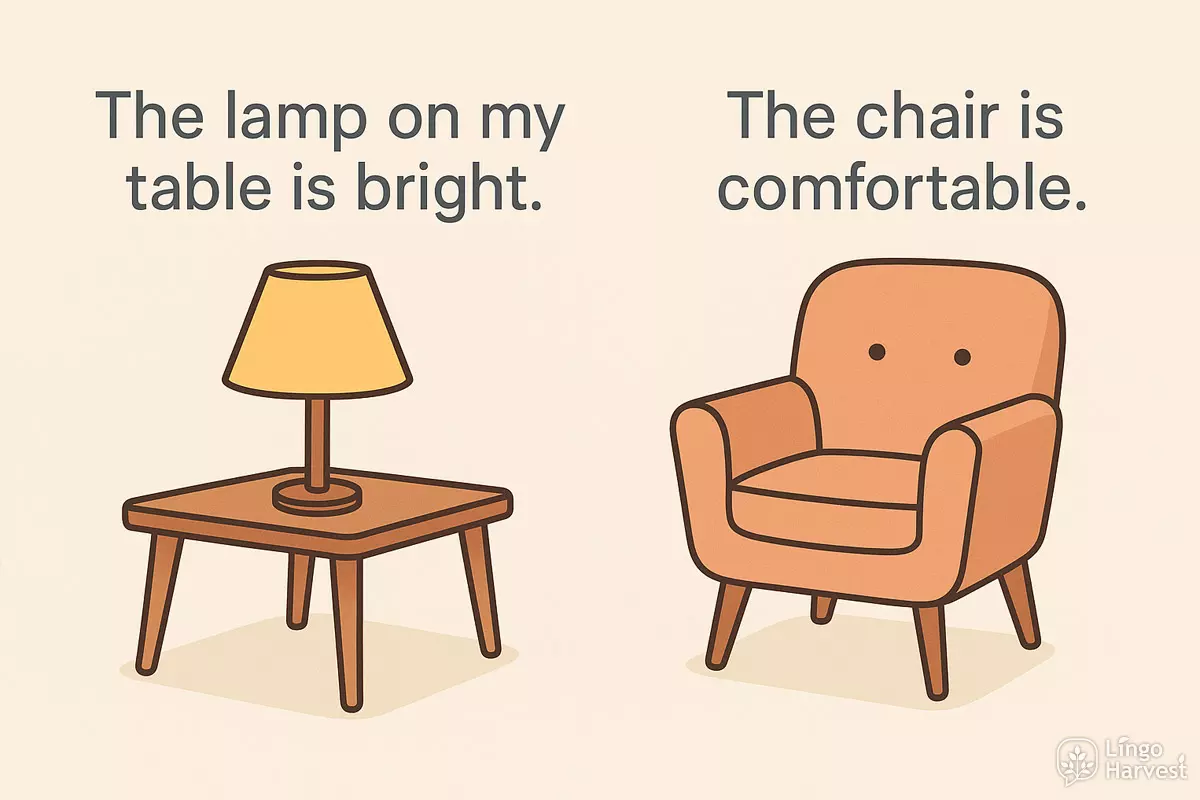
Here are some simple sentences showing how "the" works when describing familiar things in your room or city:
- The lamp on my table is bright.
- The chair is comfortable.
- The park in my city is big.
- The river goes through the city.
- The window is open.
- The museum is popular.
- The kitchen is clean.
- The bus stop is close to my house.
- The ceiling is high.
- The bridge connects two parts of the city.
Comparing "a/an" and "the"
To understand the difference, look at these pairs:
| First Mention (a/an) | Known Item (the) |
|---|---|
| There is a chair in my room. | The chair is next to the bed. |
| I see a park in my city. | The park has many trees. |
| She bought a lamp. | The lamp is on her desk. |
| We visited a museum last week. | The museum was interesting. |
Notice how "a" or "an" is used when talking about something for the first time, while "the" is used for something already introduced or known. This helps make your descriptions clear and easy to understand.
Zero article for general ideas
When we talk about things in a general sense—ideas, concepts, or categories rather than specific examples—we often leave out both "a/an" and "the." This is called using the zero article. In simple descriptions, such as when you talk about your room or your city, this approach helps you express general truths or typical characteristics.
How zero article works in descriptions
If you want to describe your room or city in broad terms, you usually skip articles before uncountable or plural nouns. For example, you might say, "People need space" or "Cities have parks." Here, "space" and "parks" refer to the general idea, not a specific one.
- Water is important in every home.
- Rooms have windows for light.
- Children play in parks after school.
- Air in the city can be polluted.
- Furniture makes a room comfortable.
- People travel by bus or train.
- Nature is part of city life.
- Noise is common in big cities.
- Plants add color to a home.
- Traffic is a problem in many places.
- Students study in library.
- Art is everywhere in the city.
- Music brings people together.
- Technology changes our homes.
- Culture shapes the city.
- Light helps us read at night.
- Space is limited in small rooms.
- Food connects families.
When to use zero article
The zero article is common with plural nouns and uncountable nouns when you mean all things of that type in general. It is not used for specific items. Compare these forms:
| General (Zero Article) | Specific (With Article) |
|---|---|
| Books help people learn. | The books on my desk are new. |
| Air is fresh in the morning. | The air in my room is cold. |
| Children love playgrounds. | The playground near my house is large. |
| People enjoy music. | The music in this café is relaxing. |
Using the zero article helps you sound more natural when describing general features or making broad statements. Remember, when you are not talking about one specific thing, skip the article for clarity and fluency.
Short description practice
Describing familiar places in a few clear sentences is a useful skill. To practice, focus on the most important features of your room or city. Use simple English and keep your sentences short. This helps others understand the main idea quickly, even if their English is basic.
Useful phrases for describing a room or city
- My room is small and bright.
- There is a big window next to my bed.
- I have a desk for studying.
- My city is busy and modern.
- There are many parks and shops.
- The streets are clean and wide.
- People are friendly here.
- There is a river in the middle of the city.
- My room has blue walls and a red carpet.
- My city has tall buildings and old churches.
- I keep my books on a shelf.
- My favourite place is the city square.
- The kitchen is near my room.
- Buses and trains are easy to find.
- At night, my city is quiet.
Practice: Write short descriptions
- Write two sentences about your room. Focus on size, color, or furniture.
- Describe your city in three sentences. Mention what you like or dislike.
- Look at these words: window, desk, park, river, friendly. Make a short description using at least three of them.
- Describe your favorite season in two sentences.
- Write three sentences about your daily morning routine.
- Use these words in a short description: beach, quiet, evening, people.
- Describe a person you know well in two sentences. Focus on appearance or personality.
- Write two sentences about a place you visited recently.
- Look at these words: café, music, street, old. Write a short description using at least two of them.
- Describe your ideal weekend in three sentences.
- Write two sentences about your favorite food. Mention taste and ingredients.
- Use these words in a description: mountain, cold, beautiful, morning.
- Describe a typical day at your school or job in three sentences.
- Write two sentences about your favorite hobby.
- Look at these words: dog, garden, sunny, small. Make a short description with at least three of them.
Show answers
- Example for 1: My room is small and has a big window. There is a desk near my bed.
- Example for 2: My city is busy and beautiful. There are many parks. I like the river in the center.
- Example for 3: My room has a window and a desk. My city has a big park and friendly people.
- Example for 4: Summer is my favorite season because it is warm. I love spending time outside.
- Example for 5: I wake up early, make coffee, and read the news. Then I get ready for work.
- Example for 6: The beach was quiet in the evening. People were walking slowly along the water.
- Example for 7: My friend is tall and kind. She always helps everyone.
- Example for 8: I visited a small village last weekend. It was peaceful and beautiful.
- Example for 9: I sat in an old café on a narrow street. Soft music was playing.
- Example for 10: My ideal weekend is relaxing. I sleep late, go for a walk, and watch movies.
- Example for 11: My favorite food is pasta. It tastes rich and creamy because it has cheese and tomatoes.
- Example for 12: The mountain looked beautiful in the cold morning air. Everything was quiet and bright.
- Example for 13: My workday is usually busy. I answer emails, have meetings, and finish reports.
- Example for 14: I love reading in my free time. It helps me relax.
- Example for 15: My dog plays in the small sunny garden. He loves running around.
Checklist for good short descriptions
- Are your sentences simple and clear?
- Did you mention the most important things?
- Is your description easy to read?
- Did you use correct word order?
- Did you avoid long or complicated sentences?
Common mistakes to avoid
- Using too many details in one sentence.
- Forgetting articles (a, an, the).
- Writing only one word, not a sentence.
- Repeating the same idea.
- Mixing present and past tense.