Determiners vs Pronouns: overlap and key distinctions

 The article reviews determiners and pronouns, shows how words like this, that, some, any, and each can be both, explains how their position signals function, why the distinction matters, common errors, and includes practice labeling them in sentences.
- Review of what determiners and pronouns are
- Words that can act as both: this, that, some, any, each
- How position in the sentence helps decide the function
- Determiners before nouns vs pronouns replacing nouns
- Why the difference matters for clarity and grammar
- Common learner errors mixing determiners and pronouns
- Practice: label words as determiners or pronouns in sentences
Distinguishing between words that identify particular items, such as demonstratives, and those that replace nouns, like pronouns, can be challenging, especially since their uses sometimes overlap. Developing a solid grasp of how these words function within sentences is crucial for effective communication because it helps prevent ambiguity and ensures your intended meaning is understood. By paying close attention to context and the specific role each word plays, you can express your ideas more clearly and accurately in both writing and speech.
Review of what determiners and pronouns are
Understanding how determiners and pronouns function is crucial for mastering English grammar. Both word types play important roles in sentence structure, but their functions and uses differ in specific ways.
What are determiners?
Determiners are words placed in front of nouns to clarify what the noun refers to. They help specify things like quantity, possession, definiteness, or proximity. Without a determiner, a noun often sounds incomplete, especially in English. Common determiners include articles, demonstratives, possessives, and quantifiers.
- Articles: a, an, the
- Demonstratives: this, that, these, those
- Possessive determiners: my, your, his, her, its, our, their
- Quantifiers: some, any, much, many, few, little, several
- Numbers: one, two, three, etc.
- Other determiners: each, every, either, neither, all, both, enough, whose
What are pronouns?
Pronouns are words that replace nouns or noun phrases in a sentence. Their main purpose is to avoid repetition and make sentences clearer or less cumbersome. Pronouns can refer to people, things, or ideas that have already been mentioned or are understood from context.
- Personal pronouns: I, you, he, she, it, we, they
- Possessive pronouns: mine, yours, his, hers, its, ours, theirs
- Demonstrative pronouns: this, that, these, those
- Reflexive pronouns: myself, yourself, himself, herself, itself, ourselves, yourselves, themselves
- Relative pronouns: who, whom, whose, which, that
- Indefinite pronouns: someone, everyone, anyone, nobody, something, anything, everything, nothing
Key differences at a glance

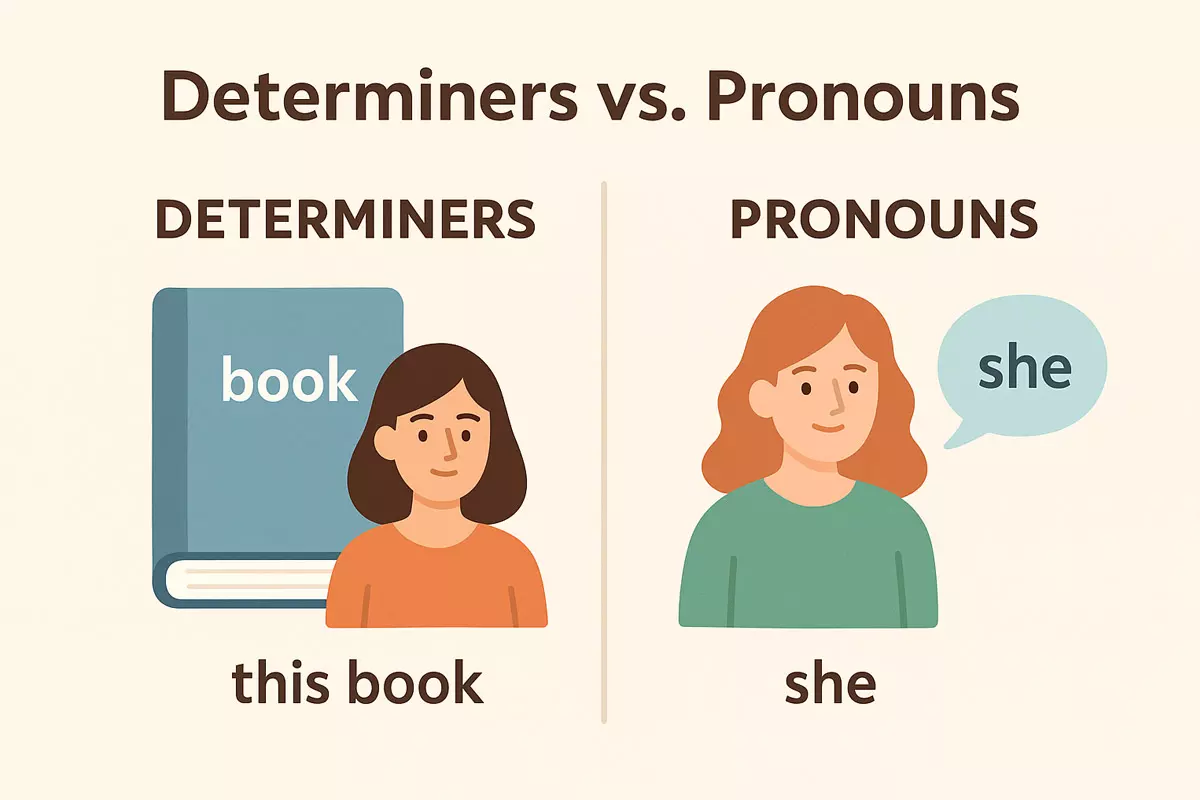
While determiners usually come before nouns to modify them, pronouns stand in for nouns altogether. Some words (like "this," "that," "these," "those") can act as either, depending on context.
| Function | Example Words | Typical Sentence Position | Example Usage |
|---|---|---|---|
| Determiner | my, the, some, these | Before a noun | This book is new. My friends arrived. |
| Pronoun | she, it, those, anyone | Replaces a noun | Those are expensive. She left early. |
| Overlap (Demonstratives) | this, that, these, those | Before a noun or alone | This car is fast. (determiner) This is fast. (pronoun) |
| Possessive forms | my, mine; your, yours | Before noun or alone | My house (determiner) Mine is big. (pronoun) |
Summary of roles
Determinants and pronouns each serve specific grammatical purposes. Determiners modify nouns and help specify which one(s) are meant, while pronouns replace nouns to streamline communication. Recognizing these distinctions is essential for constructing clear and accurate sentences.
Words that can act as both: this, that, some, any, each
Understanding how certain English words function in more than one grammatical role helps clarify why the line between determiners and pronouns can be blurry. Some commonly used terms—such as “this,” “that,” “some,” “any,” and “each”—can shift between introducing nouns and standing alone in place of nouns. Whether these words are working as determiners or pronouns depends on their position and usage within the sentence.
How usage changes meaning and function
When these words come directly before a noun, they typically act as determiners, providing information about which or how many items are being discussed. If the noun is omitted and the word stands alone, it takes on the role of a pronoun, replacing the noun entirely. Let’s break down their dual functions:
- This: “This book is new.” (determiner) / “This is new.” (pronoun)
- That: “That car is fast.” (determiner) / “That is fast.” (pronoun)
- Some: “Some people arrived early.” (determiner) / “Some arrived early.” (pronoun)
- Any: “Any student can try.” (determiner) / “Any can try.” (pronoun)
- Each: “Each child received a gift.” (determiner) / “Each received a gift.” (pronoun)
Comparison of roles in context
To make the distinction clearer, here’s a structured look at how these words operate in both roles:
| Word | As Determiner (before a noun) |
As Pronoun (replaces a noun) |
|---|---|---|
| This | This question is easy. | This is easy. |
| That | That movie was exciting. | That was exciting. |
| Some | Some apples are ripe. | Some are ripe. |
| Any | Any answer will do. | Any will do. |
| Each | Each student spoke. | Each spoke. |
Recognizing the difference in real sentences
The key to distinguishing between these roles is to look for the presence or absence of a following noun. If the word is immediately followed by a noun, it’s acting as a determiner. If not, and it stands alone, it’s functioning as a pronoun. This flexibility is especially common in everyday English, making these terms useful in both spoken and written contexts.
Quick reference: more examples
Here are additional examples to reinforce the pattern:
- “This idea is interesting.” → “This is interesting.”
- “That solution works.” → “That works.”
- “Some advice is helpful.” → “Some is helpful.”
- “Any time suits me.” → “Any suits me.”
- “Each option was considered.” → “Each was considered.”
- “Some cookies remain.” → “Some remain.”
- “This painting is beautiful.” → “This is beautiful.”
- “That door is open.” → “That is open.”
- “Any mistake can be fixed.” → “Any can be fixed.”
- “Each answer was correct.” → “Each was correct.”
By observing these patterns, you’ll be able to identify when a word is serving as a determiner and when it’s acting as a pronoun, making both comprehension and usage more precise.
How position in the sentence helps decide the function
Whether a word acts as a determiner or a pronoun often depends on its placement and what it is immediately next to in a sentence. In English, determiners almost always come directly before nouns to provide more information about which one, how many, or whose. Pronouns, by contrast, usually stand alone and replace entire noun phrases.
Key Patterns to Notice
Position within a sentence is a major clue to a word’s grammatical role. Here are some typical scenarios:
- If a word like some, each, or that comes immediately before a noun (some apples, each student, that car), it’s acting as a determiner.
- If the same word appears without a following noun (Some are missing, Each was late, That is new), it’s functioning as a pronoun.
- When a word stands alone as the subject or object, it’s almost always a pronoun.
- When it’s part of a noun phrase, it’s a determiner.
Examples: Determiner vs Pronoun by Position
Notice how the same word shifts roles depending on what follows:
| Word in Context | Role | Position/Clue |
|---|---|---|
| All students arrived. | Determiner | Directly before noun |
| All arrived on time. | Pronoun | Stands alone, replaces noun |
| Some cookies are left. | Determiner | Before noun |
| Some are left. | Pronoun | No noun after |
| That book is mine. | Determiner | Precedes noun |
| That is mine. | Pronoun | Replaces noun phrase |
| Which answer is correct? | Determiner | Before noun |
| Which is correct? | Pronoun | Stands alone |
Common Position-Based Signals
- Preceding a noun = likely a determiner
- Not followed by a noun = likely a pronoun
- Subject or object position without a noun = pronoun
- Part of a noun phrase = determiner
- Modifying a noun directly = determiner
- Replacing a noun phrase = pronoun
Understanding the placement of these words makes it much easier to distinguish between their functions, especially when the forms overlap. Pay attention to what comes after the word and whether it’s standing in for a noun or specifying one.
Determiners before nouns vs pronouns replacing nouns
When discussing English grammar, it's important to distinguish how these two word types function in a sentence. Determiners act as “helpers” for nouns, giving information about which or how many things are being referred to, while pronouns often step in to take the place of nouns altogether.
How determiners and pronouns interact with nouns
Determiners always appear with a noun, never alone. They specify identity, quantity, or ownership: for example, “my book,” “every apple,” or “this idea.” In contrast, pronouns replace the noun entirely, so you might say, “It is mine,” or “That is interesting,” instead of repeating the noun.
- Determiner + noun: her car, those shoes, some advice, each child, my keys, both options, several questions, any reason, the answer, another chance
- Pronoun (noun replaced): hers, those, some, each, mine, both, several, any, it, another
Key differences in usage
The primary distinction is syntactic placement and function. Determiners always precede nouns and never stand alone; pronouns can function as the subject or object without needing a noun.
| Role | Example | Can Stand Alone? | Requires a Noun? |
|---|---|---|---|
| Determiner | these books, my friend | ❌ | ✅ |
| Pronoun | these, mine | ✅ | ❌ |
Common sources of confusion
Many words can serve as both determiners and pronouns, depending on context. For instance, “some” in “some cookies” is a determiner, but in “Would you like some?” it’s a pronoun. “Each” works similarly: “each student” (determiner) vs “Each is responsible” (pronoun).
Summary of patterns
To tell the difference, check if the word is followed by a noun or stands on its own:
- If it’s followed by a noun: likely a determiner.
- If it stands alone and replaces a noun: it’s acting as a pronoun.
Understanding this distinction helps clarify sentence structure and avoids common mistakes, especially with words that can fill both roles depending on how they’re used.
Why the difference matters for clarity and grammar
Understanding how determiners and pronouns function keeps sentences clear and grammatical. When these two types of words are confused, the meaning can become ambiguous, or the sentence may sound awkward. For instance, using a pronoun where a determiner is needed can leave out crucial information, while using a determiner in place of a pronoun can create ungrammatical phrases.
Precision in Communication
Determiners directly modify nouns and help specify which thing, person, or amount is being referred to. Pronouns, on the other hand, stand in for nouns altogether. Mixing them up can result in sentences that are hard to follow. For example, "This book is interesting" uses a determiner ("this"), while "This is interesting" uses a pronoun. Swapping their roles would confuse the listener or reader.
Common Mistakes and How They Affect Meaning
- Missing noun: "Some prefer tea" (correct, "some" as pronoun) vs. "Some people prefer tea" ("some" as determiner).
- Redundancy: "These ones" is often redundant since "these" alone can serve as a pronoun.
- Ambiguity: "Each student handed in their homework" (determiner) vs. "Each handed in their homework" (pronoun). The latter could be unclear out of context.
Comparison of Usage
| Word | As Determiner | As Pronoun |
|---|---|---|
| Some | Some people are late. | Some are late. |
| All | All students passed. | All passed. |
| This/These | This question is hard. / These books are new. | This is hard. / These are new. |
| Each | Each child received a gift. | Each received a gift. |
Summary: Why Clear Distinction Helps
Recognizing whether a word is acting as a determiner or a pronoun helps avoid unclear references and awkward repetition. It ensures that information is neither omitted nor unnecessarily repeated. Mastery of this distinction is especially important for learners and writers aiming for precision in English grammar.
Common learner errors mixing determiners and pronouns
Confusing determiners and pronouns can lead to awkward or incorrect sentences, especially for learners trying to master English syntax. These two word types sometimes look identical but play different grammatical roles, which is where many mistakes begin. Understanding the distinction—determiners come before nouns, pronouns replace nouns—helps avoid errors.
Typical mix-ups and why they happen
Learners often use a word in the wrong slot. For example, using a pronoun where a determiner is needed, or vice versa, is a frequent source of mistakes. This happens most with words like "some," "any," "each," "all," "none," "many," and "few," which can function as either type depending on context.
- Using a pronoun before a noun: Incorrect: "Many people" is correct, but "Many they" is not.
- Leaving out the noun after a determiner: Incorrect: "I want some," when "some apples" is meant, unless the noun is clear from context.
- Adding an unnecessary noun after a pronoun: Incorrect: "These ones" instead of just "these."
- Confusing 'all' as a determiner vs. pronoun: "All students passed" (determiner + noun) vs. "All passed" (pronoun replacing the noun).
- Mixing up 'each' and 'every': "Each student" (determiner), but "Each was present" (pronoun function).
- Using 'none' incorrectly: "None students" (incorrect), "None of the students" or "None" (correct).
- Overusing 'ones' after demonstratives: "Those ones are nice" instead of "Those are nice."
- Confusing 'few' and 'a few': Both can be determiners or pronouns, but meaning changes; "Few came" (pronoun), "A few people came" (determiner).
- Incorrect double subject: "All they arrived" instead of "All arrived" or "They all arrived."
- Using 'some' or 'any' without context: "Some are missing" (pronoun), "Some books are missing" (determiner).
Comparison of forms and usage

When the same word can be either a determiner or a pronoun, context is key. See how the role changes in these examples:
| Word | As a Determiner (before noun) | As a Pronoun (replaces noun) |
|---|---|---|
| Some | Some people left early. | Some left early. |
| All | All students passed. | All passed. |
| Each | Each child got a gift. | Each got a gift. |
| None | None of the answers are correct. | None are correct. |
| Many | Many options exist. | Many exist. |
| These | These books are new. | These are new. |
| Those | Those shoes fit well. | Those fit well. |
| Few | Few people agreed. | Few agreed. |
Tips to avoid confusion
- Check if the word is directly before a noun (likely a determiner).
- If the word stands alone, replacing a noun, it's probably a pronoun.
- Don't double up: avoid "these ones," "all they," or "none students."
- Practice with example sentences to see the roles change.
- When in doubt, rephrase the sentence to clarify the function.
Misunderstanding the distinction between these word types can make sentences unclear or grammatically incorrect. Paying close attention to word position and sentence structure helps learners use both determiners and pronouns accurately.
Practice: label words as determiners or pronouns in sentences
Understanding the difference between determiners and pronouns can be tricky since some words function as both, depending on their role in a sentence. Let's practice identifying whether highlighted words are acting as determiners (modifying a noun) or pronouns (standing in for a noun).
Exercise: Identify the Function
Read each sentence below. For each bolded word, decide if it is a determiner or a pronoun in that context.
- These apples are fresh.
- Some prefer coffee over tea.
- His jacket is on the chair.
- I saw her at the store.
- Each student received a prize.
- Many attended the lecture.
- Those are my favorite shoes.
- She finished her assignment early.
- All children must be supervised.
- Several of the answers were correct.
- That car is very fast.
- I want that.
Show answers
- 1. Determiner
- 2. Pronoun
- 3. Determiner
- 4. Pronoun
- 5. Determiner
- 6. Pronoun
- 7. Pronoun
- 8. Determiner
- 9. Determiner
- 10. Pronoun
- 11. Determiner
- 12. Pronoun
Common Overlap Examples
Some words switch roles between determiner and pronoun depending on their placement and function. Here’s a quick comparison to clarify:
| Word as Determiner | Word as Pronoun |
|---|---|
| This book is new. | This is new. |
| Some people left early. | Some left early. |
| Each student passed. | Each passed. |
| All children played outside. | All played outside. |
| That movie was exciting. | That was exciting. |
Tips for Quick Identification
- If the word comes just before a noun and modifies it, it’s most likely a determiner.
- If the word stands alone and replaces a noun (not followed by a noun), it’s probably a pronoun.
- Context is key: the same word can switch categories based on its use in a sentence.
Practice with real sentences helps reinforce the distinctions between these two parts of speech. Try creating your own examples for more practice!