Common Passive Voice Mistakes and How to Fix Them

 This article explains why passive voice mistakes happen and how to fix them, including missing be, wrong tense forms, been vs. being, unnecessary by-phrases, verbs that should not be passive, when active is clearer, and a quick editing checklist.
- Why passive voice mistakes happen
- Missing be before the past participle
- Using the wrong form of be for the tense
- Confusing been and being in passive forms
- Adding unnecessary by-phrases
- Using passive with verbs that need no object
- Overusing passive when active sounds clearer
- Editing checklist for passive voice errors
- Fix it: correct common passive voice mistakes
- FAQ: passive voice errors
Many learners use sentence patterns that emphasize the action rather than the person who does it, but small mistakes can make writing sound awkward, unclear, or overly formal. In everyday English, this structure is helpful when the result matters more than the doer, yet it is often overused or formed incorrectly. This article explains the most common problems, why they happen, and how to fix them so your sentences sound clear, natural, and confident.
Why passive voice mistakes happen
Most passive voice errors come from one simple fact: a passive verb is not a single word. Learners often focus on the past participle and forget that the structure needs a form of be as well. In active sentences, the verb is often straightforward: writes, wrote, has written. In passive sentences, the grammar becomes a small system: is written, was written, has been written. If one part is missing or wrong, the whole sentence sounds broken.
Another reason is interference from other patterns. Students may mix passive voice with continuous forms, perfect forms, or adjective structures. For example, they write The room cleaned because they are thinking of The room looks clean, or they write The report is been prepared because they are trying to combine present tense and perfect tense at the same time. Passive voice is not especially difficult, but it does require good control of verb forms.
There is also a usage problem, not only a form problem. Some learners use passive because it feels more formal, so they put it everywhere: emails, instructions, narratives, even casual conversation. That often creates heavy, unclear writing. Other learners avoid passive completely because they were told it is bad style. Neither extreme is helpful. Good English uses both active and passive; the skill is knowing when and how.
- Form errors: missing be, wrong tense, wrong participle, confusion with been and being.
- Usage errors: unnecessary by-phrases, passive with intransitive verbs, passive where active would be clearer.
- Editing errors: not checking whether the subject actually receives the action.
Teacher note: In class, I often see students understand the idea of passive voice perfectly but still produce incorrect forms under time pressure. That usually means they need pattern practice, not another abstract definition.
Missing be before the past participle

This is probably the most common passive mistake. A passive verb usually needs be + past participle. If the form of be is missing, the sentence may look almost correct, but grammatically it is incomplete. English does not normally allow a passive meaning with the past participle alone.
Learners often make this error because they notice the past participle and think that is enough to show a passive idea. It is not. Compare The package delivered yesterday with The package was delivered yesterday. The first one is wrong as a complete sentence. The second one is a correct passive clause.
Look at these typical corrections:
- ❌ The meeting cancelled this morning.
✅ The meeting was cancelled this morning. - ❌ My phone stolen on the train.
✅ My phone was stolen on the train. - ❌ These forms completed online.
✅ These forms are completed online. - ❌ Dinner served at seven.
✅ Dinner is served at seven. - ❌ The windows cleaned every Friday.
✅ The windows are cleaned every Friday.
Sometimes students produce a sentence fragment because the participle is correctly used as an adjective, but they think it is a full passive sentence. For example, The broken window in the kitchen is a noun phrase, not a full sentence. To make it a sentence, you need a verb: The window in the kitchen was broken during the storm.
A good test is this: can you identify the tense of the sentence clearly? If not, you probably need a form of be. The participle by itself does not show whether the action is present, past, or future.
| Wrong pattern | Correct passive form | Use |
|---|---|---|
| The email sent. | The email was sent. | finished action in the past |
| The room cleaned every day. | The room is cleaned every day. | routine or regular process |
| The guests invited already. | The guests have been invited already. | present perfect passive |
| The work finished by noon. | The work will be finished by noon. | future passive |
Be careful with reduced clauses, because they can look similar. In Students invited to the conference must reply today, invited to the conference modifies students; it is not the main verb of the sentence. But if you write a complete sentence such as The students invited to the conference, the reader will wait for more because the sentence is unfinished.
If this kind of structure appears often in your writing, it usually connects to wider common verb mistakes, especially confusion about auxiliary verbs.
Using the wrong form of be for the tense
Many learners know that passive voice uses be + past participle, but they choose the wrong form of be. This creates tense mistakes such as is built last year or was delivered every morning. The participle stays the same, but the auxiliary must match the time meaning.
The easiest way to control passive tense is to think of the active sentence first, then change only the focus. For example, active: They deliver the milk every morning. Passive: The milk is delivered every morning. Active: They delivered the sofa yesterday. Passive: The sofa was delivered yesterday. The tense does not disappear when you make a sentence passive; it simply moves into the form of be.
Here are common tense errors and corrections:
- ❌ The bridge is repaired last month.
✅ The bridge was repaired last month. - ❌ The documents were checked every week.
✅ The documents are checked every week. - ❌ A decision was made tomorrow.
✅ A decision will be made tomorrow. - ❌ The package has delivered already.
✅ The package has been delivered already. - ❌ The roads are being closed last night.
✅ The roads were closed last night.
Three tense contrasts cause trouble especially often:
- Present simple passive for routines: Lunch is served at 12:30.
- Past simple passive for completed past actions: Lunch was served late yesterday.
- Present perfect passive for past actions connected to now: Lunch has already been served.
Compare these pairs carefully:
- Every year the prizes are given to ten students. / Last year the prizes were given to twelve students.
- The office is cleaned every evening. / The office was cleaned early because visitors were coming.
- Applications are reviewed in May. / Your application has been reviewed, so you can expect an email soon.
When learners edit passive sentences, I recommend checking the time expression first. Words like yesterday, every day, already, by next week, and right now usually tell you which auxiliary form is needed.
Teacher note: If a student keeps mixing tenses in passive voice, I ask them to write the active version first. Once the tense is correct in active voice, the passive form becomes much easier to build.
| Time meaning | Passive pattern | Example |
|---|---|---|
| routine, fact | am/is/are + past participle | The bills are paid online. |
| finished past action | was/were + past participle | The bills were paid yesterday. |
| now in progress | am/is/are being + past participle | The bills are being checked now. |
| past action with present result | has/have been + past participle | The bills have been sent. |
| future | will be + past participle | The bills will be processed tomorrow. |
Confusing been and being in passive forms
This mistake is very common because both words come from be, and both appear in passive structures. However, they do very different jobs. Been is the past participle of be, and it is used in perfect forms. Being is the -ing form, and it is used in continuous forms. If you mix them, the grammar no longer matches the meaning.
The simplest distinction is this:
- has/have been + past participle = perfect passive
- am/is/are being + past participle = present continuous passive
- was/were being + past participle = past continuous passive
Look at the contrast:
- ✅ The rooms have been cleaned. This means the cleaning is finished, and the result matters now.
- ✅ The rooms are being cleaned. This means the cleaning is happening now.
Now compare several wrong and correct examples:
- ❌ The report is been written now.
✅ The report is being written now. - ❌ The forms have being checked already.
✅ The forms have been checked already. - ❌ The car was been repaired when I called.
✅ The car was being repaired when I called. - ❌ The tickets are been printed at the moment.
✅ The tickets are being printed at the moment. - ❌ The problem has being solved.
✅ The problem has been solved.
Three practical pairs help learners feel the difference:
- The walls have been painted = the work is finished.
The walls are being painted = the work is in progress. - The meal has been prepared = it is ready now.
The meal is being prepared = someone is preparing it now. - The account had been blocked before I arrived = earlier completed action.
The account was being blocked when I called = action in progress at that past moment.
One reason this error survives for a long time is pronunciation. In fast speech, learners may not hear the difference clearly, especially in long passive forms. That is why writing practice is useful here. Say the sentence and ask, “Do I mean finished, or in progress?” Your answer will usually tell you whether you need been or being.
If you want a second check, remove the passive for a moment. They have cleaned the rooms becomes The rooms have been cleaned. They are cleaning the rooms becomes The rooms are being cleaned. The active version often makes the distinction obvious.
Adding unnecessary by-phrases
A passive sentence does not always need the agent. In other words, you do not always need to say by someone. Learners sometimes add a by-phrase because they feel the passive sentence is incomplete without it. In fact, English often uses passive specifically because the agent is unknown, unimportant, obvious, or better left unsaid.
For example, My bike was stolen sounds natural. We do not usually know who stole it. Adding by someone gives no useful information. Likewise, The building was opened in 2010 is often enough. If the opener matters historically, then mention it. If not, leave it out.
Here are some typical cases:
- ❌ The classroom is cleaned every evening by the cleaners.
✅ The classroom is cleaned every evening. - ❌ English is spoken in many countries by people.
✅ English is spoken in many countries. - ❌ The suspect was arrested by the police at 6 a.m.
✅ The suspect was arrested at 6 a.m.
✅ The suspect was arrested by local police officers at 6 a.m. if that detail matters.
A useful question is: does the agent add real information? If the answer is no, leave it out. Good reasons to keep the by-phrase include:
- the doer is surprising: The song was written by a twelve-year-old student.
- the doer is important: The vaccine was developed by an international research team.
- the sentence compares agents: The old system was replaced by a faster one.
- the writer wants to assign responsibility: The error was caused by incorrect data entry.
Compare these pairs:
- The door was left open. / The door was left open by the night manager.
- The final draft was approved. / The final draft was approved by the legal department.
- Her passport was found. / Her passport was found by a taxi driver.
In each pair, the second sentence is not more grammatical; it is simply more specific. If that specificity is not useful, it becomes extra weight. Writers who overuse passive often also overuse agents, which makes sentences long and less natural. If you struggle with that, think about voice choice before you write the sentence.
Using passive with verbs that need no object
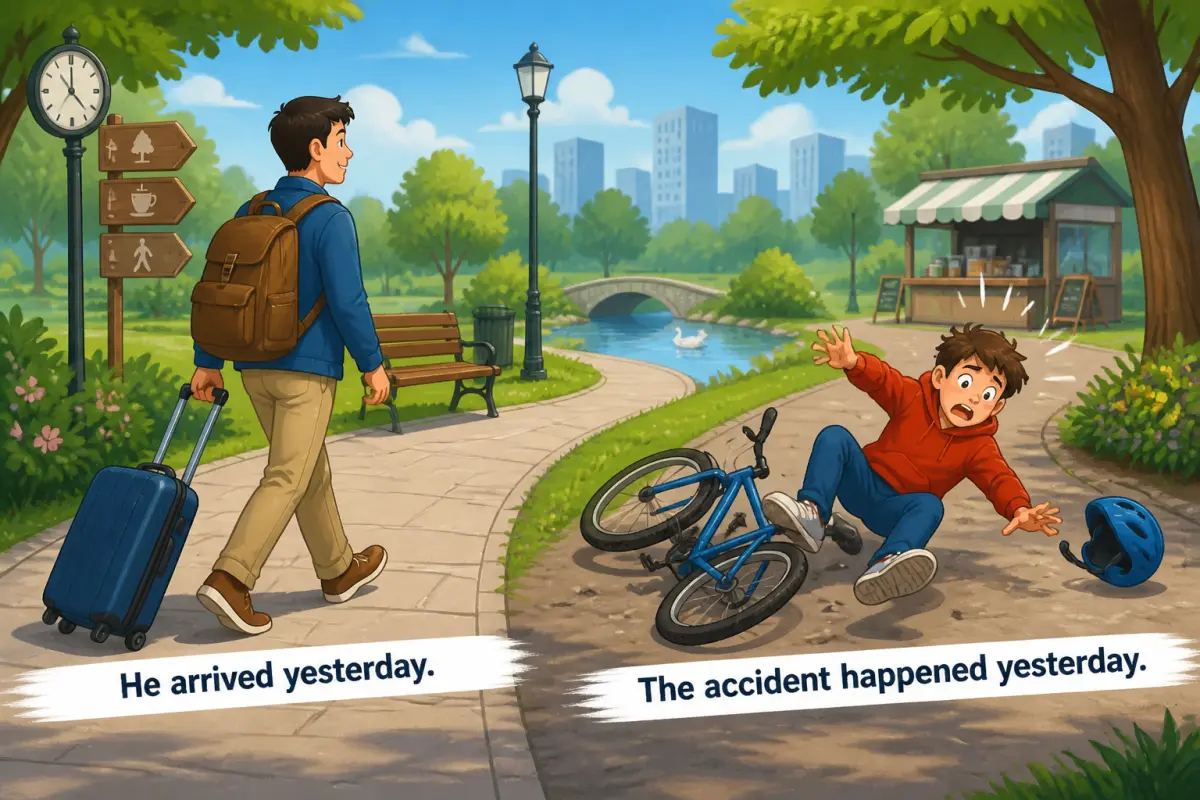
Not every verb can become passive. Passive voice normally works with transitive verbs, meaning verbs that take an object: write a report, close the gate, deliver the package. The object of the active sentence becomes the subject of the passive sentence. If there is no object, there is usually no normal passive form.
That is why sentences like He was arrived or The accident was happened are wrong. Verbs such as arrive, happen, sleep, go, and die do not normally take a direct object, so they do not form ordinary passives.
Look at these common errors:
- ❌ He was arrived late.
✅ He arrived late. - ❌ The party was happened on Saturday.
✅ The party happened on Saturday. - ❌ The baby was slept for two hours.
✅ The baby slept for two hours. - ❌ The tourists were gone to the island by boat.
✅ The tourists went to the island by boat. - ❌ Her grandfather was died in 2018.
✅ Her grandfather died in 2018.
Three active-passive comparisons make the rule clearer:
- They closed the shop. → The shop was closed. This works because the shop is the object.
- Someone damaged the fence. → The fence was damaged. This works because the fence is the object.
- The guests arrived. → no normal passive. There is no object to move into subject position.
Be careful, because some verbs can be both transitive and intransitive depending on meaning. For example:
- The soup boiled. No passive here; boil is intransitive.
- The chef boiled the soup. → The soup was boiled by the chef. Here the verb is transitive.
The same happens with verbs like grow, change, and open:
- The flowers grew quickly. No passive.
- They grew tomatoes in the greenhouse. → Tomatoes were grown in the greenhouse.
Teacher note: When students write impossible passives, the real problem is often verb type, not passive voice itself. A quick “What is the object?” question usually solves it.
Overusing passive when active sounds clearer
Passive voice is useful, but too much of it makes writing feel distant, heavy, or vague. In reports and formal writing, that may sometimes be acceptable. In emails, instructions, feedback, or storytelling, active voice often sounds more direct and easier to follow. A sentence is not better just because it sounds more formal.
Many learners overuse passive because they think it sounds academic. That can lead to sentences like The issue was discussed by us and a decision was made by the team when simple active voice would work better: We discussed the issue and the team made a decision. The second version is shorter, clearer, and more natural.
Compare these pairs:
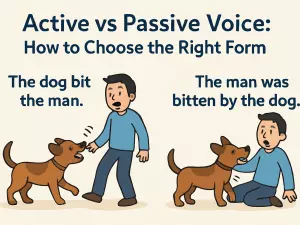
- Passive: The schedule was changed by the manager this morning.
Active: The manager changed the schedule this morning. - Passive: Several mistakes were found in your application.
Active: We found several mistakes in your application. - Passive: The problem was solved by Marta in ten minutes.
Active: Marta solved the problem in ten minutes.
When is passive still the better choice? Usually when the receiver of the action is more important than the doer, or when the doer is unknown:
- My wallet was stolen. The thief is unknown.
- The new policy will be announced tomorrow. The announcement matters more than who announces it.
- All candidates will be contacted by Friday. This focuses on candidates, which is useful in a notice.
When you revise, ask two questions:
- Does the reader need to know who did it?
- Would active voice make the sentence shorter and easier?
If the answer to both is yes, active voice is probably the better option. Tools that measure sentence clarity can also help you notice when long passive sentences are slowing your writing down.
Editing checklist for passive voice errors
When learners edit passive voice, they often check only one thing: “Is there a past participle?” That is not enough. A good edit checks structure, tense, meaning, and style. If you use the same checklist every time, passive mistakes become much easier to catch before you submit an essay or send an email.
Read the sentence slowly and test it in layers. First, make sure it is a real passive form. Then make sure it is the right passive form for the time meaning. Finally, ask whether passive is the best choice at all.
- Check that the subject receives the action.
Example: The contract was signed is passive because the contract receives the action. - Check for a form of be.
If you wrote The contract signed yesterday, you are missing was. - Check that the main verb is a past participle.
was sign is wrong; was signed is correct. - Check whether the tense matches the time expression.
is sent yesterday should be was sent yesterday. - Check been versus being.
has being prepared should be has been prepared. - Check whether the verb can actually be passive.
was arrived is impossible in normal use. - Check whether the by-phrase adds useful information.
If not, remove it. - Check whether active voice would be clearer.
The budget was reviewed by the director may be better as The director reviewed the budget.
For longer pieces of writing, it helps to search specifically for forms of be: is, are, was, were, been, being. Not every result will be passive, but many passive errors appear near those words. If you want a broader view of how often grammar issues appear in a draft, an error density checker can be useful during revision.
Fix it: correct common passive voice mistakes
The best way to improve is to correct real errors, not just read rules. The three practice blocks below focus on different skills: choosing the right passive form, rewriting active and faulty passive sentences, and spotting errors in context. Try each task before opening the answers.
If a sentence has more than one possible answer, choose the most natural one. Pay attention to time words, verb type, and whether passive is actually needed.
Practice 1: Choose the correct form
- The invitations (are sent / were sent / have being sent) every Monday.
- The road (is repaired / was repaired / has repaired) last week.
- The documents (have been signed / have being signed / are been signed) already.
- The kitchen (is being cleaned / has been cleaned / was cleaned) right now.
- The results (will be announced / will announced / are announce) tomorrow.
- My laptop (was stolen / is stolen / has stealing) on the bus yesterday.
- The rooms (are being painted / have been painted) since 9 a.m., and the smell is strong now. Choose the better option.
- The emails (are checked / were checked / are being checked) every morning before 9.
- The package (has been delivered / is being delivered) already, so please check the front desk.
- The menu (was changed / is changed / has being changed) after customers complained last month.
Show answers
- are sent
- was repaired
- have been signed
- is being cleaned
- will be announced
- was stolen
- are being painted
- are checked
- has been delivered
- was changed
Practice 2: Rewrite or transform the sentence
- They clean the gym every evening. Rewrite in passive.
- Someone has already emailed the schedule. Rewrite in passive.
- The chef is preparing the desserts. Rewrite in passive.
- The manager approved the budget yesterday. Rewrite in passive.
- The students will submit the projects next Friday. Rewrite in passive.
- The concert happened in the park. If possible, rewrite in passive; if not, write “no passive.”
- The mechanic repaired my brakes this morning. Rewrite in passive.
- They are building a new sports center near my house. Rewrite in passive.
- The guests arrived late. If possible, rewrite in passive; if not, write “no passive.”
- Someone had locked the back door before we left. Rewrite in passive.
Show answers
- The gym is cleaned every evening.
- The schedule has already been emailed.
- The desserts are being prepared by the chef.
- The budget was approved by the manager yesterday.
- The projects will be submitted next Friday.
- no passive
- My brakes were repaired this morning.
- A new sports center is being built near my house.
- no passive
- The back door had been locked before we left.
Practice 3: Spot and correct the error
- The report is send every Friday.
- My keys were lost by someone yesterday.
- The hall has being decorated for the wedding.
- He was arrived at the station at noon.
- The test papers checked last night.
- The order is delivered last Tuesday.
- The windows are been washed at the moment.
- The issue was discussed by us in the meeting.
- The new app was launch in May.
- The accident was happened near the tunnel.
Show answers
- The report is sent every Friday.
- My keys were lost yesterday.
- The hall has been decorated for the wedding.
- He arrived at the station at noon.
- The test papers were checked last night.
- The order was delivered last Tuesday.
- The windows are being washed at the moment.
- We discussed the issue in the meeting. / The issue was discussed in the meeting.
- The new app was launched in May.
- The accident happened near the tunnel.
Teacher note: When you correct practice like this, do not only check whether your final sentence is right. Ask yourself exactly what kind of error it was: missing auxiliary, wrong tense, impossible passive, or poor style choice. That habit speeds up improvement.
If you still make many small form errors, regular review of beginner grammar fixes can help stabilize the basics behind passive voice.
FAQ: passive voice errors
Learners often have the same follow-up questions after they understand the basic rules. These short answers deal with the points that usually come up in class and in writing correction.
1. Is passive voice always more formal than active voice?
Often yes, but not always. Passive voice can sound more formal because it removes the actor or shifts attention to the action. However, some passive sentences are completely ordinary: I was born in 1998, My bag was stolen. The real difference is not formality alone; it is focus.
2. Can I use passive voice in speaking, or is it mainly for writing?
You can absolutely use it in speaking. Native speakers use passive naturally when the doer is unknown or irrelevant: The train was delayed, The bill has already been paid, The window got broken somehow. In conversation, though, too much passive can sound unnatural if active voice would be simpler.
3. Why is “The car is repaired” sometimes correct and sometimes wrong?
It depends on meaning and context. The car is repaired every week is a routine, so present simple passive works. But if you mean the repair happened yesterday, then is repaired is wrong and you need was repaired. Time meaning controls the auxiliary.
4. Do all passive sentences need a past participle?
Yes, standard passive structures use a past participle. The auxiliary changes for tense, but the main verb appears in participle form: is made, was chosen, has been sent, will be finished. If you see is make or was choose, the form is wrong.
5. Is “get” passive acceptable?
Yes, in many everyday situations. He got promoted, The window got broken, and We got stuck in traffic are common in informal English. Still, learners should first master the standard be passive, because it is more flexible and more neutral in formal writing.
6. How can I tell whether a verb can be used in passive voice?
Ask whether the active verb takes a direct object. If it does, passive is usually possible. They cancelled the flight has an object, so The flight was cancelled works. The baby slept has no object, so there is no normal passive. A good dictionary will also show transitive and intransitive uses.
7. Why do teachers sometimes cross out passive sentences even when they are grammatically correct?
Usually because the sentence is grammatically correct but stylistically weak. For example, The proposal was rejected by the committee is correct, but The committee rejected the proposal may be clearer and stronger. That is a writing choice, not a grammar mistake.
8. What is the fastest way to improve my passive voice accuracy?
Learn a small set of core patterns and practice them until they feel automatic: is done, was done, is being done, has been done, will be done. Then edit your own sentences by checking the object, the tense, and the need for passive at all. Short daily correction practice usually works better than memorizing long rule lists.