Fix the Mistake Challenge: Beginner Grammar Test

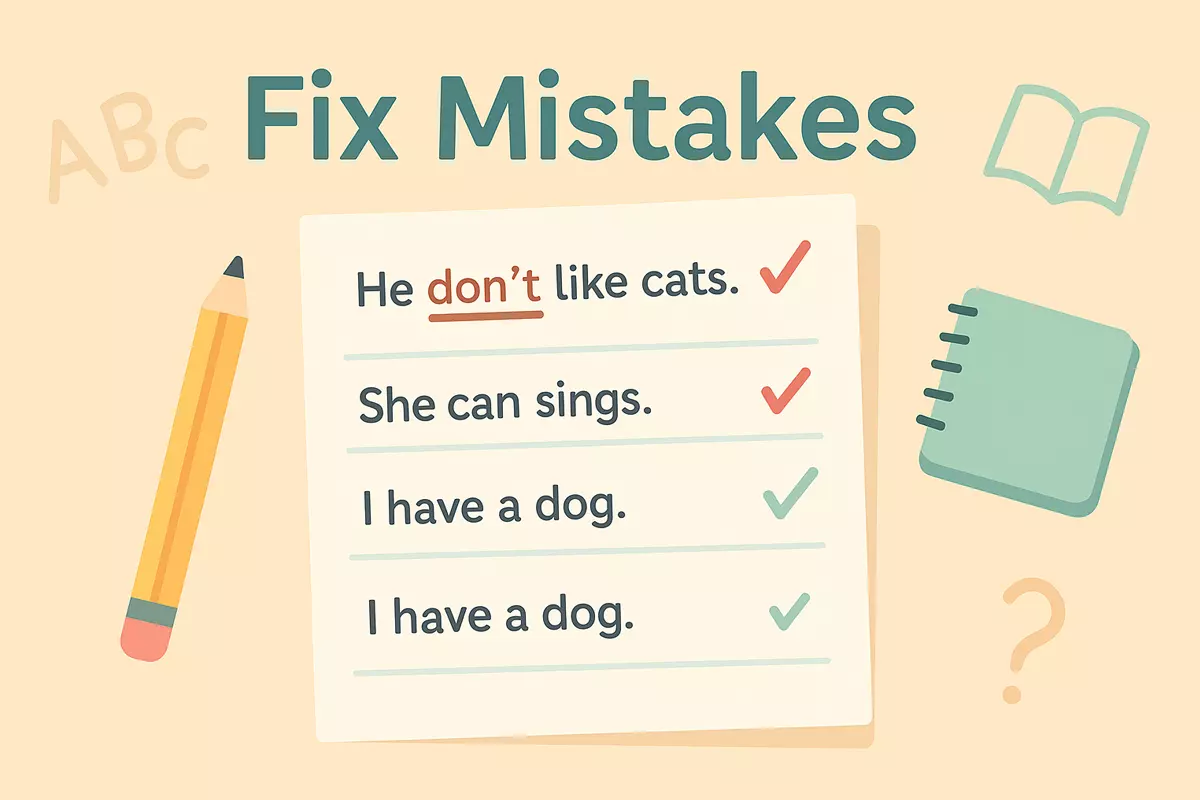 Here we common grammar mistakes, focusing on issues with articles, verbs, and prepositions. It includes error-spotting activities, correction strategies, and practice exercises to help you identify and fix mistakes in sentences.
Are you ready to improve your language skills? This engaging activity encourages you to identify and correct common grammar mistakes, making it ideal for beginners. Test your knowledge and challenge yourself to see how many errors you can find and fix. By practicing with these examples, you'll become more confident in your grammar abilities and develop a stronger understanding of English. Take the opportunity to learn from each correction and watch your language skills grow with every exercise you complete.
Common Grammar Mistakes
Many English learners struggle with particular grammar slips, especially in the early stages. Getting familiar with these typical pitfalls can help you spot and fix them in your writing and speaking. Below are some of the most frequent issues that beginners face, along with examples and tips for avoiding them.
Mixing Up Verb Tenses
Switching between past, present, and future forms incorrectly is a frequent error. For example, saying "Yesterday I go to school" instead of "Yesterday I went to school." Pay attention to time words and match your verbs accordingly.
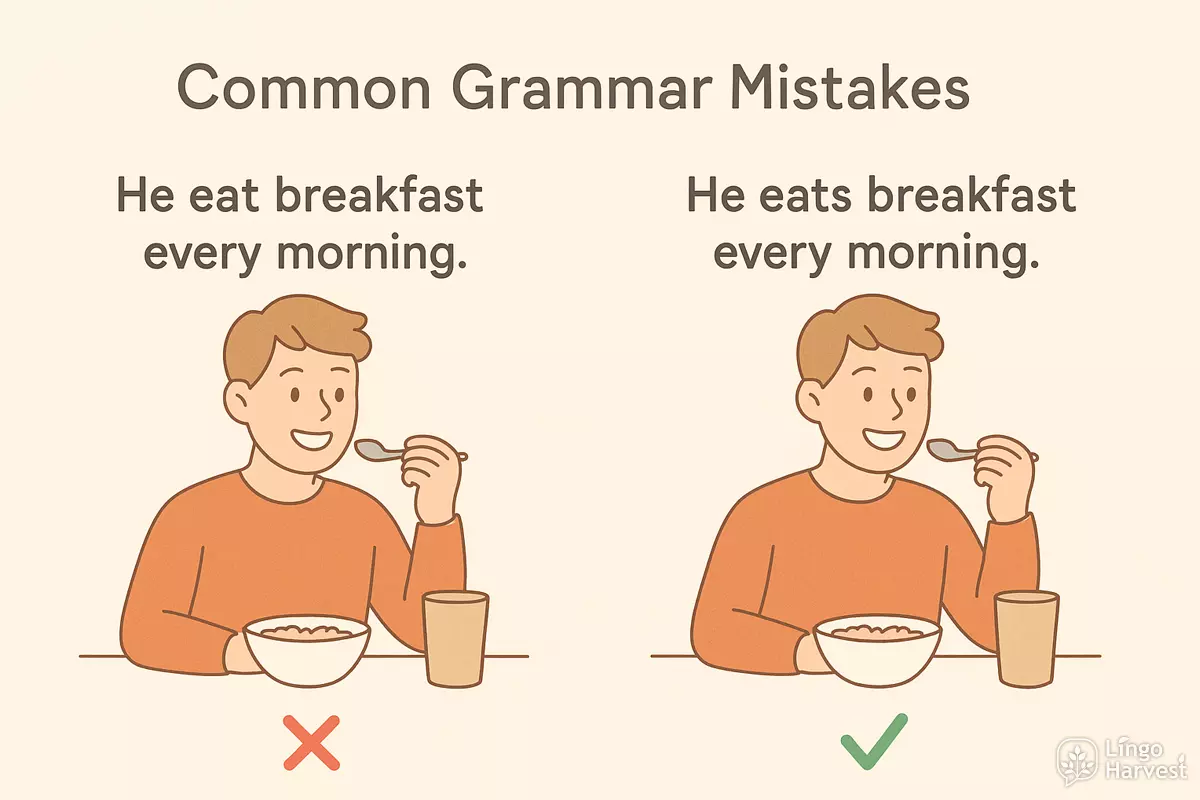
- He eat breakfast every morning. ❌ → He eats breakfast every morning. ✅
- They was happy to see us. ❌ → They were happy to see us. ✅
- I am go to the store now. ❌ → I am going to the store now. ✅
Subject-Verb Agreement
Beginners often forget to match singular and plural forms. A singular subject needs a singular verb, and a plural subject needs a plural verb.
- The cat like milk. ❌ → The cat likes milk. ✅
- My friends is here. ❌ → My friends are here. ✅
Confusing Articles: a, an, the
Choosing the right article can be tricky. Remember, "a" and "an" are used for non-specific things, and "the" is for something specific or already mentioned.
- I have the apple. (first mention) ❌ → I have an apple. ✅
- She bought a book I told you about. ❌ → She bought the book I told you about. ✅
Pronoun Confusion
Mixing up pronouns like "he," "she," "they," or using "me" instead of "I" is common. Make sure the pronoun refers clearly to the correct person or thing.
- Me went to the park. ❌ → I went to the park. ✅
- Anna is tired. He will go home. ❌ → Anna is tired. She will go home. ✅
Preposition Problems
Using the wrong preposition often leads to confusion. Here are some examples:
- I am good in English. ❌ → I am good at English. ✅
- She arrived to the airport. ❌ → She arrived at the airport. ✅
Commonly Misused Words
Some words look or sound similar but have different meanings. Watch out for these mix-ups:
- there / their / they’re
- your / you’re
- its / it’s
- then / than
- to / too / two
Summary of Frequent Errors
| Wrong Form | Correct Form |
|---|---|
| He don’t like ice cream. | He doesn’t like ice cream. |
| She can sings well. | She can sing well. |
| We was at the party. | We were at the party. |
| I have much friends. | I have many friends. |
| He is married with Anna. | He is married to Anna. |
| This is more better. | This is better. |
| I didn’t went there. | I didn’t go there. |
| She is more taller than me. | She is taller than me. |
Reviewing these examples and understanding the reasons behind them will help you strengthen your grammar and avoid frequent slips. Practice regularly, and you’ll notice improvement in both accuracy and confidence.
If you want to see how difficult your own sentences or short texts are, you can check the CEFR level of your writing with our CEFR Text Level Checker. It quickly estimates whether your text looks more like A2, B1, B2 or higher, so you know when to simplify or make it more advanced.
Articles, Verbs, and Prepositions
Understanding how to use words like "the", "is", and "in" can make a big difference in clear communication. Even beginner learners often mix up these grammar elements, leading to common mistakes such as missing articles, incorrect verb forms, or prepositions in the wrong place. Let's explore the essential rules and practical examples to spot and fix these slip-ups.
Common Article Mistakes
Articles ("a", "an", "the") are often left out or misused. For example, people might say "I have cat" instead of "I have a cat." Remember:
- Use "a" before words that start with a consonant sound: a book, a dog.
- Use "an" before words that start with a vowel sound: an apple, an idea.
- Use "the" for something specific or already mentioned: the car, the answer.
Verb Forms and Tenses
Choosing the right verb form can be tricky. Beginners often forget to match the verb with the subject or use the wrong tense. Here are some typical errors:
- He go to school every day. ❌ → He goes to school every day. ✅
- They was happy. ❌ → They were happy. ✅
- I am eat lunch. ❌ → I am eating lunch. ✅
Prepositions in Context
Prepositions tell us about time, place, and direction. They can be confusing because many languages use them differently. Look out for these mix-ups:
- She is in the bus. ❌ → She is on the bus. ✅
- I will meet you on Monday. ✅
- The book is on the table. ✅
- We arrived at the station. ✅
- He lives in London. ✅
Quick Reference: Typical Errors and Corrections
| Incorrect ❌ | Correct ✅ |
|---|---|
| I have bicycle. | I have a bicycle. |
| She go to school. | She goes to school. |
| We are in the car. | We are in the car. (correct for cars, but on for buses/trains) |
| I am student. | I am a student. |
| They was late. | They were late. |
| He is at home now. | He is at home now. (correct usage) |
| I will see you in Friday. | I will see you on Friday. |
| The sun rise in east. | The sun rises in the east. |
Grasping the differences between these fundamental grammar points helps you avoid common pitfalls and communicate more clearly. Practice by identifying these mistakes in sample sentences and correcting them as shown above.
Spot the Error Activities
Practicing error correction is a proven way to build confidence and accuracy in basic grammar. By identifying mistakes in short sentences, beginners can sharpen their eye for common issues and reinforce correct usage. Below, you’ll find guided exercises and example lists to help you recognize and fix frequent errors.
Common Beginner Grammar Mistakes
| Incorrect | Correct | Why it’s wrong |
|---|---|---|
| I goes to school every day. | I go to school every day. | Wrong verb form with “I”. Use base form “go”. |
| She don’t like apples. | She doesn’t like apples. | Use “doesn’t” with he/she/it instead of “don’t”. |
| We was late for class. | We were late for class. | Plural subject “we” takes “were”, not “was”. |
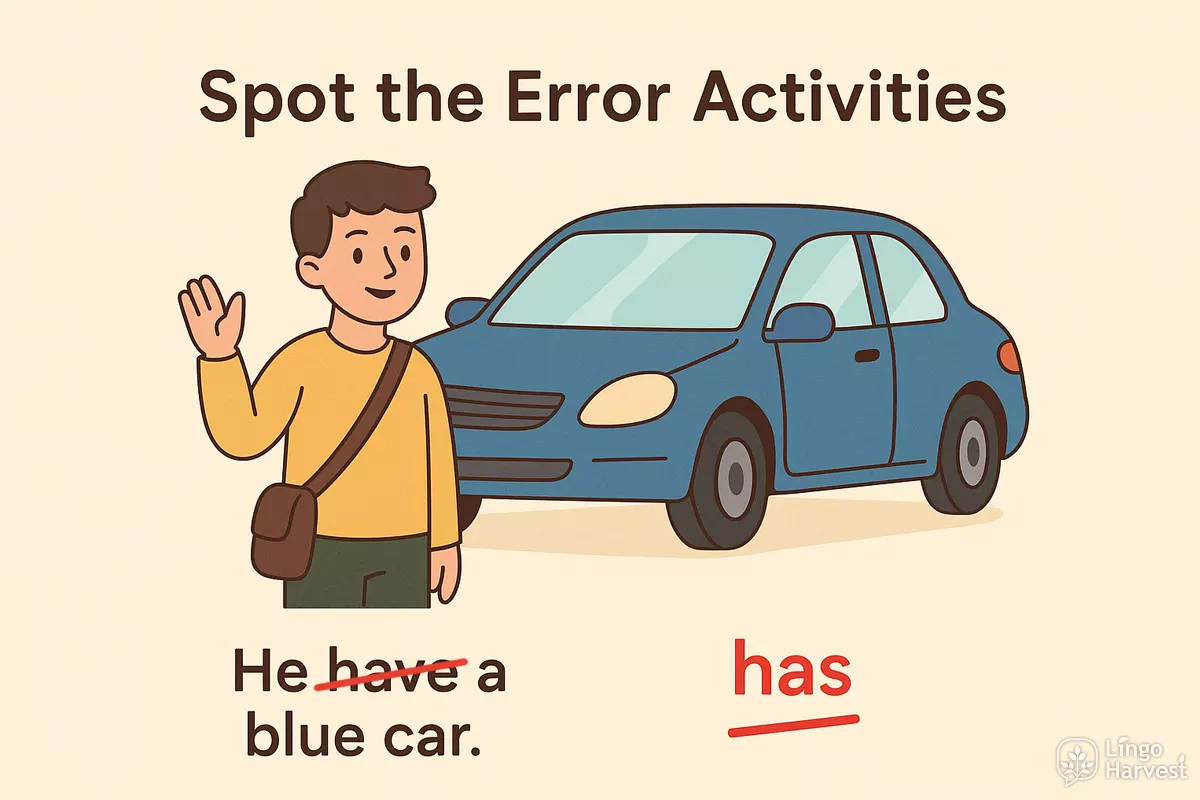
| He have a blue car. | He has a blue car. | He/she/it uses “has”, not “have”. |
| The dog run fast. | The dog runs fast. | Third person singular in present simple needs “-s”. |
| They is my friends. | They are my friends. | Plural subject “they” takes “are”, not “is”. |
| My mother cook dinner yesterday. | My mother cooked dinner yesterday. | Past time needs past tense “cooked”. |
| It raining outside now. | It is raining outside now. | Present continuous needs “be” + verb-ing. |
| There is many books on the table. | There are many books on the table. | “Books” is plural, so use “are”. |
| He can sings very well. | He can sing very well. | Modal verb “can” is followed by base form “sing”. |
| She playing tennis now. | She is playing tennis now. | Present continuous needs “is” before verb-ing. |
| I am agree with you. | I agree with you. | “Agree” is a normal verb, not used with “am” here. |
| Does she likes pizza? | Does she like pizza? | After “does” use base form “like”. |
| He don’t has a bike. | He doesn’t have a bike. | Use “doesn’t” with “he” and base form “have”. |
| We didn’t went to the party. | We didn’t go to the party. | After “didn’t” use base form “go”, not past “went”. |
Practice: Find and Correct the Errors
- Maria have two brothers.
- The children is in the park.
- I am go to the store.
- He don’t want any tea.
- We was happy yesterday.
- They goes to school every day.
- She don’t like coffee.
- My friend have a car.
- The dog eat every morning.
- I was agree with you.
Show answers
- Maria has two brothers.
- The children are in the park.
- I am going to the store.
- He doesn’t want any tea.
- We were happy yesterday.
- They go to school every day.
- She doesn’t like coffee.
- My friend has a car.
- The dog eats every morning.
- I agree with you.
Quick Reference: Typical Error Patterns and Corrections
| Incorrect Example | Correct Form |
|---|---|
| He have a cat. | He has a cat. |
| They is playing football. | They are playing football. |
| I didn’t went home. | I didn’t go home. |
| She don’t know the answer. | She doesn’t know the answer. |
| We was tired. | We were tired. |
| Does he likes coffee? | Does he like coffee? |
| It not raining now. | It is not raining now. |
| My friend live in Paris. | My friend lives in Paris. |
Mini Quiz: Which Word Is Wrong?
Choose the incorrect word in each sentence:
- They was happy to see you.
- She don’t play chess.
- We didn’t ate breakfast.
- John go to work by bus.
- I doesn’t know the answer.
- He were late for school.
- The dog run fast.
- My friends lives in Paris.
- She didn’t went home.
- The class was finish early.
Show answers
- was → should be were
- don’t → should be doesn’t
- ate → should be eat
- go → should be goes
- doesn’t → should be don’t (I don’t know)
- were → should be was
- run → should be runs
- lives → should be live
- went → should be go
- was finish → should be finished
Reviewing these examples and correcting mistakes helps develop a careful approach to grammar. Try making your own sentences and swap verbs, pronouns, or tenses to test your understanding further.
Correction Strategies
Identifying and fixing grammar mistakes is a crucial skill for language learners. When you notice an error, it helps to have a step-by-step plan for correcting it. Start by reading the sentence carefully and pinpointing what looks or sounds odd. Then, consider the grammar rule that applies—whether it’s verb tense, subject-verb agreement, word order, or article use. This process builds your confidence and accuracy over time.
Common Steps for Self-Correction
- Read the sentence out loud to catch awkward phrasing.
- Check each verb for correct tense and agreement.
- Look for missing or extra articles (a, an, the).
- Verify word order, especially in questions and negatives.
- Compare your sentence with a model or example if possible.
- Replace unclear pronouns with specific nouns.
- Watch for double negatives or confusing negatives.
- Scan for common spelling errors that change meaning.
- Identify and adjust incorrect prepositions.
- Review plural and singular forms of nouns.
Frequent Grammar Corrections (with Examples)
Below are typical mistakes beginners make, along with how to improve them:
- Tense errors: He go to school yesterday → He went to school yesterday.
- Subject-verb agreement: She like apples → She likes apples.
- Article mistakes: I have cat → I have a cat.
- Word order: You are happy always → You are always happy.
- Preposition errors: I arrived to home → I arrived home.
- Pronoun confusion: Me like pizza → I like pizza.
- Plural/singular mix-up: There is many car → There are many cars.
- Spelling: He is frendly → He is friendly.
- Negative forms: She don’t play → She doesn’t play.
- Missing auxiliary: Where you going? → Where are you going?
Quick Reference: Error Types and Corrections
| Error Type | Correction Example |
|---|---|
| Wrong verb tense | I eat breakfast yesterday → I ate breakfast yesterday |
| Incorrect article | She is doctor → She is a doctor |
| Subject-verb disagreement | They was happy → They were happy |
| Wrong preposition | I am interested on art → I am interested in art |
| Word order error | He always is late → He is always late |
Practicing these methods regularly will help you spot and correct your own mistakes more quickly. Over time, you’ll develop an instinct for proper sentence structure and usage, making your English clearer and more natural.
Practice: Fix the Mistakes in Sentences
Reviewing and correcting sentences is a practical way to strengthen your grammar skills. In this section, you’ll find a series of sentences containing common beginner-level grammar mistakes. Your challenge is to spot the errors and rewrite the sentences correctly. Pay attention to verb forms, subject-verb agreement, word order, and basic punctuation.
Task: Identify and Correct the Errors
Below is a list of sentences. Each one contains a mistake. Read each sentence carefully, find the error, and write the corrected version. Focus on typical issues such as verb tense, missing articles, plural forms, and incorrect word order.
- She go to school every day.
- I am play football now.
- There is five cats in the garden.
- He don't like apples.
- My brother have a new bike.
- We was very happy yesterday.
- The dog run fastly.
- They doesn't understand the question.
- Anna and me are friends.
- He can sings very well.
- I didn’t went to the party.
- She has two childs.
- Where you are from?
- The car is more fast than the bike.
- It raining outside.
Show answers
- She goes to school every day.
- I am playing football now.
- There are five cats in the garden.
- He doesn't like apples.
- My brother has a new bike.
- We were very happy yesterday.
- The dog runs fast.
- They don't understand the question.
- Anna and I are friends.
- He can sing very well.
- I didn’t go to the party.
- She has two children.
- Where are you from?
- The car is faster than the bike.
- It is raining outside.
Common Mistake Patterns
To help you recognize and avoid frequent errors, review this list of common beginner grammar mistakes:
- Wrong verb forms (e.g., "He don't" instead of "He doesn't")
- Incorrect use of articles ("She is teacher" vs. "She is a teacher")
- Subject-verb disagreement ("They was" instead of "They were")
- Improper pluralization ("childs" instead of "children")
- Using adjectives as adverbs ("fastly" instead of "fast")
- Confusing sentence order ("Where you are from?" instead of "Where are you from?")
- Redundant auxiliary verbs ("didn’t went" instead of "didn’t go")
- Wrong pronoun use ("Me and Anna" instead of "Anna and I")
- Missing or extra words ("It raining" instead of "It is raining")
- Incorrect comparative forms ("more fast" instead of "faster")
Quick Reference: Correct and Incorrect Forms
| Incorrect | Correct |
|---|---|
| She go | She goes |
| I am play | I am playing |
| He don't | He doesn't |
| Two childs | Two children |
| More fast | Faster |
| It raining | It is raining |
| The dog run fastly | The dog runs fast |
| We was | We were |
| Didn't went | Didn't go |
| Anna and me | Anna and I |
Regular practice with these examples will help you develop a strong foundation and avoid common errors in English sentences. Remember to check for agreement, correct forms, and proper word order as you review your own writing.