Advanced Verb + Preposition Combinations for Exam Success

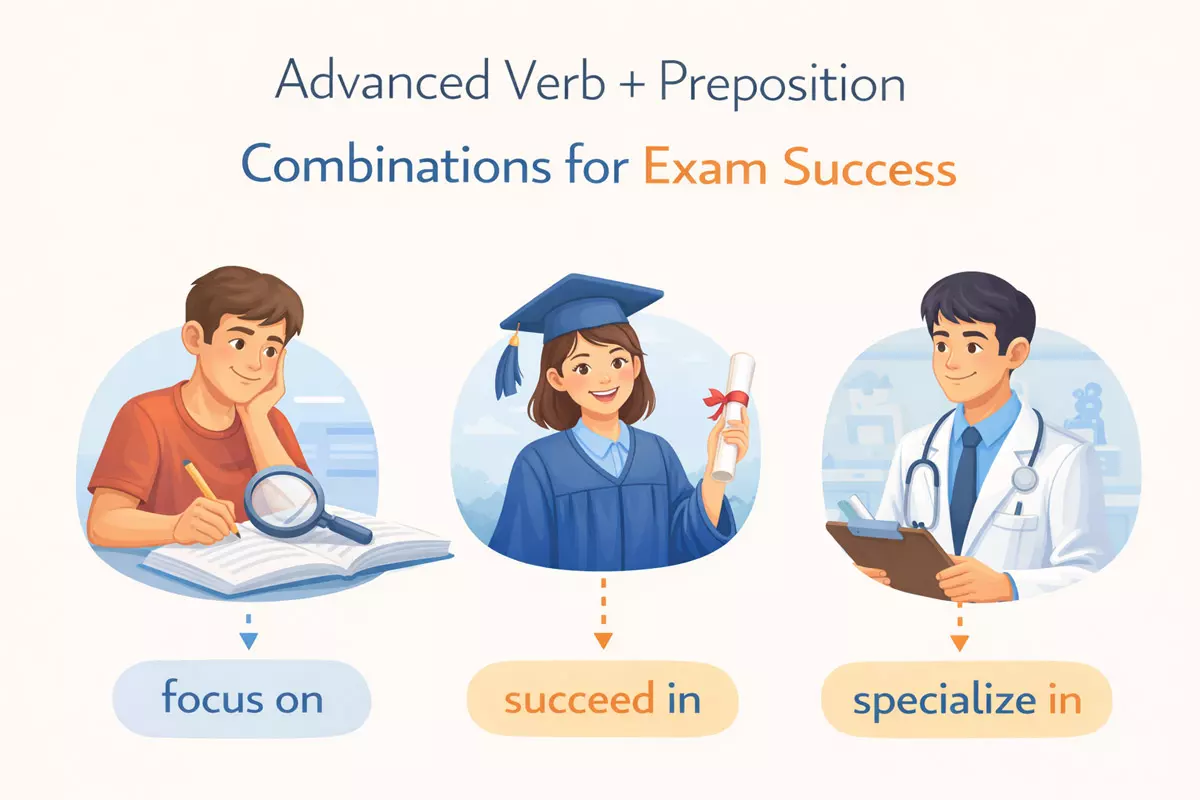 Here we why verbs take specific prepositions, how verb-preposition pairs shift meaning, and the accurate use of academic verbs. It also addresses gerund versus noun complements, advanced combinations for exams, error prevention, and scoring strategies.
- Why Verbs Take Specific Prepositions
- How Meaning Changes with Different Prepositions
- Advanced Academic Verb + Preposition Combinations
- Gerunds and Nouns After Prepositions
- Formal Alternatives to Basic Phrasal Verbs
- Common Preposition Mistakes to Avoid
- Verb + Preposition Patterns in Formal Structures
- How Collocations Improve Exam Scores
- Practice Correcting Preposition Errors
Understanding how verbs combine with prepositions is a key skill for high-level English exams. These combinations allow you to express ideas more precisely, avoid common mistakes, and sound more natural in both writing and speaking. For a structured overview of these patterns, see our prepositional verbs guide. The more familiar you are with typical verb + preposition patterns, the easier it becomes to build clear, confident, and accurate sentences.
Why Verbs Take Specific Prepositions
In English, many verbs form fixed combinations with specific prepositions. These pairings are not random — they have developed over time and are now part of standard usage. To use English accurately, especially in exams, you need to recognize and remember these patterns.
Why Some Verbs Require Prepositions
Some verbs need a preposition to complete their meaning, while others change meaning depending on the preposition used. For example, “look at,” “look for,” and “look after” all express different ideas. Because of this, choosing the wrong preposition can completely change or break the meaning of a sentence.
Common Verb + Preposition Patterns

To build a strong intuition, focus on high-frequency combinations that appear in academic and exam contexts:
| Verb + Preposition | Meaning | Example Sentence |
|---|---|---|
| Rely on | depend on | Rely on accurate data when making decisions. |
| Insist on | demand firmly | Insist on following the established procedure. |
| Apologize for | say sorry for something | Apologize for the delay. |
| Object to | express disagreement | Object to the proposed changes. |
| Focus on | direct attention | Focus on long-term goals. |
| Succeed in | achieve something | Succeed in completing the project. |
| Depend on | require support | Depend on external funding. |
| Apply for | request formally | Apply for the position. |
| Deal with | handle a situation | Deal with challenges effectively. |
| Participate in | take part | Participate in research projects. |
| Result in | lead to a result | Result in improved performance. |
How Meaning Changes with Prepositions
Some verbs combine with different prepositions, and each combination creates a new meaning. Understanding these shifts is essential for accuracy:
| Verb + Preposition | Meaning |
|---|---|
| Speak to | address someone directly |
| Speak about | discuss a topic |
| Think of | recall or imagine briefly |
| Think about | consider in detail |
| Care for | look after / like |
| Care about | feel concern |
How to Master These Patterns
There is no simple rule for all combinations, so progress depends on consistent exposure and practice. Focus on:
- Noticing patterns in real texts and listening materials
- Recording useful combinations in your own examples
- Practicing them actively in writing and speaking
- Paying attention to context and meaning differences
With regular practice, these combinations become automatic, allowing you to produce more natural and accurate English in exam situations.
How Meaning Changes with Different Prepositions
Some verbs can be followed by different prepositions, and each combination creates a distinct meaning. This is a key area tested in exams, as even a small mistake can change the meaning of a sentence. A more detailed breakdown is available in our verb preposition differences guide.
How Prepositions Change Meaning
A preposition after a verb often defines the relationship between ideas — for example, whether you are talking about a person, an action, or a decision. Compare how the meaning of “agree” changes depending on the preposition:
| Verb + Preposition | Meaning & Example |
|---|---|
| agree with | share the same opinion I agree with your idea. |
| agree to | accept a proposal or action She agreed to help us. |
| agree on | reach a decision together We agreed on a date. |
| agree upon | formal version of “agree on” The terms were agreed upon. |
Other Common Meaning Shifts
Many verbs follow the same pattern, where different prepositions create different meanings. Focus on the most useful and exam-relevant examples:
- look at → direct your eyes
Look at the screen. - look for → try to find
I’m looking for my keys. - look after → take care of
She looks after her brother. - run into → meet unexpectedly
I ran into an old friend. - run over → hit with a vehicle
The car ran over a dog. - take over → gain control
She took over the company. - take to → start to like
He took to his new job quickly. - break into → enter by force
Someone broke into the house. - break up → end a relationship
They broke up last year. - come across → find by chance
I came across an interesting article. - come up with → produce an idea
She came up with a solution.
Exam Tip
Always check the preposition after a verb. Ask yourself what the sentence is referring to — a person, an action, or a result. If the meaning changes when you switch the preposition, you are dealing with a fixed collocation that must be learned.
Mastering these small differences helps you avoid common mistakes and makes your English more precise and natural in exam conditions.
Advanced Academic Verb + Preposition Combinations
Some verb + preposition combinations are especially common in academic English and can significantly improve your exam performance. Expressions like attribute to, consist in, and derive from help you express causes, definitions, and origins more precisely. You can explore more high-level usage in our academic verb combinations guide.
Attribute to
Use attribute to when you want to explain the cause of something or identify its source.
- Many scholars attribute the decline to economic factors.
- The success was attributed to strong leadership.
Common mistake: dropping the preposition. Always use to after “attribute.”
Consist in
Use consist in to describe the essential nature or core idea of something (not its parts).
- True success consists in persistence.
- The strength of the theory consists in its simplicity.
Important: do not confuse with consist of, which is used for listing components.
Derive from
Use derive from to show origin or source.
- Many English words derive from Latin.
- Their authority derives from tradition.
Common mistake: using “derive of.” The correct form is always derive from.
Quick Comparison
| Combination | Use |
|---|---|
| attribute to | explain cause |
| consist in | define essence |
| derive from | show origin |
Exam Tip
These combinations are typical of high-level academic writing. Using them correctly shows precision and control, which can noticeably improve your score in writing and speaking tasks.
Gerunds and Nouns After Prepositions
After verb + preposition combinations, English typically uses either a gerund (-ing form) or a noun. The choice depends on whether you are talking about an action or a thing. For a deeper explanation, check our gerund after prepositions guide.
Gerund vs. Noun: Key Difference
Use a gerund when you mean an action, and a noun when you refer to a specific object, idea, or result.
- insist on doing → focus on the action
He insisted on finishing the report. - insist on something → focus on the thing
He insisted on his innocence.
Common Verb + Preposition + Gerund Patterns
Many combinations are naturally followed by a gerund, especially in academic and exam contexts:
- admit to doing → She admitted to making a mistake.
- approve of doing → They approved of changing the plan.
- object to doing → He objected to working late.
- succeed in doing → They succeeded in completing the task.
- look forward to doing → I look forward to meeting you.
Flexible Patterns (Gerund or Noun)
Some combinations allow both forms, depending on meaning:
| Structure | Example |
|---|---|
| object to doing | I object to working late. |
| object to something | I object to the plan. |
| focus on doing | Focus on improving accuracy. |
| focus on something | Focus on the main goal. |
| depend on doing | Success depends on working consistently. |
| depend on something | Success depends on good planning. |
Exam Tips
- After prepositions, use a gerund for actions: apologize for being late
- Use a noun when referring to a result or object: apologize for the delay
- Remember fixed patterns like look forward to doing (not “to do”)
- If unsure, ask: am I describing an action or a thing?
Mastering this distinction helps you avoid common grammar mistakes and produce more natural, accurate English in exam situations.
Formal Alternatives to Basic Phrasal Verbs
In exams like IELTS or TOEFL, using more formal vocabulary can significantly improve your score. One effective strategy is replacing common phrasal verbs with more precise academic alternatives.
Why Replace Phrasal Verbs
Basic phrasal verbs (e.g., look at, find out, get rid of) are common in everyday English but may sound too informal in academic writing. Using more formal verbs helps you sound more precise and demonstrates a wider lexical range.
Common Upgrades for Exams
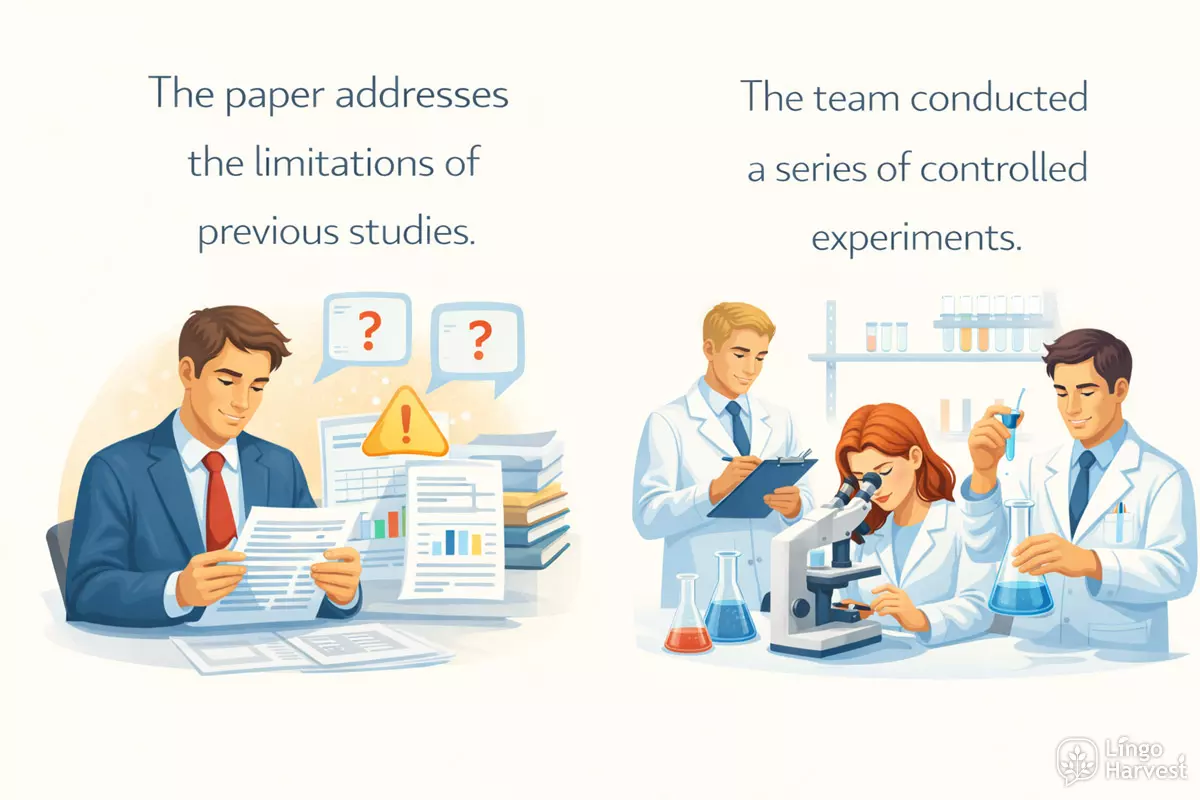
Here are high-impact substitutions that are especially useful in writing tasks:
| Basic Verb | Academic Alternative | Example |
|---|---|---|
| find out | ascertain | The study aims to ascertain the cause. |
| look at | examine | This section examines the data. |
| deal with | address | The paper addresses key issues. |
| carry out | conduct | The team conducted experiments. |
| put off | postpone | The decision was postponed. |
| set up | establish | They established a new system. |
| come up with | devise | She devised a solution. |
| go up | increase | Prices increased rapidly. |
| point out | highlight | The results highlight key trends. |
| get rid of | eliminate | The method eliminates errors. |
Exam Tips
- Use formal verbs in writing tasks, but avoid overloading every sentence
- Always check that the replacement matches the meaning exactly
- Mix simple and advanced vocabulary naturally
- Practice rewriting sentences using more formal alternatives
Using these substitutions correctly makes your writing more formal, precise, and aligned with exam expectations.
Common Preposition Mistakes to Avoid
One of the most common errors in advanced English is adding unnecessary prepositions. These “extra” words — often called ghost prepositions — make your sentences incorrect and can lower your exam score. You can review more examples in our preposition mistakes list.
What Are Ghost Prepositions?
Some English verbs do not require a preposition. However, learners often add one due to translation habits or confusion with similar structures. In formal writing and exams, this is considered a clear mistake.
Common Errors and Corrections
Focus on these high-frequency mistakes:
- ❌ discuss about → ✅ discuss
- ❌ emphasize on → ✅ emphasize
- ❌ request for → ✅ request
- ❌ enter into → ✅ enter
- ❌ mention about → ✅ mention
- ❌ attend to (a meeting) → ✅ attend
- ❌ reach to → ✅ reach
- ❌ discuss on → ✅ discuss
Quick Comparison
| Incorrect | Correct |
|---|---|
| discuss about the issue | discuss the issue |
| emphasize on the point | emphasize the point |
| request for information | request information |
| enter into the room | enter the room |
| attend to the meeting | attend the meeting |
Why These Errors Happen
Most of these mistakes come from direct translation or confusion with similar verb patterns. For example, many languages require a preposition where English does not.
Exam Tips
- Learn verbs that do not take a preposition
- Check verb patterns in reliable dictionaries
- Review your writing for unnecessary words
- Practice correcting typical mistakes
Avoiding ghost prepositions makes your writing cleaner, more accurate, and more professional — exactly what examiners expect.
Verb + Preposition Patterns in Formal Structures
In formal English, especially in exams and academic writing, prepositions are often moved before relative pronouns. This structure sounds more formal and is frequently tested at higher levels.
Prepositions in Relative Clauses
Instead of placing the preposition at the end of the sentence, formal English moves it before the relative pronoun:
| Informal | Formal |
|---|---|
| The topic that she referred to | The topic to which she referred |
| The principle that we rely on | The principle on which we rely |
| The issues that we dealt with | The issues with which we dealt |
| The process that she was involved in | The process in which she was involved |
Key Patterns to Remember
- refer to → the topic to which she referred
- rely on → the system on which we rely
- deal with → the issues with which we dealt
- participate in → the project in which they participated
Exam Tip
Use this structure in writing tasks to sound more formal. However, avoid overusing it — clarity is more important than complexity.
How Collocations Improve Exam Scores
Correct verb + preposition combinations (collocations) play a major role in high-level exam performance. They directly affect two key criteria: accuracy and cohesion.
Why Collocations Matter
- Accuracy: correct combinations reduce grammar mistakes
- Cohesion: they help connect ideas naturally
Incorrect pairings (e.g., “rely in” instead of “rely on”) make your writing sound unnatural and lower your score.
High-Value Collocations
Focus on these commonly used academic combinations:
- adhere to (rules, standards)
- account for (results, differences)
- stem from (a cause)
- result in (an outcome)
- contribute to (a result)
- cope with (difficulty)
- engage in (activity)
- comply with (rules)
Common Mistakes
| Incorrect | Correct |
|---|---|
| rely in evidence | rely on evidence |
| cope to pressure | cope with pressure |
| contribute for success | contribute to success |
| adhere at rules | adhere to rules |
Exam Tips
- Learn collocations as fixed phrases, not separate words
- Use them in context, not in isolation
- Review common mistakes regularly
- Avoid guessing prepositions
Using correct collocations consistently makes your English more natural, precise, and aligned with high-level exam expectations.
Practice Correcting Preposition Errors
In exam conditions, even strong students make mistakes with verb + preposition combinations. The key skill is spotting errors quickly and correcting them under time pressure.
Common Problem Areas
Focus on high-frequency verb + preposition pairs that are often tested:
- rely on
- insist on
- accuse of
- object to
- cope with
- apply for
- result in
- succeed in
- depend on
- contribute to
Quick Checking Strategy
- Scan for verb + preposition pairs while reading
- Ask: “Does this verb always take this preposition?”
- Watch for common traps (in / on / to confusion)
- Do not rely only on what “sounds right”
Practice Exercise
Each sentence contains one incorrect preposition. Try to correct them quickly:
- She insisted for paying the bill.
- We succeeded at finishing the project.
- He apologized about being late.
- They specialize on environmental law.
- He blamed me on the mistake.
- I am interested on learning languages.
- They objected against the policy.
- She applied to the job.
- We rely in you for support.
- The accident resulted to injuries.
Show answers
- insisted on
- succeeded in
- apologized for
- specialize in
- blamed me for
- interested in
- objected to
- applied for
- rely on
- resulted in
Similar Pairings to Watch
Some verbs change meaning depending on the preposition:
| Combination | Meaning |
|---|---|
| think of | recall or imagine |
| think about | consider in detail |
| talk to | speak with someone |
| talk about | discuss a topic |
| care for | look after |
| care about | value or be concerned |
Final Tip
Regular timed practice helps you recognize patterns automatically. The faster you spot mistakes, the more confident and accurate your exam performance will be.