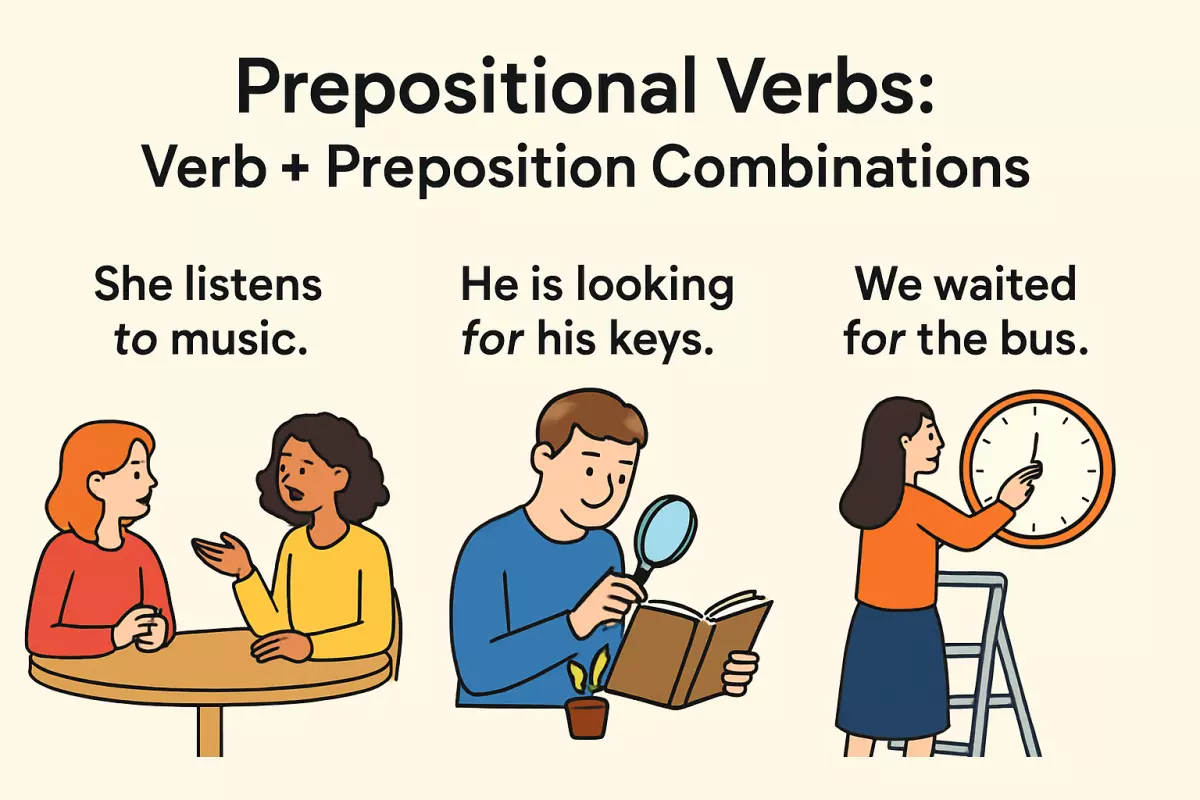
Prepositional Verbs: Verb + Preposition Combinations

 Learn what prepositional verbs are and how they differ from phrasal verbs. See common verb–preposition pairs, how meaning shifts with different prepositions, and object placement. Finish with mistakes to fix, learning tips, and homework practice.
- What prepositional verbs are
- Verb + preposition vs phrasal verbs
- Common prepositional verb combinations
- Meaning changes with different prepositions
- Word order and object placement
- Typical learner mistakes and corrections
- How to learn fixed verb–preposition pairs
- Homework: prepositional verb practice tasks
Have you noticed how a verb can shift meaning when it teams up with a small word like at or for? These verb and preposition combinations appear constantly in everyday conversation, and learning them will help you speak more naturally, understand others faster, and avoid common mistakes that can change what you mean.
What prepositional verbs are
These are verb phrases where a specific preposition regularly follows the verb to complete its meaning. The preposition is not optional: it signals the relationship between the verb and what comes next, and it often determines which object the verb can take.
A common pattern is verb + preposition + object. The object is usually a noun, pronoun, or -ing form, and it comes after the preposition (not directly after the verb).
Core pattern and word order
- Verb + preposition + noun: She apologized for the delay.
- Verb + preposition + pronoun: I can’t rely on him.
- Verb + preposition + -ing: They insisted on paying.
- Verb + preposition + wh-clause: We talked about what happened.
- Verb + preposition + object + infinitive (common with ask for): She asked for him to be removed.
Why the preposition matters
In these combinations, changing the preposition usually changes the meaning or makes the phrase incorrect. Compare how the preposition selects the “target” of the action or feeling:
- He laughed at the joke. (target of laughter)
- He laughed about the joke. (topic of laughter)
- She argued with her sister. (the person)
- She argued about money. (the topic)
How they differ from phrasal verbs
Prepositional verb phrases keep the preposition before its object, so the object cannot be moved between the verb and the preposition. This is a key usage test:
- ✅ We looked after the children.
- ❌ We looked the children after.
- ✅ She believes in hard work.
- ❌ She believes hard work in.
Common combinations to learn as chunks
- agree with (a person/opinion)
- apologize for (a mistake)
- apply for (a job/course)
- believe in (an idea)
- care about (something important)
- complain about (a problem)
- depend on (a condition/person)
- focus on (a goal/topic)
- insist on (a demand/action)
- listen to (music/someone)
- look for (something you want to find)
- pay for (a purchase)
- prepare for (an event)
- protect from (danger)
- recover from (an illness/setback)
- rely on (support/trust)
- search for (information)
- succeed in (a task/field)
Verb + preposition vs phrasal verbs
Some verb combinations look similar on the page but behave differently in grammar and meaning. The key is to notice whether the second word is a preposition (it introduces an object) or a particle (it forms a new verb meaning and may move position).
| Feature | Verb + preposition (prepositional verb) | Phrasal verb (verb + particle) |
|---|---|---|
| What follows the second word | A noun/pronoun object is required: rely on someone, apologize for something | May take an object or not, depending on the verb: wake up, turn off the light |
| Word order with an object | Fixed: verb + preposition + object ✅ look after the children ❌look the children after |
Often flexible for separable verbs: ✅turn off the TV / ✅turn the TV off |
| Pronoun placement | Pronoun stays after the preposition: ✅listen to it | With separable phrasal verbs, pronoun goes in the middle: ✅turn it off (not turn off it) |
| Meaning | Often more literal or relationship-based: belong to, depend on, agree with | Often idiomatic/new meaning: give up (stop), find out (discover), carry on (continue) |
| Stress in speech | Preposition is usually unstressed: reLY on | Particle is often stressed: TURN off, GIVE up |
| Wh-questions and relative clauses | Preposition can be stranded or fronted: ✅Who are you talking to? / ✅To whom are you talking? | Particle stays with the verb; separation depends on the type: ✅What did you find out? / ✅What did you turn off? |
How to identify the pattern quickly
Use these checks to decide which structure you are dealing with:
- Look for an object introduced by the second word. If the second word must be followed by a noun/pronoun, it is acting like a preposition: apply for a job, insist on an answer.
- Try moving the second word. If you can place the object between the verb and the second word (pick the book up), you are likely looking at a phrasal verb with a particle.
- Replace the object with a pronoun. If the pronoun must go in the middle (pick it up), that points to a separable phrasal verb; if it must stay after the preposition (look after them), that points to a prepositional verb.
- Check whether the meaning is predictable. If the combination creates a new, idiomatic meaning (run into = meet unexpectedly), it is often a phrasal verb; if it expresses a clear relationship (belong to), it is often verb + preposition.
Common learner mix-ups
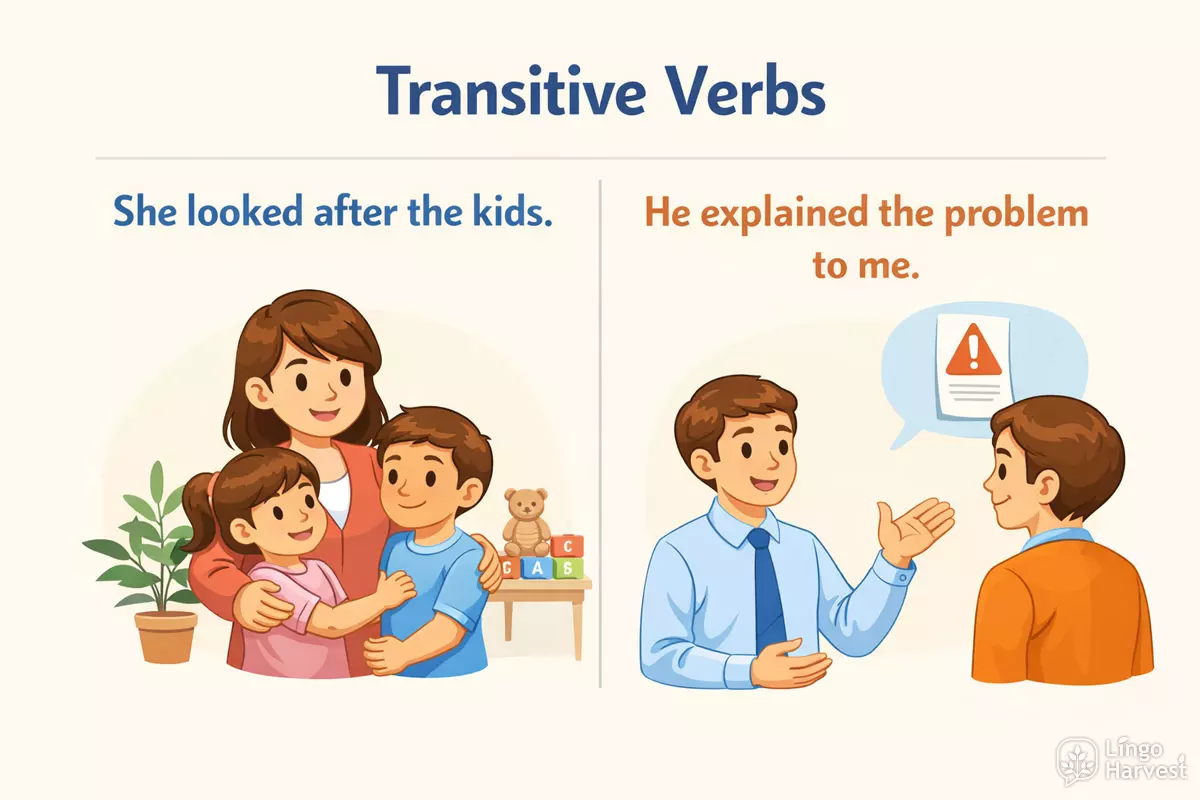
These errors come from treating a fixed preposition like a movable particle (or the other way around):
- ❌ She looked the kids after. → ✅ She looked after the kids.
- ❌ He explained me the problem. → ✅ He explained the problem to me. (not a phrasal verb; it uses a prepositional phrase)
- ❌ We discussed about the plan. → ✅ We discussed the plan. (no preposition needed)
- ❌ Please turn off it. → ✅ Please turn it off.
- ❌ Who are you looking? → ✅ Who are you looking at? (verb requires a preposition)
In practice, treat verb + preposition combinations as fixed units: the preposition is part of the verb’s pattern and the object stays after it. Treat phrasal verbs as verb + particle units where position and pronoun rules depend on whether the verb is separable or inseparable.
Common prepositional verb combinations
Many English verbs regularly pair with a specific preposition to express a stable meaning. The verb and preposition work together as a unit, so changing the preposition often changes the meaning or makes the sentence sound unnatural. The patterns below show frequent pairings and the structures they typically take.
High-frequency verb + preposition pairs (with typical patterns)
| Verb + preposition | Meaning / use | Common pattern | Example |
|---|---|---|---|
| agree with | share the same opinion; also “suit” (food/medicine) | agree with + person/idea | I agree with your point about timing. |
| apologize for | say sorry about something | apologize for + noun/-ing | She apologized for being late. |
| apply for | request formally (job, course, visa) | apply for + noun | He applied for the internship. |
| belong to | be owned by; be a member of | belong to + owner/group | This folder belongs to the finance team. |
| care about | think something is important | care about + noun/wh-clause | They care about customer feedback. |
| complain about | express dissatisfaction | complain about + noun/-ing | Guests complained about the noise. |
| consist of | be made up of | consist of + parts | The committee consists of five members. |
| depend on | be decided by; rely on | depend on + noun/wh-clause | It depends on how much time we have. |
| focus on | give attention to a topic/task | focus on + noun/-ing | Let’s focus on fixing the main bug first. |
| hear about | receive news/information | hear about + topic | I heard about the policy change yesterday. |
| insist on | say firmly that something must happen | insist on + noun/-ing | She insisted on paying for dinner. |
| laugh at | find something funny; sometimes ridicule | laugh at + person/thing | Don’t laugh at his accent. |
| listen to | pay attention to sound/speech | listen to + noun | Please listen to the instructions carefully. |
| look after | take care of | look after + person/thing | Can you look after the kids tonight? |
| look for | try to find | look for + noun | I’m looking for my keys. |
| pay for | give money for something | pay for + item/service | We paid for next-day delivery. |
| rely on | depend on; trust for support | rely on + person/thing | You can rely on her to keep it confidential. |
| respond to | reply or react | respond to + message/request | He responded to my email within an hour. |
| succeed in | achieve a result | succeed in + noun/-ing | They succeeded in reducing costs. |
| wait for | stay until something happens/arrives | wait for + noun | We’re waiting for the final approval. |
Usage patterns to notice
- Many pairings take a noun or -ing form after the preposition. This is common with items like apologize for, insist on, and succeed in: “apologize for missing the call,” “insist on checking the details,” “succeed in getting funding.”
- Some combinations are strongly “fixed,” so swapping the preposition sounds wrong. For example, English uses “listen to music” (not “listen at”), and “belong to someone” (not “belong for”). Learning the pair as a single chunk helps accuracy.
- Meaning can shift with a different preposition. Compare “look for” (search) with “look after” (take care of). Treat these as separate verb-preposition units rather than one verb with optional choices.
Meaning changes with different prepositions
With many verb + preposition combinations, the preposition is not interchangeable. Swapping it often creates a different prepositional verb with a new meaning, a different level of formality, or a different typical context. Learning these as fixed pairings helps you avoid sentences that are grammatically possible but unnatural.
A useful pattern is to treat the preposition as the “direction” of the verb’s meaning. For example, to often suggests movement toward a target, for can suggest intention or support, on can suggest continuation or pressure, and with often suggests interaction or involvement. These are tendencies, not strict rules, so examples are essential.
| Base verb | Verb + preposition | Typical meaning | Example |
|---|---|---|---|
| look | look at / look for / look after / look into | direct attention / search / take care of / investigate | Look at the chart. / Look for your keys. / Look after the kids. / Look into the complaint. |
| get | get to / get into / get over / get along with | arrive / become involved or enter / recover from / have a good relationship | We got to the station early. / She got into politics. / He got over the flu. / I get along with my neighbors. |
| run | run into / run out of / run by | meet unexpectedly / have none left / quickly check with someone | I ran into an old friend. / We ran out of milk. / Run it by your manager. |
| come | come across / come up with / come down with | find by chance / invent or think of / become ill with | I came across a useful note. / She came up with a solution. / He came down with a cold. |
| agree | agree with / agree on / agree to | share an opinion; be compatible / reach a decision about / accept a proposal | I agree with you. / We agreed on a date. / They agreed to the terms. |
| depend | depend on / depend upon | be determined by; rely on (very similar, with upon slightly more formal) | It depends on the budget. / Success depends upon preparation. |
| apply | apply for / apply to | request formally / be relevant to | She applied for the job. / The rule applies to everyone. |
| talk | talk to / talk with / talk about | speak to someone / have a conversation / discuss a topic | Talk to your teacher. / I talked with my colleague. / We talked about the plan. |
| work | work on / work with / work for | develop or improve / collaborate or use something / be employed by | I’m working on a report. / She works with data. / He works for a charity. |
| wait | wait for / wait on | expect or stay until something arrives / serve (in restaurants); sometimes “attend to” | We’re waiting for a reply. / The server waited on our table. |
| care | care about / care for | feel concern or interest / look after; also “like” in some contexts | I care about the outcome. / She cares for her grandfather. |
| hear | hear about / hear from | learn information / receive communication | I heard about the delay. / I heard from Alex yesterday. |
How to choose the right preposition in context
When you are deciding between similar options, focus on the role of what comes next:
- Person vs. topic: “talk to/with someone” but “talk about something.”
- Goal vs. subject: “apply for a job” but “apply to a rule/situation.”
- Relationship vs. decision vs. acceptance: “agree with a person,” “agree on a plan,” “agree to terms.”
Common learner errors to avoid
Because the preposition carries meaning, a small change can produce the wrong message:
- ❌ “look on the problem” (usually unnatural) → ✅ “look at the problem” or “look into the problem” (investigate).
- ❌ “apply to a job” (in standard usage) → ✅ “apply for a job.”
- ❌ “depend of” → ✅ “depend on/upon.”
- ❌ “wait on the bus” (unless you mean “serve”) → ✅ “wait for the bus.”
Word order and object placement
With prepositional verbs, the preposition is part of the verb pattern, so it normally stays directly before its object. This creates a stable structure: verb + preposition + object. Unlike many phrasal verbs, you usually cannot move the object between the verb and the preposition.
Core pattern: keep the preposition with its object
In most cases, the object comes after the preposition, whether the object is a noun phrase, a pronoun, or a longer clause. Treat the preposition as the “bridge” into the complement that follows.
- look at the map
- listen to the teacher
- wait for the bus
- apply for the job
- believe in second chances
- depend on the weather
- pay for the tickets
- care about the result
- agree with my colleague
- apologize for the mistake
- talk about the plan
- complain about the noise
- focus on accuracy
- recover from the flu
- insist on a refund
Pronouns: the same placement rule applies
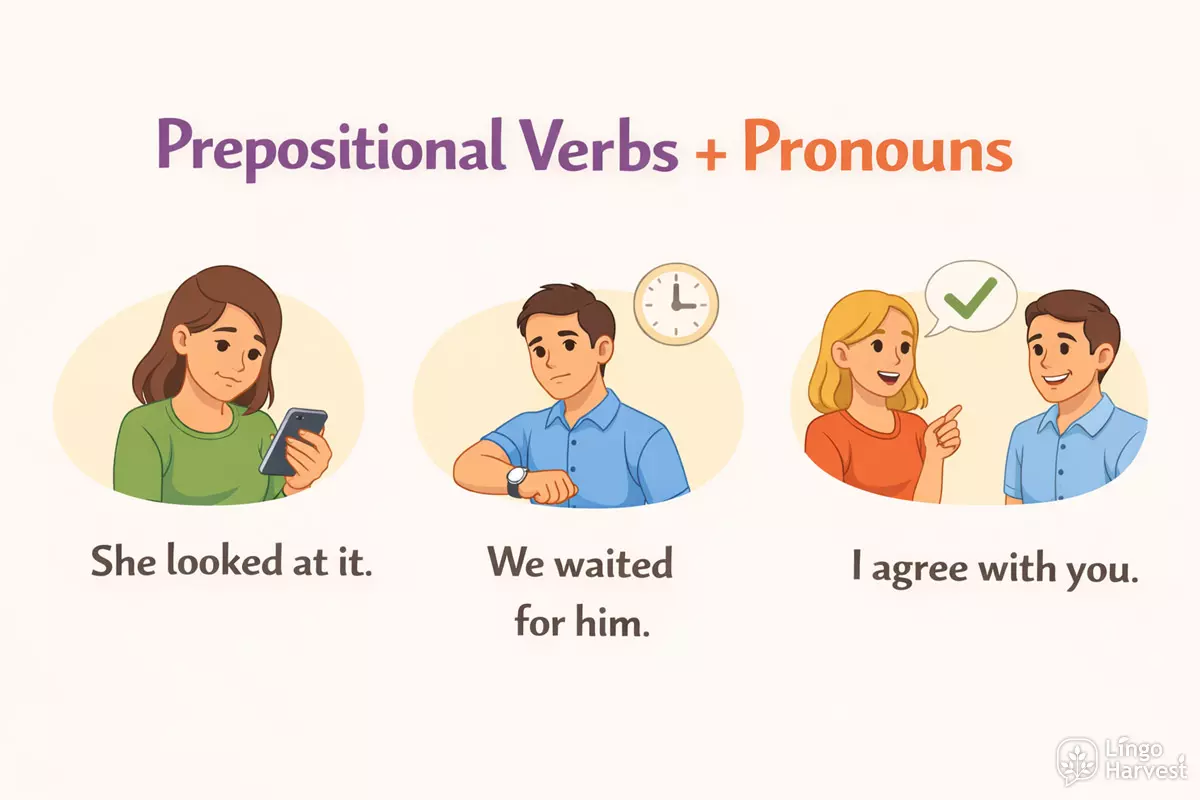
Pronoun objects still follow the preposition. This is a common error point, because learners sometimes try to place the pronoun right after the verb.
- ✅ She looked at it. ❌ She looked it at.
- ✅ We waited for him. ❌ We waited him for.
- ✅ I agree with you. ❌ I agree you with.
- ✅ They paid for them. ❌ They paid them for.
- ✅ She apologized for it. ❌ She apologized it for.
Long objects and clauses: place them after the preposition
If the complement is long (a noun phrase with modifiers) or a clause, it still comes after the preposition. This keeps the sentence readable and matches the expected verb pattern.
- We talked about how the schedule would change after the audit.
- She insisted on getting a written confirmation.
- They complained about the delays caused by the new security checks.
- I focused on what we could control.
- He applied for the role that opened last month.
Preposition stranding: when the preposition can move
In questions, relative clauses, and some passive structures, English often places the preposition at the end. This is common and natural in everyday usage, especially with who/what/which and relative pronouns.
- What are you looking at?
- Who did she talk to?
- That’s the topic we were talking about.
- This is the rule you must comply with.
- He’s someone I can rely on.
Common mix-up: prepositional verbs vs. separable phrasal verbs
A useful test is object movement. If the object can go between the verb and the particle, you are likely dealing with a separable phrasal verb (particle), not a prepositional verb (true preposition). With prepositional verbs, keep the complement after the preposition.
- look after the baby → look the baby after
- run into an old friend → run an old friend into
- get over the shock → get the shock over
- approve of the proposal → approve the proposal of
Typical learner mistakes and corrections
Most errors with verb + preposition combinations come from treating the preposition as optional, choosing the wrong one by translation, or confusing a prepositional verb with a phrasal verb. The fixes are usually pattern-based: learn the verb together with its preposition, notice what kind of object follows, and keep the preposition in questions and relative clauses.
Frequent errors and how to fix them
- Omitting the preposition (common after “listen,” “depend,” “wait”):
❌ I’m waiting you. → ✅ I’m waiting for you.
❌ It depends the price. → ✅ It depends on the price. - Using the wrong preposition by direct translation:
❌ She explained me the problem. → ✅ She explained the problem to me.
❌ We discussed about the plan. → ✅ We discussed the plan. - Adding an unnecessary preposition (some verbs take a direct object):
❌ He entered into the room. → ✅ He entered the room.
❌ They requested for a refund. → ✅ They requested a refund. - Mixing up similar patterns: “marry” vs “get married to”:
❌ She married with him. → ✅ She married him.
✅ She got married to him. - Confusing “arrive in/at” (place size matters):
❌ We arrived to the airport. → ✅ We arrived at the airport.
✅ We arrived in London. - Wrong object form after a preposition (use object pronouns):
❌ This doesn’t apply to I. → ✅ This doesn’t apply to me.
❌ They’re talking about she. → ✅ They’re talking about her. - Breaking the verb + preposition unit in questions (keep the preposition):
❌ Who are you talking? → ✅ Who are you talking to?
❌ What does it depend? → ✅ What does it depend on? - Dropping the preposition in relative clauses:
❌ The person I spoke yesterday was helpful. → ✅ The person I spoke to yesterday was helpful.
✅ The person to whom I spoke yesterday was helpful. (more formal) - Using -ing after a preposition when an infinitive is needed (or the reverse):
❌ I’m interested to learn French. → ✅ I’m interested in learning French.
❌ She insisted to pay. → ✅ She insisted on paying. - Confusing “look at / look for / look after” (different meanings):
❌ I’m looking at my keys. → ✅ I’m looking for my keys.
❌ Can you look for the baby? → ✅ Can you look after the baby? - Using “to” after “mention”:
❌ He mentioned to me the issue. → ✅ He mentioned the issue to me.
✅ He mentioned the issue. - Choosing “with” instead of “to” after “talk/speak” when the meaning is “address”:
❌ I spoke with the manager about the complaint. (possible, but different focus)
✅ I spoke to the manager about the complaint. (addressed the manager) - Misplacing the object with prepositional verbs (object normally follows the preposition):
❌ She looked the document at. → ✅ She looked at the document. - Overgeneralizing “to” for movement (some verbs prefer “at/on/in”):
❌ Throw it to the bin. → ✅ Throw it in the bin. (BrE common)
✅ Throw it into the bin. (movement into) - Mixing “complain to” and “complain about” (person vs topic):
❌ She complained about the receptionist. (topic is the receptionist, not the listener)
✅ She complained to the receptionist. (listener)
✅ She complained about the service. (topic) - Using “about” after “ask” when you need the person:
❌ I asked about my teacher for help. → ✅ I asked my teacher for help.
✅ I asked about the homework. (topic)
Practical correction habits
- Record new items as a chunk: “depend on,” “apply for,” “belong to,” “succeed in,” not the verb alone.
- Check what follows: person (talk to), topic (talk about), or purpose (ask for).
- In questions and relative clauses, keep the preposition at the end in neutral style: “Who are you waiting for?”
- After a preposition, use object pronouns and -ing forms when required: “interested in him,” “good at cooking.”
How to learn fixed verb–preposition pairs
Progress comes from treating these combinations as single units of meaning, not as a verb plus an optional add-on. Many verb–preposition pairings are “fixed” because the preposition signals a specific relationship (topic, target, source, beneficiary) and changing it often makes the sentence unnatural or changes the meaning.
Learn them in chunks with a clear pattern
Store each item as a mini-frame you can reuse: verb + preposition + object. This reduces guessing and helps you notice what kinds of nouns or clauses typically follow.
- Verb + preposition + noun: “rely on evidence,” “apologize for the delay.”
- Verb + preposition + -ing: “insist on paying,” “succeed in finding a solution.”
- Verb + preposition + wh-clause: “talk about what happened,” “think about how to respond.”
- Verb + preposition + pronoun: “depend on it,” “agree with them.”
Group pairs by meaning, not alphabet
Memorization is easier when you connect the preposition to its typical “role.” Build sets that share a purpose, then add verbs into each set.
- Topic and focus (often “about”): talk about, think about, worry about, read about, complain about, argue about.
- Support or opposition (often “for/against”): vote for, campaign for, fight for, protest against, argue against, speak against.
- Trust and dependence (often “on”): rely on, depend on, count on, focus on, concentrate on, insist on.
- Reaction and emotion (often “at/with”): laugh at, stare at, shout at, agree with, argue with, sympathize with.
- Ability and outcomes (often “in/at”) : succeed in, believe in, participate in, specialize in, excel at, aim at.
- Cause and responsibility (often “for”) : apologize for, blame for, thank for, pay for, forgive for.
Use contrast to prevent common mix-ups
Some verbs can take different prepositions with different meanings, while others are essentially fixed. Practice with minimal pairs so your ear learns what sounds natural.
- “listen to music” → receiving sound; “listen at music”
- “look at the screen” (direct attention) vs. “look for your keys” (search)
- “care about the issue” (importance) vs. “care for a child” (look after)
- “agree with a person” vs. “agree on a plan”
- “apologize for a mistake” vs. “apologize to someone”
- “depend on results” vs. “depend upon results” (often interchangeable, but choose one and be consistent)
Practice in sentences that force the right object
To make the pairing automatic, write or say short sentences that include a realistic object. Avoid practicing the verb alone; the object is what anchors the preposition choice.
- apply for a job / a visa / a grant
- belong to this group / the organization
- consist of three parts / two sections
- deal with a complaint / a delay
- focus on the main point / accuracy
- prepare for an exam / a meeting
- recover from an injury / a setback
- respond to an email / criticism
- search for information / a solution
- wait for the bus / a reply
- work on a project / your pronunciation
- protect from harm / infection
- prevent from spreading / falling
- invest in training / equipment
- complain about noise / service
Notice what changes and what stays fixed
In real use, the verb can change tense and form, but the preposition usually stays the same. Train yourself to keep the preposition “attached” even when you transform the sentence.
- “They rely on data.” → “They relied on data.” → “They have relied on data.”
- “She apologized for the error.” → “An apology for the error was issued.”
- “We agreed on the schedule.” → “An agreement on the schedule was reached.”
- “He insisted on leaving.” → “His insistence on leaving surprised us.”
When you learn a new verb–preposition combination, record it with one strong example sentence and one contrast (a nearby preposition that would be wrong or would change the meaning). That pairing of “correct use + contrast” is often enough to stop repeated errors.
Homework: prepositional verb practice tasks
Use these tasks to build accuracy with verb + preposition pairings. Focus on two habits: (1) learn the preposition as part of the verb, and (2) check the pattern that follows (noun, -ing form, or object + preposition).
Task 1: Choose the correct preposition
Complete each sentence with the best preposition.
- I’m looking ___ my keys. Have you seen them?
- She apologized ___ being late.
- We need to decide ___ a date for the meeting.
- He insisted ___ paying for dinner.
- They complained ___ the noise from the street.
- Can you rely ___ him to keep the secret?
- I’m not sure what this button does; it depends ___ the model.
- She succeeded ___ passing the exam on her first try.
- He’s thinking ___ applying for a new job.
- Don’t worry; I’ll take care ___ the details.
- We’re waiting ___ the bus.
- She belongs ___ a local chess club.
Show answers
- for
- for
- on
- on
- about
- on
- on
- in
- about
- of
- for
- to
Task 2: Verb + preposition matching
Match each verb (1–10) with the correct preposition (A–J). Write the letter.
- apply
- approve
- believe
- care
- deal
- focus
- hope
- prepare
- recover
- remind
Prepositions:
- A) about
- B) for
- C) from
- D) in
- E) of
- F) on
- G) to
- H) with
- I) at
- J) into
Show answers
- B (apply for)
- F (approve of)
- D (believe in)
- F (care about)
- H (deal with)
- F (focus on)
- F (hope for)
- B (prepare for)
- C (recover from)
- G (remind someone of)
Task 3: Fix the preposition (error correction)
Each sentence contains a preposition mistake. Rewrite the sentence correctly.
- She insisted to paying in cash.
- I’m looking at my wallet, not for my phone.
- They apologized about the confusion.
- He succeeded at getting the permit.
- We’re waiting on the train at platform 3.
- Do you agree to this plan?
- She depends of her sister for advice.
- He belongs with the drama club.
Show answers
- She insisted on paying in cash.
- I’m looking for my wallet, not my phone.
- They apologized for the confusion.
- He succeeded in getting the permit.
- We’re waiting for the train at platform 3.
- Do you agree with this plan?
- She depends on her sister for advice.
- He belongs to the drama club.
Task 4: Complete the pattern (noun or -ing?)
Choose the best completion. Use a noun phrase or an -ing form based on the normal pattern.
- She’s interested in ___ (learn) more about design.
- They’re responsible for ___ (organize) the event.
- He apologized for ___ (his mistake / make a mistake).
- We talked about ___ (the schedule / change the schedule).
- I’m worried about ___ (the results / fail the test).
- She insisted on ___ (leave) early.
- They succeeded in ___ (their plan / follow their plan).
- He complained about ___ (the service / wait too long).
Show answers
- learning
- organizing
- his mistake
- the schedule
- the results
- leaving
- following their plan
- the service
Task 5: Production drill (write your own)
Write one natural sentence for each item. Keep the verb and preposition together, and include an object when needed.
- look forward to + noun / -ing
- take care of + noun
- run out of + noun
- get used to + noun / -ing
- agree with + person / opinion
- agree on + decision
- remind (someone) of + noun
- recover from + illness / setback
- focus on + priority
- apologize for + noun / -ing
- apply for + job / course
- deal with + problem
Self-check checklist (before you submit)
- Did you keep the preposition fixed (no swapping based on your first language)?
- Did you choose the right follow-up pattern: noun, pronoun, or -ing form?
- Did you avoid inserting an extra preposition after the object (for example, ❌ “discuss about”)?
- Did you use agree with for people/opinions and agree on for decisions?
- Did you check common pairs that are easy to confuse (for example, apologize for versus complain about)?