Information Packaging: Managing Known and New Information

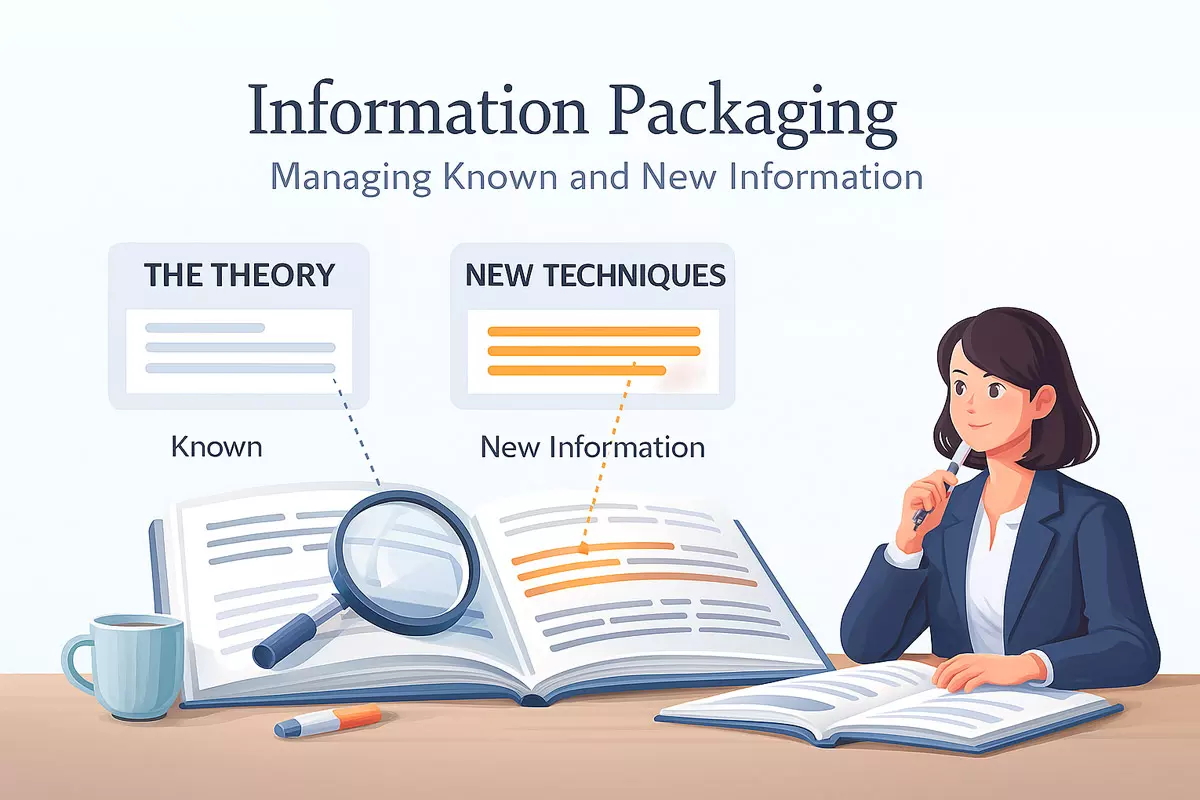 Here we how to balance given and new information in writing by positioning known and new elements in clauses, using pronouns and definite noun phrases, introducing new ideas clearly, linking sentences smoothly, and practicing text reorganization.
Organizing information so that familiar concepts are presented alongside new ideas is crucial for clear and effective communication. By thoughtfully arranging what readers already know with unfamiliar details, you create a logical flow that helps your audience connect new information to their existing knowledge. This approach not only makes your message more engaging but also ensures it is easier to understand and remember, ultimately enhancing the overall impact of your communication.
Concepts of given and new information
Understanding how speakers and writers distinguish between what the audience already knows and what is being introduced for the first time is key for effective communication. In linguistics, "given" information refers to content presumed to be familiar or accessible to listeners or readers, while "new" information presents unfamiliar or noteworthy details. This distinction shapes sentence structure, word choice, and even intonation in spoken language.
Identifying given and new elements
Writers use a range of strategies to signal whether information is assumed or novel. Given details often appear earlier in a text or conversation, are marked by pronouns, or are contextually recoverable. New information is typically highlighted by stress, placed at the end of a sentence, or introduced with indefinite articles.
- Given: pronouns (he, she, it), definite articles (the), previously mentioned topics
- New: indefinite articles (a, an), noun phrases not yet introduced, emphasized words
- Given: background knowledge, shared cultural references
- New: specific facts, updates, or contrasting points
- Given: names or terms repeated from earlier
- New: explanations, definitions, or clarifications
- Given: phrases like "as mentioned earlier"
- New: phrases like "what you may not know is..."
- Given: information in subject position (especially in English)
- New: information in focus position, often at the end
Why distinguishing matters
Recognizing the division between old and new content helps readers process information more efficiently. It allows for smoother transitions, reduces ambiguity, and ensures that important updates are not overlooked. In conversation, it also supports turn-taking and keeps exchanges relevant and coherent.
Common patterns and cues
Speakers and writers rely on various cues to clarify which information is assumed and which requires attention. These include word order, stress, and specific grammatical choices. The following table outlines typical markers for each type:
| Given Information | New Information |
|---|---|
| Definite articles ("the dog") | Indefinite articles ("a dog") |
| Pronouns ("it", "they") | New nouns or noun phrases |
| Previously mentioned topics | Unintroduced concepts or facts |
| Background/frame-setting information | Key points, main news, or contrasts |
Implications for writing and speaking
Effective use of these distinctions enhances clarity. Sentences that start with familiar elements and end with new information tend to be easier to follow. This principle, sometimes called the "given-new contract," helps ensure that audiences are not overwhelmed and can connect new knowledge to what they already know.
Positioning known vs new elements in clauses
How information is arranged within a sentence can have a strong impact on clarity and coherence. In English and many other languages, elements that are already familiar to the reader or listener (sometimes called "given" or "shared" information) are typically placed toward the beginning of a clause. New, unexpected, or emphasized details tend to appear later, often at the end of the clause. This ordering helps readers process ideas more smoothly, building from what they know toward what they need to learn.
Common patterns for arranging old and new information
- Theme–Rheme structure: The starting portion (theme) connects to previous context, while the latter part (rheme) introduces the main point or fresh content.
- Subject position: Known topics or repeated ideas often appear as subjects.
- End-focus principle: The most important or novel information is placed at the end of the sentence for emphasis.
- Passive voice: Used when the receiver of an action is already known or more relevant than the actor.
- Fronting: Sometimes, new or important elements are brought to the front for emphasis, though this is less typical.
Examples of known and new information placement
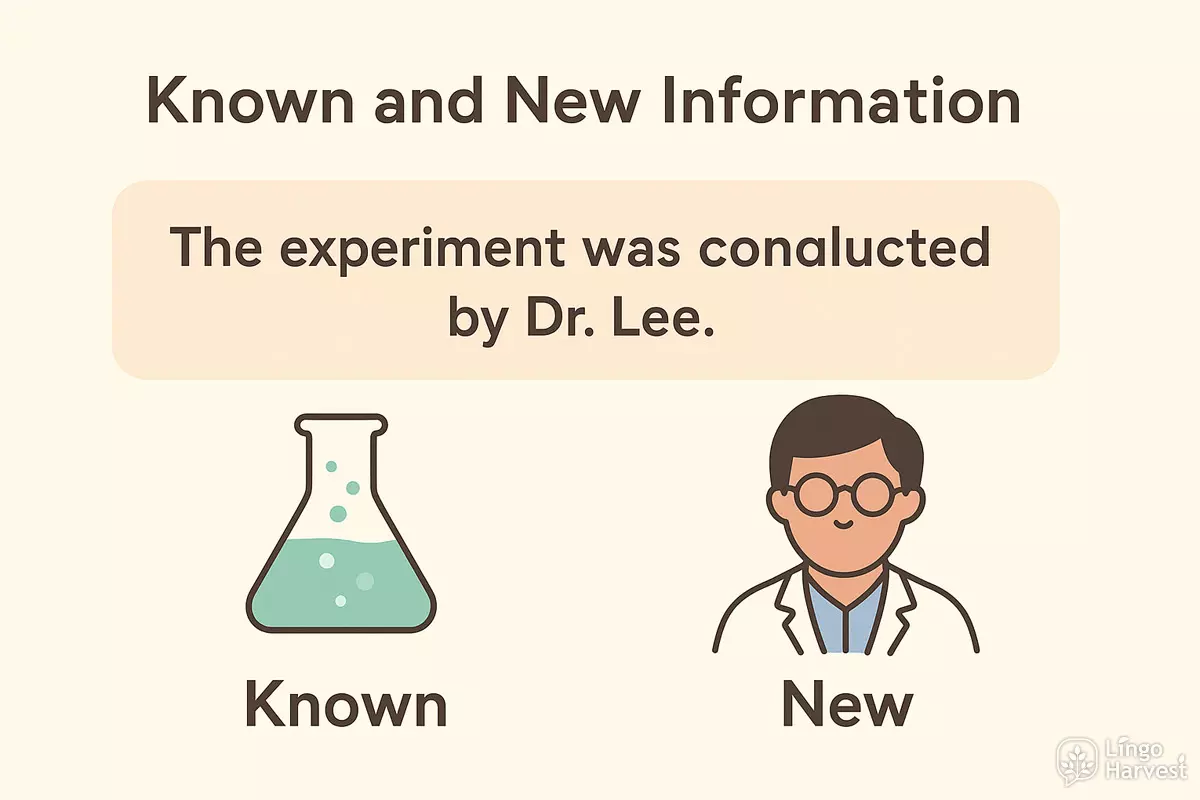
Consider how sentence structure shifts depending on what is assumed to be familiar. Here are several example sentences where the order of elements reflects their informational status:
- The experiment was conducted by Dr. Lee. (The experiment is known; Dr. Lee is new.)
- Dr. Lee conducted the experiment. (Dr. Lee is known; the experiment is new.)
- As for the new policy, it will take effect next month.
- These results suggest a different conclusion.
- Next, the samples were analyzed.
- Regarding the proposal, several changes are necessary.
- The committee approved the budget.
- The budget was approved by the committee.
- After the meeting, further discussion followed.
- This method has several advantages.
- The software update caused unexpected issues.
- Unexpected issues were caused by the software update.
- On Monday, the results were released.
- The results were released on Monday.
Summary of placement tendencies
| Element Type | Typical Position in Clause | Example |
|---|---|---|
| Known (given) information | Sentence start (subject/theme position) | The committee approved the proposal. |
| New (focus) information | Sentence end (rheme/focus position) | The proposal was approved by the committee. |
| Contrastive or emphasized information | Often at the end, sometimes fronted | It was Dr. Lee who led the team. |
| Background/context | Clause-initial (fronted) | After the meeting, decisions were made. |
Writers can guide readers by carefully choosing where to introduce familiar details and where to highlight new ones. This strategic arrangement is a key tool for making complex information accessible and for maintaining logical flow across sentences and paragraphs.
Using pronouns and definite NPs for given content
When a piece of information is already established in a conversation or text, writers and speakers often refer back to it using pronouns or definite noun phrases (NPs). This makes communication more efficient and natural. Instead of repeating the same words, we use terms like "he," "she," "it," or "the book" to reference something the audience already knows about.
Why refer back to known information?
Referring to previously mentioned concepts streamlines discourse. By signaling that something is already familiar, language avoids unnecessary repetition. This helps listeners and readers focus on what’s new or important, rather than getting bogged down in details they already know.
Common forms of reference
Writers and speakers use several strategies to tie back to known elements:
- Pronouns (he, she, it, they, etc.)
- Definite noun phrases (the dog, the teacher, the idea)
- Demonstratives (this, that, these, those)
- Possessives (his, her, their)
- Ellipsis (omitting repeated information when it’s clear)
Examples of reference in context
- Maria found a wallet. She returned it to the owner.
- I bought a new laptop. The laptop has a fast processor.
- We visited a museum. It was fascinating.
- There’s a cake in the fridge. That cake is for the party.
- Tom adopted a cat. His cat is very playful.
- Sarah read the article. The article was insightful.
- I saw a bird outside. The bird was singing.
- We watched a movie last night. It was funny.
- Jane lost her keys. They were on the table.
- A child drew a picture. The picture was colorful.
- He wrote a letter. The letter explained everything.
- The students finished their test. They were relieved.
Choosing between pronouns and definite NPs
Selecting the right form depends on clarity and context. Pronouns are concise, but can cause confusion if multiple possible referents exist. Definite noun phrases are less ambiguous but slightly longer. Good communicators balance brevity with clarity, adjusting their references as needed.
| Referential Form | Example in Context |
|---|---|
| Pronoun | John saw a fox. He was surprised. |
| Definite NP | John saw a fox. The fox ran away. |
| Demonstrative | John saw a fox. That animal was quick. |
| Possessive | John saw a fox. Its fur was red. |
Summary
Effectively managing known information is essential for clear and efficient communication. By skillfully alternating between pronouns and definite noun phrases, speakers and writers help their audience keep track of what is already understood, ensuring the focus remains on new or important details.
Introducing new ideas clearly and gradually
Presenting unfamiliar information requires careful pacing and organization. Readers process new concepts best when they can connect them to what they already know. To facilitate understanding, writers should introduce novel points in manageable steps, providing context and logical transitions.
Strategies for Presenting New Information
- Start with familiar concepts before moving to unfamiliar territory.
- Use clear topic sentences to signal new directions.
- Break complex ideas into smaller, digestible parts.
- Provide definitions or explanations when introducing specialized terms.
- Include examples to illustrate abstract or challenging content.
- Employ visual cues—such as headings or bullet points—to highlight shifts in focus.
- Summarize key points before adding more details.
- Check for logical flow between sentences and paragraphs.
- Reiterate connections to previously discussed information.
- Encourage questions or reflection to engage readers actively.
Common Pitfalls to Avoid
- Introducing too many new elements at once, which can overwhelm readers.
- Assuming prior knowledge without providing sufficient background.
- Using jargon or technical language without explanation.
- Failing to clarify the relevance of new points to the main topic.
Example Patterns for Gradual Introduction
- Begin with a general statement, then narrow to specifics.
- Use analogies or comparisons to relate new ideas to familiar ones.
- Pose a question, then answer it with new information.
- Introduce a problem, followed by a novel solution.
- Present a sequence: background → new development → implications.
- Start with a summary, then break it down into components.
- Contrast old and new perspectives to highlight innovation.
- Provide a real-world scenario before revealing the underlying principle.
- Offer step-by-step instructions when introducing a new process.
- List prerequisites before explaining advanced concepts.
- Lead with a familiar example, then introduce an exception or twist.
Organizing information in this way helps readers build confidence as they encounter unfamiliar material. By pacing the delivery and linking new content to known facts, writers can guide their audience through even the most complex topics without causing confusion or disengagement.
Linking sentences for smooth progression
Crafting fluid connections between sentences is essential in presenting information so that readers follow your logic without stumbling. This is especially important when managing the flow from established (known) information to something new or unfamiliar. Effective transitions help guide your audience, making your writing feel unified and intentional rather than a series of disconnected statements.
Why transitions matter in information packaging
When you introduce new concepts, readers benefit from clear signals about how each idea relates to the previous one. Transitional words and phrases act as bridges, ensuring that new details are anchored in what’s already been said. This helps maintain coherence and prevents confusion, particularly in dense or technical writing where the distinction between old and new information matters.
Common linking words and patterns
Writers have a variety of tools to connect sentences. These include simple conjunctions, adverbs, and more complex structures that echo or summarize earlier points. Here’s a selection of useful linking devices:
- However → The experiment was flawed; however, the results were still valuable.
- Moreover → The method is cost-effective; moreover, it improves accuracy.
- For example → Many fruits are rich in vitamins; for example, oranges and strawberries.
- In addition → The study covered economics; in addition, it examined social impacts.
- Therefore → The system failed; therefore, a redesign was necessary.
- As a result → The team missed the deadline; as a result, the project was delayed.
- In contrast → Urban areas have high pollution; in contrast, rural areas are cleaner.
- On the other hand → The policy benefits employees; on the other hand, it increases costs.
- Meanwhile → The students worked on assignments; meanwhile, the teacher prepared the next lesson.
- Consequently → The software crashed frequently; consequently, users reported frustration.
- Similarly → Reading improves vocabulary; similarly, listening enhances comprehension.
- Nevertheless → The task was difficult; nevertheless, they completed it on time.
- Specifically → The report addressed several issues, specifically the budget allocation.
- Thus → The evidence was conclusive; thus, the hypothesis was confirmed.
- That is → He specializes in renewable energy, that is, solar and wind power.
- Furthermore → The experiment is efficient; furthermore, it is environmentally friendly.
- For instance → Many countries have implemented reforms; for instance, Germany and Japan.
- Previously → Previously, data were collected manually, which was time-consuming.
- Subsequently → The system was tested; subsequently, improvements were implemented.
- Additionally → Additionally, the study considered socioeconomic factors.
Strategies for connecting old and new information
To keep your writing cohesive, try referencing a key term or concept from the previous sentence at the start of the next one. This technique, sometimes called "chaining," helps the reader see the logical thread. Pronouns (such as "this," "these," "such") and summary phrases also serve to knit ideas together, particularly when shifting from background to novel content.
Comparing linking sentence approaches
| Approach | Example & Effect |
|---|---|
| Repetition of key term | “Cell membranes are semi-permeable. This property allows selective transport.” Directly ties the second idea to the first. |
| Use of summary phrase | “The results were inconclusive. Such findings suggest further study is needed.” Summarizes and transitions smoothly. |
| Contrast connector | “Most mammals are warm-blooded. In contrast, reptiles rely on external heat sources.” Highlights difference clearly. |
| Causal connector | “The experiment failed to yield results. As a result, the hypothesis was revised.” Shows cause and effect relationship. |
| Pronoun reference | “The committee reviewed the proposal. They decided to postpone the decision.” Maintains subject continuity. |
Tips for smoother sentence connections
- Identify what’s already been introduced and echo it briefly when moving forward.
- Vary your linking phrases to avoid repetition and keep the text engaging.
- Read your paragraph aloud to spot abrupt jumps or missing links.
- Balance explicit connectors with subtle references for a natural flow.
By thoughtfully connecting sentences, you guide your readers through the progression from familiar ground to new insights, making your writing clearer and more persuasive.
Practice: reorganize texts to improve information flow
Improving how information is ordered in a text helps readers follow your ideas and understand your message more easily. This practice section offers hands-on tasks for rearranging sentences and paragraphs so that familiar (known) information comes first, and new details follow logically. By practicing, you’ll become more aware of how topic flow and sentence structure affect comprehension.
Task 1: Reordering Sentences for Clarity
Below are sentences from a short paragraph that have been mixed up. Rearrange them so that each sentence builds on what is already known, and new information is introduced smoothly.
- The Nile River flows through several countries in Africa.
- It is essential for agriculture in Egypt.
- This river provides water for millions of people.
- Because of its annual floods, fertile soil is deposited along its banks.
- It has served as a major transportation route for centuries.
- Many ancient settlements developed along its shores.
- Tourists visit the Nile each year to explore historical sites.
- The river supports diverse plant and animal life.
- Hydroelectric dams along the Nile generate power for the region.
- The Nile remains one of the most studied rivers in the world.
Show answers
- The Nile River flows through several countries in Africa.
- This river provides water for millions of people.
- It is essential for agriculture in Egypt.
- Because of its annual floods, fertile soil is deposited along its banks.
- It has served as a major transportation route for centuries.
- Many ancient settlements developed along its shores.
- Tourists visit the Nile each year to explore historical sites.
- The river supports diverse plant and animal life.
- Hydroelectric dams along the Nile generate power for the region.
- The Nile remains one of the most studied rivers in the world.
Task 2: Identifying Known and New Information
Decide which part of each sentence below presents information that is already familiar (known), and which part introduces something new.
- Solar panels convert sunlight into electricity.
- Electricity can be stored in batteries for later use.
- Batteries provide power when the sun is not shining.
- Wind turbines generate energy using air movement.
- Wind energy becomes more efficient with improved turbine design.
- Hydropower plants use flowing water to turn turbines.
- Flowing water creates mechanical force inside the turbines.
- Geothermal systems extract heat from beneath the Earth’s surface.
- This heat can be used to produce steam for electricity generation.
- Steam spins the turbines that generate electrical power.
Show answers
- Known: Solar panels; New: convert sunlight into electricity.
- Known: Electricity; New: can be stored in batteries for later use.
- Known: Batteries; New: provide power when the sun is not shining.
- Known: Wind turbines; New: generate energy using air movement.
- Known: Wind energy; New: becomes more efficient with improved turbine design.
- Known: Hydropower plants; New: use flowing water to turn turbines.
- Known: Flowing water; New: creates mechanical force inside the turbines.
- Known: Geothermal systems; New: extract heat from beneath the Earth’s surface.
- Known: This heat; New: can be used to produce steam for electricity generation.
- Known: Steam; New: spins the turbines that generate electrical power.
Common Patterns for Effective Information Flow
Writers often rely on specific structures to guide readers from familiar to unfamiliar details. Here are common ways to package information for smooth progression:
- Start each sentence with a reference to what was just mentioned (using pronouns or synonyms).
- Move from general statements to specific examples.
- Use connectors like "however," "therefore," or "for example" to link known and new information.
- Summarize previous points before introducing new concepts.
- Avoid abrupt topic changes between sentences or paragraphs.
- Repeat key terms when shifting to new but related ideas.
- Use passive voice to focus on known information when appropriate.
- Present background or context before introducing technical details.
- Highlight contrasts or exceptions only after establishing the main idea.
- Place definitions immediately before the first use of new terminology.
- Rephrase new information to reinforce understanding.
- Structure paragraphs so each begins with a known idea and adds something new.
Task 3: Improve the Flow of a Short Text
Read the following text and identify how you would reorganize it to make the progression from known to new information clearer. Write your revised version.
"Photosynthesis is a process. Plants use sunlight to produce energy. This energy is stored in the form of glucose. The process also releases oxygen into the air."
Show answers
Revised version: "Photosynthesis is a process that plants use to produce energy from sunlight. This energy is stored in the form of glucose. Additionally, the process releases oxygen into the air."
Checklist: Signs of Effective Information Packaging
- Sentences begin with familiar or previously mentioned ideas.
- Each new detail builds logically on what comes before.
- Paragraphs have a clear topic that is developed with supporting information.
- Transitions guide readers from old to new information smoothly.
- Key terms are introduced before they are discussed in detail.
By practicing these techniques, you’ll develop an instinct for organizing information in a reader-friendly way, making your writing clearer and easier to follow.