Articles in Short Stories: Spot the Mistakes

 Here we how to use articles in short narratives, including first and later mention patterns and zero article use in stories. It highlights common article errors and offers practice through sample sentence corrections and a mini story.
Small words such as a, an, and the may seem insignificant, but they play a crucial role in shaping the meaning and tone of any story. In short fiction, these articles help clarify details, guide the reader's understanding, and ensure sentences flow smoothly. Writers sometimes overlook these essential words, but paying close attention to their correct use can greatly improve the clarity and readability of a narrative, making the difference between confusion and a compelling, well-crafted tale.
How articles work in short narratives
In short stories, the use of articles (a, an, the) can shape how readers visualize and interpret the narrative. Authors rely on these small words to introduce, specify, or generalize nouns, which affects clarity, pacing, and even suspense. Choosing the right article helps set the scene, guide the reader through new and familiar information, and add subtlety to character actions or settings.
Why article choices matter in storytelling
Articles signal whether something is being mentioned for the first time or is already known. This helps readers quickly grasp whether a noun is unique, one of many, or previously introduced. In flash fiction and other brief formats, every word counts, so article mistakes are especially noticeable.
- “A dog barked.” → Any dog, introduced for the first time.
- “The dog barked.” → A specific dog, likely mentioned earlier.
- “She found an apple.” → One apple out of many possible apples.
- “She found the apple.” → A particular apple, known to both writer and reader.
- “He sat on a bench.” → Any bench, not previously specified.
- “He sat on the bench.” → A certain bench, perhaps important to the scene.
- “A key turned in the lock.” → New key; creates mystery about whose key it is.
- “The key turned in the lock.” → Refers to a known or previously mentioned key.
- “She read a book.” → Any book, not specified.
- “She read the book.” → A specific book, possibly with significance in the plot.
- “He opened a window.” → One of several windows, not unique.
- “He opened the window.” → A particular window, likely referenced before.
- “A shadow moved.” → Some undetermined shadow, adds suspense.
- “The shadow moved.” → A certain shadow, perhaps already described.
- “She wore a hat.” → Any hat, not yet described.
- “She wore the hat.” → A specific hat, perhaps with story importance.
Common article pitfalls in concise fiction
Writers sometimes leave out articles to save space, but this can make the story feel abrupt or confusing. Overusing “the” can make scenes seem overly specific or familiar, while omitting “a” or “an” may leave readers guessing about context. Paying attention to article use ensures smooth, clear storytelling even in very short texts.
| Incorrect | Corrected Version |
|---|---|
| She found cat in garden. | She found a cat in the garden. |
| He opened door slowly. | He opened the door slowly. |
| Bird landed on branch. | A bird landed on a branch. |
| Sun rose above hills. | The sun rose above the hills. |
Careful handling of articles helps short stories flow naturally, guiding the reader’s attention and making every sentence count.
First vs later mention patterns
When reading short stories, you’ll often notice that writers introduce new objects or characters in a particular way, and then refer back to them differently afterward. This is a core principle of article usage in English: we use “a” or “an” to introduce something new, and “the” when referring to it again. Understanding this sequence helps readers track what’s new and what’s already familiar in the narrative.
How articles signal new and known information
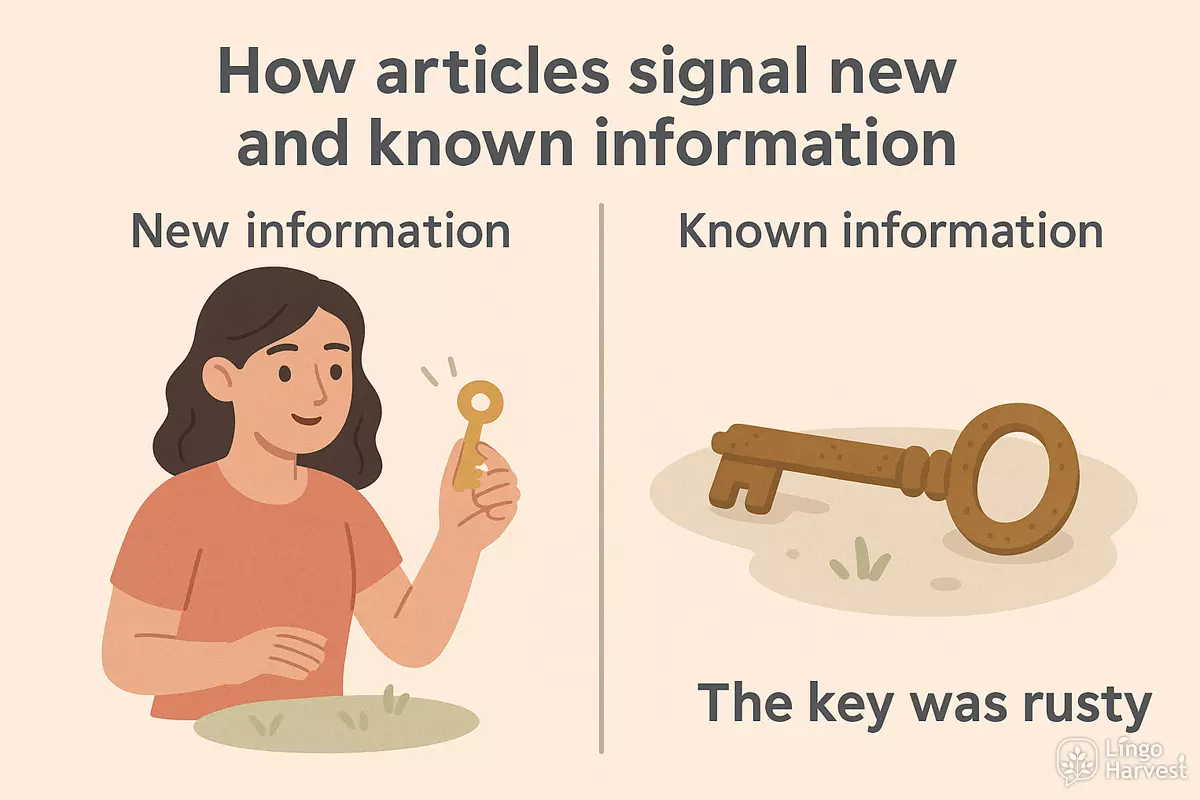
Writers rely on articles to guide the reader’s attention. Using “a” or “an” tells us that the item hasn’t been mentioned before. Switching to “the” shows we’re talking about something already introduced. This pattern is crucial for clarity and natural flow in storytelling.
- A dog barked loudly. The dog ran away.
- She found a key on the ground. The key was rusty.
- He opened a window. The window creaked.
- They saw a boat in the distance. The boat was empty.
- Maria picked up a book. The book was thick.
- We spotted a bird in the tree. The bird sang sweetly.
- He bought a pen. The pen didn’t work.
- She opened a box. The box was full of letters.
- I met a man at the market. The man smiled.
- They entered a room. The room was cold.
- Tom saw a car parked outside. The car was red.
- We found a coin on the street. The coin was old.
- She received a letter. The letter made her happy.
- He noticed a shadow in the corner. The shadow moved.
- They heard a noise downstairs. The noise stopped suddenly.
- Anna saw a cat in the garden. The cat was sleeping.
- I bought a cake. The cake was delicious.
- We visited a museum. The museum was closed.
Common mistakes with article sequencing
Writers sometimes confuse these patterns, especially when learning English. Here are frequent errors and corrections:
- ❌ The woman walked into the shop. The woman looked tired. (No introduction)
- ✅ A woman walked into the shop. The woman looked tired. (Correct)
- ❌ I saw the bird in the park. (First mention, should be “a” unless specific)
- ✅ I saw a bird in the park. (First mention, correct)
Quick reference for article use in stories
| Mention | Typical Article |
|---|---|
| First time something appears | Use “a” or “an” (e.g. a cat, an apple) |
| Second and later mentions | Use “the” (e.g. the cat, the apple) |
| Already known or unique things | Use “the” even at first mention (e.g. the sun, the president) |
| General or indefinite references | Use “a”/“an” or no article (e.g. Cats are friendly.) |
Mastering this progression helps make stories smoother and easier to follow. Proper article use is one of the subtle details that separates clear writing from confusing prose.
Zero article in storytelling
Writers often leave out the articles "a," "an," and "the" when describing general concepts, places, or people in stories. This technique helps create a sense of universality or immediacy, particularly in short stories where every word counts. Omitting articles can also make narration feel more direct, especially in dialogue or when expressing thoughts and impressions.
When do we skip the article?
In English, there are specific cases where no article is needed. In storytelling, these patterns are especially common:
- Talking about things in general: Children love stories. (Not The children)
- Describing professions or roles: She became doctor. (Not a doctor)
- Using meals, days, or places in a general sense: We met after lunch. He goes to school every day.
- With most proper nouns: London is rainy in winter.
Common zero article patterns in stories
Writers frequently omit articles in these storytelling situations:
- Abstract nouns: Hope was all he had left.
- Plural countable nouns when speaking generally: Birds sang outside.
- Uncountable nouns: Music filled the room.
- Languages and subjects: He spoke French. She studied history.
- Names of most countries, cities, streets: Canada, Main Street.
- Days, months, holidays: Monday arrived too soon. They met on Christmas.
- Meals: She skipped breakfast.
- Sports and games: He plays chess. They watched football.
- Transport by means: She went by train.
- Institutions (when used for their primary purpose): He is at university. She’s in hospital.
- Most seasons (when talking generally): Winter is cold here.
- With certain expressions of place: at home, in prison, to bed.
- With titles and names: President Lincoln, Doctor Smith.
- With times of day (sometimes): Midnight struck.
Spot the difference: article or no article?
| With article | No article |
|---|---|
| He listened to the music she played. ✅ | Music filled the air. ✅ |
| She became a teacher after college. ✅ | She dreamed of being teacher. ❌ (should be "a teacher" unless very poetic or stylized) |
| He reads the newspaper every morning. ✅ | He reads newspapers every morning. ✅ |
| He went to the hospital to visit his friend. ✅ | He is in hospital after the accident. ✅ |
| She walked in the park. ✅ | Nature calms the mind. ✅ |
Remember: omitting articles can make your writing more vivid, but misuse can confuse the reader or sound unnatural. Pay attention to which nouns are truly general or abstract, and practice spotting zero article patterns in published stories. This awareness will help you avoid common mistakes when crafting your own narratives.
Common article errors
Writers often stumble over the correct use of "a," "an," and "the" in short stories. These missteps can make sentences confusing or grammatically incorrect. In creative writing, incorrect articles may distract readers or alter the meaning of a scene.
Frequent mistakes made with articles
Misuse of articles usually falls into a few patterns. Here are some of the most typical slips:
- Leaving out an article when one is needed (e.g., "He found cat" instead of "He found a cat").
- Using "the" with nouns that are not specific or previously mentioned ("The apple fell from tree" instead of "An apple fell from a tree").
- Adding an article before uncountable nouns where none is required ("She gave the advice" instead of "She gave advice").
- Choosing "a" instead of "an" before a vowel sound ("a apple" instead of "an apple").
- Applying "the" to names or proper nouns unnecessarily ("The London is rainy" instead of "London is rainy").
- Using "a" or "an" with plural nouns ("an apples" instead of "apples").
- Omitting "the" when referring to something unique or previously specified ("Sun rose" instead of "The sun rose").
- Repeating articles unnecessarily ("the the dog ran fast").
- Incorrectly switching between definite and indefinite articles within a paragraph.
- Placing articles after adjectives incorrectly ("beautiful a day" instead of "a beautiful day").
- Using articles with abstract concepts when not needed ("the happiness is important" instead of "happiness is important").
- Forgetting to use "the" with superlatives ("She was best player" instead of "She was the best player").
- Using "the" with meals ("He ate the breakfast" instead of "He ate breakfast").
- Adding articles to languages or subjects ("the English is hard" instead of "English is hard").
Comparison of article usage in context
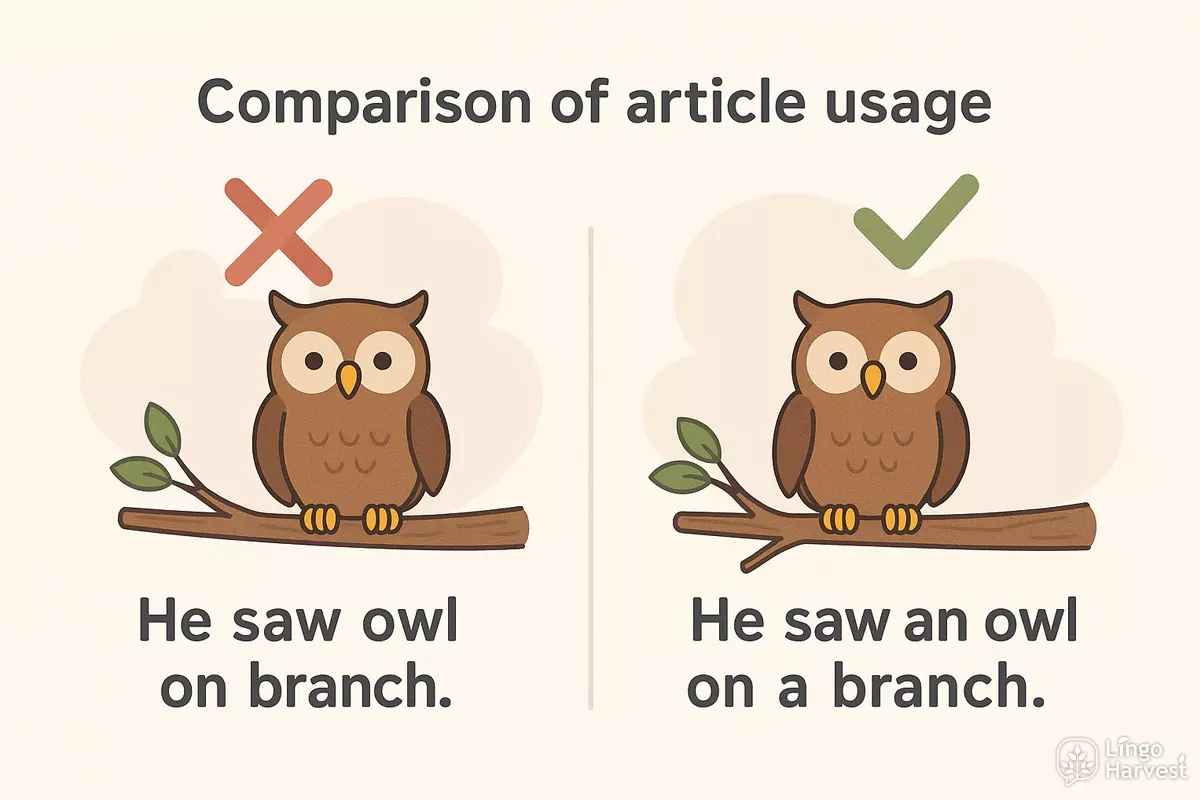
Writers can benefit from seeing how articles change meaning or clarify intent. The table below highlights different patterns in short story sentences.
| Incorrect Usage | Corrected Sentence |
|---|---|
| He saw owl on branch. | He saw an owl on a branch. |
| The children played in park. | The children played in the park. |
| She found the happiness in simple things. | She found happiness in simple things. |
| It was a unusual day. | It was an unusual day. |
| He is a best friend. | He is the best friend. |
| The John arrived late. | John arrived late. |
| She drank a water quickly. | She drank water quickly. |
| The sun set behind mountain. | The sun set behind the mountain. |
Why article accuracy matters in storytelling
Accurate use of articles helps readers visualize scenes and understand which objects or people are important. Misplaced or missing articles can subtly change the focus or meaning, leading to confusion or a loss of narrative flow. By recognizing and correcting these errors, writers ensure their short stories are clear and engaging.
Correcting sample sentences
Spotting errors with articles in short stories often means looking closely at how "a," "an," and "the" are used. Many learners struggle with when to include an article, when to leave it out, or which form to pick. By reviewing sample sentences, you can see patterns and typical mistakes. Below, you'll find common errors and their improved versions, along with explanations to help you understand why the corrections are necessary.
Frequent mistakes and their corrections
- ❌ She found cat in garden. → ✅ She found a cat in the garden.
Use "a" for the first mention, and "the" for a specific garden. - ❌ He picked up an apple from table. → ✅ He picked up an apple from the table.
- ❌ There was owl outside window. → ✅ There was an owl outside the window.
- ❌ She wanted to be astronaut. → ✅ She wanted to be an astronaut.
- ❌ They walked along river until sunset. → ✅ They walked along the river until sunset.
- ❌ Dog barked loudly at night. → ✅ The dog barked loudly at night.
- ❌ He saw old man in park. → ✅ He saw an old man in the park.
- ❌ I heard noise coming from attic. → ✅ I heard a noise coming from the attic.
- ❌ She has umbrella in her bag. → ✅ She has an umbrella in her bag.
- ❌ He is best player on team. → ✅ He is the best player on the team.
- ❌ It was beautiful day in city. → ✅ It was a beautiful day in the city.
- ❌ We visited museum yesterday. → ✅ We visited the museum yesterday.
- ❌ She became doctor after many years. → ✅ She became a doctor after many years.
- ❌ There is mouse under sofa. → ✅ There is a mouse under the sofa.
- ❌ He opened window and looked out. → ✅ He opened the window and looked out.
Explanation of patterns
The most common issues involve omitting articles before singular, countable nouns, or forgetting "the" when referring to something specific. In short stories, articles help clarify whether something is new to the reader (use "a" or "an") or already known (use "the"). Generic references often take no article at all.
Summary Table: Common Article Corrections
| Incorrect | Correct |
|---|---|
| She saw bird on branch. | She saw a bird on the branch. |
| He entered house quietly. | He entered the house quietly. |
| They waited for bus in rain. | They waited for the bus in the rain. |
| She has idea for story. | She has an idea for a story. |
| We found key under mat. | We found the key under the mat. |
By practicing these corrections, writers can improve clarity and accuracy in their storytelling. Always check if the noun is countable, specific, or mentioned for the first time to choose the right article.
Mini story practice
Let’s put your understanding of article usage in short stories to the test. Below, you’ll find a short narrative riddled with intentional mistakes in article usage. Read carefully, try to spot incorrect or missing definite and indefinite articles, and consider how these changes affect the clarity and detail of the story.
Read and correct the story
Review the following mini story. There are several errors with the, a, and an. Mark or note where you would make corrections.
Once upon time, young girl named Mia lived in small village. Every morning, she walked to river with basket. One day, she saw old man sitting on bench. He asked her for apple, but she only had orange. Mia gave him fruit and smiled. Suddenly, wind picked up and blew hat off her head. Old man laughed and returned her hat. From that day, Mia and old man became friends in village.
Spot the mistakes: Quick check
- How many article mistakes can you find in the story above?
- Which nouns are missing the, a, or an?
- Rewrite at least two sentences, correcting the article errors.
Show answers
- There are 10 mistakes in article usage.
- Missing or incorrect articles:
- Once upon a time
- A young girl
- Lived in a small village
- Walked to the river
- With a basket
- Saw an old man
- Sitting on a bench
- Asked her for an apple
- Gave him the fruit
- Blew the hat off her head
- Returned her hat (correct, no article needed)
- From that day, Mia and the old man became friends in the village
- Example corrected sentences:
- Once upon a time, a young girl named Mia lived in a small village.
- Every morning, she walked to the river with a basket.
Common article mistakes in stories
- Omitting a/an before singular countable nouns (e.g., a village, an old man)
- Leaving out the before unique or previously mentioned nouns (e.g., the river, the hat)
- Using articles with proper names (e.g., Mia does not need an article)
- Misplacing the where it’s not needed (e.g., returned her hat is correct, not the her hat)
- Forgetting to use an before vowels (e.g., an apple, an old man)
- Skipping articles before jobs or roles (e.g., a teacher, not just teacher)
- Using the for general statements when not needed (e.g., apples are healthy vs. the apples are healthy)
- Confusing countable and uncountable nouns (e.g., a water is incorrect, some water is correct)
- Using the with plural or uncountable nouns for general ideas (e.g., the children like music vs. children like music)
- Omitting the with superlatives (e.g., the best day, not best day)
Article usage: Example corrections
Here’s a quick reference of correct and incorrect article use from the story:
| Incorrect | Correct |
|---|---|
| Once upon time | Once upon a time |
| young girl named Mia | A young girl named Mia |
| lived in small village | lived in a small village |
| walked to river | walked to the river |
| with basket | with a basket |
| saw old man | saw an old man |
| sitting on bench | sitting on a bench |
| asked her for apple | asked her for an apple |
| gave him fruit | gave him the fruit |
| blew hat off her head | blew the hat off her head |
Practicing with mini narratives helps recognize where definite and indefinite articles belong in context. Review your corrections and practice rewriting short tales to sharpen your skills.