Proper vs Common Nouns: What's the Difference?

 This beginner-friendly guide explains the difference between proper and common nouns. With clear examples and simple rules, you’ll learn how to use them correctly in everyday English.
What Are Nouns?
Nouns are words that name people, places, things, or ideas. They help us identify what or who we are talking about in a sentence. Without nouns, we wouldn’t be able to communicate clearly.
Examples of Nouns
- People: teacher, doctor, friend
- Places: school, park, city
- Things: book, phone, chair
- Ideas: love, happiness, knowledge
To see how nouns work, look at simple sentences:
- The teacher is speaking.
- We went to the park.
- She has a new phone.
- Love is important.
In each sentence, the nouns show who or what the sentence is about.
Now that we understand what nouns are, let’s compare two main categories: Common Nouns and Proper Nouns.
What Are Common Nouns?
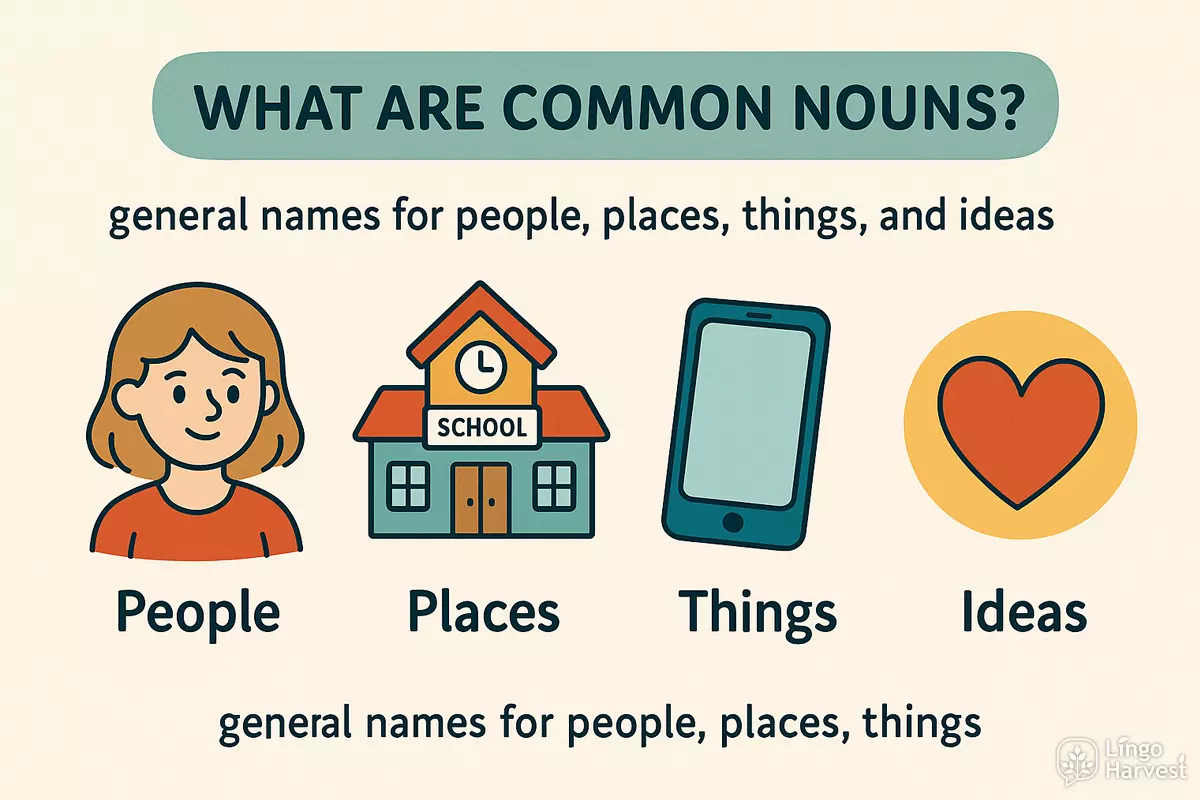
Common nouns are general names for people, places, things, or ideas. They do not refer to something specific. Because of this, they do not start with a capital letter unless they are at the beginning of a sentence.
Examples
- People: girl, doctor, student
- Places: city, restaurant, school
- Things: table, car, book
- Ideas: peace, music, love
In Sentences
- The doctor is busy today.
- We walked through the city.
- She bought a new car.
- Music makes me happy.
All of these nouns are common nouns because they name things in a general way — not a specific person, place, or object.
What Are Proper Nouns?
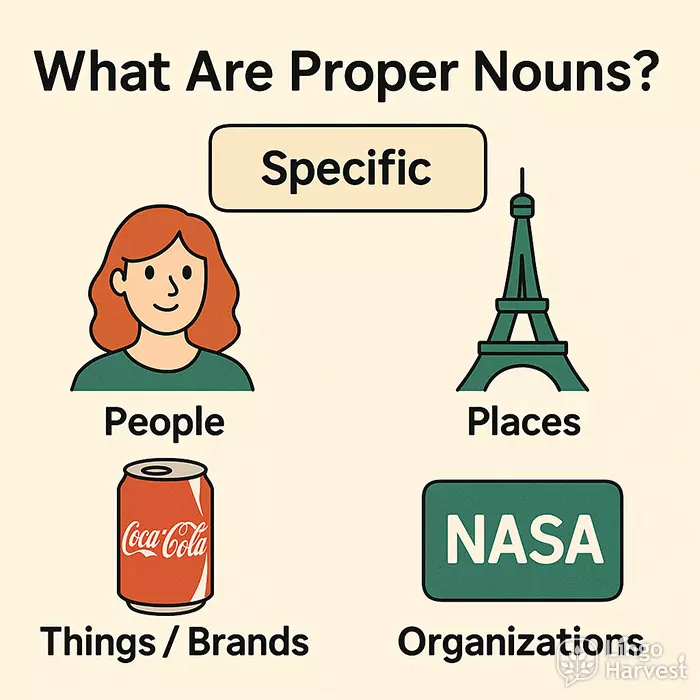
Proper nouns are the specific names of people, places, things, or organizations. Unlike common nouns, proper nouns always begin with a capital letter, no matter where they appear in a sentence.
Examples
- People: Emma, Dr. Brown, Michael Jordan
- Places: Paris, London, Central Park
- Things / Brands: Coca-Cola, iPhone, LEGO
- Organizations: Google, Harvard University, NASA
In Sentences
- Emma is learning English.
- We visited Paris last summer.
- She bought an iPhone yesterday.
- NASA launched a new satellite.
Each of these nouns refers to one exact person, place, or thing. That’s what makes it a proper noun.
Key Differences
Now that we know what common and proper nouns are, let’s look at how to tell them apart quickly. The main difference is specific vs. general and capital letter vs. no capital letter.
| Type of Noun | Meaning | Capitalization | Examples |
|---|---|---|---|
| Common Noun | General name for a person, place, or thing | Not capitalized (unless at the beginning of a sentence) | city, woman, school, phone |
| Proper Noun | Specific name of a person, place, or thing | Always capitalized | New York, Anna, Harvard, Samsung |
Fast Rule to Remember
- If the name is specific → capitalize it.
- If the name is general → do not capitalize it (unless it’s first in the sentence).
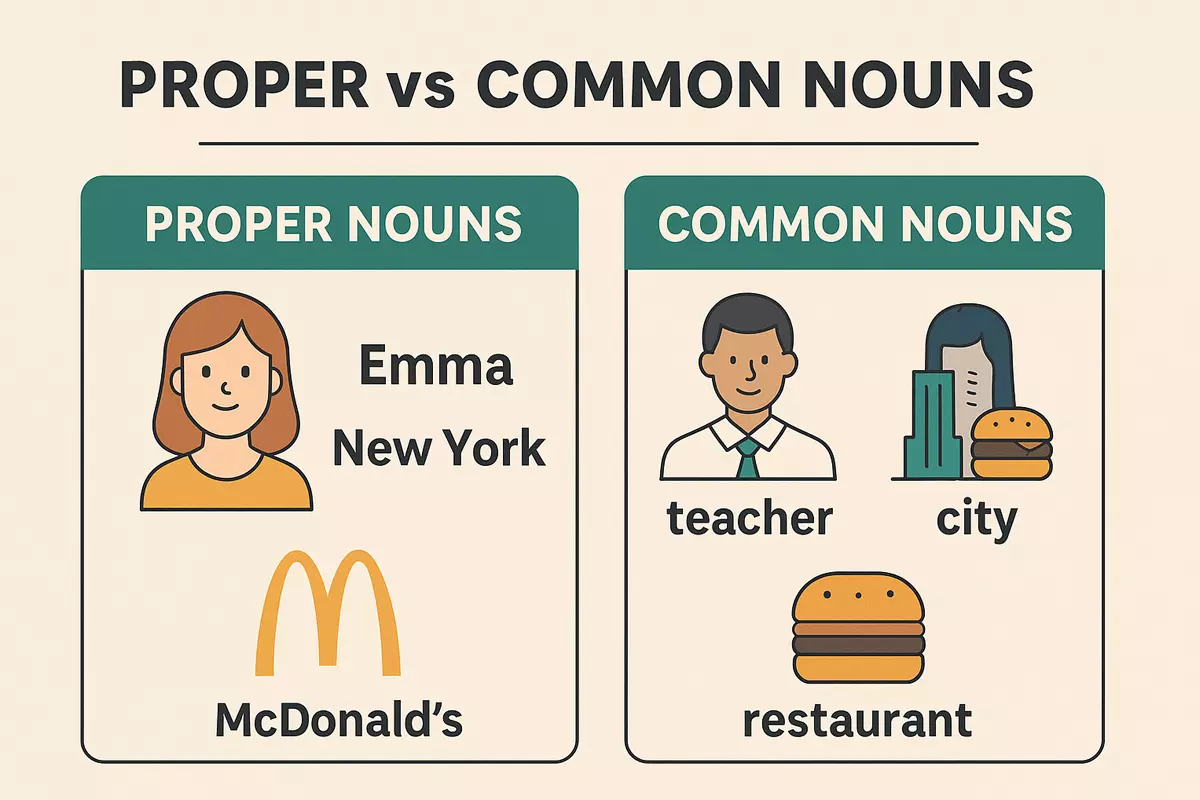
Examples Side-by-Side
- city → London
- teacher → Mr. Wilson
- phone → iPhone
- restaurant → McDonald's
Same idea, two levels of naming: general vs. specific.
Capitalization Rules

The most important difference between common and proper nouns is capitalization. Proper nouns always start with a capital letter, while common nouns do not — unless they appear at the beginning of a sentence.
When to Capitalize
- Always capitalize names of people
Emma, Dr. Smith, Michael - Always capitalize names of places
New York, Asia, Central Park - Always capitalize names of specific things and brands
Disney, Sony, Google - Always capitalize days, months, holidays
Monday, July, Christmas - Do not capitalize seasons (unless they start a sentence)
summer, winter, spring
Correct vs Incorrect
| Incorrect | Correct |
|---|---|
| i live in london. | I live in London. |
| my teacher is mr. brown. | My teacher is Mr. Brown. |
| she works at google. | She works at Google. |
| we traveled to asia in july. | We traveled to Asia in July. |
Quick Memory Tip
Think of proper nouns as unique names.
If it refers to one specific person, one exact place, or one unique thing — capitalize it.
Examples in Sentences
Let’s compare common and proper nouns side-by-side in real sentences. Notice how the common noun is general, while the proper noun names something specific and is capitalized.
Side-by-Side Examples
- The city is busy. → New York is busy.
- My teacher is kind. → Ms. Johnson is kind.
- I bought a phone. → I bought an iPhone.
- We visited a park. → We visited Central Park.
More Examples in Full Sentences
- The restaurant opens early. → Olive Garden opens early.
- The movie was exciting. → Avatar was exciting.
- The boy is playing soccer. → Liam is playing soccer.
- The mountain is tall. → Mount Everest is tall.
In each pair, the first noun is general (common noun), and the second is the specific name (proper noun).
This shows how proper nouns help us be exact and clear when we communicate.
Common Mistakes to Avoid
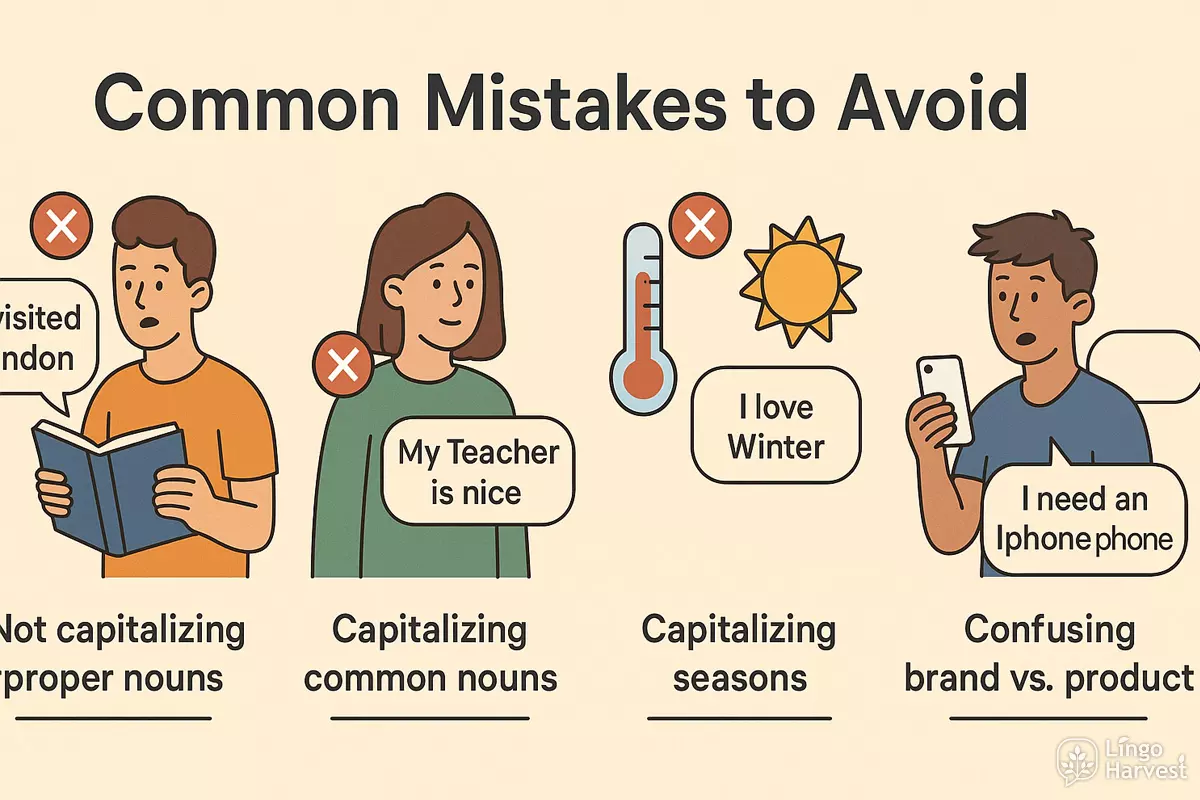
Beginners often confuse common and proper nouns because both can refer to similar things. The key is remembering specific vs. general and capital letter vs. no capital letter.
1) Not Capitalizing Proper Nouns
Incorrect: i visited london last year.
Correct: I visited London last year.
2) Capitalizing Common Nouns Without Reason
Incorrect: My Teacher is nice.
Correct: My teacher is nice.
3) Confusing Brand Names with Product Names
Brand name is proper → capitalized.
Product itself is common → not capitalized.
- He bought an iPhone. (proper noun: brand/model)
- He needs a new phone. (common noun)
4) Capitalizing Seasons
Seasons are NOT proper nouns.
Incorrect: I love Summer.
Correct: I love summer.
Quick Reference
| Mistake | Incorrect | Correct |
|---|---|---|
| Not capitalizing a proper noun | paris | Paris |
| Capitalizing a common noun | My Dog is cute. | My dog is cute. |
| Confusing brand vs item | I need an Iphone phone. | I need an iPhone. |
| Capitalizing seasons | Winter is Cold. | winter is cold. |
Short Practice + Answers
Test your understanding. Decide whether each noun is common or proper, and capitalize correctly where needed.
Part A — Common or Proper?
- teacher →
- microsoft →
- city →
- tokyo →
- restaurant →
Show answers
- teacher → common noun
- Microsoft → proper noun (capitalize)
- city → common noun
- Tokyo → proper noun (capitalize)
- restaurant → common noun
Part B — Fix the Sentence
Correct capitalization:
- we visited paris in july.
- my teacher is mr. wilson.
- the movie avatar was amazing.
Show answers
- We visited Paris in July.
- My teacher is Mr. Wilson.
- The movie Avatar was amazing.
Part C — Choose the Correct Form
- (city / New York) is very big.
- My (friend / Olivia) lives in London.
- We visited the (museum / Louvre).
Show answers
- New York is very big.
- My friend Olivia lives in London.
- We visited the Louvre.
Great work! You now understand the difference between common and proper nouns — and how to use capitalization correctly.