Common Countable and Uncountable Nouns Explained with Pictures

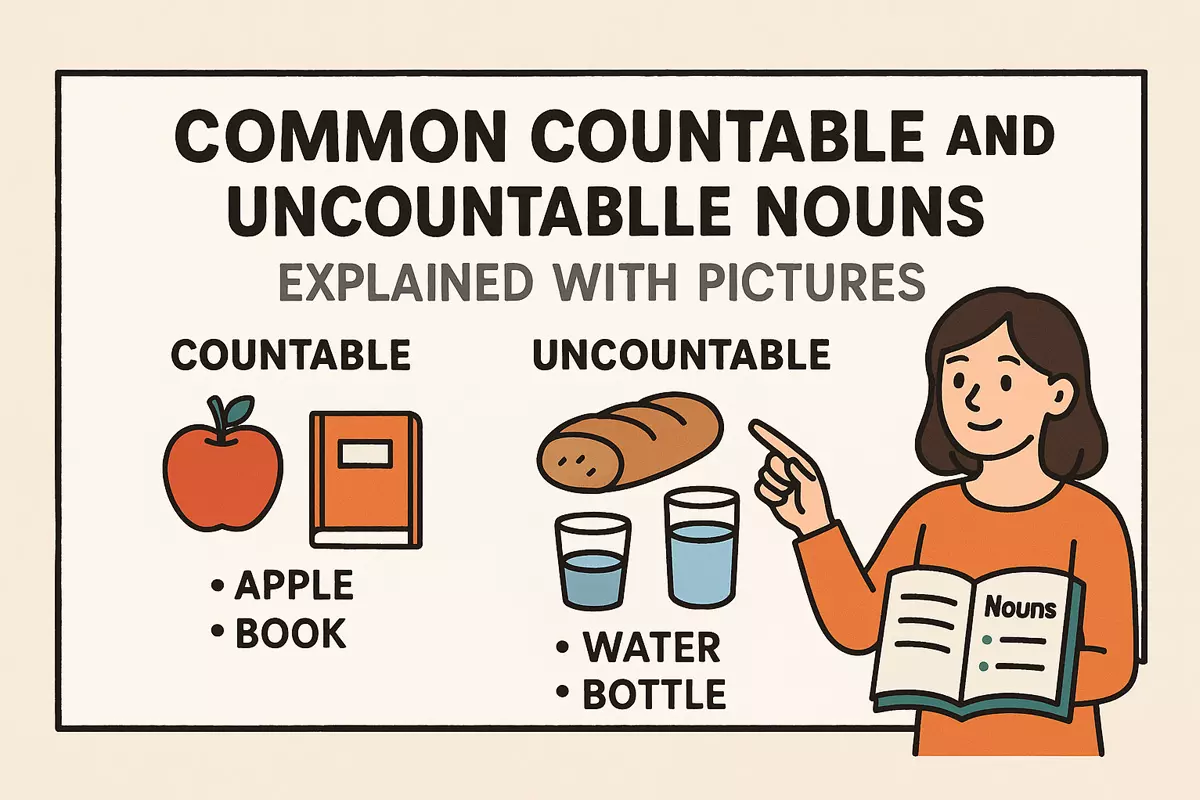 This beginner-friendly guide explains the difference between countable and uncountable nouns in simple words. With pictures and clear examples, you will learn how to use them correctly in everyday English.
- What Are Countable and Uncountable Nouns?
- Key Difference: Can We Count It?
- Common Countable Nouns
- Common Uncountable Nouns
- Articles with Countable and Uncountable Nouns
- Quantifiers: Many / Much / A Few / A Little
- Countable vs. Uncountable Food Words
- Words That Can Be Both
- Common Mistakes to Avoid
- Short Practice + Answers
What Are Countable and Uncountable Nouns?
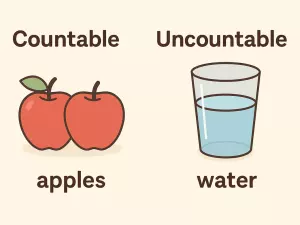
Countable nouns are things we can count as separate units (one, two, three). They have singular and plural forms.
Uncountable nouns are substances, ideas, or categories we do not count as separate items. They usually have no plural and take singular verbs.
Countable Nouns (quick view)
- Can use a / an: a book, an apple
- Have plural forms: books, apples
- Work with numbers and many / a few
- Everyday examples: chair, idea, bottle, child, photo
Uncountable Nouns (quick view)
- No a/an (use some): some water, some rice
- No plural (✖ waters, rices)
- Use much / a little and amount words (a glass of water, a bag of rice)
- Common groups: food substances (sugar, milk), materials (wood), abstracts (information, advice), fields (music, history)
| Feature | Countable | Uncountable |
|---|---|---|
| Plural form | Yes: tables | No: furniture ✖ furnitures |
| Articles | a/an: a photo | No a/an; use some: some water |
| Quantifiers | many, a few, several | much, a little |
| With numbers | Yes: two cars | No: ✔ two bottles of water (measure word) |
Spot the Difference Fast
Ask: “Can I count it one by one?” → If yes, it’s countable. If not, it’s uncountable. For uncountables, add a container/measure word to count: a piece of advice, a slice of bread, a cup of coffee.
Mini Examples
- Countable: a ticket, two tickets, many tickets
- Uncountable: coffee → a cup of coffee, some coffee, much coffee
- Abstract: information (uncountable) → ✔ some information, ✖ an information
Key Difference: Can We Count It?
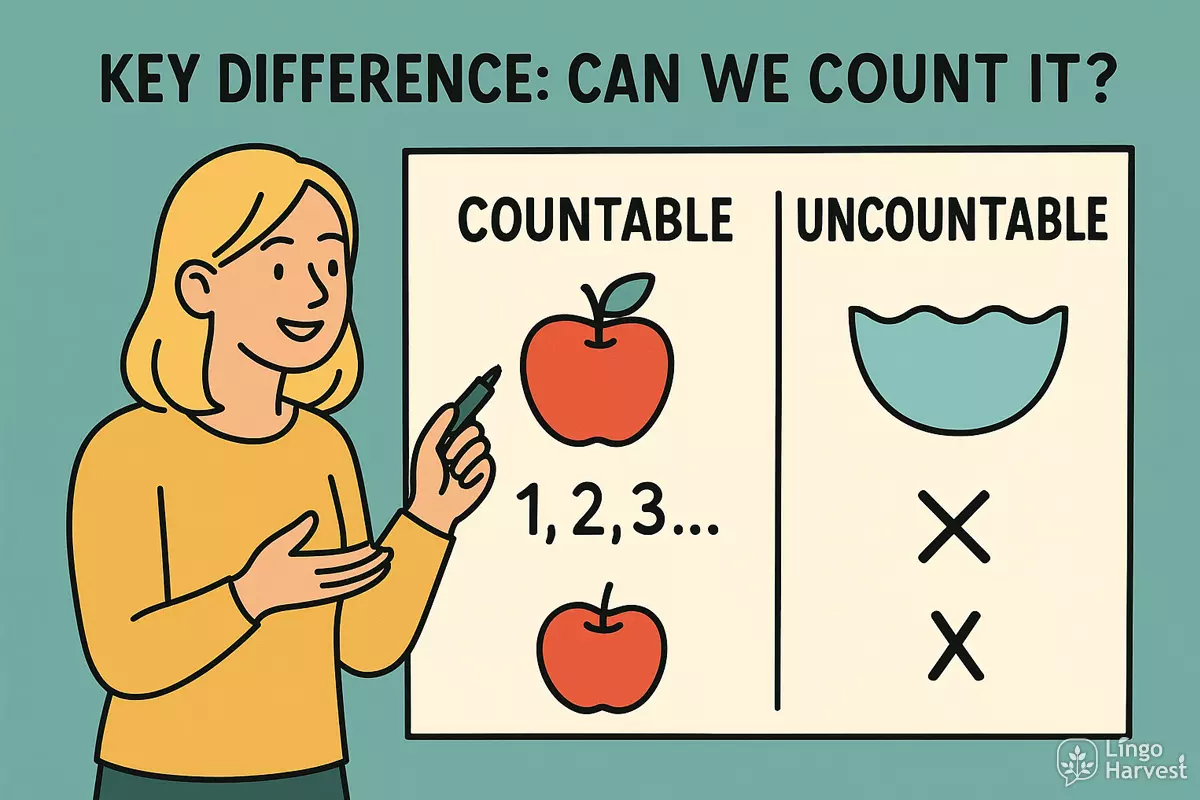
The easiest way to understand the difference between countable and uncountable nouns is to ask one clear question:
Can we count it as separate items?
If YES → Countable Noun
We can count these nouns one by one.
- 1 apple, 2 apples, 3 apples
- 1 chair, 4 chairs
- 1 idea, many ideas
They work with:
a / an, many, a few, numbers (1, 2, 3…)
If NO → Uncountable Noun
We cannot count these nouns as individual pieces because they are:
- materials (water, wood, rice)
- masses/substances (milk, flour, coffee)
- abstract concepts (love, knowledge, advice)
They work with:
some, much, a little, or containers / units to measure them.
Quick Visual Logic
| Question | Countable? | Uncountable? |
|---|---|---|
| Can we say “one / two / three”? | Yes → two pencils | No → some rice |
| Does it have a plural? | Yes → books | No → ✖ informations |
| Which article works? | a / an | No a/an → use some |
| How to measure? | By counting | By unit: a bag of rice, a cup of tea |
Fast Memory Trick
If you can count it → countable.
If you need a container to count it → uncountable.
Mini Examples
- bread (uncountable) → a slice of bread
- coffee (uncountable) → a cup of coffee
- sand (uncountable) → a handful of sand
- apple (countable) → one apple, two apples
Common Countable Nouns
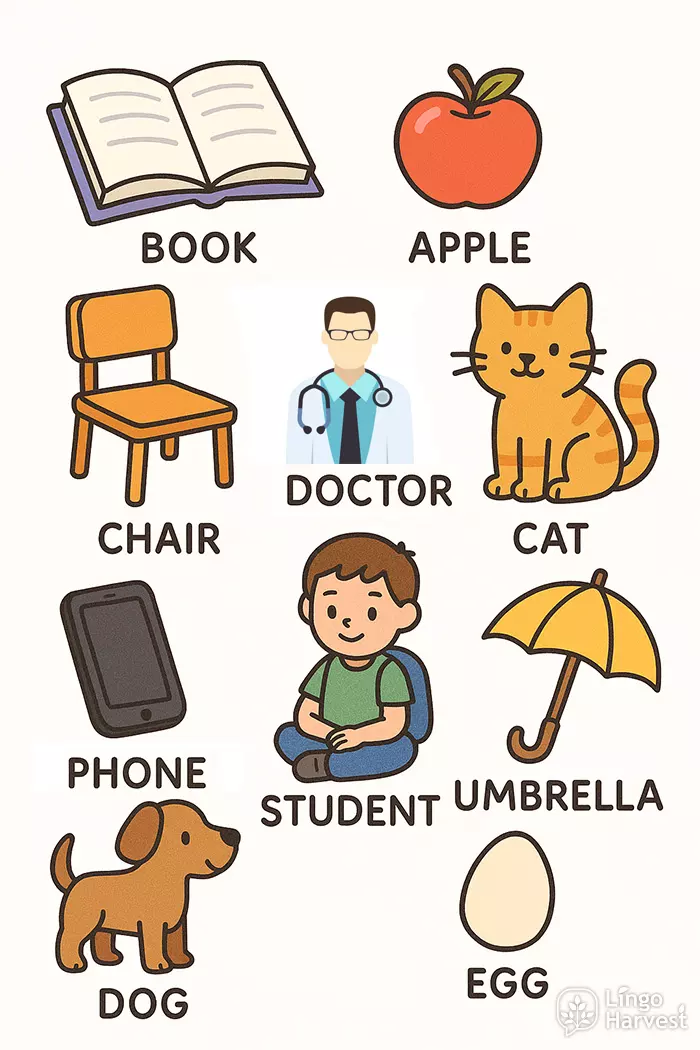
Countable nouns are the nouns that we can count one by one. They have both singular and plural forms and can use the articles a and an.
How to Recognize Countable Nouns
- You can use a / an: a book, an apple
- You can make them plural: books, apples
- You can use numbers: one book, two books, three books
- You can use many, a few, several with them.
Everyday Examples
- Objects: book, phone, chair, umbrella, bottle
- People: student, doctor, friend, neighbor, child
- Animals: cat, dog, horse, bird, fish
- Food items: apple, egg, cookie, sandwich, tomato
| Singular | Plural | Example Sentence |
|---|---|---|
| a book | books | I have two books in my bag. |
| a chair | chairs | We need four chairs for the table. |
| a friend | friends | She has many friends at school. |
| an apple | apples | He bought three apples at the market. |
Mini Practice
Make these nouns plural:
- cat →
- student →
- apple →
- chair →
Show answers
- cats
- students
- apples
- chairs
Common Uncountable Nouns
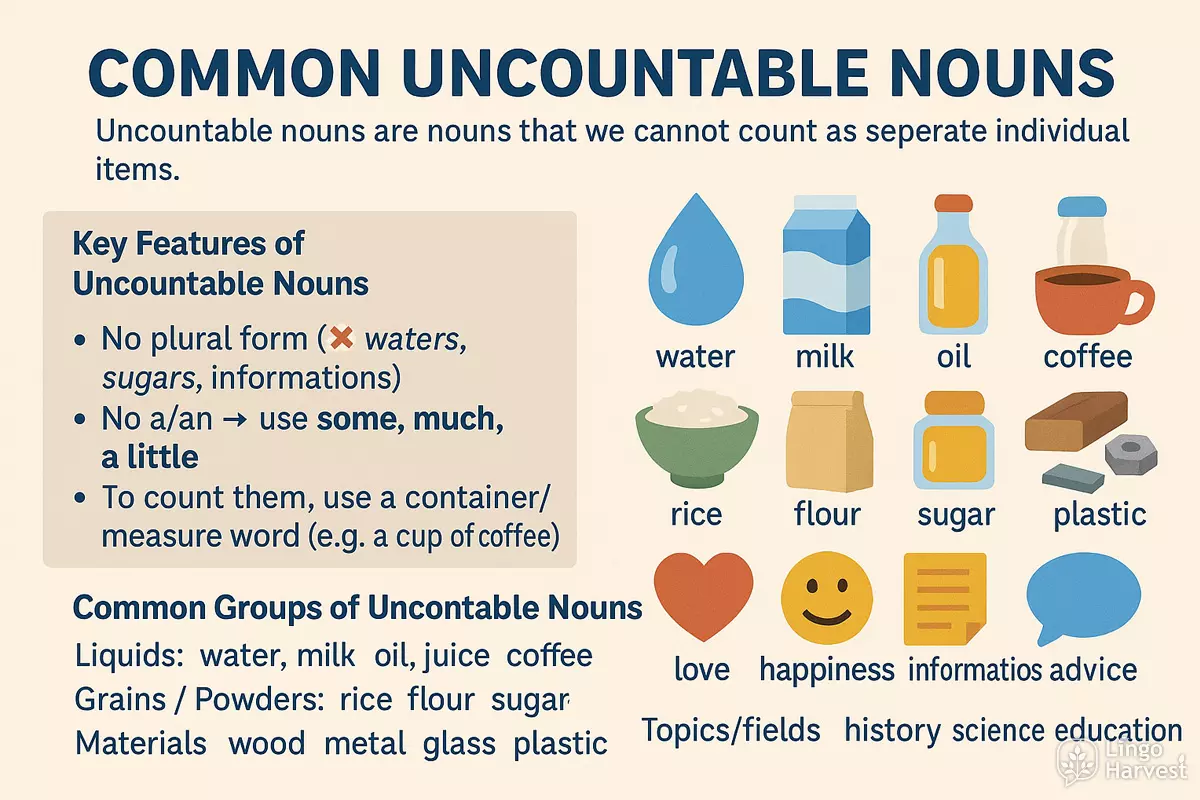
Uncountable nouns are nouns that we cannot count as separate individual items. They usually refer to substances, materials, food in bulk, or abstract ideas. These nouns do not have plural forms and do not use a/an.
Key Features of Uncountable Nouns
- No plural form (✖ waters, sugars, informations)
- No a/an → use some, much, a little
- To count them, use a container/measure word (e.g., a cup of coffee)
Common Groups of Uncountable Nouns
- Liquids: water, milk, oil, juice, coffee
- Grains / Powders: rice, flour, sugar, salt
- Materials: wood, metal, glass, plastic
- Abstract ideas: love, happiness, information, advice
- Topics/fields: music, history, science, education
| Uncountable Noun | Can we say plural? | Correct Usage |
|---|---|---|
| water | ✖ waters | some water / a glass of water |
| sugar | ✖ sugars | some sugar / a spoon of sugar |
| information | ✖ informations | some information / a piece of information |
| advice | ✖ advices | some advice / a piece of advice |
How to Count Uncountable Nouns
Instead of plural forms, we use measure words:
- a cup of coffee
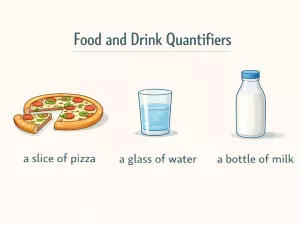
- a bottle of water
- a piece of information
- a loaf of bread
- a bag of rice
Mini Practice
Choose the correct form:
- I need (some / a) water.
- She gave me (an advice / a piece of advice).
- We learned (many / much) history in school.
Show answers
- I need some water.
- She gave me a piece of advice.
- We learned much history in school.
Articles with Countable and Uncountable Nouns
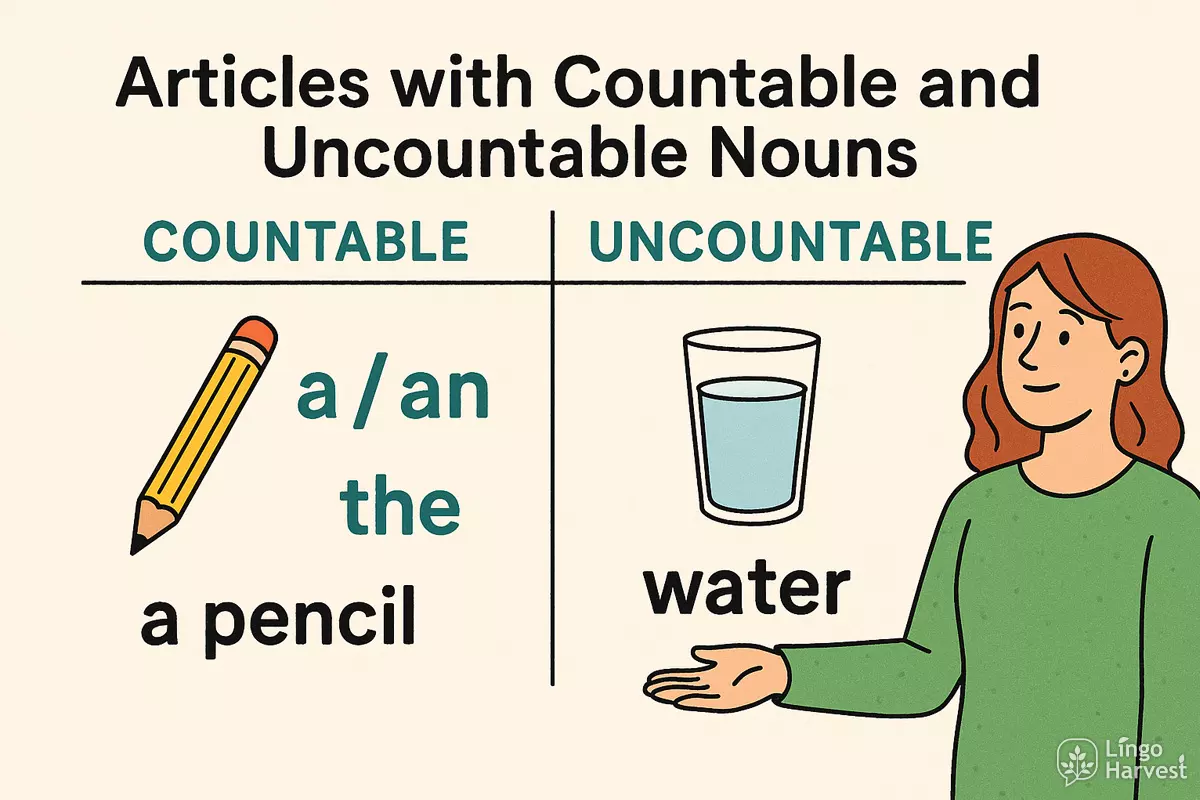
Articles help show which noun we are talking about. Countable and uncountable nouns use different articles in English, so it’s important to choose correctly.
Using a / an
We use a and an only with singular countable nouns.
- a + consonant sound → a book, a chair, a friend
- an + vowel sound → an apple, an egg, an idea
We never use “a/an” with uncountable nouns.
Using the
the works with both countable and uncountable nouns when the listener/reader knows which one you mean.
- the book on the table (specific book)
- Pass me the water. (specific water we both see)
Using some
some can be used with both countable (plural) and uncountable nouns:
- some apples (countable-plural)
- some water (uncountable)
Quick Reference
| Article / Word | Countable | Uncountable |
|---|---|---|
| a / an | ✅ a chair, an apple | ❌ ✖ a water |
| the | ✅ the chair | ✅ the water |
| some | ✅ some chairs | ✅ some water |
Mini Practice
Choose the correct option:
- Can I have (a / some) water?
- She bought (a / an) orange.
- We need (some / a) chairs.
- Where is (the / a) sugar?
Show answers
- some water
- an orange
- some chairs
- the sugar
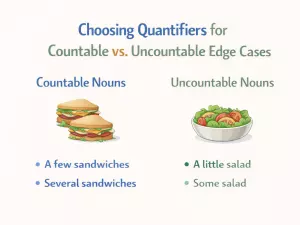
Quantifiers: Many, Much, A Few, A Little
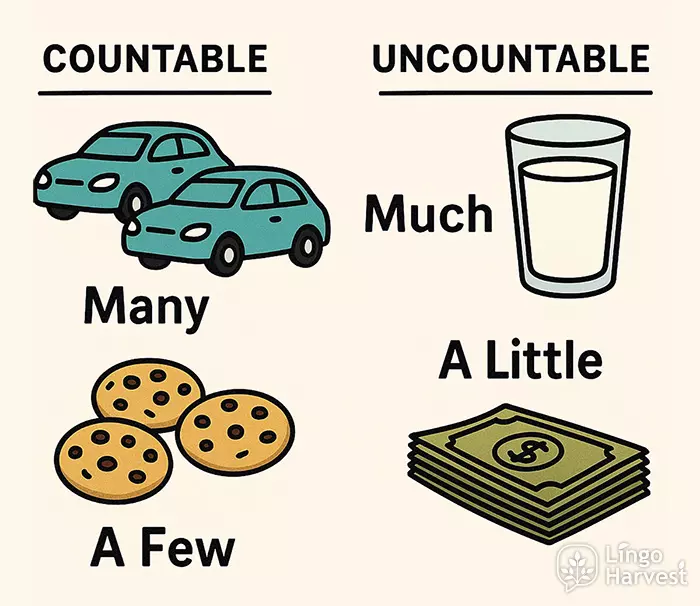
Quantifiers help us talk about the amount of something. The choice depends on whether the noun is countable or uncountable.
For Countable Nouns
- many — a large number of things
Example: We have many books. - a few — a small number (positive tone)
Example: I have a few friends. - few — a small number (negative tone: “not enough”)
Example: She has few opportunities here.
For Uncountable Nouns
- much — a large amount
Example: There isn’t much water left. - a little — a small amount (positive tone)
Example: I need a little sugar. - little — a small amount (negative tone: “not enough”)
Example: We have little time.
| Quantifier | Use With | Example |
|---|---|---|
| many | countable | many cars |
| a few | countable | a few cookies |
| much | uncountable | much milk |
| a little | uncountable | a little money |
| few | countable (negative tone) | few ideas |
| little | uncountable (negative tone) | little hope |
Quick Tip
a few / a little = some (positive)
few / little = almost none (negative)
Mini Practice
Choose the correct option:
- There are (a few / a little) cookies on the plate.
- We have (few / little) time to finish.
- I don’t have (much / many) money.
- She has (many / much) friends.
Show answers
- a few cookies
- little time
- much money
- many friends
Countable vs. Uncountable Food Words
Food vocabulary in English can be confusing because some foods are usually uncountable (they are seen as substances), while others are countable (they are seen as individual items). The same food can even be both, depending on the meaning.
Common Countable Food Words
You can count these one by one:
- apple → apples
- egg → eggs
- cookie → cookies
- carrot → carrots
- tomato → tomatoes
Common Uncountable Food Words
These are usually seen as substances or mass:
- bread
- rice
- pasta
- meat
- cheese
How to Count Uncountable Foods
Use containers or units to count them:
- a slice of bread
- a bowl of rice
- a piece of cheese
- a plate of pasta
- a cup of yogurt
| Food | Countable? | Correct Examples |
|---|---|---|
| apple | Countable | an apple / two apples |
| bread | Uncountable | some bread / a slice of bread |
| rice | Uncountable | some rice / a bowl of rice |
| egg | Countable | an egg / three eggs |
Mini Practice
Choose the correct phrase:
- We need (a loaf of / many) bread.
- She bought (some / a) cheese.
- He ate (two / much) apples.
- I cooked (a bowl of / a few) rice.
Show answers
- a loaf of bread
- some cheese
- two apples
- a bowl of rice
Words That Can Be Both
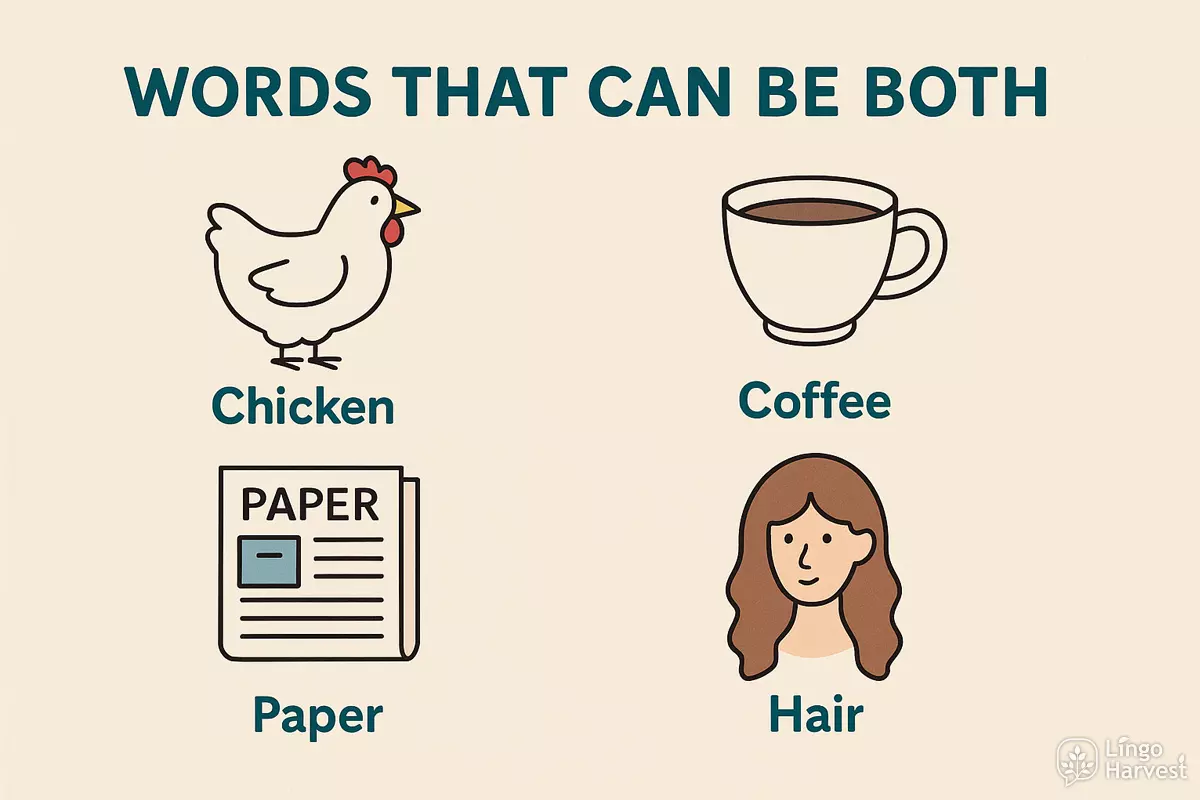
Some nouns can be countable in one meaning and uncountable in another. The difference depends on whether we talk about the item as a separate object or as a general substance/idea.
1) Chicken
- Countable (animal): a chicken, two chickens
- Uncountable (food/meat): chicken (no plural)
Example:
We saw three chickens on the farm. (animals)
We ate chicken for dinner. (food)
2) Coffee
- Countable: a coffee = a cup of coffee
- Uncountable: coffee (the substance)
Example:
I’d like a coffee, please. (one cup)
I love coffee. (in general)
3) Paper
- Countable: a paper = a newspaper / a document
- Uncountable: paper = the material
Example:
I read the paper every morning. (newspaper)
This box is made of paper. (material)
4) Hair
- Countable: a hair = one single strand
- Uncountable: hair = all hair together
Example:
There is a hair on your shirt. (one strand)
She has beautiful hair. (all of it)
| Noun | Countable Meaning | Uncountable Meaning | Example |
|---|---|---|---|
| chicken | animal | meat | We cooked chicken for lunch. |
| coffee | a cup of coffee | the drink in general | She ordered a coffee. |
| paper | document / newspaper | material | I need some paper to write. |
| hair | a single strand | all hair together | Her hair is long. |
Mini Practice
Decide if the noun is countable or uncountable in each sentence:
- I’d like a coffee. →
- He has curly hair. →
- We saw five chickens. →
- I need some paper to draw on. →
Show answers
- a coffee → countable (cup)
- hair → uncountable (all hair)
- chickens → countable (animals)
- paper → uncountable (material)
Common Mistakes to Avoid
Beginners often confuse countable and uncountable nouns because some nouns look similar or feel “countable” in meaning. Here are the most frequent errors — and how to fix them.
1) Using a / an with uncountable nouns
Incorrect: I need a water.
Correct: I need some water / a bottle of water.
2) Adding plural endings to uncountable nouns
Incorrect: informations, advices, furnitures
Correct: information, advice, furniture
If you need to count these, use a measure word:
- a piece of information
- a piece of advice
- a piece of furniture
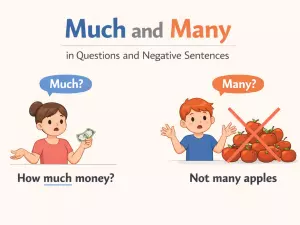
3) Confusing “many” and “much”
- many = countable → many books
- much = uncountable → much rice
4) Forgetting plural for countable nouns
Incorrect: I have two cat.
Correct: I have two cats.
5) Repeating nouns instead of using pronouns
Incorrect: The teacher is kind. The teacher helps me.
Correct: The teacher is kind. She helps me.
| Mistake Type | Incorrect | Correct |
|---|---|---|
| Uncountable with a | a water | some water / a bottle of water |
| Plural uncountable | advices | a piece of advice |
| Wrong quantifier | much books | many books |
| Missing plural | two cat | two cats |
Mini Practice
Correct the mistakes:
- He gave me an information.
- I ate two bread.
- We have much apples.
- There is a sugar on the table.
Show answers
- He gave me some information / a piece of information.
- I ate two slices of bread.
- We have many apples.
- There is some sugar on the table.
Short Practice + Answers
Now, test your understanding. Identify whether each noun is countable or uncountable, and choose the correct form.
Part A — Countable or Uncountable?
- bread →
- apple →
- rice →
- friend →
- water →
Show answers
- bread → uncountable
- apple → countable
- rice → uncountable
- friend → countable
- water → uncountable
Part B — Choose the Correct Option
- I have (a few / a little) free time.
- There are (many / much) students in the class.
- Please give me (some / a) water.
- She bought (two / much) apples.
- We have (little / a little) sugar left.
Show answers
- a little free time
- many students
- some water
- two apples
- little sugar
Part C — Complete the Sentence
Use a container word (slice, cup, piece, bowl, bottle):
- a ___ of rice
- a ___ of coffee
- a ___ of bread
- a ___ of water
- a ___ of advice
Show answers
- a bowl of rice
- a cup of coffee
- a slice of bread
- a bottle of water
- a piece of advice