Nouns in English for Beginners: Simple Definitions and Easy Examples

 This beginner-friendly guide explains what nouns are and how to use them in everyday English. With clear definitions and simple examples, you’ll start forming sentences more confidently.
What Are Nouns in English?
Nouns are one of the most important parts of speech in English. A noun is a word that names a person, place, thing, animal, or idea. In other words, nouns help us talk about what exists in the world around us. Without nouns, forming even the simplest sentence would be impossible.
For example:
- Maria is a student.
- The book is on the table.
In each sentence, nouns tell us who or what we are talking about.
Nouns Show People, Places, Things, and Ideas
To understand nouns better, let’s look at the main categories:
- People – teacher, doctor, friend, Maria, dad
- Places – school, park, Thailand, kitchen
- Things / Objects – phone, chair, car, apple
- Animals – dog, cat, elephant, parrot
- Ideas / Concepts – love, happiness, time, music
Even abstract words like freedom or confidence are nouns, because they name something we can think about, even if we cannot touch it.
How to Recognize a Noun in a Sentence
There are a few simple ways to identify a noun:
- It can usually answer the question “Who?” or “What?”
Example: What is on the desk? — A laptop.
Example: Who is calling? — Sarah. - A noun can often follow words like a, an, or the.
Example: a cat, an apple, the city. - A noun can be the subject of a sentence (the main doer).
Example: The dog sleeps.
Nouns in Real Sentences
Let’s look at a few simple examples:
| Sentence | Noun(s) | Meaning |
|---|---|---|
| The cat is sleeping. | cat | An animal we are talking about. |
| Anna likes coffee. | Anna, coffee | A person and a thing. |
| The city is beautiful. | city | A place. |
Key Idea
If a word names something — whether you can see it, touch it, visit it, or simply think about it — it is most likely a noun.
Understanding nouns is the first step to building clear and meaningful English sentences. In the next section, we’ll see why nouns play such a big role in English communication.
Why Are Nouns Important in English?
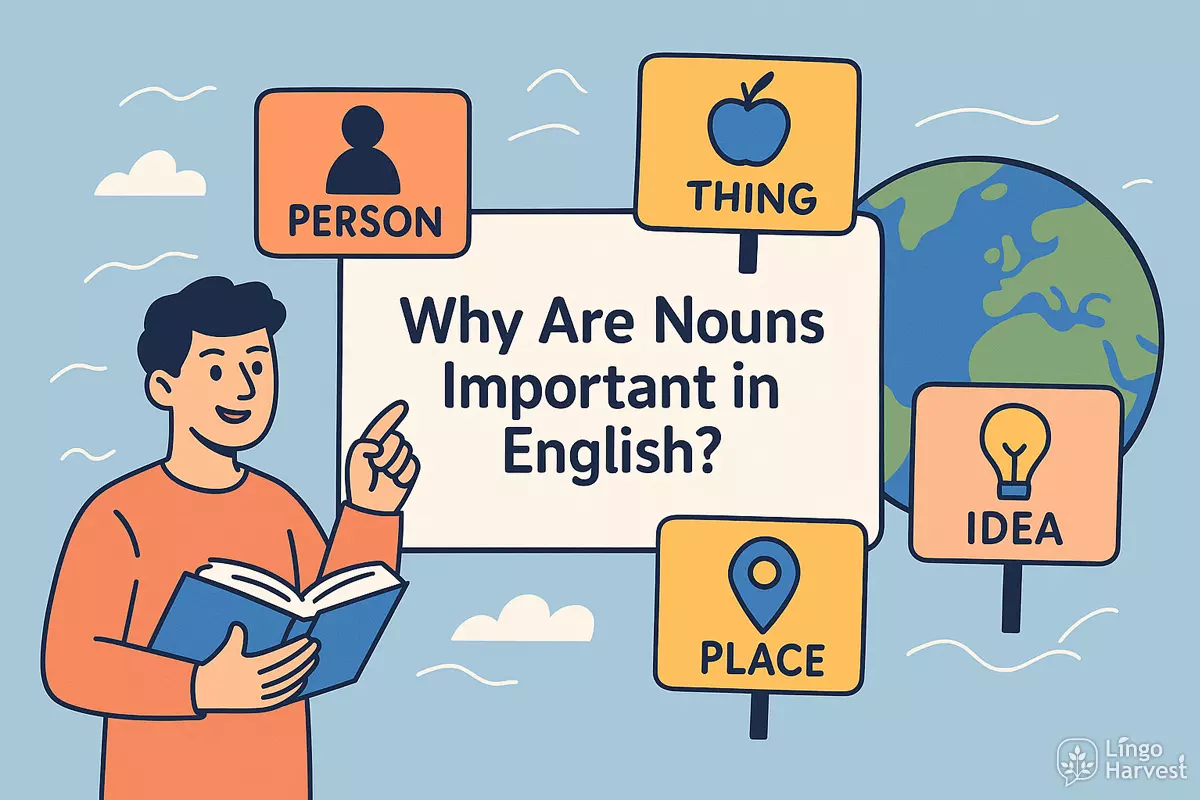
Nouns play a central role in communication because they name the people, places, things, and ideas we talk about. Without nouns, it would be difficult to explain who is doing something or what is being discussed. They give structure and meaning to sentences.
For example:
- Is cooking. (The sentence is incomplete. Who is cooking?)
- The chef is cooking. (Now the meaning is clear.)
Nouns help complete the message and make communication understandable.
Nouns Form the Core of Most Sentences
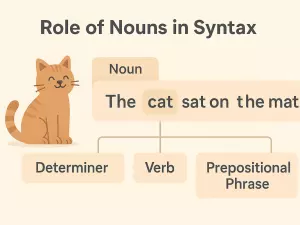
In English, nouns usually appear in two key positions:
- Subject – the one performing the action
The child plays. (child is the subject) - Object – the one receiving the action
She reads a book. (book is the object)
Without nouns, these roles cannot be defined.
Nouns Provide Clarity and Detail
Nouns allow us to give specific information:
- Who is involved? → teacher, friend, doctor
- Where does something happen? → school, home, park
- What are we talking about? → phone, food, music
The more accurate the noun, the clearer the message:
He went somewhere. → He went to the library.
Nouns Are Used in Everyday Communication
We use nouns constantly in daily conversation:
- Introducing ourselves: My name is Daniel.
- Talking about plans: I have a meeting today.
- Expressing emotions: This song gives me joy.
It is almost impossible to speak without nouns.
Key Point
Nouns are important because they:
- Complete sentence meaning
- Show what or who we are talking about
- Help express real and abstract concepts
- Make speech clear and meaningful
Understanding nouns is an essential step toward building strong and confident English communication skills.
Types of Nouns (Common, Proper, Countable, Uncountable)
Nouns are not all the same. They can be grouped into different types based on how they are used in English. Understanding these types helps you choose the right noun when speaking or writing.
Common Nouns vs. Proper Nouns
Common nouns are general names for people, places, or things.
They do not start with a capital letter unless they begin a sentence.
- Examples: city, teacher, fruit, dog
Proper nouns, on the other hand, are the specific names of people, places, or things.
They always start with a capital letter.
- Examples: London, Emma, Coca-Cola, Amazon River
| Sentence | Noun Type | Explanation |
|---|---|---|
| I live in a big city. | Common noun | A general place. |
| I live in New York. | Proper noun | A specific city’s name. |
Countable vs. Uncountable Nouns
Countable nouns are nouns that we can count. They have both singular and plural forms.
- Singular: a book, an apple, one chair
- Plural: two books, three apples, many chairs
Countable nouns often use a, an, many, a few.
Uncountable nouns are nouns that we cannot count as individual units.
They refer to substances, ideas, or categories.
- Examples: water, rice, sugar, information, music
Uncountable nouns do not take a/an and usually do not have plural forms.
We use words like some, much, a little with them.
| Type | Examples | Can we count it? | Articles/Quantifiers |
|---|---|---|---|
| Countable | apple, car, dog, bag | Yes | a, an, many, a few |
| Uncountable | water, milk, money, advice | No | some, much, a little |
Why This Helps
Knowing noun types helps with:
- Correct use of articles (a, an, the)
- Forming plurals
- Choosing the right quantifiers (many vs. much)
For example:
- ✅ I have many books. (books = countable)
- ✅ I have much time. (time = uncountable)
- ❌ I have many time. (incorrect)
Quick Tip to Remember
If you can count it one by one → it’s countable.
If you cannot count it → it’s uncountable.
How to Use Nouns in Sentences
Nouns help us form clear and meaningful sentences. To use nouns correctly, it’s important to understand their position and function in a sentence. Most often, nouns act as subjects or objects, but they can also appear after prepositions or be described by adjectives.
Nouns as Subjects
The subject is the person or thing that performs the action in the sentence.
- The cat sleeps.
- My brother plays football.
- The restaurant opens at 9 AM.
Here, cat, brother, and restaurant are nouns that do the action.
Nouns as Objects
The object receives the action. It answers the question what? or whom?
- She reads a book. (What does she read? → book)
- We visited the museum. (What did we visit? → museum)
- I called my friend. (Whom did I call? → friend)
Nouns After Prepositions
Nouns often come after prepositions such as in, on, at, to, with, about, from.
- in the house
- at the station
- with my family
- about the problem
If a word comes after a preposition and names something → it’s usually a noun.
Using Adjectives to Describe Nouns
Adjectives tell us more information about nouns (what kind, which one, how many).
- a big dog
- three fresh apples
- the old library
The structure is always: Adjective + Noun
Not: library old → ❌
Correct: old library → ✅
Using Articles with Nouns
Most singular countable nouns need a, an, or the:
- a dog (general)
- an apple (general, vowel sound)
- the sun (specific/known)
Examples:
- I see a bird. (any bird)
- I see the bird. (a specific bird we both know about)
Quick Practice (with answers)
Fill in the noun:
- I bought a ___ to read.
- The ___ is barking loudly.
- She lives in a small ___.
Show answers
- book
- dog
- house
Simple Examples from Daily Life
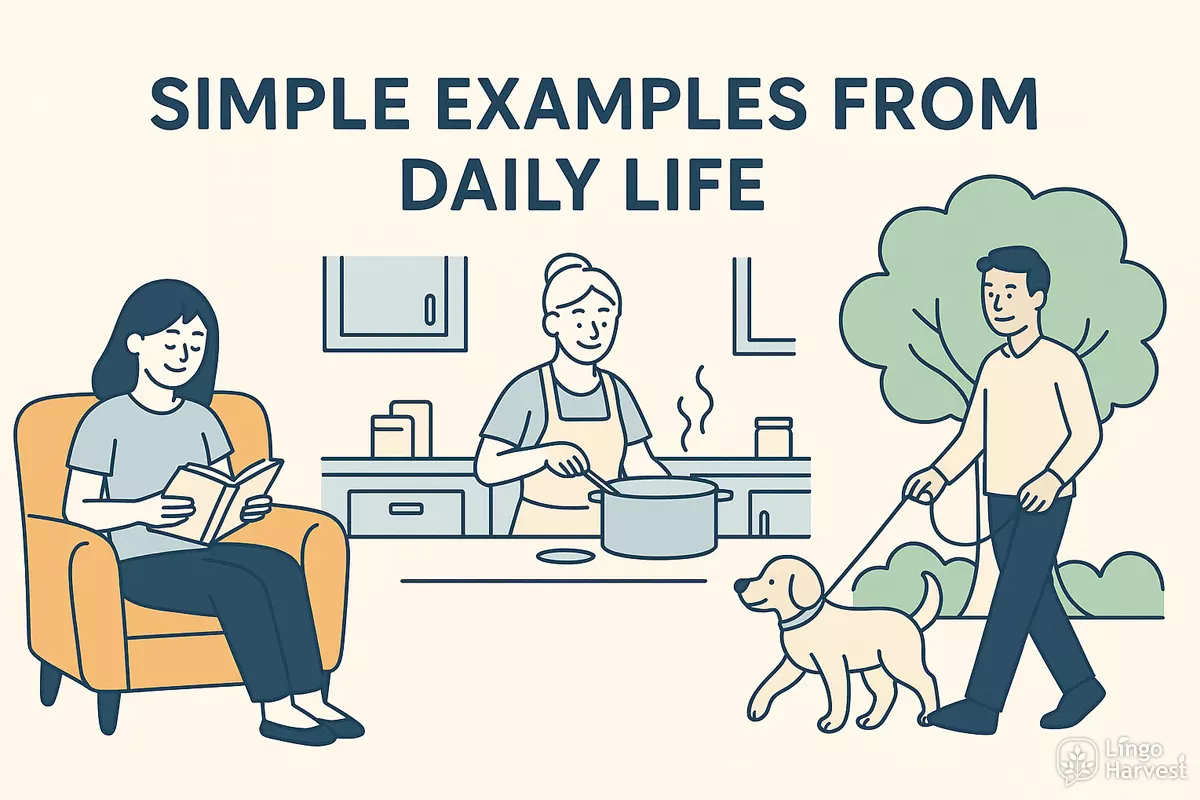
These short, everyday sentences show nouns in action. The nouns are bolded so you can spot them quickly.
Home & Family
- My mother cooks dinner.
- The kitchen is clean.
- I lost my keys.
School & Work
- The teacher gives homework.
- Our office closes at six.
- I need a new laptop.
Shopping & Food
- She buys fresh vegetables.
- The market is crowded.
- This coffee tastes great.
Travel & Places
- The bus is late.
- We visited a beautiful park.
- The city looks amazing at night.
Hobbies & Free Time
- My friend plays the guitar.
- I read a book every weekend.
- They watch a movie after dinner.
Quick Practice
Underline or say the noun(s) in each sentence:
- The dog waits at the door.
- We need more water.
- My sister loves music.
Show answers
- dog, door
- water
- sister, music
Tips to Practice and Remember Nouns
Learning nouns becomes easier when you use them regularly in real-life situations. Here are simple and effective ways to practice every day.
1) Label Objects Around You
Choose items in your room and say their names in English out loud:
- desk
- window
- chair
Seeing objects and naming them helps your brain connect the word with the image.
2) Keep a Personal Vocabulary Notebook
Write down new nouns you learn. Try to include:
- The noun itself
- A short definition
- One example sentence
This helps memory through repetition and context.
3) Use Nouns in Simple Sentences
Try making short sentences with each new noun:
- coffee → I drink coffee every morning.
- friend → My friend lives near me.
- phone → I need to charge my phone.
4) Group Nouns by Category
Organize nouns by topic — this makes them easier to remember.
- Food: apple, bread, soup
- Places: school, mall, park
- People: doctor, student, neighbor
5) Practice With Daily Situations
Describe your day using nouns:
- I woke up and turned off my alarm.
- I ate breakfast.
- I walked to the bus stop.
Quick Mini-Exercise
Write 5 nouns you can see around you right now. Then, make 1 sentence for each.
Show example answers
- table → The table is near the window.
- bag → My bag is on the chair.
- pen → I write with a blue pen.
- cup → The cup is full of tea.
- phone → I use my phone to check messages.
Common Mistakes Beginners Make
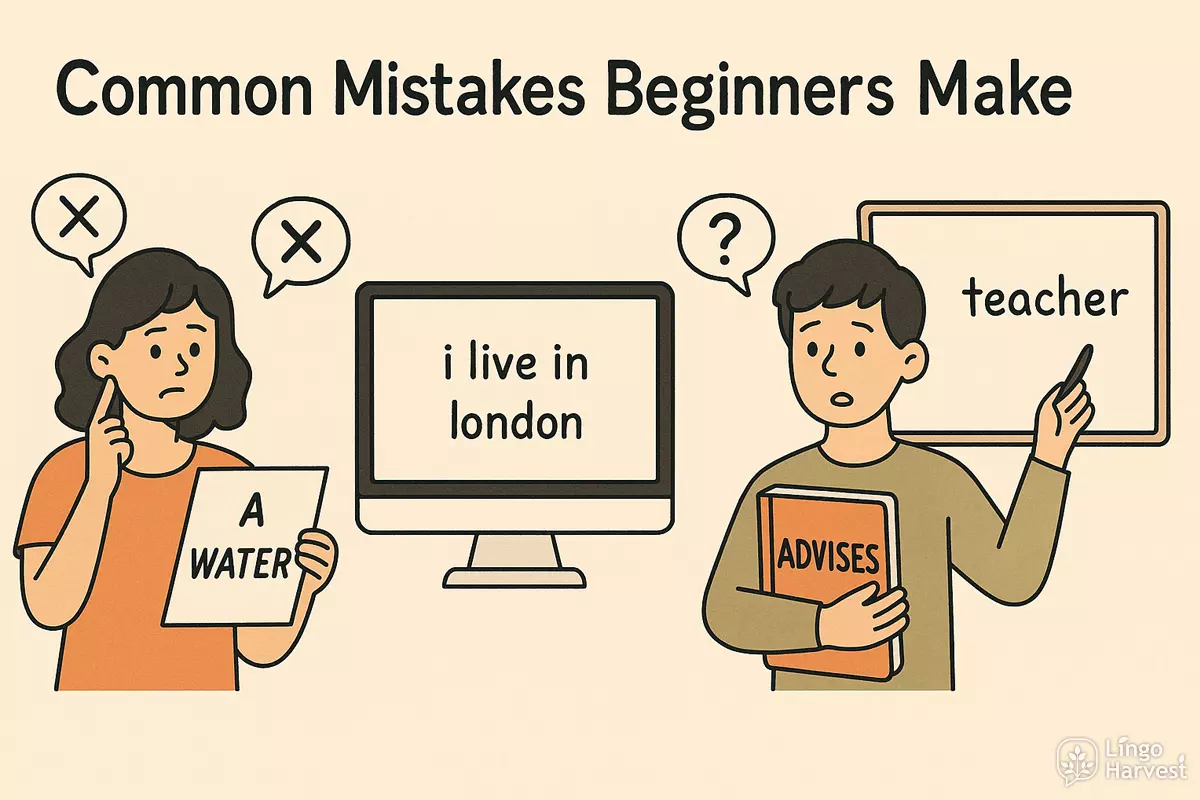
Even simple nouns can be confusing when you're just starting to learn English. Here are the most common mistakes and how to avoid them.
1) Using a / an with uncountable nouns
Uncountable nouns cannot use a or an because they do not have a single, countable unit.
Incorrect: I need a water.
Correct: I need some water.
2) Forgetting to use plural forms for countable nouns
When you talk about more than one countable noun, add -s or -es.
Incorrect: I have two cat.
Correct: I have two cats.
3) Not capitalizing proper nouns
Names of people, cities, countries, brands, etc., must always begin with a capital letter.
Incorrect: i live in london.
Correct: I live in London.
4) Mixing up similar nouns
Some nouns look similar but mean different things. For example:
- advice (uncountable idea) vs. advices (❌ incorrect plural, don't use)
- information (uncountable) vs. infos (❌ do not use)
- money (uncountable) — no plural form
5) Overusing nouns without pronouns
Repeating the same noun makes speech unnatural. Use pronouns to avoid repetition.
Example:
Instead of: The teacher is kind. The teacher helps me.
Say: The teacher is kind. She helps me.
Quick Check
Fix the mistakes:
- I have three cat.
- He gave me an information.
- we went to paris last summer.
Show answers
- I have three cats.
- He gave me some information.
- We went to Paris last summer.
Short Practice Exercise and Answers
Now it’s time to check your understanding. Read each sentence and identify the nouns. Then, decide if they are people, places, things, or ideas.
Exercise
- The dog runs in the park.
- My friend loves music.
- We ate fresh fruit at the market.
- This city has a long history.
- The teacher is in the classroom.
Think About the Categories
- People: friend, teacher
- Places: park, market, city, classroom
- Things: dog, fruit
- Ideas: music, history
Show full check
- dog → thing
- park → place
- friend → person
- music → idea (cannot touch, but can feel)
- fruit → thing
- market → place
- city → place
- history → idea
- teacher → person
- classroom → place