Past Continuous Passive: Was Being Done Then

 This article explains the past continuous passive: what it means, how to form it with was being and were being, and when to use it for actions in progress in the past. It also covers negatives and questions, examples, common mistakes, practice, FAQs, and how it differs from the past simple passive.
- What the past continuous passive means
- How was being and were being form the passive
- When to show an action in progress in the past
- Background actions and interrupted passive events
- Past continuous passive vs past simple passive
- Negatives and questions with was being and were being
- Natural examples in reports, stories, and explanations
- Common errors with being, been, and time markers
- Practice drill: past continuous passive sentences
- FAQ: was being done and were being done
Use this form to show that an action was in progress in the past while keeping the focus on the thing or person receiving the action. It is common in everyday English when the doer is unknown, unimportant, or already obvious, such as during repairs, interviews, or investigations. In real situations, it sounds natural and helps describe what was happening at that time in a clear, practical way.
What the past continuous passive means
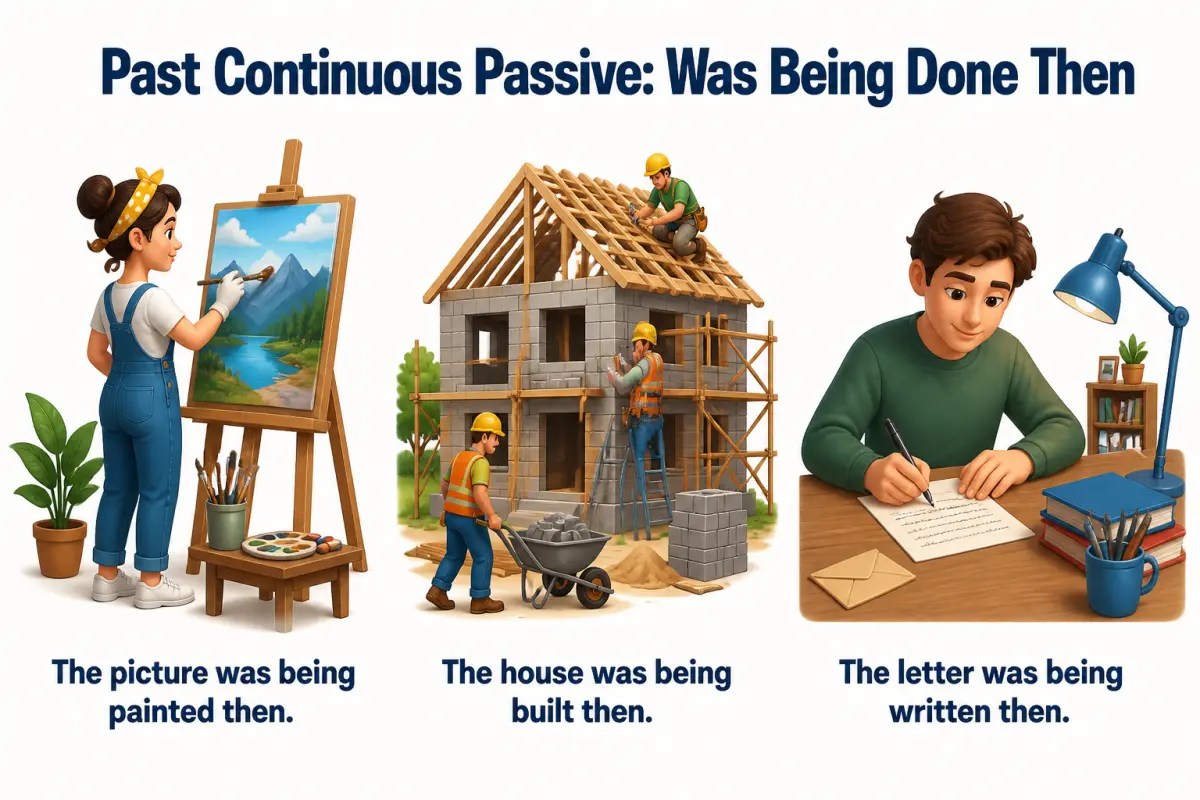
This form shows that something was in progress at a particular time in the past, but the focus is on the action itself or on the thing receiving the action, not on the person doing it. In other words, it combines two ideas: past ongoing time and passive focus.
Compare these two sentences:
- The staff were cleaning the hall at 8 p.m. (active)
- The hall was being cleaned at 8 p.m. (passive)
Both sentences describe an action in progress at that time. The difference is where your attention goes. In the active sentence, we look at the staff. In the passive sentence, we look at the hall.
This structure is useful when:
- the doer is unknown: My phone was being checked when I arrived.
- the doer is not important: The road was being repaired all week.
- the result receiver is more important: The patient was being examined by a specialist.
A simple way to understand it is this: if you already know the idea of the past continuous, this form keeps the same time meaning, but changes the sentence into the passive.
Here are a few natural examples:
- Dinner was being prepared when the guests called.
- The documents were being copied at that moment.
- A new bridge was being built near the station in 2019.
- The windows were being washed while we were inside.
Notice that this tense is not the most common passive form in everyday English, but it is very useful when you need to describe a scene, explain an event, or report what was happening at a certain moment in the past.
How was being and were being form the passive
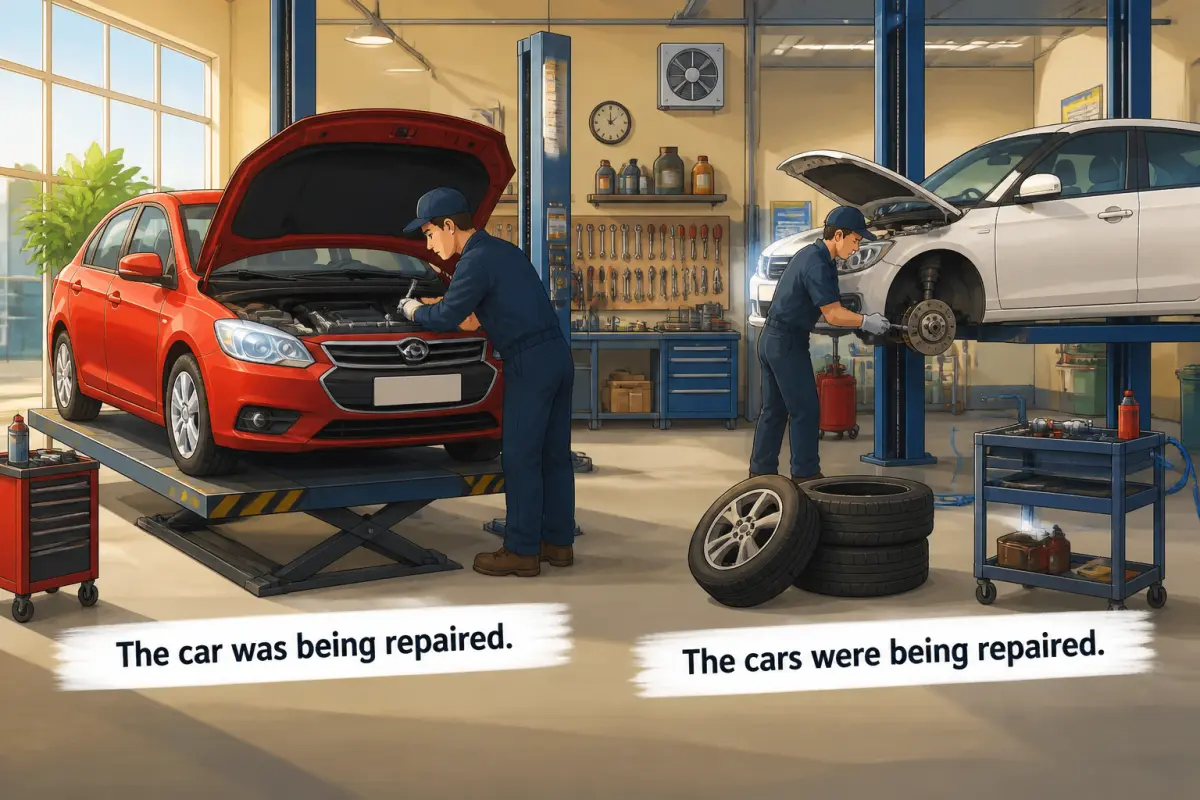
The structure is straightforward once you break it into parts. You need the past form of be, then being, and then the past participle of the main verb. With a singular subject, use was being. With a plural subject, use were being.
The pattern looks like this:
subject + was/were + being + past participle
| Subject | Form | Example |
|---|---|---|
| Singular noun | was being + past participle | The car was being repaired. |
| Plural noun | were being + past participle | The cars were being repaired. |
| He / She / It | was being + past participle | It was being used at the time. |
| We / You / They | were being + past participle | They were being interviewed. |
The last word must be a past participle: built, written, made, sent, taken, repaired. Many learner mistakes happen here, especially with irregular verbs, so it helps to review irregular verb patterns if forms like written, spoken, or driven still feel uncertain.
Look at these transformations from active to passive:
- The chef was cooking the meal. → The meal was being cooked.
- The engineers were testing the system. → The system was being tested.
- The police were questioning the driver. → The driver was being questioned.
You can add the agent with by if it matters:
- The samples were being analyzed by the lab team.
- The old theater was being restored by local volunteers.
But in many real situations, English leaves the agent out because it is obvious or unimportant.
Teacher note: Many students try to memorize this as one long block. It is easier to build it step by step: first choose was or were, then add being, then choose the correct participle.
If you need a bigger picture of how this fits into the system, it helps to compare it with other passive voice forms.
When to show an action in progress in the past
Use this form when you want to show that the action was still happening at a specific point in the past. The action had started before that moment and had not finished yet. Time expressions often make this meaning clear.
Common time references include:
- at 6 o’clock
- at that moment
- when I arrived
- while the meeting was taking place
- all morning, if the sentence emphasizes duration in progress
For example:
- The main road was being blocked by police at 7 a.m.
- The proposal was being discussed when the director came in.
- The children’s costumes were being sewn the night before the play.
- Our order was being packed when the website crashed.
This tense is especially good when the listener needs a picture of a situation rather than just a completed fact. If I say, “The stage was being decorated,” you imagine a process in progress. If I say, “The stage was decorated,” you simply hear the finished fact or a past event without that ongoing feeling.
It often appears in descriptions of work, production, repair, investigation, treatment, or administration:
- New safety checks were being introduced across the company.
- The patient was being monitored throughout the night.
- The final copies were being printed downstairs.
- A lot of data was being collected during the survey.
Use it when the process matters. If the process does not matter, another tense is often better.
Background actions and interrupted passive events
One of the clearest uses of this form is to set the background in a story or report. It helps you describe what was going on when another event happened. The action in the passive was already in progress, and then something else interrupted it, changed it, or happened during it.
That pattern is very common in narrative English:
- The files were being uploaded when the power went out.
- The suspect was being driven to the station when the car broke down.
- The house was being painted when the storm started.
In these examples, the passive action creates the background. The second action is usually in the past simple because it is seen as the shorter, interrupting event.
You can also combine passive background actions with active background actions:
- While the stage was being prepared, the actors were warming up backstage.
- As the order was being processed, I was speaking to customer support.
- The injured player was being treated while the crowd waited quietly.
Notice the balance here: English often uses one ongoing action as the setting for another action. If you want the focus on the receiver of the action, use the passive version.
Here are three useful contrasts:
- The staff were moving the chairs when I entered. (focus on staff)
The chairs were being moved when I entered. (focus on chairs) - The technician was updating the software when the screen froze. (focus on technician)
The software was being updated when the screen froze. (focus on software) - The team was preparing the report when the manager called. (focus on team)
The report was being prepared when the manager called. (focus on report)
Teacher note: In student writing, this tense works best when there is a clear time frame or interrupting event. Without that context, learners often choose it when a simpler passive would sound more natural.
Past continuous passive vs past simple passive
Learners often confuse these two because both are passive and both talk about the past. The real difference is not passive meaning. The real difference is finished event versus ongoing process.
Use the past simple passive when you see the action as complete, whole, or just a fact. Use the past continuous passive when you want to show it was in progress at a particular moment.
| Form | Main meaning | Example |
|---|---|---|
| was/were + past participle | completed event or past fact | The email was sent at noon. |
| was/were being + past participle | action in progress in the past | The email was being sent when the internet failed. |
| was/were + past participle | general report of what happened | The bridge was closed last night. |
| was/were being + past participle | focus on the ongoing process | The bridge was being closed as we arrived. |
Study these pairs carefully:
- The room was cleaned before the guests arrived. (finished)
The room was being cleaned when the guests arrived. (in progress) - The cars were inspected yesterday afternoon. (completed inspections)
The cars were being inspected at 3 p.m. (ongoing at that time) - The bill was paid on Monday. (completed action)
The bill was being paid when the system stopped working. (process interrupted)
Here are three more pairs because this contrast is one of the most important on the topic:
- The curtains were opened before the audience entered.
The curtains were being opened as the music began. - The package was delivered in the morning.
The package was being delivered when I got the message. - The wall was painted last weekend.
The wall was being painted when we visited the house.
If you are not sure which one you need, ask yourself: do I mean what happened, or do I mean what was happening then? That question usually gives you the right tense.
This is also where understanding active vs passive helps, because sometimes the better solution is not another passive tense, but an active sentence with a clearer subject.
Negatives and questions with was being and were being

Negative forms are made by putting not after was or were. Questions are made by moving was or were before the subject. The rest of the structure stays the same.
Here are the main patterns:
- Affirmative: The machine was being tested.
- Negative: The machine was not being tested.
- Question: Was the machine being tested?
And with a plural subject:
- Affirmative: The forms were being checked.
- Negative: The forms were not being checked.
- Question: Were the forms being checked?
Natural examples of negatives:
- The issue wasn’t being discussed in the meeting.
- The guests weren’t being served yet.
- The old computers weren’t being used anymore at that stage.
Natural examples of questions:
- Was the patient being moved to another room?
- Were the applications being reviewed when you called?
- Why was the front door being painted at night?
- Who said the plans were being changed?
In wh-questions, put the question word first, then the auxiliary:
- Why were the seats being removed?
- How was the data being stored?
- When was the decision being announced?
Many learners make fewer mistakes if they first form the basic yes/no question and then add the question word. If question order is still difficult, extra work on past continuous questions can help, because the same inversion idea is used here.
Natural examples in reports, stories, and explanations
This tense appears most naturally in contexts where the writer or speaker wants to describe a process at a specific past time. Reports, news-style summaries, incident descriptions, workplace explanations, and stories are all good places for it.
In a report, it often sounds formal and objective:
- At the time of the inspection, the safety equipment was being stored in the wrong area.
- Several complaints were being investigated when the department changed managers.
- The injured passenger was being assisted by airport staff.
In stories, it helps create a scene:
- The wedding cake was being carried into the hall when the lights suddenly went out.
- A speech was being given on the balcony as people gathered below.
- The campfire was being watched carefully because the wind was getting stronger.
In explanations, it often shows process and timing:
- The samples were being cooled before the final test.
- The software was being installed while the old system was still running.
- The walls were being measured so that new shelves could be fitted.
It is also common in customer service and workplace English:
- Your request was being handled by another adviser when I joined the call.
- The invoices were being prepared at the end of the month.
- The conference room was being set up for the afternoon session.
Teacher note: If a learner never uses this tense, their stories often sound flat. A few well-placed past continuous passive sentences can make time relationships much clearer.
The key is not to force it into every past description. Use it when there is a real sense of process, background, or interruption. If that sense is missing, a past simple passive usually sounds cleaner.
Common errors with being, been, and time markers
Most mistakes with this tense fall into three groups: using been instead of being, choosing the wrong verb form after it, and mixing it with time markers that do not fit its meaning. These errors are very common, so it is worth slowing down and checking each part carefully.
1. Confusing being and been
In this tense, you need being, not been. Been is used in perfect forms, not here.
- ❌ The road was been repaired when we arrived.
✅ The road was being repaired when we arrived. - ❌ The guests were been served at that time.
✅ The guests were being served at that time. - ❌ My bag was been checked at the gate.
✅ My bag was being checked at the gate.
2. Using the base verb or -ing form instead of the past participle
After being, use the past participle, not the base form and not another -ing form.
- ❌ The floor was being clean when we entered.
✅ The floor was being cleaned when we entered. - ❌ The forms were being fill in by hand.
✅ The forms were being filled in by hand. - ❌ The engine was being fixing all afternoon.
✅ The engine was being fixed all afternoon.
Irregular verbs cause extra trouble:
- ❌ The letter was being wrote at midnight.
✅ The letter was being written at midnight. - ❌ The truck was being drove into the yard.
✅ The truck was being driven into the yard. - ❌ The money was being took from the safe.
✅ The money was being taken from the safe.
3. Using time markers that suggest a finished event instead of an in-progress one
This tense works best with a point in time, a background moment, or an interrupted situation. It often sounds wrong with markers that simply report completion.
- ❌ The contract was being signed yesterday at 2 p.m. and that’s all we know.
✅ The contract was signed yesterday at 2 p.m. (completed fact) - ✅ The contract was being signed at 2 p.m. when the fire alarm rang. (in progress at that time)
- ❌ The bridge was being opened last year.
✅ The bridge was opened last year. (event) - ✅ The bridge was being opened when the ceremony was interrupted. (process underway)
4. Forgetting subject agreement
- ❌ The files was being copied.
✅ The files were being copied. - ❌ The machine were being tested.
✅ The machine was being tested. - ❌ Her ideas was being ignored.
✅ Her ideas were being ignored.
5. Choosing the passive when active is more natural
Sometimes the grammar is correct, but the sentence sounds heavy because the passive is unnecessary.
- Less natural: I saw that the waiter was being carrying the plates. (also grammatically wrong)
- Better: I saw that the waiter was carrying the plates.
- Possible passive, but different focus: The plates were being carried into the dining room.
Teacher note: When checking your own writing, look for the three-step chain: was/were + being + past participle. If one part is missing or changed, the tense is usually wrong.
Practice drill: past continuous passive sentences
The best way to make this tense feel natural is to practice it from different angles. Below are three short blocks. The first checks recognition, the second builds the form, and the third trains your ability to notice mistakes. Do them slowly and say the correct forms aloud if you can.
Pay attention to three things every time: singular or plural subject, being not been, and the correct past participle.
Practice 1: Choose the correct form
- The room (was being prepared / was prepared) when the visitors arrived.
- The reports (were being checked / were checked) at 11 a.m.
- A new menu (was being designed / was designed) when the owner changed his mind.
- The patients (were being moved / were moved) while the nurses gave instructions.
- The website (was being updated / was updated) when users started reporting errors.
- The final decision (was being discuss / was being discussed) in private.
- The old tables (were being repair / were being repaired) in the workshop.
- My suitcase (was being searched / was searched) when I got to security.
- The apartment (was being painted / was painted) at that time last week.
- The invitations (were being send / were being sent) when the printer stopped.
Show answers
- was being prepared
- were being checked
- was being designed
- were being moved
- was being updated
- was being discussed
- were being repaired
- was being searched
- was being painted
- were being sent
Practice 2: Rewrite in the passive
- The chef was preparing the soup at that moment.
- The workers were installing new lights in the office.
- The school was repainting the classroom when we visited.
- The company was reviewing my application last Friday.
- The staff were cleaning the pool when it started to rain.
- The police were questioning two witnesses downstairs.
- The team was testing the app during the presentation.
- The mechanic was checking the brakes at 9 a.m.
- The editors were correcting the article when the email arrived.
- The museum was restoring the painting at the time.
Show answers
- The soup was being prepared at that moment.
- New lights were being installed in the office.
- The classroom was being repainted when we visited.
- My application was being reviewed last Friday.
- The pool was being cleaned when it started to rain.
- Two witnesses were being questioned downstairs.
- The app was being tested during the presentation.
- The brakes were being checked at 9 a.m.
- The article was being corrected when the email arrived.
- The painting was being restored at the time.
Practice 3: Spot and correct the error
- The door was been locked when I came back.
- The files were being copy into a new folder.
- The photos was being printed in the next room.
- The new bridge were being built near the river.
- The speech was being gave when the microphone failed.
- The tickets were being solded online.
- The package was being deliver when the address changed.
- The walls were being paint all weekend.
- The car was being drove too fast by the thief.
- The forms was not being checked carefully.
Show answers
- The door was being locked when I came back.
- The files were being copied into a new folder.
- The photos were being printed in the next room.
- The new bridge was being built near the river.
- The speech was being given when the microphone failed.
- The tickets were being sold online.
- The package was being delivered when the address changed.
- The walls were being painted all weekend.
- The car was being driven too fast by the thief.
- The forms were not being checked carefully.
FAQ: was being done and were being done
1. Is this tense common in everyday English?
It is not as common as the past simple passive, but it is still very useful. You hear it in news reports, workplace explanations, police or medical contexts, and stories where timing matters. Native speakers use it when they want to show an action was underway, not just completed.
2. Can I use it without saying who did the action?
Yes, and that is one of its main uses. “The room was being prepared” is perfectly natural even if you do not say who was preparing it. Add by + agent only if that information matters: “The room was being prepared by hotel staff.”
3. Can stative verbs be used in this tense?
Usually no, or not naturally. Verbs like know, belong, understand, and resemble do not normally describe ongoing passive processes. You can say “The contract was being reviewed,” but not normally “The answer was being known.” Choose a different structure for stative meanings.
4. What is the difference between “was being done” and “had been done”?
They express different ideas. “Was being done” shows an action in progress at a past time. “Had been done” shows that something was already completed before another past moment. Compare: “The wiring was being checked when we arrived” versus “The wiring had been checked before we arrived.”
5. Can I use it with “while” and “when”?
Yes. Those words are very natural with this form because they help show timing. “While the food was being prepared, we waited outside.” “The food was being prepared when the fire alarm rang.” The first sentence gives background; the second shows interruption.
6. Why does “being” stay the same with all subjects?
Because the only part that changes for number here is was or were. The word being does not change. So you say “The machine was being tested” and “The machines were being tested.”
7. Is it always wrong to use the past simple passive instead?
No. Sometimes both are grammatically possible, but they mean different things. “The gate was closed” tells me the event happened or the state existed. “The gate was being closed” shows the action in progress. Choose according to the meaning you want, not by grammar alone.
8. How can I practice this tense effectively?
Use short picture descriptions, workplace scenarios, and interrupted-event stories. For example, describe what was happening in a kitchen, office, airport, or classroom at a certain moment. Also rewrite active sentences into passive ones and ask yourself whether the receiver of the action is really the focus.