Present Continuous Passive: Is Being Done Now

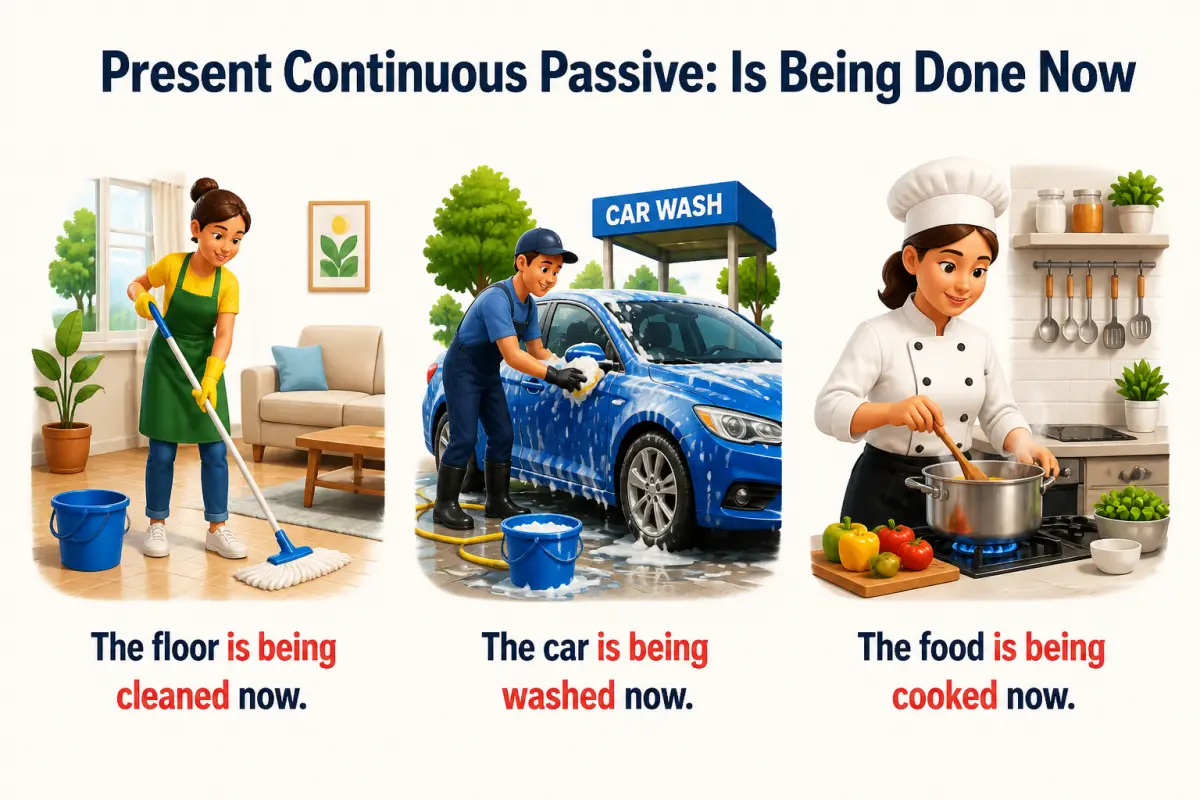 Here we the present continuous passive: what it means, how is being, are being, and am being work, and when to use it for actions happening now or temporary ongoing processes. It also explains questions, negatives, common mistakes, simple passive comparisons, and sentence-building practice.
- What the present continuous passive means
- How is being, are being, and am being work
- When to use it for actions happening now
- Temporary processes, changes, and ongoing work
- Passive questions and negatives with being
- Present continuous passive vs present simple passive
- Natural examples from news, work, and daily English
- Mistakes with being, been, and past participles
- Try it: build present continuous passive sentences
- FAQ: is being done in English
To describe something happening to a person or thing right now, this form is very useful. We use it when an action is in progress and the main focus is on what is receiving the action rather than on the person doing it. You often hear it in news reports, school notices, and workplace updates, so learning it helps you explain situations clearly and naturally as they happen.
What the present continuous passive means
This form is used when something is happening now, but we want to focus on the action or the result receiver, not on the person or thing doing it. Compare these two ideas: The staff are cleaning the rooms and The rooms are being cleaned. The action is in progress in both sentences, but the second one puts the spotlight on the rooms.
In grammar terms, it combines two ideas: present continuous for an action in progress, and passive voice for a sentence where the subject receives the action. So is being done means “someone is doing it now,” but we either do not know who, do not need to say who, or care more about the action itself.
You will often meet this form in notices, news reports, work updates, and formal English. For example:
- The road is being repaired.
- All orders are being processed.
- The patient is being examined.
- I am being interviewed for the job right now.
The passive is not always the best choice in conversation. Native speakers often prefer the active if the doer is important or obvious: The team is fixing the server sounds more direct than The server is being fixed. But when the receiver matters more, the passive is exactly the right tool. If you want a broader picture of related patterns, see these passive voice forms.
How is being, are being, and am being work

The pattern is straightforward once you separate the parts. First, choose the present form of be: am, is, or are. Then add being. After that, use the past participle of the main verb: done, made, written, sent, repaired, built, and so on.
So the structure is: subject + am/is/are + being + past participle. The subject is the thing receiving the action. That is why we say The emails are being answered, not The emails are being answer.
| Subject | Form | Example |
|---|---|---|
| I | am being + past participle | I am being shown around the office. |
| he / she / it / singular noun | is being + past participle | The contract is being reviewed. |
| we / you / they / plural noun | are being + past participle | The guests are being served now. |
| question form | am/is/are + subject + being + past participle? | Is the report being printed? |
Notice that being is necessary here. It shows the continuous part. Without it, you change the tense and meaning:
- The bridge is repaired. = usually a state or a simple passive meaning
- The bridge is being repaired. = the repair is in progress now
Also remember that the last verb must be a past participle, not an -ing form and not a base verb:
- ✅ The files are being copied.
- ❌ The files are being copy.
- ❌ The files are being copying.
Teacher note: many learners understand the meaning quickly but forget that the passive always needs a past participle at the end. When checking your own sentence, look at the last word first.
If you are still mixing this with the active present continuous, compare these:
- The manager is interviewing a candidate. Active
- A candidate is being interviewed. Passive
When to use it for actions happening now
Use this form when an action is going on at the moment of speaking or around the present time, and the receiver of the action is the most important part of the message. It is especially common when you are giving a live update, describing a current process, or reporting what is happening in a place right now.
Imagine you arrive at a hotel and ask about your room. The receptionist might say, Your room is being prepared. The cleaner matters less than the room and its current status. Or in an office: The issue is being looked into. Again, the focus is on the issue, not on the individual worker.
Typical situations include:
- service situations: Your order is being packed.
- repairs and maintenance: The elevator is being checked.
- medical contexts: The patient is being monitored.
- school and university: The exam papers are being marked.
- technology: The software is being updated.
It often appears with time expressions such as now, right now, at the moment, currently, and this week. For example:
- The kitchen is being painted this week.
- Several new safety rules are being introduced at the moment.
- I can’t print anything because the machine is being serviced right now.
Use it when the doer is unknown, unimportant, obvious, or intentionally omitted:
- The suspect is being questioned. We do not need to name the police officer.
- The package is being delivered. The delivery company is less important than the package status.
- The menu is being translated into English. The translator may not matter in the context.
If the doer is important, active voice is often more natural: Our legal team is reviewing the contract may sound better than The contract is being reviewed if you want to highlight who is doing the work. A fuller comparison is available in active vs passive.
Temporary processes, changes, and ongoing work
This form is very useful for things that are not permanent. It suggests that a process is underway for a limited time. That is why it is common in workplaces, projects, construction, product development, and public announcements. You are not talking about a general truth; you are describing a process in motion.
For example, The website is being redesigned tells us the redesign is happening these days. It is not finished, and it is not a permanent condition. The same is true in sentences like Several policies are being revised or The old stadium is being demolished.
Here are natural uses for temporary work and changes:
- The office reception area is being renovated, so please use the side entrance.
- A new payment system is being tested in our stores this month.
- Some staff roles are being reorganized after the merger.
- The city center is being cleaned up before the festival.
- My visa application is being processed, so I cannot travel yet.
It is also useful for gradual changes that are still underway:
- The neighborhood is being transformed by new housing projects.
- Traditional tickets are being replaced by digital passes.
- Old files are being moved to cloud storage.
Teacher note: learners sometimes use the passive here because it sounds formal, but ask yourself one question: do you want to highlight the process itself? If yes, the passive works very naturally.
Be careful with verbs that describe states rather than actions. A process can be being developed, being improved, or being discussed, but some stative verbs do not work naturally in this pattern. For a larger view of how ongoing and non-ongoing meanings fit into English verb aspects, it helps to compare simple and continuous forms across tenses.
Passive questions and negatives with being
Questions and negatives follow the normal grammar of be. To make a question, move am, is, or are before the subject. To make a negative, add not after am, is, or are.
This is where many students become more confident, because the pattern is regular. Once you know the statement form, the question and negative forms are predictable.
| Type | Pattern | Example |
|---|---|---|
| Statement | subject + am/is/are + being + past participle | The documents are being signed. |
| Negative | subject + am/is/are + not + being + past participle | The documents are not being signed yet. |
| Yes/no question | am/is/are + subject + being + past participle? | Are the documents being signed now? |
| Wh-question | wh-word + am/is/are + subject + being + past participle? | Why is the meeting being postponed? |
Look at these examples:
- Is the parcel being sent today?
- Are the students being tested this afternoon?
- The lights are not being used at the moment.
- I am not being included in that email chain.
- Who is being invited to the launch event?
In spoken English, contractions are common:
- The forms aren’t being and isn’t being are natural.
- I’m not being ignored, am I?
When you add adverbs, place them carefully so the sentence stays clear:
- The proposal is currently being discussed.
- The guests are still being served.
- The equipment is not being properly maintained.
If adverb position causes trouble, this guide to passive adverb placement can help.
Present continuous passive vs present simple passive

This contrast matters because both forms are passive, but they do not mean the same thing. The present simple passive describes a general fact, routine, rule, or regular process. The present continuous passive describes an action in progress now or around now.
In many learner errors, the passive part is correct but the tense is wrong. The sentence is grammatical, but the timing is not. That is why this comparison is worth practicing carefully.
Compare these pairs:
- The offices are cleaned every evening. = routine
The offices are being cleaned now. = happening at this moment - English is spoken in many countries. = general fact
Only English is being spoken in the interview today. = temporary situation now - The reports are checked before publication. = regular procedure
The reports are being checked before we send them out this morning. = current process
Three more useful contrasts:
- Lunch is served at 12:30. = schedule or routine
Lunch is being served in the garden. = action happening now - The building is protected by law. = permanent legal status
The building is being protected by police tonight. = current action - These products are made in Italy. = general manufacturing fact
These products are being made in a temporary workshop while the factory is closed. = current temporary arrangement
Use the simple passive when you answer questions like What usually happens? or What is generally true? Use the continuous passive when you answer What is happening now? or What is in progress these days?
Teacher note: if students hesitate between the two forms, I ask them to add a time expression. “Every day” usually fits the simple passive. “Right now” usually fits the continuous passive.
Natural examples from news, work, and daily English
This form often sounds more natural when you see it in real contexts. In news English, it is useful because the process matters more than the individual agent. In work English, it helps give updates. In daily life, it is common in service situations, repairs, and explanations.
Here are realistic examples grouped by context.
News and public information
- The missing hiker is being searched for by rescue teams.
- Several government proposals are being debated in parliament.
- The damaged bridge is being inspected after the storm.
- Emergency shelters are being opened across the region.
Work, business, and email English
- Your refund is being processed and should arrive within three business days.
- The draft contract is being reviewed by our legal department.
- Two new candidates are being considered for the role.
- The database is being migrated this weekend, so some delays are possible.
School, home, and daily conversation
- The living room is being painted, so we’re eating in the kitchen.
- My bike is being repaired, so I walked to class.
- The children are being shown how to use the lab equipment.
- The seats are being reserved for the guests of honor.
Notice that some of these are fairly formal. In everyday conversation, native speakers still use the passive, but they often choose shorter, more direct active forms if the doer is obvious. For example:
- Passive: The kitchen is being cleaned.
- Active: Sam is cleaning the kitchen.
Both are correct. The choice depends on focus, not on grammar difficulty.
Mistakes with being, been, and past participles
Most errors with this tense come from three areas: leaving out being, using been instead of being, and choosing the wrong verb form after it. These mistakes are very common because learners remember parts of other passive patterns and mix them together.
Let’s go through the main problem areas clearly.
1. Leaving out being
Without being, you usually change the meaning from “in progress now” to a different passive idea.
- ❌ The office is cleaned now.
✅ The office is being cleaned now. - ❌ My application is processed at the moment.
✅ My application is being processed at the moment. - ❌ The windows are washed right now.
✅ The windows are being washed right now.
2. Using been instead of being
Been belongs to perfect forms, not this one. Here we need the continuous marker being.
- ❌ The plans are been discussed.
✅ The plans are being discussed. - ❌ A new wing is been built.
✅ A new wing is being built. - ❌ The guests are been served.
✅ The guests are being served.
3. Using the wrong form after being
After being, use the past participle, not the base verb and not the -ing form.
- ❌ The food is being cook.
✅ The food is being cooked. - ❌ The report is being write.
✅ The report is being written. - ❌ The new app is being testing.
✅ The new app is being tested.
4. Mixing active and passive patterns
- ❌ They are being repair the road.
✅ They are repairing the road. - ❌ The road is being repair by them.
✅ The road is being repaired by them. - ❌ The team is being discuss the budget.
✅ The team is discussing the budget.
✅ The budget is being discussed.
5. Using it with verbs that do not fit naturally
Some stative verbs are strange or impossible in this form in normal usage.
- ❌ He is being known by everyone.
✅ He is known by everyone. - ❌ The answer is being understood by me.
✅ I understand the answer. - ❌ The city is being had many parks.
✅ The city has many parks.
Teacher note: when a sentence sounds awkward, ask two questions: “Is this a real action in progress?” and “Is the last verb a past participle?” Those two checks catch most mistakes.
Try it: build present continuous passive sentences
Now it is time to produce the form yourself. Do not just recognize it; build it. The best way to learn this structure is to control three skills separately: choosing the correct form, transforming active to passive, and correcting common errors. The practice below follows that order.
Try to answer before opening the solutions. Say the sentence aloud if possible. It helps you hear whether being and the past participle sound natural together.
Practice 1: choose the correct form
- The documents (is being / are being / are) signed right now.
- My lunch (is being prepare / is being prepared / is prepared being).
- The patients (are being examined / are examined being / is being examined).
- I (am being interviewed / am interviewed being / is being interviewed) this morning.
- The road (is being repaired / is repaired being / are being repaired) today.
- Why (is the flight being delayed / the flight is being delayed / is being delayed the flight)?
- The rooms (aren’t being cleaned / isn’t being cleaned / not are being cleaned) yet.
- A new menu (is being designed / are being designed / is being design).
- Our orders (are being packed / is being packed / are packed being) now.
- What (is being discussed / are being discussed / is discussed being) in the meeting?
Show answers
- are being
- is being prepared
- are being examined
- am being interviewed
- is being repaired
- is the flight being delayed
- aren’t being cleaned
- is being designed
- are being packed
- is being discussed
Practice 2: rewrite in the present continuous passive
- The IT team is updating the system.
- The chef is preparing the desserts.
- The company is reviewing your complaint.
- The workers are installing new lights.
- The university is changing the timetable.
- The police are questioning two witnesses.
- The staff are moving the furniture.
- The editor is checking the final page.
- The museum is restoring the old painting.
- The organizers are setting up the stage.
Show answers
- The system is being updated.
- The desserts are being prepared.
- Your complaint is being reviewed.
- New lights are being installed.
- The timetable is being changed.
- Two witnesses are being questioned.
- The furniture is being moved.
- The final page is being checked.
- The old painting is being restored.
- The stage is being set up.
Practice 3: spot and correct the error
- The forms are been printed now.
- The hall is being decorate for the wedding.
- Are the results being announce today?
- The guests is being served in the garden.
- I am being help by a colleague.
- The files are not being upload correctly.
- The car is repaired right now.
- Why are the doors being lock?
- The speeches are being writing by the communications team.
- The meal are being cooked downstairs.
Show answers
- The forms are being printed now.
- The hall is being decorated for the wedding.
- Are the results being announced today?
- The guests are being served in the garden.
- I am being helped by a colleague.
- The files are not being uploaded correctly.
- The car is being repaired right now.
- Why are the doors being locked?
- The speeches are being written by the communications team.
- The meal is being cooked downstairs. / The meals are being cooked downstairs.
FAQ: is being done in English
This pattern raises a few very specific questions for learners, especially about natural usage, formality, and common combinations. Here are the ones I hear most often.
1. Is “is being done” common in everyday English?
Yes, but not everywhere equally. It is very common in service, work, medical, and official contexts: Your request is being handled, The patient is being treated. In casual conversation, speakers often choose the active when the doer is obvious: Tom is fixing it. So the form is common, but the context matters.
2. Can I say who does the action?
Yes. You can add an agent with by if it is useful: The hall is being prepared by the event team. Still, many passive sentences leave the agent out because it is unknown, obvious, or not important. If the agent is the real focus, active voice is usually smoother.
3. Is “am being” natural, or does it sound strange?
It is grammatical and sometimes very natural: I am being interviewed, I am being shown around. It sounds less common only because fewer situations require a person to be the receiver of an action in progress. The form itself is not wrong or unusual.
4. Can I use this form with all verbs?
No. It works best with verbs that describe real actions, especially actions that can be in progress: repair, build, discuss, prepare. Many stative verbs do not fit naturally: we usually do not say is being known or is being owned in ordinary situations.
5. What is the difference between “is being done” and “has been done”?
Is being done means the action is in progress now. Has been done means the action is completed before now, with a result that matters now. Compare: The report is being written means it is still in progress. The report has been written means it is finished.
6. Can I use time expressions like “today” or “this week” with it?
Absolutely. In fact, they often help. The roof is being repaired this week shows a temporary ongoing process. The forms are being checked today also works well. These expressions make the “around now” meaning clearer.
7. Why do I keep confusing “being” and “been”?
Because both forms come from be and both appear in passive structures. A useful shortcut is this: if the action is in progress, think being. If you are using a perfect form, think been. For example, is being repaired versus has been repaired.
8. Is it wrong to avoid the passive and use active sentences instead?
No. Often that is the better choice. Good English is not about using the passive as much as possible. It is about choosing the right focus. Say The team is testing the app when the team matters. Say The app is being tested when the app or the process matters more.