Using and, but, or to Link Sentences

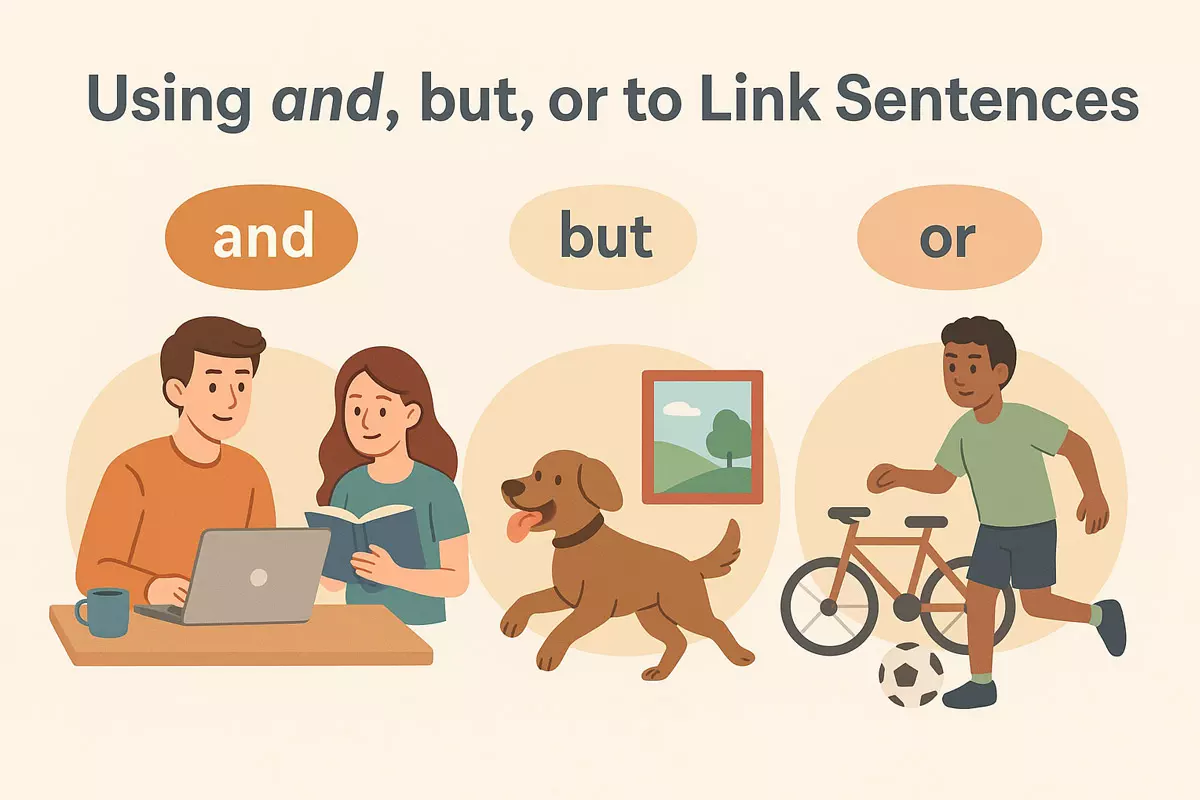 The article explains coordinating conjunctions, focusing on how and, but, and or are used for addition, contrast, and choice. It covers comma rules and provides practice joining simple sentences to improve writing clarity.
Connecting ideas smoothly is essential for clear and effective writing, as it helps your thoughts flow naturally from one point to the next. By mastering the use of simple connectors such as and, but, or, and so, you can join statements together in a way that makes your sentences more engaging and easier for readers to follow. These small linking words serve as bridges between ideas, reducing confusion and making your writing more coherent. With consistent practice, using connectors becomes second nature, greatly improving the overall quality of your communication.
What Are Coordinating Conjunctions?
Coordinating conjunctions are words that connect elements of equal grammatical rank within a sentence. Most commonly, they join two independent clauses, but they can also link words or phrases that function similarly. In English, the most familiar examples are “and,” “but,” and “or,” though there are a few others in this small group.
Core Function
The primary purpose of these connectors is to show the relationship between ideas. For instance, “and” adds or combines, “but” introduces contrast, and “or” presents alternatives. They help writers avoid repetitive or choppy sentences by smoothly linking thoughts.
Main Coordinating Conjunctions in English
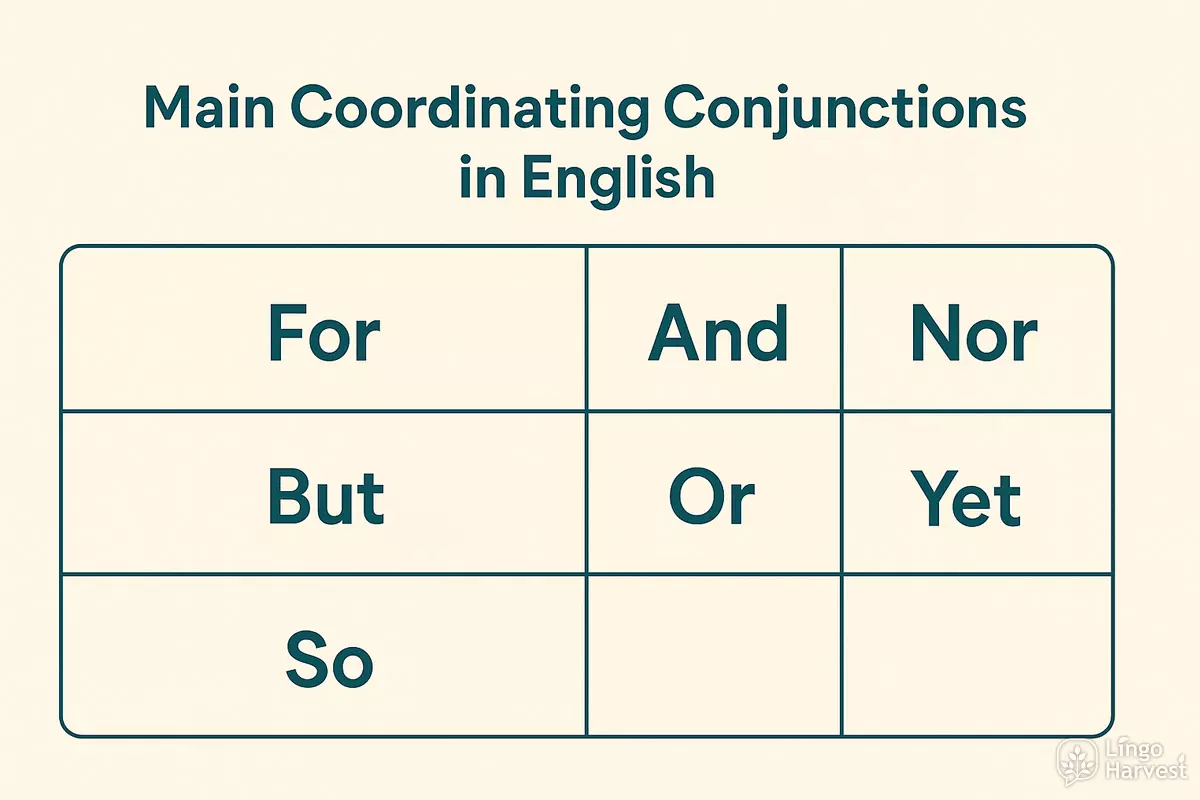
There are seven coordinating conjunctions in English, often remembered by the acronym FANBOYS:
- For → I stayed home, for it was raining.
- And → She likes coffee and tea.
- Nor → He did not call, nor did he send an email.
- But → I wanted to go, but I was too tired.
- Or → You can have cake or ice cream.
- Yet → It was cold, yet he went for a walk.
- So → She was hungry, so she made a sandwich.
Each serves a unique function, from expressing reason (“for”) to indicating consequence (“so”).
Examples in Sentences
Using these connectors, you can craft sentences such as:
- She wanted to go for a walk, but it was raining.
- We can watch a movie or play a game.
- He likes tea, and she prefers coffee.
- You can have cake or ice cream.
- The sun set, yet the sky was still bright.
- He didn’t call, nor did he write.
- She was hungry, so she made a sandwich.
How Coordinating Conjunctions Link Sentences
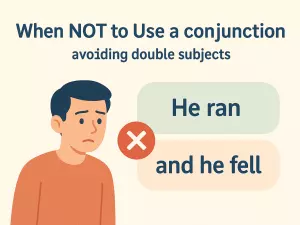
To join two independent clauses, place a comma before the conjunction. This structure keeps ideas clear and avoids run-on sentences. For example: “I finished my homework, and I went to bed.” When connecting shorter elements like words or phrases, no comma is needed: “apples and oranges.”
Quick Reference Table
| Conjunction | Relationship Expressed |
|---|---|
| And | Addition, combination |
| But | Contrast, exception |
| Or | Choice, alternative |
| Nor | Negative alternative |
| For | Reason, explanation |
| Yet | Unexpected contrast |
| So | Result, consequence |
These small but powerful words allow you to build more nuanced and connected sentences, making your writing clearer and more effective.
Using And for Addition
When you want to connect two ideas or facts that complement each other, the word and is the most common choice. This coordinating conjunction signals that information is being added, helping sentences flow smoothly and making your writing clearer. You can link words, phrases, or entire sentences with this connector.
Linking Similar Ideas with "And"
The conjunction and joins elements of equal importance. It can connect nouns, verbs, adjectives, or even whole independent clauses. This makes it an essential tool for building longer, more descriptive sentences without sounding repetitive.
- She likes apples and oranges.
- We finished our homework and watched a movie.
- The weather was cold and windy.
- He speaks English and French.
- The dog barked and ran away.
- I have a pen and a notebook.
- They laughed and cheered at the surprise.
- The room was tidy and bright.
- She wrote the letter and mailed it the next day.
- We visited the museum and took many photos.
Patterns for Joining Sentences
You can use and to link two complete sentences (independent clauses). In this case, place a comma before and to show the separation:
- He wanted to go for a walk, and she agreed.
- The sun was shining, and the birds were singing.
For shorter sentences or when connecting just words or phrases, the comma is typically omitted.
Common Mistakes to Watch For
- ❌ Don’t join unrelated ideas with and; use it only when ideas are connected.
- ❌ Avoid using and too many times in a row, which can make writing feel choppy.
- ✅ Combine similar or related actions, items, or descriptions for smoother sentences.
| Before | After Adding "And" |
|---|---|
| I like tea. I like coffee. | I like tea and coffee. |
| She sings. She dances. | She sings and dances. |
| It was late. We went home. | It was late, and we went home. |
| Tom is smart. Tom is kind. | Tom is smart and kind. |
Remember, using and helps you express connected ideas in a natural, fluid way. Practice linking your thoughts to make your sentences more engaging and easy to understand.
Using But for Contrast
When connecting two ideas that differ or oppose each other, "but" is a common coordinating conjunction. It signals a shift in thought, showing that the second part of the sentence contrasts with, limits, or corrects the first. This transition helps clarify relationships between statements, making writing clearer and more nuanced.
Common Patterns with "But"
Writers and speakers often use "but" to add nuance or express exceptions. Here are some typical ways it appears in sentences:
- He wanted to go to the party, but he was too tired.
- It's raining, but we can still go for a walk.
- She studied hard, but she didn't pass the exam.
- I like pizza, but I don't eat it often.
- They offered help, but we managed on our own.
- The movie was long, but it was interesting.
- He is young, but very talented.
- The solution is simple, but effective.
- I called her, but she didn't answer.
- The book is old, but valuable.
- We planned a picnic, but the weather changed.
- The room is small, but cozy.
- She smiled, but her eyes were sad.
- He explained, but I still didn't understand.
- The task is difficult, but not impossible.
- I agree with you, but I see it differently.
- It's cheap, but good quality.
- She apologized, but the damage was done.
Contrasting "But" with "And" and "Or"
While "and" connects similar or additional ideas, "but" introduces contrast. "Or" offers alternatives. Recognizing these differences helps in choosing the right connector for your message.
| Connector | Function | Example |
|---|---|---|
| and | Joins similar or related ideas | He likes tea and coffee. |
| but | Shows contrast or exception | He likes tea, but not coffee. |
| or | Presents alternatives or choices | Would you like tea or coffee? |
Tips for Using "But" Effectively
- Place a comma before "but" when linking two independent clauses.
- Use "but" to highlight an unexpected result or a difference.
- Avoid overusing "but" in close succession; vary your connectors for better flow.
- For formal writing, consider alternatives like "however" or "yet" for variety.
Understanding how to use contrasting conjunctions adds depth to your writing and speaking. By practicing with real examples, you can communicate differences and exceptions more clearly.
Using Or for Choice
The conjunction or is commonly used to present alternatives, options, or possibilities within sentences. It helps link ideas when a decision, preference, or selection is involved. When you use this connector, you offer two or more choices to the reader or listener, allowing them to pick one or the other.
Offering Alternatives in Sentences
Linking statements with or makes it easy to show that only one option should be chosen, or that several possibilities are available. This is especially useful in questions, instructions, or when expressing uncertainty.
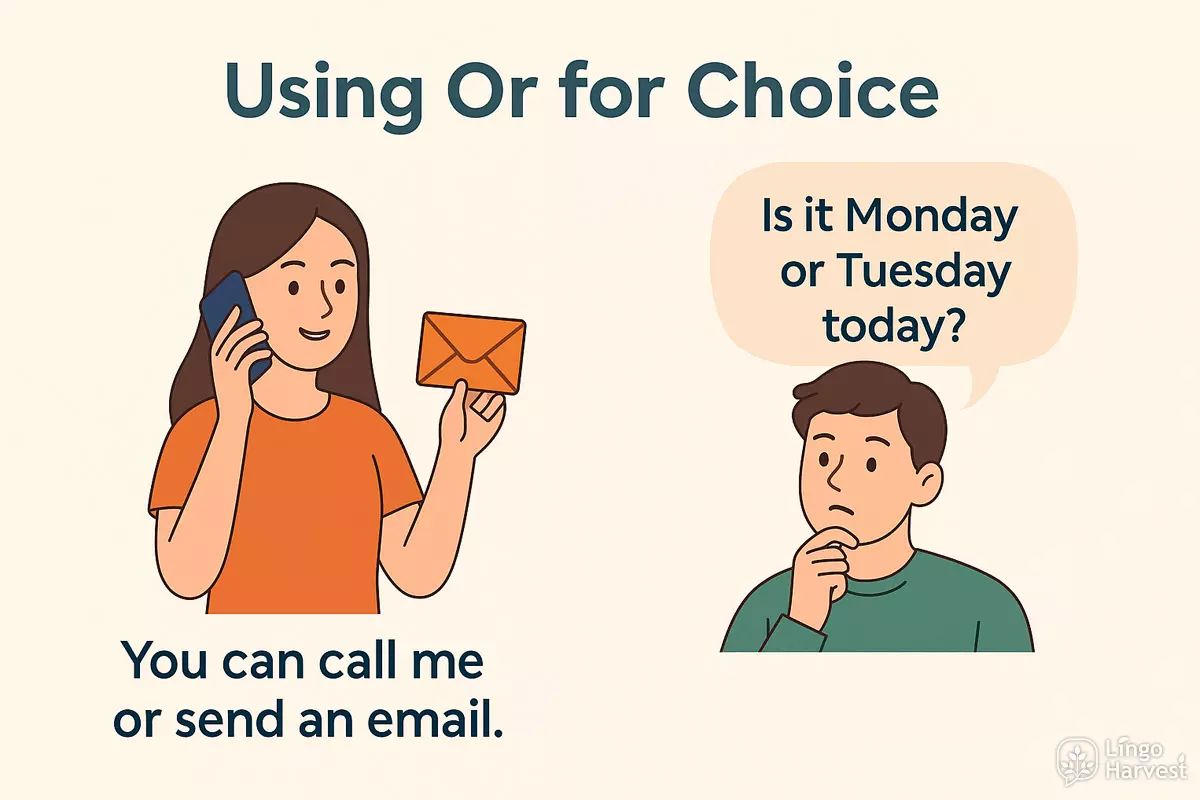
- Would you like tea or coffee?
- Should we watch a movie or go for a walk?
- You can call me or send an email.
- Is it Monday or Tuesday today?
- Do you want to eat now or later?
- Please bring your passport or ID card.
- We can meet at the cafe or the park.
- Is this your bag or hers?
- He can stay here or go home.
- Do you prefer reading or listening to music?
- Should I take notes or just listen?
- Would you like soup or salad?
- Is it better to wait or try again later?
- You may choose chocolate or vanilla.
- Shall we leave now or after lunch?
- Are you coming by bus or train?
- Do you want the window open or closed?
- Will you write the report or should I?
- Is this for here or to go?
- Can I pay by cash or card?
Common Patterns with "Or"
This conjunction often appears in both positive and negative contexts. In negative sentences, or is used after words like "not," "never," or "without" to show that neither option applies.
- She didn't call or write.
- He never speaks loudly or rudely.
- You can't enter without a ticket or a pass.
Clarifying Options with "Or"
Sometimes, or introduces a clarification or a definition, especially in explanations. For example:
- Bring your resume, or CV, to the interview.
- The capital, or main city, is very busy.
Summary Table: "Or" in Different Contexts
| Context | Example Sentence |
|---|---|
| Offering a choice | Would you like juice or water? |
| Making a suggestion | Let's eat inside or outside. |
| Negative alternatives | He didn't call or text. |
| Clarification/definition | Her pet, or companion, is a dog. |
In summary, or is an essential connector for expressing options, alternatives, and clarifications. By using it effectively, you can make your sentences clearer and more precise when presenting choices.
Comma Rules with Conjunctions
When you join two sentences with words like "and," "but," or "or," the comma often plays a key role in making your meaning clear. The main guideline is simple: if you’re connecting two independent clauses (complete sentences that could stand alone), place a comma before the coordinating conjunction. If you’re linking individual words or phrases—not full sentences—the comma usually isn’t needed.
When to Use a Comma Before "And," "But," or "Or"
A comma comes before these conjunctions when they link two independent clauses. Here’s a quick way to check: if what comes before and after the conjunction could be its own sentence, add the comma.
- He finished his homework, and he went outside to play.
- She wanted pizza, but she ordered salad instead.
- You can call me, or you can send a text.
If the second part isn’t a full sentence, skip the comma:
- He finished his homework and went outside to play.
- She wanted pizza but ordered salad instead.
Common Mistakes and How to Avoid Them
Writers sometimes place unnecessary commas when linking short phrases or compound verbs. Remember, only use the comma if each side could be a sentence on its own.
Quick Reference: Comma Placement with Conjunctions
| Correct Usage | Incorrect Usage |
|---|---|
| She reads every night, and she writes in her journal. | She reads every night and, she writes in her journal. |
| It was raining, but we went hiking. | It was raining but, we went hiking. |
| You can stay here, or you can leave early. | You can stay here or, you can leave early. |
| He washed the car and vacuumed the seats. | He washed the car, and vacuumed the seats. |
Expanded List: Examples of Proper and Improper Comma Use
- I wanted to go for a walk, but it started to rain. ✅
- Let’s eat now or wait until later. ✅
- Let’s eat now, or we can wait until later. ✅
- She likes tea and coffee. ✅
- She likes tea, and she likes coffee. ✅
- He ran to the store and bought milk. ✅
- He ran to the store, and he bought milk. ✅
- They can join us, or they can meet us there. ✅
- Finish your work but don’t rush. ✅
- Finish your work, but don’t rush. ✅
- It was cold, but sunny. ❌ (Incorrect; "sunny" isn't a full clause.)
- It was cold but sunny. ✅
- The dog barked and wagged its tail. ✅
- The dog barked, and it wagged its tail. ✅
Mastering commas with coordinating conjunctions clarifies your writing and prevents misunderstandings. Whenever you’re unsure, check if both parts could stand alone as sentences—if so, a comma is your friend.
Practice: Join Simple Sentences
Combining short statements with coordinating conjunctions like and, but, and or is an essential skill for clear, fluent writing. Let's practice turning two simple ideas into one compound sentence using these helpful connectors. Below you’ll find a series of exercises to build your confidence and understanding.
Task 1: Combine Sentences with the Right Connector
Read each pair of statements. Rewrite them as one sentence, using and, but, or or as appropriate. Think about whether the ideas add together, contrast, or offer a choice.
- She likes tea. She likes coffee.
- It was raining. We went for a walk.
- You can have soup. You can have salad.
- He is tired. He finished his homework.
- The store is open. The store is empty.
- I called him. He did not answer.
- We could watch a movie. We could play a game.
- The sun is shining. It is cold outside.
- She speaks Spanish. She does not speak French.
- You can start now. You can wait until later.
Show answers
- She likes tea and coffee.
- It was raining, but we went for a walk.
- You can have soup or salad.
- He is tired, but he finished his homework.
- The store is open, but it is empty.
- I called him, but he did not answer.
- We could watch a movie or play a game.
- The sun is shining, but it is cold outside.
- She speaks Spanish, but she does not speak French.
- You can start now or wait until later.
Task 2: Identify the Best Connector
For each group, choose whether to join the sentences with and, but, or or. Explain your choice briefly.
- He bought apples. He bought oranges.
- I am allergic to cats. I have a cat.
- Shall we take the bus? Shall we walk?
- She finished early. She helped her friend.
- He studied hard. He failed the test.
- We can go to the park. We can stay home.
- She wanted to call. She didn’t have time.
- Tom is tall. Tom is strong.
- Do you want tea? Do you want coffee?
- He ran quickly. He missed the train.
Show answers
- And — He bought apples and oranges. (Adding information)
- But — I am allergic to cats, but I have a cat. (Contrasting ideas)
- Or — Shall we take the bus or walk? (Offering choices)
- And — She finished early and helped her friend. (Sequence/addition)
- But — He studied hard, but he failed the test. (Contrasting ideas)
- Or — We can go to the park or stay home. (Offering choices)
- But — She wanted to call, but she didn’t have time. (Contrasting ideas)
- And — Tom is tall and strong. (Adding information)
- Or — Do you want tea or coffee? (Offering choices)
- But — He ran quickly, but he missed the train. (Contrasting ideas)
Common Patterns for Joining Ideas
Here are some typical ways to connect simple statements. Notice how the meaning changes depending on the conjunction:
- and – for adding similar or related ideas
Example: The dog barked and the cat hissed. - but – for showing contrast or exception
Example: He is tall, but he cannot reach the shelf. - or – for giving options or alternatives
Example: We can eat now or wait for them.
Quick Reference Table: Choosing the Right Connector
| Connector | When to Use |
|---|---|
| and | To add or link similar ideas, actions, or qualities. She reads and writes stories. |
| but | To contrast two different or unexpected ideas. He wanted to help, but he was late. |
| or | To offer choices or alternatives. Would you like tea or coffee? |