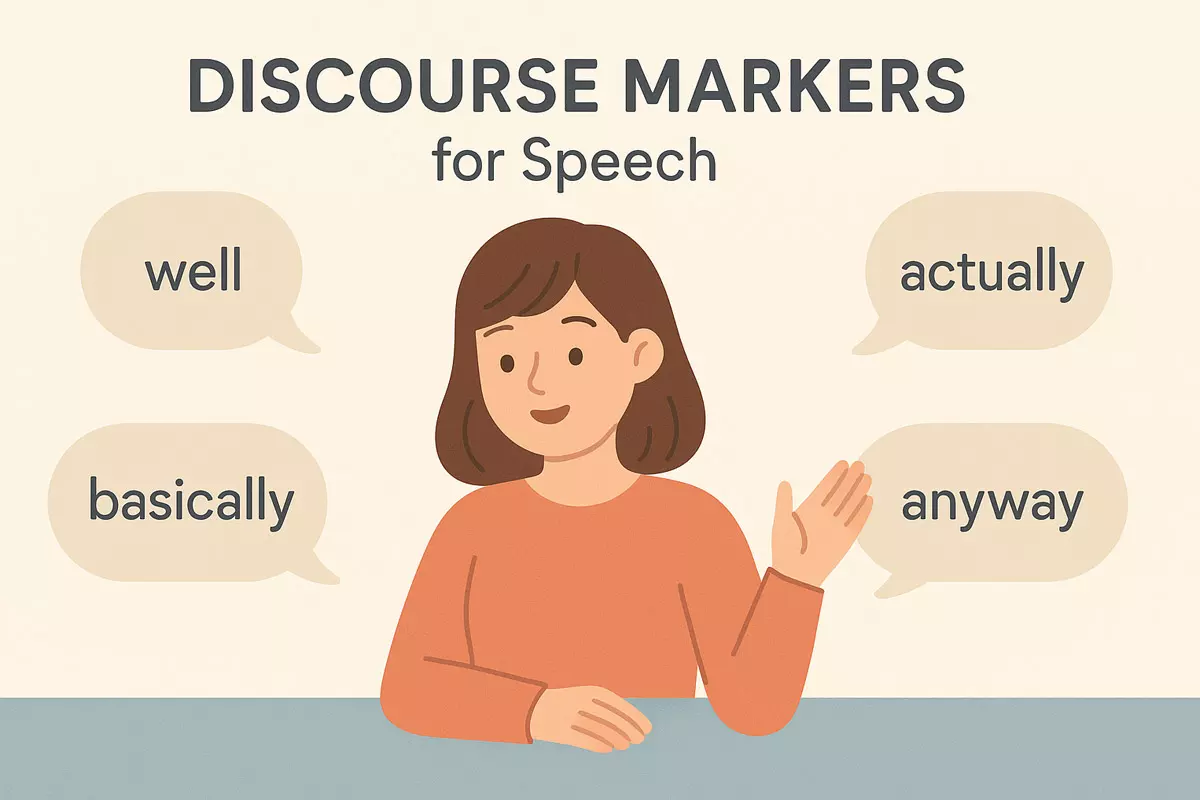
Discourse Markers for Speech (well, actually, basically, anyway)

 The article defines discourse markers, lists common spoken examples, and explains their roles as fillers, softeners, and organizers.
When we speak, certain words and phrases help guide conversations smoothly and make our thoughts clearer. Terms such as well, actually, basically, and anyway play a subtle but important role in how we interact every day. These expressions can signal hesitation, introduce clarification, or shift the topic, allowing us to navigate conversations more effectively. By understanding the impact of these common words, we can become more aware of how language shapes our interactions and improves communication in daily life.
What Discourse Markers Are
Discourse markers are words or short phrases that help organize spoken language, making conversations flow more naturally and ideas easier to follow. They don’t carry much literal meaning but play an important role in managing how speakers connect ideas, express attitudes, or signal transitions in speech. You’ll often hear them at the start of sentences or when a speaker shifts topics, clarifies, or responds.
Functions in Conversation
These expressions serve several purposes in everyday communication:
- Signaling a change in topic (e.g., "Anyway, let's move on")
- Introducing clarification or correction ("Actually, I meant Tuesday, not Monday")
- Softenening responses or opinions ("Well, I’m not sure about that")
- Summing up or concluding thoughts ("Basically, that’s all you need to know")
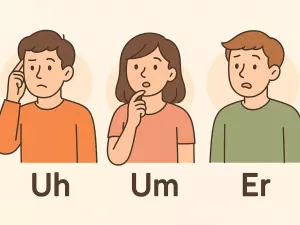
- Providing time to think or hesitate ("So, um, what do you think?")
- Showing agreement or understanding ("Right, I see what you mean")
- Managing turn-taking in dialogue ("Okay, your turn")
- Expressing contrast or exception ("However, there’s another option")
- Highlighting important points ("Look, this is crucial")
- Returning to a previous point ("As I was saying...")
Common Examples of Discourse Markers
Some frequently used markers in English include:
- Well
- Actually
- Basically
- Anyway
- So
- Right
- You know
- Like
- Now
- Okay
- However
- Then
- I mean
- As I was saying
- Look
- In fact
- By the way
- Mind you
- Still
How They Work in Speech
These markers act as conversational signals for listeners, guiding them through the speaker’s thoughts and indicating what comes next. For example, "well" can show hesitation or introduce a contrasting idea, while "anyway" may signal a return to the main topic. They’re especially useful in informal settings, helping to keep spoken language dynamic and interactive.
Discourse Markers vs. Other Connectors
While sometimes confused with conjunctions or linking words, discourse markers are unique because they often stand alone and don’t connect specific grammatical elements. Instead, they organize whole stretches of conversation or signal the speaker’s attitude.
| Discourse Marker | Typical Use in Conversation |
|---|---|
| Well | Expressing hesitation, softening disagreement |
| Actually | Correcting information, introducing new facts |
| Basically | Summarizing or simplifying an explanation |
| Anyway | Changing topic, returning to a previous subject |
| So | Introducing results, starting a new topic |
| Right | Showing agreement or transition to next point |
| By the way | Adding extra or unrelated information |
| Look | Drawing attention to something important |
Using these expressions helps speakers sound more natural and makes interactions smoother for everyone involved.
Types of Common Spoken Markers
Spoken English is full of little words and phrases that help conversations flow. These expressions often signal a speaker’s attitude, organize ideas, or show a change in topic. Some are used to buy thinking time, while others clarify, contrast, or sum up information. Understanding these can make speech sound more natural and easier to follow.
Examples of Frequently Used Markers
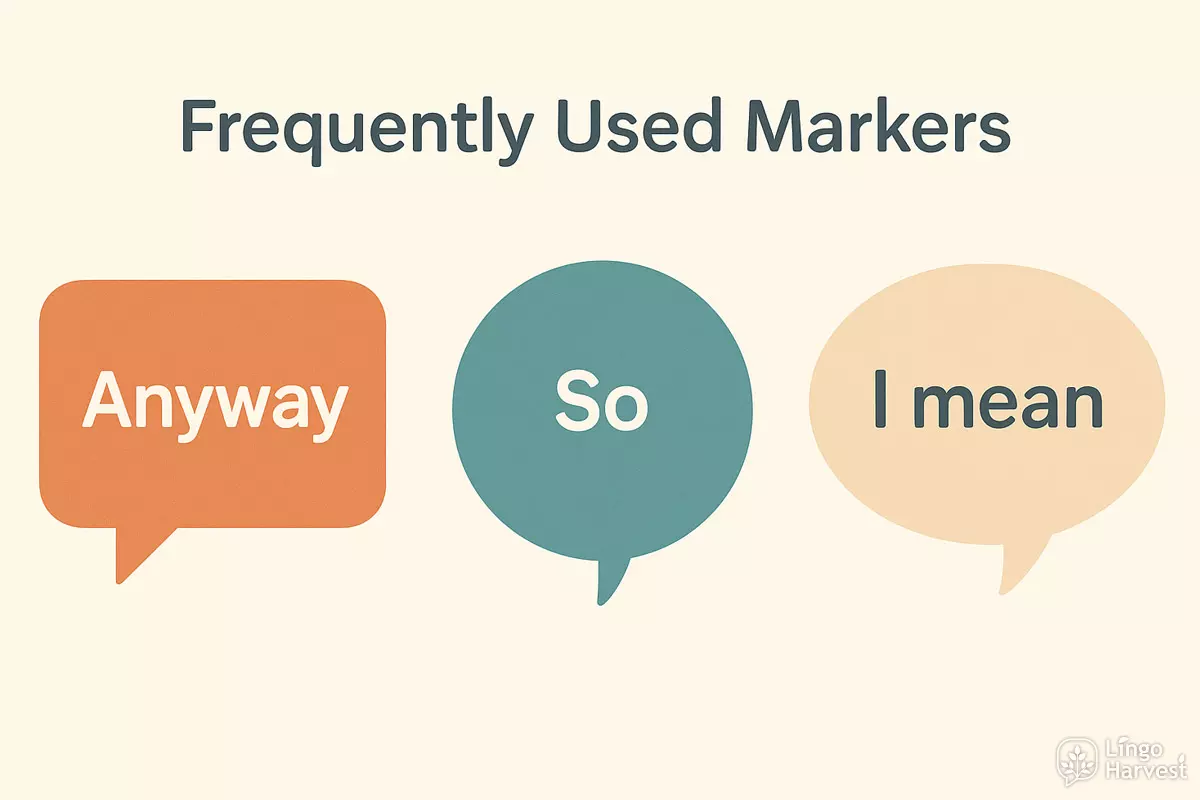
- Well – Used to introduce a response, soften disagreement, or signal hesitation.
- Actually – Often corrects or clarifies information, or adds emphasis.
- Basically – Summarizes or simplifies a point.
- Anyway – Changes the subject or wraps up a topic.
- So – Indicates a result or moves to the next part of the conversation.
- You know – Checks for understanding or agreement.
- I mean – Clarifies or rephrases what was just said.
- Right – Seeks confirmation or agreement.
- Like – Gives examples, softens statements, or fills pauses.
- To be honest – Signals a frank or personal comment.
- By the way – Introduces an additional, often unrelated point.
- In fact – Emphasizes or adds surprising detail.
- At the end of the day – Summarizes or gives a final judgement.
- Well, anyway – Used together to move past a topic or resume after a distraction.
- Sort of / kind of – Makes statements less direct or certain.
- Look – Signals importance or draws attention before making a point.
- Now – Introduces a new topic or draws focus.
- Actually, – Used at the start of a sentence to correct or clarify.
Functions of Spoken Markers
These conversational tools serve different functions in speech. Some common purposes include:
- Organizing thoughts (e.g., “So”, “Now”)
- Managing the flow (e.g., “Anyway”, “By the way”)
- Softeners and hedges (e.g., “Kind of”, “Sort of”, “Well”)
- Clarifying or correcting (e.g., “Actually”, “I mean”)
- Summarizing (e.g., “Basically”, “At the end of the day”)
| Marker | Typical Use | Example in Conversation |
|---|---|---|
| Well | Softening a reply or showing hesitation | Well, I’m not sure that’s the best idea. |
| Actually | Correcting or clarifying | Actually, I meant next Friday, not this one. |
| Basically | Summing up or simplifying | Basically, we just need to finish the report. |
| Anyway | Changing topic or returning to a point | Anyway, let’s get back to the main issue. |
| By the way | Adding extra information | By the way, did you get my email? |
| I mean | Clarifying a previous statement | He was late — I mean, really late. |
| So | Introducing a result or next step | So, what do you want to do now? |
| To be honest | Signaling honesty or personal opinion | To be honest, I didn’t enjoy the movie. |
Using these expressions naturally takes practice, but learning their roles can help make everyday conversations smoother and more engaging.
Functions: Fillers, Softeners, Organizers
Discourse markers such as "well," "actually," "basically," and "anyway" play several important roles in spoken language. They help speakers manage the flow of conversation, signal attitude, and structure their ideas for listeners. Rather than carrying concrete meaning, these words often serve to organize thoughts, create pauses, and adjust the tone of interactions.
Fillers: Giving Speakers Time
Many discourse markers act as fillers, letting speakers pause to think or prepare their next point without losing their turn in the conversation. Using these words can help avoid awkward silences and signal that more information is coming. For example:
- Well, let me think about that...
- Basically, what I mean is...
- Actually, I’m not sure about that.
- Anyway, as I was saying...
Softeners: Reducing Directness
Markers often soften statements, making them less abrupt or confrontational. This can be useful for polite disagreement, corrections, or hedging opinions. For instance, "actually" can gently correct, while "well" can introduce disagreement more diplomatically. Some ways these expressions soften speech include:
- Introducing corrections: Actually, it’s tomorrow, not today.
- Signaling uncertainty: Well, I’m not entirely sure.
- Downplaying opinions: Basically, I guess that’s how I feel.
- Changing topics gently: Anyway, let’s move on.
Organizers: Structuring Conversation
Discourse markers help organize spoken language, guiding listeners through shifts in topic, summaries, or returns to previous ideas. They can highlight a transition or indicate that a point is being wrapped up. Some common uses include:
- Introducing new topics: Anyway, have you heard the news?
- Returning to a previous subject: So, as I was saying earlier...
- Summarizing: Basically, it’s all about teamwork.
- Clarifying or correcting: Actually, what I meant was...
Comparison of Common Discourse Markers
| Discourse Marker | Typical Function | Example in Conversation |
|---|---|---|
| Well | Filler, softener, introducing hesitation or response | Well, I’m not sure that’s true. |
| Actually | Correction, softener, clarifying information | Actually, it starts at seven, not eight. |
| Basically | Summarizing, simplifying, organizing explanation | Basically, we just need to finish the last part. |
| Anyway | Topic shift, returning to main point, concluding | Anyway, let’s get back to the agenda. |
Expanded List of Useful Markers
To further illustrate, here are additional discourse markers frequently used in everyday speech:
- So
- You know
- I mean
- Like
- Right
- Now
- Then
- By the way
- In fact
- To be honest
- Let’s see
- Anyway
- Basically
- Well
- Actually
- Look
- Okay
- Alright
- At the end of the day
- After all
Register and Tone: Formal vs Informal Use
Discourse markers such as well, actually, basically, and anyway are far more common in everyday conversation than in formal presentations or academic writing. The choice to use these words often signals the level of formality and the relationship between speakers. In more relaxed or familiar settings, these markers help structure speech, indicate hesitation, or smoothly change topics. In contrast, formal communication tends to restrict their use, favoring clearer, more direct transitions and logical connectors.
Discourse Markers in Informal Contexts
In casual speech, these expressions serve a variety of purposes:
- well – softens responses, buys thinking time, or introduces opinions
- actually – corrects or clarifies previous information
- basically – simplifies complex ideas or summarizes points
- anyway – returns to the main topic or closes a digression
- so – signals a conclusion or consequence
- you know – seeks agreement or confirmation
- like – adds emphasis or gives examples
- right – checks understanding or agreement
- I mean – rephrases or clarifies a statement
- okay – signals transition or checks readiness
- just – softens requests or statements
- anyhow – similar to “anyway,” often used to move on
- by the way – introduces a new, often unrelated topic
- well then – shifts direction or signals a decision
- to be honest – introduces a candid or personal comment
- at the end of the day – summarizes or concludes
- in fact – adds emphasis or corrects
- after all – justifies a point or action
- as I was saying – returns to a previous subject
- on the other hand – introduces contrast
Formal Alternatives and Restrictions
More structured communication, such as business meetings, academic lectures, or official documents, typically relies on explicit connectors and avoids conversational fillers. Instead of informal discourse markers, speakers and writers may use:
- however
- therefore
- moreover
- in conclusion
- furthermore
- nevertheless
- in summary
- consequently
- thus
- additionally
- in contrast
- on the contrary
- alternatively
- as a result
- on the other hand
- in other words
- for example
- for instance
- similarly
- to sum up
These alternatives maintain a professional tone and ensure clarity, particularly in written formats where ambiguity or informality could be misunderstood.
Usage Comparison: Informal vs Formal
| Discourse Marker | Typical Setting | Formality Level |
|---|---|---|
| well | Conversation, interviews | Informal |
| actually | Discussion, casual correction | Informal, sometimes semi-formal |
| basically | Explaining, simplifying | Informal |
| anyway | Changing topic, ending story | Informal |
| however | Presentations, essays | Formal |
| therefore | Reports, academic speech | Formal |
| so | Conversation, storytelling | Informal, sometimes semi-formal |
| in conclusion | Academic writing, formal talks | Formal |
Key Takeaways
Choosing the right discourse marker depends on the context and the desired level of formality. Overusing informal markers in formal situations can reduce credibility, while using formal connectors in casual talk may seem stiff or unnatural. Awareness of these distinctions helps speakers and writers adjust tone and register for their audience.
Avoiding Overuse and Empty Noise
Discourse markers like well, actually, basically, and anyway help conversations flow, but excessive repetition can distract listeners and dilute your message. Instead of filling every pause with a marker, it’s more effective to use them intentionally, signaling transitions or clarifying your stance only when needed.
Recognizing When Markers Become Filler
Listeners often tune out when they notice you rely on certain words as verbal crutches. Pay attention to how often you insert these expressions—if they appear in nearly every sentence, it’s probably too much. Recording yourself or asking for feedback can help reveal hidden habits.
Strategies to Minimize Unnecessary Usage
- Pause silently instead of saying "well" or "um"—a brief moment of silence can be more powerful.
- Replace vague markers with specific statements (e.g., "to summarize" instead of "anyway").
- Use discourse markers primarily to signal genuine shifts in topic or emphasis.
- Vary your vocabulary: alternate between different expressions or omit them entirely.
- Edit your speech in real time—if you notice yourself about to add a marker, try pausing or continuing directly.
- Focus on your main point instead of "softening" statements with fillers like "basically" or "actually."
- Practice concise responses during conversations or presentations.
- Ask a friend to point out when you overuse certain expressions.
- Record and review your speech to spot patterns of filler word use.
- Prepare transitions in advance for presentations to avoid defaulting to habitual markers.
Common Pitfalls and Better Alternatives
- Overusing "actually" can make you sound defensive or overly corrective.
- Repeated "well" at the start of answers may appear hesitant.
- Starting every new point with "anyway" can seem dismissive.
- "Basically" used too often can make explanations sound oversimplified.
Impact of Reducing Filler Words
When you limit superfluous discourse markers, your speech becomes clearer and more authoritative. Audiences are more likely to focus on your ideas, and your confidence comes through more strongly. Ultimately, thoughtful use of these expressions enhances both comprehension and engagement, while minimizing what listeners perceive as "empty noise."
Discourse Markers in Conversations and Stories
In both spoken exchanges and narratives, certain short words or phrases help speakers organize their thoughts, signal changes in topic, or clarify their intentions. These connecting expressions, such as well, actually, basically, and anyway, serve as subtle guides for listeners, helping conversations and stories flow more naturally. They rarely add factual information, but they are crucial for managing interaction, expressing attitude, and structuring speech.
Common Functions in Dialogue and Storytelling
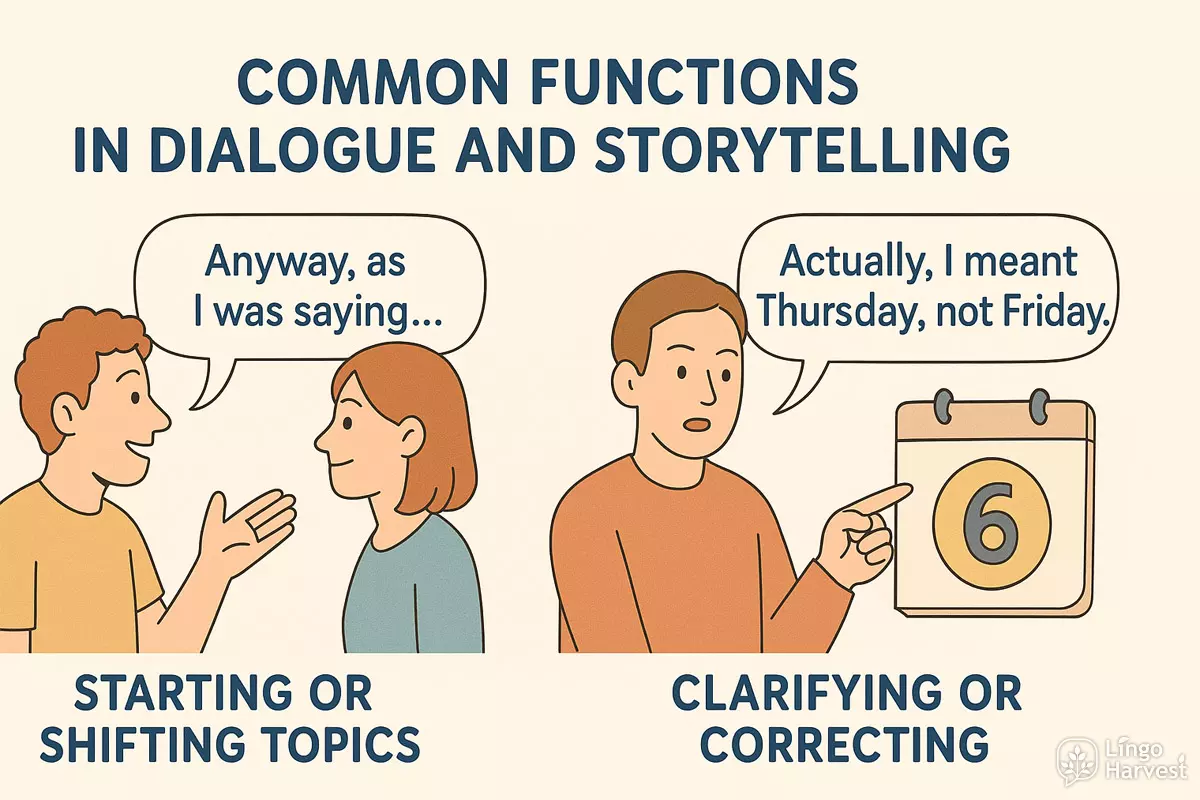
- Starting or shifting topics: “Well, let’s begin…” or “Anyway, as I was saying…”
- Clarifying or correcting: “Actually, I meant Thursday, not Friday.”
- Simplifying explanations: “Basically, the idea is to save more each month.”
- Returning to a main point: “Anyway, the important thing is…”
- Softening disagreement: “Well, I see your point, but…”
- Summing up: “So, in short, we decided to wait.”
- Expressing hesitation: “Well, I’m not sure about that…”
- Introducing examples: “For example, actually, this happened last week.”
- Marking contrast: “On the other hand, basically, it’s safer to wait.”
- Resuming after interruption: “Anyway, where was I?”
How Usage Differs in Conversation vs. Narrative
In casual talk, these markers often signal attitude, uncertainty, or a change in direction. For instance, well can show hesitation before giving an answer, while actually often introduces corrections or contrasts. In stories, they help guide the listener through events, making the sequence clear and engaging.
| Marker | Typical Use in Speech | Effect on Listener |
|---|---|---|
| Well | Signals hesitation, introduces a response, softens disagreement | Makes speech sound more natural, less abrupt |
| Actually | Corrects information, introduces a surprising fact | Draws attention to a correction or contrast |
| Basically | Simplifies or summarizes a point | Helps listeners focus on the core idea |
| Anyway | Returns to the main topic, shifts direction | Guides the conversation back on track |
Tips for Using These Markers Effectively
- Use them to help your listener follow your thoughts, not just as fillers.
- Try to match your choice of marker to the function you need—clarifying, shifting, summarizing, or softening.
- Pay attention to native speakers for natural placement and frequency.
- Don’t overuse; too many markers can make speech seem hesitant or unfocused.
Mastering these small, often overlooked words can make your spoken English sound more fluent and relatable, whether you’re chatting with friends or telling a story.
Practice: Add Markers to Short Dialogues
Applying discourse markers like "well," "actually," "basically," and "anyway" can make short exchanges sound more natural and fluent. Here you’ll find practical activities to help you insert these expressions into brief dialogues and see how meaning or tone shifts. Try the exercises below to practice your skills.
Insert the Appropriate Discourse Marker
Read each dialogue and add one of the following: well, actually, basically, or anyway. Think about the intended meaning — for example, correcting, summarizing, hesitating, or moving the conversation along.
- A: Did you finish your homework?
B: ______, I got most of it done, but I still have some math left. - A: Is this your first time here?
B: ______, I came once before with my cousin. - A: So, what do you think about the new policy?
B: ______, it doesn’t really affect me. - A: Are we finished with the meeting?
B: ______, let’s talk about the next steps. - A: I heard you moved to a new apartment.
B: ______, it’s not exactly new, but it’s new to me. - A: Did you like the movie?
B: ______, it was okay, but not my favorite. - A: Are you sure this is the right bus?
B: ______, it should take us there. - A: Why did you switch jobs?
B: ______, I wanted something closer to home. - A: Is the test very difficult?
B: ______, it’s mostly multiple choice, so it’s not too bad. - A: Did you call your friend back?
B: ______, I completely forgot!
Show answers
- Well, I got most of it done, but I still have some math left.
- Actually, I came once before with my cousin.
- Basically, it doesn’t really affect me.
- Anyway, let’s talk about the next steps.
- Well, it’s not exactly new, but it’s new to me.
- Well, it was okay, but not my favorite.
- Basically, it should take us there.
- Basically, I wanted something closer to home.
- Actually, it’s mostly multiple choice, so it’s not too bad.
- Well, I completely forgot!
Common Functions of Each Marker
Here’s a quick reference for when to use each of the four expressions:
- Well: To hesitate, soften an answer, or introduce a change in direction.
- Actually: To correct or clarify information, sometimes politely contradicting.
- Basically: To summarize, simplify, or give the main point.
- Anyway: To move the conversation forward or return to a previous topic.
Expand the Dialogue
Now, try to add a discourse marker to each of your own short exchanges. Choose a context from the list and write a two-line conversation using one of the markers:
- Ordering food at a café
- Explaining why you’re late
- Describing weekend plans
- Giving directions
- Talking about a recent movie
- Discussing a sports event
- Making a suggestion at work
- Apologizing for a mistake
- Inviting someone to an event
- Reacting to surprising news
Show answers
- Ordering food at a café: Well, I’ll have the soup, please.
- Explaining why you’re late: Actually, the bus was delayed.
- Describing weekend plans: Basically, I’m just going to relax at home.
- Giving directions: Anyway, just go straight and turn left at the light.
- Talking about a recent movie: Well, it was interesting, but a bit long.
- Discussing a sports event: Actually, our team won in the last minute.
- Making a suggestion at work: Basically, we need to update the software.
- Apologizing for a mistake: Well, I’m sorry about that.
- Inviting someone to an event: Anyway, if you’re free, you should come!
- Reacting to surprising news: Actually? I had no idea!
Practicing with these markers helps your speech sound more fluent and authentic. Try using different expressions in your daily conversations to get comfortable with their subtle differences.