Passive Voice Without By: Unknown or Obvious Doers

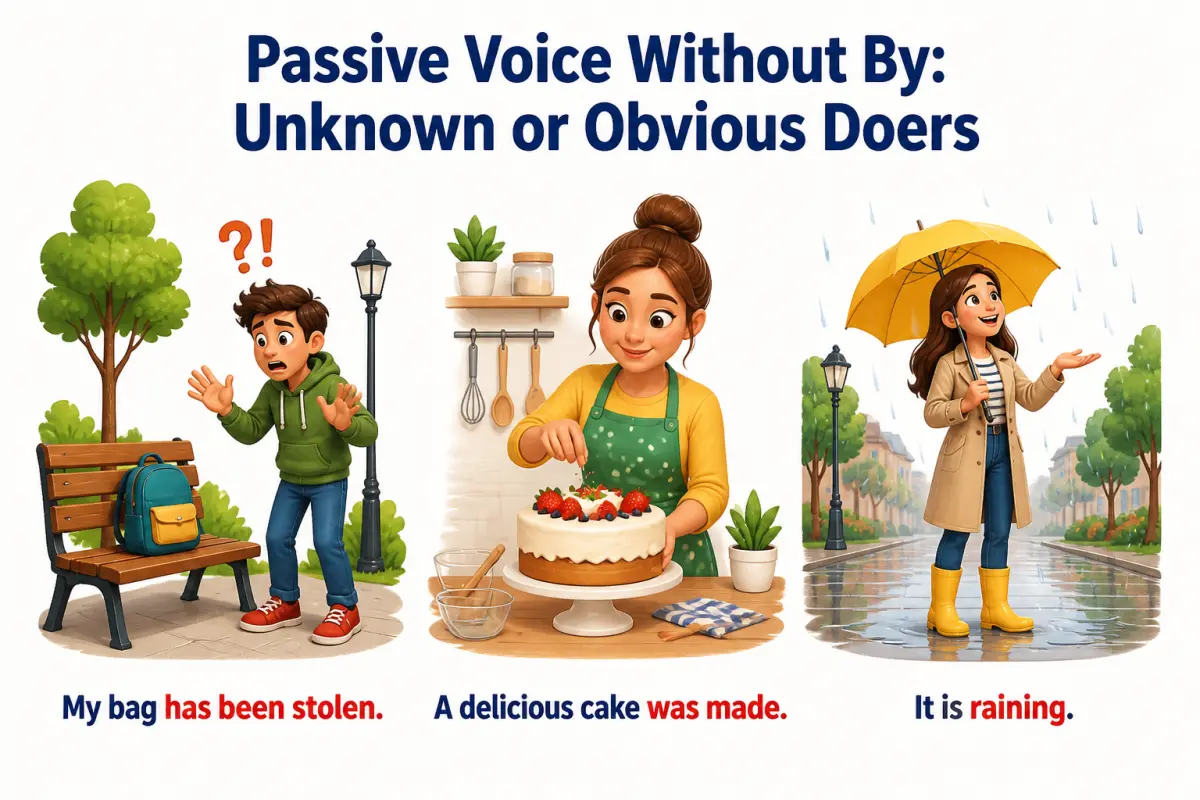 Here we why passive voice often appears without by, especially when the doer is unknown, obvious, impossible to name, or not important. It also explains how signs, rules, and announcements use this pattern, how meaning changes when the agent is removed, plus common mistakes, practice, and an FAQ.
- Why passive voice often appears without by
- When the doer is unknown or impossible to name
- When the doer is obvious from the situation
- When the doer is not important to the message
- Passive sentences in signs, rules, and announcements
- How meaning changes when the by-phrase is removed
- Natural passive examples with no named agent
- Mistakes with unnecessary by-phrases in English
- Practice: remove or add the agent in passive sentences
- FAQ: passive voice without by
In English, passive sentences are often used without naming the person who did the action. This happens when the doer is unknown, unimportant, obvious from context, or better left out for tone. In everyday speech, news reports, instructions, signs, and formal writing, the result often matters more than the person responsible.
This is why sentences like “My bike was stolen,” “The meeting has been canceled,” and “Smoking is prohibited” sound complete without a by-phrase. The passive voice can focus the listener on what happened, what changed, or what rule applies, instead of forcing the sentence to name an actor that does not add useful information.
Why passive voice often appears without by
Learners often meet passive sentences like “The window was broken,” “Your order has been shipped,” or “English is spoken here,” and ask the same question: “Where is by?” The answer is simple: in real English, the by-phrase is optional. We add it only when the agent gives useful information.
The core passive pattern is be + past participle. A by-phrase can be added after it, but it is not part of every passive sentence. This is an important point because some learners incorrectly memorize passive voice as “be + past participle + by.” That formula creates unnatural sentences such as “Lunch is served by the staff” when the doer is already obvious.
For the full form system across tenses, the guide to passive voice verb forms is useful, but the main idea here is simple: passive voice can be complete without naming the doer.
| Sentence | Main focus | Why no by-phrase sounds natural |
|---|---|---|
| The documents were lost. | The problem | The doer may be unknown or not worth mentioning. |
| Dinner is served at 7. | The schedule | The person serving dinner is obvious or irrelevant. |
| Mobile phones are not allowed. | The rule | The authority behind the rule does not need to be named. |
| My bike was stolen. | The event and its effect | The thief is unknown. |
A useful habit is to ask: Does the listener need to know who did it? If the answer is no, leaving out by is usually the most natural choice.
Teacher note: Many students try to complete every passive sentence with “by someone.” In natural English, that often weakens the sentence. If the agent adds no real information, remove it.
When the doer is unknown or impossible to name

One of the most common reasons for dropping the agent is that we genuinely do not know who did the action. If your wallet was stolen, your car was damaged overnight, or a file was deleted from your account, the agent may be impossible to identify. Passive voice lets you describe the event without pretending to know more than you do.
This is especially common with crimes, accidents, historical facts, and old information. We often know that something happened, but not exactly who was responsible. A sentence like “The painting was damaged during the move” is honest and natural because it reports the event without forcing a guess.
- My laptop was taken from the office.
- The lights were left on all night.
- Several files were deleted by mistake.
- The castle was built in the 12th century.
- His name was never recorded.
In some of these examples, the doer is not only unknown but impossible or unrealistic to recover. If a building was constructed 800 years ago, the speaker may not know which workers built it, and naming them would not help the sentence.
Here are useful active-to-passive contrasts:
- Active: Someone stole my passport.
Passive: My passport was stolen. - Active: Somebody damaged the door.
Passive: The door was damaged. - Active: People built this bridge in 1890.
Passive: This bridge was built in 1890.
In each passive sentence, the important information is still clear. The sentence does its job even without the agent.
When the doer is obvious from the situation
Sometimes the agent is left out because everyone already understands who does the action. In a restaurant, “Dinner is served at 7” clearly means the staff serve it. At an airport, “Passengers are requested to keep their bags with them” clearly comes from the airport or airline. Adding the agent would usually sound heavy because the context already supplies it.
This happens constantly in daily life. We do not normally say “The room is cleaned by the hotel staff every morning” unless we need to contrast the staff with someone else. “The room is cleaned every morning” is enough because the listener can infer the doer.
Compare these pairs:
- The coffee is served after the meal.
The coffee is served by the waiters after the meal. - Applications must be submitted by Friday.
Applications must be submitted by students by Friday. - English is taught from the first year.
English is taught by trained teachers from the first year.
The second sentence in each pair is only useful if the speaker wants to emphasize that exact agent. Without that purpose, it sounds unnecessarily obvious.
Context often tells us the hidden agent:
- At school: “Homework is checked every Monday.”
- In a hotel: “Breakfast is served until 10.”
- In an office: “Visitors are asked to sign in.”
- In a hospital: “Patients are seen in order of arrival.”
English prefers efficiency. If the listener can easily guess the agent, we usually do not spell it out.
When the doer is not important to the message
Another common reason for using passive voice without by is that the doer exists but is not the main point. In many situations, the speaker wants to focus on the action, result, or affected object rather than the person behind it. “The meeting has been canceled” is often more useful than “The manager has canceled the meeting” if the real message is the cancellation itself.
This is why passive voice is frequent in business emails, reports, academic writing, customer messages, and public updates. It creates a more objective tone and keeps attention on the information that matters most to the reader.
Look at these pairs:
- We have changed your appointment.
Your appointment has been changed. - The company will refund the money.
The money will be refunded. - Someone has made a mistake in the report.
A mistake has been made in the report.
The passive versions are useful when the result is more important than the actor. Sometimes this also makes the sentence sound more neutral. For example, “A mistake has been made” can soften blame, while “You made a mistake” sounds direct and personal.
This difference connects closely with the broader choice between active and passive voice. Active voice is clearer when responsibility matters. Passive voice is often better when the result, process, or affected thing is the real topic.
Teacher note: In workplace English, passive forms are often chosen not because they are “better grammar,” but because they manage tone. “The form wasn’t attached” sounds less confrontational than “You didn’t attach the form.”
Use the passive without by when the message is really аbout:
- the result: “The package has been delivered.”
- the process: “All requests are reviewed carefully.”
- the affected object: “Three windows were broken in the storm.”
- the event itself: “The concert was postponed.”
When adverbs are added to passive sentences, placement can affect clarity. For example, “All requests are carefully reviewed” and “All requests are reviewed carefully” are both possible, but they do not feel exactly the same in every context. This is explained in more detail in the guide to adverb placement in passive voice.
Passive sentences in signs, rules, and announcements
Public English often uses passive structures with no named agent because the message must be short, clear, and impersonal. Signs, official notices, instructions, and announcements usually care about what is required, not about naming the authority behind the rule.
Forms like “is prohibited,” “are required,” “must be shown,” and “will be fined” are common because they make the rule sound general and official. A sign saying “Cars are not permitted beyond this point” sounds more standard than “We do not permit cars beyond this point.”
- Smoking is prohibited.
- Payment must be made in advance.
- Bags may be checked at the entrance.
- Tickets should be shown on request.
- Late work will not be accepted.
- Passengers are advised to remain seated.
These are natural because the source of authority is either obvious or not the point. The school, company, station, government office, or event organizer is behind the message, but naming them would not improve the sentence.
| Context | Natural passive form | Why the agent is omitted |
|---|---|---|
| School notice | Uniforms must be worn at all times. | The school is the obvious authority. |
| Airport announcement | Boarding will be announced shortly. | The staff or speaker system is understood. |
| Museum sign | Photographs are not allowed. | The rule matters more than the rule-maker. |
| Office email | ID badges must be displayed. | The requirement is the main message. |
Many of these sentences use modal passive forms such as must be worn, may be checked, or should be shown. For more examples of this structure, see passive modal verbs.
How meaning changes when the by-phrase is removed

Removing the agent does not usually change the basic fact of the action, but it can change the focus, tone, and implication. The event stays the same, yet the sentence may sound more neutral, more general, less personal, or less informative.
This matters because grammar choices are also communication choices. Compare these pairs:
- The final decision was made.
The final decision was made by the director. - The mural was painted last year.
The mural was painted last year by local students. - The article was translated into Spanish.
The article was translated into Spanish by my colleague.
In each second sentence, the agent adds new meaning. The first pair becomes more authoritative when we hear “by the director.” The second becomes more interesting because “local students” adds social detail. The third becomes more personal and specific.
Now look at three practical contrasts:
- Neutral report: The invoice was sent yesterday.
Specific responsibility: The invoice was sent yesterday by Carla. - Focus on damage: The statue was broken.
Focus on cause or blame: The statue was broken by a tourist. - General historical statement: The temple was restored in the 1990s.
More detailed history: The temple was restored in the 1990s by Italian architects.
When you remove the by-phrase, the sentence often becomes broader and less tied to a person or group. Sometimes that is good. Sometimes it hides useful information. The correct choice depends on your purpose.
There is also a style effect. If you keep adding by-phrases where they are not needed, your English may sound heavy. If you always remove them, you may lose important details.
Teacher note: After writing a passive sentence, ask: “If I add the agent, do I learn something useful?” If the answer is no, leave it out.
Natural passive examples with no named agent
The best way to feel comfortable with this pattern is to notice how often it appears in ordinary situations. Many passive sentences without a named agent sound completely natural because English speakers use them to report events, give instructions, describe systems, and explain results.
Read these examples as whole messages, not just grammar patterns:
- Your table has been reserved for 8:30.
- The results will be posted tomorrow morning.
- The kitchen is cleaned every evening.
- Several new courses have been added this term.
- The street was blocked after the accident.
- No credit cards are accepted at this counter.
- The problem is being investigated.
- Fresh towels can be requested at reception.
- The files were uploaded successfully.
- This medication should be taken with food.
- Seats are assigned at check-in.
- The bill has already been paid.
These examples are natural for different reasons. In some, the agent is obvious. In others, it is unknown. In others, the sentence is mainly about procedure or result.
It also helps to compare common active ideas with more natural passive versions:
- Someone has changed the schedule. → The schedule has been changed.
- They serve lunch from noon. → Lunch is served from noon.
- People use this room for meetings. → This room is used for meetings.
- They are repairing the bridge. → The bridge is being repaired.
If you want your English to sound more natural, do not force an agent into every passive sentence. First ask whether a real speaker would need it in that situation.
In everyday conversation, speakers may also use informal passive forms such as “My phone got stolen” or “We got delayed.” That pattern is explained separately in the guide to get passive forms.
Mistakes with unnecessary by-phrases in English
A very common learner mistake is adding a by-phrase just because the sentence is passive. Grammatically, the sentence may still be possible, but it can sound awkward, childish, too literal, or simply unnatural. The problem is not only grammar; it is a question of style and information value.
Another mistake is choosing an agent that is far too general, such as by people, by someone, or by them, when the sentence works much better without it. English usually removes empty agents instead of naming them.
1. Adding an obvious agent
- ❌ Dinner is served by the restaurant staff at 6.
✅ Dinner is served at 6. - ❌ Students are taught by teachers in this school.
✅ Students are taught in this school. - ❌ The room is cleaned by the hotel staff every day.
✅ The room is cleaned every day.
2. Adding a vague or empty agent
- ❌ English is spoken by people in many countries.
✅ English is spoken in many countries. - ❌ The road was repaired by someone last week.
✅ The road was repaired last week. - ❌ The message was sent by somebody this morning.
✅ The message was sent this morning.
3. Keeping the by-phrase when the result is the real message
- ❌ Your request has been approved by our team.
✅ Your request has been approved. - ❌ The date was changed by the organizers.
✅ The date was changed. - ❌ The package will be delivered by our staff tomorrow.
✅ The package will be delivered tomorrow.
The corrected versions are not always better in every possible situation. If the identity of “our team,” “the organizers,” or “our staff” matters, then the by-phrase can stay. The point is that many learners add it automatically even when it does no work.
There is one more trap: translating directly from your first language. Some languages prefer to name the agent more often. English often prefers to leave it out unless it adds clear value.
- Ask whether the agent is new information.
- Avoid agents that are too general to be helpful.
- Do not add by just because the sentence is passive.
- Read the sentence aloud. If the by-phrase feels heavy or obvious, remove it and test the result.
Be careful not to confuse unnecessary by-phrases with other preposition problems. If the issue is whether to use by, with, or from, the guide to prepositions in passive voice will help you separate agent, tool, method, and source.
Practice: remove or add the agent in passive sentences
Use these tasks to build judgment, not just mechanical grammar. Sometimes the best answer is to remove the agent. Sometimes you should add one because the sentence needs more information. Read each item as if it appeared in real communication.
The three practice blocks test different skills: choosing the natural form, rewriting sentences, and correcting unnecessary or missing agents.
1. Choose the more natural option
Choose the better option for each situation.
- Which sounds more natural on a hotel notice?
A. Breakfast is served by the staff from 6 to 10.
B. Breakfast is served from 6 to 10. - Which is better if you do not know who took the bike?
A. My bike was stolen.
B. My bike was stolen by someone. - Which is better in a short office update where the result matters most?
A. The schedule has been changed.
B. The schedule has been changed by management. - Which is more natural on a museum sign?
A. Photographs are not allowed.
B. Photographs are not allowed by the museum. - Which is better if the identity of the person matters?
A. The speech was written by the president.
B. The speech was written. - Which is more natural in a school rule?
A. Uniforms must be worn.
B. Uniforms must be worn by students. - Which is better if you want to emphasize responsibility?
A. The report was prepared by Nina.
B. The report was prepared. - Which is more natural in a weather report after a storm?
A. Several trees were damaged.
B. Several trees were damaged by something. - Which is better in a restaurant conversation?
A. Dessert is served after the main course.
B. Dessert is served by the waiters after the main course. - Which is better if the agent adds interesting historical detail?
A. The palace was restored by local craftsmen.
B. The palace was restored.
Show answers
- B
- A
- A
- A
- A
- A
- A
- A
- A
- A
2. Rewrite the sentence in a natural passive form
Rewrite each sentence in a passive form without an unnecessary agent.
- Someone has canceled the meeting.
- People speak Spanish here.
- They will announce the winners tonight.
- Someone stole her phone on the train.
- They check passports at the gate.
- Someone left the door open.
- They use this app for online payments.
- Someone damaged the painting during transport.
- They serve lunch until 2 p.m.
- Someone has already sent the invoice.
Show answers
- The meeting has been canceled.
- Spanish is spoken here.
- The winners will be announced tonight.
- Her phone was stolen on the train.
- Passports are checked at the gate.
- The door was left open.
- This app is used for online payments.
- The painting was damaged during transport.
- Lunch is served until 2 p.m.
- The invoice has already been sent.
3. Spot and correct the problem
Each sentence has an unnecessary, missing, or unnatural agent. Correct it.
- The rooms are cleaned by the staff every morning.
- My bag was taken by someone on the bus.
- Smoking is prohibited by this building.
- The email was sent by somebody yesterday.
- Homework must be submitted by students by midnight.
- The windows were broken by something last night.
- English is taught by teachers from grade one.
- The problem is being investigated by the company team at the moment. Assume the team is not important.
- The forms are checked by office workers before processing.
- The decision was made. Assume you need to show that the committee, not the chairperson, made it.
Show answers
- The rooms are cleaned every morning.
- My bag was taken on the bus.
- Smoking is prohibited.
- The email was sent yesterday.
- Homework must be submitted by midnight.
- The windows were broken last night.
- English is taught from grade one.
- The problem is being investigated at the moment.
- The forms are checked before processing.
- The decision was made by the committee.
FAQ: passive voice without by
These questions come up regularly in class because learners often understand the form of the passive before they feel confident about the choice of whether to name the agent.
1. Is a passive sentence still complete without a by-phrase?
Yes. A passive sentence can be fully complete without naming the agent. “The door was locked,” “The order has been shipped,” and “No cameras are allowed” are all complete sentences. The by-phrase is optional, not required.
2. Should I learn passive voice as “be + past participle + by”?
No. That formula can mislead you. The core form is be + past participle. Then you decide whether to add the agent. If students memorize by as a compulsory part, they often write unnatural sentences like “Lunch is served by the staff.”
3. Can I use “by someone” if I do not know the doer?
You can, but it is usually weak style. “My watch was stolen” sounds much more natural than “My watch was stolen by someone.” English generally removes vague agents unless there is a special reason to mention them.
4. Why is passive voice common in formal writing?
Because it helps writers focus on process, results, and official actions. In a report, “The data were collected in March” sounds more objective than “We collected the data in March.” Formal writing often cares more about the action than about the person doing it.
5. Does removing the agent make the sentence more polite?
Often yes, especially when the sentence could sound accusatory in active voice. “The file wasn’t attached” is softer than “You didn’t attach the file.” But in some cases, removing the agent can sound evasive if people expect clear responsibility.
6. Are there cases where I should definitely keep the by-phrase?
Yes. Keep it when the agent is important, surprising, contrastive, or informative. For example: “The song was written by her grandmother,” “The building was designed by Zaha Hadid,” or “The mistake was made by the supplier, not by our team.”
7. Can every active sentence be changed into a passive without by?
No. Some active sentences sound strange in passive form, especially if the object is not worth focusing on. Passive works best when the action affects something in a meaningful way: “The contract was signed,” “The road was repaired,” “The invitation was sent.”
8. How can I decide quickly in speaking?
Ask yourself two fast questions: Do I know who did it? and Does it help to mention them? If the answer to either question is no, leaving out the by-phrase is often the natural choice. With practice, this becomes automatic.