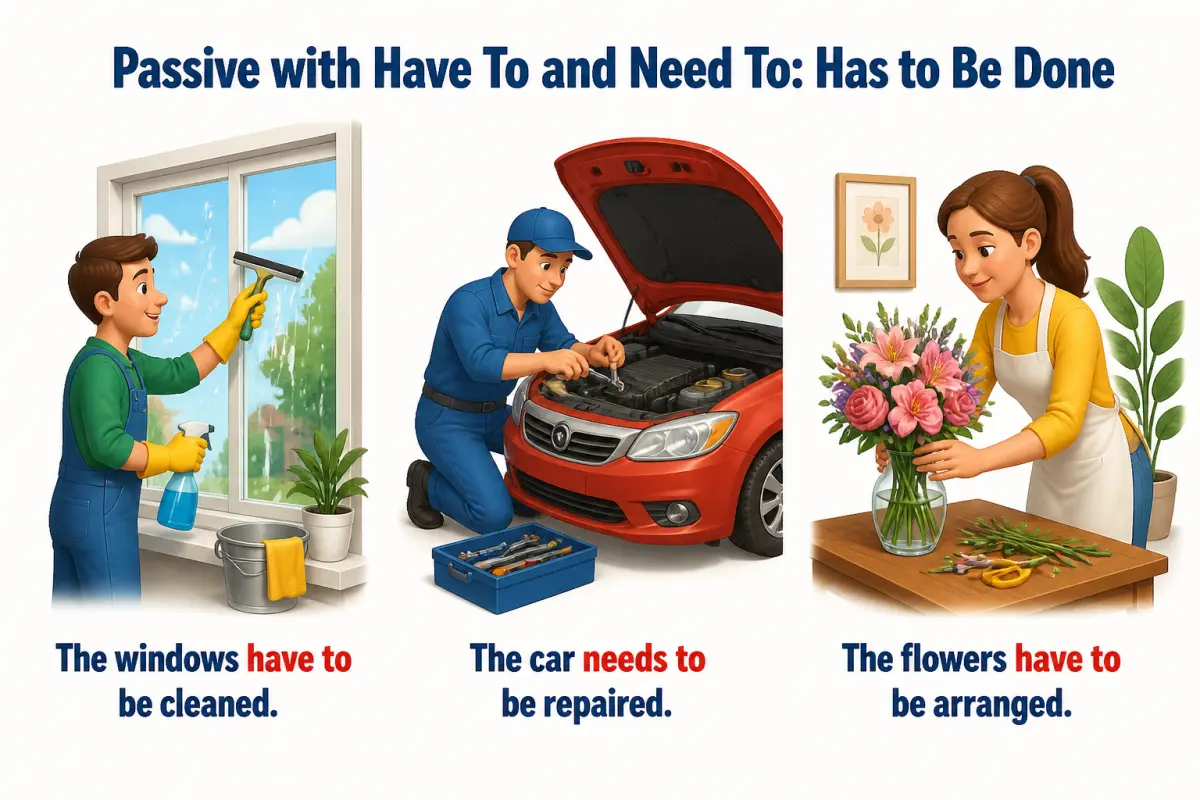
Passive with Have To and Need To: Has to Be Done

 This article explains how to use passive infinitives with have to and need to. It covers rules vs necessary tasks, need doing in American English, negatives and questions, have to be done vs must be done, common do/be mistakes, homework, and an FAQ.
- Why have to and need to use passive infinitives
- Has to be done for external rules and requirements
- Needs to be done for necessary actions and tasks
- Need doing vs need to be done in American English
- Negative forms: does not have to be done
- Questions with have to be and need to be
- Have to be done vs must be done
- Common mistakes with do, does, and be
- Homework: rewrite rules with have to and need to
- FAQ: has to be done and needs to be done
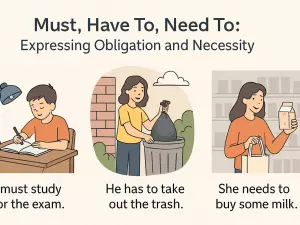
In English, when discussing jobs, rules, and responsibilities, the focus often shifts from the person to the action that must be done. This is why passive forms with have to and need to are so useful: they let you describe what is required, what must happen, or what is still unfinished in everyday situations at work, school, or home. Once you understand the pattern, it feels practical, natural, and easy to use.
Why have to and need to use passive infinitives
When we say that something is necessary, required, or expected, we often focus on the action itself, not on the person who does it. That is where forms like have to be done and need to be done become useful. They combine obligation or necessity with the passive, so the result is clear and practical: the report has to be finished, the room needs to be cleaned, the form has to be signed.
Grammatically, the pattern is simple: have to + be + past participle or need to + be + past participle. This is a passive infinitive because to be done, to be checked, and to be sent are infinitive structures in the passive voice. If you want a fuller explanation of passive infinitives, it helps to see how the passive meaning is built after another verb.
Compare these pairs:
- Active: You have to submit the form by Friday.
- Passive: The form has to be submitted by Friday.
- Active: We need to repair the printer.
- Passive: The printer needs to be repaired.
- Active: Someone has to lock the door.
- Passive: The door has to be locked.
The passive version is especially natural when the doer is unknown, obvious, unimportant, or deliberately not mentioned. In a workplace, nobody says every time who must perform each task. People often say: The invoices have to be checked, The classroom needs to be aired, The tickets have to be printed.
If you are still reviewing form building, it is useful to remember the general logic of to-infinitive basics: after have to and need to, we use an infinitive. In passive meaning, that infinitive becomes to be + past participle.
Teacher note: learners often understand the passive better when they stop asking “Who does it?” and start asking “What is necessary?” That small change in focus makes these sentences feel much more natural.
Has to be done for external rules and requirements

We commonly use has to be done when a rule, system, law, school policy, workplace procedure, or timetable creates the obligation. The speaker is not presenting a personal opinion. The idea usually comes from outside: a manager, a university, a government office, a deadline, or a formal process.
This is why the phrase often appears in notices, instructions, and professional English. It sounds practical and neutral. Instead of saying who is responsible every time, English often names the task: Payment has to be made in advance. The application has to be completed online. The equipment has to be returned by Monday.
Look at these typical situations:
- At school: The essay has to be uploaded before midnight.
- At work: Every expense claim has to be approved by the finance team.
- While traveling: Passports have to be shown at the border.
- In housing rules: Bicycles have to be kept in the storage area.
- In healthcare: The form has to be signed before treatment begins.
A useful point for learners: has to be done agrees with the subject before it. So we say The task has to be done, but The tasks have to be done. The passive part does not change for number, but has and have do.
| Situation | Natural passive sentence | Meaning |
|---|---|---|
| Office procedure | The invoice has to be processed today. | An external process requires it. |
| University rule | ID cards have to be shown during exams. | This is part of official rules. |
| Building policy | Guests have to be registered at reception. | The building system requires registration. |
| Shipping requirement | The package has to be labeled correctly. | There is a formal requirement. |
Notice how these sentences are less personal than active ones. Compare:
- Active: The finance team has to approve every expense claim.
- Passive: Every expense claim has to be approved.
- Active: Staff have to register all visitors.
- Passive: All visitors have to be registered.
- Active: The doctor has to sign this certificate.
- Passive: This certificate has to be signed.
The passive sentence is often better when the task matters more than the person. This is one reason it appears so often with obligation modals and similar expressions of necessity.
Needs to be done for necessary actions and tasks
We usually choose needs to be done when we want to say that something is necessary because of the situation itself. The focus is often practical rather than official. There may be no formal rule, but the action is still required if you want a good result.
This form is very common for chores, repairs, preparation, editing, maintenance, and planning. It sounds natural in daily conversation: The kitchen needs to be cleaned. This paragraph needs to be rewritten. The car needs to be serviced. In many cases, the speaker is not ordering someone; they are simply identifying a necessary job.
Here are some common examples:
- The plants need to be watered.
- Your resume needs to be updated before you apply.
- The meeting room needs to be booked early.
- These photos need to be backed up.
- The soup needs to be stirred more often.
A good way to feel the meaning is to compare these pairs:
- The floor needs to be cleaned. = It is dirty, so cleaning is necessary.
- The floor has to be cleaned. = There may be a rule, schedule, or instruction that requires it.
- This draft needs to be shortened. = It is too long.
- This draft has to be shortened. = Someone set a word limit.
- The dog needs to be walked. = This is necessary for the dog.
- The dog has to be walked before 8 a.m. = There is a plan, routine, or instruction.
In real life, the line is not always sharp. Speakers sometimes choose either form, depending on what they want to emphasize. Need to be done often sounds a little more like diagnosis; have to be done often sounds a little more like obligation.
Teacher note: if a student asks, “Which one should I use?” I usually suggest this test: are you describing a rule, or are you noticing a necessary task? That quick question helps in most cases.
Need doing vs need to be done in American English
English has two patterns with a similar meaning: needs doing and needs to be done. For example, The car needs washing and The car needs to be washed. Both mean that washing the car is necessary.
However, in American English, the form need to be done is much more common and safer for learners. Many American speakers understand needs doing, but it can sound more British or less natural in everyday American usage. If your goal is natural American English, choose The report needs to be printed rather than The report needs printing.
Compare these pairs:
- British-friendly: The windows need cleaning.
- American-friendly: The windows need to be cleaned.
- British-friendly: My hair needs cutting.
- American-friendly: My hair needs to be cut.
- British-friendly: The sofa needs fixing.
- American-friendly: The sofa needs to be fixed.
There is another important point. Need doing looks active, but the meaning is passive. That can confuse learners because The wall needs painting does not mean the wall will paint something. It means someone should paint the wall.
For clarity, especially in writing, many learners prefer these forms:
- The invoice needs to be corrected.
- The batteries need to be replaced.
- The schedule needs to be revised.
Those are straightforward and widely accepted. If you want to sound natural in American English, they are an excellent choice.
Negative forms: does not have to be done
The negative form is one of the most misunderstood areas. Does not have to be done means that something is not necessary. It does not mean that the action is forbidden. This is the same difference learners meet in active sentences: You don’t have to come means “it is optional,” not “you must not come.”
In passive form, the meaning stays the same. The form does not have to be printed means printing is unnecessary; maybe a digital version is enough. It does not mean printing is prohibited.
Study these contrasts carefully:
- The receipt does not have to be attached. = You can attach it, but it is optional.
- The receipt must not be attached. = Do not attach it.
- The lights do not have to be turned off during the test. = It is not necessary.
- The lights must not be turned off during the test. = Turning them off is forbidden.
- The old password does not have to be entered. = You can skip that step.
- The old password must not be entered. = Do not type it.
With need, the negative form is also useful: does not need to be done, do not need to be checked, did not need to be changed. It again means lack of necessity.
Examples:
- The chairs do not need to be moved; the room is large enough.
- This sentence does not need to be translated.
- The files did not need to be uploaded again.
Be careful with short answers in conversation:
- Does the contract have to be signed today? — No, it doesn’t have to be.
- Do these pages need to be copied? — No, they don’t need to be.
That final be matters. Without it, the sentence is incomplete.
Questions with have to be and need to be
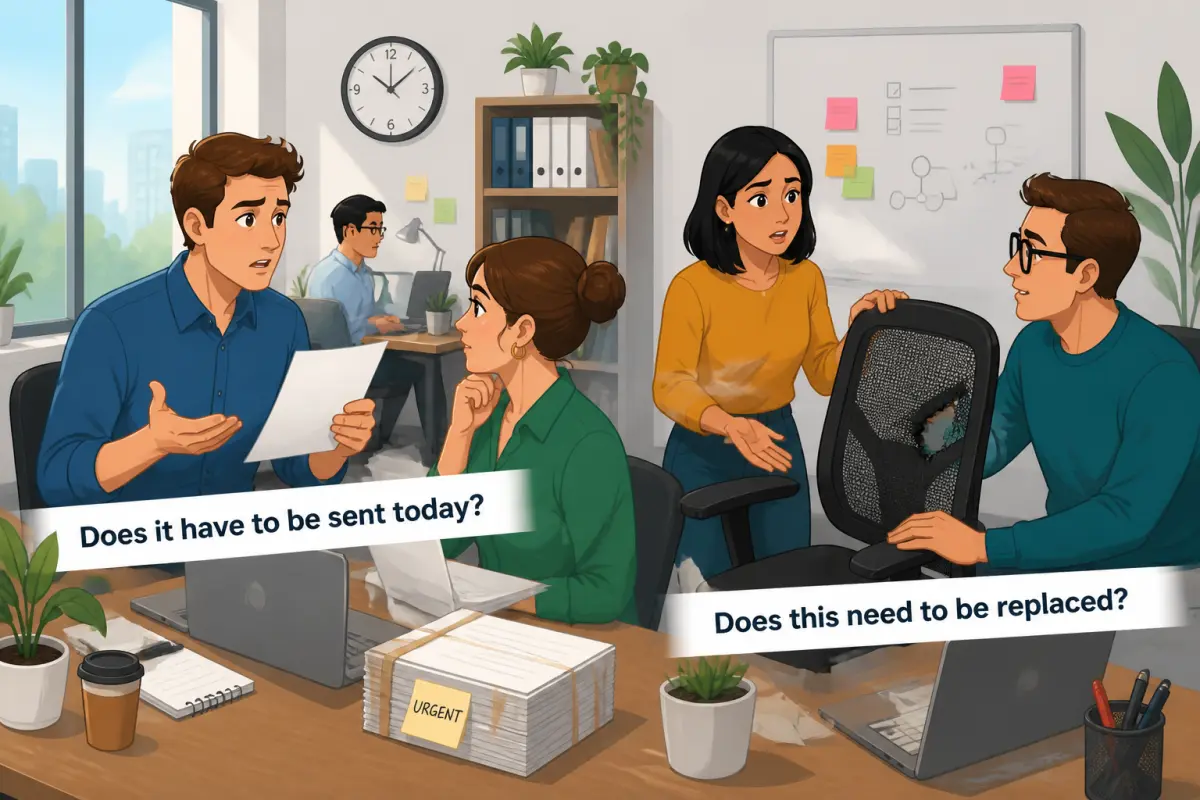
Questions are built with the auxiliary do/does/did before have to and with the normal verb order after that: Does it have to be sent today? For need to, the structure is similar: Does this need to be replaced? Many mistakes happen because learners try to move have or forget be.
These questions are extremely common in real life because they ask about deadlines, procedures, and necessary tasks. You hear them in offices, classrooms, homes, and customer service all the time.
| Type | Pattern | Example |
|---|---|---|
| Present with have to | Do/Does + subject + have to + be + past participle? | Does the order have to be confirmed today? |
| Past with have to | Did + subject + have to + be + past participle? | Did the room have to be repainted last year? |
| Present with need to | Do/Does + subject + need to + be + past participle? | Do these forms need to be stamped? |
| Past with need to | Did + subject + need to + be + past participle? | Did the file need to be renamed? |
Here are some natural question-and-answer sets:
- Does the car have to be booked in advance? — Yes, especially on weekends.
- Do all the pages have to be signed? — No, only the last one.
- Does this app need to be updated? — Yes, the current version is unstable.
- Did the meeting need to be postponed? — Yes, two speakers were sick.
Compare correct and incorrect forms:
- ✅ Does the package have to be weighed?
- ❌ Has the package to be weighed?
- ✅ Do these labels need to be changed?
- ❌ Need these labels to be changed?
- ✅ Did the report have to be rewritten?
- ❌ Did the report had to be rewritten?
Teacher note: when students ask questions too slowly, I tell them to memorize two useful frames: “Does it have to be...?” and “Does it need to be...?” Once those frames become automatic, accuracy improves fast.
Have to be done vs must be done
Both expressions communicate obligation, but they are not identical. Have to be done often suggests an external requirement or practical necessity. Must be done sounds stronger, firmer, and sometimes more formal. It can express a rule, but it can also reflect the speaker’s strong authority or emphasis.
In passive sentences, the difference is often a difference of tone. Compare the feeling in these pairs:
- The tax form has to be submitted by April 15. = This is the official requirement.
- The tax form must be submitted by April 15. = Strong official instruction; more forceful.
- The safety checklist has to be completed before departure. = Procedure requires it.
- The safety checklist must be completed before departure. = Strong command or serious rule.
- Your final draft has to be edited before publication. = Editing is required.
- Your final draft must be edited before publication. = The speaker insists; stronger pressure.
In many practical situations, both are possible. The best choice depends on voice and context:
- Have to be done is common in everyday explanations.
- Must be done is common in formal instructions, warnings, and strong recommendations.
- Must not be done expresses prohibition very clearly.
- Do not have to be done means no necessity, not prohibition.
If you want a broader comparison, this topic connects naturally with must versus have to. The same differences appear when the sentence becomes passive.
Common mistakes with do, does, and be
This area causes predictable errors because learners are combining several pieces at once: subject agreement, do/does/did, have to or need to, and the passive form be + past participle. The good news is that the mistakes are repetitive, so they are easy to fix once you notice the pattern.
The three biggest problems are: using the wrong auxiliary, changing have incorrectly after does/did, and forgetting be in the passive structure.
1. Wrong auxiliary in questions and negatives
With ordinary have to and need to, standard English uses do/does/did in questions and negatives.
- ❌ Has the form to be signed?
- ✅ Does the form have to be signed?
- ❌ Need the files to be deleted?
- ✅ Do the files need to be deleted?
- ❌ Had the room to be cleaned yesterday?
- ✅ Did the room have to be cleaned yesterday?
2. Using has/had after does/did
After does and did, use the base form have, not has or had.
- ❌ Does the bill has to be paid now?
- ✅ Does the bill have to be paid now?
- ❌ Did the banner had to be removed?
- ✅ Did the banner have to be removed?
- ❌ Does this chair has to be assembled?
- ✅ Does this chair have to be assembled?
3. Forgetting be before the past participle
This is probably the most common passive mistake. If you say has to done or needs to repaired, the sentence is missing the passive verb be.
- ❌ The contract has to signed.
- ✅ The contract has to be signed.
- ❌ The sink needs to fixed.
- ✅ The sink needs to be fixed.
- ❌ These boxes do not have to stored here.
- ✅ These boxes do not have to be stored here.
4. Mixing active and passive forms
Some learners accidentally build a sentence that starts passive and ends active, or the opposite.
- ❌ The report has to be finish.
- ✅ The report has to be finished.
- ❌ The letters need to be send today.
- ✅ The letters need to be sent today.
- ❌ Does the wall need to painted?
- ✅ Does the wall need to be painted?
5. Confusing not necessary with forbidden
This is a meaning error rather than a form error, but it matters a lot.
- ❌ “The shoes don’t have to be removed” = removing them is forbidden.
- ✅ “The shoes don’t have to be removed” = removing them is not necessary.
- ❌ “The form must not be printed” = printing is optional.
- ✅ “The form must not be printed” = printing is forbidden.
- ❌ “The names don’t need to be included” = do not include them.
- ✅ “The names don’t need to be included” = you can include them, but it is not required.
If you want more sentence-level review after reading this lesson, a short round of have to practice is a good next step because accuracy with obligation forms supports passive accuracy too.
Homework: rewrite rules with have to and need to
These tasks are designed to make you produce the structure, not just recognize it. Do them slowly at first. Check three things every time: the correct subject form of have, the presence of be, and the correct past participle.
The three blocks below test different skills: choosing the best form, transforming active sentences into passive ones, and correcting mistakes. Try to say your answers aloud as well. Spoken repetition helps these patterns become automatic.
Block 1: Choose the correct form
- The visitor badge (has to be worn / has to worn) at all times.
- This file (needs be updated / needs to be updated) before the meeting.
- Do the windows (have to be cleaned / have be cleaned) today?
- The extra chairs (do not have to be moved / must not be moved) if you want to say they are optional.
- Does the package (have to be checked / has to be checked) again?
- The final version (needs to be approved / needs approve) by the editor.
- These medicines (have to be kept / have to kept) in a cool place.
- Did the carpet (need to be replaced / needed to be replace) last year?
- The payment (does not need to be made / must not be made) today; tomorrow is fine.
- Does every page (need to be signed / need be signed)?
Show answers
- has to be worn
- needs to be updated
- have to be cleaned
- do not have to be moved
- have to be checked
- needs to be approved
- have to be kept
- need to be replaced
- does not need to be made
- need to be signed
Block 2: Rewrite the sentences in the passive
- You have to lock the storage room every evening.
- We need to translate these instructions.
- The school has to update the emergency contacts.
- Someone needs to clean the coffee machine.
- They have to test the alarm system once a month.
- We do not have to print the tickets.
- Do they need to fix the projector?
- Did the team have to cancel the workshop?
- The manager needs to sign both copies.
- You do not need to return the key today.
Show answers
- The storage room has to be locked every evening.
- These instructions need to be translated.
- The emergency contacts have to be updated by the school.
- The coffee machine needs to be cleaned.
- The alarm system has to be tested once a month.
- The tickets do not have to be printed.
- Does the projector need to be fixed?
- Did the workshop have to be canceled?
- Both copies need to be signed by the manager.
- The key does not need to be returned today.
Block 3: Spot and correct the error
- Does this document has to be scanned?
- The walls need to painted before Friday.
- Did the labels had to be changed?
- The password does not have to changed every week.
- Need these chairs to be folded after the event?
- The samples has to be stored in the fridge.
- This app needs be updated on older phones.
- The old posters do not need to removed.
- Has the package to be delivered today?
- The form must not be completed means it is optional.
Show answers
- Does this document have to be scanned?
- The walls need to be painted before Friday.
- Did the labels have to be changed?
- The password does not have to be changed every week.
- Do these chairs need to be folded after the event?
- The samples have to be stored in the fridge.
- This app needs to be updated on older phones.
- The old posters do not need to be removed.
- Does the package have to be delivered today?
- The form must not be completed means it is forbidden, not optional.
FAQ: has to be done and needs to be done
These short answers deal with the questions learners often ask after they already know the basic rule.
1. Can I use “has to be done” when I know who will do the action?
Yes. The passive does not mean the doer is unknown; it only means the doer is not the focus. You can say The presentation has to be prepared by Maya if you want to mention the person. In everyday English, though, we often leave that part out unless it matters.
2. Is “needs to be done” softer than “has to be done”?
Often yes. Needs to be done can sound more like practical necessity, while has to be done can sound more like obligation. Compare: The summary needs to be shortened sounds like advice based on the text itself. The summary has to be shortened sounds more like a requirement, perhaps because of a word limit.
3. Can I say “is needed to be done”?
Usually no. That structure is unnatural in normal English. Instead, say needs to be done or has to be done. For example, say The repair needs to be done soon, not The repair is needed to be done soon.
4. Which is more natural in instructions: “has to be done” or “must be done”?
Both are possible, but the tone changes. In manuals, contracts, and safety notices, must be done often sounds stricter. In workplace explanations or everyday procedures, has to be done is often more conversational. A hotel guide might say Check-out forms have to be completed at the front desk; a safety manual might say Protective gloves must be worn.
5. Can “need to be done” refer to the future?
Yes. The form itself does not block future meaning. Time usually comes from the context or an added time phrase: The guest list needs to be finalized by Thursday. You are talking about a future deadline even though the verb is present.
6. Do native speakers always use the passive in these cases?
No. Sometimes the active is clearer and more direct. Compare You need to save the file as a PDF with The file needs to be saved as a PDF. The active is better when the listener should clearly do the action. The passive is better when the rule or task matters more than the person.
7. Can I shorten answers and avoid repetition?
Yes. Short answers are common: Does the equipment have to be tested? — Yes, it does. Or more fully: Yes, it has to be. With need: Do the names need to be listed? — No, they don’t. Or No, they don’t need to be. Both styles are used.
8. Is “need doing” wrong in American English?
No, not wrong, but less standard in many American contexts than need to be done. If you are writing for an international audience or learning American English, The filters need to be replaced is the safest and clearest option. It sounds natural almost everywhere.