Past Perfect Passive: Had Been Done Before

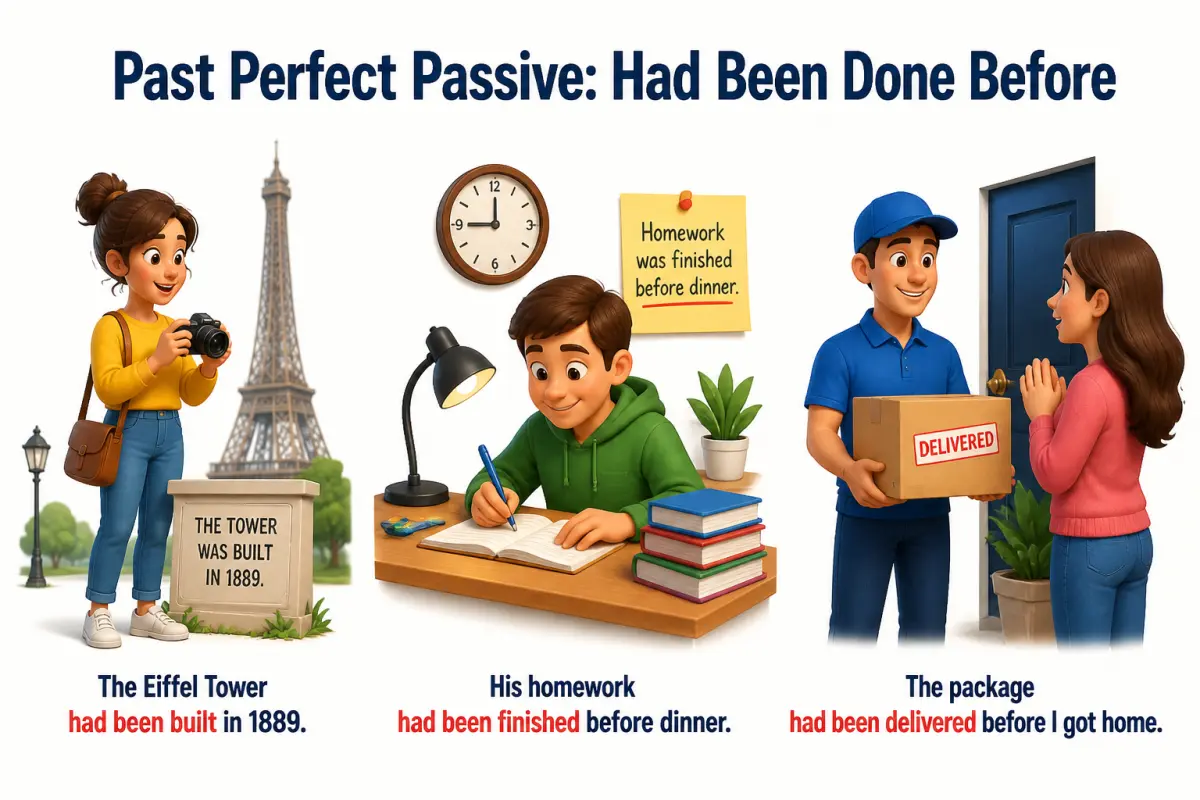 This article explains the past perfect passive, especially how had been done shows a passive action before another past event. It covers timelines, questions, negatives, key time words, common mistakes, comparisons with past simple passive, practice, and an FAQ.
- What the past perfect passive shows
- How had been creates earlier passive actions
- Using past perfect passive before another past event
- Timeline examples with reports, stories, and explanations
- Past perfect passive vs past simple passive
- Questions and negatives with had been done
- Past perfect passive with already, before, and by then
- Common mistakes with had, have, and been
- Timeline practice: build past perfect passive sentences
- FAQ: had been done in English
The past perfect passive is useful when you need to describe something that had already been completed before another moment in the past. It helps focus on the result rather than the person or thing that did the action, especially when the doer is unknown, unimportant, or obvious. This structure is often used in news, stories, and explanations to show clearly what had already happened before the next past event.
What the past perfect passive shows
This form helps you talk about something that was done before another moment in the past, when the action itself matters more than the person who did it. In other words, it combines two ideas: earlier in the past and passive meaning. That is why learners often meet it in news reports, formal writing, stories, workplace updates, and explanations of events.
Look at the structure: had been + past participle. For example, “The documents had been signed before the meeting started.” The signing happened first, and the meeting happened later. The speaker is not focusing on who signed the documents. The important point is that the documents were already signed at that earlier time.
Compare these meanings:
- “Someone had cleaned the room before we arrived.” This is active. We care that someone did the cleaning.
- “The room had been cleaned before we arrived.” This is passive. We care about the result in the room.
Common situations where this form is useful include:
- explaining the background to a past event
- reporting completed procedures
- describing discoveries made later
- showing that a task was already finished
- focusing on results, not the doer
Here are a few natural examples:
- By the time we reached the station, our bags had been loaded onto the wrong bus.
- She was nervous because the final decision had been made without her.
- The road was closed because a large tree had been blown down during the storm.
- He could not enter the building because his name had been removed from the list.
How had been creates earlier passive actions

The key part is had been. The word had places the action before another past reference point. The word been tells you that the sentence is passive, not active. Then you add the past participle of the main verb: done, sent, built, written, chosen, repaired, and so on.
So when you say, “The email had been sent before lunch,” you are not simply saying that the email was sent in the past. You are showing that, at some later past moment, the sending was already complete. This is what makes the form especially useful in sequences and explanations.
| Meaning | Form | Example |
|---|---|---|
| Active earlier past action | had + past participle | The manager had approved the plan. |
| Passive earlier past action | had been + past participle | The plan had been approved. |
| Past simple passive | was/were + past participle | The plan was approved yesterday. |
| Present perfect passive | has/have been + past participle | The plan has been approved. |
You will notice that the passive form often appears when the doer is unknown, obvious, or unimportant:
- The windows had been broken before the police arrived.
- The package had been delivered to the wrong address.
- The topic had been discussed many times already.
Teacher note: many learners understand the time meaning of past perfect but forget to keep the passive pattern. If you say “had cleaned” when you mean “had been cleaned,” the meaning changes completely.
If you want more general review of passive patterns across tenses, a separate guide to passive verb forms can help you see where this structure fits.
Using past perfect passive before another past event
This form usually appears when there are two past points: an earlier action and a later event. The earlier action is in the past perfect passive, and the later event is often in the past simple. This is why sentences with “before,” “after,” “when,” “by the time,” and “already” often use it.
For example, “The tickets had been printed before the concert was canceled.” The printing happened first; the cancellation happened later. The sentence gives the reader a clear time relationship, and it does so without focusing on who printed the tickets.
Here are more examples with different connectors:
- Before: The room had been prepared before the guests arrived.
- After: After the files had been copied, the old computer was removed.
- When: When we checked again, the error had been corrected.
- By the time: By the time I called, the booking had been canceled.
In longer writing, this form is useful because it lets you explain background clearly. Without it, events can sound flat or confusing. Compare:
- Less clear: The office was locked. The alarm was turned on. We arrived at 8:10.
- Clearer: When we arrived at 8:10, the office had been locked and the alarm had been turned on.
You do not need this form in every sentence about the past. Use it when the earlier-than-past idea really matters. If the order is obvious from context, native speakers may prefer a simpler form. But if you want to show sequence precisely, especially in narratives, reports, and formal explanations, it is very useful. For a broader look at ordering past actions, you may also find this article on past perfect sequence helpful.
Timeline examples with reports, stories, and explanations
Many learners understand the rule but still hesitate when they need to use it in real communication. A timeline approach helps. Ask yourself two questions: What happened first? and Do I want passive meaning? If the answer is “yes” to both, the form is often the right choice.
Below are examples from common situations where the timing matters and the result is more important than the doer.
| Situation | Earlier action | Later past event |
|---|---|---|
| Work report | The invoices had been checked | before the finance team submitted the report. |
| Travel story | Our seats had been changed | when we reached the gate. |
| School explanation | The exam papers had been marked | by the time students returned. |
| News update | The area had been evacuated | before the fire spread. |
Now look at these expanded examples:
- When the manager opened the shared folder, several files had been deleted. He immediately asked the team what had happened.
- By the time the doctor saw the patient, the wrong medicine had been given. That changed the treatment plan.
- We were surprised to learn that the apartment had been rented before our second visit.
- The teacher explained that the classroom rules had been changed during the summer.
In reports, the tone is often more objective with the passive:
- The samples had been tested before the final recommendation was made.
- The complaint had been recorded incorrectly, which caused a delay.
- The equipment had been stored in the wrong room.
Teacher note: in storytelling, students often overuse “then” and a chain of past simple verbs. Adding one well-chosen past perfect passive sentence can make the time order much easier for the listener to follow.
This form also appears in reporting and indirect explanation, especially when past time references mix. If you work with reported information often, a guide to mixed tense reports can be useful.
Past perfect passive vs past simple passive
These two forms are close, so learners often confuse them. The difference is not about passive meaning; both are passive. The real difference is time relationship. The past simple passive tells you that something happened in the past. The past perfect passive tells you that it happened before another past event.
If there is no need to show an earlier-later contrast, the past simple passive is often enough. But if the sentence compares two past moments, the past perfect passive is usually better.
Compare these pairs carefully:
- “The door was locked at 9:00.”
Simple past fact. - “The door had been locked before we arrived at 9:00.”
The locking happened earlier than our arrival.
- “The order was canceled yesterday.”
One completed past event. - “The order had been canceled before the customer called.”
The cancellation came first; the call came later.
- “The road was closed after the accident.”
This sentence reports a past action. - “The road had been closed before the buses reached the city.”
The closure happened earlier than the buses’ arrival.
- “The meal was prepared in the hotel kitchen.”
- “The meal had been prepared before the guests sat down.”
A good test is this: can you naturally add a later past event such as “before we arrived,” “when I checked,” or “by the time they returned”? If yes, the past perfect passive may be the right choice.
Also compare these common learner choices:
- “When we got there, the stage was built.” Possible, but it sounds more like a state.
- “When we got there, the stage had been built.” Clearer if you want to stress the earlier completed action.
- “Her application was rejected, so she appealed.” Good if both events are simply told in sequence.
- “Her application had been rejected before she spoke to the director.” Better when the rejection is background to the later conversation.
Choosing between these forms is part of a bigger skill: deciding how much time detail your sentence needs. If you want a wider comparison of tenses, you may want to read more about verb tense choice.
Questions and negatives with had been done
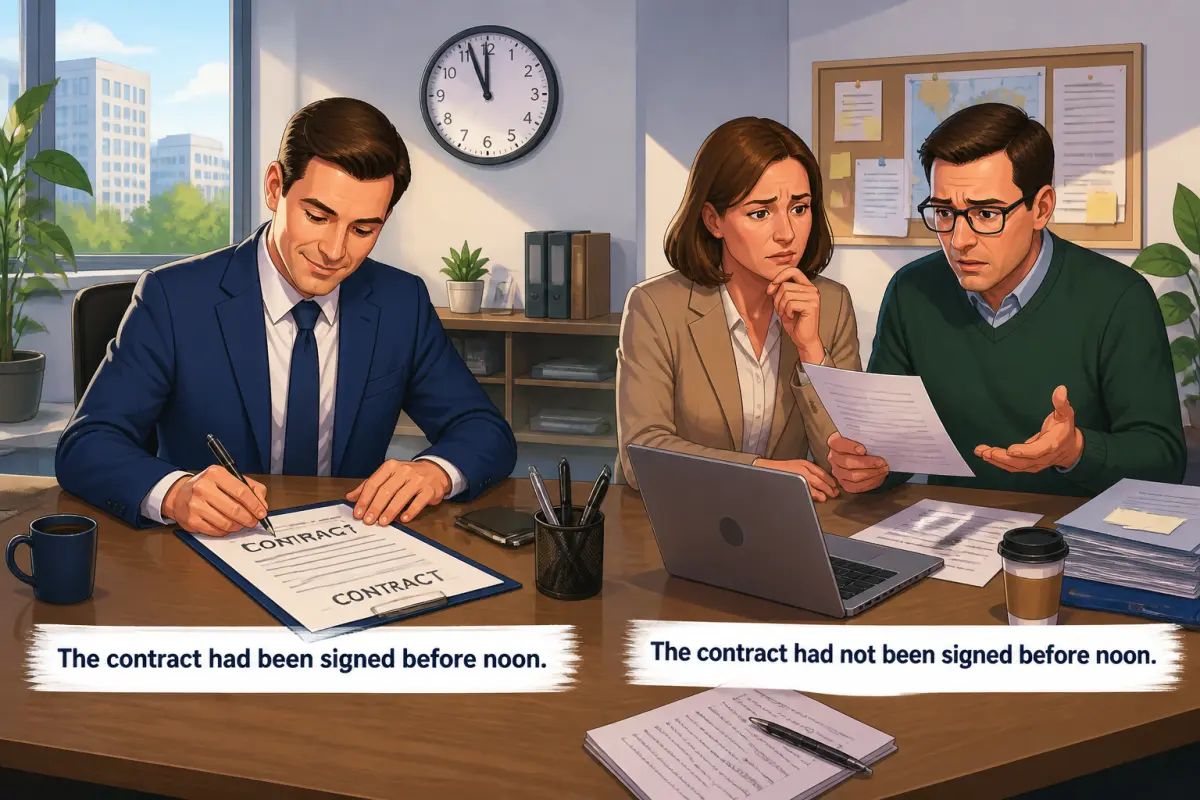
The grammar here is straightforward once you keep the order clear. For negatives, put not after had. For questions, move had before the subject. The rest of the passive form stays the same: been + past participle.
These patterns are common in checks, investigations, and follow-up conversations, especially when people want to know what was already finished before something else happened.
- Positive: The contract had been signed before noon.
- Negative: The contract had not been signed before noon.
- Question: Had the contract been signed before noon?
More examples:
- The dinner had not been served when the power went out.
- Had the luggage been loaded before the passengers boarded?
- The windows had not been cleaned when the guests arrived.
- Had the payment been received before the order was shipped?
Short answers are simple:
- Had the room been booked already? — Yes, it had.
- Had the forms been printed by then? — No, they hadn’t.
Be careful not to break the passive form when asking questions. Many learners say things like “Had been the report finished?” That word order is wrong. The subject must come after had:
- ❌ Had been the report finished before the deadline?
- ✅ Had the report been finished before the deadline?
Here are a few more negative examples in natural contexts:
- The invitation had not been sent, so nobody knew about the event.
- The damage had not been reported when the inspector arrived.
- The chairs had not been arranged properly before the meeting began.
If question formation is still difficult, a separate review of past perfect questions can make the word order much easier to remember.
Past perfect passive with already, before, and by then
Some time expressions fit this form very naturally because they make the earlier-later relationship clearer. Three of the most useful are already, before, and by then. They often appear in stories, explanations, emails, and spoken updates.
Already shows that something was complete earlier than expected or earlier than another past point. Before directly marks the earlier action. By then refers to a later past moment and tells us the action was complete at that time.
Examples with already:
- When I opened my inbox, the problem had already been solved.
- By the time we arrived, the lights had already been switched off.
- The table had already been booked, so we had to wait.
Examples with before:
- The forms had been checked before the interview started.
- The old bridge had been inspected before the repairs began.
- The message had been translated before it was forwarded to the client.
Examples with by then:
- By then, the guests had been informed of the delay.
- By then, the final copy had been printed.
- By then, all the boxes had been labeled correctly.
Word position matters most with already. It usually goes after had or after the subject + had pattern:
- The cake had already been cut.
- The files had already been uploaded when I asked for them.
With before, notice two possibilities:
- The order had been packed before the driver arrived.
- Before the driver arrived, the order had been packed.
Teacher note: if learners keep forgetting where “already” goes, I tell them to build the core first — “had been sent” — and then insert “already” after “had”: “had already been sent.”
Common mistakes with had, have, and been
The biggest problems are usually not with meaning, but with form. Learners mix past perfect passive with present perfect passive, forget been, or use the wrong participle. These mistakes are very common because several English perfect forms look similar.
Start by keeping one model sentence in your head: “The work had been finished before 5:00.” If your sentence describes an earlier passive action in the past, it should usually follow that shape.
Mistake 1: using have/has instead of had
- ❌ The tickets have been printed before the event started.
- ✅ The tickets had been printed before the event started.
- ❌ The room has been cleaned when we arrived.
- ✅ The room had been cleaned when we arrived.
- ❌ The report have been sent before the call.
- ✅ The report had been sent before the call.
The wrong versions mix a present perfect passive form with a past time relationship. If there is a later past event, had is usually needed.
Mistake 2: forgetting been
- ❌ The chairs had arranged before the meeting.
- ✅ The chairs had been arranged before the meeting.
- ❌ The package had delivered by then.
- ✅ The package had been delivered by then.
- ❌ The walls had painted before we moved in.
- ✅ The walls had been painted before we moved in.
Without been, the sentence is incomplete as a passive form.
Mistake 3: using the wrong verb form after been
- ❌ The message had been send before noon.
- ✅ The message had been sent before noon.
- ❌ The machine had been repair before inspection.
- ✅ The machine had been repaired before inspection.
- ❌ The names had been write incorrectly.
- ✅ The names had been written incorrectly.
After been, you need the past participle, not the base verb.
Mistake 4: mixing active and passive meaning
- ❌ The team had been finish the project before Friday.
- ✅ The team had finished the project before Friday.
- ✅ The project had been finished before Friday.
- ❌ Someone had been repaired the roof before winter.
- ✅ Someone had repaired the roof before winter.
- ✅ The roof had been repaired before winter.
Choose one pattern: active or passive. Do not combine them by accident.
Mistake 5: wrong question order
- ❌ Had been the apartment cleaned before the visit?
- ✅ Had the apartment been cleaned before the visit?
- ❌ Had been the bill paid by then?
- ✅ Had the bill been paid by then?
- ❌ Had not the email been answered?
- ✅ Had the email not been answered?
These are the kinds of mistakes that disappear when you practice full sentence patterns, not isolated words.
Timeline practice: build past perfect passive sentences
This section gives you practical sentence-building work. Use the earlier/later logic every time: first decide which action happened earlier, then decide whether the sentence should be passive. Try to say the full form aloud as you answer. That helps the structure become automatic.
The three blocks below test different skills: choosing the correct form, rewriting, and correcting mistakes. Keep your sentences natural and complete.
Practice 1: Choose the correct form
- By the time we entered the hall, the chairs (had been arranged / were arranged).
- When she checked the website, her order (had already been canceled / was already canceled) earlier that morning.
- The letter (had been delivered / was delivered) before the office opened.
- By then, the results (had been published / were published) online.
- When the guests arrived, the flowers (had been placed / were placed) on every table.
- The password (had been changed / was changed) before I tried to log in.
- By the time the class started, the board (had been cleaned / was cleaned).
- When the police questioned him, his car (had already been found / was already found).
- The food (had been packed / was packed) before the driver came.
- By then, the mistake (had been noticed / was noticed) by several people.
Show answers
- had been arranged
- had already been canceled
- had been delivered
- had been published
- had been placed
- had been changed
- had been cleaned
- had already been found
- had been packed
- had been noticed
Practice 2: Rewrite the sentences in the past perfect passive
- Someone locked the office before we returned.
- They printed the menus before the customers arrived.
- Someone removed the old sign before the ceremony started.
- They repaired the heating system before winter began.
- Someone uploaded the photos before the team meeting.
- They completed the bridge before the rainy season.
- Someone washed the uniforms before the match.
- They checked the passports before boarding.
- Someone sent the invitation before Monday morning.
- They cleaned the pool before the hotel reopened.
Show answers
- The office had been locked before we returned.
- The menus had been printed before the customers arrived.
- The old sign had been removed before the ceremony started.
- The heating system had been repaired before winter began.
- The photos had been uploaded before the team meeting.
- The bridge had been completed before the rainy season.
- The uniforms had been washed before the match.
- The passports had been checked before boarding.
- The invitation had been sent before Monday morning.
- The pool had been cleaned before the hotel reopened.
Practice 3: Spot and correct the error
- The report have been finished before the director arrived.
- Had been the room cleaned before the visitors came?
- The parcel had been send to the wrong office.
- By then, the names had wrote on the list.
- The windows had not cleaned before the storm.
- When I called, the table has been reserved already.
- The floor had been mop before the store opened.
- Had the documents been signed before the meeting started, wasn’t it?
- The plan had been discuss before the vote.
- The lights had already been switch off when we arrived.
Show answers
- The report had been finished before the director arrived.
- Had the room been cleaned before the visitors came?
- The parcel had been sent to the wrong office.
- By then, the names had been written on the list.
- The windows had not been cleaned before the storm.
- When I called, the table had already been reserved.
- The floor had been mopped before the store opened.
- Had the documents been signed before the meeting started?
- The plan had been discussed before the vote.
- The lights had already been switched off when we arrived.
Teacher note: when students struggle in practice, I ask them to underline the later past event first. Once they can see that reference point clearly, the earlier passive action is much easier to build.
FAQ: had been done in English
1. Can I use the past perfect passive without mentioning the later past event?
Yes, if the later past point is clear from context. For example, in a story you can say, “The room looked different. The walls had been painted.” The listener understands that the painting happened before the moment you are describing.
2. Is this form common in everyday conversation?
Yes, but not in every sentence. People use it when they need to explain sequence clearly: “The booking had been canceled before I got there.” In casual conversation, speakers may choose simpler forms if the order is obvious, but this structure is still very natural.
3. Can I say who did the action?
Yes. You can add a by phrase if it matters: “The mistake had been noticed by the editor before publication.” But if the doer is unknown, obvious, or unimportant, it is better to leave it out.
4. What is the difference between “had been done” and “has been done”?
“Has been done” connects to the present. “Had been done” connects to a later moment in the past. Compare: “The form has been completed” means it is complete now. “The form had been completed before the interview” places the completion before a past event.
5. Can stative verbs be used in the past perfect passive?
Sometimes, but not all verbs sound natural in the passive. Verbs like “know” are rarely used this way in ordinary speech. Practical verbs such as “finish,” “send,” “approve,” “build,” “clean,” and “prepare” are much more common.
6. Do I always need time words like “before” or “by then”?
No. They help, but they are not required. The context can show the sequence. For example: “She was upset because her request had been refused.” The refusal clearly happened before her emotional reaction.
7. Is “had got done” the same as “had been done”?
No. “Had been done” is the standard passive form. “Got” sometimes appears in informal passive structures such as “got lost” or “got hurt,” but it does not replace this grammar pattern. For earlier passive actions before another past event, use had been + past participle.
8. How can I practice this tense effectively?
Do not only memorize the formula. Practice with timelines, story pairs, and real contexts from your life. For example, write three sentences about work, school, or travel: one active, one past simple passive, and one past perfect passive. That contrast helps you feel when the form is truly needed.