Get Passive in Spoken English

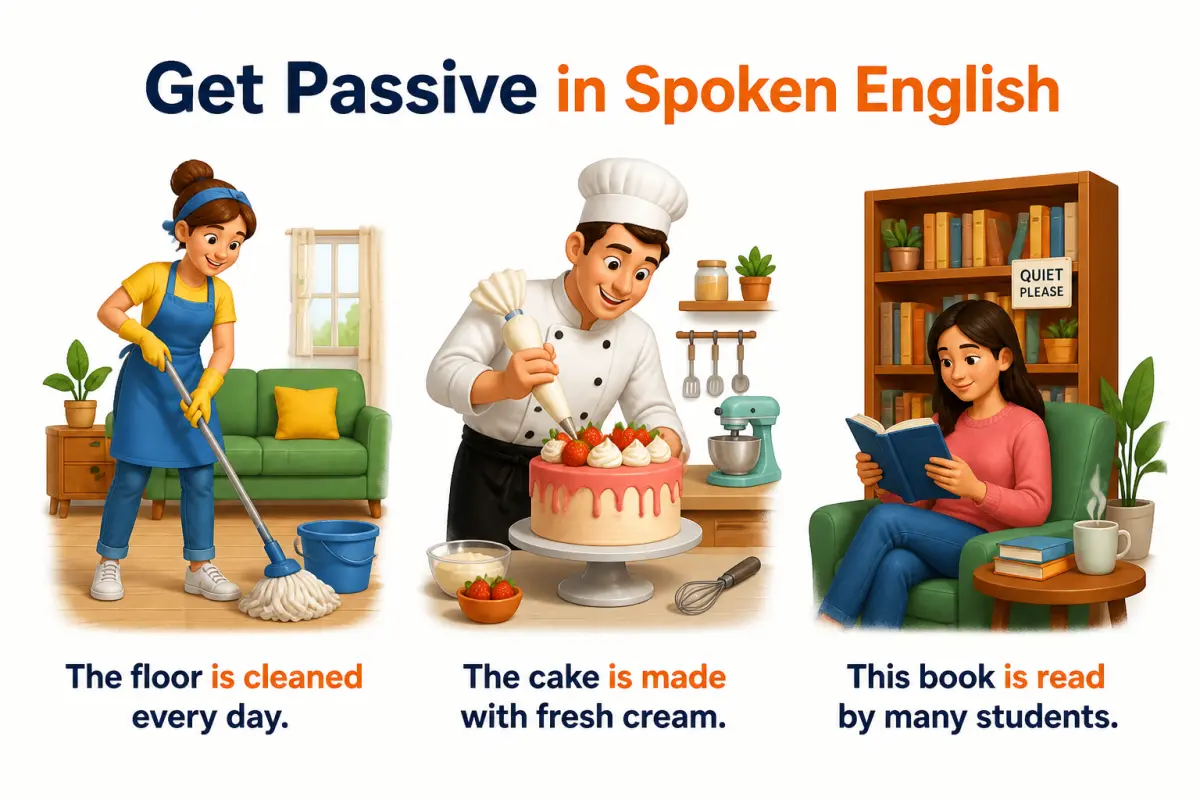 Here we what the get passive means in spoken English and how it differs from the be passive. It explains when get passive sounds natural or too informal in American English, how it is used for accidents, changes, and results, and reviews common forms, mistakes, questions, negatives, practice, and an FAQ.
- What the get passive means in spoken English
- How get passive differs from be passive
- When get passive sounds natural in American English
- Get passive for accidents, changes, and results
- Get paid, get hired, get fired, and get hurt
- When get passive sounds too informal
- Questions and negatives with did and get
- Common mistakes with get, got, and gotten
- Speaking practice: choose be passive or get passive
- FAQ: get passive in English
Many learners notice that everyday conversation often shifts focus away from who does an action and toward the result, which is why this structure matters in real speech. If you see it only in grammar exercises, it may seem formal or distant, but native speakers use it naturally when the doer is unknown, unimportant, or already obvious. Once you begin to hear it this way, everyday English becomes clearer and easier to use.
What the get passive means in spoken English
In everyday English, speakers often use get + past participle to talk about something that happens to a person or thing. A past participle is the form like paid, hurt, broken, invited, or fired. So when someone says, “I got invited,” “She got hurt,” or “We got stuck,” they are using the passive with get.
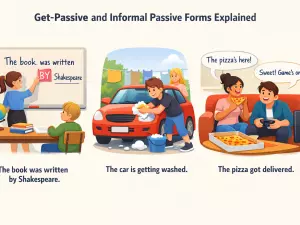
This structure is especially common in speech because it sounds direct, natural, and connected to real events. It often suggests that a change happened, a result became true, or someone was affected by an action. Compare these: “He was promoted last month” and “He got promoted last month.” Both are correct, but the second one sounds more conversational and more focused on the event itself.
The basic pattern is simple:
- subject + get + past participle
- I got hired.
- My phone got stolen.
- They got married in June.
Many learners first meet passive voice with be, but in real conversation the get passive is extremely useful. You hear it at work, at school, in family stories, in travel situations, and in casual complaints:
- We got delayed at the airport.
- I got charged twice.
- Did you get invited to the meeting?
- He got stopped by the police.
One important point: get here does not mean “receive” in the usual sense. In “I got paid,” it is close to “I was paid,” not “I received paid.” Think of it as a spoken passive pattern rather than the normal lexical meaning of get.
Teacher note: Many students understand the form quickly but hesitate to use it. The best way to make it natural is to learn it in chunks: get hired, get stuck, get caught, get injured. Spoken grammar often becomes fluent through fixed combinations, not through rules alone.
How get passive differs from be passive

Both forms are passive, but they do not feel exactly the same. The be passive is more neutral and more common in formal writing. The get passive is more conversational and often carries a stronger sense of event, change, or involvement. In other words, be often describes a state, while get often highlights what happened.
That difference is not absolute, but it is very useful. If I say, “The window was broken,” I may simply be describing the condition of the window. If I say, “The window got broken,” I am more likely talking about the incident that caused that condition. Native speakers often choose between them based on tone and focus, not just grammar.
| Pattern | Typical feel | Example |
|---|---|---|
| be + past participle | neutral, descriptive, more formal | The files were deleted yesterday. |
| get + past participle | spoken, event-focused, more personal | The files got deleted yesterday. |
| be + past participle | often describes a state | The door is closed. |
| get + past participle | often suggests a change into that state | The door got closed by mistake. |
Look at these pairs:
- The store was robbed last night. / The store got robbed last night.
- She was promoted after two years. / She got promoted after two years.
- My bag was damaged in transit. / My bag got damaged on the flight.
In each pair, the version with get sounds more like natural conversation. The version with be sounds more report-like or official. That is why a police report may say “Three people were injured,” while a friend telling a story may say “Three people got hurt.”
There is another difference: the get passive is less common with long agent phrases. An agent phrase tells us who did the action, often with by.
- More natural: She was interviewed by the hiring committee.
- Less natural in many contexts: She got interviewed by the hiring committee.
The second sentence is possible, especially in speech, but when the sentence becomes more formal or the agent is important, many speakers prefer be. If you want a fuller comparison of common get passive forms, it helps to study them as style choices as well as grammar forms.
When get passive sounds natural in American English
In American English, this structure appears most naturally in conversation, texting, interviews, stories, and informal explanations. It fits situations where speakers are talking about what happened to them, what result occurred, or how someone was affected. It is very common when people tell short personal stories: “I got locked out,” “We got lost,” “He got promoted,” “The kids got soaked in the rain.”
You will hear it a lot when the speaker is emotionally involved or when the event feels immediate. It sounds especially natural in complaints, warnings, and everyday updates. For many learners, the most useful question is not “Is it grammatical?” but “Would a person actually say this in normal conversation?” In many casual situations, the answer is yes.
- At work: I got copied on the wrong email thread.
- At school: She got moved to a different class.
- While traveling: Our flight got canceled.
- At home: The laundry got mixed up.
- In social life: They got invited to dinner.
American speakers also use it in many common expressions where the passive idea feels fixed and automatic:
- get married
- get dressed
- get caught
- get stuck
- get injured
Notice that these phrases are especially frequent in informal conversations. They belong to the kind of spoken grammar that makes English sound less textbook-like and more natural. You may also notice reduced spoken forms around them, such as “I got stuck” pronounced quickly in connected speech, which links closely to broader spoken verb patterns.
Teacher note: If your goal is fluent speaking, learn where the form lives. It lives in stories, reactions, complaints, and updates. Students who only practice passive voice in formal written sentences often miss how common this structure is in real life.
Get passive for accidents, changes, and results
One of the strongest uses of this pattern is for situations where something changes unexpectedly or a result appears after an action. That is why it is so common with accidents and problems. When we say “The vase got broken,” “My shirt got stained,” or “We got separated in the crowd,” the form naturally suggests that something happened and the situation changed.
It is also useful when the speaker does not want to focus on who caused the action, or when the cause is unknown, unimportant, or obvious from context. In real speech, people often care more about the result than the agent. If your laptop is not working, you are more likely to say “It got damaged” than to produce a full formal passive sentence with details.
Here are three common meaning areas:
- Accidents: My glasses got bent in my backpack.
- Changes: The hallway got painted over the weekend.
- Results: Everything got sorted before noon.
Compare these pairs carefully:
- The soup was spilled on the floor. / The soup got spilled on the floor.
- His jacket was torn during the game. / His jacket got torn during the game.
- The seating chart was changed this morning. / The seating chart got changed this morning.
In each second sentence, the event feels more active in the listener’s mind. It often sounds more personal too. That is why this pattern is common when people explain mishaps:
- My passport got wet, so I had to dry it carefully.
- The cookies got burned because the oven was too hot.
- Our reservation got lost somehow.
- One of the boxes got left in the garage.
Be careful, though: not every result needs get. If you are simply describing a condition, be may be better:
- The office is closed today. Describing a current state.
- The office got closed during the snowstorm. Describing the event that caused the closure.
Get paid, get hired, get fired, and get hurt
Some combinations are so common that you should learn them as whole expressions. Four of the most useful are get paid, get hired, get fired, and get hurt. These appear constantly in spoken English, especially in job-related talk and daily life.
Although they are passives, many speakers do not consciously think of them as grammar patterns. They feel like normal vocabulary. That is good news for learners, because once you know the chunk, you can use it naturally in many tenses.
| Expression | Meaning | Natural example |
|---|---|---|
| get paid | receive money for work | We get paid every other Friday. |
| get hired | be given a job | She got hired right after graduation. |
| get fired | lose a job because the employer ends it | He got fired for missing too many shifts. |
| get hurt | be injured physically or emotionally, depending on context | Nobody got hurt in the crash. |
Now look at how flexible these are:
- I got paid late this month.
- Are interns getting paid now?
- She hopes to get hired by a larger company.
- Two applicants got hired from our department.
- If you keep ignoring safety rules, you could get fired.
- Did anyone get hurt when the shelves fell?
These combinations are also useful for tense review:
- Present: I get paid weekly.
- Past: I got paid yesterday.
- Present perfect in American English: I’ve gotten paid already.
- Future: You’ll get paid after training.
Here are a few more very common chunks in the same family:
- get promoted
- get transferred
- get arrested
- get injured
- get approved
- get rejected
If you listen closely to native conversation, you will hear these chunks more often than many learners expect. They are part of ordinary spoken grammar, not advanced stylistic decoration.
When get passive sounds too informal
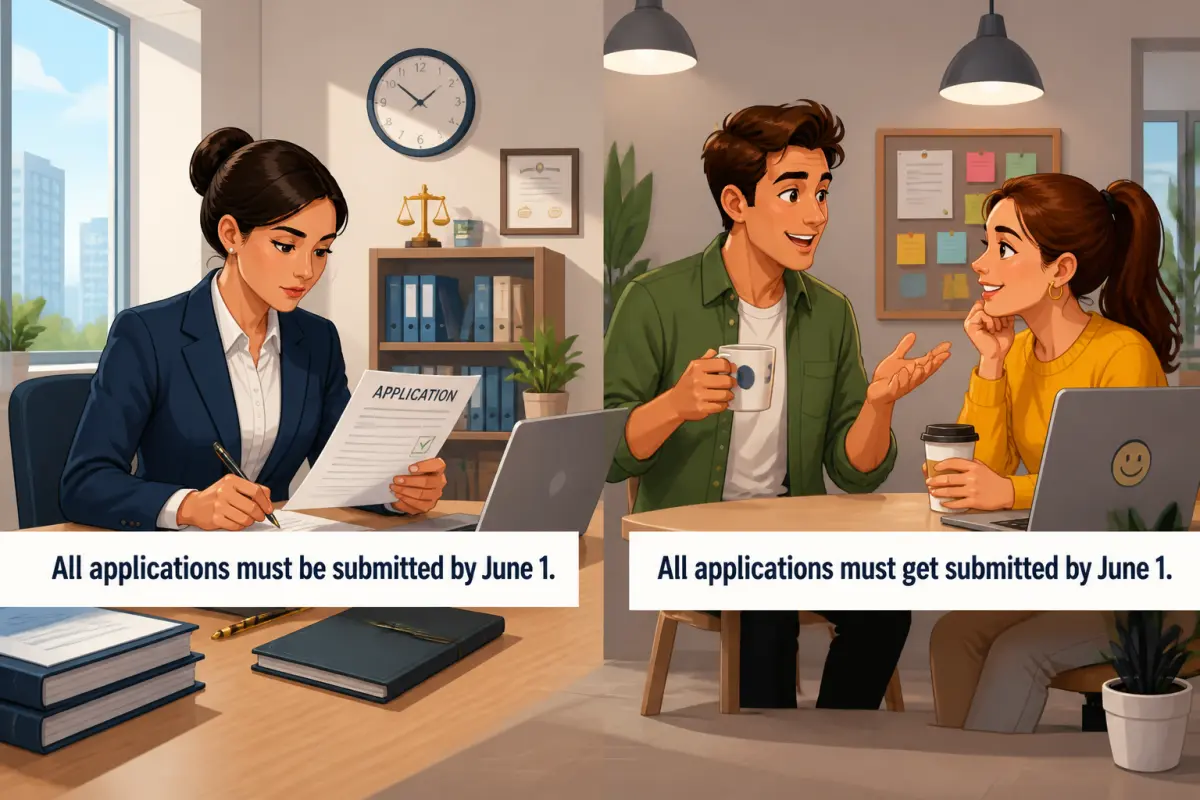
Even though this structure is common and useful, it is not always the best choice. In formal writing, academic prose, official notices, legal language, and carefully edited business communication, be passive usually sounds more appropriate. The reason is tone. Get passive often feels personal, spoken, or slightly casual.
For example, compare these:
- More formal: All applications must be submitted by June 1.
- Too conversational for a formal notice: All applications must get submitted by June 1.
The second sentence is not impossible, but it sounds wrong for the context. In formal documents, we usually want neutral structure, not conversational rhythm.
Here are contexts where be passive is usually better:
- Research writing: The samples were analyzed in a certified lab.
- Official reports: The request was denied due to missing documents.
- Policies and instructions: ID cards are required at entry.
- Professional announcements: The meeting has been postponed until further notice.
And here are conversational versions that might be fine in speech but not in a formal document:
- The samples got analyzed yesterday.
- My request got denied.
- You’ll get asked for ID at the door.
- The meeting got pushed back.
Another place to be careful is when you need a more polished verb choice. Sometimes the issue is not only passive grammar but also register. Spoken English often prefers everyday verbs, while formal English uses more neutral or technical ones. That broader difference appears in choices of formal and informal verbs as well.
Teacher note: I usually tell students this: if you are speaking, the get passive is often your friend; if you are drafting a report, let the be passive do more of the work.
Questions and negatives with did and get
In the simple past, questions and negatives use did, so the verb after it returns to the base form get, not got. This is one of the most common areas of confusion. Learners often say “Did you got hired?” because they are thinking about the past meaning, but after did the main verb must be the base form.
The same rule applies in negatives. We say “didn’t get,” not “didn’t got.” Once you control this, your spoken English becomes much more accurate immediately.
- Question: Did you get invited?
- Negative: I didn’t get chosen.
- Question: Did the package get delivered?
- Negative: The form didn’t get submitted on time.
Compare correct and incorrect forms:
- ✅ Did she get promoted?
- ❌ Did she got promoted?
- ✅ We didn’t get charged extra.
- ❌ We didn’t got charged extra.
- ✅ Did anyone get hurt?
- ❌ Did anyone got hurt?
You can also form present and future questions in the usual way:
- Do you get paid hourly or monthly?
- Does the room get cleaned every day?
- Will I get notified by email?
- Can this file get opened on a phone?
And negatives:
- I don’t get invited to those events.
- The back door doesn’t get locked automatically.
- We won’t get reimbursed for that expense.
One more useful pattern is with question words:
- Why did the order get canceled?
- How did your sleeve get torn?
- When did the account get approved?
Common mistakes with get, got, and gotten
The verb get causes trouble because it changes form a lot, and the passive pattern adds another layer. In American English, the main forms are get, got, and gotten. To use them well, you need to know both grammar and style. The biggest mistakes usually involve the wrong form after auxiliaries, confusion between past and participle, and mixing active and passive structures.
Start with the core pattern:
- Base form: get
- Past simple: got
- Past participle: gotten in American English, often got in British English for many uses
Major mistake 1: using got after did.
- ❌ Did he got fired?
- ✅ Did he get fired?
- ❌ I didn’t got paid last week.
- ✅ I didn’t get paid last week.
- ❌ How did your bag got damaged?
- ✅ How did your bag get damaged?
Major mistake 2: using the wrong form in the present perfect.
- ❌ I’ve got paid already. Possible in some meanings of possession, but not for this passive event in standard American English.
- ✅ I’ve gotten paid already.
- ❌ She has got hired by a startup.
- ✅ She has gotten hired by a startup.
- ❌ The forms have got lost in the mail. Possible in some varieties, but not the standard American pattern for this article’s focus.
- ✅ The forms have gotten lost in the mail.
Major mistake 3: forgetting that the passive needs a past participle after get.
- ❌ He got fire last month.
- ✅ He got fired last month.
- ❌ We got pay on Fridays.
- ✅ We get paid on Fridays.
- ❌ The window got break during the storm.
- ✅ The window got broken during the storm.
Major mistake 4: confusing the passive with active meanings of get.
- ❌ I got my boss yesterday. Unclear and not a passive.
- ✅ I got called by my boss yesterday.
- ❌ She got the email sent. This could mean causative grammar, not passive.
- ✅ She got sent the email. Passive meaning.
- ❌ They got the tickets checked. This may sound causative.
- ✅ Their tickets got checked at the gate.
For quick orientation, keep these forms in mind:
| Time or structure | Correct form | Example |
|---|---|---|
| simple present | get / gets | Employees get trained on day one. |
| simple past | got | I got promoted in April. |
| past question/negative | did + get | Did you get approved? |
| present perfect, AmE | have/has + gotten | She has gotten injured before. |
Teacher note: Students often memorize “get, got, gotten” but still make errors because they do not connect form to structure. Practice whole frames such as Did you get...?, I didn’t get..., I’ve gotten.... That usually works better than studying the forms alone.
Speaking practice: choose be passive or get passive
This section is where you turn the explanation into speaking choices. The goal is not only to produce a correct passive but also to choose the one that sounds natural for the situation. In everyday speech, both forms are possible in many cases, but one often fits the context better.
Work slowly. First decide whether the sentence sounds formal, neutral, or conversational. Then think about whether the focus is a state or an event. Finally, choose the tense carefully. The three practice blocks below test different skills: choosing the best option, rewriting for a more natural style, and correcting mistakes.
Practice block 1: Choose the best form
- At the airport, our flight (was canceled / got canceled) after two delays.
- In the employee handbook: All expense reports (must be submitted / must get submitted) within 30 days.
- My cousin finally (was hired / got hired) by the hospital last week.
- According to the lab report, the samples (were tested / got tested) twice.
- Nobody (was hurt / got hurt) when the ladder fell.
- The front gate usually (is locked / gets locked) at 10 p.m.
- I don’t know how my charger (was damaged / got damaged).
- In the announcement: The final exam (has been postponed / has gotten postponed) until Monday.
- He was careless and (was caught / got caught) using his phone during the test.
- The apartment (was painted / got painted) before the new tenants moved in. Choose the more conversational option.
Show answers
- got canceled
- must be submitted
- got hired
- were tested
- got hurt
- gets locked
- got damaged
- has been postponed
- got caught
- got painted
Practice block 2: Rewrite for the target style
- Rewrite in a more conversational way: The printer was broken during the move.
- Rewrite in a more formal way: My application got rejected because one file was missing.
- Rewrite in a more conversational way: She was promoted after only six months.
- Rewrite in a more formal way: The meeting got moved to Thursday.
- Rewrite in a more conversational way: Our names were left off the list.
- Rewrite in a more formal way: A lot of customer records got deleted by mistake.
- Rewrite in a more conversational way: No one was injured in the kitchen fire.
- Rewrite in a more formal way: The wrong package got sent to our office.
- Rewrite in a more conversational way: The kids were separated from the group in the museum.
- Rewrite in a more formal way: He got fired after repeated policy violations.
Show answers
- The printer got broken during the move.
- My application was rejected because one file was missing.
- She got promoted after only six months.
- The meeting was moved to Thursday.
- Our names got left off the list.
- A lot of customer records were deleted by mistake.
- No one got hurt in the kitchen fire.
- The wrong package was sent to our office.
- The kids got separated from the group in the museum.
- He was fired after repeated policy violations.
Practice block 3: Spot and correct the error
- Did your order got shipped yesterday?
- I didn’t got paid for the extra shift.
- She has got promoted twice this year.
- The report must get submitted by noon. Make it formal.
- He got choose for the training program.
- How did the screen got cracked?
- Those files have got deleted somehow.
- The guests got welcomed by the director at the ceremony. Change it to a more natural formal version.
- My backpack got steal on the train.
- Did anyone gotten hurt in the storm?
Show answers
- Did your order get shipped yesterday?
- I didn’t get paid for the extra shift.
- She has gotten promoted twice this year.
- The report must be submitted by noon.
- He got chosen for the training program.
- How did the screen get cracked?
- Those files have gotten deleted somehow.
- The guests were welcomed by the director at the ceremony.
- My backpack got stolen on the train.
- Did anyone get hurt in the storm?
FAQ: get passive in English
The questions below cover the doubts that often appear after learners understand the basic rule but still feel unsure in real use.
1. Is the get passive always informal?
No. It is more conversational than the be passive, but not automatically wrong outside casual speech. You can hear it in interviews, news speech, and workplace conversations. The real issue is tone. In highly formal writing, be is usually safer. In ordinary speaking, get often sounds completely normal.
2. Can I use the get passive with all verbs?
Not with all verbs equally naturally. It works best when the event affects someone or something clearly, especially in cases of change, result, trouble, or personal experience. “He got promoted” sounds excellent. “The theory got believed by many researchers” sounds very strange. If the verb does not fit a natural spoken event, the structure becomes awkward.
3. Why does “get married” feel different from “be married”?
Because the first one focuses on the event and the second one focuses on the state. “They got married in 2018” tells you when the event happened. “They are married” tells you their current relationship status. This event-versus-state contrast is one of the most useful ways to understand the pattern.
4. Is “gotten” necessary in American English?
For many meanings, yes, especially in perfect forms. If you are using American English, “I’ve gotten paid” and “She has gotten hired” are standard. Some learners avoid gotten because they mostly study British material, but in American English it is a normal and important form.
5. Can the get passive sound negative?
Very often, yes. Many common examples involve problems: get hurt, get fired, get robbed, get stuck, get caught. But it is not only negative. We also say get paid, get hired, get invited, and get promoted. The pattern is strongly associated with impact, not only bad news.
6. Can I include the agent with “by” after a get passive?
Yes, but use it carefully. “He got stopped by the police” sounds natural. However, long or formal agent phrases often sound better with be, such as “The proposal was reviewed by a three-member panel.” If the sentence starts sounding official or heavy, switch to be.
7. Do native speakers notice if I overuse the be passive?
Usually they will still understand you, but your speech may sound more written than spoken. A learner who always says “was invited,” “was promoted,” and “was hurt” is grammatically correct, yet less natural in many everyday conversations. Adding some get passives in the right places can make your English sound more relaxed and realistic.
8. What is the best way to practice this so it becomes automatic?
Practice with short life-based prompts, not isolated grammar labels. For example: job, travel, accident, school, phone, package, email. Then make quick spoken responses: “I got hired,” “My flight got delayed,” “My phone got cracked,” “We got charged twice.” This kind of pattern practice helps the structure become part of your active speech instead of remaining a rule you remember too late.