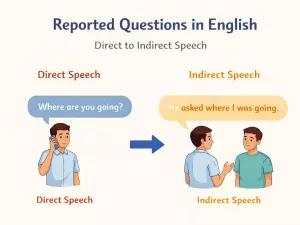
Reporting Questions: ask where / ask if

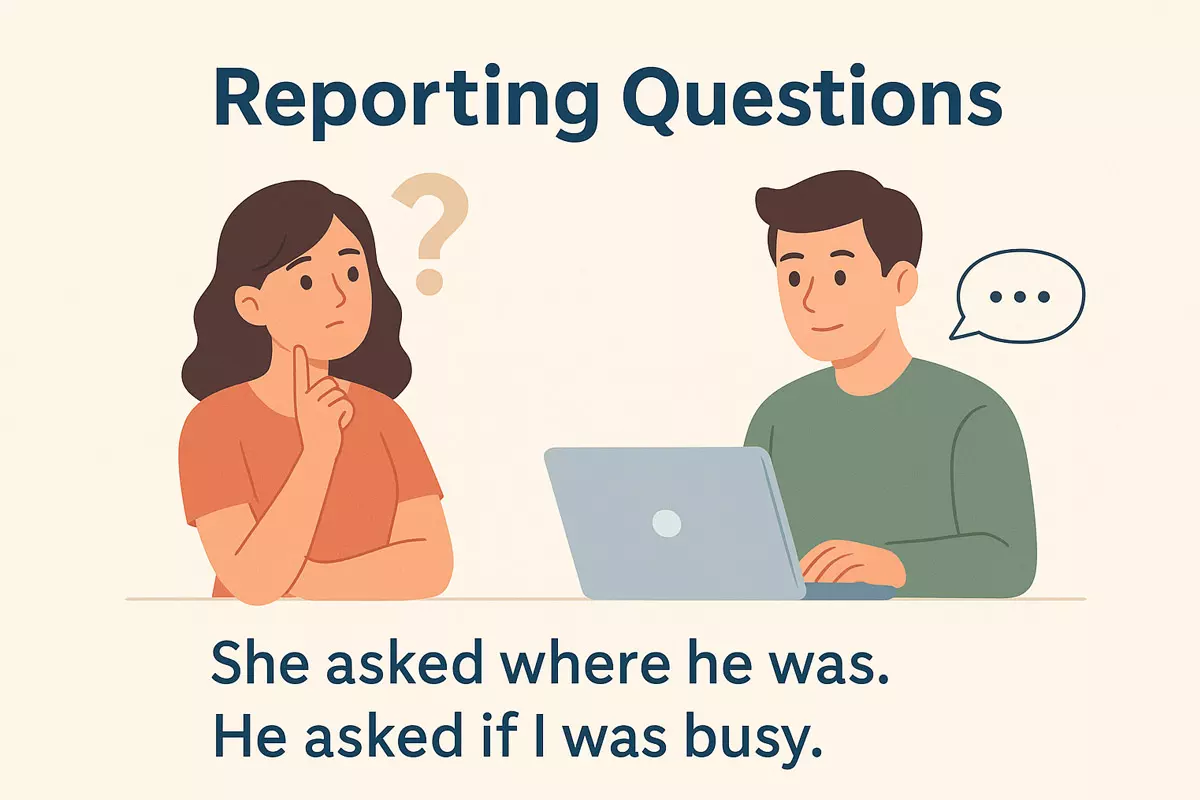 This article explains how to change direct questions into reported questions. It covers word order rules, using ask where for wh-questions, ask if or whether for yes–no questions, removing do/does/did, and common reporting verbs.
Learning to change direct questions, whether about places or requiring yes-no answers, into reported speech is an important skill that can make both your spoken and written English clearer and more effective. For example, instead of saying, "Where is the station?" you would report it as, "He asked where the station was." For yes-no questions like, "Is it raining?" you would say, "She asked if it was raining." Practicing these transformations helps you communicate more naturally and accurately in a variety of situations.
To understand how indirect questions blend into storytelling, try the dialogue-to-narration balance checker and see how much of your text is reported speech versus narrative explanation.
How Reported Questions Differ from Direct Questions
When we change a direct question into reported speech, several important modifications take place in both grammar and word order. Instead of quoting someone’s exact words, we summarize or paraphrase what was asked. This process involves specific changes that help distinguish between the original inquiry and the way it is conveyed indirectly.
Key Differences in Structure and Word Order
Direct questions usually begin with an auxiliary verb or a question word and end with a question mark. In contrast, reported questions are statements: they do not use question word order, and the sentence ends with a period. For example, “Where is the station?” becomes “He asked where the station was.” Notice how the word order shifts to a statement format.
- Question marks are removed.
- Word order shifts to subject + verb.
- Tenses often move one step back (present to past, etc.).
- Pronouns and time expressions may change.
- Reporting verbs like ask, want to know, or inquire are used.
- “If” or “whether” is introduced for yes/no questions.
- Question words (who, where, why, etc.) are kept for wh-questions.
- No auxiliary verbs at the beginning (do/does/did are dropped).
- Politeness and indirect forms are more common.
- Subject comes before the verb, just like in normal statements.
Comparing Direct and Reported Forms
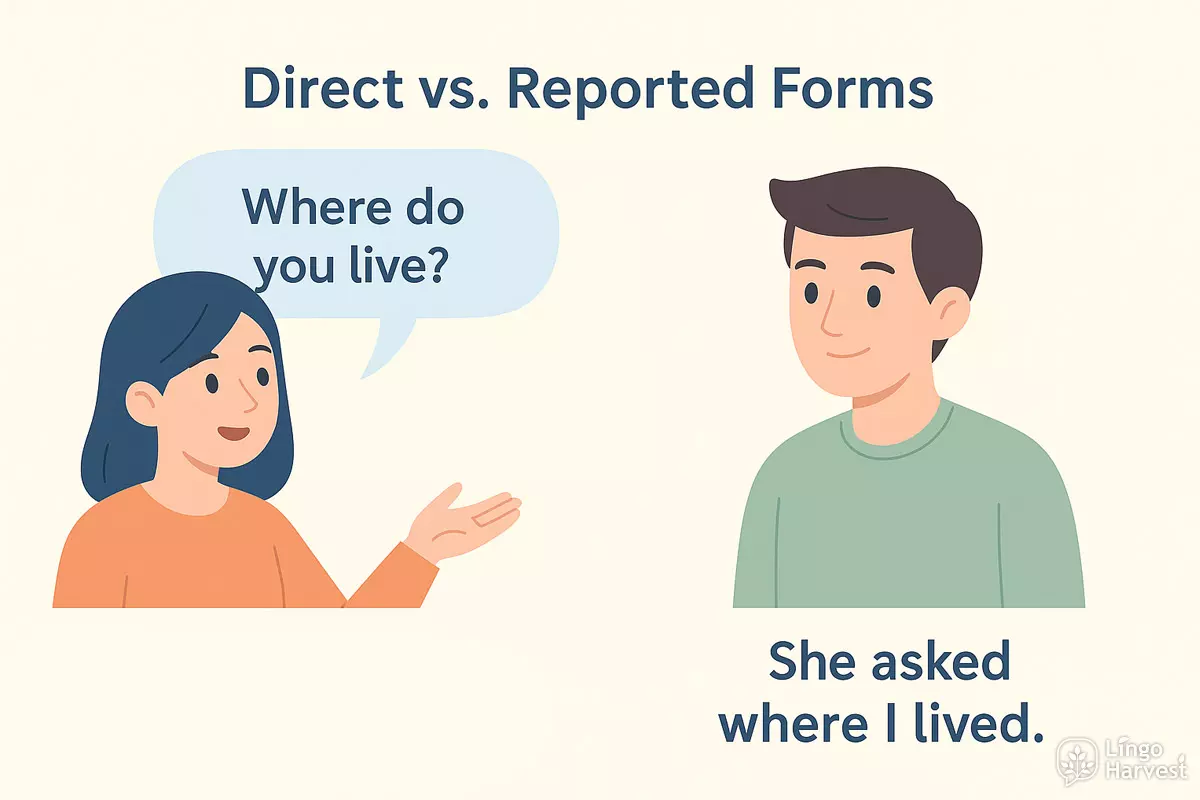
Below is a comparison table showing typical transformations from direct to reported questions:
| Direct Question | Reported Question |
|---|---|
| Where do you live? | She asked where I lived. |
| Is it raining? | He asked if it was raining. |
| What time does the train leave? | They wanted to know what time the train left. |
| Did you see the movie? | She asked if I had seen the movie. |
| Why are you late? | He asked why I was late. |
Common Patterns for Reporting Questions
For yes/no questions, use if or whether:
- He asked if she was coming.
- They wanted to know whether it was possible.
For wh-questions, keep the question word and use statement order:
- She asked where I had been.
- He wondered why they left early.
Summary of Main Adjustments
The transformation from a direct to an indirect inquiry involves changing the word order, adjusting tenses, and swapping out pronouns or time markers as needed. The result is a clear, neutral statement that communicates the original question without quoting it word-for-word. This approach is common in both spoken and written English when relaying what someone else wanted to know.
Word Order Rules in Reported Questions
When turning direct questions into reported speech, the sentence structure changes significantly. Unlike direct questions, which use inversion (verb before the subject), reported questions follow the standard statement word order—subject comes before the verb. This shift helps clarify that you are reporting what someone asked, not asking the question yourself.
Direct vs. Reported Question Structure
In direct speech, questions often start with an auxiliary verb or a question word. However, when reporting, you drop the auxiliary (do/does/did) and do not use question marks. For yes/no questions, use "if" or "whether" after the reporting verb. For questions starting with "where," "what," "how," etc., simply continue with the question word.
- Direct: "Where does she live?"
- Reported: He asked where she lived.
- Direct: "Did you see the movie?"
- Reported: She asked if I had seen the movie.
- Direct: "What time will you arrive?"
- Reported: He asked what time I would arrive.
- Direct: "Is it raining?"
- Reported: They asked if it was raining.
- Direct: "Who called you?"
- Reported: She asked who had called me.
- Direct: "Why are you late?"
- Reported: He asked why I was late.
- Direct: "Can you help me?"
- Reported: He asked if I could help him.
- Direct: "How did you do that?"
- Reported: She asked how I had done that.
- Direct: "Will you come tomorrow?"
- Reported: He asked if I would come the next day.
- Direct: "Where are my keys?"
- Reported: She asked where her keys were.
Key Patterns to Remember
- No inversion: Use subject + verb after the question word or "if/whether".
- No question mark: Reported questions are statements.
- Backshift tenses: If the reporting verb is in the past, shift the tense back (present → past, will → would, etc.).
- Pronoun and time change: Adjust pronouns and time expressions as needed (e.g., today → that day).
Common Mistakes and How to Avoid Them
- ❌ Incorrect: He asked where does she live.
- ✅ Correct: He asked where she lived.
- ❌ Incorrect: She asked if do I like coffee.
- ✅ Correct: She asked if I liked coffee.
Understanding these structural changes helps you report questions clearly and accurately, whether using "ask where" for information questions or "ask if" for yes/no questions.
Using Ask Where for Wh-Questions
When reporting questions that begin with a question word (such as where, when, why, or how), the reporting verb ask is followed by the appropriate question word instead of if or whether. The word order in reported speech changes to a statement structure, and the auxiliary do/does/did is omitted. This pattern is essential for clear and natural indirect speech.
How to Form Reported Wh-Questions with "Ask"
To report a question that starts with a wh-word, follow these steps:
- Begin with the reporting verb (e.g., asked).
- Add the wh-word from the original question (e.g., where).
- Use subject + verb (statement order), not question word order.
- Do not use a question mark at the end.
Common Patterns and Examples
Here are some typical ways to turn direct wh-questions into reported speech using ask:
| Direct Question | Reported Question |
|---|---|
| “Where are you going?” | He asked where I was going. |
| “When did she leave?” | They asked when she had left. |
| “Why is it so expensive?” | She asked why it was so expensive. |
| “How do you know that?” | He asked how I knew that. |
| “What time does the train arrive?” | I asked what time the train arrived. |
| “Who called you yesterday?” | She asked who had called me the day before. |
| “Which book do you prefer?” | He asked which book I preferred. |
| “Whose bag is this?” | They asked whose bag it was. |
| “How long have you lived here?” | She asked how long I had lived there. |
| “What happened?” | He asked what had happened. |
Key Points to Remember
- Keep the question word (where/when/why/how/etc.) at the start of the reported clause.
- Change the verb tense if necessary (backshifting).
- Use statement word order, not a question form.
- Do not use if or whether for wh-questions.
- Remove any auxiliary verbs used for questions (do, does, did).
Mastering this structure makes your indirect speech more accurate and natural. Practice with a variety of wh-questions to build confidence and fluency.
Using Ask If/Whether for Yes–No Questions
When we want to report questions that can be answered with a simple "yes" or "no," we typically use the verbs "ask if" or "ask whether." This structure helps us turn direct questions into indirect speech, making them more formal or suitable for relaying information. Instead of repeating the original question word-for-word, we report the inquiry by embedding it into a statement.
How It Works
To form these reported questions, start with the reporting verb ("ask"), then add "if" or "whether" before the rest of the statement. The word order changes from question form to statement form, and you do not use a question mark at the end.
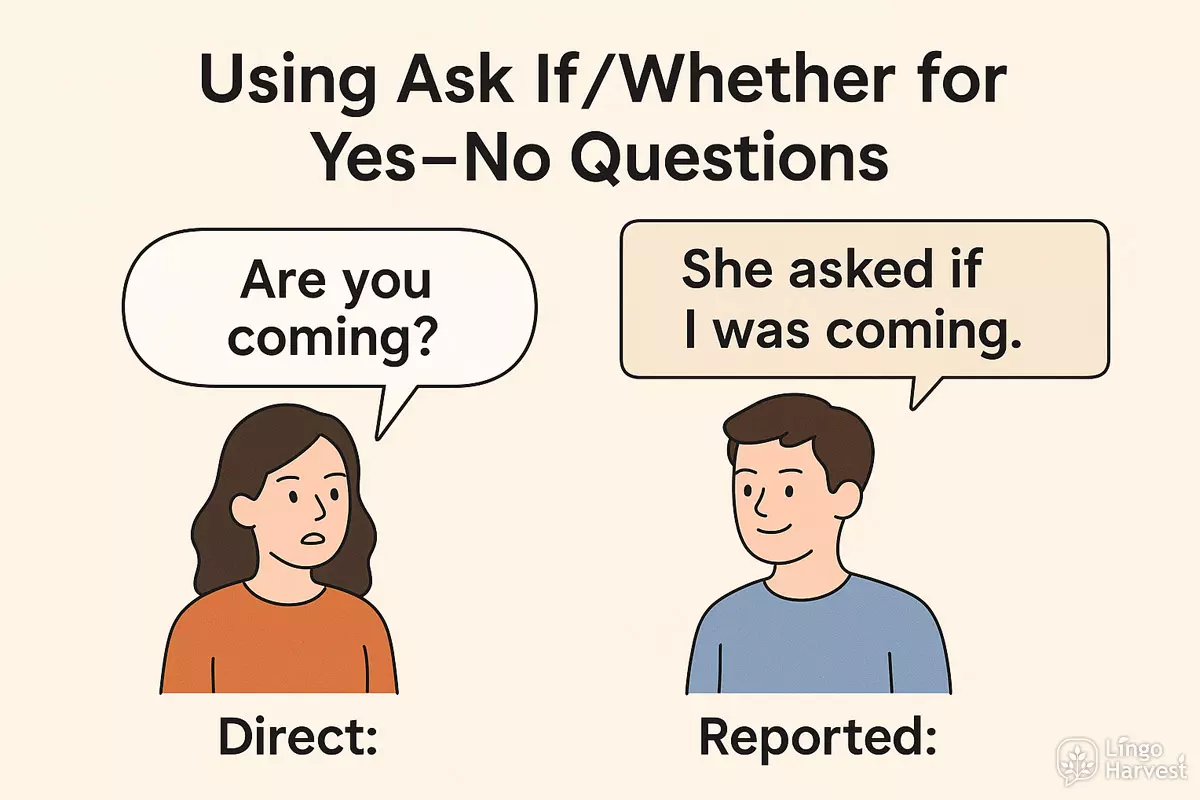
- Direct: "Are you coming?"
Reported: She asked if I was coming. - Direct: "Did he finish the report?"
Reported: They asked whether he had finished the report. - Direct: "Will you help me?"
Reported: He asked if I would help him.
When to Use "If" and "Whether"
Both "if" and "whether" are generally interchangeable in reported yes–no questions. However, "whether" is preferred in more formal contexts, or when presenting two alternatives (for example, "whether or not"). "If" is more common in everyday conversation.
- She asked if I wanted coffee. ✅
- He asked whether it was going to rain. ✅
- Let me know whether or not you can attend. ✅
Reporting Yes–No Questions: Pattern Overview
Here’s a concise guide to the typical structure:
- Reporting verb ("ask") + if/whether + subject + verb (statement word order)
- No auxiliary (do/does/did) in the reported clause
- No question mark at the end
- Change pronouns and time expressions as needed
Common Examples in Context
To help visualize the transformation, here are more sample pairs:
- Direct: "Is she at home?"
Reported: He asked if she was at home. - Direct: "Have you seen my keys?"
Reported: She asked whether I had seen her keys. - Direct: "Can you speak French?"
Reported: They asked if I could speak French. - Direct: "Are they coming to the party?"
Reported: He asked whether they were coming to the party. - Direct: "Did you like the movie?"
Reported: She asked if I had liked the movie. - Direct: "Will it snow tomorrow?"
Reported: They asked whether it would snow the next day. - Direct: "Is the store open on Sundays?"
Reported: He asked if the store was open on Sundays. - Direct: "Was the test difficult?"
Reported: She asked whether the test had been difficult. - Direct: "Do you need help?"
Reported: They asked if I needed help. - Direct: "Can I join the club?"
Reported: He asked whether he could join the club.
Summary Table: Direct vs. Reported Yes–No Questions
| Direct Question | Reported Question |
|---|---|
| Are you busy? | She asked if I was busy. |
| Will they arrive on time? | He asked whether they would arrive on time. |
| Do you know the answer? | They asked if I knew the answer. |
| Did it work? | She asked whether it had worked. |
| Can you drive? | He asked if I could drive. |
By following this pattern, you can accurately and naturally report yes–no questions in English, making your speech and writing clearer and more professional.
Removing Do/Does/Did in Reported Forms
When changing direct questions into reported speech, auxiliary verbs like "do," "does," and "did" are usually dropped. This is because reported questions use statement word order rather than question word order. This shift is especially important in English when reporting yes/no questions with "ask if" or "ask whether," or when reporting wh-questions with "ask where," "ask what," etc.
How It Works
Instead of keeping the auxiliary verb, you simply use the subject + verb (in the correct tense). The reporting verb ("asked," "wanted to know," etc.) is followed by the question word (if there is one). No inversion or "do/does/did" is required.
- Direct: "Where do you live?"
- Reported: She asked where I lived.
- Direct: "Did he finish the work?"
- Reported: She asked if he had finished the work.
- Direct: "What does she want?"
- Reported: He asked what she wanted.
Key Patterns and Examples
The following list shows how questions with "do," "does," or "did" change when reporting them. Notice that the auxiliary is removed and the verb tense may shift back (sequence of tenses):
- "Do you like pizza?" → He asked if I liked pizza.
- "Does she work here?" → They asked whether she worked there.
- "Did you see the movie?" → She asked if I had seen the movie.
- "Where do they live?" → He asked where they lived.
- "Why did you leave?" → She wanted to know why I had left.
- "What does this mean?" → He asked what that meant.
- "When did the show start?" → They asked when the show had started.
- "How do you know him?" → She asked how I knew him.
- "Did she call you?" → He asked if she had called me.
- "What do you want?" → She asked what I wanted.
- "When does the train leave?" → He asked when the train left.
- "Why did you go?" → She wanted to know why I had gone.
Summary Table: Direct vs. Reported Forms
| Direct Question | Reported Form |
|---|---|
| Do you understand? | He asked if I understood. |
| Does she play tennis? | She asked whether she played tennis. |
| Did they arrive on time? | He asked if they had arrived on time. |
| Where do they go? | She asked where they went. |
| What does it mean? | He wanted to know what it meant. |
| Why did you call? | She asked why I had called. |
Tips for Learners
- Always use statement word order in the reported version—never invert the subject and verb.
- Drop "do," "does," and "did" completely unless they are the main verb (not auxiliary).
- Adjust verb tenses as needed (often backshift: present → past, past simple → past perfect).
- If there is no question word, use "if" or "whether" to introduce the reported clause.
By focusing on these patterns, you can confidently convert questions into indirect speech without confusion over auxiliary verbs. This approach streamlines reported questions and helps your speech and writing sound more natural.
Common Reporting Verbs for Questions
When you need to report a question in English, certain verbs are commonly used to introduce the reported speech. These verbs help indicate that someone originally asked or inquired about something. Choosing the right verb often depends on the type of question and the level of formality.
Frequently Used Verbs for Reporting Questions
You’ll most often see verbs like ask, want to know, and inquire when reporting questions. However, there are many alternatives, each bringing a slightly different nuance. Here is a list of verbs that are regularly used for this purpose:
- ask → I asked her about the schedule.
- want to know → I want to know what time the meeting starts.
- inquire → He inquired about the refund policy.
- wonder → I wonder if they’re still open.
- question → She questioned his reasons for leaving early.
- enquire (British spelling) → I’d like to enquire about availability.
- query → The customer queried the extra charge on the bill.
- check → Let me check whether the file was uploaded.
- find out → I’ll find out who is responsible.
- investigate → The team is investigating the cause of the outage.
- probe → The reporter probed for more details.
- press → She pressed him for an exact answer.
- request (less common for questions, more for actions or information) → We requested additional information in writing.
- challenge → He challenged the claim with new evidence.
- interrogate → The suspect was interrogated for several hours.
- verify → Please verify your email address before continuing.
- consult → You should consult a specialist about the issue.
- appeal (to) → They appealed to the manager for a final decision.
- interview → The journalist interviewed the witness.
- seek to know → Researchers seek to know how people learn languages.
Choosing the Right Verb
The verb you select can affect the tone and clarity of your sentence. For example, ask is neutral and suitable in almost any context, while inquire and enquire are more formal. If you want to express curiosity, wonder is a good choice. When the question is persistent or challenging, press or challenge may fit better.
Examples of Reporting Verbs in Use
Notice how different verbs can slightly change the meaning or emphasis:
- She asked if the meeting was still on.
- He wondered where everyone had gone.
- The journalist inquired about the new policy.
- They wanted to know when the results would be ready.
Comparison of Common Verbs
| Reporting Verb | Typical Use & Register |
|---|---|
| ask | General, neutral; works for most direct and indirect questions. |
| wonder | Expresses curiosity or uncertainty, often more informal or thoughtful. |
| inquire / enquire | Formal, polite requests for information; common in business or official contexts. |
| question | Implies a more critical or investigative approach; can be formal or informal. |
| press | Suggests persistence or insistence in seeking an answer. |
| check | Informal; used when verifying information or confirming details. |
Choosing the right reporting verb adds precision and nuance to your reported questions, making your writing clearer and more engaging.
Practice: Change Direct Questions to Reported Form
When learning how to report questions in English, it's crucial to recognize the structure and verbs used—especially with "ask where" for information questions and "ask if/whether" for yes/no questions. Below you'll find practical exercises to help you transform direct questions into their reported equivalents, following the patterns discussed in the article.
Instructions
Read each direct question. Rewrite it as a reported question, making sure to:
- Change the word order (no auxiliary verb before the subject in reported questions).
- Use asked if/whether for yes/no questions.
- Use asked where/when/what/etc. for information questions.
- Adjust pronouns and tense if needed.
Exercise: Change Direct to Reported Questions
- “Where do you live?”
- “Are you coming to the party?”
- “What time did the train leave?”
- “Can you help me with this?”
- “Why was she upset?”
- “Have you seen my keys?”
- “Who is at the door?”
- “Will it rain tomorrow?”
- “How much does it cost?”
- “Did you call your mother?”
Typical Patterns for Reporting Questions
- ask + if/whether + subject + verb (for yes/no questions)
- ask + question word (where/what/how) + subject + verb (for information questions)
- Remove the auxiliary verb (do/does/did) in reported speech
- Shift tenses back (present → past, will → would, etc.), if necessary
- Adjust pronouns and time expressions
Common Mistakes to Avoid
- Keeping question word order in reported speech (incorrect: He asked where do I live)
- Forgetting to change pronouns (incorrect: She asked where do you live → correct: She asked where I lived)
- Using "if" with information questions (incorrect: He asked if where I was going)
Reported Questions: Direct vs. Indirect
| Direct Question | Reported Form |
|---|---|
| “Where is the station?” | He asked where the station was. |
| “Did you finish your homework?” | She asked if I had finished my homework. |
| “Why are they late?” | He asked why they were late. |
| “Can you drive?” | He asked if I could drive. |
| “Who called you?” | She asked who had called me. |
| “Will he join us?” | They asked if he would join them. |
Show answers
- She asked where I lived.
- He asked if I was coming to the party.
- She asked what time the train had left.
- He asked if I could help him with that.
- She asked why she had been upset.
- He asked if I had seen his keys.
- She asked who was at the door.
- He asked if it would rain the next day.
- She asked how much it cost.
- He asked if I had called my mother.