Grammar ▾
▸ Articles ▸ Advanced Grammar ▸ Adjectives & Adverbs ▸ Conjunctions ▸ Conditionals ▸ Determiners ▸ Gerunds & Infinitives ▸ Grammar Practice ▸ Modal Verbs ▸ Nouns ▸ Parts of Speech ▸ Prepositions ▸ Pronouns ▸ Quantifiers ▸ Question Formation ▸ Reported Speech ▸ Verbs
Writing ▾
▸ Punctuation ▸ Sentence Structure ▸ Writing Mistakes
Vocabulary ▾
▸ Visual Vocabulary ▸ Food Vocabulary ▸ People Vocabulary ▸ Places Vocabulary ▸ Hobbies Vocabulary ▸ Home Vocabulary ▸ School Vocabulary ▸ Weather Vocabulary ▸ Basic Vocabulary ▸ General Vocabulary
Speaking ▾
▸ Conversational English
Calculators Contacts
Home » B1–B2 Intermediate

Infinitives After Verbs of Perception: See, Hear, Watch

Infinitives After Verbs of Perception: See, Hear, Watch
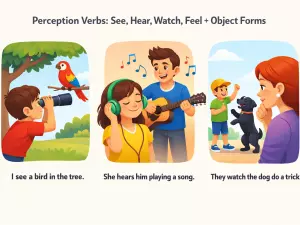
This article explains how perception verbs like see, hear, watch, notice, and feel work with the bare infinitive, the main sentence patterns, and when to use the -ing form instead. It shows meaning changes, common mistakes, and includes practice exercises.

May and Might: Probability and Polite Permission Explained

May and Might: Probability and Polite Permission Explained
This article explains the basic meanings of may and might, how they express probability and different certainty levels, and how to use them for polite permission and formal requests. It also covers negatives, questions, may have/might have, common mistakes, and homework practice tasks.
Infinitives After Question Words: How, What, Where, When

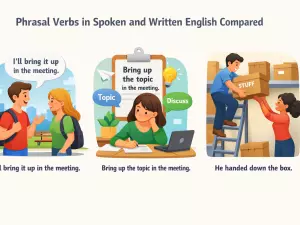
Infinitives After Question Words: How, What, Where, When
This article explains how question words combine with infinitives in English, with patterns like how to do, where to go, and what to say. It shows when they replace longer clauses, how they differ from direct questions, common learner errors, and ends with sentence-completion practice.

Verb + Gerund Patterns: Enjoy, Avoid, Finish, Consider

Verb + Gerund Patterns: Enjoy, Avoid, Finish, Consider
Learn what verb + gerund patterns are, which common verbs take gerunds, and how gerunds work after prepositions. It explains meanings these patterns express, negatives and questions, a quick gerund vs infinitive comparison, typical mistakes with fixes, and homework practice tasks.

Using Infinitives After Nouns: Rules and Examples

Using Infinitives After Nouns: Rules and Examples
Learn why some English nouns are followed by an infinitive, the most common noun + to + verb patterns, and how they show purpose, intention, or possibility. Covers key nouns like decision, plan, and chance, sentence structure, common mistakes, and practice exercises.

Verb + Infinitive Patterns: Want, Plan, Decide and More

Verb + Infinitive Patterns: Want, Plan, Decide and More
This article explains what verb + infinitive patterns are, lists common verbs that take to + verb, and shows how meaning and intention affect them. It covers negatives and questions, verb + object + infinitive, infinitives after adjectives and nouns, common mistakes and fixes, plus homework practice tasks.

Using Infinitives After Adjectives in English

Using Infinitives After Adjectives in English
This article explains why adjectives often take infinitives, shows key adjective + to + verb patterns, lists common adjectives, and gives real examples where infinitives express feelings, reactions, or results. It also flags typical mistakes and includes practice exercises.

Infinitive vs Gerund: How to Choose the Correct Form

Infinitive vs Gerund: How to Choose the Correct Form
Learn the core difference between infinitives and gerunds, plus which verbs take each form. It also covers verbs that allow both with a meaning change, gerunds after prepositions, and infinitives for purpose and intention. Finish with common mistakes, quick rules, and homework practice tasks.

Verbs Followed by Gerund or Infinitive (Different Meaning)

Verbs Followed by Gerund or Infinitive (Different Meaning)
This article explains why meaning shifts between gerunds and infinitives, focusing on verbs like remember, stop, forget, and try. It gives paired sentence examples, shows how context picks the right pattern, flags common mistakes, and ends with practice exercises.

Bare Infinitive: When and Why To Is Not Used

Bare Infinitive: When and Why To Is Not Used
This article explains what a bare infinitive is and where to use it: after modal verbs, make and let, help, and perception verbs. It also covers do as a dummy verb with the base form, common learner mistakes with fixes, and homework practice tasks.
Previous 1 ... 3 4 5 6 7 8 9 10 11 ... 41 Next
English Learning Tools
  • CEFR Text Level Checker
  • Type-Token Ratio Calculator
  • Sentence Length & Clarity Analyzer
  • Reading Time Calculator
  • Dialogue vs Narrative Analyzer
  • Question Types Analyzer
  • Error Density Checker
  • English Learning Time Calculator
  • Syllable Counter
Popular Articles
Modal Verbs in Job Interview Questions and Answers
Modal Verbs in Legal and Rule-Based Language
Using Modal Verbs in Instructions and Written Rules
Modal Verbs in Safety Instructions and Warnings
Modal Verbs Commonly Used in Professional Emails
Modal Verbs Used in Negotiation and Persuasion
About / Privacy Policy / Cookie Policy / Terms of Use

© 2025-2026 LingoHarvest — lingoharvest.com

Content on this website is provided for informational and educational purposes. You may share links to our pages; copying full texts is not permitted without permission.