Coordinating vs Subordinating Conjunctions: Easy Explanation

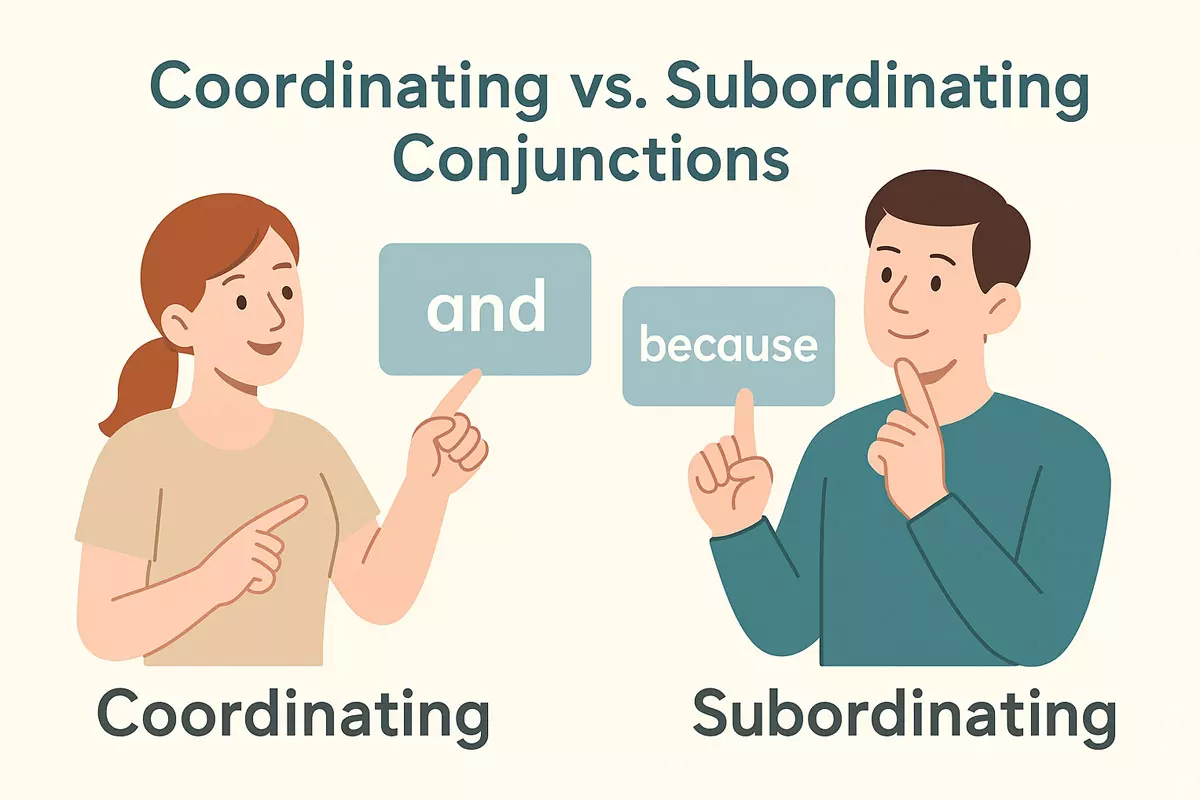 The article defines conjunctions, clearly distinguishes coordinating and subordinating conjunctions with simple examples, uses diagrams to show main versus subordinate clauses, and provides practice classifying conjunction types.
- Quick review: what a conjunction is
- Definition of coordinating conjunctions with simple examples
- Definition of subordinating conjunctions with simple examples
- How coordinating and subordinating conjunctions join ideas differently
- Easy diagrams to show main clause vs subordinate clause
- Practice: classify each conjunction as coordinating or subordinating
Have you ever noticed how some words help link ideas smoothly within a sentence? Learning to distinguish between linking words that connect equal parts, like and or but, and those that show dependence, such as although or because, can greatly improve the clarity and flow of your writing. By choosing the right connectors, you make your ideas easier to follow and your arguments more persuasive, resulting in writing that is both engaging and effective.
Quick review: what a conjunction is
Conjunctions are small but powerful words that link other words, phrases, or clauses within a sentence. Their main job is to show relationships between different parts of a sentence, such as connecting similar ideas, contrasting information, or explaining causes and results. Without these connecting words, sentences would be choppy and ideas harder to follow.
What do conjunctions join?
Conjunctions can connect:
- Two words (e.g., bread and butter)
- Phrases (e.g., in the morning or at night)
- Clauses (e.g., She ran because she was late)
Common conjunctions in English
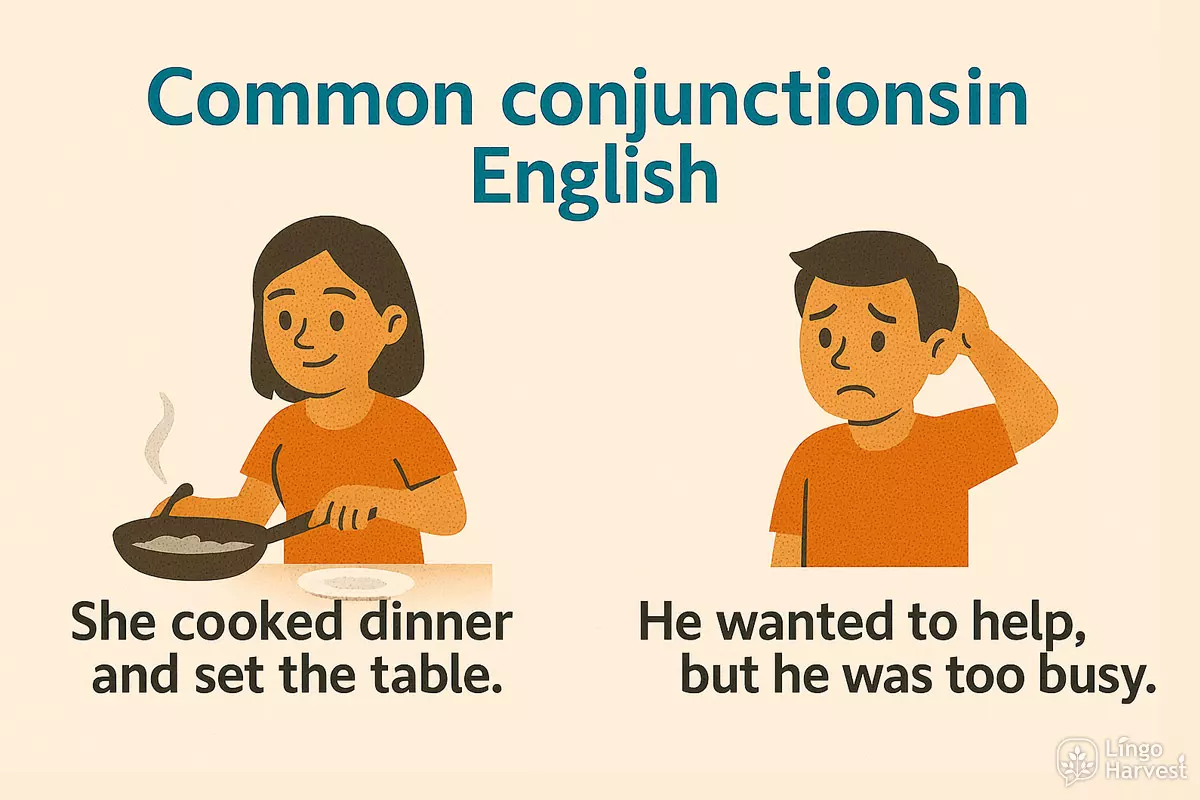
You see these linking words in everyday sentences. Some of the most frequently used include:
- and → She cooked dinner and set the table.
- but → He wanted to help, but he was too busy.
- or → You can stay here or come with us.
- nor → She didn’t call, nor did she write.
- for → I stayed home, for it was too cold outside.
- so → It was late, so we went to bed.
- yet → He is strict, yet he is fair.
- because → I left early because I felt sick.
- although → Although it was raining, they went out.
- while → She read a book while he cooked.
- since → We haven’t met since you moved away.
- if → If it rains, we’ll stay inside.
- unless → You can’t go out unless you finish your homework.
- after → After he ate, he went for a walk.
- before → Wash your hands before you eat.
- when → Call me when you arrive.
- as → She smiled as she opened the gift.
- until → Wait here until I return.
- whereas → She loves skiing, whereas he prefers surfing.
- though → He was tired, though he kept working.
Why are conjunctions important?
Using the right conjunction helps your writing flow smoothly and makes your meaning clear. They allow you to:
- Combine similar ideas without repeating yourself
- Show contrast or alternatives
- Explain reasons, results, or conditions
- Build longer, more complex sentences
Types of conjunctions (overview)
There are several categories, but the two main types you’ll often hear about are:
- Coordinating conjunctions: join elements of equal importance (e.g., and, but, or).
- Subordinating conjunctions: connect a main clause with a dependent clause (e.g., because, although, if).
Conjunctions in action: examples
- I want tea and coffee.
- She can stay or go.
- He was tired, but he finished the race.
- We left because it was late.
- If it rains, we’ll stay inside.
Quick practice: identify the conjunction
Find the conjunction in each sentence:
- She likes apples and oranges.
- He ran fast because he was late.
- We can go now or wait until later.
- She will leave if you are not ready.
- I wanted to go, but I was too tired.
- Call me when you arrive.
- Although it was cold, we went outside.
- It was raining, so we stayed at home.
- She was reading while he was cooking.
- Wait here until I come back.
Show answers
- and
- because
- or
- if
- but
- when
- although
- so
- while
- until
Definition of coordinating conjunctions with simple examples
Coordinating conjunctions are short words that connect two or more elements of equal grammatical importance in a sentence. They link words, phrases, or clauses that are similar in structure, helping sentences flow smoothly and ideas relate clearly. The most common coordinating conjunctions in English can be remembered with the acronym FANBOYS: for, and, nor, but, or, yet, so.
What do coordinating conjunctions do?
These connectors join things that are the same type—like two nouns, two verbs, or two independent clauses. They do not make one part of the sentence depend on the other; instead, they keep both parts equally important.
- and – adds one thing to another: She likes apples and oranges.
- but – shows contrast: He ran fast, but he missed the bus.
- or – presents alternatives: Do you want tea or coffee?
- nor – connects negative ideas: He doesn’t eat meat, nor does he drink milk.
- for – gives a reason: I was tired, for I had not slept well.
- yet – introduces something surprising: The task was hard, yet she finished it quickly.
- so – shows result: It was raining, so we stayed inside.
Simple sentence patterns using coordinating conjunctions
Here are some basic ways these conjunctions appear in everyday sentences:
- Tom and Jerry are friends.
- I want pizza or pasta.
- She is tired, but she keeps working.
- Would you like juice or water?
- He didn’t call, nor did he text.
- I was late, so I took a taxi.
- We can go hiking, or we can visit the museum.
- She studied hard, yet she didn’t pass the test.
- He is young, but very wise.
- I will go to the store, for we need milk.
Quick reference: Common coordinating conjunctions
- for
- and
- nor
- but
- or
- yet
- so
Coordinating conjunctions are essential for writing clear and natural sentences. They help you connect ideas without creating complicated sentence structures, making your communication smoother and easier to follow.
Definition of subordinating conjunctions with simple examples
Subordinating conjunctions are words that connect two clauses by making one clause dependent on the other. In other words, they introduce a dependent (or subordinate) clause and link it to an independent clause, showing the relationship between the two parts. These conjunctions often answer questions like why, when, or under what condition something happens. For example, in the sentence "I stayed home because it was raining," the word "because" joins the reason (it was raining) to the main action (I stayed home). The clause with "because" cannot stand alone, so it is considered dependent.
Common subordinating conjunctions
You’ll often encounter these words at the start of a dependent clause:
- after → We went for a walk after it stopped raining.
- although → Although it was cold, they played outside.
- as → She smiled as she opened the gift.
- because → He stayed home because he felt sick.
- before → Wash your hands before you eat.
- even though → Even though he was tired, he kept working.
- if → If it rains, we'll stay inside.
- since → We haven’t talked since you moved away.
- so that → She saved money so that she could travel.
- though → He tried hard, though he failed.
- unless → You can’t leave unless you finish your work.
- until → Wait here until I return.
- when → Call me when you arrive.
- whenever → Whenever I see her, she’s smiling.
- where → This is the place where we met.
- whereas → She loves hiking, whereas he prefers swimming.
- wherever → Sit wherever you like.
- while → He listened to music while studying.
Simple sentence examples
Here are some basic sentences to clarify how these connectors work:
- She went to bed after she finished her homework.
- Although it was late, he kept working.
- You can play outside if you finish your chores.
- Because I was tired, I took a nap.
- Stay here until I come back.
- When the bell rings, class will start.
- He wore a coat since it was cold.
- Unless you hurry, you’ll miss the bus.
- She whispered so that nobody would hear.
- I’ll call you before I leave.
How subordinating conjunctions function
These linking words help clarify the relationship between ideas in a sentence. They signal time, cause, condition, contrast, and purpose. The dependent clause introduced by a subordinating conjunction can come before or after the main clause:
- Because it rained, the picnic was canceled. → Reason comes first.
- The picnic was canceled because it rained. → Main clause comes first.
By using subordinating conjunctions, you can add detail and complexity to your writing, making your ideas clearer and more connected.
How coordinating and subordinating conjunctions join ideas differently
Conjunctions connect ideas, but they do so in distinct ways depending on their type. Coordinating conjunctions (like and, but, and or) link words, phrases, or independent clauses of equal importance. In contrast, subordinating conjunctions (such as because, although, and while) introduce a dependent clause, showing how one idea relies on or relates to another.
Coordinating Conjunctions: Equal Partners
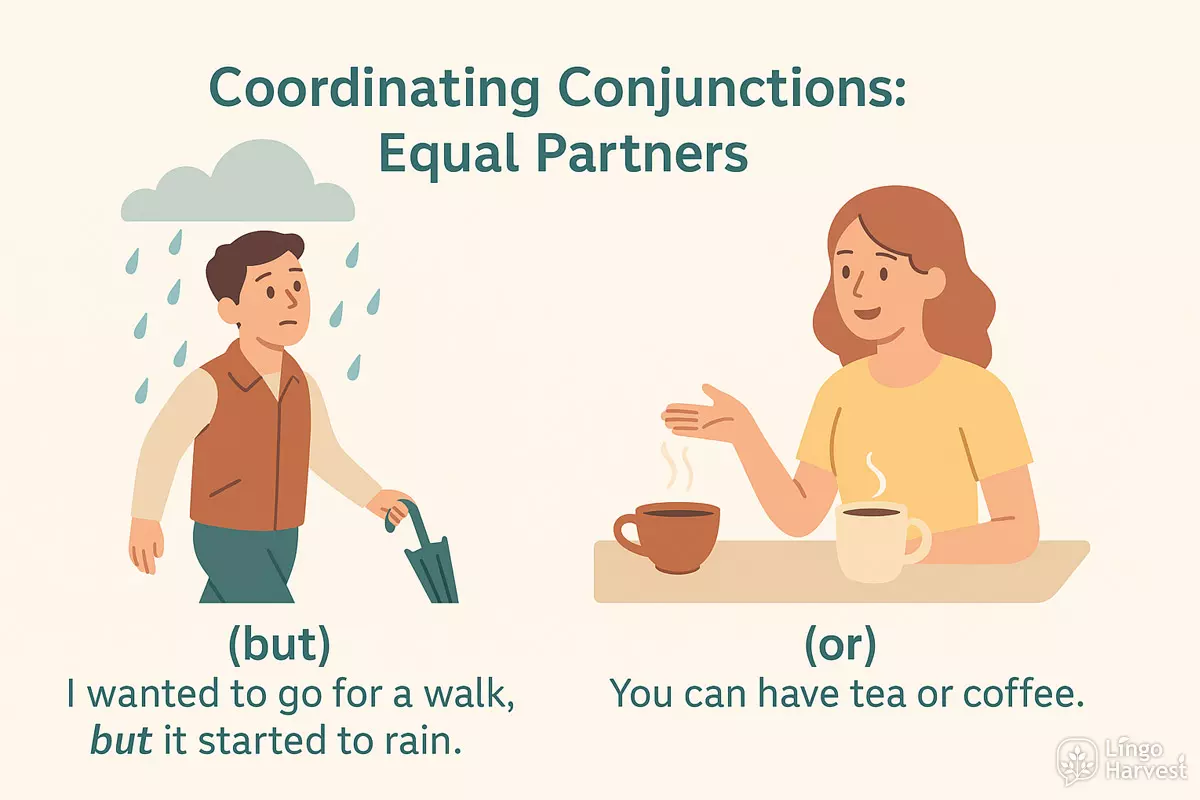
When you use a coordinating conjunction, you’re joining two grammatical units that could stand alone as complete sentences. This method signals that neither idea is more important than the other. For example:
- I wanted to go for a walk, but it started to rain.
- You can have tea or coffee.
- She likes to read and write.
Notice how each part could be its own sentence, but the conjunction brings them together smoothly.
Subordinating Conjunctions: Giving Structure and Emphasis
Subordinating conjunctions work differently. They attach a dependent clause to a main clause, indicating relationships like cause, time, or condition. The dependent clause cannot stand alone; it needs the main clause to form a complete thought. Here are some typical examples:
- Because it was late, we went home.
- We will wait until you arrive.
- Although he was tired, he finished his work.
- You can go out if you finish your homework.
This approach adds depth, showing which idea is the main focus and which one provides background or detail.
Key Differences at a Glance
| Coordinating Conjunctions | Subordinating Conjunctions |
|---|---|
| Connect ideas of equal rank (main clauses) | Link a dependent clause to an independent clause |
| Examples: and, but, or, so, yet, for, nor | Examples: because, although, since, unless, if, when, after, before, while, until, even though |
| Both parts can stand alone as sentences | Dependent clause cannot stand alone |
| Shows addition, contrast, choice, result | Shows cause, time, condition, contrast, purpose |
| No change in word order | May require a comma if dependent clause comes first |
Summary of Usage
In short, coordinating conjunctions give equal weight to the ideas they connect, while subordinating conjunctions clarify relationships and highlight which idea is primary. Understanding these differences helps you write clearer, more nuanced sentences.
Easy diagrams to show main clause vs subordinate clause
Understanding the difference between main and subordinate clauses is much simpler with visual aids. A main clause can stand alone as a complete sentence, while a subordinate clause cannot; it needs the main clause to make sense. Diagrams can quickly clarify how each type functions within a sentence.
Visualizing Clauses with Simple Diagrams
Imagine a sentence as a train: the main clause is the engine—it can travel by itself. The subordinate clause is like a carriage; it must be connected to the engine to move. Here’s how you might picture this relationship:
- Main clause: The sun set ✅
- Subordinate clause: because the day ended ❌
- Together: The sun set because the day ended. ✅
Comparing Clause Types in Sentences
To see the contrasts more clearly, here are a variety of sample clauses and sentence structures. Notice how only the main clause can stand alone, while the subordinate clause always relies on another part for meaning:
| Main Clause (Complete thought) |
Subordinate Clause (Incomplete thought) |
|---|---|
| I went home | because it was raining |
| She smiled | when she saw the puppy |
| We will eat dinner | after Dad arrives |
| The phone rang | while I was sleeping |
| My friend called | if he finished his homework |
| They cheered | although they lost the game |
| The cat purred | as I petted it |
| You can go out | unless it gets dark |
| We stayed inside | since it was cold |
| He will join us | once he finishes |
Quick Tips for Spotting the Difference
- Main clauses express a complete thought and can be a full sentence.
- Subordinate clauses begin with words like because, when, if, although, since, while, unless, after, once, as and cannot stand alone.
- Look for the conjunction—if it starts the clause and the thought feels unfinished, it’s probably subordinate.
- In complex sentences, the subordinate clause either comes before or after the main clause, but never alone.
These diagrams and examples help make the structure of sentences with main and subordinate clauses much easier to recognize and understand.
Practice: classify each conjunction as coordinating or subordinating
Understanding the difference between coordinating and subordinating conjunctions is essential for building clear, complex sentences. Below, you'll find a set of conjunctions commonly used in English. Your task is to decide whether each one connects elements of equal importance (coordinating) or introduces a dependent clause (subordinating).
Choose the right category for each conjunction
Look at the list below and try to determine if each word is a coordinating or subordinating conjunction. Think about how each one functions in a sentence: does it join two main clauses, or does it make one clause dependent on the other?
- and
- although
- but
- because
- or
- since
- so
- unless
- while
- for
- after
- before
- if
- yet
- when
- nor
- once
- though
- as
- whereas
Show answers
- Coordinating: and, but, or, so, for, yet, nor
- Subordinating: although, because, since, unless, while, after, before, if, when, once, though, as, whereas
Test your understanding with example sentences
Try to identify the type of conjunction in each sentence. Is it connecting two independent clauses, or does it make one clause dependent on the other?
- She stayed home because she was feeling sick.
- He can have tea or coffee.
- Although it rained, the match continued.
- Would you like pizza and salad?
- Call me if you need help.
- He stayed awake although he was very tired.
- She bought apples and oranges.
- They left early because the weather got worse.
- You can stay here or come with us.
- I’ll visit you when I have time.
Show answers
- Subordinating (because)
- Coordinating (or)
- Subordinating (although)
- Coordinating (and)
- Subordinating (if)
- Subordinating (although)
- Coordinating (and)
- Subordinating (because)
- Coordinating (or)
- Subordinating (when)
Quick reference: common conjunctions by type
| Coordinating Conjunctions | Subordinating Conjunctions |
|---|---|
| and | because |
| but | although |
| or | since |
| so | while |
| for | if |
| nor | unless |
| yet | after |
| before | |
| once | |
| as | |
| when | |
| though | |
| whereas |
Remember: coordinating conjunctions link words, phrases, or clauses of the same type, while subordinating conjunctions introduce a dependent (subordinate) clause. Practicing with real examples helps you recognize these patterns naturally in both writing and speech.