How to Join Two Actions Using Simple Conjunctions

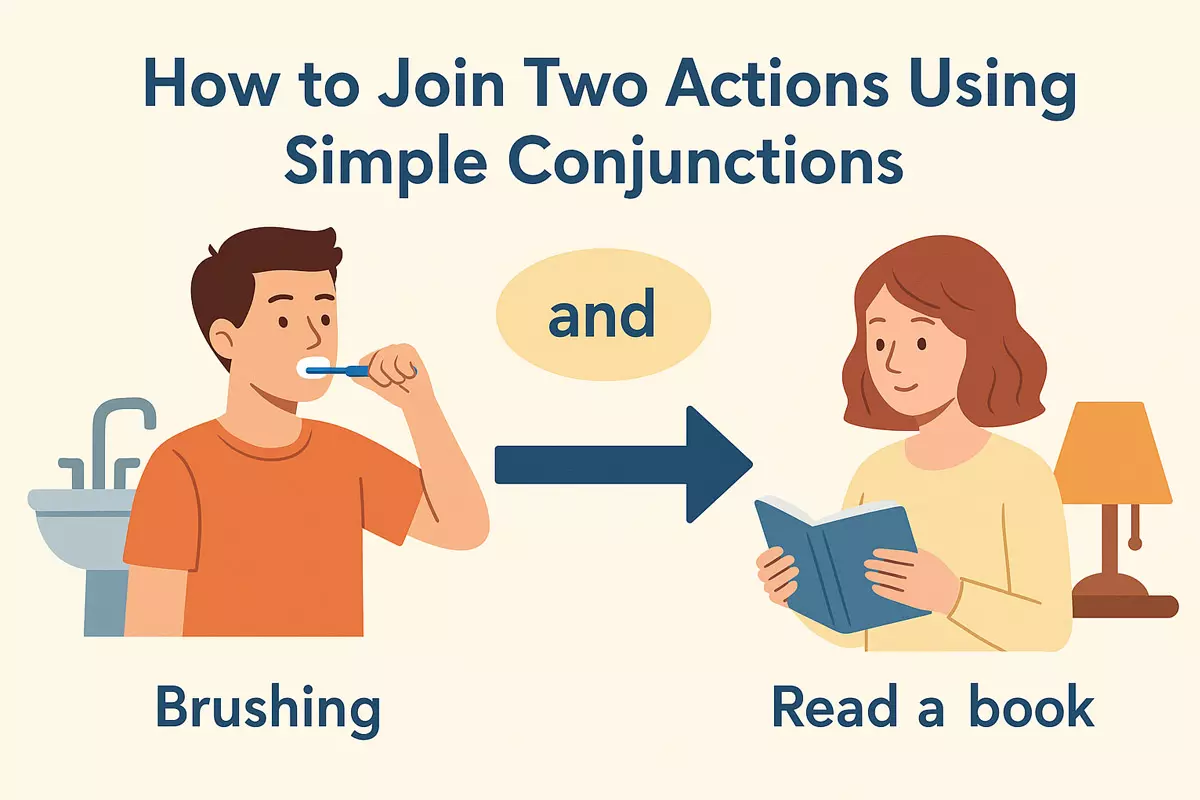 Here we how to use basic conjunctions to join actions, including connecting verbs with and, but, or, showing sequence, making choices, and avoiding sentence fragments. It also offers practice combining short action sentences.
Linking two activities in a single, fluid sentence helps make your writing clearer and more interesting for readers. By using simple connecting words like "and," "while," or "as," you can easily join actions and convey your ideas more efficiently, whether you are narrating an event, describing a process, or providing instructions. This technique not only enhances the flow of your writing but also ensures that your message is delivered in a concise and engaging manner, making it easier for readers to follow and understand your points.
Review of basic conjunctions for joining actions
Understanding how to link actions smoothly is essential for clear communication. Simple conjunctions play a key role in connecting two or more actions within a sentence. These words not only help with sentence flow but also clarify the relationship between the actions described.
Common conjunctions for joining actions
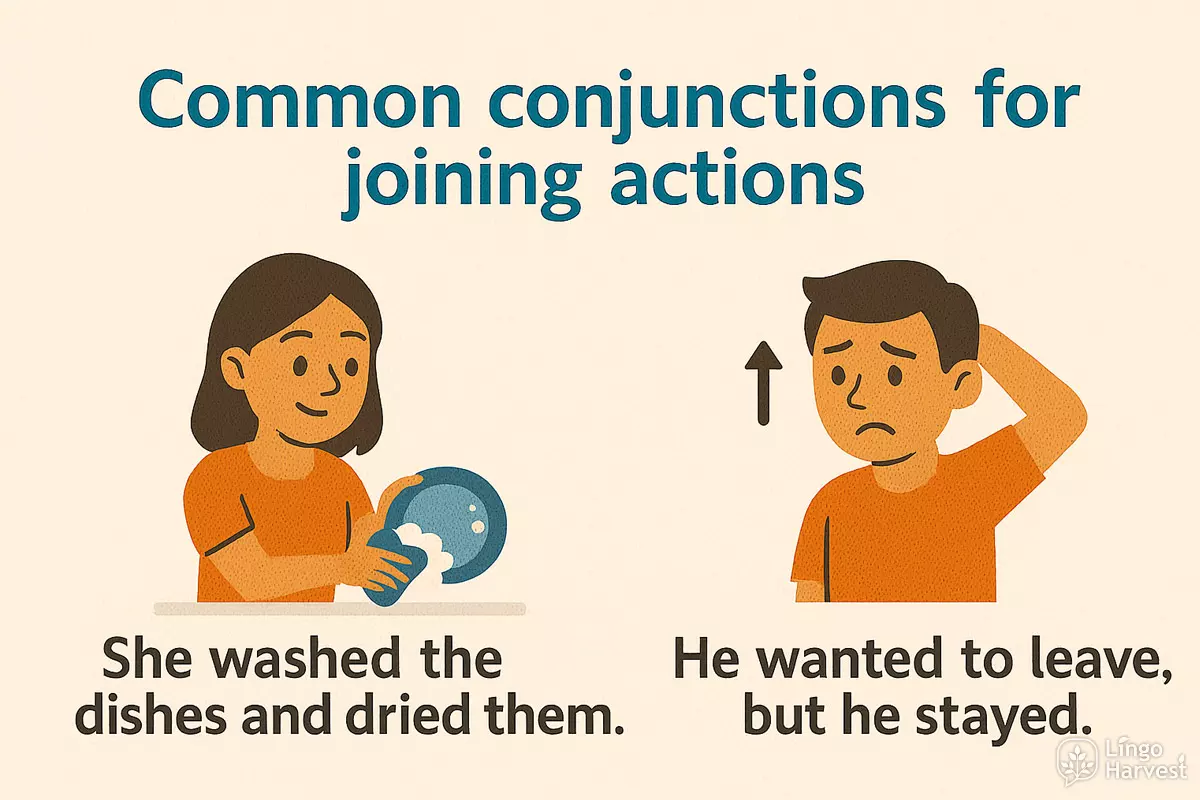
The most frequently used conjunctions to connect actions include “and,” “but,” “or,” “so,” and “then.” Each serves a slightly different purpose, signaling addition, contrast, choice, result, or sequence. Here are some typical conjunctions and their uses:
- and – adds one action to another (“She washed the dishes and dried them.”)
- but – shows contrast between actions (“He wanted to leave, but he stayed.”)
- or – offers options or alternatives (“You can read a book or watch TV.”)
- so – indicates a result or consequence (“It was late, so we went home.”)
- then – suggests a sequence (“I finished my work, then I called my friend.”)
- because – gives a reason (“She left early because she was tired.”)
- while – indicates simultaneous actions (“He cooked while she set the table.”)
- after – shows order (“After he ate, he went for a walk.”)
- before – also shows order, but in reverse (“Before you go out, lock the door.”)
- when – marks the timing of actions (“Call me when you arrive.”)
- if – introduces a condition (“If it rains, we will stay inside.”)
- unless – introduces an exception (“I won’t go unless you come with me.”)
- until – shows a limit in time (“Wait here until I return.”)
- as soon as – indicates immediate sequence (“As soon as I finish, I’ll call you.”)
- since – gives a reason or time reference (“Since you’re here, let’s start.”)
- so that – shows purpose (“She spoke quietly so that no one would hear.”)
- although – marks contrast (“Although it was raining, he went out.”)
- even though – similar to although, for stronger contrast (“Even though he was tired, he kept working.”)
- as – can mean “because” or “while” (“As it was getting dark, we left.” or “She sang as she worked.”)
Comparing conjunctions in use
Some conjunctions may seem similar but have distinct uses. Here’s a comparison of a few common ones:
| Conjunction | Typical Use & Example |
|---|---|
| and | Connects similar or related actions. “She opened the window and let in fresh air.” |
| but | Links contrasting actions or ideas. “He wanted to go, but he was too tired.” |
| so | Shows cause and effect between actions. “She forgot her umbrella, so she got wet.” |
| or | Presents options or alternatives. “You can stay here or come with us.” |
| while | Indicates two actions happening at the same time. “He read while she cooked.” |
| because | Gives a reason for the action. “They left because it was late.” |
Practical tips for using conjunctions
When linking actions, think about the relationship you want to express: addition, contrast, sequence, or cause. Choose the conjunction that best fits the connection. Overusing “and” can make writing monotonous, so try mixing in other conjunctions to vary your sentences.
Try the following exercises to practice:
- Combine these actions with a suitable conjunction: “I made coffee. I read the newspaper.”
- Link these actions to show contrast: “She studied hard. She didn’t pass the exam.”
- Join these actions to express a result: “It rained all night. The streets were flooded.”
- Combine these actions using a time sequence: “He finished dinner. He watched TV.”
- Join these actions to show a reason and result: “He was tired. He went to bed early.”
- Link these ideas to show contrast: “They wanted to travel. They didn’t have enough money.”
- Combine these actions to express a result: “She missed the bus. She was late for work.”
- Join these actions using a time conjunction: “The teacher entered the room. The students stopped talking.”
Show answers
- I made coffee and read the newspaper.
- She studied hard, but she didn’t pass the exam.
- It rained all night, so the streets were flooded.
- He finished dinner, then watched TV.
- He was tired, so he went to bed early.
- They wanted to travel, but they didn’t have enough money.
- She missed the bus, so she was late for work.
- When the teacher entered the room, the students stopped talking.
Joining two verbs with and, but, or
When you want to connect two actions performed by the same subject, simple conjunctions like and, but, and or are your best tools. These words help you combine verbs smoothly, making your sentences more natural and efficient. Each conjunction adds a slightly different meaning, showing addition, contrast, or choice between actions.
How each conjunction works
- And links two actions that both happen or are true. It shows addition.
- But connects actions that contrast or show a surprising difference.
- Or offers a choice between two possible actions.
Examples of connecting two verbs
- She cooked and cleaned all afternoon.
- He wanted to stay, but had to leave early.
- You can read or watch TV before bed.
- They laughed and danced at the party.
- I should study, but feel tired.
- We could walk or take the bus.
- She tried and succeeded.
- He called but didn’t get an answer.
- You can draw or paint for art class.
- We planned and prepared together.
- They could stay or go home.
- I want to travel but need to save money.
- She can sing and play guitar.
- He might visit or call later.
- You should finish but can rest afterward.
Patterns to remember
When using these conjunctions, make sure both verbs agree with the subject and tense. In most cases, you do not need to repeat the subject or auxiliary verb unless it changes meaning or adds clarity.
| Conjunction | Function | Example |
|---|---|---|
| And | Adds another action | She writes and draws. |
| But | Shows contrast | He wants to go but has no time. |
| Or | Offers a choice | You can run or walk there. |
Practice combining actions with these conjunctions to make your sentences more varied and clear. This approach helps you avoid repetition and makes your writing or speech more fluent.
Talking about sequence: first action and second action
When you want to describe events that happen one after another, using simple conjunctions helps your listener or reader follow the order easily. In English, words like then, after that, before, and and then are commonly used to link two actions and make the sequence clear.
Common conjunctions for sequencing actions
- and then — connects two actions in order: "I brushed my teeth and then went to bed."
- before — shows that one action happens prior to another: "Wash your hands before you eat."
- after — indicates the second action follows the first: "We left after the movie ended."
- next — suggests the immediate following action: "First, open the box. Next, take out the parts."
- then — similar to "and then," it moves the story forward: "She finished her work, then called her friend."
- when — can link actions that happen at the same or closely connected times: "Call me when you arrive."
- after that — emphasizes the sequence even more clearly: "He finished breakfast. After that, he went jogging."
- once — means "as soon as" or "when" the first action is complete: "Once you finish, submit your work."
- until — shows one action continues up to a certain point: "Wait until I call your name."
- while — sometimes used for overlapping actions: "Listen while I explain."
Patterns for sequencing two actions
There are several ways to organize sentences to express the order of two actions. Here are some typical patterns:
- First action, then second action: "I locked the door, then left the house."
- After + first action, second action: "After I finished dinner, I watched TV."
- Second action after first action: "I watched TV after I finished dinner."
- Before + second action, first action: "Before I go to bed, I brush my teeth."
- First action before second action: "I brush my teeth before I go to bed."
- Once + first action, second action: "Once you arrive, call me."
Examples of sequencing in everyday situations
- Take off your shoes before entering the house.
- First, mix the flour and water. Next, add the eggs.
- He read the instructions, then started the test.
- After class ended, everyone left the room.
- Finish your homework before you play games.
- Once the bell rings, the class begins.
- Wash vegetables before cutting them.
- After you log in, you can access your account.
- She waited until the rain stopped, then went outside.
- Call me when you get home.
- Turn off the lights before leaving the office.
Quick comparison: Sequencing conjunctions
| Conjunction | How it shows sequence |
|---|---|
| before | Action 1 happens earlier than Action 2 ("Wash hands before eating.") |
| after | Action 2 happens following Action 1 ("Go home after work.") |
| then / and then | Action 2 follows Action 1 in time ("She ate breakfast and then left.") |
| once | Action 2 happens as soon as Action 1 is complete ("Once you finish, call me.") |
| when | Action 2 happens at the same time or directly after Action 1 ("Call me when you arrive.") |
Using these conjunctions and patterns allows you to clearly express the order of events, making your communication more organized and easy to understand. Practice combining actions with these words to improve your fluency and clarity.
Making choices between actions using or
When you want to show that someone has more than one possible action, the conjunction "or" is the simplest way to connect those options. This word signals a choice: only one of the actions will happen, not both at the same time. In everyday English, "or" is often used to offer alternatives or decisions between two or more possibilities.
Basic patterns with "or"
You can join two verbs, verb phrases, or even whole sentences using "or" to suggest that only one will happen. Here are some guidelines:
- Use the base form of the verb after "or" if the first verb is also in base form: Do you want to read or write?
- If the sentence is in the past, keep both verbs in the past tense: She cooked dinner or ordered food.
- You can join actions with different objects: He will call you or send a message.
- For negative choices, "or" still works: Don’t run or shout in the hallway.
Common examples of using "or" to connect actions
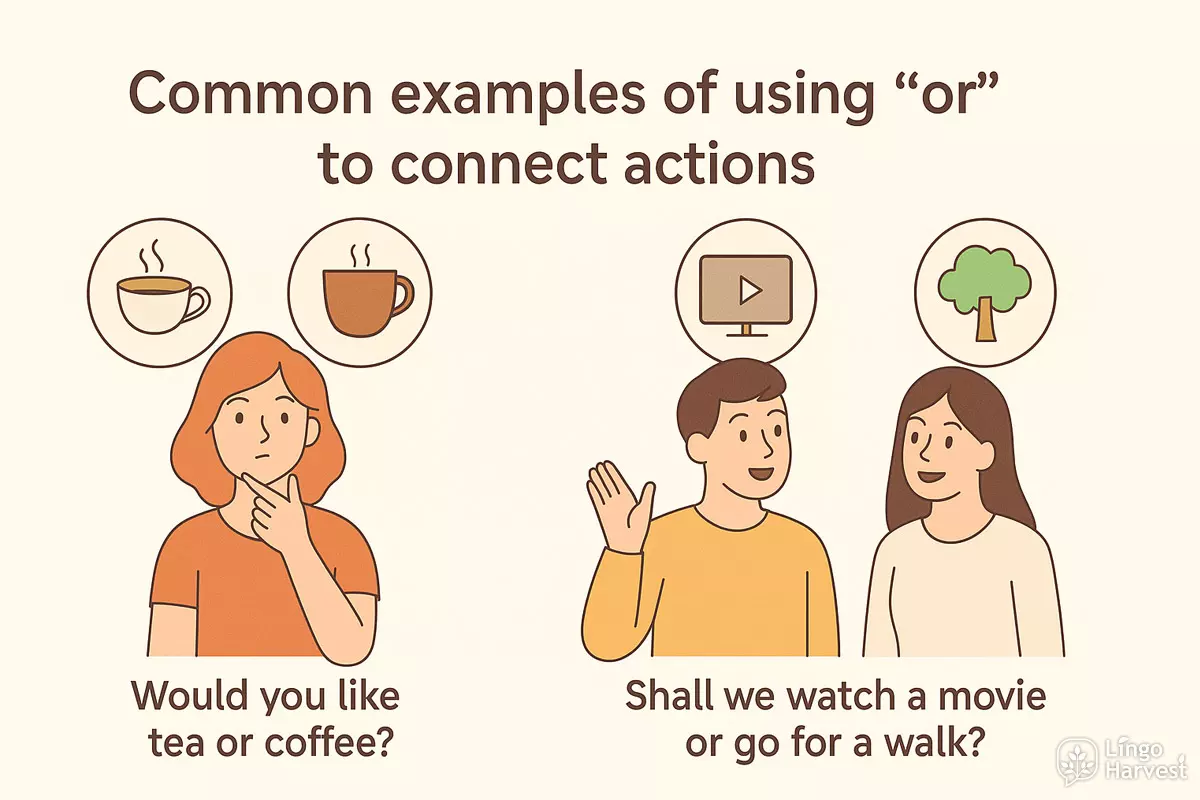
Here are some everyday ways to use "or" when giving options:
- Would you like tea or coffee?
- Shall we watch a movie or go for a walk?
- You can stay home or come with us.
- I might read a book or listen to music.
- Will you drive or should I?
- Finish your homework or you can’t play outside.
- Do you want to eat now or later?
- She can email or call you tomorrow.
- They could start now or wait until later.
- Should I write it down or remember it?
- Buy apples or oranges for the fruit salad.
- We can leave early or stay until the end.
- Is it better to ask for help or figure it out alone?
- Accept the offer or decline politely.
- Take the bus or walk to school?
Tips for choosing when to use "or"
- Use "or" when only one action can be chosen at a time.
- If both actions could happen together, use "and" instead.
- To clarify that any option is acceptable, use "either...or": You can either stay or leave.
- For more formal situations, "whether...or" is possible: Let me know whether you will attend or not.
Quick comparison: "or" vs. "and"
| "Or" | "And" |
|---|---|
| Choose one action: Do you want pizza or pasta? |
Do both actions: He washed and dried the dishes. |
| Only one possibility is expected. | Both actions are expected or required. |
| Offers alternatives or options. | Connects actions that happen together. |
| Use for decisions or preferences. ✅ Stay or leave? |
Use for sequences or combinations. ✅ Stand up and speak. |
By understanding how "or" works to link actions, you can clearly present choices and alternatives in your sentences. This helps make instructions, offers, and questions much easier to understand.
Avoiding sentence fragments when joining actions
When combining two actions with a conjunction, it’s important to ensure your sentence remains complete and clear. Sentence fragments—groups of words that do not express a complete thought—often occur when the second action is missing a subject or verb, or when the conjunction is misused. To prevent such errors, always check that both actions have a subject and verb, and that the conjunction properly links two independent or related ideas.
Common Causes of Fragments with Simple Conjunctions
Writers sometimes leave out essential parts of the second action, especially when using words like "and," "but," or "or." Here are some typical mistakes:
- Omitting the subject or verb in the second action
- Using a conjunction to connect a complete sentence with a fragment
- Adding extra conjunctions that break the sentence flow
How to Spot and Fix Fragments
To avoid incomplete sentences, read each part joined by a conjunction separately. If one half doesn’t make sense alone, revise it. Consider these examples:
- Incorrect: She finished her homework and then.
- Correct: She finished her homework and then went to bed.
- Incorrect: We went to the park but.
- Correct: We went to the park but forgot our snacks.
Checklist for Complete Sentences When Joining Actions
Before finalizing your sentence, ask yourself:
- Does each action have a subject and a verb?
- Does the conjunction connect related ideas?
- Can each part stand alone as a sentence (if needed)?
- Are unnecessary conjunctions avoided?
Examples: Complete vs. Fragmented Sentences
Below are examples showing how to correctly join actions and avoid fragments:
- She called her friend and invited her over. ✅
- He opened the window but did not close the door. ✅
- They played music and danced all night. ✅
- We left early or we missed the bus. ✅
- She tried to bake a cake but. ❌
- The dog barked and. ❌
- He studied for the test but forgot his notes. ✅
- They went shopping and bought groceries. ✅
- I called you but no answer. ❌
- She cooked dinner and set the table. ✅
- He ran fast but tripped. ✅
- We can stay home or go out. ✅
- The rain fell and. ❌
- She wrote a letter and sent it. ✅
- He arrived late but. ❌
- They watched a movie and ate popcorn. ✅
- You can call me or send a message. ✅
- We traveled by train and enjoyed the view. ✅
By checking both parts of your sentence, you can confidently use simple conjunctions to link actions without creating fragments. This approach helps your writing stay clear, logical, and easy to follow.
Practice: combine two short action sentences into one
Combining two simple actions into a single sentence helps make writing smoother and less repetitive. This is usually done with basic conjunctions such as and, but, or, and so. Let's look at how to merge two actions effectively by practicing with examples and some hands-on tasks.
Common conjunctions for joining actions
- and – to add similar actions: "She washed her hands and dried them."
- but – to contrast actions: "He wanted to go, but he stayed home."
- or – to show options: "You can eat now or wait for dinner."
- so – to express a result: "It rained, so we stayed inside."
Examples: Before and After Combining
- Original: "I opened the window. I let fresh air in."
Combined: "I opened the window and let fresh air in." - Original: "She finished her meal. She left the table."
Combined: "She finished her meal and left the table." - Original: "He studied hard. He passed the test."
Combined: "He studied hard, so he passed the test." - Original: "You can watch TV. You can read a book."
Combined: "You can watch TV or read a book." - Original: "It was cold. She wore a jacket."
Combined: "It was cold, so she wore a jacket." - Original: "I called my friend. She didn’t answer."
Combined: "I called my friend, but she didn’t answer." - Original: "He loves coffee. He doesn’t drink tea."
Combined: "He loves coffee but doesn’t drink tea." - Original: "We finished our homework. We went outside."
Combined: "We finished our homework and went outside." - Original: "Take a bus. Take a taxi."
Combined: "Take a bus or a taxi." - Original: "She felt tired. She kept working."
Combined: "She felt tired, but she kept working."
Practice Tasks
Try combining the following pairs of action sentences into one, using a suitable conjunction:
- He washed the dishes. He dried them.
- The sun set. The sky turned pink.
- She can go to the park. She can stay at home.
- It started to rain. They stopped playing outside.
- I wanted to help. I didn’t know how.
- The phone rang. I didn’t answer it.
- He opened the book. He started reading.
- They were hungry. They ordered pizza.
- She finished her homework. She watched a movie.
- The alarm went off. He woke up immediately.
Show answers
- He washed and dried the dishes.
- The sun set and the sky turned pink.
- She can go to the park or stay at home.
- It started to rain, so they stopped playing outside.
- I wanted to help, but I didn’t know how.
- The phone rang, but I didn’t answer it.
- He opened the book and started reading.
- They were hungry, so they ordered pizza.
- She finished her homework and watched a movie.
- The alarm went off, so he woke up immediately.
Tips for Combining Sentences Smoothly
- Make sure the actions are related and can logically be joined.
- Choose the conjunction that best shows the relationship (addition, contrast, choice, result).
- Remove repeated subjects if possible: "She washed the dishes and dried them."
- Keep your combined sentence clear and concise.
Practicing these combinations will help you write and speak in a more natural, connected way, making your communication clearer and more engaging.