Reason vs Contrast Conjunctions: avoiding confusion

 Here we reason and contrast conjunctions, shows how confusing them alters meaning, and lists signal words to tell them apart. It also gives examples, practical steps, and exercises to help you choose the right conjunction in context.
- Reminder of reason conjunctions (because, since, as)
- Reminder of contrast conjunctions (although, though, whereas)
- How using the wrong type changes the meaning of a sentence
- Signal words that help identify reason vs contrast in context
- Examples of confusing sentences and how to repair them
- Guided steps for choosing the correct relation between ideas
- Practice: choose reason or contrast conjunctions in short texts
Understanding the subtle differences between connectors that indicate cause, such as because or since, and those that signal opposition, like although or however, can be challenging for many writers. Developing the ability to distinguish and use these linking words accurately is essential for producing clear and persuasive writing, as it helps convey relationships between ideas more effectively and allows your arguments to flow logically. With practice, you can improve your command of these connectors and enhance the overall quality of your communication.
Reminder of reason conjunctions (because, since, as)
When explaining why something happens, English relies on certain linking words to introduce the cause. These include "because," "since," and "as." Each has its own nuance and typical usage, but all serve to connect a result with its reason.
How these conjunctions function
"Because" directly introduces the reason and is often used when the cause is new or important information. "Since" and "as" can be more formal or less emphatic, sometimes appearing at the beginning of sentences to set the scene for the main point.
- "Because" usually answers the question "Why?" and is the most explicit.
- "Since" often suggests the reason is already known or not the main focus.
- "As" typically introduces background information or less crucial reasons.
Examples in context
Here are various ways to use these conjunctions to express cause and effect:
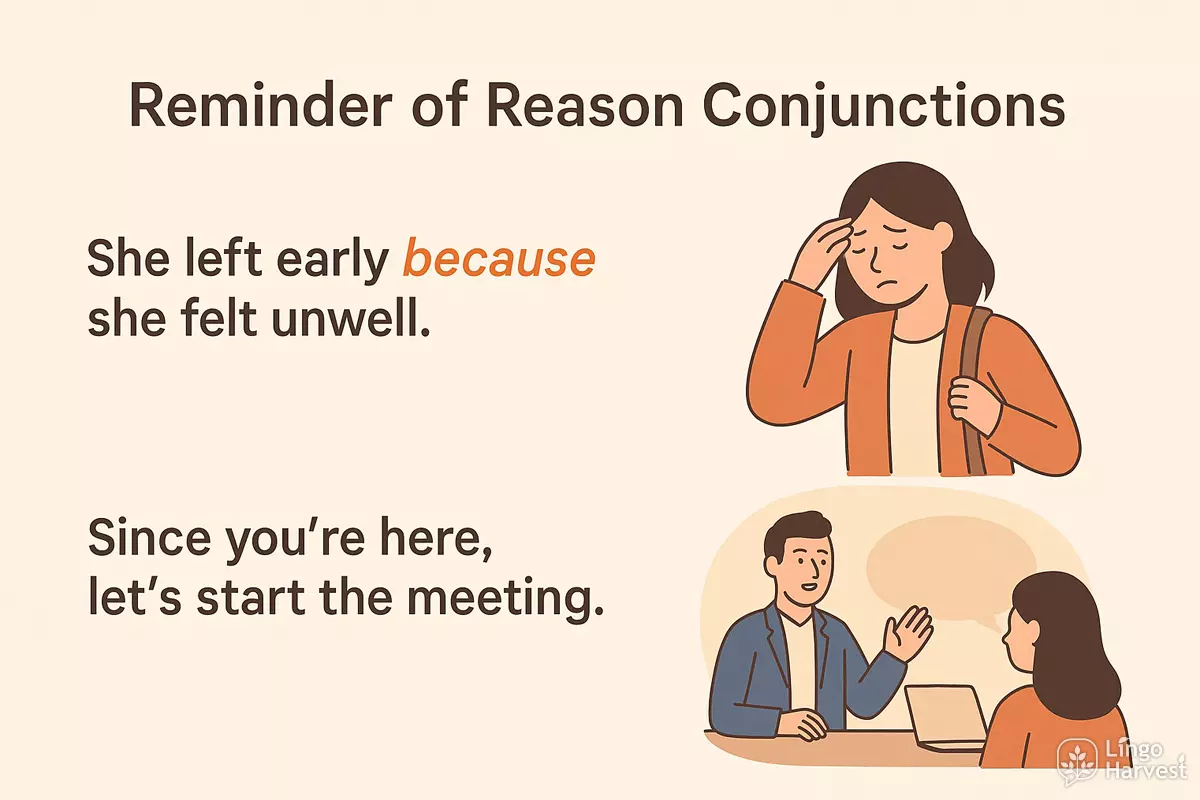
- She left early because she felt unwell.
- Since you’re here, let’s start the meeting.
- As I was tired, I went straight to bed.
- They canceled the picnic because it was raining.
- Since the shop is closed, we’ll try tomorrow.
- As you’re new, I’ll show you around.
- He stayed home because of the storm.
- Since we have time, let’s get coffee.
- As there was nothing to do, we left early.
- I skipped dessert because I was full.
- Since everyone agrees, we’ll proceed.
- As it’s late, we should go.
Comparing reason conjunctions
The table below summarizes the typical use and tone of each word:
| Conjunction | Typical Use | Example |
|---|---|---|
| Because | Direct, often new or important information | I stayed home because I was sick. |
| Since | Background, assumed or less-emphasized reason | Since it’s raining, let’s stay in. |
| As | Background, often at the start of the sentence | As I had no money, I didn’t go out. |
Understanding the subtle differences among these connectors helps you choose the most natural and precise way to express reasons in English writing and conversation.
Reminder of contrast conjunctions (although, though, whereas)
To effectively show contrast in English sentences, speakers often rely on conjunctions like although, though, and whereas. These words serve to highlight differences, unexpected outcomes, or oppositions between two ideas. Understanding their nuances helps avoid confusion, especially when distinguishing between contrast and reason conjunctions.
How these conjunctions work
Although and though introduce subordinate clauses that present a contrast to the main clause. They are nearly interchangeable, although though is more common in informal speech and can also appear at the end of a sentence. Whereas, in contrast, is used to compare two facts or characteristics, often in more formal or written contexts.
- Although she was tired, she finished her assignment.
- He went out, though it was raining.
- She likes tea, whereas her brother prefers coffee.
- The left side is blue, while the right side is red. (Similar use, but less formal than whereas.)
- I enjoyed the movie, though it was a bit long.
- Although the exam was difficult, many students passed.
- He is very outgoing, whereas his sister is shy.
- Though I tried hard, I couldn’t solve the problem.
- She accepted the job, although the salary was low.
- My parents love classical music, whereas I prefer jazz.
- Although it was expensive, they bought the car.
- Though we arrived early, the hall was already full.
Key differences and usage tips
Choosing between these linking words depends on sentence structure and the level of formality required. Although and though introduce a contrast within a single situation, while whereas directly compares two distinct facts or people. Also, though can follow the main clause as a sentence adverb, a feature less common with although or whereas.
| Conjunction | Typical usage | Example | Formality |
|---|---|---|---|
| although | Introduces subordinate clause showing contrast | Although it was cold, we went for a walk. | Neutral |
| though | Similar to "although"; also used at sentence end | I liked the food. The service was slow, though. | Informal |
| whereas | Compares two facts or people directly | He enjoys hiking, whereas she prefers swimming. | Formal/written |
| while | Alternative to "whereas" in comparisons | My car is red, while hers is blue. | Neutral |
Practicing these conjunctions in context helps clarify their distinctions and prevents mixing them up with cause/reason linkers. The contrastive function is key: focus on how each word sets up a difference or unexpected result, rather than an explanation or justification.
How using the wrong type changes the meaning of a sentence
Choosing between reason and contrast conjunctions is not just a matter of style; it directly affects what your sentence communicates. Using the incorrect type can reverse the intended logic, confuse your reader, or even create ambiguity about cause and effect versus opposition.
What happens when conjunctions are mixed up?
Swapping a reason conjunction (like "because" or "since") with a contrast conjunction (such as "although" or "but") can shift the whole relationship between your ideas. For example, "She left because it was late" explains a cause, but "She left although it was late" implies her departure was unexpected given the time.
- He stayed home because he was sick. → Explains the reason he stayed home.
- He stayed home although he was sick. → Suggests he did something surprising despite being sick.
- We went outside since it stopped raining. → Shows the rain stopping is the reason for going out.
- We went outside even though it stopped raining. → Implies a contrast, but makes less sense logically.
- She passed the test because she studied hard. → Her studying led to success.
- She passed the test although she studied hard. → Unexpected result, as if studying didn't help much.
- I called you since I needed help. → Needing help is the reason for calling.
- I called you although I needed help. → Implies calling was in spite of needing help, which is confusing.
- They ate dinner because they were hungry. → Hunger caused the action.
- They ate dinner although they were hungry. → Odd, since eating when hungry is expected, not contrasting.
- He smiled because he won the prize. → The prize is the cause of his smile.
- He smiled although he won the prize. → Suggests he might not normally smile after winning, which is unusual.
- We stayed in since it was raining. → Rain is the reason for staying in.
- We stayed in although it was raining. → Implies that staying in was unexpected given the rain, which can sound odd.
- She went to work because she had a meeting. → The meeting required her presence.
- She went to work although she had a meeting. → This suggests she went to work despite the meeting, which could confuse the timeline or logic.
Common misunderstandings caused by misuse
A misplaced conjunction can make it unclear whether you are expressing a motive or highlighting a contrast. This is especially problematic in academic writing, instructions, or any context where precision matters. The wrong connector can:
- Imply an unintended relationship between ideas
- Lead to logical contradictions
- Make your argument less convincing or harder to follow
- Confuse readers about what you actually mean
Quick comparison of meaning shifts
| Original Sentence | Changed Conjunction | New Meaning |
|---|---|---|
| She went home because she was tired. | She went home although she was tired. | From explaining her reason for leaving to suggesting her departure was surprising given her tiredness. |
| He ate dessert since he finished dinner. | He ate dessert even though he finished dinner. | From cause and effect to a contrast that doesn't logically connect. |
| They left early because the event was boring. | They left early although the event was boring. | From a clear reason to an unexpected action, which may confuse readers. |
| I didn't go out because it was raining. | I didn't go out although it was raining. | From rain being the cause of staying in to suggesting the rain was not a factor, which changes the logic. |
Being careful with conjunctions helps ensure your writing is clear and your ideas are logically connected. When in doubt, check the relationship you want to express—cause or contrast—and choose your conjunction accordingly.
Signal words that help identify reason vs contrast in context
Recognizing whether a conjunction expresses a reason or a contrast is easier when you’re familiar with the typical words used for each function. Certain connecting words act as clear signals, helping readers or listeners quickly figure out how ideas relate within a sentence or paragraph. Let’s break down some of the most common indicators for both relationships.
Common reason conjunctions and phrases
Words that introduce a cause, explanation, or justification often include:
- because → He stayed home because he was sick.
- since → Since it was raining, we canceled the trip.
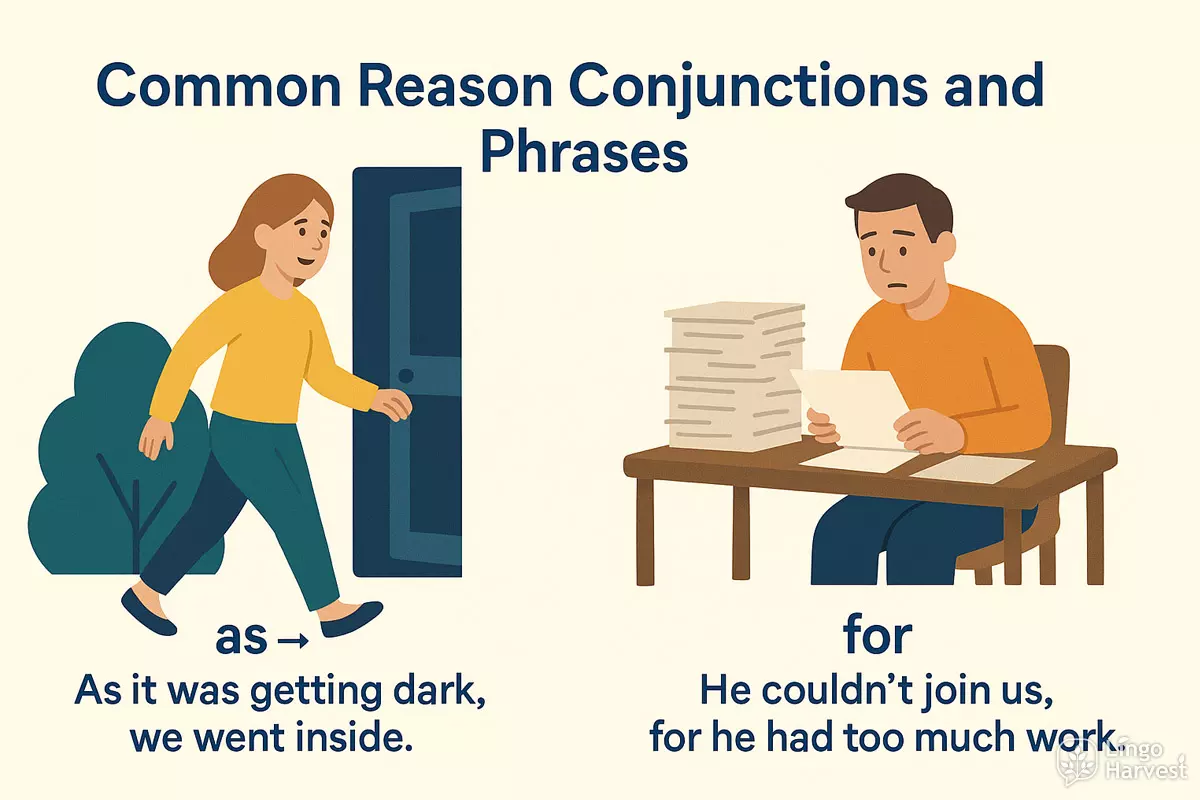
- as → As it was getting dark, we went inside.
- for → He couldn’t join us, for he had too much work.
- due to → The flight was delayed due to bad weather.
- owing to → Owing to the traffic, we arrived late.
- thanks to → Thanks to your help, we finished early.
- as a result of → The streets flooded as a result of the storm.
- seeing that → Seeing that she was tired, he offered to help.
- considering that → Considering that it's winter, it's quite warm.
- for the reason that → They canceled the event for the reason that attendance was low.
- in view of → In view of recent changes, we updated our plans.
- so (meaning "therefore") → It was late, so we went home.
These words typically answer questions like “Why did this happen?” or “What caused this?”
Contrast conjunctions and markers
When the purpose is to highlight differences, unexpected results, or opposition, English uses a different set of linking words:
- but → I wanted to go out, but it started raining.
- however → The task was difficult; however, she completed it.
- although → Although he was tired, he kept working.
- even though → Even though it was cold, they continued hiking.
- though → She smiled, though she was nervous.
- whereas → She loves coffee, whereas he prefers tea.
- while → She is calm, while her brother is energetic.
- nevertheless → It was raining; nevertheless, they played outside.
- nonetheless → It was expensive; nonetheless, he bought it.
- yet → He is young, yet very talented.
- in contrast → The north is cold; in contrast, the south is warm.
- on the other hand → She loves cities; on the other hand, he prefers nature.
- despite → Despite the noise, he fell asleep.
- in spite of → In spite of the traffic, they arrived on time.
- still → It was risky; still, they decided to try.
- conversely → He is very outgoing; conversely, his brother is shy.
These signal that the following information will differ from, or contradict, what’s come before.
Comparing reason and contrast signals
Sometimes, it’s useful to see these words side by side to clarify their roles. Here’s a comparison of typical reason and contrast connectors:
| Reason Connectors | Contrast Connectors |
|---|---|
| because | but |
| since | however |
| due to | although |
| as a result of | yet |
| for the reason that | in contrast |
| thanks to | despite |
| so (meaning "therefore") | on the other hand |
How to spot the difference in real sentences
When reading or listening, pay attention to the context and what the connector is linking. If the information following the word gives an explanation, it’s likely a reason marker. If it introduces an alternative, opposite, or surprising idea, it’s a contrast marker. Practicing with real examples and noticing these cues will help you avoid confusion between cause-and-effect and contrasting ideas.
Examples of confusing sentences and how to repair them
Misusing conjunctions that signal reason (like "because," "since," or "as") and those showing contrast (such as "but," "although," or "however") often leads to unclear or awkward sentences. It's easy to blend these two kinds of connectors, especially in complex ideas, which can confuse readers about whether you’re explaining a cause or highlighting an opposition.
Common problem areas
Writers often mix up these conjunctions when:
- They use a contrast word where a reason is intended, or vice versa.
- They combine both types in a single sentence, making the logic unclear.
- They place conjunctions incorrectly, affecting the sentence flow.
Confusing sentences and clearer alternatives
Below are some real-world examples showing how subtle conjunction errors can muddle meaning—and how to clarify them:
| ❌ Incorrect | ✅ Correct | Explanation |
|---|---|---|
| She stayed at home but she was tired. | She stayed at home because she was tired. | "But" shows contrast; the meaning here is causal. |
| He didn’t go out since it was raining, but he wanted to meet his friends. | He didn’t go out because it was raining, although he wanted to meet his friends. | Use "because" for cause and "although" for contrast. |
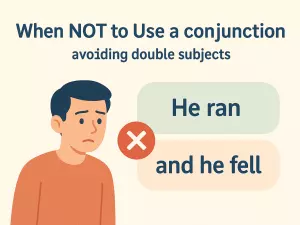
| Although she was tired, but she finished the project. | Although she was tired, she finished the project. | "Although" and "but" cannot be used together in this structure. |
| He failed the test but he didn’t study. | He failed the test because he didn’t study. | Cause, not contrast. |
| Because the weather was cold, but they went swimming. | Although the weather was cold, they went swimming. | "Although" expresses contrast; "because" does not fit. |
| She was late since the traffic was heavy, however she apologized. | She was late because the traffic was heavy; however, she apologized. | Use "because" for the reason and "however" to show contrast. |
| I like coffee, because it keeps me awake, but I don’t like the taste. | I like coffee because it keeps me awake, although I don’t like the taste. | Separate cause and contrast correctly. |
| He didn’t call me, although he promised he would, because he was busy. | He didn’t call me because he was busy, although he promised he would. | Cause should come first; contrast follows. |
| She studied hard but she passed the exam. | She studied hard, so she passed the exam. | Logical result, not contrast. |
| Since it was late, but he kept working. | Although it was late, he kept working. | Use a contrast marker, not a cause marker. |
Quick reference: Reason vs. Contrast conjunctions
| Reason Conjunctions | Contrast Conjunctions |
|---|---|
| because | but |
| since | although |
| as | however |
| so (as a result) | though/even though |
| for (formal) | nevertheless |
Tips for clearer writing
- Choose connectors that match the logical relationship you want to express: cause or contrast.
- Avoid doubling up ("although...but") in the same clause.
- If in doubt, separate your ideas into two sentences for clarity.
Guided steps for choosing the correct relation between ideas
Understanding how to link your thoughts with the appropriate conjunction can clarify your message and prevent ambiguity. Start by identifying the relationship between your clauses: do you want to show similarity, add reasons, or point out differences? This initial analysis will help you select the right connector and avoid common mix-ups between cause and contrast.
Step 1: Analyze the Connection
Before choosing a conjunction, ask yourself: are the ideas supporting each other, or are they opposing? For example, if one idea explains or results from another, a reason conjunction is suitable. If the ideas conflict or present alternatives, a contrast conjunction is needed.
- Reason connectors: because, since, as, due to, so that, for
- Contrast connectors: but, however, although, yet, whereas, nevertheless, on the other hand, in contrast, while
Step 2: Check for Causality or Opposition
Causality is present when one statement explains why another happens. Opposition highlights a contradiction or difference.
- ✅ Causality example: "She left early because she felt sick."
- ✅ Contrast example: "She left early, but she wasn’t feeling sick."
Step 3: Review Common Patterns
Some sentence structures are more natural with certain conjunctions. Recognizing these patterns can help you avoid awkward or unclear phrasing.
| Relation Type | Typical Conjunctions & Examples |
|---|---|
| Reason/Cause |
|
| Contrast |
|
Step 4: Test with Paraphrasing
Try restating your sentences with different connectors. If the meaning changes, you may have chosen the wrong relation. For instance, swapping "because" and "although" will completely alter the message.
Step 5: Practice with Expanded Examples
Here are diverse conjunctions in context to illustrate their proper use:
- since, as, so, because, for (reason)
- but, yet, although, though, whereas, while, however, nevertheless, nonetheless, on the contrary, in contrast, still, even though, despite, in spite of (contrast)
If you’re ever unsure, ask yourself: Does the second idea explain the first, or does it challenge or contradict it? This question will guide you toward the right connector and ensure your ideas are clearly related.
Practice: choose reason or contrast conjunctions in short texts
Grasping the difference between conjunctions that express reasons (like “because,” “since,” “as”) and those that show contrast (such as “but,” “although,” “however”) is vital for clear writing. Below, you’ll find focused exercises and practical tips to help you select the right linking words in context.
Task 1: Fill in the blanks
Choose the best conjunction (reason or contrast) to complete each sentence. Options: because, although, but, since, however, as.
- She was tired, _______ she kept working late into the night.
- I didn’t go to the party _______ I wasn’t feeling well.
- _______ he studied hard, he didn’t pass the exam.
- He wanted to buy the jacket, _______ it was too expensive.
- _______ it was raining, they went for a walk.
- We left early _______ we wanted to avoid traffic.
- She studied a lot, _______ she still failed the test.
- He stayed home _______ he had no work to do.
- _______ she called him many times, he didn’t answer.
- We can go out, _______ it stops raining.
Show answers
- but
- because
- Although
- however
- Although
- because
- yet
- because
- Although
- if
Common Reason and Contrast Conjunctions
- Reason: because, since, as, due to, owing to
- Contrast: but, although, though, even though, however, nevertheless, yet, whereas, while
Task 2: Identify the conjunction type
For each sentence, decide if the conjunction expresses reason or contrast.
- She didn’t answer the phone because she was busy.
- He is very talented, but he doesn’t practice much.
- Although the weather was bad, the match continued.
- We stayed home since it was snowing heavily.
- They left early because they had an appointment.
- She likes coffee, but she doesn’t drink it every day.
- Even though he was tired, he kept studying.
- Because it was dark, we used a flashlight.
- While the food was delicious, the service was slow.
- As it was getting late, we decided to go home.
Show answers
- Reason
- Contrast
- Contrast
- Reason
- Reason
- Contrast
- Contrast
- Reason
- Contrast
- Reason
Quick Reference: Linking Words in Context
| Conjunction | Function | Example |
|---|---|---|
| because | Reason | I left early because I was tired. |
| although | Contrast | Although it was cold, she went swimming. |
| since | Reason | Since you’re here, let’s start. |
| however | Contrast | He is rich; however, he is not happy. |
| but | Contrast | I wanted to help, but I couldn’t. |
| as | Reason | As it was late, we went home. |
| even though | Contrast | Even though he tried, he failed. |
| while | Contrast | She likes tea, while he prefers coffee. |
| due to | Reason | The flight was delayed due to fog. |
| yet | Contrast | He is young, yet very wise. |
| nevertheless | Contrast | The task was difficult; nevertheless, she succeeded. |
Task 3: Rewrite for clarity
Rewrite these sentences using a suitable reason or contrast conjunction from the table above.
- It was raining. They played football. (show contrast)
- He failed the test. He didn’t study. (show reason)
- Mary loves classical music. Her brother prefers rock. (show contrast)
- The road was closed. There was an accident. (show reason)
- She was tired. She kept working. (show contrast)
- They arrived late. Their car broke down. (show reason)
- He likes cats. His sister prefers dogs. (show contrast)
- The restaurant closed early. There were no customers. (show reason)
- He wanted to help. He didn’t know what to do. (show contrast)
- She stayed home. She had a headache. (show reason)
Show answers
- Although it was raining, they played football.
- He failed the test because he didn’t study.
- Mary loves classical music, while her brother prefers rock.
- The road was closed due to an accident.
- Although she was tired, she kept working.
- They arrived late because their car broke down.
- He likes cats, whereas his sister prefers dogs.
- The restaurant closed early because there were no customers.
- He wanted to help, but he didn’t know what to do.
- She stayed home because she had a headache.
With regular practice distinguishing between these linking words, your sentences will become clearer and more precise. Remember to check the function the conjunction serves—does it explain why, or does it highlight a difference?