Conjunctions of Purpose: to, so that (A2 Level)

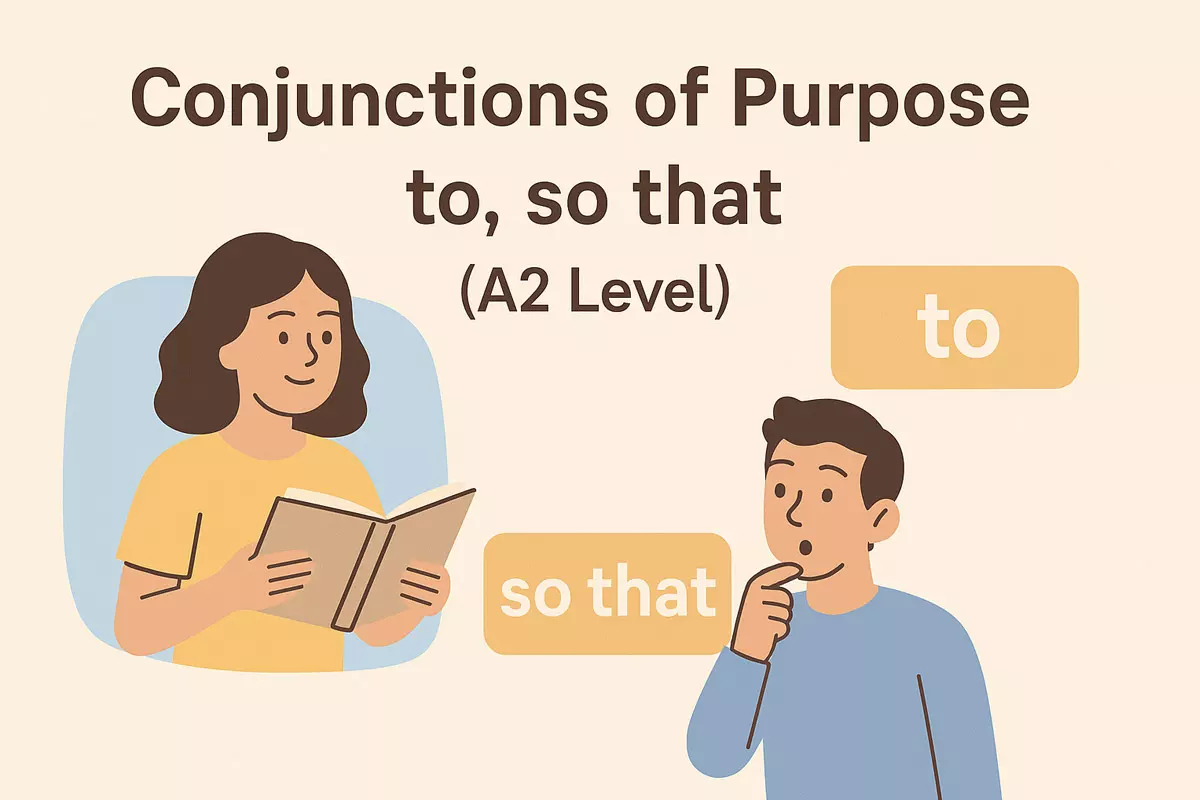 Here we what a purpose clause is, how to express purpose with to plus a verb or so that, and the differences in meaning and style between them. It also lists common verbs and includes practice rewriting sentences to show purpose.
Expressing reasons or intentions in English is important for clear communication, and using appropriate connectors can make your sentences more effective. Words like because, so that, in order to, and for help link your ideas and explain why something happens or what someone hopes to achieve. For example, you might say, I studied hard because I wanted to pass the exam, or She left early so that she could catch the bus. Practicing these connectors will help you build better sentences and share your thoughts more easily with others.
What a purpose clause is in simple terms
A purpose clause is a way to explain why something is done. In English, we often use special words or phrases to show the reason for an action. These are called conjunctions of purpose, and they help connect two parts of a sentence: the action and its goal. At the A2 level, you’ll usually see “to” and “so that” used for this. When you use a purpose clause, you’re answering the question “Why?” about an action. For example, if you say, “She goes to the gym to get fit,” the reason (getting fit) is linked to the action (going to the gym) with “to.” This makes your sentences clearer and more natural.
How purpose clauses work
The main job of a purpose clause is to add the reason for an action. In simple sentences, this is usually done with either “to” plus a verb, or with “so that” plus a full clause (subject + verb).
- to + verb: I study to learn English. (Why do I study? To learn English.)
- so that + subject + verb: I study so that I can speak English. (Why do I study? So that I can speak English.)
Common patterns with purpose clauses
Here are some typical ways to express purpose in English, especially at the elementary level:
- to + base form of a verb
- in order to + base form of a verb (more formal)
- so that + subject + can/will + base verb
- so (that) + subject + verb (sometimes “that” is optional in spoken English)
Examples of purpose clauses
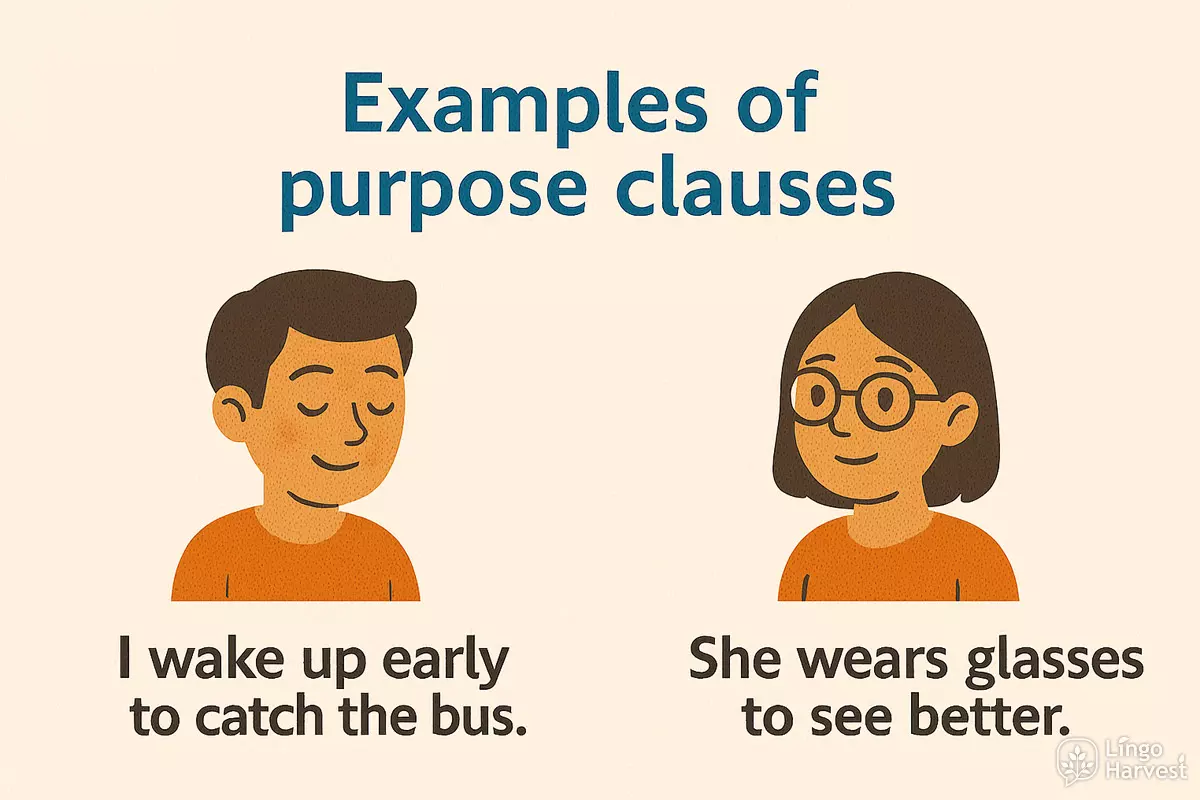
Here are several examples showing how you can use purpose clauses in everyday sentences:
- I wake up early to catch the bus.
- She wears glasses to see better.
- We went to the shop to buy some bread.
- He studies hard so that he can pass the exam.
- They left early so that they wouldn't be late.
- I called you to ask a question.
- Maria saved money to travel abroad.
- We turned on the fan to cool the room.
- She spoke slowly so that everyone could understand.
- He took notes to remember the details.
- Lucy went to the library to study in quiet.
- We closed the window so that the rain wouldn't come in.
When to use “to” and when to use “so that”
Choosing between “to” and “so that” depends on the sentence structure:
- Use to when the subject is the same in both parts: “She went out to buy milk.”
- Use so that when you need a new subject or want to show possibility, permission, or result: “She left early so that her brother could use the car.”
Understanding these simple rules will help you clearly express reasons for actions in your sentences.
Using to + verb to show purpose
One of the simplest ways to express purpose in English is by using “to” followed by the base form of a verb. This structure is direct and common, especially at the A2 (elementary) level. It helps explain why someone does something, or what their goal is. The pattern is: subject + verb + to + base verb. This is often used instead of longer phrases like “in order to” in everyday speech.
Pattern and Examples
After the main verb, “to” introduces the reason or intention behind the action. Here are some examples:
- I went to the shop to buy some bread.
- She studies hard to pass her exams.
- We called a taxi to get to the airport.
- He wakes up early to exercise before work.
- They wear coats to stay warm.
- Anna saved money to travel abroad.
- I use a notebook to write new words.
- We opened the window to let fresh air in.
- He brought a map to find the museum.
- She called her friend to invite her to the party.
- Tom left early to avoid traffic.
Form: “to” + base verb
The verb after “to” is always in its base form (infinitive without “to”). You do not change the verb for tense or subject:
- ✅ I go to learn English. (correct)
- ❌ I go to learning English. (incorrect)
Common Mistakes
- Don’t use “to” with -ing forms for purpose.
- Don’t use “for” + verb for purpose (use “to” + verb instead).
Comparing: “to” vs. “so that”
Both “to” and “so that” can express reasons, but “to” is shorter and only works with the base verb. Here’s a simple comparison:
| With "to" + Verb | With "so that" + Subject + Can/Will |
|---|---|
| I went to the park to relax. | I went to the park so that I could relax. |
| He studies to improve his skills. | He studies so that he can improve his skills. |
| She called to ask a question. | She called so that she could ask a question. |
| We left early to catch the bus. | We left early so that we could catch the bus. |
In summary, using “to” plus a verb is a quick way to show why you do something. It’s easy to use and very common in everyday English.
Using so that to introduce a purpose clause
"So that" is a useful conjunction when you want to explain why someone does something. It helps connect two ideas: the action and the intended result. This structure is common in everyday English and helps make your sentences clear and logical. When you use "so that," the second part of the sentence usually describes the goal or reason behind the action in the first part.
Basic Structure
The typical pattern is: Action + so that + result/purpose. The clause after "so that" often contains a subject and a modal verb like can, could, will, or would.
- I left early so that I could catch the bus.
- She speaks slowly so that everyone can understand.
- We wore warm clothes so that we wouldn’t get cold.
- He saved money so that he could buy a new phone.
- Close the window so that the room stays warm.
- They studied hard so that they would pass the exam.
- I wrote it down so that I wouldn’t forget.
- Bring your umbrella so that you don’t get wet.
- She called ahead so that they would be ready.
- We left a note so that he knew where we were.
Choosing the Modal Verb
The verb after "so that" depends on the situation and tense. For present or future reasons, use can or will. For past intentions or hypothetical situations, use could or would.
| Time | Example |
|---|---|
| Present/Future | She writes notes so that she can remember. |
| Past | He left early so that he could catch the train. |
| Present/Future | Lock the door so that no one will come in. |
| Past | We spoke quietly so that we wouldn’t wake the baby. |
Tips for Using "So That"
- Don’t forget to include a subject after "so that." Unlike "to" (for infinitives), "so that" clauses need a full subject and verb.
- Use "so that" to express real reasons, not just possible results.
- Choose the modal verb according to the time of your main action.
Mastering "so that" makes your explanations clearer and your English more natural. Remember: use it when you want to show a reason or purpose for an action, especially when you need to mention who benefits or acts in the result clause.
Differences between to and so that in meaning and style
Understanding how "to" and "so that" function as conjunctions of purpose helps learners choose the appropriate expression for different situations. Both are used to explain why someone does something, but they differ in structure, meaning, and formality.
Meaning and Usage
- "To" + base verb expresses a direct purpose or intention. It is concise and often used for simple, immediate goals.
Example: She went to the shop to buy bread. - "So that" introduces a reason or purpose, often emphasizing the result or benefit. It can include a subject and modal verb.
Example: She went to the shop so that she could buy bread.
Formality and Style
- "To" sounds more neutral and is commonly used in spoken and informal written English.
- "So that" can be more formal or explanatory, especially in writing or when the result is important.
Structure and Flexibility
- "To" is followed directly by a verb (infinitive form): to open, to see, to help.
- "So that" is followed by a clause (subject + verb), often with a modal (can, could, will, would):
so that he can, so that we could, so that I will.
| Purpose Expression | Example Sentence | Notes |
|---|---|---|
| to + verb | He studies to pass the exam. | Simple, direct, no subject change |
| so that + subject + verb | He studies so that he can pass the exam. | Allows for different subjects; can use modals |
| to + verb | She left early to avoid traffic. | Focuses on personal purpose |
| so that + subject + verb | She left early so that her friend would not wait alone. | Shows purpose for someone else |
Common Patterns and Examples
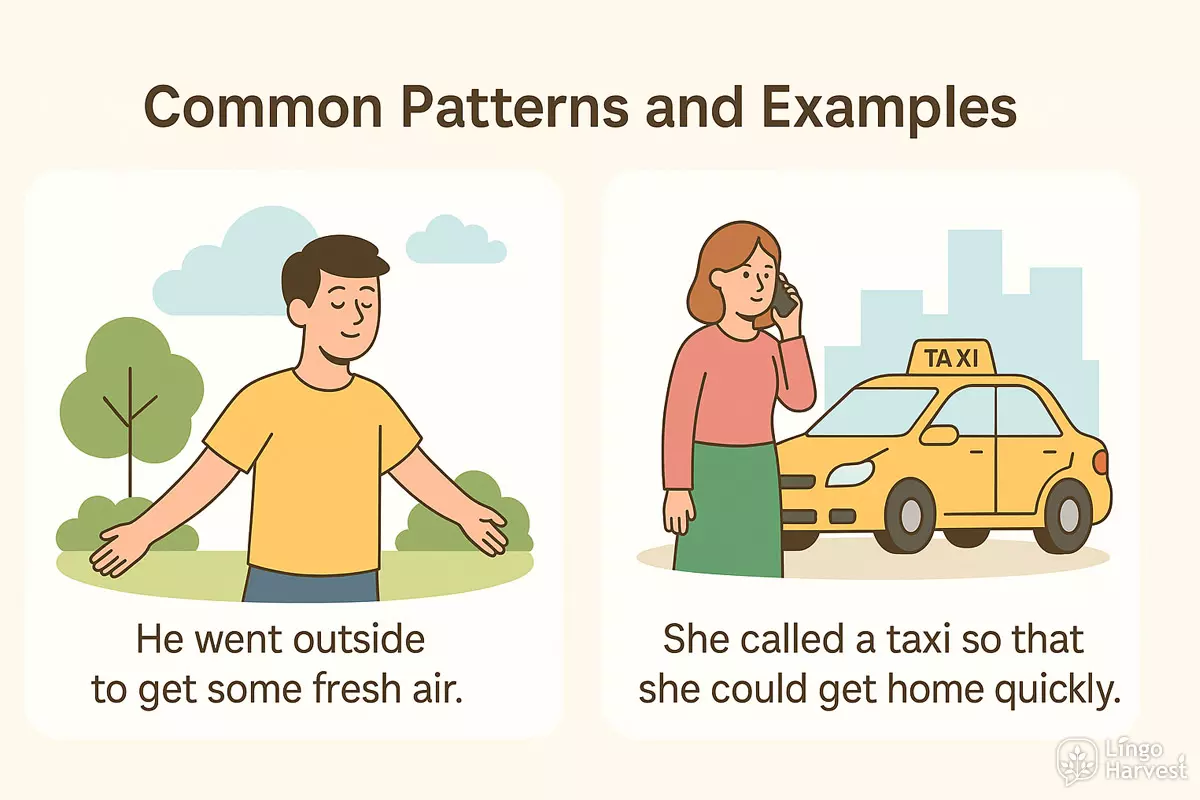
- He went outside to get some fresh air.
- She called a taxi so that she could get home quickly.
- I opened the window to let in some light.
- We saved money so that we can travel next year.
- He turned on the light to read his book.
- They studied hard so that they would pass the test.
- I took notes to remember the information.
- She whispered so that no one else would hear.
- He wore a coat to stay warm.
- We left early so that we wouldn't miss the bus.
- She bought flowers to decorate the table.
- He spoke slowly so that everyone could understand.
In summary, choose "to" when the purpose is simple and the subject stays the same. Use "so that" when you need to explain the result, include a different subject, or want a more formal style.
Common verbs and phrases often used with purpose conjunctions
When expressing purpose in English, certain verbs and phrases naturally pair with connectors like "to" and "so that." These combinations help learners clearly state intentions, reasons, or goals in everyday communication. Recognizing which verbs and phrases are frequently used with these conjunctions can make sentences more precise and natural.
Typical verbs used before "to" and "so that"
Many action verbs are commonly followed by "to" or "so that" to explain why something is done. Here are some of the most frequent verbs in this context:
- go (go to learn, go so that you can help)
- come (come to see, come so that we can talk)
- study (study to pass, study so that you understand)
- work (work to earn, work so that you succeed)
- save (save to buy, save so that you can travel)
- practice (practice to improve, practice so that you get better)
- leave (leave to catch, leave so that you arrive on time)
- call (call to ask, call so that we can discuss)
- send (send to inform, send so that they know)
- eat (eat to stay healthy, eat so that you have energy)
- exercise (exercise to feel good, exercise so that you stay fit)
- plan (plan to succeed, plan so that nothing is forgotten)
- bring (bring to share, bring so that everyone has enough)
- prepare (prepare to win, prepare so that you are ready)
- buy (buy to use, buy so that you have what you need)
Useful phrases for stating purpose
Besides single verbs, some phrases naturally fit with "to" and "so that" when explaining reasons. These are especially helpful at the A2 level:
- in order to (in order to finish on time)
- with the aim of (with the aim of saving money)
- for the purpose of (for the purpose of learning English)
- so as to (so as to avoid mistakes)
Comparing "to" and "so that" with common verbs
The table below shows how some frequent verbs are used with both "to" and "so that" to express purpose. Notice that "so that" often introduces a subject and sometimes uses modal verbs like "can" or "will."
| Verb + to | Verb + so that |
|---|---|
| I study to pass the test. | I study so that I can pass the test. |
| She leaves early to catch the bus. | She leaves early so that she will catch the bus. |
| He works extra to earn more money. | He works extra so that he can earn more money. |
| We meet to discuss the project. | We meet so that we can discuss the project. |
| They save to buy a car. | They save so that they can buy a car. |
Learning these verbs and phrases makes it easier to form clear, goal-oriented sentences. Practicing with real-life examples will help you use "to" and "so that" naturally in conversation and writing.
Practice: rewrite sentences to show purpose using to or so that
Understanding how to express purpose helps make your sentences clearer and more precise. In English, we often use "to" or "so that" to show why someone does something. Below, you'll find tasks to help you practice changing sentences to include these expressions of purpose.
Rewrite the sentences
Read each sentence. Rewrite it using either "to" or "so that" to show the purpose. Sometimes both are possible, but consider which fits better for each case.
- She went to the store. She wanted to buy some bread.
- Tom studies every evening. He wants to pass his exams.
- We left early. We didn't want to miss the train.
- I turned on the light. I wanted to read my book.
- Anna wears glasses. She can see better.
- They saved money. They hoped to travel to Spain.
- He called his friend. He needed some help.
- We closed the windows. We wanted to keep the room warm.
- She speaks slowly. Everyone can understand her.
- I brought an umbrella. I didn't want to get wet.
Show answers
- She went to the store to buy some bread.
- Tom studies every evening so that he can pass his exams.
- We left early so that we wouldn't miss the train.
- I turned on the light to read my book.
- Anna wears glasses so that she can see better.
- They saved money to travel to Spain.
- He called his friend to get some help / so that he could get some help.
- We closed the windows to keep the room warm.
- She speaks slowly so that everyone can understand her.
- I brought an umbrella so that I wouldn't get wet / to avoid getting wet.
Common patterns and examples
Here are several ways to show purpose using “to” and “so that.” Notice how each pattern fits different situations:
- He goes to the gym to get fit.
- She wakes up early to catch the bus.
- We study English so that we can talk to people when we travel.
- I wear a coat so that I don't get cold.
- They arrived early to get good seats.
- He writes notes to remember important things.
- She learns French so that she can work in France.
- We save money to buy a car.
- I take notes so that I don't forget.
- He finished his homework to watch TV later.
- They went to the library to study.
- She called her mother so that she could tell her the news.
Tips for using "to" and "so that"
- Use "to" with the base verb for simple, direct reasons: She went out to buy milk.
- Use "so that" when you need to introduce a subject and a verb: He whispered so that he wouldn't wake the baby.
- "So that" often needs a modal (can, will, could, would): I left early so that I could catch the bus.