Passive Voice with By: How to Name the Doer

 This article explains how by works in passive voice: how it names the doer, when the by-phrase is needed, and when to leave it out. It also covers placement, doers like people or companies, active/passive examples, common by/from/with mistakes, homework, and FAQ.
- What by means in passive voice sentences
- How by names the doer of the action
- When the by-phrase is necessary for clear meaning
- When to leave the doer out of a passive sentence
- By-phrases with people, companies, and institutions
- Where to place by in different passive sentences
- Active and passive examples with the same doer
- Common mistakes with by, from, and with
- Homework: add the correct by-phrase or remove it
- FAQ
A passive sentence with by lets you name who or what caused an action while still keeping the result, object, or affected person in focus. This is useful in everyday English when the broken window, delayed train, rejected application, or completed report matters more than the person responsible.
In this guide, you will learn when the by-phrase sounds natural, when it is better to leave the doer out, where to place by in different passive forms, and how to avoid common mistakes with by, from, and with.
What by means in passive voice sentences
In a passive sentence, the subject receives the action. The preposition by is used when we want to name the real doer of that action. The doer is no longer the grammatical subject, but it can still be added later in the sentence.
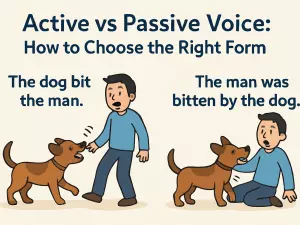
Compare the basic difference. In active voice, the doer usually comes first. In passive voice, the receiver comes first, and the doer may appear later with by. This lets us change the focus without losing important information.
| Active sentence | Passive sentence with by | What by names |
|---|---|---|
| The chef prepared the meal. | The meal was prepared by the chef. | the person who prepared it |
| A technician fixed the printer. | The printer was fixed by a technician. | the person who fixed it |
| The storm damaged several houses. | Several houses were damaged by the storm. | the cause of the damage |
| Maria translated the report. | The report was translated by Maria. | the person who translated it |
The by-phrase usually comes after the passive verb phrase:
- The windows were cleaned by the building staff.
- The article was edited by a senior editor.
- The old bridge was damaged by heavy rain.
Be careful: by can also show method or means, not only the doer. For example, in “The invitation was sent by email,” the phrase by email explains the method. In “The invitation was sent by the event coordinator,” the phrase names the doer.
When you are unsure, ask: “Does this phrase answer Who did it? or What caused it?” If yes, it is probably the passive by-phrase. If it answers “How?”, it may be a method phrase instead.
Teacher note: A passive sentence does not automatically need by. Add it only when the doer gives useful information. Otherwise, the sentence often sounds cleaner without it.
If you need a broader review of how passive sentences shift attention from the doer to the receiver, see this guide to active and passive voice.
How by names the doer of the action
The doer in a passive sentence is often called the agent. The agent can be a person, group, company, machine, system, natural force, or organization. In passive grammar, the agent is commonly introduced with by.
A useful test is to turn the passive sentence back into an active sentence. The words after by usually become the subject of the active sentence.
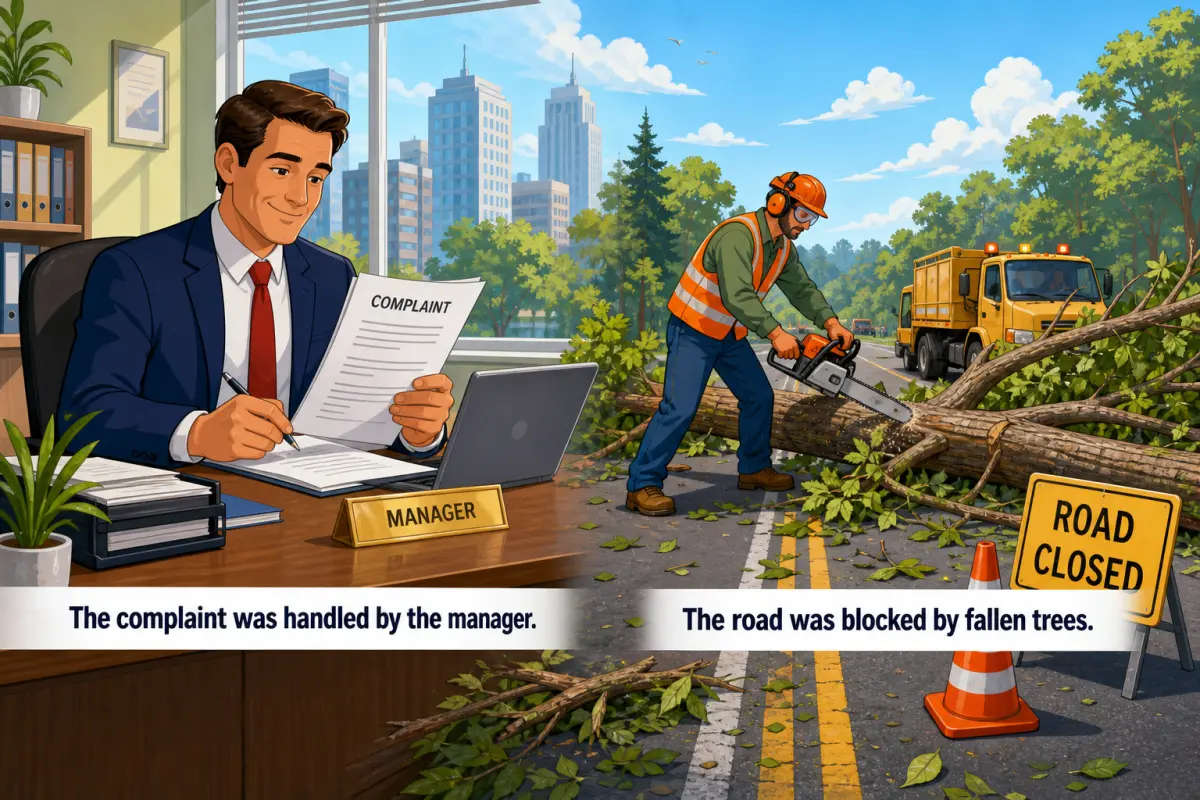
- Passive: The complaint was handled by the manager.
Active: The manager handled the complaint. - Passive: The road was blocked by fallen trees.
Active: Fallen trees blocked the road. - Passive: The mistake was noticed by a new employee.
Active: A new employee noticed the mistake. - Passive: The final scene was filmed by a small camera crew.
Active: A small camera crew filmed the final scene.
The doer does not have to be human. English uses by with many kinds of agents:
- Person: The form was signed by Mr. Patel.
- Group: The decision was supported by most parents.
- Company: The app was developed by a local startup.
- System: The tickets were checked by an automated scanner.
- Natural force: The roof was lifted by strong winds.
Notice that the by-phrase names the performer or cause of the action, not the owner, source, location, tool, or material. In “The cake was made by my sister,” my sister did the making. In “The cake was made with almonds,” almonds are ingredients, not the doer.
This is why passive grammar often connects with preposition choice. If you want to study this distinction in more detail, the article on prepositions in passive voice explains how by, with, and other prepositions affect meaning.
When the by-phrase is necessary for clear meaning
Sometimes a passive sentence sounds incomplete or too vague without the doer. This happens when the identity of the doer changes the meaning, explains responsibility, shows authority, or gives information the listener cannot guess.
In real communication, the by-phrase is most useful when it answers a natural question in the listener’s mind: “Who said that?”, “Who made the decision?”, “What caused the problem?”, or “Which organization is responsible?”
Use a by-phrase when the doer is important because it:
- shows responsibility: The incorrect invoice was issued by the accounts department.
- gives authority: The new rule was approved by the school board.
- identifies the creator: The mural was painted by a group of local artists.
- explains the cause: The delay was caused by heavy traffic near the airport.
- prevents confusion: The message was deleted by the administrator, not by the user.
Look at how the by-phrase changes the usefulness of the sentence:
- The contract was cancelled.
This tells us what happened, but not who made the decision. - The contract was cancelled by the client.
Now we know responsibility belongs to the client.
- The window was broken.
This may be enough if the result is all we care about. - The window was broken by a delivery driver.
This is clearer if we need to report the incident or decide who pays.
- The article was removed.
This could sound mysterious. - The article was removed by the editor.
This explains who had control over the action.
In academic, legal, workplace, and news writing, the by-phrase is often used when naming the doer makes the statement more precise. “The policy was rejected by the committee” is stronger than “The policy was rejected” if the reader needs to know who rejected it.
Teacher note: If a passive sentence immediately makes the reader ask “by whom?”, add the by-phrase. If the reader would not care or can easily guess, you probably do not need it.
When to leave the doer out of a passive sentence
Many good passive sentences have no by-phrase at all. English speakers often leave out the doer when it is unknown, obvious, unimportant, or deliberately not mentioned. This is not a mistake; it is one of the main reasons passive voice exists.
Leaving out the doer helps the sentence focus on the action, result, rule, process, or experience instead of the person who caused it.
You can usually omit the by-phrase in these situations:
- The doer is unknown: My bike was stolen last night.
- The doer is obvious: The suspect was arrested after the interview.
- The doer is not important: The office will be painted next week.
- The result matters more than the agent: Three flights were cancelled because of fog.
- The sentence describes a general process: The beans are roasted before they are packed.
- The speaker wants to be tactful: Several errors were made in the report.
In everyday English, adding an obvious or empty by-phrase can sound unnatural:
- ❌ My wallet was stolen by someone on the train.
✅ My wallet was stolen on the train. - ❌ The meeting was postponed by people.
✅ The meeting was postponed. - ❌ English is spoken by people in many countries.
✅ English is spoken in many countries.
However, do not remove the by-phrase if it carries useful information:
- The meeting was postponed by the director. This tells us who made the decision.
- The award was presented by the mayor. This may be important for status or ceremony.
- The account was closed by the bank. This explains who controlled the action.
A practical editing habit is to read your passive sentence and ask: “Does the by-phrase add new, useful information?” If yes, keep it. If it only says “by someone,” “by people,” or “by them” without adding meaning, remove it.
This choice is part of a wider question: when should passive voice name the doer, and when should it hide or omit the doer? The article on passive voice forms and uses gives more examples across different tenses.
By-phrases with people, companies, and institutions
A by-phrase can name an individual person, a job title, a team, a company, a government body, a school, a hospital, or another institution. The grammar is the same, but the tone can feel different depending on how specific the agent is.
When you name a person, the sentence often feels personal and concrete. When you name an institution, the sentence often sounds more formal, official, or businesslike.
- The patient was examined by Dr. Lewis.
- The patient was examined by a specialist.
- The patient was examined by the clinic. This may mean the clinic as an organization, although a person actually did the examination.
With companies and institutions, English often treats the organization as the doer because it is responsible for the action:
- The parcel was delivered by a private courier company.
- The survey was conducted by the university’s research team.
- The warranty was provided by the manufacturer.
- The road repairs were funded by the city council.
- The safety notice was issued by the transport authority.
Be careful with vague institutional agents. “By the company” may be correct, but sometimes a more exact phrase is better:
- The email was sent by the company. This is possible, but broad.
- The email was sent by the customer service department. This is clearer.
- The email was sent by Helen in customer service. This is most specific.
In formal writing, the by-phrase can also show authority. For example, “The certificate was signed by the principal” sounds more meaningful than “The certificate was signed” because the principal’s role gives the action official value.
Teacher note: In business English, try to name the responsible team or role when possible. “By support” is not natural; say “by the support team” or “by a support agent.”
Where to place by in different passive sentences

The by-phrase usually comes after the passive verb phrase and after any necessary complement. In simple sentences, this is easy: “The room was cleaned by the housekeeper.” In longer sentences, placement matters because the sentence must stay clear and natural.
Most of the time, put the by-phrase near the passive verb it explains. Do not separate it too far from the verb if another phrase could create confusion.
| Passive form | Pattern | Example with by |
|---|---|---|
| Present simple passive | am / is / are + past participle + by | The files are checked by the supervisor. |
| Past simple passive | was / were + past participle + by | The old bridge was designed by a French engineer. |
| Present perfect passive | has / have been + past participle + by | The application has been reviewed by admissions staff. |
| Modal passive | modal + be + past participle + by | The password must be reset by an administrator. |
| Future passive | will be + past participle + by | The results will be announced by the exam board. |
| Passive infinitive | to be + past participle + by | The document needs to be approved by legal counsel. |
When the sentence has time, place, or reason phrases, the by-phrase can come before or after them depending on what sounds clearest:
- The package was collected by a courier at 8 a.m.
- The package was collected at 8 a.m. by a courier. This is also possible, especially if the courier is new or important information.
- The documents were stored by the records team in a secure archive.
- The documents were stored in a secure archive by the records team. This is grammatical, but the first version is usually smoother.
In questions, the by-phrase usually stays after the past participle or at the end of the question:
- Was the decision made by the whole committee?
- When was the painting restored by the museum team?
- Has the software been tested by external reviewers?
In negative sentences, place not with the auxiliary verb, and keep the by-phrase after the passive verb structure:
- The letter was not written by the tenant.
- The machines have not been inspected by a qualified engineer.
- The schedule cannot be changed by individual employees.
Modal passive sentences are especially common in rules and procedures: “must be approved by,” “can be changed by,” “should be checked by.” For a deeper look at this structure, see passive modal verbs.
Active and passive examples with the same doer
Active and passive sentences can describe the same event. The difference is focus. Active voice puts the doer first. Passive voice puts the receiver, result, or affected thing first, and the doer can be added with by.
This is not only a grammar transformation. It is a writing choice. Choose active voice when the doer is the natural topic. Choose passive voice when the receiver or result is the natural topic.
Example pairs
- Active: The receptionist greeted the visitors at the front desk.
Passive: The visitors were greeted by the receptionist at the front desk. - Active: A software update caused the error message.
Passive: The error message was caused by a software update. - Active: The landlord replaced the broken heater.
Passive: The broken heater was replaced by the landlord. - Active: Two volunteers organized the charity dinner.
Passive: The charity dinner was organized by two volunteers. - Active: The airline changed our seats without warning.
Passive: Our seats were changed by the airline without warning. - Active: A security guard found the lost passport.
Passive: The lost passport was found by a security guard.
Sometimes both versions are correct, but one sounds more natural for the situation:
- If you are telling a story about a person, “The receptionist greeted the visitors” is direct and natural.
- If you are reporting the visitors’ experience, “The visitors were greeted by the receptionist” is more suitable.
- If you are explaining a technical problem, “The error message was caused by a software update” puts the problem first, which is often clearer.
With pronouns, remember that the by-phrase needs an object pronoun, not a subject pronoun:
- ❌ The photo was taken by she.
✅ The photo was taken by her. - ❌ The plan was suggested by they.
✅ The plan was suggested by them. - ❌ The question was answered by he.
✅ The question was answered by him.
This happens because by is a preposition, and pronouns after prepositions use object forms: me, you, him, her, it, us, them. This point also connects with pronouns in passive voice, especially when the agent is a person.
Common mistakes with by, from, and with
Learners often choose the wrong preposition after a passive verb because several prepositions can appear near passive structures. The most common confusion is between by, from, and with.
The basic difference is practical: by names the doer or cause of the action, from often shows source or origin, and with often shows the tool, material, ingredient, or thing used.
| Preposition | Main use | Example |
|---|---|---|
| by | doer, responsible agent, cause | The announcement was made by the principal. |
| from | source, origin, sender, starting point | The message was received from the hotel. |
| with | tool, material, ingredient, instrument | The label was printed with a barcode printer. |
| by + -ing | method or way of doing something | The issue was solved by restarting the device. |
Mistake 1: using from for the doer in a passive sentence
Use by when the phrase names the person, group, organization, or thing that performed the passive action.
- ❌ The report was written from Angela.
✅ The report was written by Angela. - ❌ The door was repaired from the maintenance team.
✅ The door was repaired by the maintenance team. - ❌ The training video was created from our HR department.
✅ The training video was created by our HR department.
Use from when you mean source, not the doer:
- The instructions were received from head office.
- The warning was sent from an unknown number.
- The data was taken from public records.
Mistake 2: using by when you mean a tool or material
If the phrase tells us what someone used, choose with, not by.
- ❌ The form was completed by a black pen.
✅ The form was completed with a black pen. - ❌ The soup was made by fresh vegetables.
✅ The soup was made with fresh vegetables. - ❌ The photo was edited by special software.
✅ The photo was edited with special software.
However, if the software, machine, or system acts as the agent automatically, by can be possible:
- The suspicious login was detected by the security system.
- The number plates were read by traffic cameras.
- The payment was processed by an online platform.
For a broader comparison of these two prepositions, the guide to by vs with is useful because the difference appears in many contexts, not only passive voice.
Mistake 3: confusing by someone with by doing something
By + noun can name the doer in passive voice. By + -ing usually explains the method.
- ❌ The problem was fixed by cleaned the filter.
✅ The problem was fixed by cleaning the filter. - ❌ The room was warmed by turn on the heater.
✅ The room was warmed by turning on the heater. - ❌ The account was protected by changed the password.
✅ The account was protected by changing the password.
Compare the meanings:
- The problem was fixed by the technician. The technician is the doer.
- The problem was fixed by cleaning the filter. Cleaning the filter is the method.
Teacher note: A good classroom test is this: if you can ask “Who did it?”, use by for the doer. If you can ask “What was used?”, use with. If you can ask “Where did it come from?”, use from.
Homework: add the correct by-phrase or remove it
These exercises help you decide when a by-phrase is useful, where it belongs, and when it should be removed. Read each sentence for meaning first. Do not add by automatically just because the sentence is passive.
There are three different skills below: choosing the best preposition or phrase, rewriting active sentences into passive sentences, and correcting unnatural or incorrect passive sentences.
1. Choose the correct option
Choose the best option for each sentence.
- The museum guide was written ___ a local historian.
A. by B. with C. from - The receipt was printed ___ a small thermal printer.
A. by B. with C. from - The complaint was received ___ a customer in Leeds.
A. by B. with C. from - The match was cancelled ___ the referee after the storm became dangerous.
A. by B. with C. from - The cake was decorated ___ fresh strawberries and cream.
A. by B. with C. from - The package was delivered ___ a driver from the local depot.
A. by B. with C. from - The noise was caused ___ loose parts inside the fan.
A. by B. with C. from - The address was copied ___ an old contact list.
A. by B. with C. from - The lock was opened ___ a spare key.
A. by B. with C. from - The invitation was designed ___ the marketing team.
A. by B. with C. from
Show answers
- A. by a local historian
- B. with a small thermal printer
- C. from a customer in Leeds
- A. by the referee
- B. with fresh strawberries and cream
- A. by a driver from the local depot
- A. by loose parts inside the fan
- C. from an old contact list
- B. with a spare key
- A. by the marketing team
2. Rewrite in the passive with by
Rewrite each active sentence in the passive voice. Keep the same doer in a by-phrase.
- The school nurse checked the children’s temperatures.
- A local architect designed the new library.
- The finance team approved the travel budget.
- A strong earthquake damaged the old church tower.
- The night manager locked the main entrance.
- Several students prepared the welcome posters.
- The repair company replaced the broken lift cable.
- The interviewer recorded the whole conversation.
- The city mayor opened the sports centre.
- A computer program sorted the applications automatically.
Show answers
- The children’s temperatures were checked by the school nurse.
- The new library was designed by a local architect.
- The travel budget was approved by the finance team.
- The old church tower was damaged by a strong earthquake.
- The main entrance was locked by the night manager.
- The welcome posters were prepared by several students.
- The broken lift cable was replaced by the repair company.
- The whole conversation was recorded by the interviewer.
- The sports centre was opened by the city mayor.
- The applications were sorted automatically by a computer program.
3. Spot and correct the error
Each sentence has a problem with the by-phrase, preposition, or pronoun. Correct the sentence.
- The parcel was sent by my cousin from express delivery.
- The note was written by he before lunch.
- The windows were washed by water and soap.
- The problem was solved by discussed it in a team meeting.
- The refund was issued from the online store.
- The presentation was given by she at the conference.
- The fish was cooked by lemon juice and herbs.
- The email was received by my manager yesterday.
- The report was completed from the intern.
- The phone was charged by a USB cable.
Show answers
- The parcel was sent by my cousin by express delivery. If the delivery company did the sending, say: The parcel was sent by an express delivery company.
- The note was written by him before lunch.
- The windows were washed with water and soap.
- The problem was solved by discussing it in a team meeting.
- The refund was issued by the online store.
- The presentation was given by her at the conference.
- The fish was cooked with lemon juice and herbs.
- The email was received from my manager yesterday. If your manager received it, say: The email was received by my manager yesterday.
- The report was completed by the intern.
- The phone was charged with a USB cable.
FAQ
Here are answers to common learner questions about passive sentences with by. Use them to check the small grammar choices that often cause hesitation in speaking and writing.
1. Does every passive sentence need a by-phrase?
No. Many passive sentences sound better without one. Say “My car was repaired yesterday” if the mechanic’s identity is not important. Add the doer only when it helps: “My car was repaired by a mechanic who specializes in electric vehicles.”
2. Can I use by with things, or only with people?
You can use by with things if they perform the action or cause the result. For example, “The village was flooded by heavy rain” and “The error was detected by the system” are both natural. The agent does not have to be human.
3. Is “by someone” ever useful?
Usually it is unnecessary because it does not add real information: “The door was opened by someone” often sounds weaker than “The door was opened.” However, it can be useful if you want to stress that an action was intentional or done by an unknown person: “The settings were changed by someone with access to the account.”
4. What is the difference between “made by” and “made with”?
Made by names the maker: “The table was made by a carpenter.” Made with names materials or ingredients: “The table was made with recycled wood.” A sentence can have both: “The soup was made by my grandmother with fresh tomatoes.”
5. Can the by-phrase come before the passive verb?
In normal English word order, no. We do not usually say “By the manager the decision was made.” The natural order is: “The decision was made by the manager.” Very unusual fronting can appear in literary or dramatic writing, but learners should avoid it in everyday English.
6. Should I use active voice instead of passive voice with by?
Use active voice if the doer is the main topic: “The technician installed the router.” Use passive voice if the receiver or result is more important: “The router was installed by the technician.” Both are correct; the better choice depends on what your sentence is about.
7. Why do we say “by him” and not “by he”?
Because by is a preposition, and pronouns after prepositions use object forms. Say “by me,” “by him,” “by her,” “by us,” and “by them.” For example: “The final answer was given by them,” not “by they.”
8. Can I use two by-phrases in one sentence?
Sometimes, but be careful because the sentence may become unclear. “The order was approved by the manager by signing the digital form” is grammatical but heavy. A smoother version is: “The manager approved the order by signing the digital form,” or “The order was approved by the manager, who signed the digital form.”