Passive Voice with Two Objects

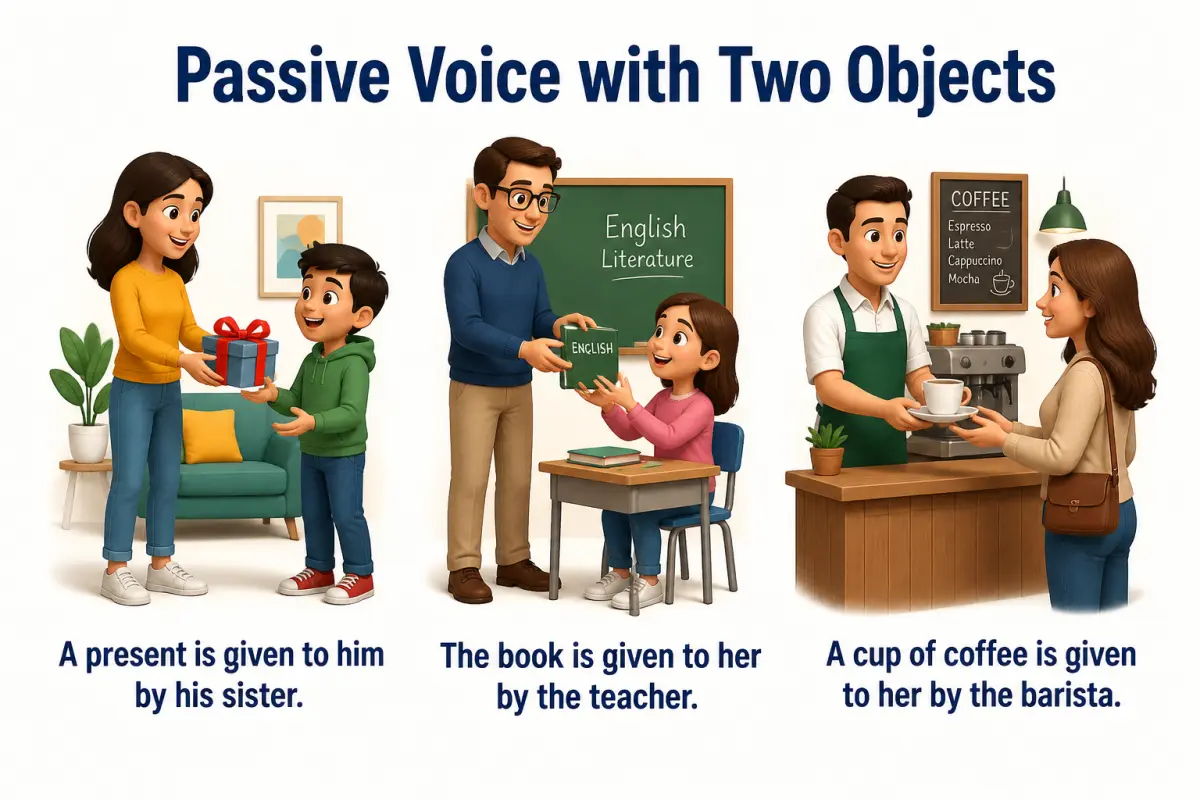 This article explains passive voice with two-object verbs. It covers how direct and indirect objects change place, when forms like She was given or A gift was given sound more natural, plus by-phrases, prepositions, questions, common mistakes, and rewrite practice.
- What two-object verbs are in passive voice
- How direct and indirect objects change position
- She was given vs a gift was given
- Which passive option sounds more natural
- Two-object passive with give, send, show, and tell
- By-phrases and prepositions after two-object passives
- Passive questions with two objects
- Common mistakes with object order and to
- Sentence practice: rewrite two-object verbs
- FAQ: passive voice with two objects
Many learners feel unsure when a sentence has two receivers of an action, but this grammar point is simpler than it seems. In everyday English, either the person or the thing can become the subject, depending on what you want to emphasize. By comparing a few natural examples, you can quickly notice the pattern and choose the form that sounds clear, polite, and useful in real communication.
What two-object verbs are in passive voice
Some verbs can take two objects in the active voice: an indirect object and a direct object. In a sentence like “The manager gave the new employee a handbook,” the new employee is the person who receives something, and a handbook is the thing that is given. These verbs are often called two object verbs.
When we make these sentences passive, English gives us an interesting choice. Either object can become the subject of the passive sentence. That is why learners often see both patterns and wonder whether both are correct. For many common verbs, the answer is yes. Compare:
- Active: The school offered the students free tutoring.
- Passive: The students were offered free tutoring.
- Passive: Free tutoring was offered to the students.
Typical verbs in this pattern include give, send, offer, show, tell, teach, lend, pay, promise, read, write, bring, and award. Not every verb behaves in exactly the same way, but the general principle is simple: if a verb can naturally have a recipient and a thing, it often allows two passive forms.
It helps to think about meaning, not only grammar labels. One part answers “to whom?” or “for whom?” and the other answers “what?” If you already understand verb objects in active sentences, this passive pattern becomes much easier to manage.
How direct and indirect objects change position
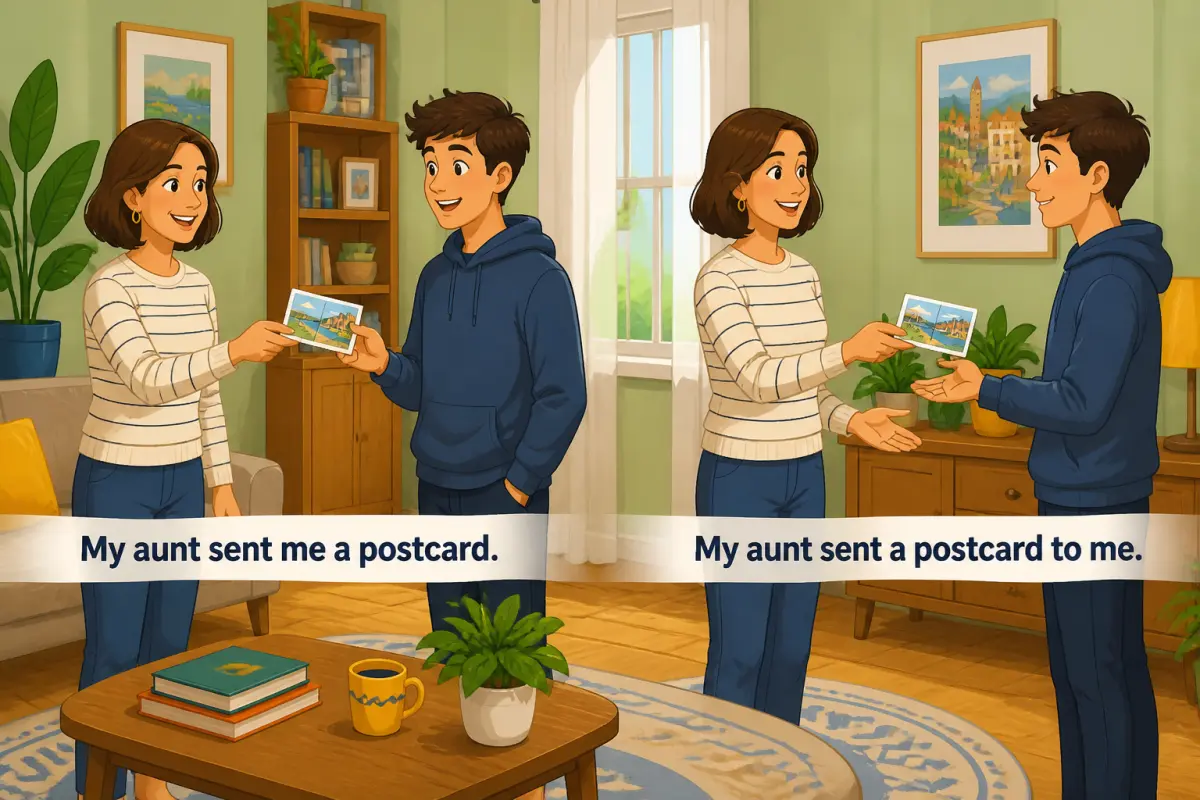
In the active voice, the most common order is subject + verb + indirect object + direct object: “My aunt sent me a postcard.” There is also another active pattern with a preposition: “My aunt sent a postcard to me.” Both are active, and both can lead to passive sentences.
When we form the passive, one object moves into the subject position, and the other stays after the verb or appears in a prepositional phrase. The verb changes to be + past participle. This movement is the main reason the structure looks different, but the basic meaning stays the same.
| Active sentence | Passive with recipient as subject | Passive with thing as subject |
|---|---|---|
| The company sent the client an invoice. | The client was sent an invoice. | An invoice was sent to the client. |
| They offered the team extra time. | The team was offered extra time. | Extra time was offered to the team. |
| The guide showed us the route. | We were shown the route. | The route was shown to us. |
| The teacher taught the class a new song. | The class was taught a new song. | A new song was taught to the class. |
Notice what changes. In “The client was sent an invoice,” the indirect object the client becomes the subject. In “An invoice was sent to the client,” the direct object an invoice becomes the subject, and the recipient appears after to.
Pronouns also change form when they move into subject position. “They sent him a reminder” becomes “He was sent a reminder.” If you still mix up forms like he/him or they/them, a quick review of object pronouns is very useful here.
Teacher note: learners often understand the passive verb but forget to change the pronoun form. “Him was sent an email” is a very common classroom mistake.
She was given vs a gift was given
Both patterns are grammatically possible, but they do not feel equally natural in every sentence. “She was given a gift” is a very typical English sentence. “A gift was given” is also correct, but it often feels incomplete unless you add more information such as to whom, when, why, or by whom.
The reason is practical. In real communication, people are often more interested in the recipient than in the object, especially when the object is general or already understood from context. That is why English frequently prefers the person as the passive subject.
Compare these pairs:
- She was given a second chance. / A second chance was given to her.
- We were offered a refund. / A refund was offered to us.
- He was sent the final schedule. / The final schedule was sent to him.
All six sentences are correct. However, the versions with she, we, he sound more conversational and more common in everyday English. The versions with the thing as subject usually sound more formal, more written, or more useful when the thing is the real focus.
Now compare three more pairs where the thing is more important:
- A medal was awarded to the winner. / The winner was awarded a medal.
- A detailed map was given to every visitor. / Every visitor was given a detailed map.
- A new name was given to the project. / The project was given a new name.
Here, either form may sound natural depending on what the writer wants to highlight. If the topic is the medal, the map, or the new name, using that thing as the subject makes sense.
Which passive option sounds more natural
In most everyday situations, the passive with the recipient as subject sounds more natural, especially with personal pronouns and common verbs like give, send, show, and tell. Native speakers often choose “I was given…”, “We were shown…”, and “He was told…” because these sentences are lighter, smoother, and more personal.
The passive with the thing as subject becomes more natural when the object itself is the topic of the sentence, when the style is formal, or when the recipient is less important. You often hear it in announcements, reports, academic writing, and official communication.
- More natural in conversation: I was sent the wrong file.
- More natural in an office email: The wrong file was sent to several clients.
- More natural when telling a story: She was taught French by her grandmother.
- More natural in a school report: French was taught to the children twice a week.
A useful rule is this: if one option sounds shorter and more human, it is often the better everyday choice. If one option places the key information first, it is often the better writing choice.
Teacher note: when students ask “Which one should I use in speaking?”, I usually recommend the person-first passive first. It is not the only correct form, but it is the safest natural choice in ordinary conversation.
Also remember that naturalness depends on context, not only grammar. “The results were shown to the committee” is perfectly natural if the conversation is about the results, not about the committee.
Two-object passive with give, send, show, and tell
These four verbs are among the most useful for learners because they appear everywhere: at school, at work, in messages, and in conversation. They all commonly allow the passive with either object as subject, although the recipient-first passive is often the more common one in speech.
It is worth learning them as patterns, not as isolated sentences. Once you can use these four comfortably, other two-object verbs become easier as well.
| Verb | Recipient-first passive | Thing-first passive |
|---|---|---|
| give | We were given extra instructions. | Extra instructions were given to us. |
| send | I was sent a replacement card. | A replacement card was sent to me. |
| show | The visitors were shown the garden. | The garden was shown to the visitors. |
| tell | She was told the truth. | The truth was told to her. |
With give, the person-first passive is extremely common:
- The nurse gave me some advice. → I was given some advice.
- They gave the children stickers. → The children were given stickers.
- The landlord gave us a warning. → We were given a warning.
With send, both forms are common because letters, emails, parcels, and documents are often the topic:
- HR sent the staff an update. → The staff were sent an update.
- HR sent the staff an update. → An update was sent to the staff.
- The bank sent her a new PIN. → She was sent a new PIN.
With show, the recipient-first passive is very natural when we focus on what someone saw or learned:
- The technician showed us the controls. → We were shown the controls.
- The curator showed the guests a private room. → The guests were shown a private room.
- The app showed users an error message. → Users were shown an error message.
With tell, the person-first passive is especially common because the listener is usually central to the message:
- No one told me the deadline. → I wasn’t told the deadline.
- They told the interns the rules. → The interns were told the rules.
- Someone told her a strange story. → She was told a strange story.
If you enjoy grammar patterns, this topic also connects to verb valency, which explains how many complements a verb can take and what kinds of patterns are possible.
By-phrases and prepositions after two-object passives

After a passive sentence, we can add a by-phrase to mention the doer of the action: “She was given a scholarship by the university.” But in real English, we often leave the agent out if it is unknown, obvious, or unimportant. That is why many passive sentences stop after the object or prepositional phrase.
The other important point is the preposition after the thing-first passive. With many verbs, especially give, send, show, lend, offer, we usually use to. In some patterns, especially with buying or making something for someone, the preposition may be for, but those are less central to this article.
- The documents were sent to the director.
- A full explanation was given to the passengers.
- The final design was shown to the client.
- Dinner was cooked for the guests.
Look at how the by-phrase and the recipient phrase work together:
- The prize was given to Lena by the judges.
- A warning was sent to all residents by text message.
- The policy was explained to the new staff by the supervisor.
Be careful with verbs that do not naturally fit the double-object pattern in the same way. For example, “explain” usually prefers “explain something to someone” in active voice, so “The rule was explained to us” is normal, but “We were explained the rule” is usually not standard.
Teacher note: one reliable habit is to learn passive forms together with their prepositions. Students who memorize “sent to,” “shown to,” and “explained to” make fewer errors later.
Passive questions with two objects
Questions follow the normal passive pattern: be + subject + past participle, or with a question word before that. The main challenge is deciding which noun becomes the subject and which meaning you are asking about.
Start with simple yes/no questions. If the recipient is the subject, ask about that person. If the thing is the subject, ask about that thing.
- Was he offered the job?
- Were you sent the details?
- Was the job offered to him?
- Were the details sent to you?
Wh-questions work the same way:
- Who was given the spare key?
- What were the guests shown?
- When were you told the news?
- Why was a refund offered to the customer?
Notice the difference between asking about the person and asking about the thing:
- Who was sent a replacement? → asks about the recipient.
- What was she sent? → asks about the thing.
- Who were the photos shown to? → asks about the recipient after a preposition.
This is also a good area to compare passive questions with active subject object questions, because learners often confuse “Who sent you the file?” with “Who were you sent the file by?” The second question is grammatical but much less natural. In real speaking, the active question is often better if you mainly want the agent.
Common mistakes with object order and to
The most common errors happen when learners mix the two patterns: the recipient-first passive without a preposition, and the thing-first passive with to. Another frequent problem is trying to use a double-object passive with verbs that do not allow it naturally.
Below are the mistakes I hear most often, with clear corrections.
- ❌ She was given to a certificate.
✅ She was given a certificate. - ❌ A certificate was given her.
✅ A certificate was given to her. - ❌ He was sent to an email yesterday.
✅ He was sent an email yesterday. - ❌ An email was sent him yesterday.
✅ An email was sent to him yesterday.
The rule behind these examples is straightforward:
- If the person becomes the passive subject, there is usually no to: “Maya was offered a seat.”
- If the thing becomes the passive subject, the recipient usually comes after to: “A seat was offered to Maya.”
Another mistake is keeping the active order after changing the verb to passive:
- ❌ Was given the teacher the students homework.
- ✅ The students were given homework.
- ✅ Homework was given to the students.
And a third mistake is using the wrong verb pattern:
- ❌ We were explained the problem.
- ✅ The problem was explained to us.
- ❌ She was described the suspect.
- ✅ The suspect was described to her.
- ❌ They were suggested a better route.
- ✅ A better route was suggested to them.
Here are three more wrong/correct pairs for each major danger area.
1. Adding to after a recipient-first passive
- ❌ I was offered to a refund.
✅ I was offered a refund. - ❌ The tourists were shown to a shortcut.
✅ The tourists were shown a shortcut. - ❌ She was told to the truth.
✅ She was told the truth.
2. Forgetting to after a thing-first passive
- ❌ A refund was offered me.
✅ A refund was offered to me. - ❌ The shortcut was shown the tourists.
✅ The shortcut was shown to the tourists. - ❌ The truth was told her.
✅ The truth was told to her.
3. Forcing the pattern with unsuitable verbs
- ❌ We were mentioned the issue.
✅ The issue was mentioned to us. - ❌ He was introduced the manager.
✅ The manager was introduced to him. - ❌ I was announced the result.
✅ The result was announced to me.
Sentence practice: rewrite two-object verbs
Practice is where this grammar really becomes automatic. The best method is to transform active sentences in two ways: first with the recipient as the passive subject, and then with the thing as the passive subject. After that, do a second kind of exercise where you choose the more natural option. Finally, correct wrong sentences so you train your eye to notice object order and missing to.
Try to say your answers aloud before checking them. This helps you feel which version sounds natural, not just which one is technically possible.
Practice block 1: rewrite into passive in two ways where possible
- The receptionist gave the visitor a parking code.
- My cousin sent me a wedding invitation.
- The trainer showed the new staff the safety equipment.
- The editor told the writer the deadline.
- The shop offered customers a free sample.
- The university awarded Sara a research grant.
- The waiter brought us the bill.
- The company lent the team a van.
- The guide taught the tourists a local phrase.
- The assistant wrote the manager a reminder.
Show answers
- The visitor was given a parking code. / A parking code was given to the visitor.
- I was sent a wedding invitation. / A wedding invitation was sent to me.
- The new staff were shown the safety equipment. / The safety equipment was shown to the new staff.
- The writer was told the deadline. / The deadline was told to the writer.
- Customers were offered a free sample. / A free sample was offered to customers.
- Sara was awarded a research grant. / A research grant was awarded to Sara.
- We were brought the bill. / The bill was brought to us.
- The team was lent a van. / A van was lent to the team.
- The tourists were taught a local phrase. / A local phrase was taught to the tourists.
- The manager was written a reminder. / A reminder was written to the manager.
Practice block 2: choose the more natural passive for everyday English
- Someone gave Nina a seat by the window.
- The IT department sent all employees a password reset link.
- The museum showed the children a fossil collection.
- The doctor told me the test results.
- The airline offered the passengers hotel vouchers.
- The organizer gave each speaker a name badge.
- The librarian sent Daniel a message.
- The coach showed the players a new drill.
- The receptionist gave us directions.
- The teacher told the class a short story.
Show answers
- Nina was given a seat by the window.
- All employees were sent a password reset link.
- The children were shown a fossil collection.
- I was told the test results.
- The passengers were offered hotel vouchers.
- Each speaker was given a name badge.
- Daniel was sent a message.
- The players were shown a new drill.
- We were given directions.
- The class was told a short story.
Practice block 3: spot and correct the error
- A discount was offered the guests.
- She was sent to a confirmation email.
- We were explained the new schedule.
- The children were given to extra blankets.
- A map was shown us at the station.
- He was told to the answer after the quiz.
- The problem was described us very clearly.
- I was promised to a refund within five days.
- The recipe was taught the students by the chef.
- They were mentioned the delay in the meeting.
Show answers
- A discount was offered to the guests.
- She was sent a confirmation email.
- The new schedule was explained to us.
- The children were given extra blankets.
- A map was shown to us at the station.
- He was told the answer after the quiz.
- The problem was described to us very clearly.
- I was promised a refund within five days.
- The recipe was taught to the students by the chef.
- The delay was mentioned to them in the meeting.
FAQ: passive voice with two objects
These are the questions learners usually ask after they understand the main pattern but still want to use it confidently and naturally.
1. Do all verbs with two objects allow two passive forms?
No. Many common verbs do, but not all of them behave equally well in both patterns. Verbs like give, send, show, offer, tell, and teach are very flexible. Others prefer a structure with to and do not sound natural with the recipient as passive subject. For example, “The rule was explained to me” is normal, but “I was explained the rule” is generally not standard.
2. Is “She was given a gift” better than “A gift was given to her”?
Not always better, but often more natural in everyday speech. The first version focuses on she, which is common in conversation. The second version focuses on a gift, which may fit better in a formal report or a sentence where the gift itself is the topic.
3. Can I omit the by-phrase in these passives?
Yes, and very often you should. If the agent is unknown, obvious, or not important, leave it out. “We were offered coffee” sounds complete by itself. Add a by-phrase only when the doer matters: “We were offered coffee by the host.”
4. Why do I need “to” in some passive sentences but not in others?
You use to when the thing becomes the passive subject and the recipient comes later: “The tickets were sent to us.” You usually do not use to when the recipient is the passive subject: “We were sent the tickets.” Learners often mix these two patterns.
5. Are both passive forms equally common in writing and speaking?
No. Speech usually favors the recipient-first pattern: “I was told…”, “She was given…”, “They were shown…”. Writing, especially formal or informational writing, may use the thing-first pattern more often: “Further details were sent to all applicants.” The choice depends on style and focus.
6. Can passive questions sound awkward with by?
Yes. A question like “Who were you given the documents by?” is grammatical, but many speakers would prefer an active version: “Who gave you the documents?” Use passive questions when the passive focus is genuinely useful, not just because you can form them.
7. What happens with pronouns in these sentences?
The form changes according to the sentence role. “They gave him a key” becomes “He was given a key.” “She sent us a link” becomes “We were sent a link.” Always check whether the word is acting as a subject or an object.
8. How can I practice this topic efficiently?
Use a three-step routine. First, rewrite active sentences into both passive patterns. Second, decide which version sounds more natural in a real context. Third, correct wrong examples with missing to or bad object order. Ten minutes of focused transformation practice is much more useful than reading long rule lists.