Get Something Done: Informal Causative Passive

 This article explains what get something done means, why get is more informal than have, and how to use it for errands, repairs, and tasks. It also covers get someone to do something, tense forms, questions, negatives, American usage, and practice.
- What get something done means
- Why get sounds more informal than have
- Get something done for errands, repairs, and tasks
- Get someone to do something vs get something done
- Past and future examples with got and will get
- Questions and negatives with get something done
- American English notes: got vs gotten
- Have something done vs get something done
- Practice: choose have or get in causative sentences
- FAQ: get something done
English often uses a natural, everyday pattern to show that someone else did something for you. You hear it when people talk about services and arrangements, like getting their hair cut, having a phone repaired, or arranging furniture delivery. It is a common structure in daily conversation, and once you start noticing it, you will hear it often. Learning it can make your English sound smoother, clearer, and more natural.
What get something done means
This pattern is used when you arrange for another person to do a job for you. You do not do the action yourself, but you make sure it happens. In everyday English, the basic structure is get + object + past participle.
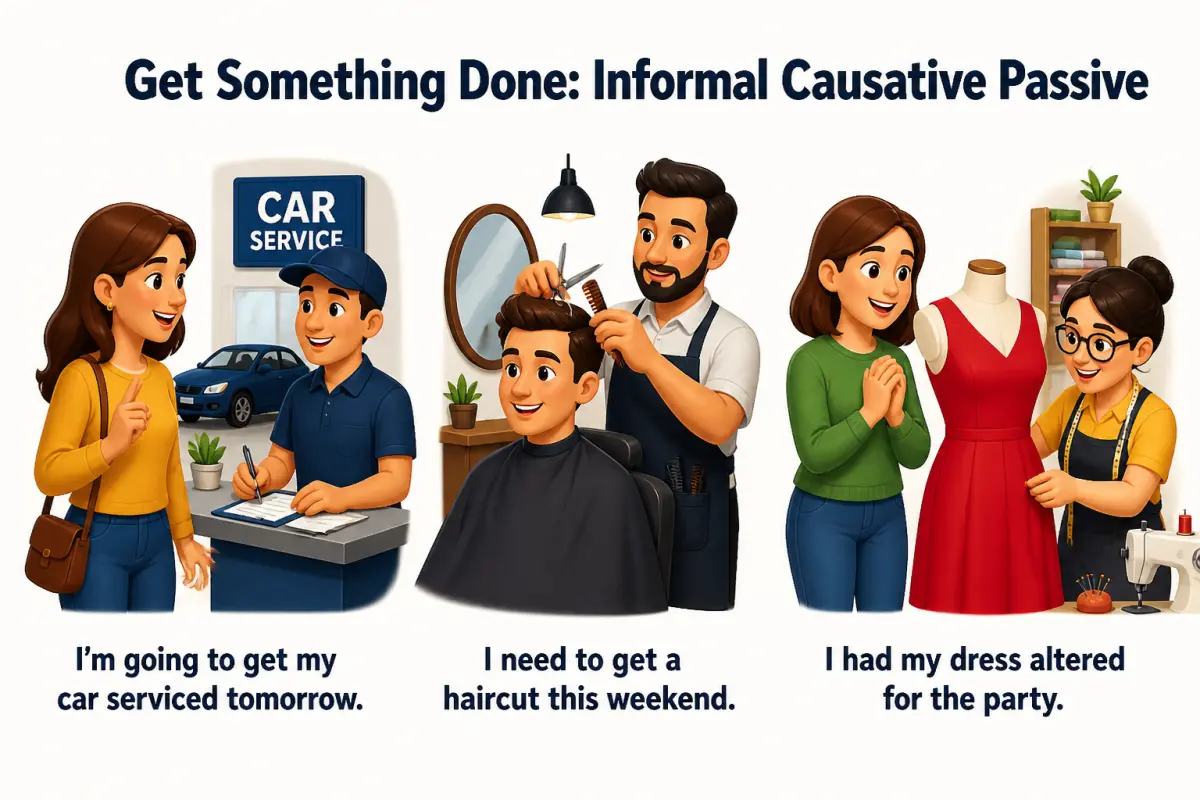
For example, if you say, “I got my hair cut,” the meaning is not “I cut my own hair.” It means someone else cut it, and you arranged it. In the same way, “We got the windows cleaned” means a cleaner or company did the work. The focus is usually on the result or the service, not on the worker.
Here are some very common examples:
- I need to get my phone repaired.
- She’s getting her passport renewed next week.
- We got the kitchen painted before moving in.
- He wants to get his suit cleaned before the wedding.
- They had to get the locks changed after losing the keys.
Notice that the past participle describes the completed action on the object: cut, repaired, renewed, painted, cleaned, changed.
A very useful contrast is this:
- I cleaned the windows. = I did the work myself.
- I got the windows cleaned. = Someone else did the work for me.
Learners sometimes confuse this with the ordinary passive. Compare these:
- The windows were cleaned yesterday. = plain passive; we only know the action happened.
- We got the windows cleaned yesterday. = causative meaning; we arranged it.
Teacher note: if your first language often leaves out the person who did the action, this structure is worth practicing carefully. The idea of “I arranged it” is the key, not just “it happened.”
Why get sounds more informal than have
English has two very common causative patterns here: have something done and get something done. Both can mean that you arrange for another person to do the work. The difference is mainly in tone. Get usually sounds more conversational and natural in everyday speech, while have can sound a little more neutral, organized, or formal.
That does not mean have is stiff or strange. Native speakers use both all the time. But in normal conversation, especially when talking about daily life, many people prefer get.
| Pattern | Typical feel | Example |
|---|---|---|
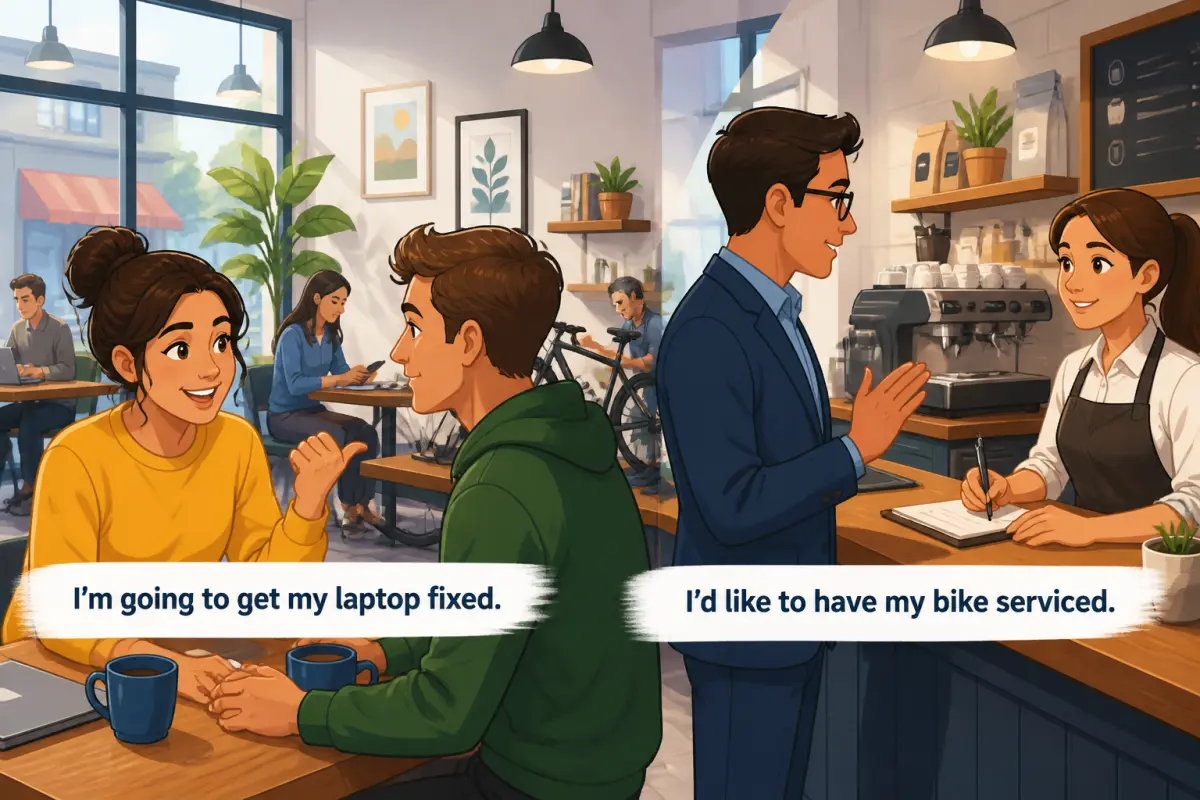
| get something done | more informal, spoken, everyday | I need to get my laptop fixed. |
| have something done | neutral to slightly more formal | I need to have my laptop fixed. |
| get + person + to do | focus on persuading/arranging with a person | I got the technician to check it. |
| ordinary passive | focus on event/result, not arrangement | The laptop was fixed yesterday. |
Look at these pairs:
- I got my watch repaired at the mall. / I had my watch repaired at the mall.
- We should get the air conditioner serviced. / We should have the air conditioner serviced.
- She’s going to get her eyebrows done before the party. / She’s going to have her eyebrows done before the party.
All of them are grammatical. The versions with get sound a little more casual and speech-like.
This is part of a wider pattern in informal verb use. English often chooses lighter, more flexible verbs in conversation, and get is one of the most common.
One small warning: because get has many meanings in English, learners sometimes use it too broadly. It works very naturally in this pattern, but you still need the correct form: get + object + past participle.
Get something done for errands, repairs, and tasks
This structure is especially common when talking about practical life: appointments, services, maintenance, paperwork, and jobs you pay for or arrange. It fits naturally with errands and tasks because these are often things you cannot, should not, or do not want to do yourself.
Think of it as a very useful “real life” pattern. If you can use it well, your English immediately sounds more natural in conversations about homes, cars, health, travel, and work.
Common areas where people use it:
- Personal care: get your hair cut, get your nails done, get your eyes tested
- Home repairs: get the sink fixed, get the roof repaired, get the walls painted
- Car maintenance: get the tires changed, get the oil checked, get the brakes repaired
- Documents and admin: get your visa renewed, get the form signed, get your ID replaced
- Technology: get the printer repaired, get the software installed, get the screen replaced
Examples in realistic situations:
- I need to get my suit altered before Friday.
- Did you ever get that bathroom leak fixed?
- We finally got the internet connected in the new apartment.
- She’s trying to get her prescription renewed before the holiday.
- Let’s get these copies printed today so we’re ready for the meeting.
- He got his bicycle tuned up for the race.
It also works well when the job is not a repair:
- I need to get my taxes done.
- We got the invitations printed locally.
- She wants to get the spare room organized before her guests arrive.
Be careful with jobs that you normally do yourself. Some sentences are grammatical, but the meaning changes:
- I washed the car. = I did it.
- I got the car washed. = someone else washed it, or I used a service.
Teacher note: a good way to remember this pattern is to connect it to services. If money, booking, scheduling, or professional help is involved, get something done is often the right choice.
Get someone to do something vs get something done
These two patterns are related, but they are not the same. With get someone to do something, the focus is on the person you persuade, instruct, convince, or arrange to act. With get something done, the focus is on the task or result.
Compare the structure:
- get + someone + to + base verb
- get + something + past participle
Now look at the difference in meaning:
- I got Sam to fix the shelf. = focus on Sam
- I got the shelf fixed. = focus on the shelf/result
Here are more pairs:
- I got the receptionist to print the document. / I got the document printed.
- She got her brother to drive her to the station. / She got a ride to the station arranged.
- We got the IT team to reset the passwords. / We got the passwords reset.
Sometimes both are possible in the same situation, but your choice changes what sounds important. If the person matters, name the person. If the completion of the task matters, use the object.
Common learner mistakes:
- ❌ I got my car to repair.
✅ I got my car repaired. - ❌ I got the mechanic repaired my car.
✅ I got the mechanic to repair my car. - ❌ She got her essay to check.
✅ She got her essay checked. - ❌ We got the manager approved the request.
✅ We got the manager to approve the request.
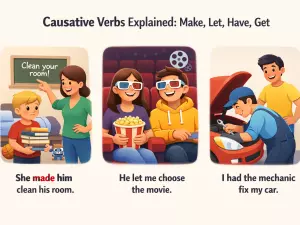
If you want the wider system of these patterns together, including make, let, have, and get, see this explanation of causative make get.
Past and future examples with got and will get
Once learners understand the basic structure, the next step is to use it comfortably in different time frames. In the past, you will often hear got something done. For future plans, will get something done is very common, especially for promises, intentions, and arrangements.
The grammar stays the same after get: the object is followed by a past participle. Only the tense of get changes.
| Time | Form | Example |
|---|---|---|
| present | get / gets | I get my shirts cleaned downtown. |
| past | got | She got her laptop repaired yesterday. |
| future | will get | We’ll get the fence painted next month. |
| present continuous | am/is/are getting | They’re getting the carpets replaced this week. |
| present perfect | have/has got | I’ve got my teeth checked already. |
Past examples:
- I got my passport renewed before the trip.
- They got the office repainted during the summer break.
- He got his bike repaired after the accident.
- We got the carpets cleaned last weekend.
Future examples:
- I’ll get the report printed tomorrow morning.
- She’ll get her phone screen replaced after work.
- We’ll get the guest room prepared before your parents arrive.
- Don’t worry. I’ll get the documents signed today.
And for arrangements already in progress:
- I’m getting my eyes tested on Thursday.
- They’re getting the kitchen measured this afternoon.
- He’s getting his résumé edited by a friend.
A common mistake is to use the wrong verb form after the object:
- ❌ I got my phone repair yesterday.
✅ I got my phone repaired yesterday. - ❌ We will get the room decorate next week.
✅ We will get the room decorated next week. - ❌ She got her application approve in time.
✅ She got her application approved in time.
If you want more background on how get works in passive-like structures, the topic connects closely to the get passive.
Questions and negatives with get something done
Questions and negatives follow the normal rules for the verb get. In the present simple, use do/does. In the past simple, use did. The main verb stays in the base form get, and the final verb stays as a past participle.
This is where learners often make small but important errors, especially with did got and don’t got. Remember: after do/does/did, use get, not got.
Examples of questions:
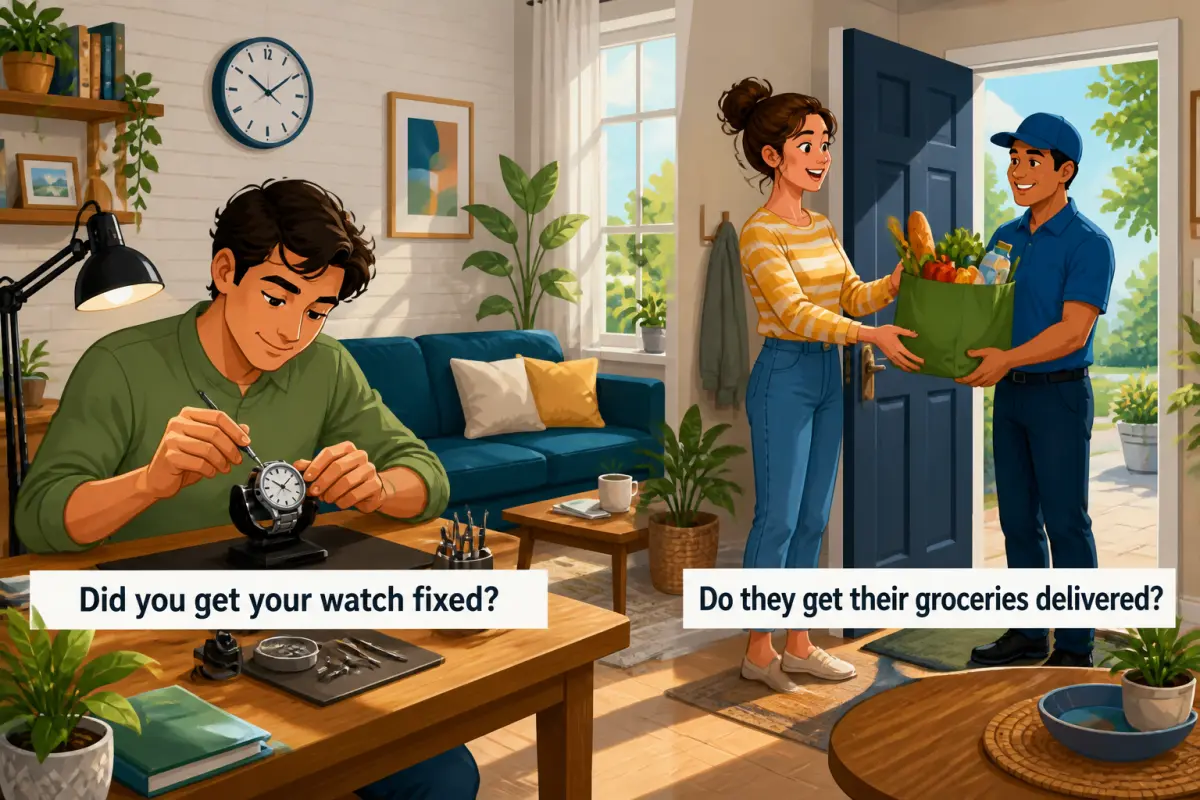
- Did you get your watch fixed?
- Do they get their groceries delivered?
- When are you getting the sofa cleaned?
- Has she got her visa renewed yet?
Examples of negatives:
- I didn’t get my jacket cleaned after all.
- We don’t usually get the car serviced here.
- He isn’t getting the bathroom painted this month.
- They haven’t got the contract checked by a lawyer yet.
Common mistakes and corrections:
- ❌ Did you got your hair cut?
✅ Did you get your hair cut? - ❌ I don’t got my suits cleaned there.
✅ I don’t get my suits cleaned there. - ❌ She didn’t get her car fix.
✅ She didn’t get her car fixed. - ❌ Are you get the sink repaired?
✅ Are you getting the sink repaired?
Useful question patterns for daily conversation:
- Where do you get your glasses adjusted?
- How often do you get the air filters changed?
- Why didn’t you get the package sent earlier?
- Who’s getting the invitations delivered?
Teacher note: when students make mistakes here, the problem is usually not the causative pattern itself. It is usually the basic tense pattern with do/does/did. Fix that first, and the causative becomes much easier.
American English notes: got vs gotten
This topic can confuse learners because American English uses both got and gotten, but not in the same way. In the simple past, both British and American English use got: “I got the brakes checked yesterday.”
In American English, gotten often appears as the past participle of get in some meanings, but in the causative pattern have got something done is not the usual form people focus on. In practice, learners will hear and use forms like these much more often:
- I got my license renewed last month.
- I’ve got my taxes done already.
- I need to get my car inspected.
In American English, gotten is common in meanings such as “become” or “obtained”:
- He has gotten much better at presentations.
- She has gotten a lot of support from her team.
But with this causative service pattern, learners should not force gotten into every perfect form. Natural English depends on the exact phrase and region, and many speakers simply use forms with get, got, or have had/have got depending on context.
A few practical points:
- Simple past: “I got the windshield replaced.”
- Question in the past: “Did you get the windshield replaced?”
- Future: “I’ll get it replaced next week.”
If you are a learner of American English, it is better to master these clear, frequent forms first than to worry too much about every possible use of gotten.
Have something done vs get something done
These two patterns overlap a lot, so learners often ask whether one is more correct. The answer is simple: both are correct. The main differences are style, tone, and sometimes a small change in emphasis. Have something done can sound a bit more neutral or formal. Get something done usually sounds more everyday and active.
In many situations, you can choose either one without changing the basic meaning.
Compare these pairs:
- I had my teeth cleaned yesterday. / I got my teeth cleaned yesterday.
- We should have the contract reviewed. / We should get the contract reviewed.
- She’s going to have her portrait taken. / She’s going to get her portrait taken.
Now the practical difference:
- Have often sounds more planned, professional, or formal.
- Get often sounds more conversational and more common in spontaneous speech.
Here are three contrast pairs with a more noticeable difference in tone:
- I must have this report edited before submission. / I need to get this report edited before I send it in.
- The company will have the equipment tested annually. / We’ll get the equipment tested every year.
- She had the documents translated by a certified agency. / She got the documents translated downtown.
Some learners also overuse have in friendly spoken English because textbooks often introduce it first. In real conversation, get is extremely common. If you want your spoken English to sound natural, make room for both.
Another point: have can sometimes feel less direct about the effort of arranging the action, while get can feel slightly more dynamic. That difference is subtle, but native speakers often feel it.
To build more confidence with patterns like these, learners often benefit from extra sentence building work, especially with tense changes and object placement.
Practice: choose have or get in causative sentences
Use this section to check whether you can choose naturally between have and get, form the structure correctly, and notice common errors. There are exactly three practice blocks, and each one tests a different skill.
Try to answer before opening the solutions. In many cases, both verbs are possible, but one may sound more natural in the given context. The answers explain that where necessary.
Practice 1: Choose the more natural form
- For everyday conversation: “I need to _____ my phone repaired before the trip.”
- In a formal business email: “We should _____ the final draft reviewed by legal.”
- Talking casually with a friend: “Did you ever _____ that stain removed from the sofa?”
- At a salon reception desk: “I’m here to _____ my hair cut.”
- In a hotel management report: “The maintenance team will _____ the damaged locks replaced.”
- Speaking informally at home: “Let’s _____ the grocery order delivered tonight.”
- In a neutral work meeting: “We need to _____ the presentation slides printed.”
- Chatting about wedding plans: “She’s going to _____ her nails done on Friday.”
- Formal written instruction: “All applicants must _____ their identity verified.”
- Relaxed conversation: “I finally _____ my glasses adjusted.”
Show answers
- get
- have
- get
- get
- have
- get
- have or get, with have slightly more neutral
- get
- have
- got, from get
Practice 2: Rewrite using a causative structure
- A mechanic checked my brakes yesterday.
- A designer is going to update our website.
- A photographer took their family portrait last weekend.
- A repair company will fix the elevator tomorrow.
- A friend edited my cover letter for me.
- A clinic tests her eyes every year.
- An electrician is installing new lights in the kitchen.
- A tailor altered his jacket before the conference.
- A travel agent will book their flights.
Show answers
- I got/had my brakes checked yesterday.
- We are going to get/have our website updated.
- They got/had their family portrait taken last weekend.
- We will get/have the elevator fixed tomorrow.
- I got/had my cover letter edited.
- She gets/has her eyes tested every year.
- We got/had our event posters printed.
- We are getting/having new lights installed in the kitchen.
- He got/had his jacket altered before the conference.
- They will get/have their flights booked.
Practice 3: Spot and correct the error
- I got my passport renew last week.
- Did you got your laptop fixed?
- She is geting the living room paint.
- We don’t got the carpets cleaned here.
- He got the plumber repaired the pipe.
- I had my application to checked by a lawyer.
- They will get their new office decorate next month.
- Did she get her photo to take for the visa?
- We got someone fixed the alarm.
- He isn’t get his beard trimmed before the interview.
Show answers
- ✅ I got my passport renewed last week.
- ✅ Did you get your laptop fixed?
- ✅ She is getting the living room painted.
- ✅ We don’t get the carpets cleaned here.
- ✅ He got the plumber to repair the pipe. / He got the pipe repaired.
- ✅ I had my application checked by a lawyer.
- ✅ They will get their new office decorated next month.
- ✅ Did she get her photo taken for the visa?
- ✅ We got someone to fix the alarm. / We got the alarm fixed.
- ✅ He isn’t getting his beard trimmed before the interview.
Teacher note: when you practice this grammar, do not only fill in blanks. Also try saying the sentences aloud in situations from your own life: dentist, bank, phone repair, travel documents, school forms, and home problems.
FAQ: get something done
These are some of the questions learners ask most often once they start using this pattern in real speech and writing.
1. Can I use this structure when I pay for a service?
Yes, very often. In fact, paid services are one of the most common situations for this pattern. “I got my coat cleaned,” “We got the heater repaired,” and “She got her taxes done” all sound natural because they describe arranged services. Payment is common, but not required. A friend can also do the job.
2. Does it always mean another person did the action?
Usually yes. That is the normal meaning. If you say, “I got my kitchen painted,” listeners understand that someone else painted it. If you did it yourself, say “I painted my kitchen.” This difference matters because the two sentences describe different realities.
3. Can I say who did the work?
Yes. You can add that information if it helps. For example: “I got my watch repaired by a shop near the station.” But in everyday English, people often leave the agent out because the result is more important than the worker.
4. Is this the same as the passive voice?
Not exactly. It is related, because it uses a past participle and focuses on the object, but it adds the idea that someone arranged the action. “The gate was repaired” is a simple passive statement. “We got the gate repaired” means we made the arrangement happen.
5. Can I use get something done with bad experiences?
Yes, and English does this quite naturally. For example, “I got my phone stolen” is possible, but be careful: that meaning is different. It usually suggests an unwanted event affecting you, not a service you arranged. So the pattern can appear in different meanings, and context is very important.
6. Which sounds more natural in conversation: have or get?
In relaxed spoken English, get often sounds more natural. “I need to get my car checked” is very typical conversation English. Have is also correct, but it can sound a little more neutral or formal depending on context. In writing at work, both may be fine.
7. Can I use it with everyday non-professional tasks?
Yes, if another person does the task for you. For example, “I got the kids’ lunch boxes washed” could work if someone else washed them, though it is less common than service examples. The more ordinary the task is, the more likely people are to simply say who did it instead.
8. What should I memorize first to use this well?
Start with the pattern get + object + past participle and learn it through useful daily expressions: get my hair cut, get the car serviced, get the form signed, get my phone repaired. Building a small set of practical chunks is often more helpful than memorizing a long rule list. If you want better fluency with common vocabulary around this pattern, work with more everyday verbs.