Future Perfect Passive: Will Have Been Done

 This article explains what will have been done means, how it marks completion before a future deadline, and how it is used in reports, projects, and schedules. It also compares it with will be done, covers questions, negatives, timelines, practice, and FAQs.
- What will have been done means
- How future perfect passive shows completion before a deadline
- By Monday, by then, and by the time in passive sentences
- Future perfect passive in project, report, and schedule updates
- Will have been done vs will be done
- Questions and negatives with will have been done
- Why this form is rare in everyday speech
- Sentence timeline: choose future passive or future perfect passive
- Practice check: complete future perfect passive examples
- FAQ: will have been done
Although some grammar forms seem intimidating, this one is more approachable than it looks. It is used to describe something that will be completed before a specific point in the future, with attention on the result rather than the person doing it. You will often hear it in situations involving projects, reports, repairs, or decisions. Once you notice how it appears in everyday use, it becomes a practical and clear way to express future completion with confidence.
What will have been done means
This form is the future perfect passive. We use it when we want to say that something will be completed before a point in the future, and we focus on the action or result, not on the person who does it.
The structure is: will + have + been + past participle. For example: “The work will have been finished by Friday.” The important idea is not who finishes the work. The important idea is that, before Friday arrives, the work will already be complete.
Compare these examples:
- The documents will have been signed by noon.
- The hotel rooms will have been cleaned before the guests arrive.
- The bridge will have been repaired by the end of the month.
- The results will have been announced by then.
This form combines two ideas:
- Passive voice: the receiver of the action comes first. “The report” is more important than the person writing it.
- Perfect meaning: the action is seen as completed before a future reference point.
That is why “will have been done” can look long, but the meaning is quite precise. If you already know the passive and the perfect, this is really those two ideas working together. If you need a wider review of the perfect idea itself, the article on perfect aspect uses helps connect this form to the bigger grammar picture.
| Part | Example | Function |
|---|---|---|
| will | will | future reference |
| have | have | perfect form |
| been | been | passive marker |
| past participle | done, sent, built, checked | main action |
Common learner problem: students often confuse it with the active future perfect.
- Active: “They will have finished the work by Friday.”
- Passive: “The work will have been finished by Friday.”
Both are correct, but the focus changes. In the active sentence, “they” matters. In the passive sentence, “the work” matters.
Teacher note: many learners understand this form faster if they first build the active sentence and then change the object into the subject. “They will have completed the repairs” becomes “The repairs will have been completed.”
How future perfect passive shows completion before a deadline
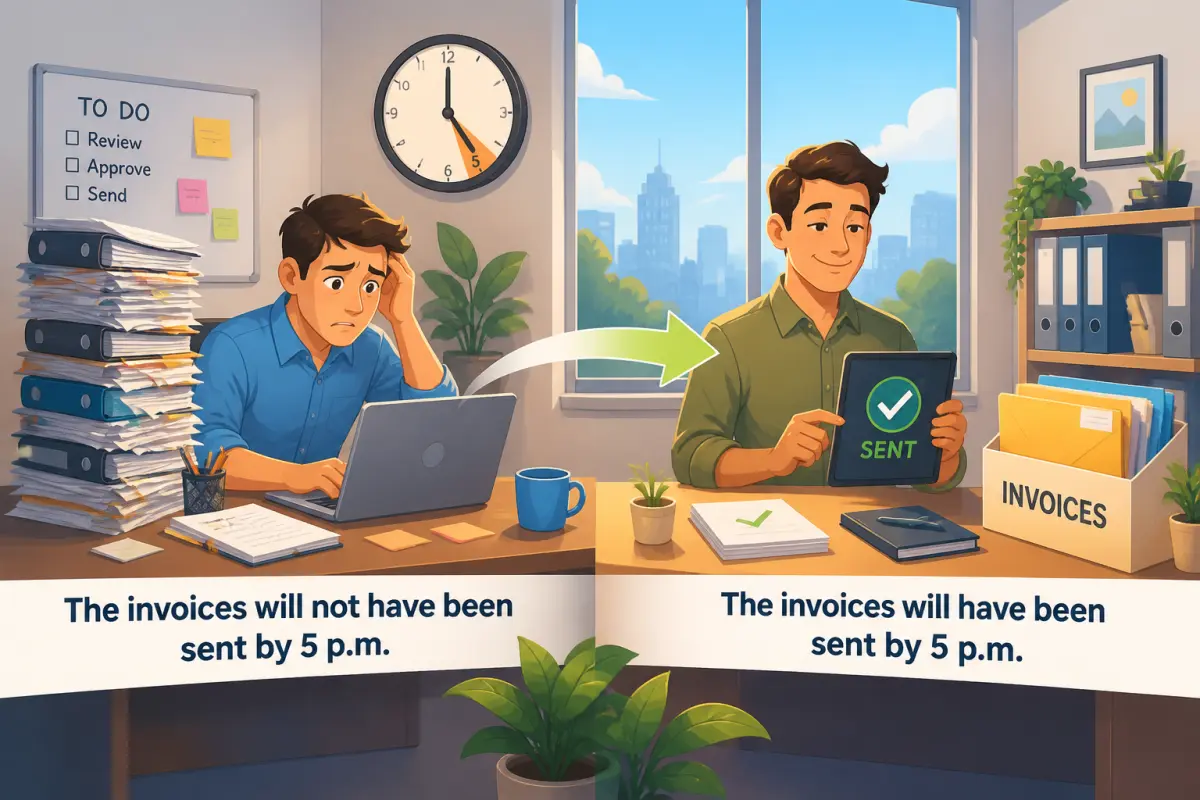
The core meaning is easier to understand if you imagine a timeline. There is a future point such as Friday, next week, 6 p.m., or the time the guests arrive. Before that point, the action will already be complete. That “already complete” feeling is the reason we use this form.
For example, “The invoices will have been sent by 5 p.m.” means that at 5 p.m., the sending is not still in progress. It is finished. The deadline is the future reference point, and the passive keeps attention on the invoices, not the staff member who sends them.
Notice how the meaning changes in these sentence pairs:
- “The stage will be built tomorrow.” = a future action is planned for tomorrow.
- “The stage will have been built by tomorrow evening.” = by tomorrow evening, the building will already be finished.
- “The essays will be marked next week.” = marking happens next week.
- “The essays will have been marked by next Wednesday.” = before next Wednesday, all marking will be complete.
- “The road will be closed at 8.” = closure starts at 8.
- “The road will have been closed for two hours by 10.” = at 10, the closed state will already have lasted two hours.
In practical use, this form often appears with words and phrases that suggest a deadline or a checkpoint:
- by Friday
- by then
- by the time you arrive
- before the meeting starts
- by the end of the year
Common mistake: using future perfect passive when there is no deadline idea.
- ❌ “The office will have been painted next month.”
- ✅ “The office will be painted next month.”
Why? Because “next month” is just a future time, not a completion point. If you want the completion meaning, add a deadline:
- ✅ “The office will have been painted by the end of next month.”
Another common issue is mixing the time reference badly:
- ❌ “The package will have been delivered yesterday.”
- ✅ “The package will have been delivered by tomorrow morning.”
- ✅ “The package had been delivered by yesterday morning.”
Future perfect passive always points toward a future reference point, not a past one.
By Monday, by then, and by the time in passive sentences
These expressions are extremely common with this grammar because they make the deadline clear. They answer the question: completed before when? If you can answer that question naturally, the form often fits well.
By Monday gives a specific time limit. By then refers back to a future point already mentioned. By the time introduces another future event, and the action will be completed before that event happens.
Look at the difference in use:
- “The final draft will have been approved by Monday.”
- “The software update will have been installed by then.”
- “The room will have been prepared by the time the guests arrive.”
Now notice some useful patterns:
- by + time/date: “The payment will have been processed by 3 p.m.”
- by then: “We expect the issue to be solved. The files will have been restored by then.”
- by the time + present simple clause: “The forms will have been checked by the time the manager comes in.”
The clause after by the time usually takes the present simple, not “will.” This is a standard future time clause pattern.
- ✅ “The dinner will have been served by the time we arrive.”
- ❌ “The dinner will have been served by the time we will arrive.”
More wrong/correct examples:
- ❌ “The forms will have been printed by the time the meeting will start.”
- ✅ “The forms will have been printed by the time the meeting starts.”
- ❌ “The guests will have been seated by then we reach the hall.”
- ✅ “The guests will have been seated by the time we reach the hall.”
- ❌ “The contract will have been signed until Monday.”
- ✅ “The contract will have been signed by Monday.”
Be careful with until. It usually shows duration up to a point, not completion before a point. With completed actions, by is usually the right choice.
Teacher note: if a student says “until Friday” when they mean “completed before Friday,” I ask them a simple question: “At Friday, is it finished already?” If yes, they probably need by Friday.
If you want to improve your control of future time clauses more generally, it also helps to review wider future verb forms, especially after words like when, before, after, and by the time.
Future perfect passive in project, report, and schedule updates
This form is especially useful in formal communication where the result matters more than the person doing the action. That is why you often see it in project plans, progress reports, business emails, construction updates, and administrative writing.
When people manage deadlines, they often need language that sounds objective and precise. “The safety checks will have been completed by 14 June” sounds more formal and report-like than “We will complete the safety checks by 14 June.” Both are correct, but the passive is common when the document focuses on stages, deliverables, and status.
Here are realistic examples from workplace contexts:
- “All user accounts will have been created by the end of the week.”
- “The revised budget will have been submitted before the board meeting.”
- “The damaged parts will have been replaced by tomorrow afternoon.”
- “The training materials will have been translated by the launch date.”
- “The inspection report will have been shared with all departments by then.”
Useful mini-patterns for update writing:
- will have been completed
- will have been submitted
- will have been approved
- will have been delivered
- will have been reviewed
| Context | Natural example | Why passive fits |
|---|---|---|
| Project update | The first phase will have been completed by 30 September. | focus on milestone |
| Report writing | The full data set will have been analyzed by then. | focus on result |
| Schedule notice | The venue will have been prepared before the speakers arrive. | focus on readiness |
| Maintenance email | The system will have been tested by tomorrow morning. | focus on procedure status |
Still, do not force this form into every sentence. In ordinary workplace conversation, people often choose something shorter:
- Formal written update: “The revised figures will have been circulated by noon.”
- More natural spoken version: “We’ll send the revised figures by noon.”
That is one reason this form appears more in documents than in casual speech.
Will have been done vs will be done
This is the contrast learners need most. Both forms are passive and both refer to the future, but they do not mean the same thing. Will be done simply places an action in the future. Will have been done shows that the action will be complete before another future point.
If you are not sure which one to use, ask yourself: Am I talking about a future action, or about a finished result before a deadline?
| Form | Main meaning | Example |
|---|---|---|
| will be done | future action or arrangement | The forms will be checked tomorrow. |
| will have been done | completed before a future point | The forms will have been checked by tomorrow afternoon. |
| will be done | what happens later | The rooms will be cleaned after lunch. |
| will have been done | what is already finished by a later time | The rooms will have been cleaned by the time guests arrive. |
Now compare these pairs carefully:
- “The invitations will be sent tomorrow.”
- “The invitations will have been sent by tomorrow evening.”
- “The issue will be discussed at the next meeting.”
- “The issue will have been discussed before the director returns.”
- “The new shelves will be installed next week.”
- “The new shelves will have been installed by next Friday.”
Common mistakes with this contrast:
- ❌ “The repairs will be completed by the time you get back” when the focus is specifically on completed status before your return.
- ✅ “The repairs will have been completed by the time you get back.”
- ❌ “The documents will have been signed tomorrow” when there is no deadline point after tomorrow.
- ✅ “The documents will be signed tomorrow.”
- ❌ “The meal will have been cooked at 7 p.m.” if you mean that cooking starts or happens then.
- ✅ “The meal will be cooked at 7 p.m.”
- ✅ “The meal will have been cooked by 7 p.m.” if you mean it will already be ready.
In writing, choosing correctly helps your meaning stay exact. This is especially useful in formal reports, and it also supports better tense consistency when you describe schedules and future milestones.
Questions and negatives with will have been done
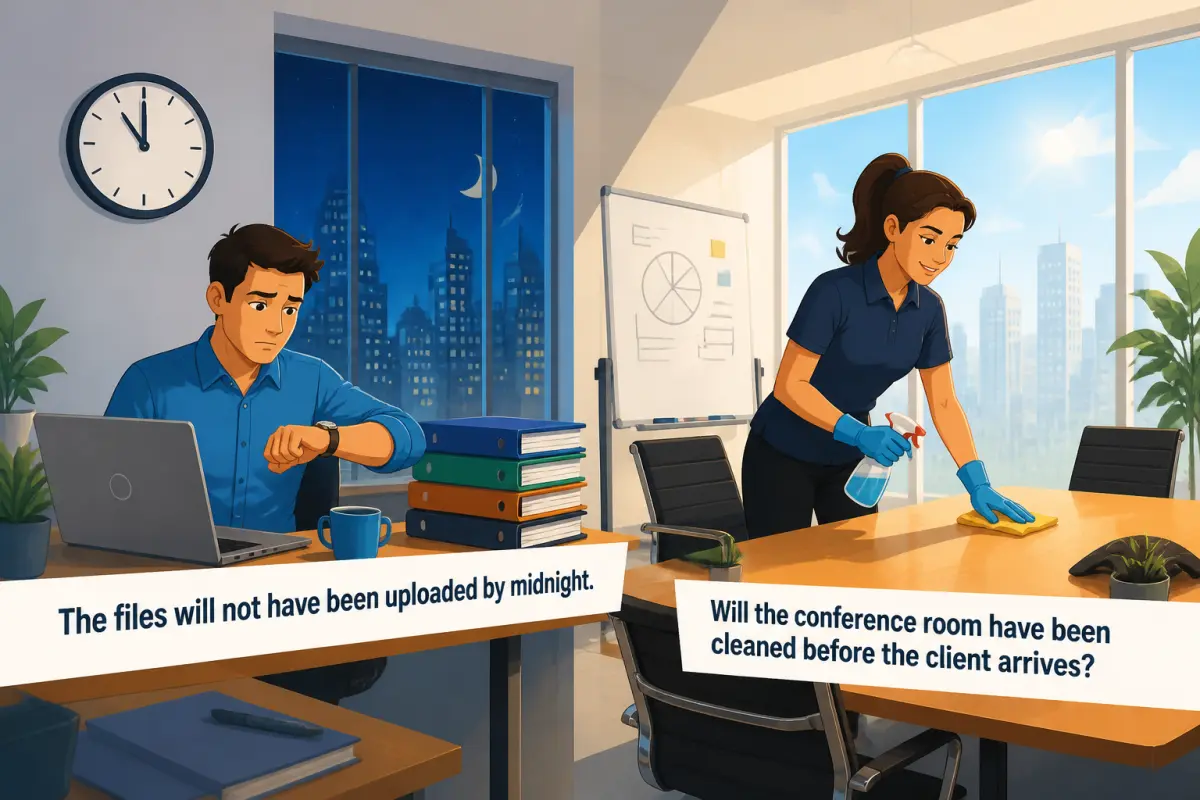
The form is long, but the grammar is regular. For negatives, put not after will. For questions, move will before the subject. The rest of the structure stays the same.
Here are the basic patterns:
- Affirmative: “The files will have been uploaded by midnight.”
- Negative: “The files will not have been uploaded by midnight.”
- Question: “Will the files have been uploaded by midnight?”
More examples:
- “The order won’t have been processed by then.”
- “Will the conference room have been cleaned before the clients arrive?”
- “The article will not have been edited in time.”
- “Will all the passports have been checked before boarding begins?”
Common learner errors are usually about word order or missing parts of the form:
- ❌ “Will have the report been sent by noon?”
- ✅ “Will the report have been sent by noon?”
- ❌ “The room will not been cleaned by six.”
- ✅ “The room will not have been cleaned by six.”
- ❌ “Will the package have delivered by tomorrow?”
- ✅ “Will the package have been delivered by tomorrow?”
You can also ask information questions:
- “When will the invitations have been printed?”
- “Why won’t the documents have been approved by then?”
- “How many rooms will have been painted by Friday?”
These are not common in casual conversation, but they do appear in planning meetings, project discussions, and formal emails. If question formation is still tricky, reviewing broader patterns in future questions can make this structure feel much less intimidating.
Teacher note: when students get lost in long questions, I tell them to build the statement first, then move only will. “The report will have been sent” becomes “Will the report have been sent?”
Why this form is rare in everyday speech
This grammar is correct and useful, but it is not common in relaxed daily conversation because it is long and quite formal. Native speakers often prefer shorter active forms when the doer is obvious or unimportant. They usually choose the clearest, quickest sentence.
For example, instead of saying “The groceries will have been delivered by 6,” many people would simply say “They’ll deliver the groceries by 6” or “The groceries should be there by 6.” The exact future perfect passive meaning exists, but everyday speech often replaces it with something more direct.
Here are some natural spoken alternatives:
- Formal: “The forms will have been processed by tomorrow morning.”
- Everyday: “They’ll process the forms by tomorrow morning.”
- Formal: “The tables will have been set by the time the guests arrive.”
- Everyday: “They’ll set the tables before the guests arrive.”
- Formal: “The issue will have been resolved by then.”
- Everyday: “It should be solved by then.”
That does not mean you should ignore the form. It matters because:
- you will meet it in formal writing and exams;
- it is useful in reports, updates, and official notices;
- it helps you express a very specific time relationship.
A good learner goal is not “use it everywhere.” A better goal is “recognize it easily, understand it clearly, and use it when the situation really needs precision.” If you want to explore passive structures beyond the basic level, work on complex passives too, because this form belongs to that wider family.
Sentence timeline: choose future passive or future perfect passive
A simple timeline test can help you choose the right form quickly. First, identify the future time reference. Then ask whether the action happens at that future time or is already complete before that time.
If the sentence means “this action will happen later,” use will be done. If it means “this action will already be finished before that later point,” use will have been done.
Use this thinking process:
- Step 1: Find the time phrase or future event.
- Step 2: Ask: “At that future point, is the action still just a future event, or is it already complete?”
- Step 3: Choose the passive form that matches the meaning.
Examples:
- “The office lights will be turned off at 9.”
At 9, the action happens. Use will be turned off. - “The office lights will have been turned off by the time security arrives.”
Before security arrives, the action is complete. Use will have been turned off.
- “The package will be collected tomorrow.”
Collection is the planned future action. - “The package will have been collected by noon tomorrow.”
By noon, collection is already complete.
- “The classroom will be decorated on Friday.”
Friday is when the action happens. - “The classroom will have been decorated by Friday evening.”
By Friday evening, the decorating is finished.
Another useful check: if by introduces the future point, future perfect passive is often possible. If the sentence uses a simple future time like tomorrow, next week, or at 3 p.m., future passive is often enough unless you clearly mean completion before another point.
Teacher note: students often improve when they draw a quick line on paper: one mark for the future deadline, one mark before it for the action. If the action sits before the deadline and is complete, the future perfect passive usually fits.
Practice check: complete future perfect passive examples
Use these tasks to check whether you can form, choose, and correct this grammar accurately. The three blocks test different skills. Try to answer before opening the key.
Keep an eye on two things: first, whether the sentence really needs the future perfect passive; second, whether every part of the form is present: will + have + been + past participle.
- Choose the correct form: The hall will be decorated / will have been decorated by 5 p.m.
- Choose the correct form: The tickets will be checked / will have been checked at the gate.
- Choose the correct form: The speeches will be printed / will have been printed by the time the guests sit down.
- Choose the correct form: The road will be repaired / will have been repaired next month.
- Choose the correct form: The laptops will be delivered / will have been delivered by Monday morning.
- Choose the correct form: The dinner will be served / will have been served at 7:30.
- Choose the correct form: The forms will be signed / will have been signed before the office closes.
- Choose the correct form: The results will be announced / will have been announced tomorrow.
- Choose the correct form: The walls will be painted / will have been painted by the end of the week.
- Choose the correct form: The website will be updated / will have been updated after lunch.
Show answers
- will have been decorated
- will be checked
- will have been printed
- will be repaired
- will have been delivered
- will be served
- will have been signed
- will be announced
- will have been painted
- will be updated
- Rewrite in the passive future perfect: They will complete the audit by Friday.
- Rewrite in the passive future perfect: The team will send the invitations by noon.
- Rewrite in the passive future perfect: Someone will clean the pool before the guests arrive.
- Rewrite in the passive future perfect: They will install the equipment by next Tuesday.
- Rewrite in the passive future perfect: The editor will publish the article by then.
- Rewrite in the passive future perfect: They will check all passports before boarding begins.
- Rewrite in the passive future perfect: The company will deliver the chairs by the end of the week.
- Rewrite in the passive future perfect: Someone will lock the doors by 10 p.m.
- Rewrite in the passive future perfect: The school will announce the winners by Monday.
- Rewrite in the passive future perfect: They will finish the repairs before winter starts.
Show answers
- The audit will have been completed by Friday.
- The invitations will have been sent by noon.
- The pool will have been cleaned before the guests arrive.
- The equipment will have been installed by next Tuesday.
- The article will have been published by then.
- All passports will have been checked before boarding begins.
- The chairs will have been delivered by the end of the week.
- The doors will have been locked by 10 p.m.
- The winners will have been announced by Monday.
- The repairs will have been finished before winter starts.
- Find and correct the error: The report will have been send by noon.
- Find and correct the error: Will have the files been copied by then?
- Find and correct the error: The room will not been prepared by six.
- Find and correct the error: The packages will have delivered by tomorrow morning.
- Find and correct the error: The meal will have been cooked until 8.
- Find and correct the error: The forms will have been checked by the time the manager will arrive.
- Find and correct the error: The windows will have been cleaned tomorrow.
- Find and correct the error: The order will has been processed by then.
- Find and correct the error: Will the contract have been sign by Friday?
- Find and correct the error: The guests will have been seated by then we enter.
Show answers
- The report will have been sent by noon.
- Will the files have been copied by then?
- The room will not have been prepared by six.
- The packages will have been delivered by tomorrow morning.
- The meal will have been cooked by 8.
- The forms will have been checked by the time the manager arrives.
- The windows will be cleaned tomorrow. / The windows will have been cleaned by tomorrow.
- The order will have been processed by then.
- Will the contract have been signed by Friday?
- The guests will have been seated by the time we enter.
FAQ: will have been done
1. Is this a tense?
Teachers often call it a tense for convenience, but more exactly it is a combination of future meaning, perfect aspect, and passive voice. For learners, the label matters less than the function: it shows that something will be completed before a future point, and the focus is on the thing affected.
2. Can I use “going to” instead?
Not usually in the same neat structure. You may hear or see forms like “is going to have been completed,” but they are less common and can sound heavy. In most real situations, people choose either “will have been completed” or a simpler active sentence such as “They’re going to complete it by Friday.”
3. Do I always need a “by” phrase?
No, but you usually need some clear future reference point. That point may appear as “by then,” “before the guests arrive,” “by the time class starts,” or “before noon.” Without a clear checkpoint, the form often sounds unnecessary or awkward.
4. Can I say who does the action?
Yes. You can add a by + agent phrase if it matters: “The final decision will have been made by the committee by next week.” Still, many passive sentences omit the agent because the result is more important than the doer.
5. Is it common in exams?
Yes, especially in grammar tests on passive forms, perfect forms, or formal writing. Exams like it because it checks several things at once: word order, participles, passive structure, and time meaning. Even if it is not very common in speech, it is worth learning well.
6. What is the difference between “will have done” and “will have been done”?
“Will have done” is active: “The staff will have packed the boxes by noon.” “Will have been done” is passive: “The boxes will have been packed by noon.” The time meaning is similar, but the focus changes from the doer to the thing receiving the action.
7. Can I use contractions in this form?
Yes, especially in speech and informal writing. “Will not” becomes won’t: “The repairs won’t have been completed by Friday.” In questions, contractions are less relevant because the form begins with “Will.” In formal reports, full forms are still very common.
8. How can I make my sentences sound more natural if this form feels too heavy?
Try asking whether you really need the passive and the perfect together. If not, simplify. Instead of “The parcels will have been delivered by noon,” you might say “They’ll deliver the parcels by noon” or “The parcels should arrive by noon.” Use the longer form when precision about completion really matters.