Passive Questions and Negatives in English

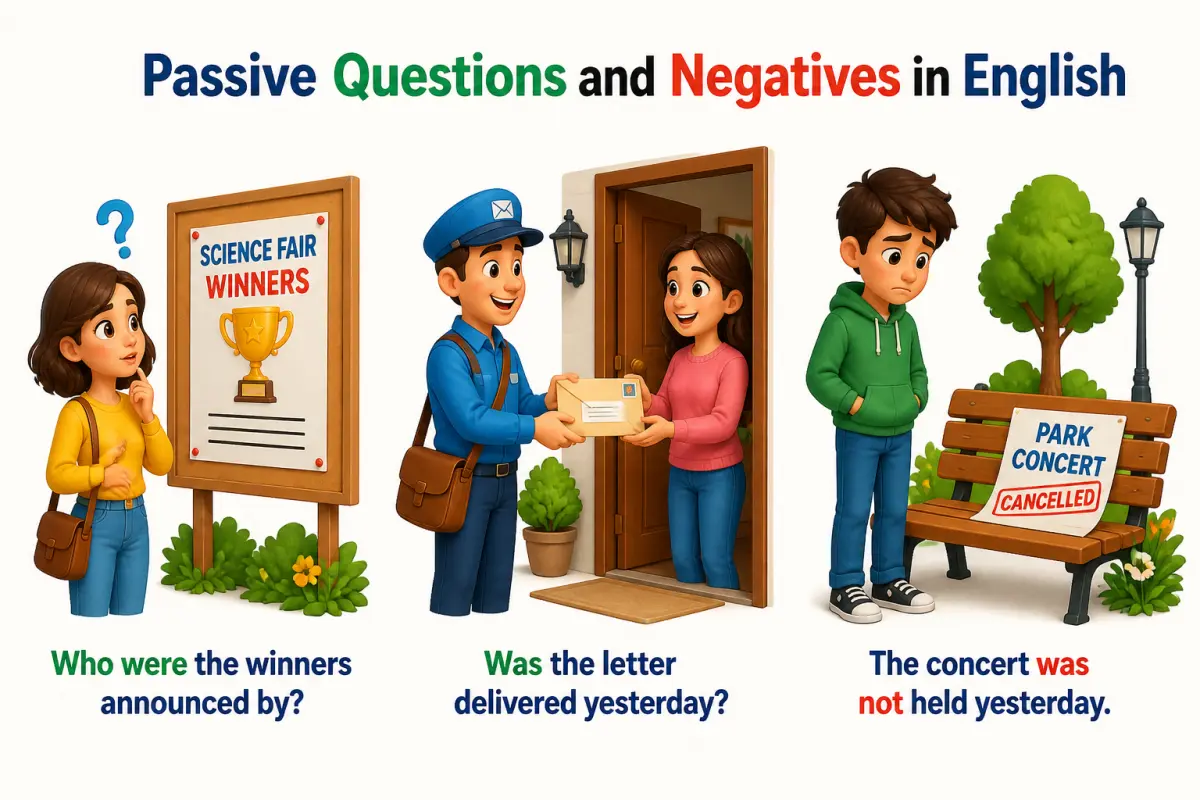 Here we how to form passive questions and negatives. It explains be in yes-no and wh-questions, how not works with be, have, and modals, tense patterns, agent use, common word order mistakes, a quick correction test, practice, and an FAQ.
- How passive questions and negatives are formed
- Where be goes in passive yes-no questions
- Wh-questions in passive voice sentences
- How not works after be, have, and modal verbs
- Passive negatives in simple, continuous, and perfect tenses
- Questions with by, without by, and unknown agents
- Common word order mistakes in passive questions
- Quick correction test for passive negatives
- Practice: ask and answer passive questions
- FAQ: passive questions and negatives
Questions and negative sentences in the passive can seem difficult at first, but they are common in everyday English, from news reports to workplace emails and casual conversation. Once you understand how the verb changes and where words like not, do, or the subject belong, the pattern becomes much easier to follow. In this lesson, you will learn how to recognize and form these structures so your English sounds clear and natural.
How passive questions and negatives are formed
The passive voice is built with a form of be plus the past participle. In an active sentence, the subject does the action: “The manager approved the report.” In a passive sentence, the subject receives the action: “The report was approved.” When you turn passive sentences into questions or negatives, the main change happens around be, not around the past participle.
That is the point many learners miss. In a passive sentence, the past participle does not move by itself. To make a question, you usually move be before the subject. To make a negative, you usually put not after be. So “The package was delivered” becomes “Was the package delivered?” and “The package was not delivered.”
Compare these basic patterns:
- Statement: The room is cleaned every day.
- Yes-no question: Is the room cleaned every day?
- Negative: The room is not cleaned every day.
- Statement: The documents were sent yesterday.
- Yes-no question: Were the documents sent yesterday?
- Negative: The documents were not sent yesterday.
- Statement: The road has been closed.
- Yes-no question: Has the road been closed?
- Negative: The road has not been closed.
A useful way to think about passive grammar is this:
- The passive form needs an auxiliary structure.
- The auxiliary controls the question form.
- The auxiliary also carries the negative.
That is why learners should pay close attention to the helping verb chain. In “The problem will be solved,” the question is “Will the problem be solved?” and the negative is “The problem will not be solved.” In “The machines have been checked,” the question is “Have the machines been checked?” and the negative is “The machines have not been checked.”
Notice also that passive meaning often appears when the doer is less important, unknown, obvious, or deliberately omitted. For example, “Was my email received?” is more natural than “Did someone receive my email?” when the speaker cares more about the result than the person.
Where be goes in passive yes-no questions
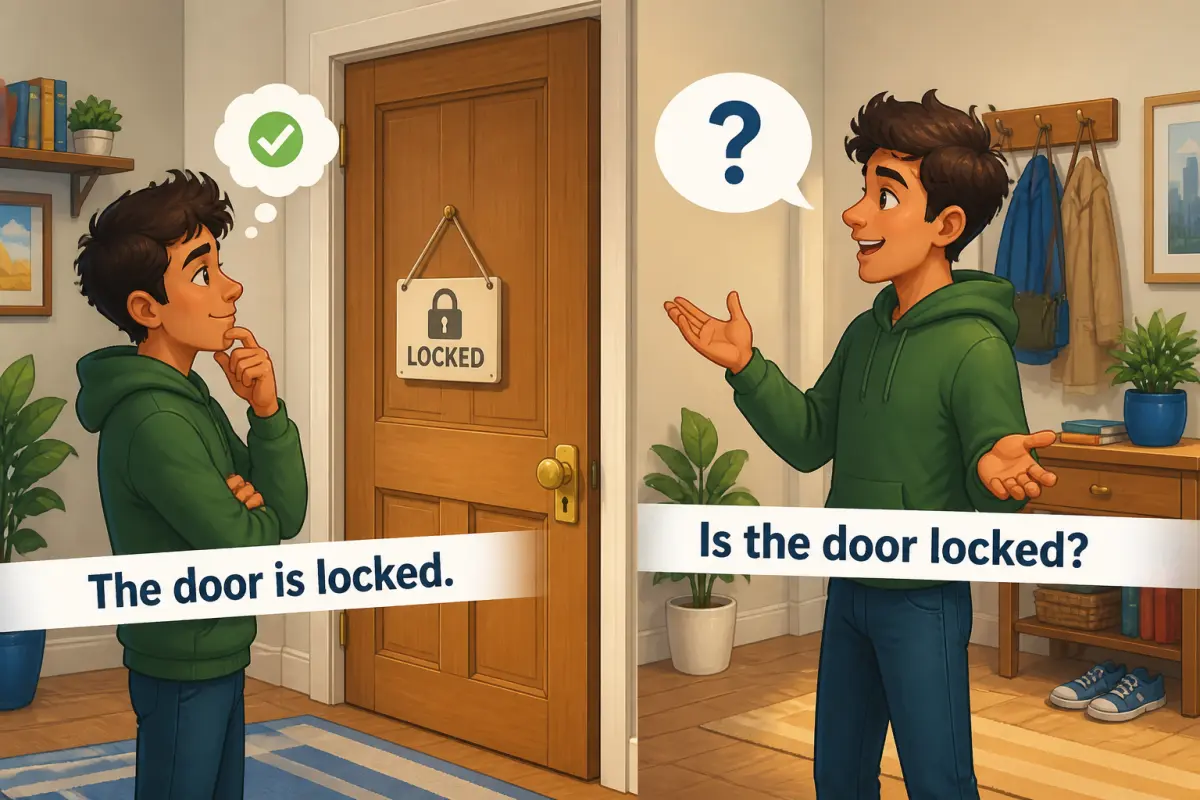
In yes-no questions, the first auxiliary comes before the subject. In simple passive forms, that auxiliary is often a form of be. So you invert the subject and be: “The door is locked” becomes “Is the door locked?” This is the same logic used in many yes-no questions, but passive sentences are especially good practice because learners can clearly see the auxiliary.
If the passive verb phrase has more than one auxiliary, only the first one moves before the subject. The rest stay in place. That means “The goods have been shipped” becomes “Have the goods been shipped?” and “The guests will be invited” becomes “Will the guests be invited?”
| Statement | Yes-no question | What moved? |
|---|---|---|
| The tickets are printed. | Are the tickets printed? | Are moved before the subject. |
| The files were copied. | Were the files copied? | Were moved before the subject. |
| The room is being prepared. | Is the room being prepared? | Only is moved. |
| The order has been confirmed. | Has the order been confirmed? | Only has moved. |
Three contrasts help learners fix the word order in their minds:
- Statement: The meal is served at six.
Question: Is the meal served at six? - Statement: The windows were cleaned this morning.
Question: Were the windows cleaned this morning? - Statement: The application has been reviewed already.
Question: Has the application been reviewed already?
Teacher note: If a learner keeps saying “Was delivered the package?”, I ask them to underline the subject first. Once they can see “the package” as one unit, it becomes much easier to place the auxiliary before it.
Be careful not to add do, does, or did to normal passive yes-no questions. These belong to active questions when there is no other auxiliary. So these are wrong: ❌ “Did the package delivered?” ❌ “Does the room cleaned every day?” The correct forms are ✅ “Was the package delivered?” and ✅ “Is the room cleaned every day?”
Wh-questions in passive voice sentences
Wh-questions in the passive usually follow this order: question word + auxiliary + subject + past participle. For example: “When was the meeting scheduled?” “Why were the lights turned off?” “How is this word pronounced?” The question word comes first, then the same auxiliary inversion happens that you use in other questions.
The real difficulty is deciding whether the question word asks about the subject, the object, the time, the place, the reason, or the agent. In passive sentences, the person or thing receiving the action is already in subject position, so many wh-questions sound very natural: “Where was the car found?” “How were the results calculated?” “When will the bill be paid?”
Look at these useful patterns:
- When was the report finished?
- Where were the keys kept?
- Why was the lesson cancelled?
- How are these forms completed?
- Which package was sent to the wrong address?
Now compare active and passive meaning:
- Active: Who sent the invitation?
Passive: When was the invitation sent? - Active: Who damaged the screen?
Passive: How was the screen damaged? - Active: Who announced the decision?
Passive: Where was the decision announced?
Notice that passive wh-questions often focus on process, result, or circumstances rather than the doer. That is why they are common in formal speaking, customer service, instructions, academic writing, and news reports.
One more point: if the question word itself is the subject, the structure changes. Compare:
- Passive: What was stolen from the office?
- Passive: Which documents were lost?
- Passive: How many seats were reserved?
Here, the question word or phrase functions as the subject, so you do not add another subject after it. Learners who struggle with this often benefit from reviewing general question word order, especially the difference between subject questions and object questions.
How not works after be, have, and modal verbs
In passive negatives, not goes after the first auxiliary. Very often that auxiliary is be, but it can also be have or a modal verb such as will, can, or should. The basic rule is simple: find the first helping verb, then put not after it.
This matters because passive verb phrases can be short or long. “The office is closed” becomes “The office is not closed.” But “The office has been closed” becomes “The office has not been closed.” And “The office will be closed” becomes “The office will not be closed.” The negative stays close to the first auxiliary, not the participle.
Here are some clear comparisons:
- be: The food is served here. → The food is not served here.
- be: The rooms were cleaned. → The rooms were not cleaned.
- have: The message has been forwarded. → The message has not been forwarded.
- have: The forms had been signed. → The forms had not been signed.
- modal: The problem can be fixed. → The problem can not be fixed.
- modal: The request should be approved. → The request should not be approved.
Contractions are common in speech and informal writing:
- is not → isn’t
- are not → aren’t
- was not → wasn’t
- were not → weren’t
- has not → hasn’t
- have not → haven’t
- will not → won’t
- should not → shouldn’t
Three contrasts that often help:
- “The order is not shipped today” is present simple passive negative.
“The order has not been shipped yet” is present perfect passive negative. - “The room was not cleaned yesterday” refers to a finished past time.
“The room was not being cleaned when I arrived” refers to an action in progress in the past. - “The guests cannot be seated here” shows possibility or rule.
“The guests are not seated here” describes the current arrangement.
Teacher note: Many learners place not too late because they focus on the main idea word, usually the participle. I tell them to listen for the first helper. Negatives in English almost always attach there.
If you want more work on where negatives belong in verb phrases generally, the topic connects closely to verb negation.
Passive negatives in simple, continuous, and perfect tenses
Learners often understand “is not made” but become less confident with longer forms such as “has not been repaired” or “was not being used.” The easiest way to stay accurate is to separate tense from voice. First choose the tense you need. Then build the passive. Then put not after the first auxiliary.
The passive negative appears in all the major tense families, although some forms are used more often than others. In everyday English, simple and perfect forms are especially common. Continuous passive forms are also correct, but they are less frequent and usually used when the speaker wants to emphasize an ongoing process.
| Tense | Passive negative form | Example |
|---|---|---|
| Present simple | am/is/are not + past participle | The bills are not paid online. |
| Past simple | was/were not + past participle | The seats were not reserved. |
| Present continuous | am/is/are not being + past participle | The road is not being repaired this week. |
| Past continuous | was/were not being + past participle | The luggage was not being checked at that moment. |
| Present perfect | has/have not been + past participle | The password has not been changed. |
| Past perfect | had not been + past participle | The mistake had not been noticed before the meeting. |
Now look at some tense contrasts in pairs:
- Present simple: The forms are not signed on site.
Present continuous: The forms are not being signed right now. - Past simple: The parcel was not delivered on Monday.
Past continuous: The parcel was not being delivered when the address changed. - Present perfect: The account has not been activated yet.
Past perfect: The account had not been activated before the user called support.
Some forms are grammatically possible but stylistically heavy. For example, “The bridge has not been being repaired for long” is technically possible in theory, but almost nobody says it. In real communication, speakers usually choose a simpler structure: “Repair work on the bridge hasn’t been going on for long” or “The bridge hasn’t been under repair for long.” Good grammar also includes knowing which correct forms sound natural.
Another practical issue is meaning. Compare:
- “The windows were not opened” means the action did not happen.
- “The windows were not being opened” means the action was not in progress at that time.
- “The windows have not been opened” means up to now, the action still has not happened.
Once learners understand that time meaning comes from the auxiliary chain, the passive becomes much less confusing.
Questions with by, without by, and unknown agents
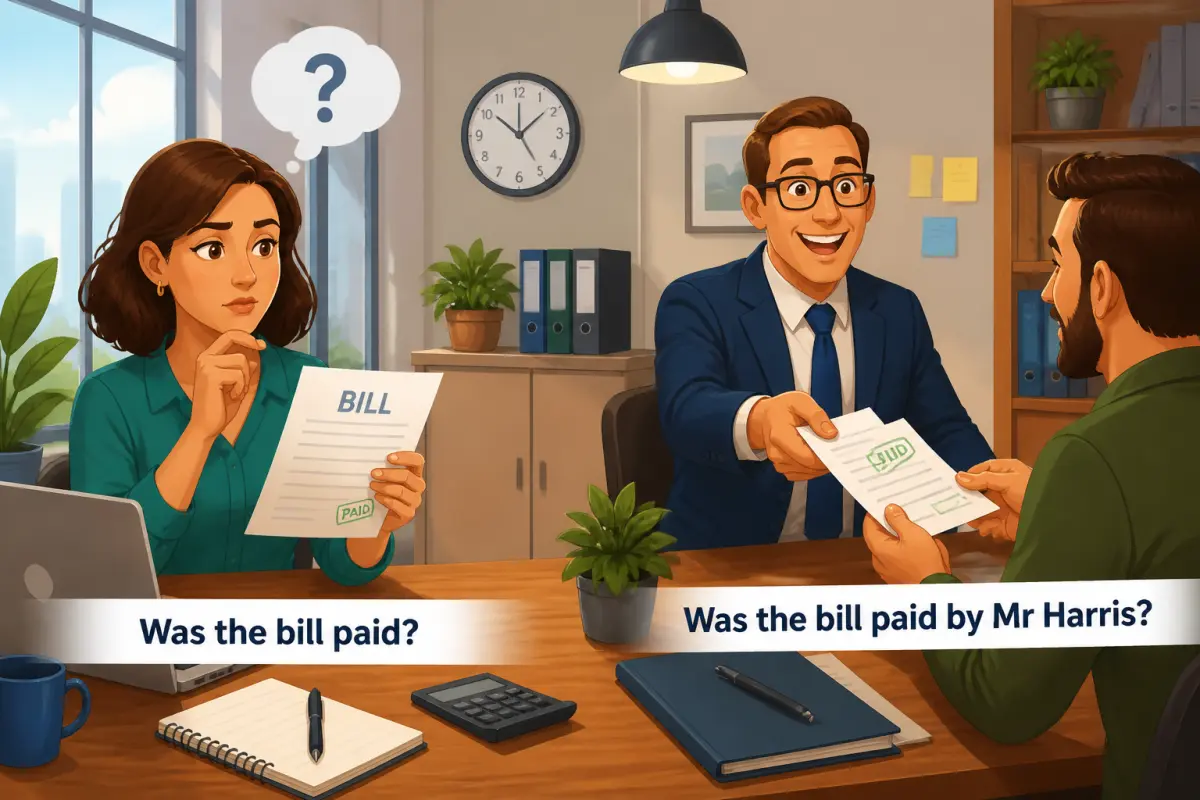
Passive questions may include the agent with by, but very often they do not. The agent is the person or thing that performs the action. In many real situations, we leave it out because it is unknown, unnecessary, obvious, or not the main focus. So all of these are possible: “Was the bill paid?” “Was the bill paid by Mr Harris?” “Was the bill paid by anyone?”
The choice depends on what you want to ask. If the identity of the doer matters, use by. If you care mainly about the result, leave it out. This is one reason passive questions are common in offices, customer service, schools, and formal communication.
Compare these patterns:
- Without by: Was the complaint answered?
- With by + named agent: Was the complaint answered by the sales team?
- With by + indefinite agent: Was the complaint answered by anyone?
- Without by: Has the gate been locked?
- With by: Has the gate been locked by security?
- Unknown agent idea: Has the gate been locked yet?
Three useful contrasts:
- “Was the article translated?” asks about completion.
“Was the article translated by a professional translator?” asks about the agent. - “Were the children picked up?” asks whether it happened.
“Were the children picked up by their grandparents?” asks who did it. - “Will the hall be decorated?” asks about the plan.
“Will the hall be decorated by the event company?” asks who is responsible.
When the agent is unknown, English often uses very natural passive questions such as:
- Who was the message sent by?
- What was the wall damaged with?
- Which company was the software developed by?
These sentences end with a preposition, which is normal in everyday English. In more formal styles, you may also hear “By whom was the message sent?” but that sounds much less natural in conversation.
Teacher note: Many students overuse by because textbooks often introduce the passive with “by + agent.” In real life, the agent is omitted most of the time. Encourage yourself to ask first: do I actually need that information?
If you need to choose a pronoun after by, pay attention to object forms: “by him,” “by her,” “by them,” not “by he” or “by they.” That area overlaps with passive pronouns.
Common word order mistakes in passive questions
Most passive question errors come from word order, not from the participle itself. Learners usually know the participle, but they place the auxiliary in the wrong position, add do, or break up the verb phrase. If you can control the order of auxiliary + subject + rest of verb phrase, your passive questions will improve very quickly.
Below are the mistakes I hear most often in class and in writing, with corrected versions and a short reason.
- ❌ Was delivered the parcel yesterday?
✅ Was the parcel delivered yesterday?
The subject must come right after the auxiliary. - ❌ Is cleaned the kitchen every evening?
✅ Is the kitchen cleaned every evening?
Do not leave the subject out of place. - ❌ Has been the order confirmed?
✅ Has the order been confirmed?
Only the first auxiliary moves.
- ❌ Did the files sent already?
✅ Were the files sent already?
Do not add did to a passive form that already needs be. - ❌ Does the room decorated for weddings?
✅ Is the room decorated for weddings?
The passive requires be + past participle. - ❌ Did the contract signed by both sides?
✅ Was the contract signed by both sides?
Use the passive auxiliary, not did.
- ❌ Why the lights were turned off?
✅ Why were the lights turned off?
In a wh-question, the auxiliary still comes before the subject. - ❌ When the room will be prepared?
✅ When will the room be prepared?
The modal moves before the subject. - ❌ Where the documents have been stored?
✅ Where have the documents been stored?
Again, move the first auxiliary.
Another common problem is mixing active and passive structure in one sentence:
- ❌ Was they send the invoice?
- ✅ Was the invoice sent?
- ❌ Are they delivered the chairs?
- ✅ Are the chairs delivered?
- ❌ Has she been invite?
- ✅ Has she been invited?
If this area still feels shaky, it often helps to compare passive questions with active questions side by side and review negative questions separately, because learners sometimes mix negative word order habits into passive structures.
Quick correction test for passive negatives
This short test focuses on forms learners often confuse: the place of not, the choice of auxiliary, and the order of longer passive verb phrases. Read each sentence and decide whether it is correct. If it is wrong, correct it fully.
Try to hear the auxiliary chain in your head as you work. That is much more reliable than translating word by word from your first language.
- The tickets not were printed at home.
- The food isn’t served after 10 p.m.
- The documents have not sent yet.
- The room was not being painted when we arrived.
- The rules are not followed always.
- The window has been not repaired.
- The guests won’t be invited this time.
- The package did not be delivered yesterday.
- The message had not been understood clearly.
- The tables are not being clean at the moment.
Show answers
- ❌ The tickets were not printed at home.
- ✅ The food isn’t served after 10 p.m.
- ❌ The documents have not been sent yet.
- ✅ The room was not being painted when we arrived.
- Usually better: The rules are not always followed.
- ❌ The window has not been repaired.
- ✅ The guests won’t be invited this time.
- ❌ The package was not delivered yesterday.
- ✅ The message had not been understood clearly.
- ❌ The tables are not being cleaned at the moment.
Practice: ask and answer passive questions
The best way to master this topic is to produce the forms yourself. The three practice blocks below build different skills: choosing the right form, transforming sentences, and spotting errors. Do them in order if you want a structured workout.
Try to say your answers aloud as well as writing them. Passive questions become much easier when your ear gets used to the auxiliary pattern.
Practice block 1: choose the correct form
- ___ the final email sent before noon?
(A) Was (B) Did (C) Has - Why ___ the meeting cancelled?
(A) did (B) was (C) has - The forms ___ not being checked at the desk.
(A) is (B) are (C) has - ___ the lights been turned off already?
(A) Have (B) Are (C) Did - The room ___ not cleaned yesterday.
(A) is (B) were (C) was - When ___ the results be announced?
(A) will (B) are (C) did - The phones ___ not allowed during the exam.
(A) are (B) have (C) was - ___ the guests being served now?
(A) Do (B) Are (C) Have - The file has ___ been uploaded yet.
(A) no (B) not (C) never - Who was the package delivered ___?
(A) by (B) from (C) at
Show answers
- A — Was the final email sent before noon?
- B — Why was the meeting cancelled?
- B — The forms are not being checked at the desk.
- A — Have the lights been turned off already?
- C — The room was not cleaned yesterday.
- A — When will the results be announced?
- A — The phones are not allowed during the exam.
- B — Are the guests being served now?
- B — The file has not been uploaded yet.
- A — Who was the package delivered by?
Practice block 2: rewrite or transform the sentences
- Change to a yes-no passive question: The car was repaired last week.
- Change to a negative passive sentence: The application is reviewed by the team.
- Change to a wh-question asking about time: The announcement was made on Friday.
- Change to a yes-no passive question: The guests have been invited.
- Change to a negative passive sentence: The hall will be decorated for the ceremony.
- Change to a wh-question asking about place: The files are stored in the basement.
- Change to a negative passive sentence: The problem had been solved before lunch.
- Change to a yes-no passive question: The streets are being cleaned.
- Change to a wh-question asking about reason: The trip was cancelled because of snow.
- Change to a negative passive sentence: The door can be opened from inside.
Show answers
- Was the car repaired last week?
- The application is not reviewed by the team.
- When was the announcement made?
- Have the guests been invited?
- The hall will not be decorated for the ceremony.
- Where are the files stored?
- The problem had not been solved before lunch.
- Are the streets being cleaned?
- Why was the trip cancelled?
- The door cannot be opened from inside.
Practice block 3: spot and correct the error
- Was chosen the winner by the judges?
- The letters have not wrote yet.
- Why the menu was changed?
- The room is not being prepare for the interview.
- Did the package be delivered this morning?
- The report had been not finished on time.
- Are invited all the parents to the event?
- The tickets was not checked at the entrance.
- When the new rules will be announced?
- The equipment not is allowed on the plane.
Show answers
- Was the winner chosen by the judges?
- The letters have not been written yet.
- Why was the menu changed?
- The room is not being prepared for the interview.
- Was the package delivered this morning?
- The report had not been finished on time.
- Are all the parents invited to the event?
- The tickets were not checked at the entrance.
- When will the new rules be announced?
- The equipment is not allowed on the plane.
FAQ: passive questions and negatives
Learners often understand the rule but still have practical doubts. These short answers deal with the questions that come up most often after the first explanation.
1. Can I use do, does, or did in passive questions?
Normally, no. Standard passive questions use a form of be, or another auxiliary if the verb phrase already contains one: “Is it included?” “Was it sent?” “Has it been checked?” “Will it be changed?” A form like “Did it be sent?” is incorrect.
2. Is “not” always after the first auxiliary?
Yes, in normal passive negatives. Say “is not made,” “has not been made,” “will not be made,” and “should not be made.” If you train yourself to identify the first auxiliary quickly, your negatives will become much more accurate.
3. Are passive questions always more formal than active questions?
Not always. Some are formal, especially in reports or official communication, but many are completely ordinary: “Was my order shipped?” “Is breakfast included?” “When was this built?” They are common whenever the result matters more than the doer.
4. Can I leave out the agent in a passive question?
Yes, and you often should. “Was the document signed?” is usually enough if the important information is whether the action happened. Add by only when the doer matters: “Was the document signed by the director?”
5. Why does “Who was it written by?” sound natural, but “By whom was it written?” sounds formal?
Because everyday English often leaves the preposition at the end: “written by,” “sent to,” “spoken about.” The version with “By whom” is grammatically correct, but it belongs more to formal writing or careful formal speech than to normal conversation.
6. Can passive negatives describe states as well as actions?
Yes. “The shop is not closed yet” can describe a current state. “The shop was not closed by the staff” clearly refers to an action. Sometimes context decides whether the sentence feels more action-based or state-based, especially with participles like “closed,” “locked,” or “finished.”
7. Which passive forms are most useful for everyday speaking?
Start with these: present simple, past simple, present perfect, and future with will. For example: “Is it included?” “Was it delivered?” “Has it been fixed?” “Will it be replaced?” Those patterns cover a lot of real communication.
8. How can I check my own passive question before I say it?
Use a quick three-step check. First, identify the subject: “the package,” “the room,” “the documents.” Second, find the first auxiliary: “is,” “was,” “has,” “will.” Third, place that auxiliary before the subject if it is a question, or put not after it if it is negative. This simple habit prevents most errors.