Mixed Passive Voice Exercises for All Main Tenses

 This article reviews passive tenses, explains how mixed exercises improve accuracy, and gives practice with present, past, future, perfect, modal, and causative forms. It also includes rewriting, context choices, error correction, answers, a writing task, and an FAQ.
- How mixed passive exercises build accuracy
- Passive tense review before you start
- Present, past, future, and perfect passive forms
- Modal passive and causative passive practice
- Active-to-passive rewriting tasks
- Choose the correct passive form in context
- Error correction with common passive mistakes
- Answer key and explanations for each item
- Practice challenge: write your own passive paragraph
- FAQ: mixed passive voice practice
If passive forms in the main English tenses still seem confusing, these practice tasks can help you understand how they work in real communication. Rather than memorizing rules, you will see how speakers shift attention from the person doing something to the action itself in news, instructions, formal writing, and everyday speech. With varied examples, you can build confidence, notice patterns faster, and choose the right structure more naturally.
How mixed passive exercises build accuracy
Many learners can form one passive tense when they see a clear grammar label, but they hesitate when different tenses appear together. That is where mixed practice becomes useful. In real English, you do not get a warning such as “now use the past passive.” You read a sentence, notice the time meaning, and choose the correct structure. Mixed exercises train exactly that skill.
They also reveal weak points very quickly. A student may know is made and was built, but still write has made instead of has been made, or will built instead of will be built. When present, past, future, perfect, and modal forms are all tested together, you stop guessing by memory and start noticing the pattern: be + past participle, with the tense carried by the form of be.
A second benefit is accuracy in reading and writing. In instructions, news, reports, emails, and academic writing, passive forms often appear because the action matters more than the person doing it. Compare these natural examples:
- The documents were sent yesterday.
- A new password will be emailed to you.
- The results have been checked twice.
- Mobile phones must be switched off during the test.
Mixed work helps you choose correctly because you learn to ask practical questions:
- Is the sentence about now, the past, or the future?
- Is the action finished, in progress, or connected to a result?
- Is there a modal such as must, can, should, or might?
- Does the sentence need a passive at all, or is active voice more natural?
Teacher note: Students often think passive practice is only about changing active sentences. In class, I see much better progress when they also choose tenses from context, because that is closer to real reading and real writing.
If you want to check your own sentences after practice, a passive checker can help you notice missing words such as been or be. Use it as a review tool, not as a replacement for thinking about tense and meaning.
Passive tense review before you start

Before doing mixed exercises, make sure the core structure is clear. The passive is built with a form of be plus a past participle. The object of the active sentence becomes the subject of the passive sentence. For example, The company delivered the chairs becomes The chairs were delivered.
The most common problem is that learners remember only the participle and forget that the tense lives in be. That is why The room cleaned yesterday is wrong. You need was cleaned. The same idea applies in every tense: present passive, past passive, future passive, perfect passive, and modal passive.
Keep these practical rules in mind before you begin:
- Use passive when the action or result is more important than the doer.
- You can include the doer with by if it matters: The painting was restored by a local expert.
- Do not force a passive where active voice sounds better. Someone called me is often more natural than I was called by someone.
- Not every verb is used naturally in the passive. Verbs with clear objects work best: make, build, send, approve, cancel.
Notice these useful contrasts:
- Active: The manager approves the schedule. / Passive: The schedule is approved.
- Active: They repaired the road last week. / Passive: The road was repaired last week.
- Active: The team will announce the winner tomorrow. / Passive: The winner will be announced tomorrow.
One more thing matters in mixed exercises: adverbs and time phrases. They usually tell you which tense to choose. Words like every day, right now, last month, by Friday, and already are strong clues. If tense choice still feels messy, a clear tense comparison is worth reviewing before you start the exercises below.
Present, past, future, and perfect passive forms
To handle mixed tasks well, you need a compact mental map of the main forms. Do not try to memorize long grammar labels first. Instead, notice the time meaning and the shape of the verb. The passive always keeps the same backbone, but the form of be changes with the tense.
The table below covers the forms that appear most often in mixed practice. Learn them as working patterns, then test them in context.
| Tense | Passive form | Example |
|---|---|---|
| Present simple | am/is/are + past participle | Lunch is served at noon. |
| Present continuous | am/is/are being + past participle | The office is being painted. |
| Present perfect | has/have been + past participle | The order has been confirmed. |
| Past simple | was/were + past participle | The gate was locked at 9 p.m. |
| Past continuous | was/were being + past participle | The files were being copied. |
| Past perfect | had been + past participle | The room had been cleaned before we arrived. |
| Future simple | will be + past participle | The results will be posted online. |
| Future perfect | will have been + past participle | All tickets will have been sold by Friday. |
Now notice how meaning changes across similar sentences:
- The doors are closed at 6. = regular rule
- The doors are being closed. = action happening now
- The doors have been closed. = result is important now
- The bridge was repaired in May. = completed past action
- The bridge was being repaired when we visited. = action in progress in the past
- The bridge had been repaired before the storm hit. = earlier past result
- The package will be delivered tomorrow. = future action
- The package will have been delivered by noon. = completed before a future point
- The package has been delivered already. = completed with present relevance
In mixed exercises, learners often confuse present perfect passive and past simple passive. Compare these three pairs carefully:
- The message was sent at 8:15. / The message has been sent.
- The bill was paid yesterday. / The bill has been paid.
- The apartment was cleaned before the guests arrived. / The apartment has been cleaned.
The left sentence usually has a finished past time. The right sentence focuses on the current result. That difference matters in exercise questions with time markers.
Modal passive and causative passive practice
Once the main tense forms are clear, learners should add two very common patterns: the modal passive and the causative passive. These do not belong to one single tense family, but they appear often in rules, instructions, customer service, and everyday conversation.
The modal passive is simple in shape: modal + be + past participle. The modal carries the meaning of possibility, obligation, advice, or permission. The passive keeps the focus on the action or result.
- Visitors must be registered at reception.
- This form can be completed online.
- The problem should be reported immediately.
- The meeting might be postponed because of the weather.
The causative passive usually appears with have or get when someone arranges for another person to do something. It is especially useful for services.
- I had my watch repaired.
- She got her hair cut before the interview.
- We are having the kitchen painted next month.
- He had his laptop checked by a technician.
Do not confuse these with ordinary passive sentences:
- The watch was repaired. = focus on the watch
- I had my watch repaired. = I arranged the service
Here are three useful contrasts learners often need:
- You must submit the form. / The form must be submitted.
- Someone cleaned her coat. / She had her coat cleaned.
- They may announce the results tonight. / The results may be announced tonight.
Teacher note: The causative is easier to remember if you connect it to real life services: haircuts, car repairs, eye tests, home deliveries, and document translation. Students remember grammar better when it sounds like something they might actually say.
A common error is forgetting be after a modal, or using the wrong word order in causatives:
- ❌ The report must finished today. / ✅ The report must be finished today.
- ❌ I had repaired my phone. / ✅ I had my phone repaired.
- ❌ She got cut her hair. / ✅ She got her hair cut.
Active-to-passive rewriting tasks
Rewriting is the best way to test whether you can control both structure and meaning. When you change active to passive, the first job is not moving words around. The first job is finding the object of the active sentence. That object usually becomes the subject of the passive sentence. Then choose the correct tense of be and add the past participle.
You also need to decide whether the agent matters. Sometimes by + doer is useful, but often it is unnecessary. Compare: The essay was marked is enough in many situations; The essay was marked by Ms Patel is only needed if the doer matters.
- They print the labels in this room.
- Someone has stolen my bicycle.
- The hotel will serve breakfast until 10:30.
- The editor was checking the article.
- They had cancelled the flight before noon.
- You must wear a helmet on this site.
- A local company built the sports hall.
- The staff are uploading the photos now.
- Someone should clean these windows.
- The technician fixed my tablet yesterday. Change this to a causative sentence with have.
While you do these, watch for three traps: keeping the same tense, changing the object into the new subject, and not losing small but important words such as been or being. If rewriting is one of your weaker skills, extra rewrite practice can make the pattern much more automatic.
Show answers
- The labels are printed in this room.
- My bicycle has been stolen.
- Breakfast will be served until 10:30.
- The article was being checked by the editor.
- The flight had been cancelled before noon.
- A helmet must be worn on this site.
- The sports hall was built by a local company.
- The photos are being uploaded now.
- These windows should be cleaned.
- I had my tablet fixed yesterday.
Choose the correct passive form in context
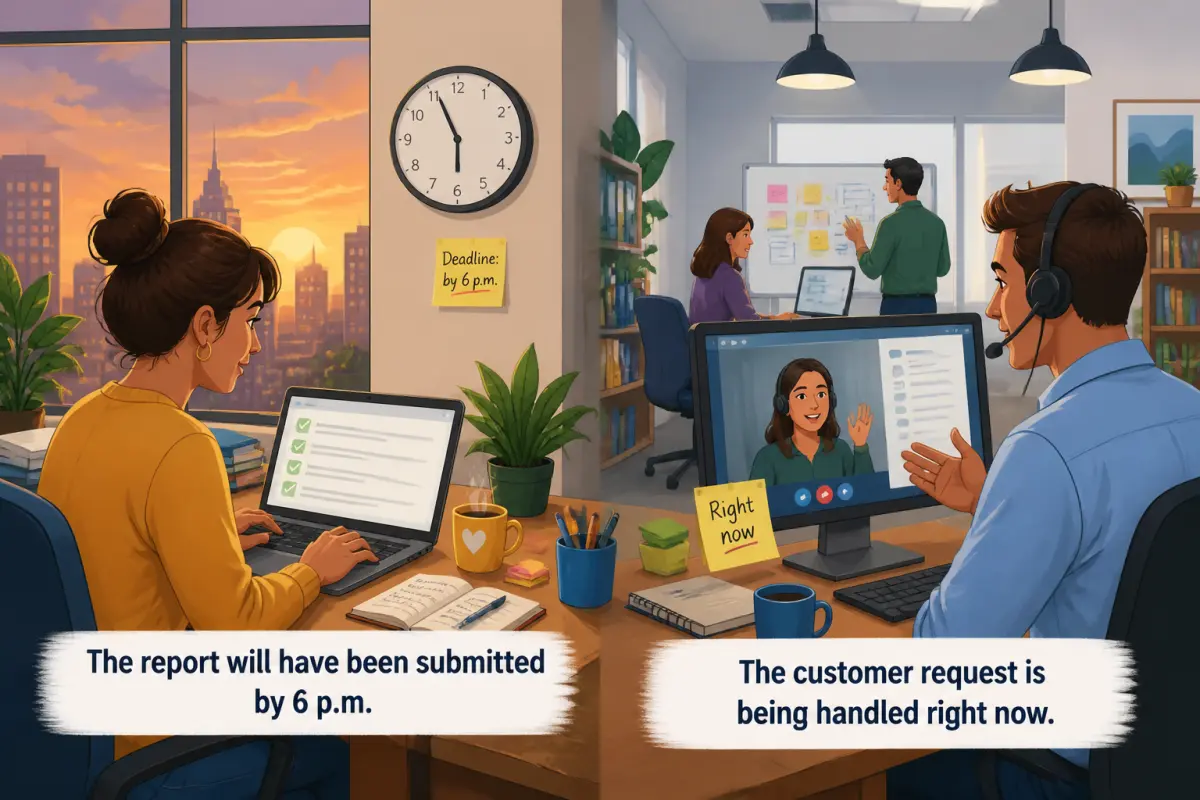
This kind of exercise is closer to real language use because you must read the clue in the sentence and select the correct form. It is not enough to know the passive pattern; you must connect it to time words, logic, and meaning. A sentence with by 6 p.m. may need a future perfect passive, while a sentence with right now may need a present continuous passive.
Read slowly and look for signals. Ask yourself: Is it a regular fact? A process happening now? A finished past action? A present result? A rule? A service arranged by someone? Those questions usually lead you to the correct form much faster than trying random grammar options.
| Clue in context | Likely passive choice | Example |
|---|---|---|
| every day, usually, often | Present simple passive | The mail is delivered at 8 a.m. |
| now, at the moment, currently | Present continuous passive | The floor is being washed. |
| yesterday, last week, in 2019 | Past simple passive | The contract was signed yesterday. |
| already, just, yet, no finished time | Present perfect passive | The package has been sent. |
| by tomorrow, by next month | Future perfect or future simple passive | The work will have been completed by Friday. |
- All visitors ________ (register) at the front desk before entering the lab.
- The street ________ (close) right now because of the parade.
- My application ________ (approve) last Thursday.
- The final version ________ (not/send) yet.
- By next summer, the old bridge ________ (replace).
- This soup ________ (make) without cream, so it is suitable for vegans.
- The living room looks great. It ________ just ________ (paint).
- During the interview, all mobile phones ________ (switch off).
- When we arrived, dinner ________ still ________ (prepare).
- At the salon, she ________ (cut/her hair) before the wedding.
If you want more short grammar drills of this type, beginner-friendly fill in blanks can be useful for building speed before you try longer tasks.
Show answers
- must be registered
- is being closed
- was approved
- has not been sent
- will have been replaced
- is made
- has just been painted
- must be switched off
- was still being prepared
- had her hair cut
Error correction with common passive mistakes
Error correction is where many learners make the biggest jump. When you correct a wrong passive sentence, you are not just producing grammar; you are diagnosing it. That builds careful attention, which is exactly what mixed tense practice needs.
The same mistakes appear again and again, so it helps to group them. Below are the major problem areas, each with wrong and correct examples. Read them closely, because these are the patterns that often appear in tests, homework, and real writing.
1. Missing a form of be
- ❌ The tickets sold online. / ✅ The tickets are sold online.
- ❌ The office cleaned every evening. / ✅ The office is cleaned every evening.
- ❌ My bag stolen yesterday. / ✅ My bag was stolen yesterday.
2. Forgetting been in perfect passives
- ❌ The email has sent. / ✅ The email has been sent.
- ❌ The forms have not checked. / ✅ The forms have not been checked.
- ❌ The room had cleaned before noon. / ✅ The room had been cleaned before noon.
3. Forgetting being in continuous passives
- ❌ The road is repaired now. / ✅ The road is being repaired now.
- ❌ The costumes were washed when I arrived. / ✅ The costumes were being washed when I arrived.
- ❌ The walls are painted at the moment. / ✅ The walls are being painted at the moment.
4. Using the wrong participle
- ❌ The letter was wrote by hand. / ✅ The letter was written by hand.
- ❌ The cake is maked fresh daily. / ✅ The cake is made fresh daily.
- ❌ The stadium was build in 2008. / ✅ The stadium was built in 2008.
5. Keeping active word order in a passive sentence
- ❌ They were delivered the chairs this morning. / ✅ The chairs were delivered this morning.
- ❌ Someone was sent the files to me. / ✅ The files were sent to me.
- ❌ The manager approved was the plan. / ✅ The plan was approved by the manager.
6. Wrong structure after modals or in causatives
- ❌ The bill should paid today. / ✅ The bill should be paid today.
- ❌ I got repaired my glasses. / ✅ I got my glasses repaired.
- ❌ The form can filled in online. / ✅ The form can be filled in online.
Teacher note: When students correct errors, I ask them to name the missing piece aloud: “missing be,” “wrong participle,” “need been,” “need being.” That simple habit makes grammar far less mysterious.
- The invitations have sent already.
- This medicine should taken after meals.
- The windows were cleaned when we got there.
- My passport was stole at the station.
- The new app is develop by a small team.
- She had cut her hair before the conference.
- The lights must turned off at midnight.
- The meal was cook while we waited.
- The final payment has not received.
- The hall built in the 1970s.
Show answers
- The invitations have been sent already.
- This medicine should be taken after meals.
- The windows were being cleaned when we got there.
- My passport was stolen at the station.
- The new app is being developed by a small team. / The new app is developed by a small team. Both are possible depending on meaning, but the original sentence suggests a process, so is being developed is stronger.
- She had her hair cut before the conference.
- The lights must be turned off at midnight.
- The meal was being cooked while we waited.
- The final payment has not been received.
- The hall was built in the 1970s.
Answer key and explanations for each item
Answers help most when they explain the grammar choice, not only the final sentence. If you got an item wrong, do not just read the correct version and move on. Ask why that tense was needed and which clue in the sentence pointed to it. That is how mixed practice starts to transfer into real use.
Below are short explanations for the exercise items from the three practice blocks. Keep them brief and practical: look for time markers, result meaning, modal meaning, or the causative pattern.
Rewriting task explanations
- 1. are printed because the active verb is present simple: They print.
- 2. has been stolen because the active sentence is present perfect and the result matters now.
- 3. will be served because the active verb is future simple.
- 4. was being checked because the action was in progress in the past.
- 5. had been cancelled because the cancellation happened before another past time.
- 6. must be worn because modals take be + past participle in the passive.
- 7. was built because the action is a finished past event.
- 8. are being uploaded because now signals an action in progress.
- 9. should be cleaned because advice or recommendation with a modal needs passive structure.
- 10. had my tablet fixed because the sentence asks for a causative, not an ordinary passive.
Context choice explanations
- 1. must be registered fits a rule before entering the lab.
- 2. is being closed fits right now, so the action is happening at this moment.
- 3. was approved fits the finished past time last Thursday.
- 4. has not been sent fits yet and present relevance.
- 5. will have been replaced fits by next summer, a deadline before a future point.
- 6. is made describes a general fact about the soup.
- 7. has just been painted fits the visible result in the present.
- 8. must be switched off expresses obligation during the interview.
- 9. was being prepared shows an unfinished action in progress when we arrived.
- 10. had her hair cut is a service she arranged at the salon.
Error correction explanations
- 1. Add been after have in a perfect passive.
- 2. Add be after the modal should.
- 3. The time clause when we got there suggests an action in progress, so use were being cleaned.
- 4. Replace the wrong participle stole with stolen.
- 5. If the app is in development now, use is being developed; if you mean a general fact, is developed is possible.
- 6. The intended meaning is a salon service, so use the causative pattern.
- 7. Modals need be in the passive: must be turned off.
- 8. The cooking was in progress while we waited, so use was being cooked.
- 9. Perfect passive negative needs has not been received.
- 10. The sentence needs a past simple passive because the building date is finished in the past.
When checking yourself, do not only mark right or wrong. Write a one- or two-word reason beside each answer: finished past, present result, rule, service, action in progress. That habit makes future exercises much easier.
Practice challenge: write your own passive paragraph
Controlled exercises are useful, but the real test is whether you can use passive forms naturally in your own writing. A short paragraph forces you to choose tenses for meaning, not because a worksheet tells you which one to use. That is where accuracy becomes flexible skill.
Choose one topic below and write a paragraph of 80 to 120 words. Your paragraph should include at least five passive forms, and they should not all be the same tense.
- How a school event is organized
- What happens to an online order after you buy it
- How a hotel room is prepared for new guests
- How your town is being changed or improved
- A day when you had something repaired, delivered, or arranged
Try to include this mix:
- one present simple passive
- one present continuous or past continuous passive
- one present perfect or past perfect passive
- one modal passive
- one causative if it fits the topic
Here is a model opening on the topic of an online order:
An order is placed through the website, and a confirmation email is sent immediately. At the moment, my package is being prepared in the warehouse. The payment has already been checked, so no further action is needed. Before the parcel leaves the building, the address must be verified carefully. Last month, I had a damaged item replaced by customer service, and the process was very smooth.
Teacher note: Do not chase difficult vocabulary here. Simple words with correct grammar are much better practice than advanced vocabulary with broken verb forms.
After writing, check three things:
- Did you include the right helper words: be, been, or being?
- Does each tense match the time meaning?
- Would any sentence sound better in active voice?
If you want more guided production, short mini writing tasks are a good next step after sentence-level grammar work.
FAQ: mixed passive voice practice
Learners usually understand the basic formula first and then run into smaller but important questions. These are the ones I hear most often in class and in written work.
Use the answers below as practical guidance, especially if you can form passive sentences but still hesitate when choosing between similar forms.
1. Why do I know the rule but still make mistakes in mixed passive exercises?
Because mixed tasks test two skills at once: passive structure and tense choice. Many learners know how to build a passive after they are told the tense, but they do not yet recognize the time meaning quickly. Practice identifying clues first: yesterday, already, right now, by next week, must.
2. When should I use passive instead of active voice?
Use passive when the action, process, or result is more important than the doer, or when the doer is unknown or obvious. For example, My phone was stolen is more natural than naming an unknown thief. But in conversation, active voice is often more direct: The manager approved it may sound better than It was approved if the person matters.
3. What is the difference between present perfect passive and past simple passive?
The present perfect passive connects a finished action to the present: The report has been printed. The past simple passive places it clearly in the past: The report was printed at 7 a.m. If you mention a finished past time, you usually need the past simple, not the present perfect.
4. Are continuous passive forms common?
Yes, especially is being done and was being done. They are common when you want to show a process in progress: The kitchen is being cleaned, The road was being repaired. They are less common than simple passives, but they are very useful and worth learning well.
5. Do I always need to include by + agent?
No. In fact, you often leave it out. The documents were uploaded is enough if the doer is unimportant or obvious. Add by + agent only when it adds useful information: The mural was painted by local students.
6. Is “get” passive the same as ordinary passive?
Not exactly. Get + past participle is more informal and often appears in speech: He got invited, The window got broken. It can sound more personal or more event-focused than be passive. Use it carefully in formal writing, where be passive is usually safer.
7. How can I practise passive tenses without memorizing long grammar charts?
Work with short sets of contrastive examples. For instance: is cleaned, is being cleaned, has been cleaned. Then create your own examples from daily life: room, email, payment, package, car, homework. Small meaningful sets are easier to remember than abstract charts.
8. What is the fastest way to improve before a test?
Do three kinds of review: choose the correct form, rewrite active to passive, and correct errors. That combination catches most test problems. When you check answers, write the reason beside each one. If you only read the answer key passively, improvement is slow. If you explain why a form is correct, the pattern stays with you much longer.