English Articles: A, An, The and No Article

 The article explains English articles, including the use of a, an, the, and when to use no article. It covers beginner rules, common mistakes, and offers a short practice section to help reinforce understanding.
Articles are small words, but they control a big part of English meaning. When you choose a, an, the, or no article, you show whether a noun is new, specific, general, countable, known to the listener, or part of a wider group. This guide gives you a clear beginner system, plenty of natural examples, common error fixes, and practice tasks so you can use English articles with more confidence.
What articles are in English
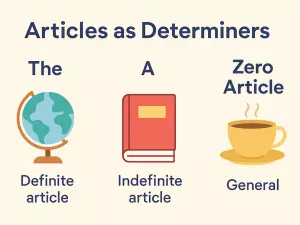
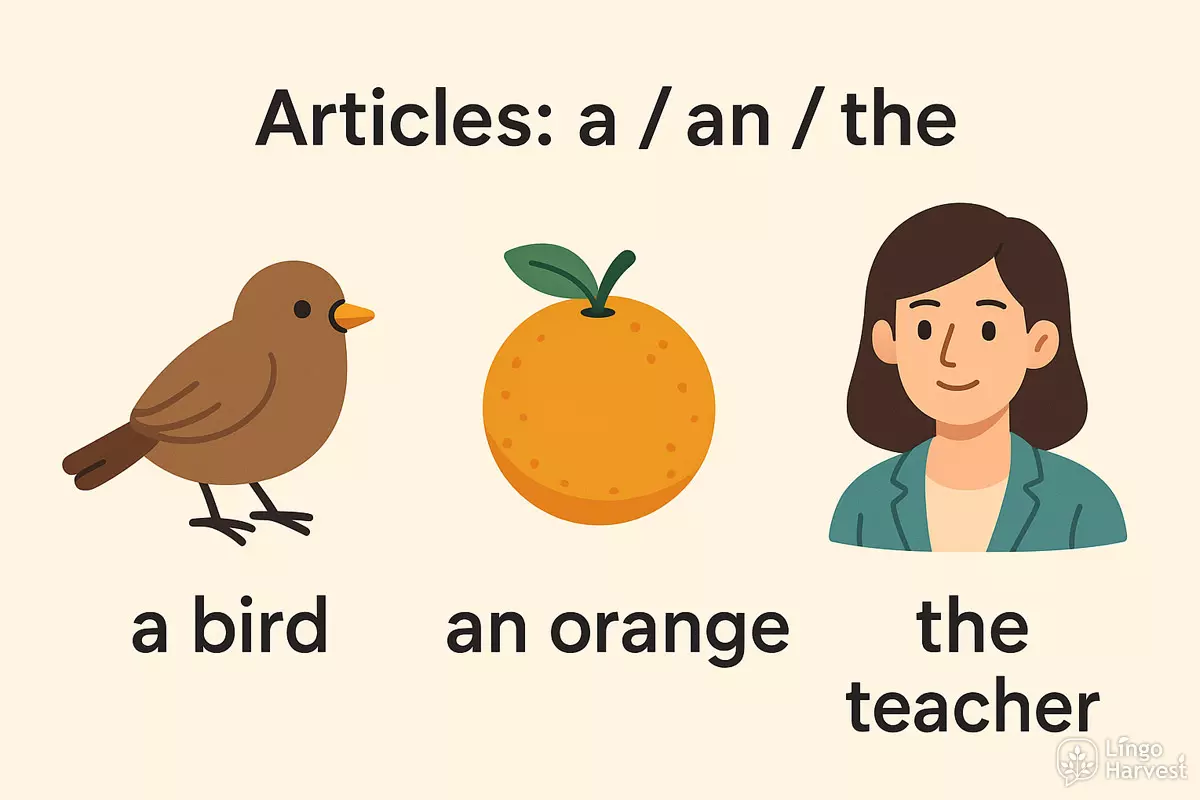
English articles are words placed before nouns or noun phrases. The main articles are a, an, and the. Sometimes English uses no article at all; this is often called the zero article.
The easiest way to understand articles is to ask one question: Do I mean one general thing, a specific thing, or things in general?
The four basic choices
| Choice | Basic meaning | Example |
|---|---|---|
| a | One non-specific thing before a consonant sound | I need a notebook. |
| an | One non-specific thing before a vowel sound | She has an idea. |
| the | A specific thing, or something already known | Please close the window. |
| No article | General plural nouns, general uncountable nouns, many names and fixed expressions | Books help people learn. |
Quick examples in sentences
- I found a wallet near the bus stop. (one wallet, not specific before this sentence)
- She waited for an answer. (one answer, vowel sound)
- The answer was shorter than expected. (now the answer is specific)
- Students often forget articles. (students in general)
- Advice can be useful. (advice in general, uncountable)
Quick article decision
When you are not sure which article to use, do not try to memorize every rule first. Use a short decision process. This is often faster and more practical than checking a long list of exceptions.
Use this beginner decision path
- Is the noun singular and countable? If yes, it usually needs a, an, the, or another determiner.
- Are you mentioning it for the first time? Use a or an: I bought a phone.
- Does the listener know which one you mean? Use the: The phone is in my bag.
- Are you talking generally about all things of that type? Use no article with plural or uncountable nouns: Phones are useful. Technology changes quickly.
- Is it a name, language, meal, sport, or common fixed phrase? It often takes no article: Emma speaks Italian. We had lunch. He plays tennis.
Mini comparison
| Sentence | Meaning |
|---|---|
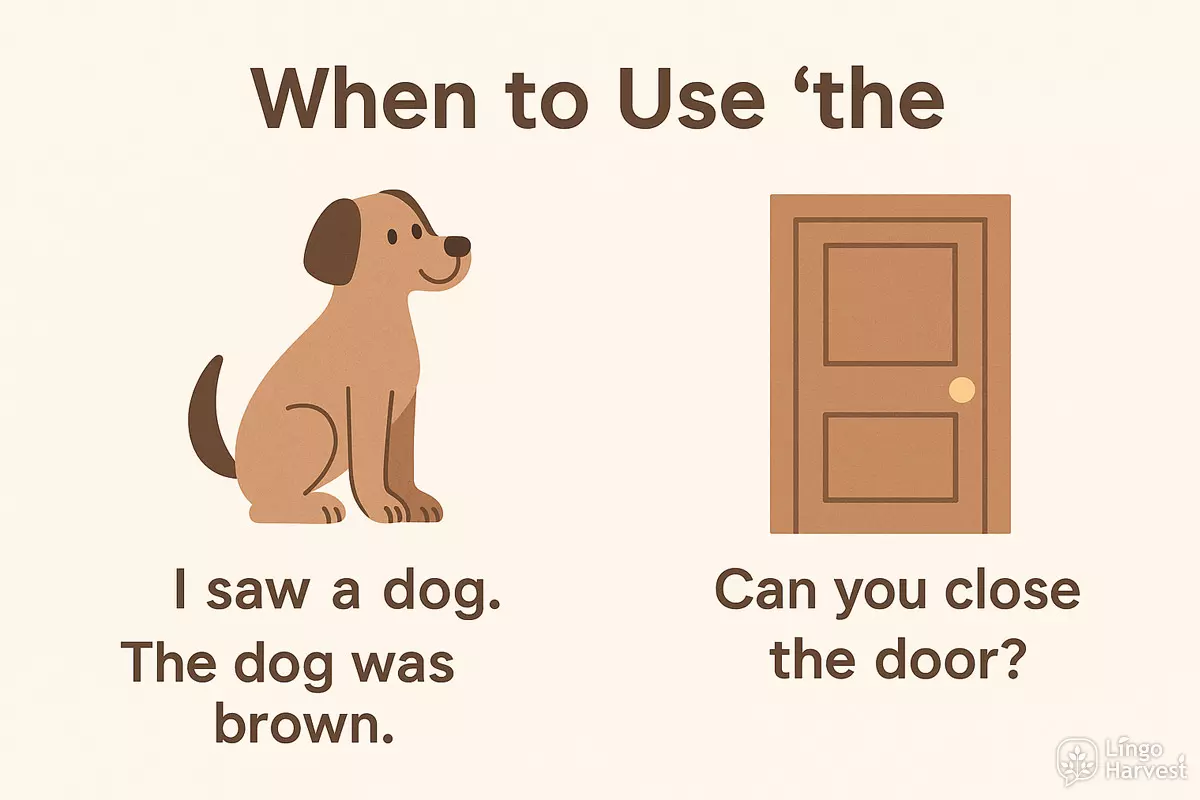
| I saw a dog outside. | One dog; you do not know which dog yet. |
| The dog was wearing a red collar. | The same dog; now it is specific. |
| Dogs need exercise. | Dogs in general. |
| I like the dogs in this park. | A specific group of dogs. |
This “new → known → general” pattern is one of the most useful ideas for beginners. You can also study the focused a vs an rule separately if the sound difference still feels confusing.
A vs an: sound rule
A and an have the same basic function: they introduce one non-specific singular countable noun. The difference is pronunciation. Use a before a consonant sound and an before a vowel sound.
Use a before consonant sounds
- a book
- a chair
- a problem
- a useful tip
- a university
The words useful and university start with the letter u, but the first sound is like you. That is a consonant sound, so we say a useful tip and a university.
Use an before vowel sounds
- an apple
- an email
- an idea
- an honest answer
- an hour
The words honest and hour start with the letter h, but the h is silent. The first sound is a vowel sound, so we say an honest answer and an hour.
Common sound-based traps
| Correct | Not correct | Why |
|---|---|---|
| a European city | an European city | European starts with a “yoo” sound. |
| an old house | a old house | Old starts with a vowel sound. |
| a one-time offer | an one-time offer | One starts with a “w” sound. |
| an unusual result | a unusual result | Unusual starts with a vowel sound. |
My practical tip for learners: say the next word aloud in your head. If your mouth starts with a vowel sound, choose an. If it starts with a consonant sound, choose a.
How to use the
The is the definite article. It tells the reader or listener: “You know which person, place, thing, or idea I mean.” You can use the with singular nouns, plural nouns, and uncountable nouns.
Use the when something was already mentioned
This is one of the clearest uses of the.
- I watched a documentary last night. The documentary was about volcanoes.
- She opened an email. The email contained the meeting notes.
- We found a small café. The café had excellent coffee.
Use the when the noun is specific from context
- Can you turn off the light? (the light in this room)
- I left my keys in the car. (my car, or the car we both know)
- Please check the address before you send it. (the address connected to this situation)
Use the with unique or clearly identifiable things
- the sun
- the moon
- the sky
- the internet
- the police
Use the with superlatives and ordinal numbers
- She is the youngest person in the group.
- This is the most useful rule for beginners.
- He made the first mistake, but he fixed it quickly.
- We stayed until the last train arrived.
For a deeper lesson on this pattern, review the definite article guide.
Zero article: no article
The zero article means that no article is used before the noun. This is not “missing grammar.” In many English sentences, no article is the correct choice.
Use no article with plural nouns in general
- Children learn languages quickly.
- Cars are expensive in many cities.
- Teachers need patience.
- Articles can be difficult at first.
Do not use the when you mean the whole category in general.
- Correct: Birds can fly.
- Not natural for general meaning: The birds can fly.
Use no article with uncountable nouns in general
- Water is necessary for life.
- Information spreads quickly online.
- Music helps me concentrate.
- Advice is useful when it is specific.
Use no article in many common expressions
- go to school
- go to work
- come home
- go to bed
- have breakfast
- play football
- speak English
- by train
- on Monday
- in July
A useful learner tip: when a noun names a general activity, subject, language, meal, or transport method, English often uses no article. For more examples, see the zero article lesson.
Zero article vs the: meaning change
| Sentence | Meaning |
|---|---|
| Life is unpredictable. | Life in general. |
| The life of a doctor can be stressful. | A specific kind of life. |
| Music relaxes me. | Music in general. |
| The music in this café is too loud. | Specific music in a specific place. |
Articles with countable and uncountable nouns
Articles depend strongly on whether a noun is countable or uncountable. This is why article mistakes often happen together with noun mistakes.
A/an only works with singular countable nouns
- a lesson
- an example
- a mistake
- an exercise
- a question
You cannot normally use a or an before plural nouns or uncountable nouns.
- Incorrect: a informations
- Correct: information
- Incorrect: an advices
- Correct: advice
- Incorrect: a furnitures
- Correct: furniture
Use the with countable and uncountable nouns when specific
- The lesson was clear. (specific lesson)
- The examples helped me. (specific examples)
- The information on this page is useful. (specific information)
- The advice you gave me worked. (specific advice)
Quick article table by noun type
| Noun type | General meaning | Specific meaning |
|---|---|---|
| Singular countable | A student needs practice. | The student near the door is new. |
| Plural countable | Students need practice. | The students in this class are new. |
| Uncountable | Practice improves grammar. | The practice we did yesterday was helpful. |
When articles feel confusing, first check whether the noun is countable. The guide on countable and uncountable nouns can make article choice much easier.
Articles with names, places, meals, and jobs
Some article rules are connected to specific groups of nouns. These groups are common in everyday English, so it is worth learning the patterns early.
Jobs and roles usually use a/an
When you say what someone’s job is, use a or an before a singular job noun.
- She is a nurse.
- He is an architect.
- My brother is a driver.
- Emma wants to become an editor.
Use the only when the job or role is specific.
- She is the nurse who helped me yesterday.
- He is the editor of this magazine.
Most personal names take no article
- Correct: Sarah lives in Canada.
- Incorrect: The Sarah lives in Canada.
- Correct: Mr. Brown called this morning.
- Incorrect: The Mr. Brown called this morning.
Most countries and cities take no article
- France
- Japan
- Brazil
- London
- Toronto
- Seoul
Some country names and place names use the, especially names with words like states, kingdom, republic, or plural country names.
- the United States
- the United Kingdom
- the Czech Republic
- the Netherlands
- the Philippines
Meals usually take no article
- We had breakfast at seven.
- Lunch was quick today.
- They invited us for dinner.
Use a or the when the meal is described as a specific event.
- We had a wonderful dinner.
- The breakfast at the hotel was excellent.
Common article mistakes
Many article mistakes happen because learners translate directly from their first language. Instead of translating, try to identify the noun type and the meaning: new, known, general, or specific.
Common mistakes and fixes
| Incorrect | Correct | Why |
|---|---|---|
| I have cat. | I have a cat. | Singular countable nouns need an article or determiner. |
| She is an university student. | She is a university student. | University starts with a “yoo” sound. |
| He gave me a advice. | He gave me advice. | Advice is uncountable. |
| The music is important in life. | Music is important in life. | General uncountable noun: no article. |
| I visited the Paris. | I visited Paris. | Most city names take no article. |
| She is best student. | She is the best student. | Superlatives usually use the. |
| I bought book yesterday. | I bought a book yesterday. | First mention of one countable thing. |
| A book you gave me is useful. | The book you gave me is useful. | The phrase you gave me makes it specific. |
| Children in my class are the friendly. | The children in my class are friendly. | The group is specific; do not use the before a normal adjective here. |
| We go to the work by bus. | We go to work by bus. | Go to work is a common no-article expression. |
Personal correction tip
When editing your own writing, circle every singular countable noun. Then ask: Does this noun have a determiner? A determiner can be an article, possessive word, demonstrative, number, or quantifier. For example, a book, the book, my book, this book, and one book are all possible, but I bought book is incomplete.
Article practice exercises
Now practice the rules in context. Choose a, an, the, or no article. After each task, open the answer block and compare your choices.
Exercise 1: Fill in the correct article
- I need ___ umbrella because it is raining.
- She bought ___ new laptop yesterday.
- ___ laptop she bought is very light.
- He works as ___ engineer in Berlin.
- ___ water in this bottle is cold.
- We usually have ___ breakfast at 8 a.m.
- They live in ___ United States.
- My sister wants to study at ___ university in Canada.
- ___ information you sent was very helpful.
- ___ books can change the way people think.
Show answers
- I need an umbrella because it is raining.
- She bought a new laptop yesterday.
- The laptop she bought is very light.
- He works as an engineer in Berlin.
- The water in this bottle is cold.
- We usually have breakfast at 8 a.m. (no article)
- They live in the United States.
- My sister wants to study at a university in Canada.
- The information you sent was very helpful.
- Books can change the way people think. (no article)
Exercise 2: Correct the article mistakes
- She is a honest person.
- I like the coffee in general.
- He has car.
- We visited the Spain last summer.
- This is an useful exercise.
- I need a information about the course.
- The Mount Everest is very high.
- He is the teacher. (Meaning: teaching is his job, not a specific teacher.)
- I saw an dog near the station.
- She plays the tennis every weekend.
Show answers
- She is an honest person.
- I like coffee in general. (no article)
- He has a car.
- We visited Spain last summer. (no article)
- This is a useful exercise.
- I need information about the course. (no article before general uncountable information)
- Mount Everest is very high. (no article)
- He is a teacher.
- I saw a dog near the station.
- She plays tennis every weekend. (no article)
Exercise 3: Homework sentences
Write your own sentence for each prompt. Then compare your answer with the sample answer. Your sentence can be different, but the article pattern should match.
- Write one sentence with a before a job.
- Write one sentence with an before a vowel sound.
- Write one sentence with the for something already mentioned.
- Write one sentence with no article before a plural noun in general.
- Write one sentence with no article before an uncountable noun in general.
- Write one sentence with the before a superlative.
- Write one sentence with no article before a country name.
- Write one sentence with the before a country name that needs it.
- Write one sentence with no article before a meal.
- Write one sentence where the changes a general noun into a specific noun.
Show sample answers
- My aunt is a dentist.
- He gave me an interesting answer.
- I found a note. The note was under my chair.
- Languages help people connect.
- Education changes lives.
- This is the easiest explanation.
- She lives in Mexico.
- They moved to the United Kingdom.
- We had dinner at home.
- Water is important, but the water in this glass tastes strange.
More practice idea
After finishing this page, read a short paragraph from any article and underline every a, an, and the. Then ask why each one was used. This simple habit turns grammar rules into real reading practice. You can also continue with focused article practice exercises.
FAQ
1. What are articles in English grammar?
Articles are small words that come before nouns or noun phrases. The main English articles are a, an, and the. They help show whether a noun is general, specific, new, known, singular, or part of a wider group.
2. What is the difference between a and an?
A and an have the same basic meaning, but they are used before different sounds. Use a before a consonant sound, as in a book or a university. Use an before a vowel sound, as in an apple or an hour.
3. When should I use the?
Use the when the noun is specific or already known. For example, after you say I bought a phone, you can say The phone is expensive. Use the also with many unique things, superlatives, and clearly identified nouns.
4. What does no article mean?
No article means that English leaves the space before the noun empty. This is common with plural nouns in general, uncountable nouns in general, most names, languages, sports, meals, and many fixed phrases.
5. Can I use a or an with plural nouns?
No. A and an mean one, so they are used with singular countable nouns. Say a book, but not a books. For plural nouns, use no article for general meaning or the for specific meaning.
6. Why do we say a university but an umbrella?
The choice depends on sound, not spelling. University begins with a “yoo” sound, which acts like a consonant sound, so we say a university. Umbrella begins with a vowel sound, so we say an umbrella.
7. Why do we say I am a teacher?
Job names usually use a or an when they describe one person’s profession. Say She is a teacher, He is an engineer, and My father is a doctor. Use the only when the person is a specific teacher, engineer, or doctor.
8. What is the easiest way to remember English articles?
Use this simple memory rule: a/an = one new thing, the = a specific known thing, and no article = general plural or general uncountable meaning. This rule will not solve every exception, but it covers many everyday sentences.